
Back Pain Relief Yoga Asanas for Lasting Comfort
You wake up, swing your legs off the bed, and your back argues with you before your feet even hit the floor. The first few steps feel stiff. Sitting to put on socks feels awkward. By the time you reach your desk or get in the car, you're already shifting, stretching, and trying to find one position that doesn't feel irritating.
That's the kind of back pain many people live with. Not always dramatic, but persistent enough to shape the whole day. It can show up as morning tightness, an ache after standing, or that familiar low-back fatigue that builds after too much sitting.
Gentle yoga can help, but only when it's used the right way. Back pain relief yoga asanas shouldn't be treated like a test of flexibility. They work best when they restore comfortable movement, reduce guarding, and teach you how to move without provoking symptoms. Done carelessly, the same poses can make a sensitive back more reactive.
Finding Relief When Your Back Aches
You get through the day by adjusting around your back. You brace before standing up, avoid twisting to reach the seatbelt, and hesitate before bending to pick something up. By the time you try yoga, what's needed is usually not a bigger stretch. It is a safer way to move that calms the area instead of irritating it.
Used well, yoga gives the back graded exposure to movement. In practice, that means small, controlled motions, steady breathing, and positions you can tolerate without guarding. The goal is not to make your spine looser at any cost. The goal is to restore motion your nervous system will accept.
For someone practicing at home, this insight changes the goal. A good session helps your body trust movement again. It should leave you feeling a little freer, not wrung out.
If you want another practical read on topical strategies that can complement movement, this guide on topical relief for back pain recovery is a useful companion resource. For readers who also want non-yoga options, MedAmerica has a straightforward guide on natural ways to relieve lower back pain.
Practical rule: A therapeutic pose should feel relieving, neutral, or mildly effortful. It should not create a pinch, a sharp catch, or symptoms that spread farther down the leg.
What a good starting session feels like
A safe session for an irritated back often feels modest. That is usually a good sign.
The most useful work is often slow and repeatable. You move in a range that feels available today, pause before strain starts to build, and notice whether symptoms settle, stay the same, or begin to spread. In clinic, that response matters more than how deep the pose looks. A smaller motion done comfortably is often more productive than an aggressive stretch that leaves the back tighter an hour later.
A good starting session usually includes:
- Gentle spinal motion to rebuild comfort with movement
- Supported positions that reduce unnecessary muscle guarding
- Light trunk and hip work so the low back is not doing everything alone
- Symptom-guided pacing based on how you feel during and after practice
What tends to backfire
Problems usually start when people chase the shape of the pose instead of the body's response. I see this often with sensitive backs that are stiff in the morning or flare after long periods of sitting.
Common mistakes include:
- Going too deep too early because the stretch feels productive in the moment
- Locking the knees in forward folds and shifting stress into the low back
- Forcing twists when rotation already feels restricted or sharp
- Using pain as a signal to push harder instead of backing off and modifying
Some discomfort from effort is acceptable. Sharp pain, pinching, numbness, tingling, or pain that travels down the leg are different. Those signs call for a change in position, a different pose, or a pause from yoga altogether. If symptoms are severe, recurring, or getting harder to calm down, professional guidance from a rehab team such as MedAmerica is the safer next step.
Five Foundational Yoga Asanas for Back Health
The most useful back pain relief yoga asanas aren't the flashiest ones. They're the poses that help your spine move, your hips open gradually, and your trunk support the work without strain.
A practical sequence often starts with gentle mobility, then supported relief, then mild strengthening. A randomized clinical trial reported that 12 weeks of virtual live-streamed yoga led to significant improvements in pain and function for adults with chronic low back pain, with a safe structure built around gentle mobility such as Cat-Cow, supported poses such as Child's Pose, and mild back extension such as Bridge, while avoiding aggressive twists or deep forward folds (JAMA Network Open trial on virtual yoga for chronic low back pain).
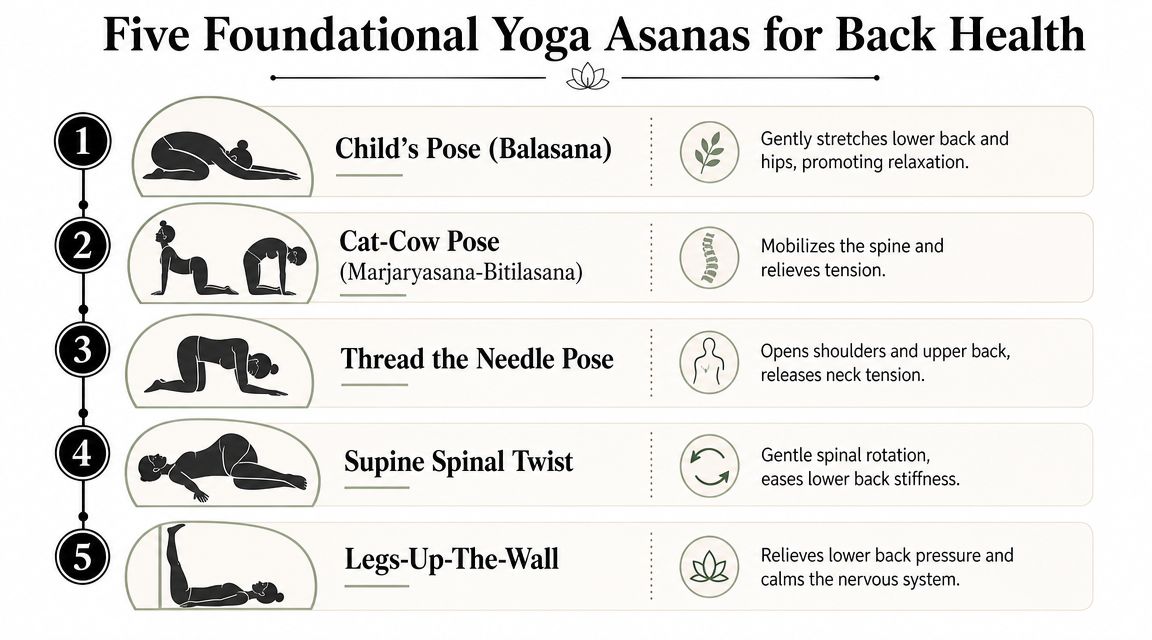
Cat-Cow
Start on hands and knees with your wrists under your shoulders and knees under your hips. As you inhale, let the chest open and the tailbone tip slightly up. As you exhale, round gently through the mid-back and let the head follow naturally.
This pose is less about making a dramatic arch and more about reintroducing comfortable motion.
What you should feel:
- A smooth change in spinal position
- Mild movement through the back, not a jam in the low back
- Easy breathing
What to avoid:
- Dumping into the lower back during the “cow” position
- Moving too fast and turning it into momentum
- Holding your breath
Child's Pose
From hands and knees, bring your hips back toward your heels and let your arms rest forward or alongside your body. If your knees or hips feel crowded, widen the knees or place a cushion between the hips and heels.
This is often the first pose that gives people a sense of decompression. It can quiet low-back guarding and reduce the need to constantly brace.
If Child's Pose causes pinching in the front of the hips or a pulling pain in the back, raise the floor to you with a folded blanket, pillow, or bolster.
Bridge Pose
Lie on your back with knees bent and feet planted. Press through the feet and lift the hips only as high as you can while keeping the movement even and controlled. Lower slowly.
Bridge is useful because it brings in glute and trunk support. Many people with recurring back pain need more support, not just more stretching.
Look for:
- Pressure through both feet
- Gentle work in the glutes and back of the hips
- A steady ribcage rather than flaring upward
Common errors:
- Pushing into a high backbend
- Cramping in the hamstrings because the feet are too far away or the glutes aren't contributing
- Holding the top too long when the back starts to tense
Supported Supine Twist
Lie on your back, bend your knees, and let them tip slightly to one side with support under them if needed. The movement should be small. This is not a pose to force.
A supported twist can relieve stiffness, especially after long periods of sitting, but the key word is supported. The knees should rest on a pillow, folded blanket, or block if the stretch feels too intense.
Legs-Up-The-Wall
Sit sideways near a wall, then turn and bring your legs up as you lower your back onto the floor. Bend the knees if hamstrings pull or if your pelvis tucks hard.
This pose is restorative more than corrective. It can reduce the sense of compression many people feel after a long day. It also pairs well with slow breathing.
For readers who need more than mobility work, a stronger trunk often helps back symptoms stay calmer over time. MedAmerica's guide on core-strengthening exercises for back support is a useful next step.
Quick comparison of what each pose does
| Pose | Main purpose | Best cue |
|---|---|---|
| Cat-Cow | Restore gentle spinal motion | Move slowly enough to feel each segment |
| Child's Pose | Reduce guarding and give relief | Let support come to you if hips feel blocked |
| Bridge | Add low-load support from glutes and trunk | Lift only as high as you can control |
| Supported Supine Twist | Ease stiffness without forcing rotation | Keep the twist small and supported |
| Legs-Up-The-Wall | Settle tension and unload the back | Bend knees if the hamstrings pull |
How to Modify Poses for Your Body and Pain Level
The most important yoga skill for back pain isn't flexibility. It's modification. A pose only helps if your body can tolerate it today, not in theory.
That means changing range, using props, shortening the hold, or swapping the pose entirely. Expert guidance often recommends safer substitutions for common back-pain poses. Sphinx is preferred over Cobra, and supported supine twists are safer than deep seated twists, with the emphasis on gentle strengthening and mobility over aggressive stretching, especially for people with limited mobility or acute pain (practical modifications for yoga and back pain).
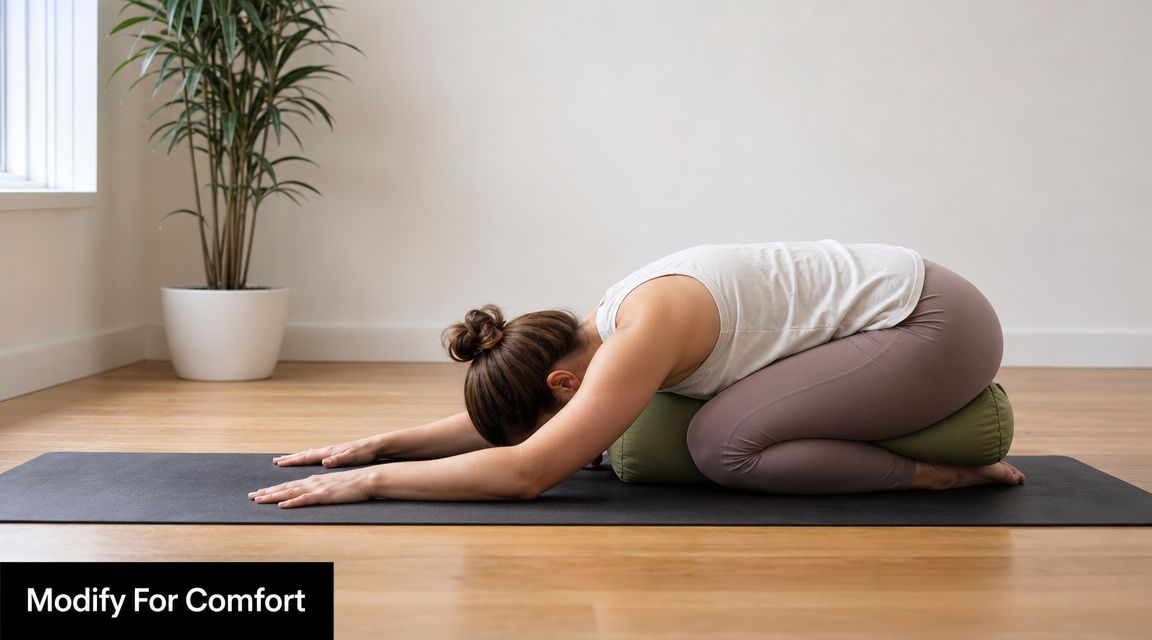
Use props to reduce strain
Props aren't a shortcut. They're often the reason a pose becomes therapeutic.
A few useful examples:
- Bolster or pillow in Child's Pose to reduce hip and back strain
- Block under the knees in a twist so the spine doesn't hang in rotation
- Folded blanket under the head when lying on your back to avoid neck tension
- Wall support for standing variations so balance doesn't become the main challenge
If you also deal with postural asymmetry, a condition-specific resource such as this guide to safe yoga for scoliosis can help you think more carefully about alignment and asymmetrical loading.
Swap risky versions for calmer ones
Some poses are popular online because they look like they “open the back.” In practice, they can be too much.
A better substitution list looks like this:
- Choose Sphinx instead of Cobra if extension causes pinching. Sphinx keeps the lift lower and usually feels more supported.
- Choose supported supine twist instead of deep seated twist if rotation feels sharp or unstable.
- Choose bent-knee forward folds if straight legs pull hard on the back of the pelvis and low back.
- Choose bridge with a small lift instead of a high wheel-style shape.
The goal isn't to perform the most advanced version of a pose. The goal is to find the version your back doesn't fight.
Let symptoms make the decision
Pain changes the rules. If your back is flared up, the right version today may look very different from the right version next week.
Use this simple filter:
- During the pose, symptoms should stay the same or improve.
- Right after the pose, you should feel easier, lighter, or unchanged.
- Later that day, you shouldn't feel a delayed spike that clearly traces back to practice.
If a pose repeatedly creates a pinch, spreading ache, or nerve-like symptoms, stop trying to “make it work.” Sometimes hip stiffness is part of the problem, and improving that can reduce stress on the lumbar spine. MedAmerica's guide on improving hip mobility can help if your back seems to overwork when your hips don't move well.
Creating Your Daily Back-Care Yoga Routine
A back-care routine works best when it feels doable on your worst week, not just your best one. Consistency matters more than ambition. One does better with a short practice they'll repeat than with a long session they avoid.
Published guidance for back-pain yoga often uses specific dosage ranges. Voltarol's guide instructs practitioners to hold Cobra for 15 to 30 seconds and repeat the standing forward bend 3 to 5 times, while other clinical-style guidance uses holds of 3 to 5 breaths, reinforcing that modern therapeutic yoga is often treated like a structured, dose-like tool and should stay gentle and stop if pain increases (Voltarol back-pain yoga guidance).
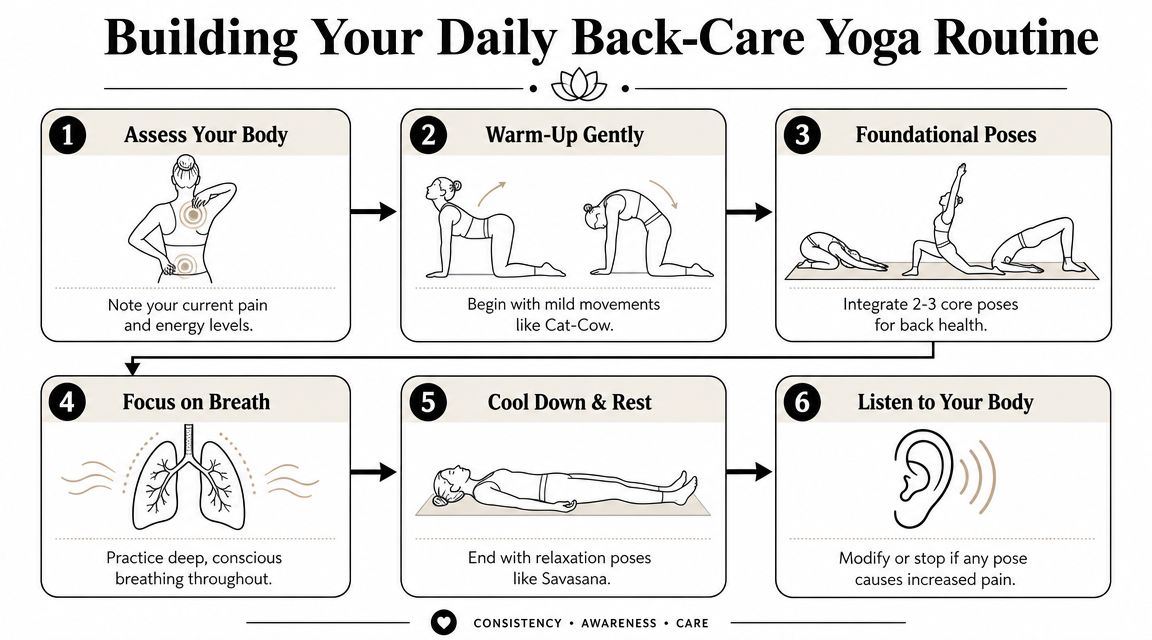
A simple visual can help when you're building the habit:
A simple sequence that makes sense
Instead of picking random poses, think in phases.
Phase one is settling the system. Start with easy breathing and a check-in. Notice whether your back feels stiff, guarded, tired, or sharp. Then begin with Cat-Cow or another very small motion.
Phase two is the main work. Choose two or three foundational poses that match how you feel that day. Many people do well with Child's Pose, a supported twist, and a small Bridge.
Phase three is downshifting. Finish with something restorative such as Legs-Up-The-Wall or quiet rest on your back.
Use your breath as part of the treatment
Breathing isn't decoration in yoga. It changes muscle tension and pacing. If you rush, brace, or hold your breath, your back often reads the movement as a threat.
Try this:
- Inhale through the nose and feel the ribs widen
- Exhale slowly and let the shoulders and abdomen soften
- Match movement to breath so nothing feels abrupt
This walkthrough can help if you like practicing with a guided visual pace:
Keep the routine realistic
A useful routine often follows a few plain rules:
- Start shorter than you think you need. A brief daily practice is easier to maintain than a long occasional one.
- Repeat familiar poses first. Your back usually responds better to predictable movement than constant novelty.
- Leave a little in the tank. Finishing while you still feel good helps your nervous system trust the routine.
Some people also find that setting a consistent environment helps them stick with the habit. If scent helps you settle into slower breathing, the Aroma Warehouse sandalwood collection is one example of a simple ritual support. It's not treatment, but it can make the practice feel calmer and easier to repeat.
Red Flags When Yoga Is Not Enough for Your Back Pain
You finish a gentle yoga session expecting your back to loosen up, but instead the pain spreads into your leg or lingers for hours. That pattern deserves caution, not more stretching.
Yoga can help stiffness, muscle guarding, and fear around movement. It does not treat every source of back pain, and it should not be used to push through warning signs. A 2022 Cochrane review found that compared with no exercise, yoga may offer only small improvements for chronic non-specific low back pain, and it was not meaningfully better than other exercise for function at three months (Cochrane review on yoga for chronic non-specific low back pain). The practical takeaway is simple. If your symptoms suggest nerve irritation, structural injury, or an active medical problem, a generic online routine is not specific enough.
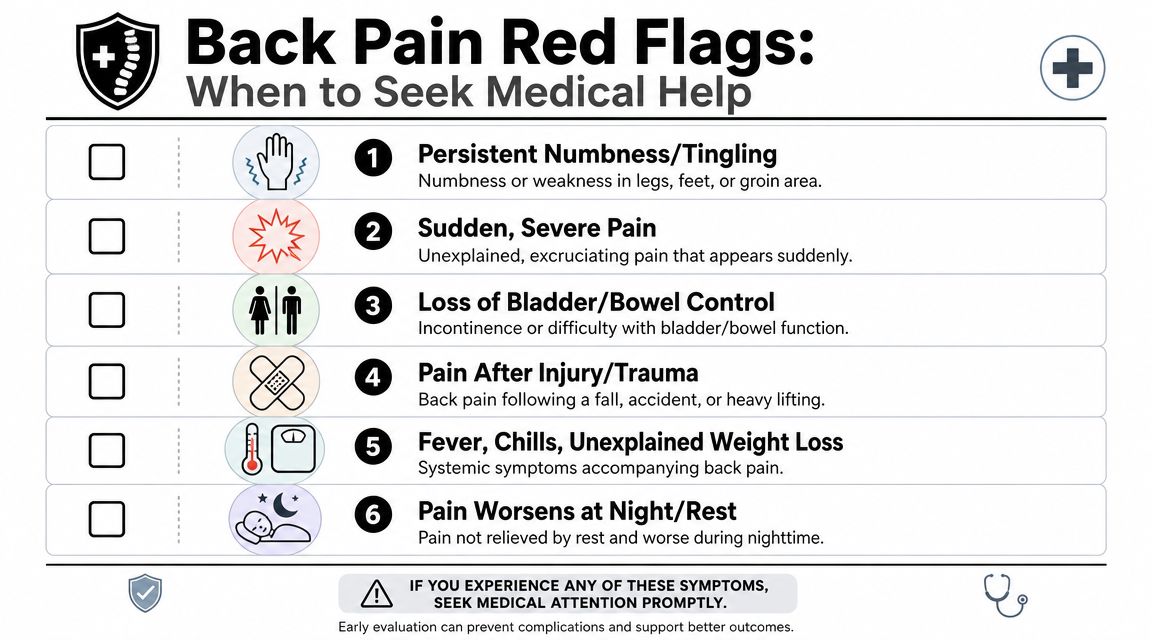
Signs to stop self-treating
Seek prompt medical evaluation if you have:
- Pain shooting down the leg with numbness, tingling, or weakness
- Loss of bladder or bowel control
- Pain after a fall, car accident, or lifting injury
- Back pain with fever, chills, or unexplained weight loss
- Pain that is worse at night or not eased by rest
- Symptoms that consistently worsen during or after yoga
Sharper pain, spreading symptoms, and progressive weakness are reasons to get assessed, not cues to stretch deeper.
When a professional plan makes more sense
Some back problems need more than careful pose selection. Disc-related pain, spinal stenosis, sciatica, arthritis flare-ups, and post-accident injuries usually respond better to an exam that tests strength, sensation, joint motion, and symptom behavior. That process matters because the right plan is often less about doing more yoga and more about choosing the right movement, the right range, and the right dose.
A clinic such as MedAmerica Rehab Center can help in these situations. Their care model includes physical therapy, chiropractic care, acupuncture, and rehab planning for back pain, sciatica, arthritis, sports injuries, and auto accident recovery. If your symptoms do not behave like simple stiffness, or if each attempt at yoga leaves you more guarded afterward, get an individualized evaluation instead of cycling through random poses.
Building a Stronger Back for the Long Term
A stronger back is usually built in ordinary moments. You get out of bed with less bracing. You sit through a meal without shifting every minute. You bend to put on shoes and do not tense up first. That is the goal of yoga for back pain. Better tolerance for daily life, not a perfect pose.
Long-term progress comes from using yoga as movement practice, not as a test of flexibility. The people I see improve are usually the ones who keep the range modest, repeat the positions that calm symptoms, and stay consistent enough that the back stops treating movement like a threat. As noted earlier, research on chronic low back pain supports yoga as a reasonable part of conservative care, especially when the practice improves function and confidence rather than chasing intensity.
A few habits matter more than doing a long routine:
- Use the version of each pose that feels steady and controlled
- Keep your breath easy instead of holding tension through the ribs and jaw
- Build support through the hips, trunk, and posture, not by forcing more stretch
- Repeat tolerable movement often enough that your body relearns it safely
There is a trade-off here. Doing too little may keep you stiff and guarded. Doing too much, too soon can flare symptoms and set you back for days. The sweet spot is practice that feels manageable during the session and acceptable afterward, with no sharp increase in pain, no spreading symptoms, and no loss of function later in the day.
If your back pain keeps returning despite careful practice, or if it starts to limit walking, sleep, work, or exercise, yoga may need to become one part of a broader plan. MedAmerica Rehab Center offers physical therapy, chiropractic care, acupuncture, and guided rehabilitation for people who need an individualized approach instead of more trial and error on their own.
MedAmerica Rehab · Deerfield Beach
Talk to a clinician about your pain
Physical therapy, chiropractic, acupuncture and shockwave therapy under one roof, since 1995. Same-day appointments are available.
Mon–Thu 8:00 AM – 6:30 PM · Fri 8:00 AM – 3:00 PM