

Physical Therapy for Arthritis: Reduce Pain, Boost Mobility
Mornings can become a negotiation when arthritis settles into your routine. You swing your legs out of bed, wait for your knees or hips to loosen, and plan your first few steps more carefully than you used to. Later in the day, small tasks can feel oddly expensive. Opening a jar, standing up from the couch, walking through the grocery store, getting down to the garden, or lifting a grandchild can all come with a private calculation: is this worth the flare-up afterward?
That’s where many people start to shrink their lives. They stop taking walks. They skip social plans that involve stairs. They move less because movement hurts, then feel stiffer because they’ve moved less. Arthritis starts in the joints, but its effects spill into confidence, sleep, work, and independence.
Physical therapy for arthritis offers a different path. It doesn’t ask you to ignore pain or push recklessly through it. It gives you a structured way to calm irritated joints, rebuild support around them, and learn what your body can still do safely. Just as important, it helps you turn short-term clinic progress into daily habits that last after formal treatment ends.
Living Beyond Arthritis Pain A New Approach to Mobility
A common story sounds like this: the pain didn’t arrive all at once. It built gradually. First, your knees felt stiff after sitting. Then stairs became something you approached with a hand on the railing. Eventually, you gave up a walk around the neighborhood because the recovery took too long. At that point, many people assume arthritis means permanent decline.
That assumption is understandable, but it’s often incomplete. Arthritis changes how a joint tolerates load, yet your strength, balance, flexibility, and movement patterns still matter. Those factors can improve. When they improve, daily life often becomes more manageable.

Why more people need this option
Physical therapy is recommended often, but many patients still don’t receive it early enough. In a study of patients with symptomatic knee osteoarthritis, 52% had used physical therapy, a rate higher than in broader arthritis populations, yet the authors still highlighted a gap between recommended care and actual access and urged clinicians to close it (study on physical therapy use in symptomatic knee osteoarthritis).
That matters because too many people reach care only after they’ve already adjusted their lives downward. By then, the problem isn’t just joint irritation. It’s deconditioning, guarded movement, reduced endurance, and fear of making things worse.
Arthritis management works better when you treat the joint and the habits that formed around the pain.
What a better path looks like
A good arthritis rehab plan doesn’t promise a miracle. It aims for something more useful. Less pain during common activities. Better confidence getting up, walking, turning, and climbing. More tolerance for the things that make life feel normal.
Patients are often relieved to learn that therapy isn’t just a sheet of generic exercises. It’s a process of matching the right load to the right person at the right time. Some days the focus is calming an irritated joint. Other days it’s retraining strength, balance, or walking mechanics. Over time, the goal shifts from symptom relief to self-management.
That final step is where many guides fall short. They tell you what to do in the clinic, but not how to keep going once life gets busy, motivation drops, or a flare-up makes you second-guess the plan. Lasting relief depends on that transition. If you can build a home routine you’ll follow, arthritis stops dictating as much of your day.
How Physical Therapy Reclaims Your Joints from Arthritis
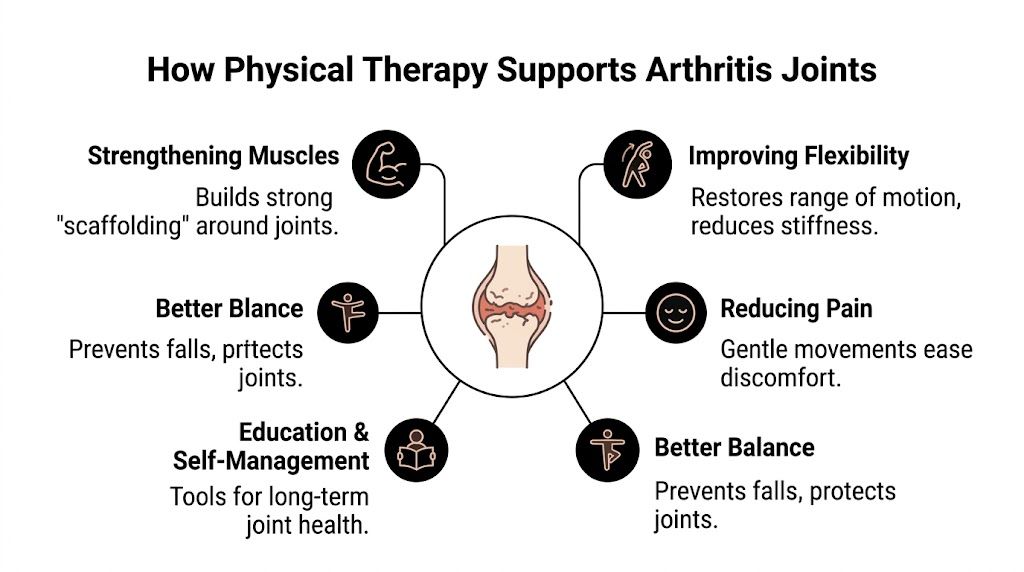
Arthritic joints do better when the muscles around them do their job. The simplest way to picture it is scaffolding. If a structure is under stress, you don’t keep asking the weak points to absorb more load. You build support around it. In the body, that support comes from strength, flexibility, balance, and better movement habits.
For osteoarthritis, that support helps reduce stress on a joint that has already changed over time. For rheumatoid arthritis, the goal also includes protecting a joint affected by inflammation while keeping the surrounding muscles active enough to prevent avoidable loss of function. The diagnosis matters, but the principle is similar. Better support usually means better tolerance.
Breaking the pain and inactivity loop
People with arthritis often get caught in the same loop:
- Pain limits activity. You avoid walking, bending, lifting, or exercise because the joint feels aggravated.
- Inactivity weakens support. The muscles that help absorb force become less effective.
- Movement becomes less efficient. Stiffness rises, balance often worsens, and the joint sees more strain during ordinary tasks.
- Pain increases again. That confirms the fear that movement is the problem, when poor conditioning is often part of it.
Physical therapy for arthritis is designed to interrupt that cycle. The plan starts below your current tolerance, then builds steadily. That’s why a well-designed program can help even when random exercise attempts haven’t.
Why this approach is widely recommended
Physical therapy for osteoarthritis is recommended by international organizations as a foundational treatment because it strengthens muscles around joints, reducing degenerative processes and pain. The same review describes a multimodal approach that can include heat, exercise, and hydrotherapy, with a superior cost-benefit profile and minimal side effects compared with drugs or surgery (review on physical therapy as a foundational osteoarthritis treatment).
That doesn’t mean every tool works equally well for every person. Heat may help one patient move more comfortably at the start of a session. Water-based exercise may suit someone who can’t yet tolerate much land-based loading. Manual therapy may improve comfort, but it won’t replace strength work. The strongest plans combine symptom relief with active retraining.
Practical rule: If a treatment feels good but doesn’t help you move better over time, it’s incomplete.
Different forms of arthritis need different emphasis
Rheumatoid arthritis is a good example of why personalization matters. Evidence-based physical therapy for rheumatoid arthritis uses a three-tiered treatment profile based on how mild, moderate, or severe the presentation is. Across those profiles, the cornerstone is active exercise therapy plus education, while passive treatments such as massage, electrotherapy, thermotherapy, ultrasound, low-level laser therapy, and taping play a subordinate role (evidence-based physical therapy profiles for rheumatoid arthritis).
That same logic applies in the clinic every day. A person with hand stiffness from inflammatory arthritis won’t get the same plan as someone with knee osteoarthritis after years of reduced walking. A person whose jaw is affected by tension or joint dysfunction may also benefit from more specific care, such as this guide to physical therapy for TMD symptoms, because arthritis and chronic pain often overlap with broader movement and muscle issues.
Movement retraining also matters. If balance, coordination, and joint control have slipped, focused work like neuromuscular reeducation can help restore cleaner, safer movement patterns so your exercise carries over into daily life.
Your Personalized Arthritis Treatment Toolkit
Arthritis rehab works best when patients understand what each tool is doing. Many people walk into a clinic expecting either a massage table or a stack of exercises. In reality, effective care usually blends several categories of treatment. Some reduce irritation so you can move. Others build the capacity that keeps pain from returning as quickly.
The strongest evidence supports structured, supervised exercise. The Fitness Arthritis and Seniors Trial enrolled 439 adults aged 60+ and showed that both aerobic and resistance exercise significantly improved disability symptoms, physical performance, and pain in osteoarthritis. The same overview notes that this evidence supports structured programs such as Denmark’s GLA:D, which reduced pain medication use and sick leave through supervised exercise (Hopkins Arthritis Center summary of exercise and OA evidence).
Hands-on care and symptom relief
Hands-on treatment can help lower the entry barrier to movement. If a knee is stiff, a shoulder is guarded, or the surrounding muscles are constantly braced, manual techniques may make exercise more tolerable. Patients often describe this phase as the part that “loosens things up.”
Examples include:
- Joint mobilization to improve how a stiff joint moves
- Soft tissue work to reduce muscle guarding around painful areas
- Guided range-of-motion work when movement feels rusty or apprehensive
- Heat or cold to make motion easier or calm a flare after exercise
These tools are useful, but they’re not the whole treatment. Relief that ends when the session ends isn’t enough.
Active therapy that changes function
Exercise is where the long-term gains usually come from. Not random exercise. Targeted exercise matched to your current tolerance and goals.
Some people need strengthening first. Others need flexibility, walking endurance, posture correction, or sit-to-stand training. If weight-bearing is too uncomfortable at first, water can be a smart bridge. That’s one reason pool-based physical therapy is often valuable for arthritis. The water reduces joint loading while still giving you resistance and movement practice.
For patients who want more ideas on staying active between sessions, this practical resource on managing arthritis pain with exercise offers a helpful companion perspective.
Common PT modalities for arthritis
| Modality | What It Is | Primary Goal |
|---|---|---|
| Manual therapy | Hands-on joint or soft tissue techniques | Reduce stiffness and improve comfort for movement |
| Therapeutic exercise | Customized strengthening, mobility, and endurance work | Improve function and support around joints |
| Balance training | Drills that challenge stability and coordination | Lower fall risk and improve confidence |
| Heat therapy | Warmth applied before or during treatment | Ease stiffness and prepare joints for activity |
| Cold therapy | Cooling after activity or during flares | Calm irritation and reduce post-exercise soreness |
| Hydrotherapy or pool therapy | Exercise performed in water | Allow movement with less joint stress |
| Education | Coaching on pacing, form, and joint protection | Help patients manage arthritis outside the clinic |
What tends to work and what doesn’t
What works is usually consistent, boring in the best sense, and progressive. It respects pain without surrendering to it. It adjusts load instead of avoiding load forever.
What doesn’t work is chasing temporary relief while neglecting the underlying problem. A passive treatment can help open the door, but active work is what keeps that door open. Patients often improve faster once they understand that point. They stop asking, “What can someone do to my joint today?” and start asking, “What can I build so this joint handles life better next month?”
Building Your At-Home Arthritis Management Plan
The clinic can start the process, but home is where arthritis management either sticks or fades. Patients typically don’t lose progress because they’re lazy. They lose progress because the home plan doesn’t fit real life. It asks too much, feels too vague, or falls apart the first time pain spikes.
That’s why the home program should feel doable, not impressive. Small, repeatable actions beat heroic routines you abandon after one tough week.

Start with a short routine you can repeat
A good home plan often includes just a few categories:
- Mobility work such as gentle knee bends, heel slides, or shoulder range-of-motion drills
- Strength work such as sit-to-stands, step-ups, or band exercises
- Walking or low-impact cardio to build endurance
- Balance practice like supported single-leg stance or tandem standing
- Recovery tools such as planned rest, pacing, and ice when needed
The exact exercises depend on your joints, diagnosis, irritability, and current ability. The key is that every exercise should have a clear purpose. If you don’t know why it’s on your list, you’re less likely to keep doing it.
Why people stop and how to prevent it
Adherence is the main challenge. A 2023 study found that only 35% of arthritis patients adhered to prescribed home exercises after 6 months, with pain flare-ups and boredom listed among the main barriers. The same source notes that behavioral strategies such as habit stacking and simple digital tools can improve long-term adherence (discussion of arthritis home exercise adherence barriers).
That matches what clinicians see every week. People don’t usually quit because they don’t care. They quit because the plan has no anchor in daily life.
Try these strategies:
- Attach the routine to something fixed. Do your knee exercises after brushing your teeth or before lunch, not “when you have time.”
- Track one simple sign of progress. Use a notebook to record whether stairs felt easier, whether you walked farther, or whether morning stiffness passed faster.
- Lower the minimum. On rough days, do the smallest version instead of skipping entirely.
- Rotate options. If boredom sets in, keep the goal the same but swap the exercise variation.
Missing one day is normal. Turning one missed day into a stopped program is the real setback.
What to do during a flare-up
Pain flare-ups confuse people because they make it seem as if exercise has failed. Usually, the answer is to adjust, not abandon.
A sensible flare plan may look like this:
- Reduce the dose of the exercise rather than stopping all movement.
- Choose gentler options such as shorter walks, easier mobility work, or water-based exercise.
- Use symptom relief tools if they help you settle the area. Many patients use ice after activity. If you’re unsure how to use it correctly, this overview of ice pack use in physical therapy is a practical reference.
- Resume progression gradually once the joint calms.
A short visual can also help reinforce safe movement habits at home:
Motivation often comes from people, not willpower
Home exercise is easier when another person is involved. That might be a spouse who walks with you, a friend who checks in, or an adult child who helps you stay on schedule. Emotional support changes follow-through. This is one reason broader care matters too. The role of social connection in recovery is well described in this discussion of why companionship is vital as physical care.
The goal isn’t perfection. It’s sustainability. If your home routine is simple enough to continue during busy weeks, flexible enough to survive flare-ups, and clear enough to show progress, you’re far more likely to keep the gains you worked for in therapy.
What to Expect On Your First Visit and Beyond
The first visit is usually less intimidating than people expect. You won’t be asked to perform like an athlete or prove how much pain you can tolerate. A good arthritis evaluation is more like an investigation. The therapist wants to learn which joints are involved, what movements trigger symptoms, what daily tasks matter most to you, and which physical limitations are driving the problem.
That means the conversation matters as much as the exam. You’ll talk about when the pain started, how stiffness behaves during the day, whether swelling or flare-ups occur, what previous treatments you’ve tried, and what you’ve had to stop doing. Those details shape the plan.

During the evaluation
Expect the therapist to assess things like:
- Range of motion to see how stiff the joint is
- Strength in the muscles that support the painful area
- Balance and gait if walking confidence or fall risk is part of the picture
- Movement patterns such as standing up, stepping down, reaching, or climbing stairs
- Pain behavior to separate helpful movement discomfort from warning signs
You’ll also set goals that are concrete and personal. “Feel better” is too vague to guide treatment. “Walk through the grocery store with less knee pain,” “get up from a chair without using my hands,” or “return to morning walks” gives the program direction.
What follow-up visits usually feel like
Most follow-up sessions include a mix of symptom relief, guided exercise, and progression. Some days begin with heat, hands-on work, or gentle mobility drills to reduce guarding. Then the session shifts into active work. That may include strengthening, stretching, balance practice, walking drills, or task-specific movements tied to your goals.
Patients are often surprised by how carefully the difficulty is adjusted. If an exercise is too easy, it won’t change much. If it’s too aggressive, you may flare up and lose confidence. The sweet spot is enough challenge to build capacity without creating unnecessary backlash.
A good session should leave you feeling worked, not wrecked.
How progress is measured
Progress isn’t judged by pain alone. Pain can fluctuate from day to day. Functional change tells a fuller story.
A therapist may look for improvements such as:
- getting in and out of a chair more easily
- walking with a smoother stride
- needing fewer rest breaks
- tolerating stairs better
- moving with less hesitation
- showing gains in strength or range of motion
At one stage of care, MedAmerica Rehab Center may use hands-on therapy, targeted strengthening, balance work, and home exercise coaching as part of an individualized plan based on the joint involved and the patient’s goals.
The final phase of care matters just as much as the first. Before discharge, you should understand which exercises are your long-term keepers, how to scale them during a flare, and which warning signs mean you need reassessment. That handoff is what turns treatment into long-term management.
Take Control of Your Arthritis at MedAmerica Rehab Center
Arthritis can narrow a person’s world slowly. It changes how you move first, then how you plan your day, then what you decide isn’t worth doing anymore. Physical therapy for arthritis pushes in the opposite direction. It helps reduce pain, improve mobility, restore confidence, and give you a practical way to stay active without relying only on medication or waiting until surgery feels unavoidable.
The most important message is simple. You do not have to wait until things get worse to get help. Arthritis responds best when you address the whole picture. Joint irritation, muscle weakness, stiffness, balance loss, guarded movement, and the home habits that either support recovery or undermine it.
When to reach out
Consider scheduling an evaluation if any of these sound familiar:
- Morning stiffness lingers and makes it hard to get moving
- Walking distance is shrinking because pain or fatigue builds too quickly
- Stairs, squatting, or standing up have become more difficult
- You’ve stopped activities you enjoy because recovery takes too long afterward
- Your home exercise plan keeps collapsing after a few days or weeks
Why acting now helps
The earlier you start, the easier it is to break the cycle of pain, avoidance, weakness, and loss of confidence. Physical therapy can give you a plan that’s specific to your joints, your lifestyle, and your actual barriers. That includes what to do on good days, what to do on flare days, and how to keep progress going once supervised visits taper down.
If you’re in Deerfield Beach or a nearby community, the next step is straightforward. Contact the clinic, ask about a physical therapy evaluation for arthritis, and get clear guidance on scheduling, insurance, and what to bring to your first visit. A good first appointment should leave you with a roadmap, not more guesswork.
Frequently Asked Questions About Arthritis Physical Therapy
Will physical therapy make my arthritis hurt more
Some discomfort during rehab is normal, especially when a stiff or weak joint starts moving more again. But therapy shouldn’t feel reckless. The plan should match your current tolerance, and your therapist should show you how to tell the difference between expected exercise soreness and a true flare. If pain spikes sharply and stays high, the program usually needs adjustment.
How long does it take to notice improvement
That depends on the joint involved, the type of arthritis, your baseline strength, and how consistently you follow the home plan. Many people notice early wins first in stiffness, confidence, or ease of movement before they notice major pain changes. The bigger pattern to watch is functional progress. Are everyday tasks becoming less costly?
Is physical therapy only for osteoarthritis
No. Physical therapy can help people with osteoarthritis, rheumatoid arthritis, and other forms of joint-related pain. The difference is in how the program is built. In inflammatory conditions, the therapist has to respect disease activity and fatigue while still protecting strength and mobility.
Do I have to exercise forever
You don’t have to do the exact same routine forever, but arthritis usually responds best when movement becomes a regular part of life. Think of home exercise as maintenance, not punishment. Once symptoms improve, individuals can often shift to a shorter, simpler plan that preserves their gains.
What if I’m overweight and worried exercise will be too hard on my joints
That concern is common, and it’s valid. The answer is not to avoid therapy. It’s to tailor it. Research described in a clinical source on chronic joint pain reports that physical therapy alone may lead to less pain reduction in obese patients with knee osteoarthritis, but combining PT with other approaches such as aquatic therapy or nutrition counseling can improve outcomes by as much as 65% (overview of tailored PT approaches for obese patients with arthritis pain).
In practical terms, that means your therapist may start with lower-impact options, shorter exercise bouts, water-based activity, or a slower progression. The right plan reduces injury risk while still building mobility.
Will I just be handed exercises and sent home
You shouldn’t be. Good care includes evaluation, hands-on guidance, exercise coaching, form correction, pacing advice, and a clear plan for progression. A printed home sheet is helpful, but it’s only one part of treatment. The bigger goal is teaching you how to manage arthritis over time.
Is arthritis therapy covered by insurance
Coverage varies by plan, diagnosis, referral requirements, and visit limits. The best next step is to contact the clinic and ask what information they need to verify benefits. It’s worth checking before you delay care based on assumptions.
What if I’ve already tried exercise and it didn’t help
That doesn’t mean physical therapy for arthritis won’t work. Many people have only tried generic workouts, internet routines, or exercises that were either too aggressive or too vague. Success often depends on dosage, progression, form, and choosing the right movements for the right stage of irritability.
If arthritis is limiting how you move, work, or enjoy daily life, MedAmerica Rehab Center can help you take the next step with a personalized plan focused on pain relief, mobility, and a home routine you can maintain. Reach out to schedule an evaluation and get clear guidance on what care may look like for your joints, your goals, and your day-to-day life.