
A Guide to Hand Exercise Putty for Strength
If you’ve ever struggled with a weak grip or recovering hand, you know how frustrating simple things can be. Opening a jar, buttoning a shirt, or just holding a pen can suddenly feel like a massive challenge.
This is where hand exercise putty comes in. It’s not just a simple stress ball; it's a dynamic tool that we use to rebuild real-world, functional strength in the hands and fingers.
More Than Just a Squeeze Ball
Unlike a mechanical grip strengthener that only works on one squeezing motion, therapy putty is incredibly versatile. You can pinch it, stretch it, twist it, and press it. This allows us to target all the different muscle groups in your hand and forearm.
This adaptability is exactly why it's so effective for a range of conditions:
- Arthritis: Gentle squeezing and manipulation can improve joint mobility and ease stiffness without putting high stress on your joints.
- Carpal Tunnel Syndrome: We can use specific putty exercises to strengthen the supporting muscles, which helps relieve pressure on the median nerve.
- Post-Injury or Surgery: After a fracture or operation, putty is fantastic for regaining dexterity, coordination, and the fine motor control you need for everyday life.
Therapists have relied on this simple tool since the 1970s because it gets results. A typical routine targets over 10 key muscles in the hand. Just 2 to 3 sets of 10 reps for each exercise can increase grip strength by 25-35% in as little as 4-6 weeks for many patients. You can read more about its history in therapy on ProHealthcareProducts.com.
Choosing Your Starting Point
One of the most critical steps is picking the right resistance. If the putty is too firm, you risk straining your hand. If it's too soft, you won't get enough of a challenge to actually build strength.
Most putty is color-coded for resistance, though the exact colors can differ between brands. Here’s a quick guide to get you started.
Choosing Your Hand Putty Resistance Level
Use this quick guide to select the correct putty firmness based on your condition, from post-surgical rehab to advanced athletic strengthening.
| Putty Color (Typical) | Resistance Level | Best For | Example Use Case |
|---|---|---|---|
| Tan/Yellow | Extra Soft | Post-surgical recovery, severe arthritis, starting a gentle rehab program. | Gently squeezing after a recent finger fracture or carpal tunnel release. |
| Red | Soft | Improving fine motor skills, mild arthritis, early-stage strengthening. | Pinching exercises to regain dexterity for tasks like buttoning or writing. |
| Green | Medium | General hand strengthening, improving grip for daily activities. | Building grip endurance for carrying groceries or holding tools. |
| Blue | Firm | Advanced strengthening, sports training, building powerful grip. | Athletes (climbers, golfers) looking to maximize their grip strength. |
| Black/Gray | Extra Firm | High-level athletic training, for individuals with very strong hands. | A powerlifter or tradesperson needing to develop a crush grip for their sport. |
The key is finding a resistance that feels challenging by the end of a set but doesn't cause sharp pain.
A good rule of thumb: If you can't complete 8-10 repetitions with good, clean form, the putty is probably too firm for you right now.
At MedAmerica Rehab, we see tools like therapy putty as one piece of a much larger puzzle. Our patient-focused approach means we integrate these simple but powerful exercises into your complete, personalized care plan. Having a licensed therapist provide hands-on guidance ensures you’re using the right techniques for your specific goals, whether that’s getting back to daily life after an injury or building strength to avoid surgery.
To see how this fits into a full recovery plan, you can learn more about our comprehensive occupational therapy services.
Mastering Key Hand Putty Exercises
Once you've picked out the right putty, it's time to put your hands to work. The real magic of hand exercise putty isn't just mindless squeezing; it’s how we can use it to mimic the exact movements you need for daily life.
Proper form is everything. It’s what turns a simple motion into powerful rehab, ensuring you target the right muscles without causing any unnecessary strain. At MedAmerica Rehab, we teach these exercises to everyone from people recovering from a car accident to those dealing with a work-related injury.
This simple flow chart breaks down how to get started.
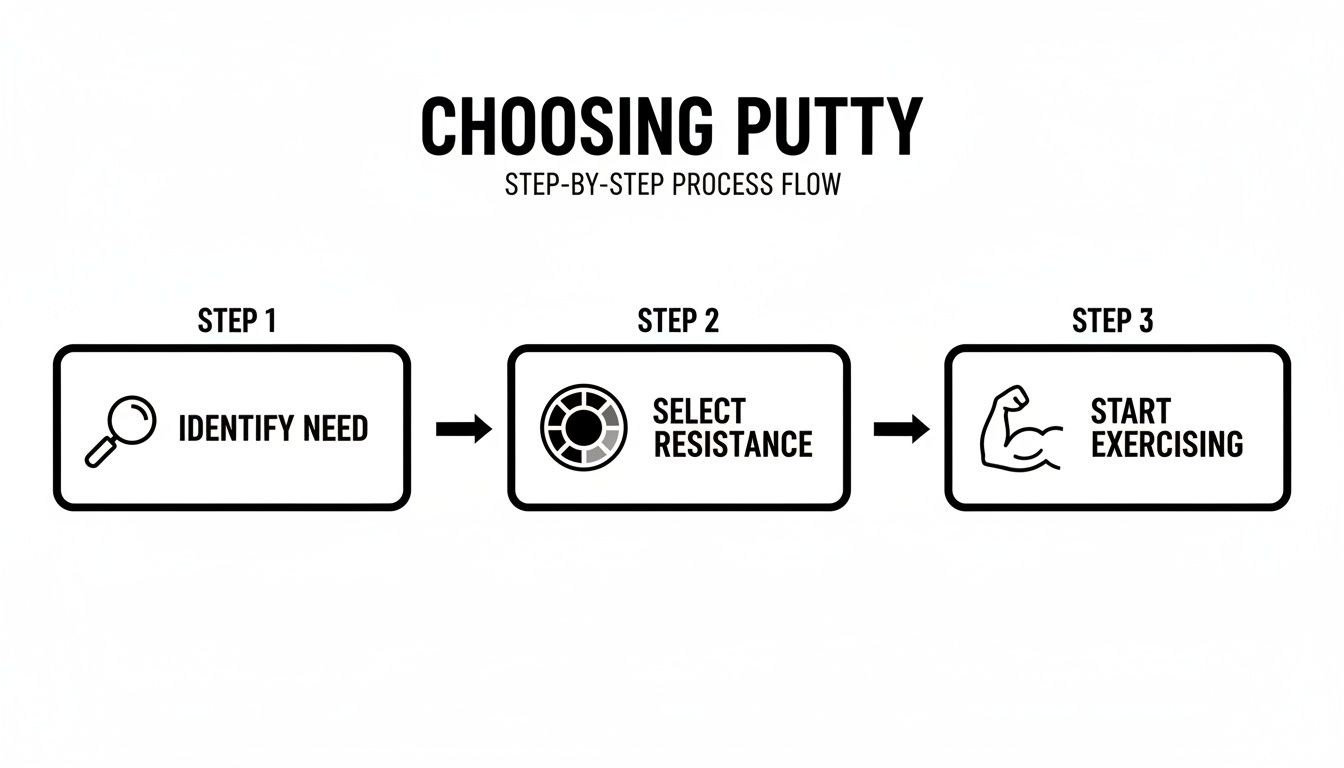
The key is to find a resistance that challenges you without causing pain. That’s the sweet spot for safe and effective progress.
The Full Grip Squeeze
This is your foundational move for building overall grip strength. Think about what it feels like to firmly grasp a tool or carry a full bag of groceries. That’s the functional strength we're building here.
- First, roll the putty into a ball and place it in your palm.
- Next, squeeze the putty with your whole hand, wrapping your fingers and thumb around it.
- Hold that squeeze for 3-5 seconds, feeling the work through your palm and up into your forearm.
- Slowly relax your grip, reshape the putty, and aim for 10-15 repetitions.
This exercise is a go-to for anyone looking to improve their ability to hold onto objects securely, which is a common goal for our patients with arthritis or general hand weakness.
The Finger Scissor Spread
Ever find it tricky to hold a key or use a fork? Weakness between the fingers might be the culprit. This exercise targets those small, intrinsic muscles that are responsible for spreading your fingers apart.
- Prep: Roll the putty into a smaller ball and position it between any two fingers.
- Action: First, squeeze your fingers together to pinch the putty. Then, try to spread them apart against the putty’s resistance.
- The Payoff: This isolates the interossei muscles, which are absolutely vital for fine motor skills and dexterity. It’s a fantastic move for musicians or anyone whose job requires precise hand movements.
This targeted exercise is a perfect example of how therapy putty is so much more than a stress ball. Instead of a general squeeze, you are isolating and strengthening specific muscle groups needed for complex hand functions.
The Thumb Pinch and Press
A strong, stable thumb is a non-negotiable for almost every grasp we make. This exercise focuses on "opposition," the crucial movement that lets your thumb touch your other fingertips.
Start by rolling the putty into a ball. Then, practice these two key movements:
- Pinch: Pinch the putty between the pad of your thumb and the pad of your index finger. Try to make a perfect "O" shape.
- Press: Place the putty in your palm and use only your thumb to press down into it, making deep imprints.
Since its adoption in pediatric therapy in the 1980s, hand exercise putty has become a clinical staple. Today, 75% of occupational therapists use it to improve fine motor skills. Exercises like pressing fingers into the putty can improve range of motion by up to 40% in just four weeks—a huge benefit for post-surgical recovery. You can find more great ideas in these Thera-putty activities on Gateshead Health's resource page.
These simple movements translate directly into being able to button a shirt, write clearly, or pick up small objects without fumbling. For our patients at MedAmerica Rehab, mastering these hand putty exercises is a critical step toward getting back to their daily lives with confidence and without limitation.
Why Your Grip Strength Matters More Than You Think
When you think about hand strength, what comes to mind? Probably opening a stubborn jar or carrying in all the groceries at once. But what if I told you your grip is one of the best predictors of your overall health and how long you’ll live?
It's true. We see it in the clinic all the time. Your grip isn't just about your hands; it’s a window into your body's total muscle strength and resilience. Think of it as a vital sign, just as important as your blood pressure.
Grip Strength as a Health Predictor
A weak grip is often one of the first signs of a body-wide decrease in muscle. This is a huge deal, especially as we get older, because it’s so closely tied to frailty and the risk of chronic disease.
The research is pretty eye-opening. A major 2022 Johns Hopkins study looked at half a million adults and found that people with the weakest grips—the bottom 20%—had a 2.5 times higher risk of dying over the next ten years.
The study specifically linked weak hands to heart disease and frailty in 65% of seniors. It’s become one of the most reliable ways to predict future health. You can read more about how hand therapy connects to overall health on ToolsToGrowOT.com.
This means squeezing hand exercise putty isn't just for recovering from an injury. It's a proactive way to build strength that helps you stay independent and well for years to come.
From Hand Exercises to Holistic Wellness
Once you see grip strength this way, it changes how you think about hand exercises. It’s no longer an isolated task but a key part of your bigger wellness picture—directly impacting your balance, stability, and confidence.
Let’s look at a couple of real-world examples:
The Office Worker: Someone who spends all day at a computer often gets neck and shoulder pain that creeps down their arms. Using putty to strengthen their grip improves forearm muscles, which helps support a better wrist position and takes the strain off the entire chain, all the way up to the neck.
The Active Grandparent: For a senior, strong hands are everything. A solid grip means you can carry your groceries without worry, pick up a grandchild, or, most importantly, catch yourself to prevent a fall. It's a cornerstone of the fall-prevention programs we build for our patients.
Your hand strength is directly connected to your body's overall resilience. By improving your grip, you're not just strengthening your hands—you're investing in your long-term stability, balance, and quality of life.
At MedAmerica Rehab Center, this is a core part of how we care for our patients. We know that hand strength is tied to core stability and balance. That’s why our physical therapy and chiropractic plans often start with a grip assessment, ensuring we’re building a healthier you from the hands up.
Making Your Putty Routine Stick

Knowing a few good exercises is one thing. Actually doing them is where the magic happens. The good news? You don't need to carve out a huge chunk of your day. With hand exercise putty, real progress comes from small, consistent efforts, not from one heroic workout session.
The trick is to weave these exercises into the small pockets of time you already have. Forget about a rigid schedule and look for these simple opportunities.
- During your desk break: Keep a container of putty right next to your keyboard. When you take a five-minute break, do a few squeezes or finger pinches instead of scrolling on your phone.
- While watching TV: A commercial break is the perfect amount of time to get a few sets in. It’s an easy win and won't feel like a chore.
- On your commute: If you’re a passenger in a car or on the train, putty is a fantastic, discreet way to work your hands.
When you reframe it from a "workout" to a simple habit, everything changes. A few minutes here and there throughout the day adds up to far more than you'd think.
How To Progress Your Exercises Safely
As your hands get stronger, you'll need to challenge them a bit more to keep improving. This doesn't need to be complicated. A smart progression plan involves changing just one thing at a time: how long you hold the squeeze, how many reps you do, or moving to a firmer putty.
Here’s a look at what a beginner's first month might look like. We start gentle and build up steadily to prevent strain.
Sample 4-Week Putty Exercise Progression Plan
This is a basic template to give you an idea of how to build strength safely. Always listen to your body and don’t push through sharp pain.
| Week | Focus | Sets & Reps (Per Exercise) | Frequency |
|---|---|---|---|
| Week 1 | Activation: Gentle movement, perfect form. | 2 sets of 10 reps, 3-second hold. | 3 days per week |
| Week 2 | Endurance: Increase the hold time. | 2 sets of 10 reps, 5-second hold. | 3-4 days per week |
| Week 3 | Volume: Build endurance with more reps. | 3 sets of 10-12 reps, 5-second hold. | 4 days per week |
| Week 4 | Strength: Consider a firmer putty. | 3 sets of 12 reps, 5-second hold. | 4-5 days per week |
This structured approach is key to building strength without overdoing it. For a closer look at how our therapists build these into a comprehensive treatment, you can learn more about what a typical physical therapy session looks like on our blog.
Therapist Tip: Your body will tell you what it needs. A little muscle fatigue or a dull ache is normal. But if you feel any sharp, shooting, or radiating pain, that’s your signal to stop and reassess.
Common Mistakes To Avoid
Even with a simple tool like hand exercise putty, a few common missteps can slow you down or even cause a setback.
The biggest mistake we see is starting with a putty that’s way too firm. It’s tempting to go for a challenge, but this often leads to joint strain and can flare up your original injury. It's always better to start too soft than too hard.
Another issue is poor form. For example, when you do a full grip squeeze, check your wrist. Is it bending forward or back? It should be in a straight, neutral line. Rushing through the motions with a bent wrist puts a lot of unnecessary stress on your tendons. Slow, controlled movements with good form will always give you better results than sloppy, fast reps.
When to Get Professional Help for Your Hand Pain

Using hand exercise putty at home can be a fantastic tool for building back strength and reclaiming your grip. But it's not a magic fix for everything.
It’s one thing to feel the satisfying ache of muscles getting stronger. It’s another thing entirely to feel pain that signals a bigger problem. Pushing through the wrong kind of pain can set your recovery back, and trying to guess what’s wrong is a risky game. What feels like simple overuse could be a more complex issue brewing under the surface.
Warning Signs You Should Not Ignore
Listen to your body. If you run into any of these red flags, it's time to pause your home routine and get a professional opinion.
- Sharp, Shooting, or Radiating Pain: A dull ache is one thing. Sharp, zinging, or electric-like pain that travels up your arm is not normal muscle fatigue.
- Persistent Numbness or Tingling: We've all had a hand "fall asleep," but if that pins-and-needles feeling won't go away or keeps getting worse, it could point to nerve pressure.
- A Sudden Loss of Strength or Function: If you suddenly can't open a jar you opened yesterday or your hand just feels weak and clumsy, it needs a proper evaluation.
- Visible Swelling, Redness, or Warmth: These are the classic signs of inflammation or even an infection that needs to be addressed by a healthcare provider.
- Pain That Wakes You Up at Night: Discomfort that’s bad enough to disrupt your sleep is often a sign of a more significant nerve issue or inflammatory condition.
If you're experiencing symptoms like these, especially numbness or tingling, our guide on carpal tunnel syndrome symptoms may offer some helpful insights.
Don't guess when it comes to your health. A professional diagnosis provides a clear and safe path forward, ensuring the exercises you do are helping, not hurting.
Your Path to Recovery in Deerfield Beach
At MedAmerica Rehab Center, we take the guesswork out of getting better. Your recovery starts with a conversation and a comprehensive evaluation. We listen to your story and use a thorough physical assessment to find the real source of your pain.
From there, our team of physical therapists, chiropractors, and acupuncturists collaborates to build a plan that works for you. We combine hands-on therapy, specific exercises, and modern modalities to get you out of pain and back to your life. For our neighbors in the Deerfield Beach community, this is your invitation to get the expert care you deserve and get on the fast track to healing.
Common Questions We Hear About Hand Putty
Once you get your hands on therapy putty, a few questions always come up. It looks simple, but using it the right way makes all the difference for a safe and speedy recovery. Let's walk through some of the things we discuss with patients every day in the clinic.
How Often Should I Be Doing These Exercises?
Think of it like any other workout. For general strengthening, aiming for 3 to 5 sessions per week is a solid goal. This schedule gives your hand and forearm muscles the time they need to recover and actually get stronger.
If you’re coming back from an injury or surgery, your therapist will give you a specific "dosage." The most important thing is to pay attention to your body. If you feel any sharp pain or your hand just feels wiped out, that's a signal to take a day off.
Short, consistent sessions will always beat one long, exhausting workout. It’s about building strength safely over time, not pushing to the point of fatigue.
Can Using Putty Make My Pain Worse?
You should expect to feel some muscle fatigue, that satisfying "burn" that tells you your muscles have been working hard. That’s a good sign! It means you’re creating the challenge needed for them to adapt and strengthen.
What you should never feel is sharp, shooting, or radiating pain. If your symptoms spike or feel worse than when you started, stop immediately. This is your body's warning light. It could mean the putty is too firm, you're using improper form, or you're just overdoing it. It's always best to stop and check in with a professional.
Is Putty Better Than One of Those Grip Strengtheners?
They’re actually two different tools for two very different jobs. The classic spring-loaded grip strengthener is really only good for one thing: the crush grip. It’s great for building pure squeezing force.
Hand putty, on the other hand, is much more adaptable. Because it’s so pliable, you can work on individual finger strength, practice the precise pinching motions needed for buttons or keys, and improve overall dexterity. You can stretch it, roll it, and twist it to mimic countless daily movements. For a well-rounded rehab program, the versatility of putty is tough to beat.
How Do I Keep My Putty Clean?
A little bit of care goes a long way in making your putty last. The most important habit is to wash and dry your hands right before you use it. This keeps oils, lotions, and dirt from breaking down the material over time.
When you're done, just pop it back into its airtight container. This simple step keeps it from drying out or picking up dust and lint. When you take care of it, a single piece of good-quality putty can last you a very long time.
At MedAmerica Rehab Center, tools like hand putty are just one part of a comprehensive, hands-on treatment plan. If you're tired of guessing and want expert guidance to resolve your hand pain for good, visit us at https://www.medamericarehab.com to schedule your appointment.
MedAmerica Rehab · Deerfield Beach
Talk to a clinician about your pain
Physical therapy, chiropractic, acupuncture and shockwave therapy under one roof, since 1995. Same-day appointments are available.
Mon–Thu 8:00 AM – 6:30 PM · Fri 8:00 AM – 3:00 PM