
Unlock Pain with manual physical therapy techniques
When you’re dealing with pain, stiffness, or an injury that just won’t quit, you want a solution that gets right to the source of the problem. That's where manual physical therapy comes in—it’s a hands-on approach where a skilled therapist uses their hands, not just machines, to diagnose and treat what’s really going on with your muscles and joints.
What Is Manual Physical Therapy

Think of it this way: if your body is a high-performance machine, sometimes a few key parts get stuck or tight, causing friction and pain. Manual physical therapy is like having a master mechanic use their expert touch—not just diagnostic tools—to feel, identify, and gently correct those specific issues.
It's a specialized field of physical therapy that focuses on the "why" behind your pain. Instead of just giving you exercises, a manual therapist uses skilled touch to figure out exactly which joints are stiff and which muscles are tight, addressing the problem right where it starts.
A Hands-On Diagnostic Approach
A manual therapist’s hands are their most important diagnostic tool. While imaging and tests have their place, nothing replaces the ability to feel how a joint moves, where a muscle is knotted up, or which tissues are restricted.
This direct, tactile feedback gives us critical information that we use to build a treatment plan that is 100% specific to you and your body. The core idea is simple but powerful.
By physically manipulating and mobilizing the body’s tissues, a therapist can trigger positive changes, restoring proper biomechanics and allowing the body to move efficiently—and critically, without pain.
The goal is always to treat the root cause, not just chase the symptoms. For that nagging low back pain, a manual therapist won’t just look at your back. We’ll assess your hip mobility, spinal alignment, and the tension in surrounding muscles to find what’s really pulling things out of balance.
What Manual Therapy Addresses
This targeted, hands-on approach is incredibly effective for a wide range of conditions where movement feels painful or limited. It is often a key part of a comprehensive recovery plan, like the specialized methods used in effective scoliosis treatment in adults.
Here are some of the most common issues we address with these techniques:
- Significant Pain Relief: By easing muscle spasms and relieving pressure on joints, we can directly calm down an overactive nervous system and reduce your pain.
- Improved Mobility: We can gently loosen stiff joints and stretch tight connective tissues, helping you get your natural range of motion back.
- Reduced Muscle Tension: This hands-on work is perfect for breaking up deep muscle knots and stubborn trigger points that cause chronic tightness.
- Faster Healing: These techniques can improve blood flow to an injured area, bringing more oxygen and nutrients to damaged tissues to speed up recovery.
Ultimately, manual therapy is all about restoring function. By correcting the underlying mechanical problems first, we set the stage for therapeutic exercises to be far more effective. This helps you regain pain-free movement and get back to doing what you love.
The Ancient Roots of Modern Hands-On Healing
It might feel like a cutting-edge treatment, but the idea of using skilled hands to heal is as old as human history. The manual physical therapy techniques we use today are built on centuries of wisdom from healers who understood the powerful link between touch and recovery. This isn't a new trend; it’s a refined art with deep roots.
Long before there were formal medical schools, every community had its own skilled practitioners for managing injuries. We often hear them called "bone-setters," and in many ways, they were the first manual therapists. They had a practical, hands-on knowledge of the body, passed down from one generation to the next.
From Folk Healers to Medical Pioneers
The practice of using hands-on techniques to treat joint problems goes back more than 1,000 years in Europe. It evolved from those very bone-setters who handled sprains, strains, and dislocations long before physical therapy was a formal profession. This tradition of hands-on healing eventually made its way to the Americas, laying the groundwork for what would become modern medicine. You can explore more on the rich history of manual therapy development here.
Even Hippocrates, often called the father of medicine, wrote about using manipulation and traction for spinal problems around 400 B.C. He knew that proper alignment was key to good health—a principle that is still at the heart of what we do.
"It is most necessary to know the nature of the spine, what its natural purposes are, for this is the requisite knowledge for dealing with many diseases." – Hippocrates
For centuries, this knowledge was kept alive not in textbooks, but by those folk healers who continued their work outside of the medical establishment. Their methods were based on what they could see and feel, honed by experience. They understood a simple truth: the body has an incredible capacity to heal itself, and sometimes, skilled hands are just what's needed to unlock it.
The Catalyst of Modern Rehabilitation
The leap from folk tradition to established science really picked up speed during the 20th century. Two major world events created a massive, urgent need for effective rehabilitation, pushing hands-on techniques right into the spotlight.
First came the Polio epidemics. These outbreaks left thousands, many of them children, with muscle weakness and paralysis. Doctors and nurses quickly learned that hands-on care—like massage, stretching, and guided movement—was essential for preventing permanent deformities and helping patients get back on their feet.
Then, World War I created a generation of soldiers with life-altering injuries. Getting these men back to civilian life was a national priority. The "Reconstruction Aides," who were the direct predecessors of today's physical therapists, were given this huge task. Their main tools were manual physical therapy techniques and specific exercises, and they proved that this structured, hands-on approach could lead to incredible recoveries.
These events cemented physical therapy’s place as a core medical discipline. The practical knowledge of the old bone-setters was finally blended with modern science. This is the legacy we’ve proudly built upon at MedAmerica Rehab since 1995—combining time-tested manual care with the latest evidence to help our community heal and get stronger.
A Closer Look at Core Manual Therapy Techniques
So, what actually happens during a manual therapy session? Once we’ve identified the source of your pain, we use a specific set of hands-on techniques to get you moving freely and comfortably again.
Think of your physical therapist as a skilled mechanic for the human body. We have a whole toolbox of methods, and each one is designed for a specific job—whether it’s easing a stiff joint, releasing a tight muscle, or retraining a faulty movement pattern. The goal is always the same: to create lasting, positive change.
This isn't just about a temporary fix. It's about getting to the root of the problem.
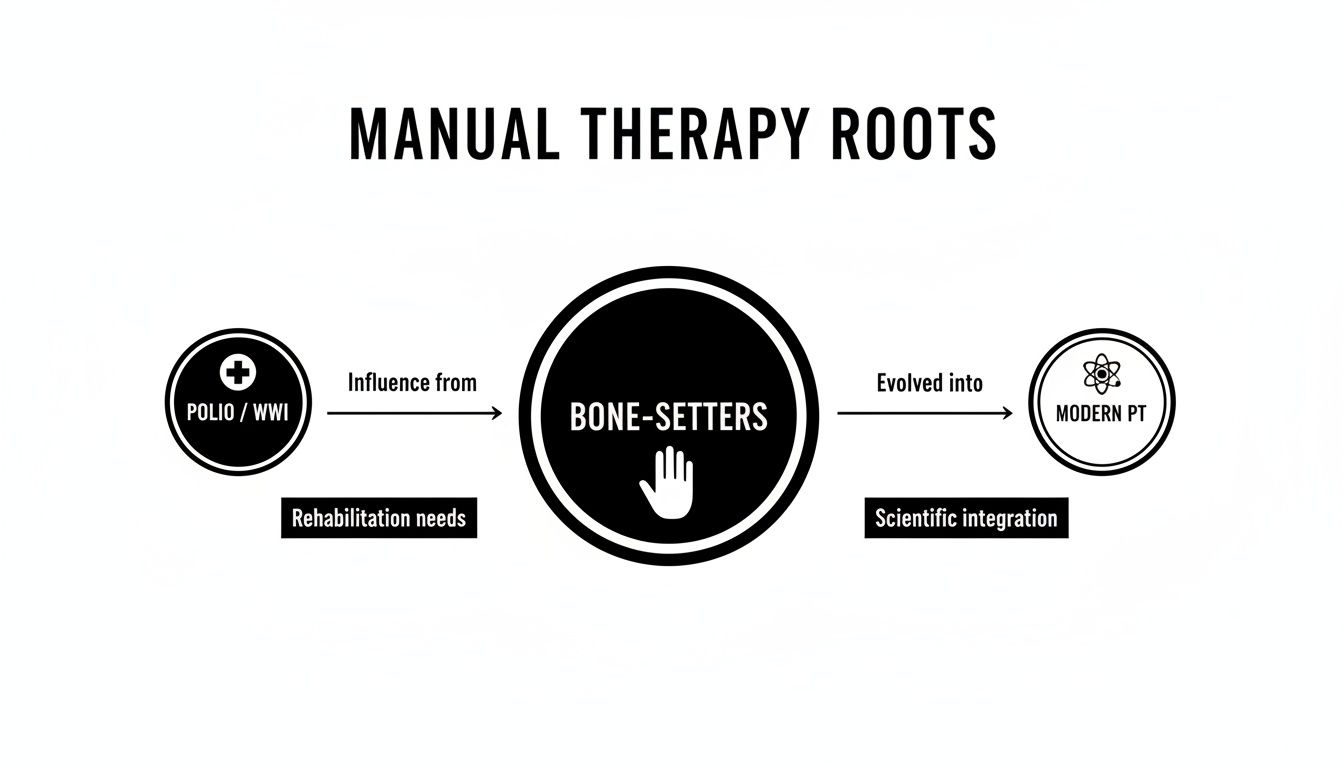
As you can see, the techniques we use today didn't appear overnight. They have a direct lineage from historical "bone-setters" and were refined through the urgent needs of the Polio era and World Wars, evolving into the evidence-based practice we call modern PT.
A Quick Guide to Manual Therapy Techniques
Here’s a simple breakdown of common manual therapy techniques, what they feel like, and the conditions they’re used to treat.
| Technique | What It Treats | Analogy (What It Feels Like) |
|---|---|---|
| Joint Mobilization | Stiff or "locked" joints, arthritis, post-surgical stiffness | Gently wiggling a rusty door hinge back and forth until it swings freely. |
| Soft Tissue Mobilization | Muscle knots, scar tissue, chronic muscle tightness | Ironing out deep wrinkles in a piece of thick fabric. |
| Myofascial Release | Widespread tightness, fascial restrictions | A slow, sustained stretch that feels like taffy being gently pulled. |
| Strain-Counterstrain | Acute muscle spasms, tender points | Finding a perfectly comfortable, "zero-tension" position and resting there. |
| Muscle Energy Technique | Limited flexibility, poor joint alignment | An active "push-pull" where you gently engage a muscle against your therapist's hand. |
Each of these methods has a unique purpose, but they often work together to provide comprehensive relief and restore function.
Joint Mobilization: Easing The Stuck Hinge
One of our most common and powerful tools is Joint Mobilization. Imagine a door hinge that’s gotten stiff and rusty over time. You can’t just yank it open; that would do more harm than good. Instead, you have to gently work it back and forth, coaxing it to move a little further each time until it swings freely again.
That’s exactly what we do with a stiff joint. Your therapist will use slow, rhythmic, and gentle pressure to restore the small but critical movements that allow for a full, pain-free range of motion. This is not a forceful, high-speed chiropractic adjustment. It's a very controlled and subtle technique, always performed within your comfort zone.
We often use Joint Mobilization for:
- Post-Surgical Stiffness: After a knee replacement or shoulder surgery, joints can get incredibly rigid. Mobilization is a safe way to get things moving again.
- Arthritis: Gentle movements help lubricate the joint and can significantly ease the stiffness and pain of osteoarthritis.
- Frozen Shoulder: This frustrating condition responds very well to targeted mobilizations that carefully stretch the tight joint capsule.
- Spinal Stiffness: It’s a go-to for neck and lower back pain caused by locked-up spinal joints that prevent you from bending and turning properly.
Soft Tissue Mobilization: Ironing Out The Wrinkles
Of course, joints don't work in isolation. The muscles and connective tissues around them are just as important, which is where Soft Tissue Mobilization comes in. The best way to picture it is like ironing deep, stubborn wrinkles out of a piece of fabric.
Injury, poor posture, or simple overuse can cause your muscles and the fascia wrapping them to develop adhesions, knots, and scar tissue. These "wrinkles" are what restrict your movement and trigger pain.
A therapist uses their hands to apply specific, directed pressure to break down these restrictions. It's more than just a relaxing rubdown; it’s a targeted medical treatment designed to lengthen tight tissues and improve circulation right where you need it. While it shares some principles with massage therapy, soft tissue mobilization is focused on correcting specific dysfunctions.
Myofascial Release And Strain-Counterstrain
Two other amazing techniques work on this same network of muscle and fascia. Myofascial Release targets the fascia itself—the thin, web-like tissue that encases every muscle and organ. When this tissue gets tight, it can exert incredible pressure on pain-sensitive structures. Your therapist will apply slow, sustained pressure to a tight area, allowing the fascia to slowly "melt" and lengthen.
Strain-Counterstrain, on the other hand, is an incredibly gentle and indirect method. Instead of stretching a tight, spasming muscle, the therapist will guide your body into a position of absolute comfort and ease, holding it for about 90 seconds. This simple act "resets" the neurological signals that are keeping the muscle in a state of high alert, allowing it to relax all on its own.
Muscle Energy Techniques And Neuromuscular Re-education
Some of the most effective techniques are the ones that involve you as an active partner. Muscle Energy Techniques (METs) are a perfect example. Here, your therapist will position you and then ask you to gently contract a specific muscle against their resistance for a few seconds before relaxing.
This "contract-relax" sequence is a powerful way to convince a chronically tight muscle to let go, helping to restore normal joint mechanics and flexibility almost immediately.
Finally, we have Neuromuscular Re-education. This is all about fixing the communication breakdown between your brain and your muscles. After an injury or a long period of pain, the body develops sloppy movement habits to compensate. We can show you exactly what Neuromuscular Re-education is and how it works to help you unlearn these bad habits and restore efficient, pain-free movement patterns for good.
Why Science Backs Hands-On Treatment
While the idea of hands-on healing is as old as time, modern manual therapy isn't some "alternative" treatment. It's a core part of mainstream physical therapy, and its effectiveness is backed by a huge and growing body of scientific research.
If you’re wondering whether a therapist's skilled touch can really make a difference, the answer from the research community is a resounding yes. For years, people questioned if the benefits were measurable. Now, we have overwhelming proof.
The core idea is simple: a therapist’s trained hands can create real, physiological changes in your body. This touch can calm down an overactive nervous system, boost circulation to injured tissues, and physically break down the knots and restrictions that cause pain and stiffness.
This isn't just a theory. We see it in clinical studies all the time. When you combine manual therapy with the right exercises, patients often get better, faster, and more completely than with exercise alone.
The Explosion of Evidence
Over the last two decades, the amount of research digging into manual therapy has skyrocketed. As our scientific tools got better, so did our ability to measure exactly why these hands-on techniques work so well. The evidence isn't just a handful of studies anymore; it's substantial and convincing.
This trend is easy to see. A deep dive into the PEDro database, a major archive for physical therapy research, shows an incredible surge. The number of published articles on manual therapy jumped 2.4-fold in the decade after 2011 compared to the one before. You can explore the research trends in manual physical therapy yourself to see how the science has evolved.
Even more importantly, the quality of this research has gone through the roof. The number of studies providing "strong evidence" for manual therapy’s effectiveness leaped by an incredible 9.5 times in that same period.
Translating Research Into Real-World Results
So, what does all this data mean for you? It means that when you come in for manual therapy, you're getting a treatment that is proven to work. It’s the scientific validation behind the relief and progress our patients feel every single day.
This solid evidence applies to a whole range of common problems, including:
- Chronic Low Back Pain: Study after study shows that manual therapy provides major pain relief and gets people moving better, especially when it’s paired with strengthening exercises.
- Neck Pain and Headaches: For those nagging headaches that start in your neck (cervicogenic headaches) and general stiffness, hands-on treatment is a cornerstone of getting better.
- Shoulder Impingement: Research fully supports using joint and soft tissue work to get your shoulder moving correctly again and to stop that pinching pain.
- Hip and Knee Osteoarthritis: Gentle mobilization techniques can do wonders for improving movement and easing the ache of arthritic joints.
The science is clear: manual therapy gets right to the heart of the mechanical problems causing your pain. By improving how your joints move and your muscles work, it lays the foundation for a true, lasting recovery.
It’s an essential tool that helps your body heal the right way so you can get back to an active, confident, and pain-free life. At MedAmerica Rehab, this evidence-first approach guides everything we do.
Your First Manual Therapy Session: What to Expect

Walking into any new treatment when you’re already in pain can feel a little uncertain. We get it. But the great news is that your first manual therapy session is all about clarity, collaboration, and getting to the root of the problem.
Our first goal isn’t to treat you; it’s to listen to you.
We’ll start with a simple conversation. We want to hear your story—what brings you in, what movements trigger your pain, and what you want to get back to doing. This talk is the foundation for your entire recovery plan.
The Hands-On Assessment
After our chat, your therapist will begin the hands-on assessment. This is where the real power of manual physical therapy techniques comes into play. Using their skilled touch, your therapist will gently investigate what’s going on.
- Joint Mobility: We’ll carefully move your joints to feel for stiffness, clicking, or any areas that just feel “stuck.”
- Muscle Tone: We’ll assess your muscles for tightness, spasms, or painful trigger points that could be causing your symptoms.
- Tissue Texture: We’ll also feel for changes in the soft tissues, like scar tissue or fascial restrictions that can limit movement.
This isn’t something that happens to you; it’s a process we do with you. Your therapist will constantly communicate, asking what you feel as they work. Your feedback is crucial for us to pinpoint the true source of your discomfort. Afterward, we’ll explain exactly what we found in plain English and map out a personalized plan together.
What to Expect During Treatment
Once we have a plan, the hands-on work can often start in that very first session. The entire experience is meant to be gentle and controlled. You are always an active partner in your own healing.
The heart of a great session is communication. Your therapist will always work within your comfort zone. Never hesitate to speak up if a technique feels too intense—your feedback guides everything we do.
During the treatment, you might notice a few different sensations. These are all normal parts of the healing process:
- A deep, focused pressure over a stubborn muscle knot.
- A gentle, rhythmic stretching as a stiff joint is mobilized.
- The feeling of a tight band slowly letting go during myofascial work.
This hands-on care is one piece of a bigger puzzle. Combining different approaches for the best results has a long history in our field—from the early days of physical therapy during WWI to today’s integrated methods. You can discover more insights about the history and impact of physical therapy if you’re curious!
Our goal is to blend this specific manual work with other elements of your care. To see how it all fits together, you can learn more about what a typical physical therapy session looks like in our detailed guide.
You should leave your first visit feeling more hopeful and in control, with a clearer understanding of your body, some initial relief, and a solid plan for the road ahead.
Of course. Here is the rewritten section, crafted to match the specified human-like, expert voice and style.
Your Questions About Manual Therapy, Answered
It’s completely normal to have questions before starting a new treatment. You want to know what to expect and feel confident in your decision. We get it. Here are the answers to some of the most common questions we hear from patients just like you.
Is Manual Physical Therapy Painful?
This is the big one, isn't it? The short answer is no. The entire goal of our hands-on work is to bring relief and calm your system down, not add more pain to it.
Now, some techniques might feel a bit intense, like working through a stubborn knot or deep scar tissue. You might feel a dull ache, similar to a deep-tissue massage. But it should always feel productive—like something good is happening. It should never be sharp, scary, or out of your control.
We work as a team. Your feedback is what guides our hands. We will constantly check in to make sure the pressure feels right for you, ensuring every technique is helpful, not harmful. You are always in the driver’s seat.
Think of it this way: your body won't heal if it's on high alert. Our job is to create a sense of safety so your muscles can relax and your joints can move freely again.
How Is This Different From Chiropractic or Massage?
While all three use a hands-on approach, we’re all playing a different game with a different rulebook. A massage therapist is fantastic for general muscle relaxation and easing stress. A chiropractor typically focuses on the spine, using quick adjustments to improve alignment.
Manual physical therapy is different. We start with a full-body diagnostic process to figure out why you're having pain or problems moving. We don't just look at the sore muscle or the stiff joint in isolation. We look at how your entire body moves as a system. It's this integrated approach to manual physical therapy techniques—combining joint and soft tissue work to fix the root cause—that truly sets us apart.
How Many Sessions Will I Need?
There’s no magic number here, because your recovery plan is built just for you. The number of sessions you'll need is based on a few key things:
- The specific injury or condition we’re treating.
- How long you’ve been dealing with the symptoms.
- Your personal goals—what you want to get back to doing.
- How consistent you are with your exercises at home.
After your very first visit, we’ll lay out a clear roadmap for your recovery. You'll know what to expect from the get-go, including an estimated timeline to get you back on track.
Can Manual Therapy Help My Chronic Pain?
Absolutely. For people stuck in a cycle of chronic pain—whether it's from arthritis, fibromyalgia, or that low back pain that just won’t quit—manual therapy can be a lifeline. Chronic pain often traps the body in a vicious loop of pain, stiffness, and protective muscle guarding.
Our hands-on techniques are designed to interrupt that very cycle. By gently mobilizing stiff joints and releasing muscles that have been tight for months or years, we can actually dial down the pain signals your brain is receiving. This gives us a window of opportunity to retrain your body to move in healthier, more efficient ways, paving the way for real, lasting relief.
Begin Your Recovery at MedAmerica Rehab
Knowing what manual physical therapy techniques are is one thing. Finding the right hands to put that knowledge to work for you is what truly matters. For our neighbors in and around Deerfield Beach, that trusted partner has been MedAmerica Rehab Center since 1995.
We're a family-owned clinic, not a big, impersonal chain. That means we’re part of the community, and our promise is simple: to give you the focused, one-on-one attention you deserve so you can heal properly and get back to feeling like yourself.
A Team Approach to Your Wellness
Everyone’s path to recovery looks a little different. Our multidisciplinary team gets that. We’ve helped people from all walks of life get their health back on track, including:
- Athletes trying to get back on the field after a sidelining injury.
- Seniors hoping to improve their balance and avoid a dangerous fall.
- Office workers looking for real relief from nagging neck and back pain.
- People recovering from the shock and trauma of a car accident.
By bringing physical therapists, chiropractors, and acupuncturists together under one roof, we can look at your recovery from all sides. The goal is always to get you out of pain, restore your movement, and give you your life back—without surgery or a reliance on medication.
We see you as a person, not just a condition. Our consistently high ratings are a testament to the compassionate, results-focused care we have provided for decades.
We also make it easy to get started. We offer same-day appointments and have a friendly team that makes dealing with insurance straightforward. Your job is to focus on getting better, not on paperwork. As you continue learning, you can see more about our complete physical therapy services and how hands-on care is at the heart of what we do.
It’s time to stop letting pain run your life.
Don't wait another day to start feeling better. Contact MedAmerica Rehab Center to schedule your consultation and see how our expert, hands-on care can help you get back to the active, pain-free life you love. Schedule your appointment today!
MedAmerica Rehab · Deerfield Beach
Talk to a clinician about your pain
Physical therapy, chiropractic, acupuncture and shockwave therapy under one roof, since 1995. Same-day appointments are available.
Mon–Thu 8:00 AM – 6:30 PM · Fri 8:00 AM – 3:00 PM