

Physical Therapy West Palm Beach: Your 2026 Guide
You're limping out of a meeting in downtown West Palm Beach, your back's been flaring for weeks, and the hardest part isn't the pain, it's figuring out who to call, where to park, whether your insurance will cover anything, and if the first visit will just be a stack of stretches you could've found online. That's the reason many people delay care. The clinical question is important, but the access question usually decides whether they ever start.
Physical therapy West Palm Beach is a busy, established part of the local healthcare sector. The Miami-Fort Lauderdale-West Palm Beach metro employed 5,430 physical therapists in May 2023, with a mean annual wage of $87,770, a mean hourly wage of $42.20, 2.00 physical therapists per 1,000 jobs, and a location quotient of 1.26 according to the U.S. Bureau of Labor Statistics BLS occupational data. Florida's supply base is also large, with about 19,607 licensed physical therapists in the state and a physical therapy industry estimated at $3.2 billion with 13,752 establishments and 35,929 workers Florida PT market context. That scale matters because it means patients in this market have options, but they still need a smart way to sort them.
What Physical Therapy Actually Does for Your Body
A good therapist acts more like a mechanic than a parts replacer. If your shoulder hurts every time you reach overhead, the goal isn't to hand you a random exercise sheet and hope the pain disappears. The goal is to figure out what's driving the problem, then change the way the joint, muscles, and nervous system are working together.
That's why physical therapy isn't just “exercise.” It can include manual therapy, movement analysis, progressive strengthening, balance work, and retraining how your body tolerates load. In real treatment rooms, the best therapists watch how you squat, step, reach, breathe, and turn. They're looking for compensation patterns, stiffness, weakness, irritability, and fear of movement, because pain often survives when the body keeps protecting the same area the same way.
Why this matters in everyday recovery
People often assume PT is only for post-surgery rehab or athletes. In practice, it's also used for back pain, neck pain, sciatica, arthritis, balance issues, and the nagging injuries that don't fully settle on their own. That's especially important in a city where people stay active year-round, commute in traffic, and push through pain until movement gets limited.
Practical rule: if the treatment plan looks identical for every patient, you're probably looking at generic care, not real rehabilitation.
PT is not a replacement for medical care when you need imaging, injections, or surgery. It's often the first step that helps people avoid those paths when conservative care is appropriate. The strongest programs don't promise a magic fix. They build capacity, reduce irritation, and restore confidence in movement so daily life gets easier again.
Common Conditions Treated by West Palm Beach Physical Therapists
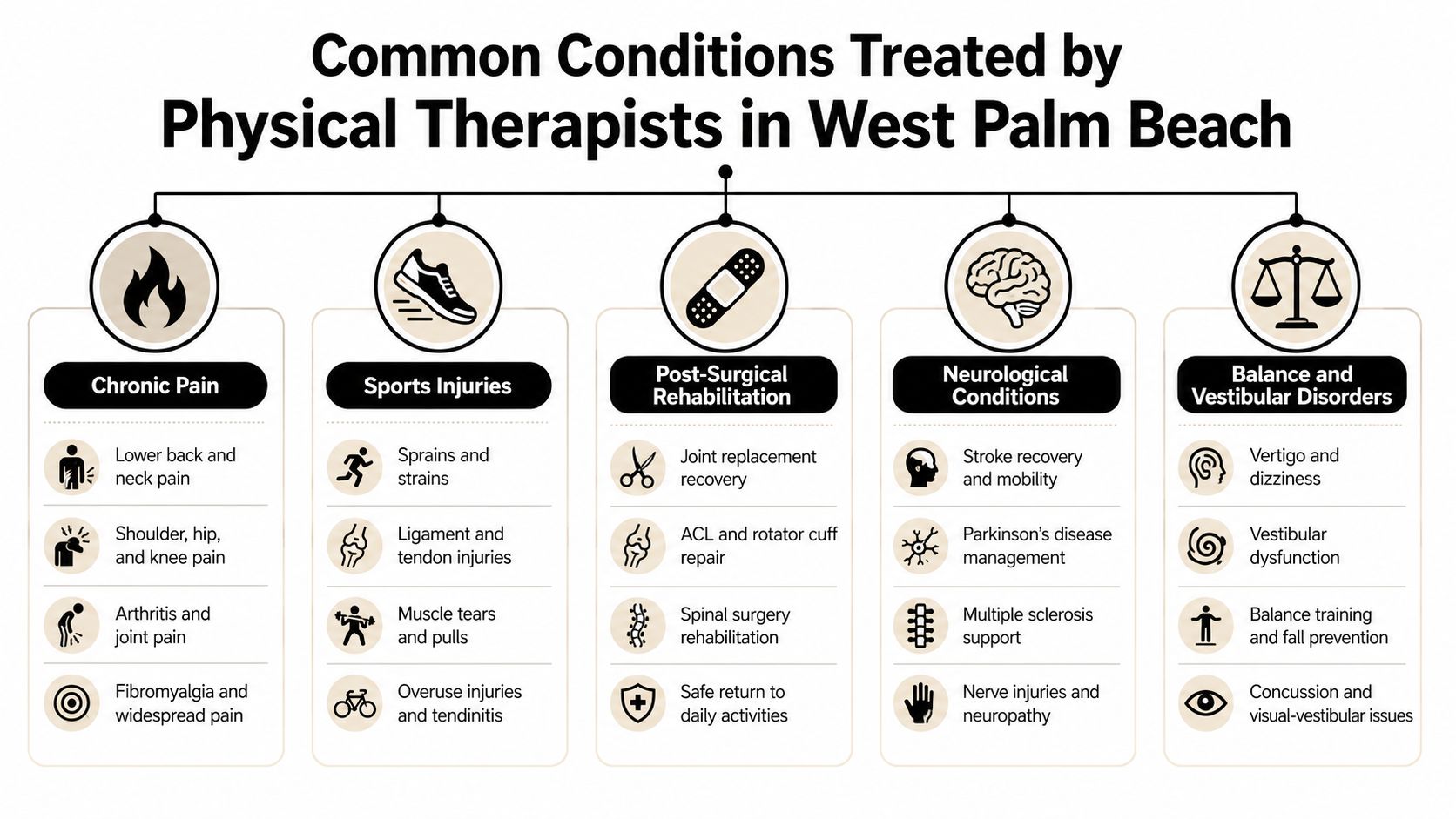
West Palm Beach clinics see a wide mix of patients, and the plan should change with the problem, the irritability of the tissue, and the demands of daily life. A runner with a tendon issue does not need the same approach as someone recovering from a joint replacement, and an older adult who feels shaky on tile floors needs a different progression again. Good therapy starts by matching treatment to what the body is doing.
Chronic pain and spine-related problems
Back pain, neck pain, sciatica, and arthritis are common reasons people look for physical therapy West Palm Beach. These cases usually start with symptom control, then move into restoring motion and rebuilding tolerance so ordinary tasks like standing, bending, or getting out of a car stop setting everything off again. A patient with back pain may need trunk control work and movement retraining, while someone with sciatica may need a different mix of nerve-sensitive positioning, strengthening, and activity modification. For a closer look at spine-focused rehab, read how physical therapy helps with back and neck pain.
Sports injuries and active adults
Weekend golfers, pickleball players, runners, and gym regulars often come in with shoulder strain, knee pain, Achilles irritation, or flare-ups after a game or workout. These cases usually need load management, strength progression, and return-to-sport testing, not just rest. If treatment never moves past light band work, many active patients improve for a short time, then flare again the moment they return to real activity.
Post-surgical and complex orthopedic rehab
Joint replacement, spine procedures, and more complex orthopedic cases need more structure. Some recovery plans are tightly controlled, especially when motion has to be protected and rebuilt at the same time. The Paley Rehabilitation Department notes that lengthening patients remain in West Palm Beach during the lengthening phase and receive daily physical therapy, 5 days per week Paley rehabilitation protocol. That kind of schedule shows how closely rehab has to match tissue healing in complex cases.
Balance, gait, and fall-risk concerns
Older adults often need work on steadiness, walking confidence, and safe transfers. That can include step practice, strength work, ankle and hip control, and balance challenges that are scaled carefully so the person can build skill without getting overwhelmed. For pregnancy-related pelvic or back discomfort, some patients also need support strategies during daily activity, and a resource like find a comfortable pregnancy belt can help them think through comfort and positioning alongside therapy.
What to Expect During Your First Physical Therapy Visit
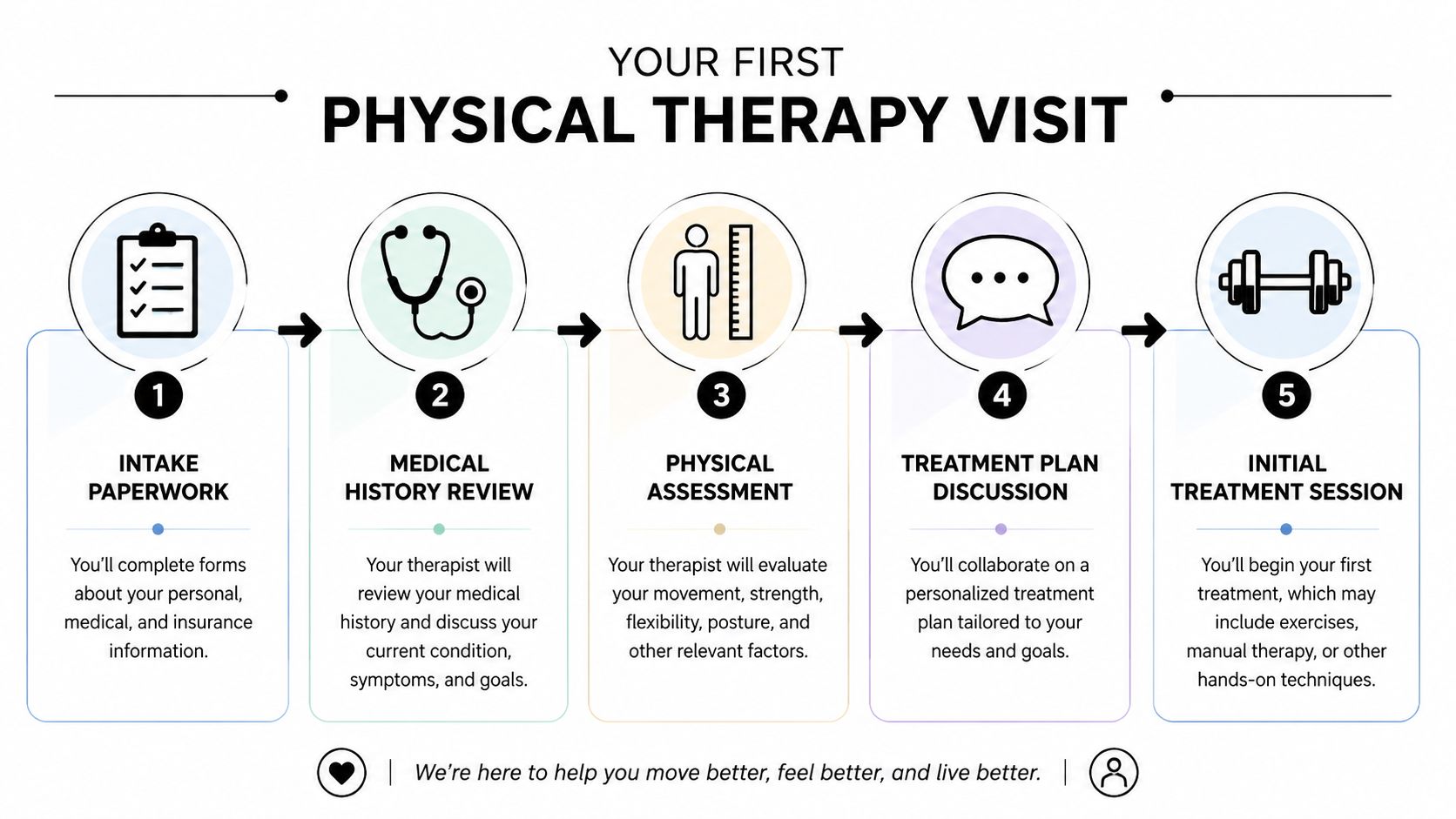
The first visit usually feels more like a careful investigation than a workout. That's a good thing. If a therapist spends the first session watching how you move, asking about symptom triggers, and testing specific motions, they're trying to avoid the common mistake of treating the diagnosis instead of the person.
The intake and evaluation process
You'll usually start with paperwork, medical history, and questions about what hurts, when it started, and what makes it better or worse. Then the therapist checks range of motion, strength, posture, balance, and movement patterns. They may also palpate tissue, test function, or ask you to perform simple tasks like standing from a chair, reaching overhead, or walking a short distance.
That evaluation matters because pain can come from many different sources that feel similar at first. Two people may both say “my lower back hurts,” but one needs spinal mobility and trunk endurance, while another needs hip mechanics, walking tolerance, or nerve-related management. Good care depends on that difference.
What the session usually feels like
Wear clothes you can move in, ideally something that lets the therapist see the area being treated. You may receive hands-on care, guided exercises, and a first set of home instructions. The homework should feel targeted, not overwhelming. If you leave with 12 exercises and no explanation for why they matter, that's a sign the plan may be too generic.
Most patients do better when the therapist explains the “why” behind each exercise, not just the movement itself.
It's normal to feel nervous about being touched or asked to move in ways that reproduce symptoms a little. A careful therapist should keep you informed, adjust if something feels too intense, and build the session around tolerance, not toughness. If you're looking at a clinic's process before you book, a practical overview like what a typical physical therapy session looks like can make that first appointment feel less uncertain.
How to Choose the Right Physical Therapy Clinic Near You
A good clinic isn't the one with the flashiest homepage. It's the one that makes it easy to get evaluated, explains the plan clearly, and adjusts care when progress stalls. In a dense market like West Palm Beach, the challenge is separating legitimate individualized treatment from a polished version of the same generic exercise program.
What to compare before you book
Start with the evaluation. Ask whether the therapist does a full assessment before prescribing exercises. If the front desk can't tell you how much one-on-one time you'll have or whether your visits are mostly with a licensed therapist versus being handed off, that's a red flag. You're looking for a clinic that treats your first visit like a decision point, not a sales funnel.
Next, look at communication. A strong clinic tells you what they're treating, how they'll measure progress, and what happens if the plan isn't working. That's especially relevant because West Palm Beach search results often surface clinics with addresses and service lists, but not much clarity on commute, scheduling, parking, or low-friction access. Independent research on PT access found that the biggest barriers were financial issues, incomplete knowledge of PT services, and poor proximity to clinics, including transportation and scheduling problems PT access research.
A quick clinic checklist
- Evaluate the exam first: ask whether the therapist performs a movement-based assessment before choosing exercises.
- Ask about continuity: find out if you'll see the same clinician consistently or bounce between providers.
- Confirm the time slot: shorter, rushed visits can make it harder to adjust the plan when symptoms change.
- Check logistics early: parking, elevator access, and traffic patterns can matter as much as the treatment itself.
- Verify the plan fits your condition: back pain, post-op rehab, balance deficits, and sports injuries should not all receive the same template.
For patients who like to compare clinics visually, this clinic selection guide can be useful as a reference point for what a well-run rehab practice looks like in day-to-day operations.
Navigating Insurance and Appointment Logistics
The financial side of PT can be the part that stops people. Insurance language is confusing on purpose, and many patients don't know whether they need a referral, what their copay is, or how much they'll owe after the deductible is applied. The cleanest way to avoid surprises is to ask the right questions before the first visit.
Questions to ask your insurer
First, confirm whether the clinic is in network. Then ask whether physical therapy visits are covered under your plan, whether a referral or prescription is required, and how your deductible and copay apply. If the answer seems vague, ask the insurer to explain the benefit in plain language and write down the name of the person you spoke with.
Scheduling matters too. Some clinics book out further than patients expect, while others offer same-day or quicker access depending on staffing. If pain is escalating, waiting weeks can make recovery slower and the first session harder because the body has had more time to protect itself.
Special cases that need extra paperwork
Workers' compensation and auto accident claims usually bring more documentation, not less. That's because the clinic has to coordinate with adjusters, physicians, and the claim itself. If you're dealing with an auto-related injury, a practical overview like the Florida All Risk Insurance PIP guide can help you understand why benefit verification matters before you start care.
Practical rule: never assume “PT is covered” means “PT will be inexpensive.” Coverage, deductibles, and visit limits all affect the final bill.
Frequency also varies by condition. Some patients start with a few visits each week, especially early in recovery, while others do better with less frequent sessions and a stronger home plan. The right schedule is the one that matches symptom irritability, goals, and how much treatment the body can absorb without flaring.
MedAmerica Rehab Center and Local Care Options
MedAmerica Rehab Center is one local option for patients who want physical therapy, chiropractic care, acupuncture, and advanced shockwave therapy under one roof. The clinic is family-owned and has served the community since 1995, which gives it the kind of continuity many patients look for when they're trying to avoid bouncing between disconnected providers. Its approach also fits the access problems discussed earlier, because patients often need clear expectations, practical scheduling, and treatment that feels individualized from day one.
Why its model stands out in practice
The clinic's service mix includes hands-on manual therapy, strengthening exercise, hot or cold packs, electrical stimulation, and stretching during visits. That matters because patients with back pain, post-accident stiffness, arthritis, shoulder pain, or balance issues often need more than a printed routine. A multidisciplinary setting can also help when a problem isn't purely muscular, since pain, mobility, and irritability don't always improve on the same timeline.
MedAmerica also emphasizes same-day appointments, insurance-friendly processes, and individualized treatment plans designed to reduce pain and restore mobility without unnecessary surgery or medication. Those features line up with the access and navigation issues West Palm Beach patients face, especially when they're trying to move quickly after an injury or when pain is affecting work and family life. The clinic's long-standing presence and consistent five-star reputation are additional trust signals for people who want a stable local provider.
For someone comparing options, the practical question is simple. Does the clinic assess your movement carefully, explain the plan clearly, and adapt treatment when progress changes? MedAmerica's mix of therapies gives it the tools to do that for a wide range of outpatient rehab cases.
Taking the First Step Toward Pain-Free Movement
People usually wait too long because they hope the pain will settle on its own, or they don't want to deal with insurance, traffic, or another appointment. That hesitation is understandable, but it often makes the problem harder to solve. Once pain changes how you walk, sit, lift, or sleep, the body starts compensating, and those compensations can become the new problem.
The better approach is straightforward. Know what PT does, match your symptoms to the right kind of rehab, ask what happens on the first visit, compare clinics on evaluation quality and access, and get the insurance details before you show up. If you stay active, something as simple as checking tips for paddleboarding for fitness can also remind you how much healthy movement matters when recovery is going well.
If your pain is limiting daily life, don't wait for it to become a bigger, more expensive problem. Book an evaluation, ask direct questions, and choose the clinic that gives you a clear plan instead of a generic handout.
If you're ready to move better, MedAmerica Rehab Center offers physical therapy, manual treatment, and individualized rehab planning in a local setting that's built around practical access. Visit MedAmerica Rehab Center to explore care that fits your condition, your schedule, and your recovery goals.
MedAmerica Rehab · Deerfield Beach
Talk to a clinician about your pain
Physical therapy, chiropractic, acupuncture and shockwave therapy under one roof, since 1995. Same-day appointments are available.
Mon–Thu 8:00 AM – 6:30 PM · Fri 8:00 AM – 3:00 PM