
Muscle Strain Recovery: A Practical Step-by-Step Guide
You felt it right away. A sharp tug in the hamstring, a grab in the calf, a sudden ache in the low back while lifting a bag or sprinting for a ball, and now every step reminds you that something pulled the wrong way. Muscle strain recovery starts with understanding what was injured, because the right next step depends on whether you're dealing with a small fiber irritation or a true tear.
What Happens When You Pull a Muscle
A muscle strain usually begins with a sudden load that exceeds what the tissue can handle. One person feels it during a deadlift, another while reaching into a car trunk, and someone else notices it halfway through a run when the muscle just stops cooperating. The injury can feel dramatic, but most muscle injuries respond to conservative care, and the modern model favors short protection, then guided movement rather than long rest (PMCID PMC3899907).
The three grades in real life
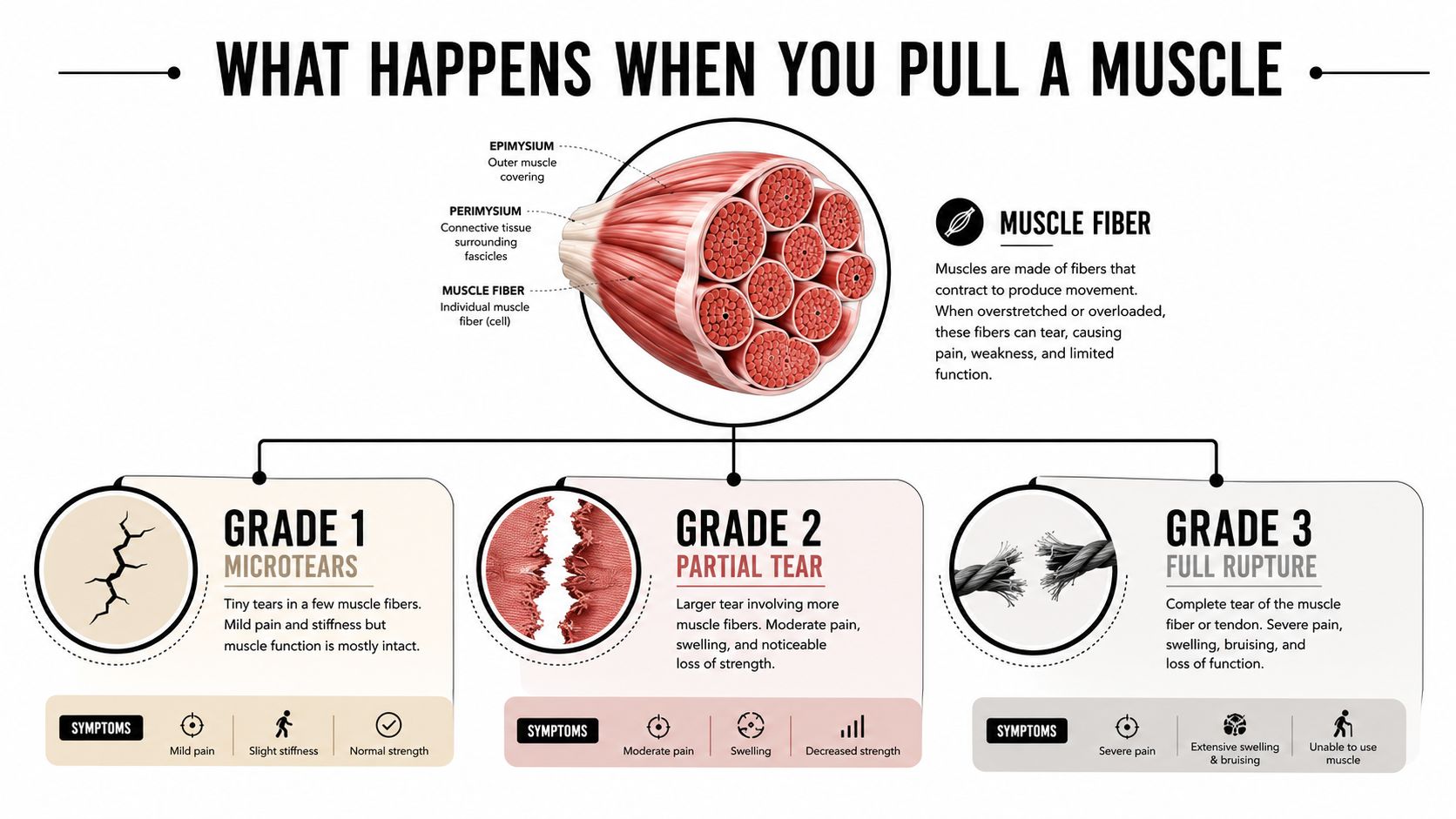
A Grade 1 strain is the one that often gets described as a “pull.” The muscle fibers are overstretched or lightly damaged, pain is usually localized, and you can often still move the area, just not comfortably.
A Grade 2 strain is more than a tweak. That's a partial tear, and it tends to show up as more obvious pain, swelling, and weakness. Movement is still possible, but it usually feels wrong.
A Grade 3 strain is a full rupture. That's the one more likely to cause a pop, marked loss of function, and a clear need for medical evaluation.
Practical rule: if you can still use the muscle, the injury may be mild, but if the area feels unstable, visibly deformed, or function drops off sharply, treat it like something that needs an exam.
What matters most in the first few days is not waiting for the tissue to “just calm down” on its own. The literature emphasizes that rehabilitation strategy drives recovery, not passive waiting, and early mobilization can help lower-grade injuries while a short period of immobilization, usually 1 to 3 days, may be useful for higher-grade injuries (PMCID PMC3899907). That balance is the thread running through the rest of this guide.
Immediate Care With the PEACE and LOVE Protocol
A pulled muscle in the first 48 to 72 hours needs protection, but not total shutdown. Keep the injured area out of painful, forceful use, then use simple measures that reduce swelling and pain without locking the muscle in place. For a mild muscle strain, that usually means ice for 15 to 20 minutes at a time every 2 to 3 hours during the first few days, compression with an elastic bandage, and elevation when the injury site can be raised above heart level (Mayo Clinic).
What PEACE means in practice
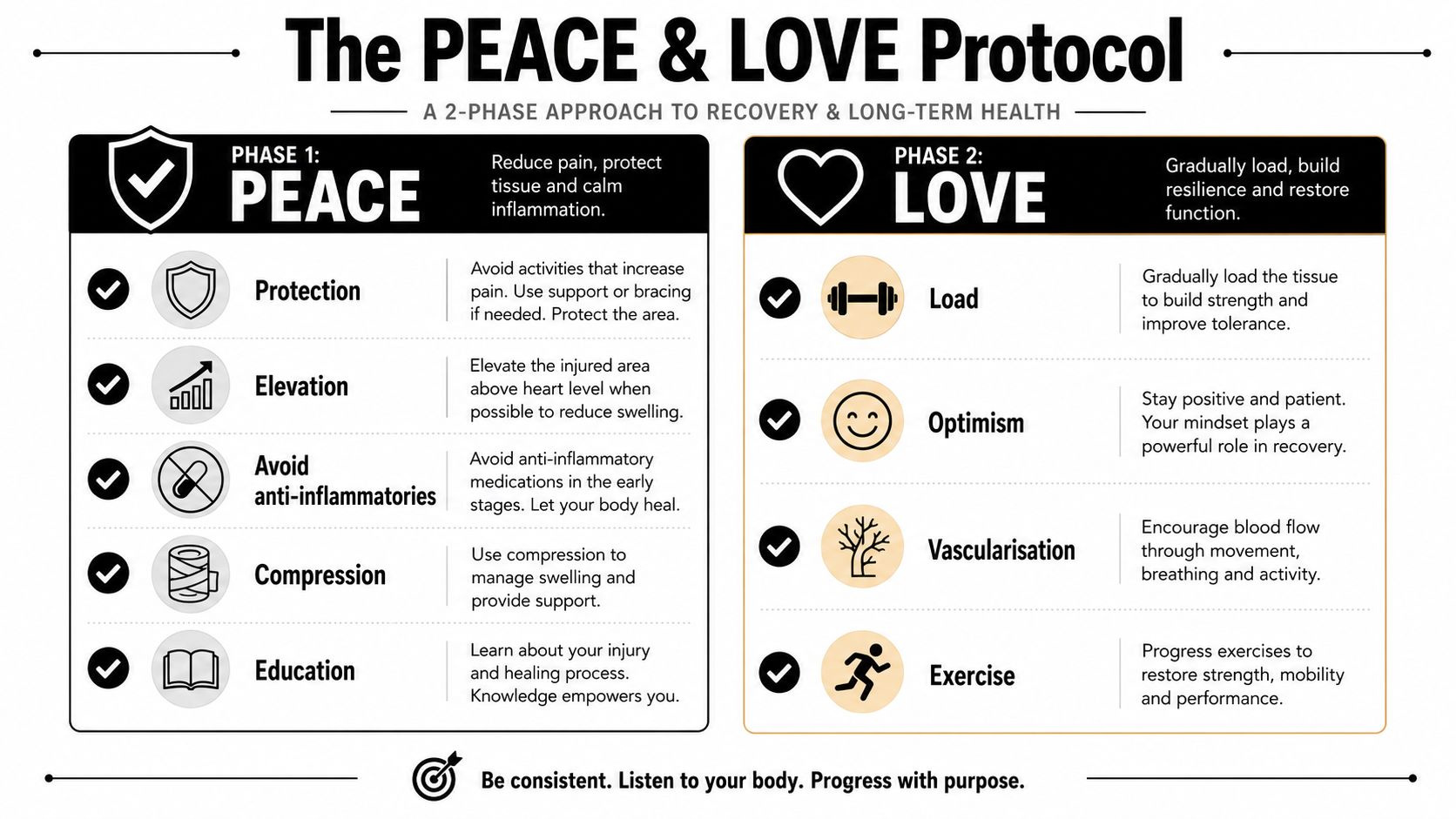
Protection means you stop testing the injury with hard, fast movements.
Elevation helps when swelling is part of the picture.
Avoid anti-inflammatories means not reaching for NSAIDs automatically, because they are not the default answer for every strain.
Compression should feel snug, not tight enough to cut off circulation.
Education means following a plan instead of guessing from day to day.
Mayo Clinic notes that acetaminophen can help with short-term pain control, and that wrapping should never be so tight that circulation is affected. For a practical clinic-style walkthrough of cold therapy, this ice pack physical therapy resource shows how cold application is used in rehab settings.
Where LOVE starts
The LOVE part is where recovery starts to become active again. Load means you return to pain-limited movement before the muscle gets stiff and weak. Exercise does not mean jumping back into workouts. It means controlled reloading that matches what the tissue can handle.
Rest helps early, but if the injury stays protected for too long, the muscle can lose strength and become harder to rebuild.
That is why the first-aid window is short. After the protection phase, the goal shifts from symptom control to careful movement, then to strengthening. A video overview of the same framework is embedded below for people who want to see the sequence visually.
Realistic Recovery Timelines by Severity
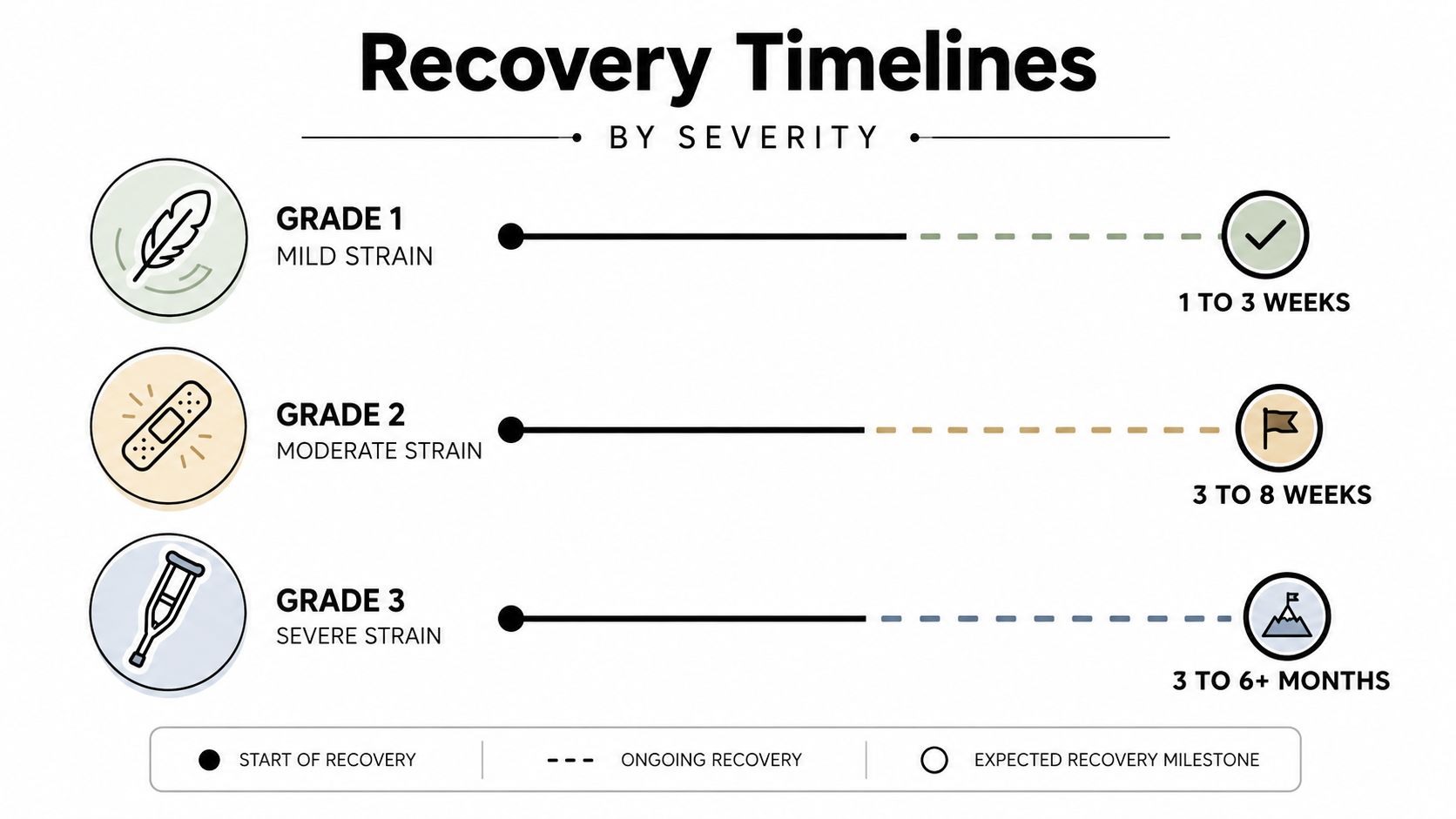
A pulled muscle does not heal on a single clock. The timeline depends on how much fiber was overstretched or torn, and that changes the plan for rest, loading, and return to normal activity. Mild strains often settle in 1 to 3 weeks, partial tears can take 4 to 8 weeks, and severe tears may need several months of recovery (SMJRSCorp). That range is not a flaw. It reflects real differences in tissue injury and why muscle strain recovery has to be guided by severity, not by hope.
Mild, partial, and severe injuries do not behave the same
Mild strains often calm down quickly, but location matters. Harvard Health reports that mild back strains usually improve within 1 to 2 weeks and resolve within 4 to 6 weeks, while mild or moderate leg strains may take 8 to 10 weeks or more to heal (SMJRSCorp). In practical terms, a sore back muscle that eases when you move may return sooner than a leg strain that keeps getting loaded every time you walk, climb stairs, or squat.
Once the tear is more than mild, the timeline stretches. Grade II strains may take 2 to 3 months or longer, and Grade III strains may need surgery followed by several months of rehabilitation (SMJRSCorp). That is where a criteria-based rehab plan matters, because time alone does not tell you when the tissue is ready for more load. If the muscle is still weak, still painful with basic movement, or still giving way, rest has not done its job yet.
Returning too early raises the chance of another pull. Hospital for Special Surgery notes that going back before 4 to 6 weeks can increase reinjury risk, and more severe injuries may take 4 to 6 months to settle fully (SMJRSCorp). A muscle model for research can help show why a partially healed fiber can feel fine at rest but fail under force. For patients who need a guided rebuild rather than trial and error, active recovery physical therapy guidance is often the next step.
Use the timeline as a checkpoint, not a promise
A mild strain that still hurts after the first few days deserves a closer look, and a partial tear that improves but never regains strength needs structured rehab. The point is not to predict an exact finish date. The point is to recognize whether the injury behaves like a short recovery, a longer one, or a problem that is not tracking the way a simple strain should.
If you are still limping, still losing strength, or still avoiding the motion that triggered the pain, the injury probably is not as mild as you hoped.
A Phased Rehab Plan You Can Follow at Home
Once the sharpest pain and swelling settle, recovery turns into rebuilding. A useful way to think about muscle strain recovery is in four phases, symptom control, isometric activation, controlled strengthening, and then sport or task-specific return. That progression fits the early-mobilization model described in the clinical literature, where the body does better with the right amount of motion than with prolonged waiting (PMCID PMC3899907).
Phase 1 to Phase 2
Start with pain-limited movement and gentle daily activity. Walking, easy cycling, and basic position changes are fair game if they don't spike symptoms. Then move into submaximal isometrics, which means tightening the muscle without changing its length. Harvard Medical School specifically recommends gentle stretching, submaximal isometrics for about 30 seconds, 7 to 9 hours of sleep, protein at each meal, and hydration to support repair (Mayo Clinic).
If you want a visual refresher on what muscle tissue is doing during this phase, a muscle model for research can help you picture why controlled loading matters more than aggressive stretching.
Useful benchmark: when a movement is still painful, keep the load below the pain threshold rather than forcing range.
Phase 3 to Phase 4
After isometrics feel stable, progress to concentric and eccentric strengthening. That's the stage where the muscle learns to produce force and then control force under load. A common rhythm is about 3 strengthening sessions per week with at least 1 rest day between sessions, which gives tissue time to adapt between efforts (YouTube rehab protocol).
A short-hold active stretch often works better than a long static hold here. One rehab guideline warns that prolonged static stretching can aggravate a strain and slow healing, while 5 to 10 second active stretches fit better with early rebuilding (YouTube rehab protocol). For a clinic-based progression that emphasizes active recovery, this active recovery physical therapy resource lines up with the same idea.
When to advance
Advance only when range of motion and strength are symmetric and jogging or brisk walking is pain-free. If the injured side still feels guarded, shaky, or weaker, don't jump ahead just because the calendar says you should. The muscle doesn't care about the date, it cares about the load it can tolerate.
Managing Pain Safely With Medications and Comorbidities
A pulled muscle isn't always a simple “take ibuprofen and move on” situation. That advice can be wrong for older adults, people on blood thinners, and anyone with kidney or stomach problems, so pain control needs to match the person as much as the injury. A senior-focused health source specifically warns that anti-inflammatory drugs can be inappropriate in those situations, and it notes that acetaminophen may be safer than NSAIDs in some cases because it reduces pain without reducing inflammation (HHCSeniorServices).
Choose the symptom relief that fits the body
The simple rule is this. If inflammation control is useful and NSAIDs are medically safe for you, they may have a role. If they're risky, skip the reflex and consider pain relief that doesn't create a medication problem. If you're not sure, that's the moment to ask a clinician rather than guessing.
Heat can be useful later, after the first few days, when stiffness is the bigger complaint than swelling. That said, the first choice in the early window is still usually protection plus cold, not heat layered on too soon. Recovery is easier to derail by overdoing comfort measures than many realize.
Sleep, hydration, and protein matter too. Harvard Medical School's guidance to aim for 7 to 9 hours of sleep, protein at each meal, and hydration isn't glamorous, but it supports actual tissue repair rather than just symptom relief (Mayo Clinic).
For people managing several medications at once, a structured review can be helpful, and this explore medication management options resource is a reminder that pain control should be coordinated, not improvised.
Red Flags and When Professional Therapy Helps
Home care has a ceiling. If pain is still clearly limiting you after 3 to 7 days, a clinician should evaluate the injury, because a strain that does not follow a normal recovery curve may be more than a mild pull. If strength is slipping instead of coming back, more rest alone usually does not solve the problem.
Signs it's time to get examined
Stop self-treating and get assessed if you notice any of the following:
- Pain that lingers or worsens: especially if it is still significant after several days.
- Marked swelling or bruising: more than the usual soreness you would expect from a minor tweak.
- A palpable gap in the muscle: that can suggest a more serious tear.
- Numbness or weakness: these are not normal strain symptoms.
- Loss of function: trouble walking, lifting, or using the limb the way you normally do.
Those signs point to a higher-grade injury or a problem that does not belong in a casual home-rehab plan.
What in-clinic care can add
The right clinic does more than treat pain. It helps restore tissue glide, loading tolerance, and confidence in movement. Hands-on manual therapy can reduce guarding and improve motion, targeted acupuncture may help with pain modulation, and shockwave therapy is sometimes used for stubborn soft tissue cases when progress has stalled.
A practical visit also gives you a chance to see what a typical physical therapy session looks like, which can remove some of the uncertainty before you go in. MedAmerica Rehab Center offers physical therapy, chiropractic care, acupuncture, and shockwave therapy in one place, so the next step can match the pattern of the injury instead of relying on guesswork.
Your Recovery Checklist and Next Steps in Deerfield Beach
A simple recovery roadmap keeps people from doing too much too soon, or staying too protected for too long. Use this checklist as a working plan, not a guess.
| Phase | Time Window | Key Actions | Advance When |
|---|---|---|---|
| Early protection | First few days | Protect, compress, elevate, ice, keep movement below pain | Swelling and pain start settling |
| Activation | After symptoms calm | Begin isometrics and easy walking or cycling | You can contract the muscle without a spike in pain |
| Strength rebuilding | Next stage | Add concentric and eccentric work, short active stretches | Range of motion and strength are close to symmetrical |
| Return to function | Final phase | Add task-specific drills, then full activity | Movement is pain-free and controlled |
What to do today
- Use the first few days wisely: protect the muscle, keep motion gentle, and don't force a workout through pain.
- Start loading when symptoms allow: isometrics first, then controlled strengthening.
- Treat your return like a test: if motion, strength, or walking still feels off, you're not ready.
- Get help if the pattern doesn't improve: persistent pain, weakness, or swelling deserves an exam.
For Deerfield Beach readers who want a same-day evaluation, MedAmerica Rehab Center offers physical therapy, chiropractic care, acupuncture, and shockwave therapy in one place, with an insurance-friendly process and clear expectations for the first visit. If the injury is affecting work, training, or even simple daily lifting, getting seen early can keep the problem from dragging on.
If your muscle strain still hurts when you walk, lift, or turn, don't wait for it to sort itself out. Visit MedAmerica Rehab Center to get evaluated and start a plan that matches the actual severity of your injury, not just the way it feels on day one.
MedAmerica Rehab · Deerfield Beach
Talk to a clinician about your pain
Physical therapy, chiropractic, acupuncture and shockwave therapy under one roof, since 1995. Same-day appointments are available.
Mon–Thu 8:00 AM – 6:30 PM · Fri 8:00 AM – 3:00 PM