
Parkinson’s BIG and LOUD Exercises: A Practical Guide
You notice it in small, frustrating moments. Your spouse asks you to repeat yourself at dinner because your voice faded halfway through the sentence. You stand up to walk across the room and your steps get shorter than you intended. Reaching for a cup in the cabinet feels hesitant, and your handwriting keeps shrinking even when you try to slow down.
For many people with Parkinson's, that's the hard part. It doesn't only affect one big activity. It chips away at everyday movement and communication. The body starts doing things smaller and quieter, even when the intention is still there.
That's why Parkinson's BIG and LOUD exercises matter. They aren't random stretches or generic speech drills. They're built around a simple but powerful idea. If Parkinson's pulls movement and voice output downward, training needs to push in the opposite direction with deliberate, repeated practice that feels bigger and louder than normal.
Used correctly, this approach can help people move with more confidence, speak with more presence, and carry those gains into real life. It also comes with real-world questions that patients ask all the time. What if the standard schedule feels too intense? What should you do after the initial therapy block ends? Those questions deserve practical answers, not just a description of the classic program.
Reclaiming Your Movement and Voice from Parkinson's
A common scene in the clinic goes like this. Someone tells me, “I feel like I'm moving fine until I see myself on video.” Then they notice the small arm swing, the shorter stride, the slower turn, or the voice that sounded stronger in their own head than it did to everyone else in the room.
That mismatch is painful because it can feel personal. People start wondering if they're not trying hard enough. In reality, Parkinson's often changes how movement and effort are perceived. What feels normal may be too small. What feels loud enough may still not carry across a busy room.
What people usually notice first
The changes often show up in practical tasks:
- Walking gets tighter: Steps can shorten, turning can become cautious, and starting or stopping may feel less automatic.
- Daily tasks shrink: Reaching overhead, rolling in bed, getting out of a chair, and buttoning clothes can take more effort.
- Speech fades: Family members may say your voice sounds soft, flat, or hard to understand, especially later in the day.
- Writing changes: Handwriting often becomes smaller and more cramped.
These symptoms can lead people to pull back from activities they enjoy. They speak less in groups. They avoid crowded restaurants. They move more carefully, but not always more effectively.
Practical rule: If Parkinson's is making your movements smaller, your exercise strategy usually needs to go in the opposite direction.
That's the heart of BIG and LOUD work. The goal isn't to “exercise harder” in a vague sense. It's to retrain movement amplitude and vocal output so the body and brain relearn what functional movement and speech should feel like. With good instruction, that can instill a sense of capability. Patients often do better when they stop chasing perfect, delicate movement and start practicing clear, intentional, bigger movement patterns.
Understanding the Science Behind BIG and LOUD Therapy
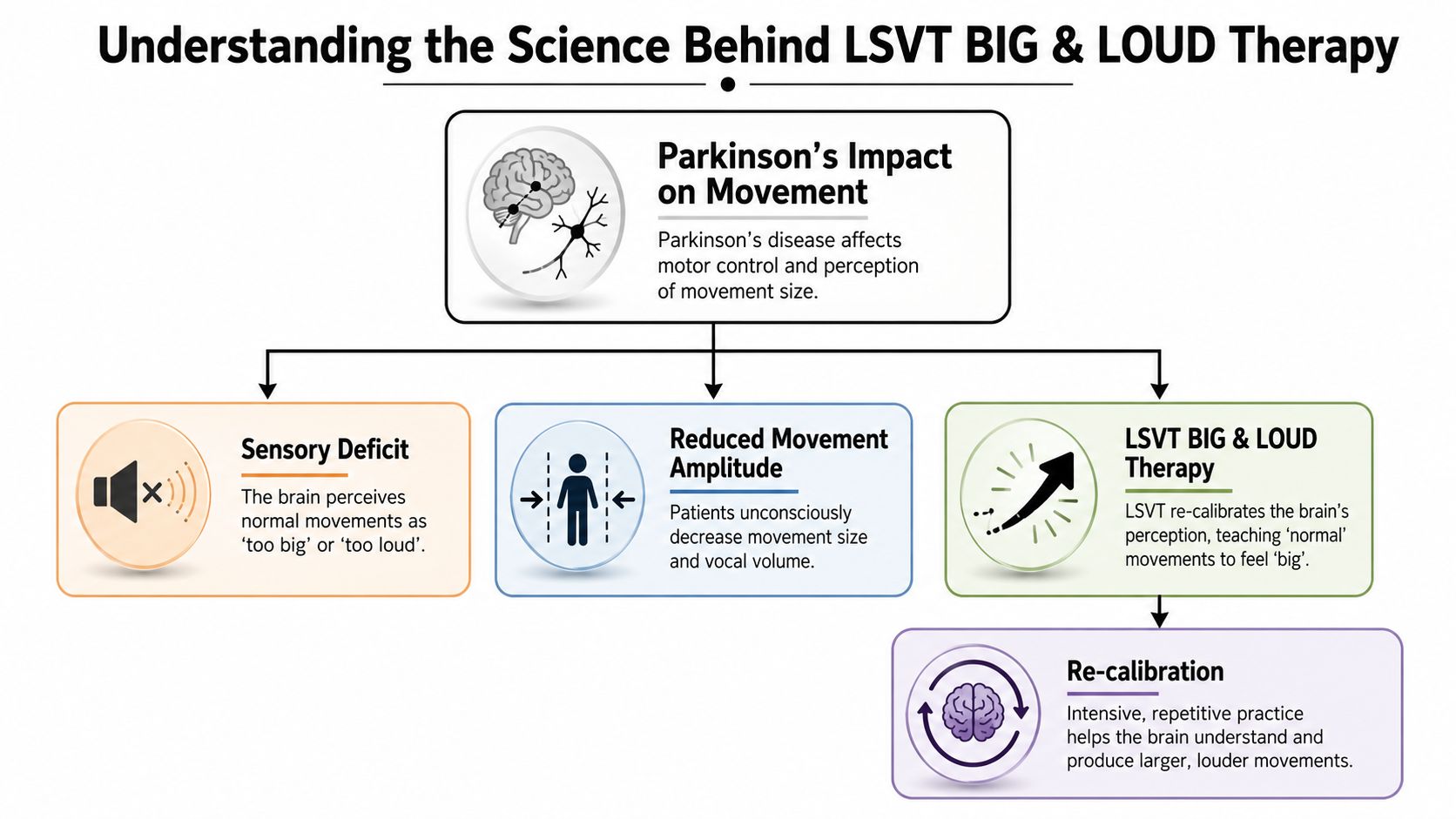
Parkinson's often creates a sensory problem as much as a movement problem. Many people aren't fully aware of how small their movements have become, because the brain starts accepting those reduced patterns as normal. That's why merely telling yourself to “move better” usually doesn't work for long.
LSVT BIG was developed as an amplitude-based therapy to counter the small, slow movements common in Parkinson's disease. It's typically delivered as 16 one-hour sessions over 4 weeks, and research summarized by Michigan Medicine reports meaningful improvements in motor function and daily activities, with benefits sustained for at least 2 years in some reports. In one occupational therapy study, participants' self-rated performance and satisfaction on COPM goals improved by 3 to 6 points with p < .001 after the program, according to Michigan Medicine's overview of BIG and LOUD therapy.
Why bigger and louder helps
The principle is straightforward. If your brain is under-scaling movement and voice, therapy has to over-correct during practice. That's why these drills can feel exaggerated at first. The exaggeration is the treatment.
This kind of training overlaps with what rehab professionals call neuromuscular re-education. The nervous system isn't just building strength. It's relearning how much effort to use, how large a movement should be, and how to make that output automatic during normal activity.
Three ideas matter most:
- Amplitude matters: Bigger reaching, larger stepping, taller posture, and stronger voice output are practiced on purpose.
- Repetition matters: The system learns through frequent, structured practice, not occasional reminders.
- Carryover matters: Clinic exercises only help if they show up when you stand, walk, talk, reach, and turn at home.
This is not generic exercise
People with Parkinson's often ask if walking more or doing basic stretching is enough. Those things can help overall health, but they don't replace amplitude-specific training. BIG and LOUD are task-focused. They target the exact outputs Parkinson's commonly reduces.
The movement has to be large enough, and the voice has to be strong enough, for the brain to register a new normal.
That's one reason these programs became so widely used. They gave clinicians a standardized way to train a problem that many patients experience every day but struggle to self-correct without feedback.
Fundamental LSVT BIG Exercises You Can Practice
The most useful home exercises are the ones that teach you to think in directions, not just body parts. Forward. Upward. Sideways. Rotational. Parkinson's tends to shrink all of that, so your job is to reclaim space.

Before you start, use a stable chair or countertop nearby if your balance is limited. Stand tall. Open your chest. Look straight ahead instead of down at your feet. Say your cue out loud if it helps: “Big movement.”
Floor to ceiling
Sit toward the front of a sturdy chair with your feet planted.
- Start rounded and small: Hands near your knees.
- Reach forward and up: Sweep both arms out and overhead as if you're making your whole body longer.
- Open the fingers wide: Don't keep the hands half-closed.
- Finish tall: Lift through the chest and sit upright, not leaned back.
- Return with control: Reset and repeat.
Why this one works: it fights the flexed, compressed posture that often creeps into daily life. It also helps with reaching up for shelves, putting on a shirt, and initiating larger movements from the trunk.
Side to side reach
Stay seated or perform this standing if you're steady.
- Reach one arm across your body, then sweep it wide to the side.
- Let your trunk rotate with the movement.
- Turn your head and eyes toward the reaching hand.
- Switch sides and make each repetition broad and intentional.
This is one of the most practical Parkinson's BIG and LOUD movement drills because it trains rotation. Rotation matters when you roll in bed, back out of a car, reach for a seatbelt, or turn to speak to someone beside you.
Rock and reach
Stand with one foot in front and one behind, with a counter or chair nearby for safety.
- Rock your weight forward onto the front foot while the opposite arm reaches forward.
- Rock your weight backward onto the back foot while the other arm swings back.
- Let the movement become rhythmic and full.
- Keep the steps planted and focus on weight shift, posture, and arm swing.
Many people lose natural arm swing and smooth weight transfer when walking. This drill helps restore both. It pairs especially well with formal gait training in physical therapy when walking has become hesitant or shuffling.
For a visual example of BIG-style movement practice, this clip can help you picture the speed and size you're aiming for.
What usually works and what doesn't
What works is quality. Slow, careful, tiny motions rarely solve a problem caused by under-scaled movement. The goal is controlled amplitude, not timid repetition.
What doesn't work is rushing through a checklist with poor form. If your shoulders stay hunched, your eyes stay down, and your movement stays small, you may finish the routine without training the target.
“Big” should show up in your posture, your reach, your step length, and your intent.
If stiffness limits you, a mobility warm-up can make these drills more productive. The Full Circle Function & Fitness mobility guide is a useful general resource for loosening the hips, trunk, and shoulders before more focused movement practice.
Foundational LSVT LOUD Exercises for a Stronger Voice
Voice work needs the same mindset as movement work. The target isn't yelling. The target is a healthy, intentional voice that carries. Many people with Parkinson's feel as if they're speaking normally when listeners still hear them as too soft. LOUD training addresses that gap directly.
Peer-reviewed evidence on LSVT LOUD describes a structured protocol that often includes 15 repetitions of sustained phonation and pitch changes, plus 5 repetitions of 10 functional phrases. The same review found conversational vocal loudness improved with an effect size of 1.20 immediately after treatment and 1.03 at 24 months, based on this review of LSVT LOUD outcomes.
Three core voice drills
Start seated or standing tall with both feet supported. Relax your shoulders. Breathe low into the rib cage and abdomen rather than lifting the shoulders on each inhale.
Sustained “Ah”
Take a breath, then say “Ah” in a clear, steady voice.
Focus on strong, even sound, not strain.
Stop if the throat feels squeezed or scratchy.Pitch glides
Start with “Ah” or “Oo.”
Glide up to a higher pitch, then down to a lower pitch.
Keep the sound connected and supported by breath.Functional phrases
Practice short lines you use every day, such as “I need the phone,” “Turn on the light,” or “I'm ready to go.”
Say them with a deliberate, confident voice.
Repeat them enough that the stronger voice starts to feel familiar.
Good technique matters more than force
A stronger voice should come from breath support, posture, and intentional output. It shouldn't come from neck tension or throat pushing. If the chin juts forward and the shoulders tighten, the sound often becomes harsh rather than effective.
Helpful cues include:
- Stand or sit tall: A collapsed posture limits breath support.
- Think forward voice: Aim the sound outward to a listener.
- Use feedback: A sound level meter app can help some people notice when their “loud” voice is consistent and healthy.
- Practice in real situations: Use your stronger voice at breakfast, on the phone, and when greeting someone at the door.
When patients struggle with LOUD exercises, it's usually because they try to whisper louder instead of speaking with full voice. Those aren't the same thing. Full voice uses breath and resonance. Whispering harder only creates effort without the carryover you want.
Building Your Daily BIG and LOUD Practice Routine
Consistency beats good intentions. People do best when practice is tied to a predictable part of the day and when the routine is simple enough to repeat even on lower-energy days.
The classic LSVT BIG schedule is intensive. Still, that doesn't mean all-or-nothing. A 2024 study comparing standard and modified LSVT BIG protocols found that both improved motor symptoms, postural stability, functional mobility, and gait speed. The standard protocol was superior for sensory integration and gait-cycle symmetry, but the modified protocol still produced meaningful gains for people who may not tolerate the full intensity, according to the 2024 study on standard and modified BIG protocols.
A sample week you can actually follow
Use this as a practical template, not a rigid rule.
| Day | Morning (15-20 min) | Afternoon (15-20 min) |
|---|---|---|
| Monday | BIG seated reach sequence, sit-to-stand practice, short LOUD warm-up | Functional phrases, walking with bigger steps |
| Tuesday | Floor to ceiling, side to side reach, sustained “Ah” practice | Rock and reach, posture reset, conversation practice |
| Wednesday | BIG trunk rotation, chair rise practice, pitch glides | Functional walking tasks at home, phrase repetition |
| Thursday | Repeat strongest BIG drills with full effort | LOUD practice during phone call or family conversation |
| Friday | BIG reaching and stepping routine | Rock and reach, sustained phonation, phrase carryover |
| Saturday | Shortened routine with focus on form | Practice voice and movement during errands or chores |
| Sunday | Recovery pace, posture and breathing focus | Gentle review of favorite drills |
How to modify without losing the point
If the full standard schedule feels unrealistic, don't assume the answer is to stop. A modified plan may still help if you keep the key ingredients intact.
Try these adjustments:
- Shorter blocks: Split practice into two shorter sessions instead of one longer one.
- Priority drills: Keep the highest-value movements and phrases instead of doing every exercise when fatigue is high.
- Functional pairing: Attach practice to daily tasks, such as standing up BIG from every chair or using LOUD phrases during meals.
- Energy-based pacing: Use your better time of day for the most demanding work.
A modified routine still has to feel purposeful. If the exercises become casual, tiny, or inconsistent, you lose the treatment effect.
Safety first
Many home programs fall apart. People either push through poor balance or they make everything so small that it no longer challenges the problem.
Use these guardrails:
- Choose a stable setup: Work near a counter, heavy chair, or wall if balance is limited.
- Clear the floor: Remove loose rugs, cords, and clutter before standing drills.
- Stop for dizziness or near-falls: Fatigue is one thing. Loss of control is another.
- Protect quality: Fewer strong reps are better than many weak ones.
One option for individualized planning is a rehab clinic that can adapt exercise intensity, gait work, and carryover tasks to the person in front of them. For people in South Florida, MedAmerica Rehab Center provides balance and mobility-focused physical therapy that can be adapted to work schedules, transportation limits, and day-to-day symptom variation.
When to See a Therapist in Deerfield Beach
Home practice helps, but formal BIG and LOUD treatment isn't just a list of exercises. It depends on dosing, cueing, observation, and correction. That's where a therapist adds value.
A therapist discerns details that individuals may overlook. Is the reach originating from the trunk, or only the shoulders? Is the step bigger, or is the person leaning instead of shifting weight? Is the voice stronger, or is the throat tightening to fake volume? Those distinctions matter.
Signs you need hands-on guidance
You should consider a formal evaluation if any of these are happening:
- Your movement still feels cramped: Even when you try to move bigger, daily tasks haven't changed much.
- Balance is becoming a concern: Turning, backing up, or dual-task walking feels unsafe.
- Your family keeps saying “speak up”: But you feel like you already are.
- Fatigue or stiffness disrupts consistency: You need a plan that fits the way your symptoms fluctuate.
What a first visit should accomplish
A good evaluation should connect your symptoms to your actual goals. Not just “improve mobility,” but getting out of a low car seat, turning in the kitchen without freezing, being heard by grandchildren, or walking through a grocery store with better stride and confidence.
If you're comparing clinics, this guide on how to choose a physical therapist can help you ask better questions about experience, communication style, and treatment planning. If travel is difficult on some days, it's also worth understanding how HIPAA compliant video conferencing can support remote follow-up, caregiver education, or progress check-ins when available.
Frequently Asked Questions About BIG and LOUD Therapy
What happens after the initial program ends
This is one of the biggest gaps in most discussions of Parkinson's BIG and LOUD exercises. Finishing the first treatment block doesn't mean you're done. It means you've built a foundation that now needs maintenance.
A growing trend is the use of BIG for LIFE and LOUD for LIFE group classes after one-on-one treatment. These programs offer a lower-cost, community-based way to continue high-effort practice and preserve gains, as described by Oaklawn Hospital's overview of BIG and LOUD maintenance options.
Do modified schedules still help
They can. The trade-off is that a less intensive schedule may be more realistic and sustainable, but it may not produce every advantage of the full standard protocol. That doesn't make it a poor option. It makes it a practical one for people dealing with work, transportation, fatigue, or symptom fluctuation.
The key is honesty. If the standard plan isn't feasible, it's better to build a modified plan you'll do than to commit to an ideal schedule you can't maintain.
How do I stay motivated when progress feels slow
Use visible targets, not vague hope.
- Tie practice to specific tasks: Standing from the couch, speaking on the phone, turning in the bathroom, walking to the mailbox.
- Track one daily win: Better posture at breakfast counts. A stronger greeting counts.
- Use family feedback carefully: Ask whether they noticed better volume or larger steps, not just whether you looked “better.”
- Expect recalibration to feel strange: Bigger and louder often feels excessive before it starts feeling normal.
The early goal isn't comfort. The early goal is accurate retraining.
If you're in Deerfield Beach or a nearby community and want a personalized plan for movement, balance, gait, and Parkinson's-related function, MedAmerica Rehab Center can help you figure out what level of BIG and LOUD practice makes sense, how to modify it safely, and how to maintain gains after formal therapy ends.
MedAmerica Rehab · Deerfield Beach
Talk to a clinician about your pain
Physical therapy, chiropractic, acupuncture and shockwave therapy under one roof, since 1995. Same-day appointments are available.
Mon–Thu 8:00 AM – 6:30 PM · Fri 8:00 AM – 3:00 PM