
Metagrip Thumb Brace: Arthritis Relief & Mobility Guide
Twisting open a jar shouldn't feel like a negotiation with your own hand. But for many people, thumb pain shows up exactly there. It bites when you turn a key, swipe on your phone, hold a coffee mug, pinch a zipper, or carry a grocery bag by the handles.
That kind of pain is frustrating because the thumb is involved in almost everything. When the base of the thumb hurts, even simple routines start to feel awkward, weak, and tiring. Many people try to push through it, rest it for a day or two, then get discouraged when the pain comes right back during the next round of everyday tasks.
The good news is that thumb pain often responds best to a smart support strategy, not just total rest. One of the most commonly recommended tools for this is the Push MetaGrip thumb brace, a brace designed specifically for the thumb CMC joint. Used well, it can make daily life more manageable while you work on the bigger picture of joint protection, movement, and strength.
Freedom from Everyday Thumb Pain
A common story goes like this. You notice a sore ache at the base of the thumb when opening containers or gripping the steering wheel. Then the pain starts showing up more often. You change how you hold things. You use your other hand more. You stop trusting your grip.
That pattern matters because pain at the thumb base often isn't about weakness alone. It's often about irritation at the carpometacarpal, or CMC, joint, where support and movement have to work together. The Push MetaGrip thumb brace is designed for that joint, and the manufacturer describes it as placing the thumb in a functional position to reduce pain and loss of strength while preserving hand function. It's also marketed in the U.S. as the “gold standard” for thumb CMC care through Performance Health's product page.
That “functional position” piece is what makes this brace worth discussing. It isn't meant to lock the whole thumb down and make the hand useless. It's meant to support the painful area while still letting you use the hand for real life.
What people usually want from a thumb brace
Most patients aren't asking for a complicated device. They want a brace that helps them:
- Open things again without that sharp catch at the base of the thumb
- Grip more confidently during cooking, cleaning, work, or hobbies
- Reduce flare-ups during repetitive hand use
- Keep moving instead of feeling stuck in a bulky splint
Clinical perspective: The best brace is the one that matches the job. For thumb base pain, that usually means support during aggravating tasks, not all-day shutdown.
Some people also like to combine mechanical support with comfort measures such as topical products, warm-up strategies, or gentle recovery routines. If you're exploring options beyond bracing, HempWell USA pain relief solutions may be one of several comfort-focused resources you look at alongside professional guidance.
The bigger point is simple. You don't have to choose between suffering through activity and giving up activity completely. A well-chosen brace can create a middle path.
How the Metagrip Brace Provides Targeted Relief
Think of the MetaGrip as a compact scaffold for the base of the thumb. A scaffold doesn't replace the building. It supports the weak spot so the structure can handle load more safely. That's the basic idea here.
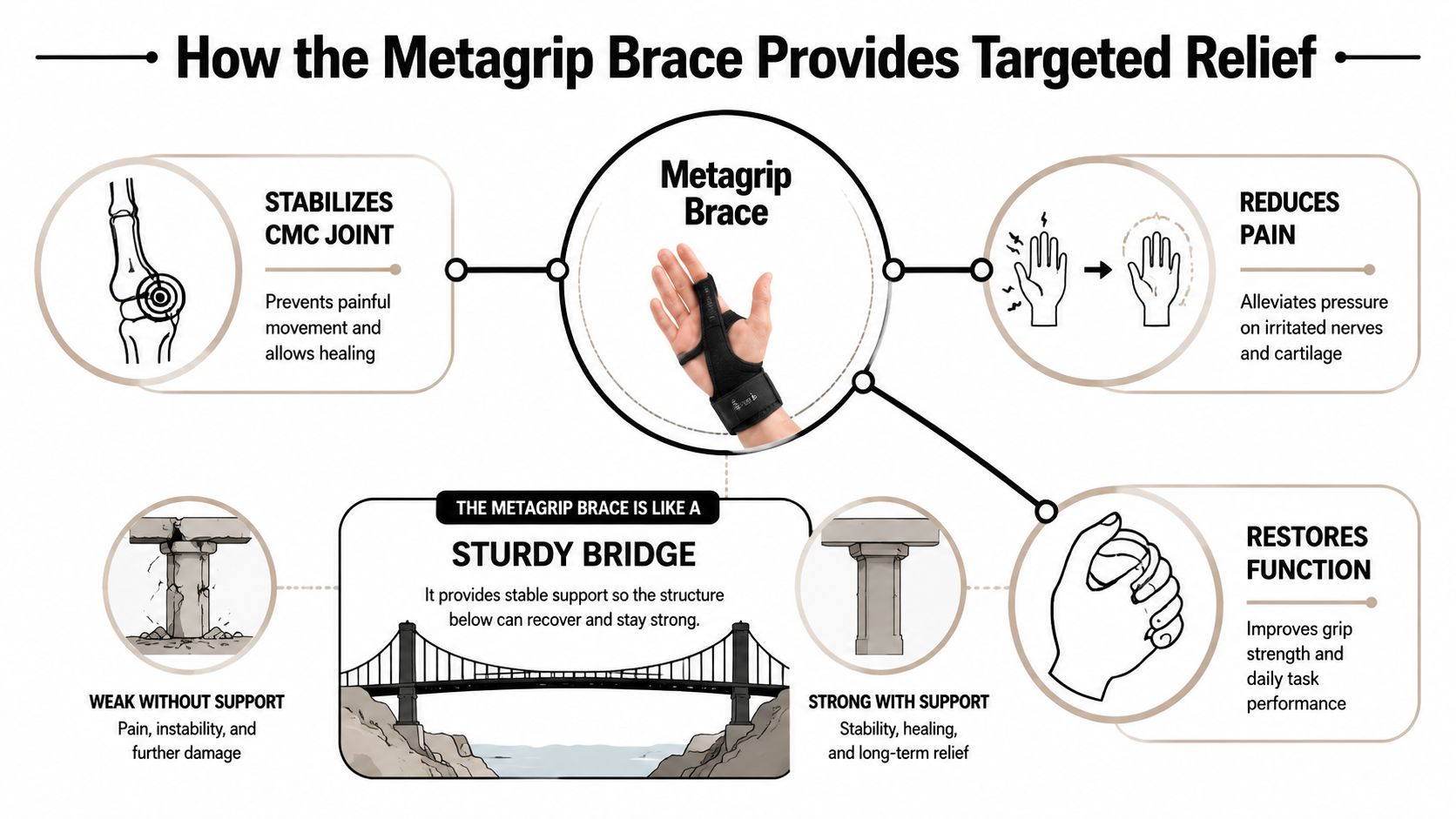
What makes this brace different is that its support is focused. The stabilizing mechanism is engineered to limit dorsal translation and palmar abduction at the CMC joint, which are the motions linked with painful instability in thumb osteoarthritis, while still preserving functional pinch and grasp because it avoids immobilizing adjacent joints, as described in the Push white paper on the stabilizing mechanism.
Why targeted support matters
A lot of generic braces miss the mark in one of two ways. They either don't control the painful motion enough, or they control so much of the hand that normal use becomes difficult.
The MetaGrip aims for the middle ground. It supports the thumb base where people with CMC irritation often feel unstable, but it doesn't wrap the whole hand in a way that shuts down every useful movement.
Here's what that means in practice:
- Pinch is less threatened. You may still be able to button clothing, hold a pen, or pick up small objects.
- Grip stays more functional. Tasks like carrying a bag or holding a pan handle may feel more manageable.
- Finger motion remains freer. That matters if you type, cook, fold laundry, or do repetitive home tasks.
What the brace can and can't do
The brace can reduce stress on a painful joint during activity. It can improve confidence with movement. It can help some tasks feel possible again.
What it can't do is fix every cause of thumb pain on its own. If your thumb mechanics are poor, your surrounding muscles are underperforming, or your activity habits keep provoking flare-ups, the brace works best as part of a broader plan.
A brace should make activity smarter. It shouldn't become a substitute for restoring useful movement and hand control.
Signs the support is working
A brace is usually helping when you notice patterns like these:
- Less pain during specific tasks such as opening containers or gripping larger objects
- Less hesitation when using the hand in routine activities
- Better tolerance for repetitive use before symptoms start building
- Less end-of-day aggravation after hand-heavy tasks
If you put on a brace and your fingers feel trapped, your skin gets irritated quickly, or you still feel the same painful shift at the base of the thumb during every task, something needs adjusting. Sometimes the issue is fit. Sometimes it's the wrong brace for the problem. Sometimes the joint needs more than external support.
Is the Metagrip Brace Right for Your Thumb Pain
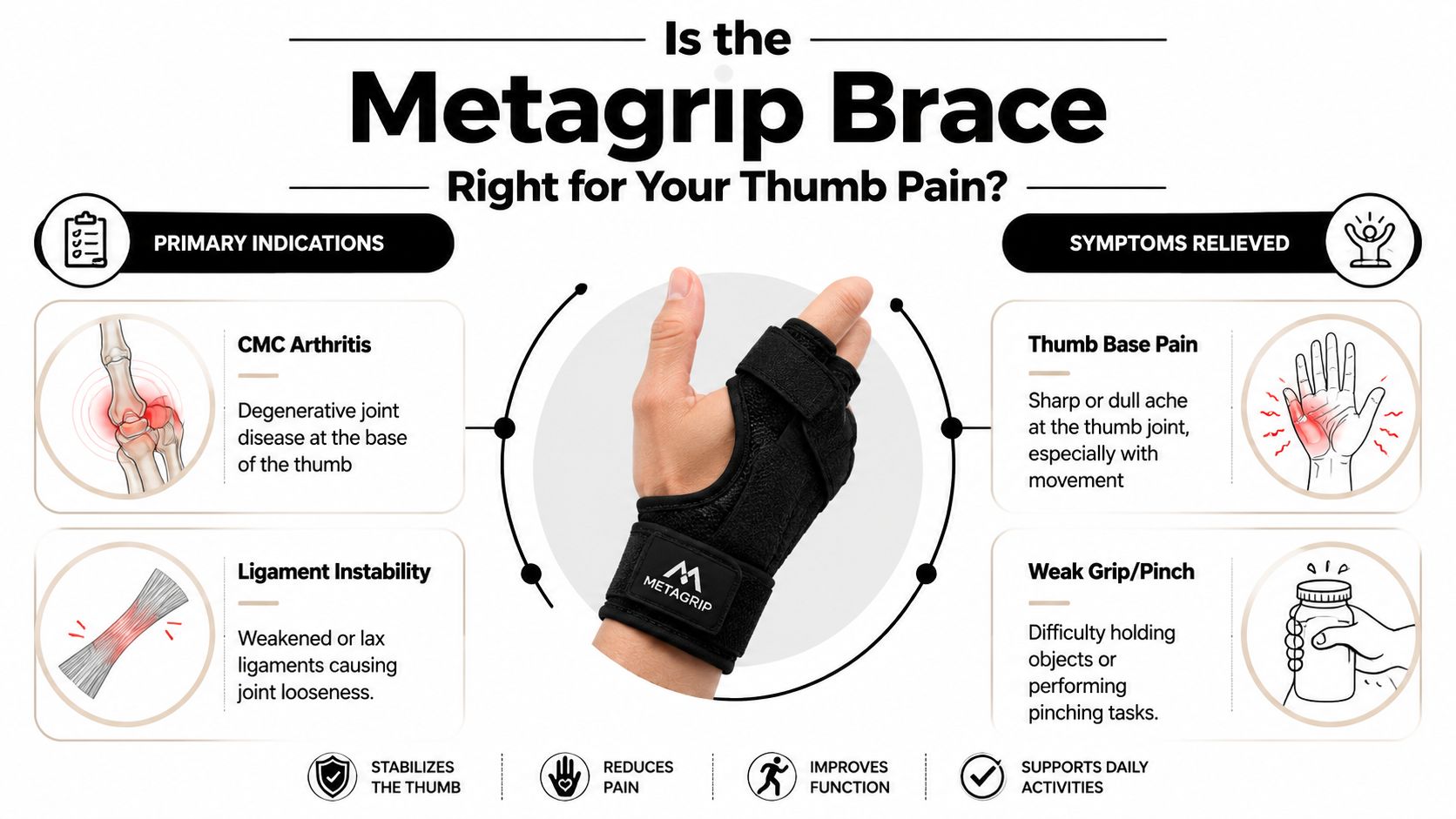
Not every sore thumb needs a MetaGrip. The brace makes the most sense when the problem is centered at the base of the thumb, especially when gripping, pinching, twisting, or repetitive use stirs symptoms up.
It's commonly considered for people dealing with thumb CMC arthritis, rheumatoid-related thumb pain, or hypermobility-related thumb symptoms. It's also positioned as a task-specific orthosis, meaning it's intended to be worn during pain-provoking activities rather than continuously, reflecting a modern approach that balances support with mobility for everyday use, as noted in this instructional overview of the Push MetaGrip.
Clues that point toward the right use case
You may be a good candidate for this type of brace if you notice:
- Pain at the thumb base more than in the tip or middle joint
- Trouble with pinch tasks like keys, zippers, lids, or turning knobs
- A sense of weakness when carrying, gripping, or twisting
- Symptoms that rise with activity more than symptoms that bother you only at rest
If your pain is mostly numbness, tingling, or wrist-based, a different issue may be driving the problem.
How it compares with other common thumb supports
| Support type | Best use | Main advantage | Main trade-off |
|---|---|---|---|
| Soft neoprene sleeve | Mild comfort needs, warmth, light reminder support | Feels soft and easy to wear | Usually offers minimal mechanical control |
| Rigid thumb spica splint | Short-term rest when the thumb needs stronger unloading | More immobilization | Can feel bulky and interfere with daily hand use |
| Push MetaGrip | Painful tasks that need support without shutting down the hand | Targets the thumb base while keeping more function | Must fit well and isn't ideal if you need full rest |
Many people get confused. A soft sleeve can feel nice, but comfort alone doesn't always change the painful mechanics of the joint. A rigid spica splint can calm things down, but it often makes ordinary hand use clumsy.
The MetaGrip sits between those options. It's often the better choice when the goal is to stay active with less pain, not to fully immobilize the thumb.
When a professional hand assessment helps
If you aren't sure whether your pain is coming from the thumb base, tendon irritation, nerve involvement, or another hand condition, getting evaluated saves time. A focused exam can sort out what movement pattern is provoking symptoms and whether a brace is likely to help. For readers who want a better understanding of conservative care for hand problems, MedAmerica also offers helpful information on hand physical therapy services.
Proper Fitting and Care for Your Metagrip Brace
A good brace in the wrong size can disappoint you fast. If the fit is off, the brace may not control the joint well enough, or it may press in the wrong spots and become annoying to wear.
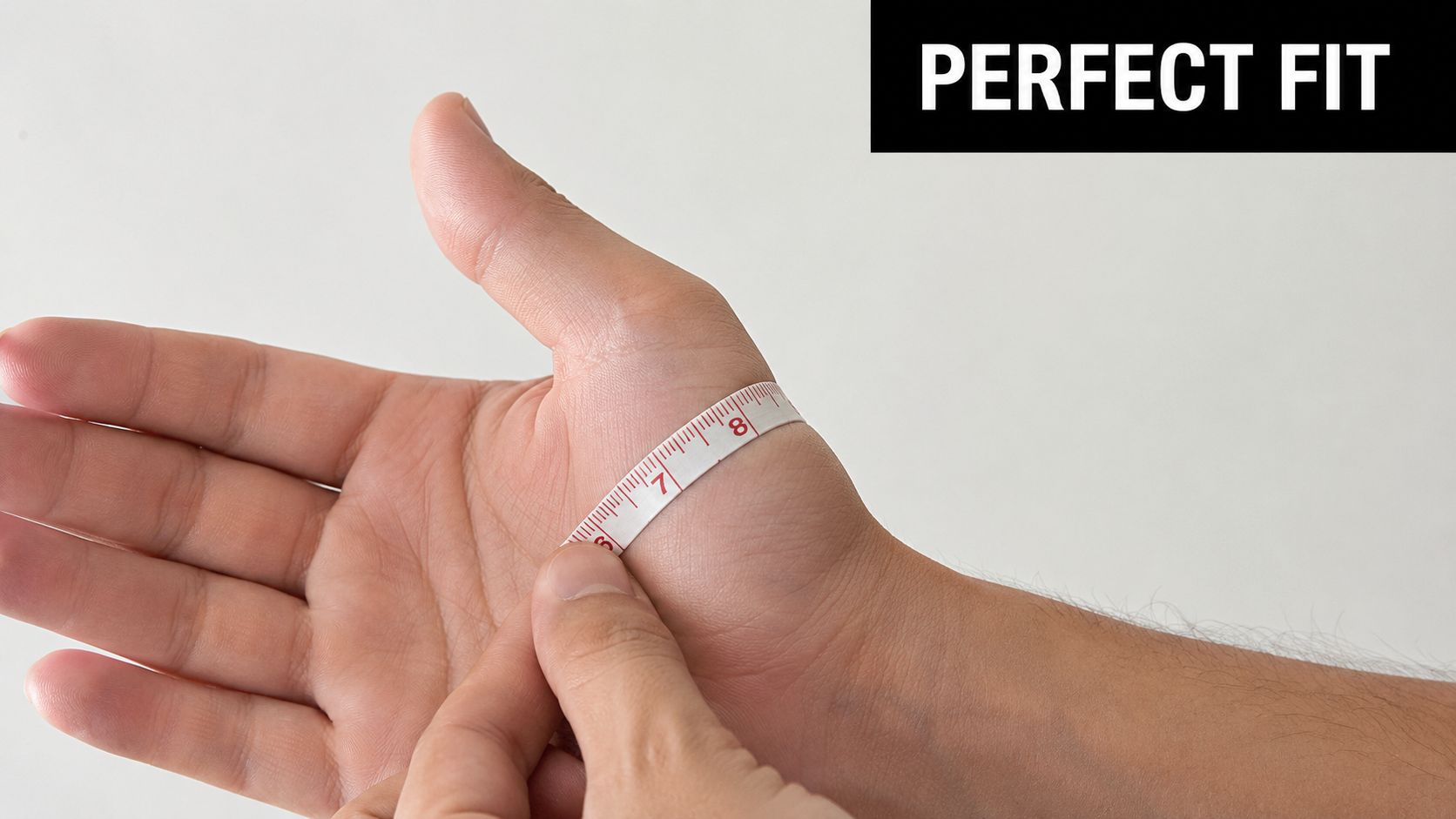
Sizing is critical for the MetaGrip's performance. It's selected by measuring hand circumference across the base of the metacarpals, and an incorrect size can fail to control motion or create pressure points during load-bearing tasks, as described in the University of Colorado handout on the MetaGrip brace.
How to measure and fit it well
Start with the basics. Measure around the hand at the base of the metacarpals, not around the wrist and not around the thumb itself. That measurement guides the size choice.
Then use this fitting checklist:
- Place the brace at the thumb base. The support should sit where the painful joint needs control, not drift too far toward the wrist.
- Secure the strap firmly. Snug is the goal. Loose won't stabilize enough, but over-tightening can create pressure and skin irritation.
- Move the fingers. You should still be able to use the fingers and do light functional movements.
- Test one real task. Try holding a mug, gripping a handle, or simulating a daily activity that usually bothers you.
- Check the skin afterward. Mild temporary marking can happen with a snug brace, but strong pressure spots or lingering irritation are a sign to recheck fit.
What a proper fit feels like
A well-fitted brace usually feels supportive rather than restrictive. The painful joint should feel guided. The hand shouldn't feel trapped.
Use these quick rules:
- Good sign: The thumb base feels steadier during a task.
- Bad sign: The brace slides around when you grip.
- Good sign: Fingers can still move naturally.
- Bad sign: You feel pinching at the skin or edges.
- Good sign: You're more willing to use the hand.
- Bad sign: You want to remove the brace immediately.
If swelling fluctuates or your hand shape makes fit tricky, a therapist can help fine-tune placement and tension. Some people need only a small adjustment to make the brace go from irritating to very usable. If you're also using icing as part of a symptom-management routine, these tips on physical therapy cold packs can help you use cold more comfortably and purposefully.
Here's a helpful visual for fitting and use:
Basic care that helps the brace last
Keep care simple and consistent.
- Wipe it down regularly if you're wearing it during chores, workouts, or warm weather
- Check the strap and edges for wear that changes how it fits
- Store it where it keeps its shape, not crushed into a bag or drawer
- Reassess fit over time if pain changes, swelling changes, or the brace starts feeling different
What works best: People tend to do better when they treat fitting as part of the therapy, not as an afterthought.
Simple Exercises to Complement Your Brace
A brace protects the joint during aggravating tasks. Exercises help the rest of the hand do its job better. Both matter.
When I guide patients through thumb rehab, I keep the exercise plan simple at first. If exercises are too aggressive, the thumb gets angry. If they're too timid, the hand never regains useful control. The sweet spot is gentle movement with good form and no symptom spike that lingers.

Thumb opposition touch
This helps maintain coordination and comfortable range.
- Start position Sit with your forearm supported and hand relaxed.
- The motion Touch the tip of your thumb to the tip of each finger, one at a time.
- What to watch for Keep the movement smooth. Don't force a big stretch at the thumb base.
- What you should feel Gentle motion, not pinching pain.
Tendon glides for the fingers and hand
These keep the hand from getting stiff when you've been protecting the thumb.
- Open your hand fully.
- Move into a loose hook shape.
- Then make a gentle fist.
- Return to an open hand.
Do the sequence slowly. The goal is fluid movement, not squeezing hard.
Gentle isometric thumb press
This can help wake up support muscles without a lot of joint motion.
- Set up Hold your hand in a relaxed, neutral position.
- Action Press the thumb lightly into the side of the index finger or against a stable surface.
- Effort level Keep it mild. This should feel like a muscle activation, not a strain.
- Stop if You feel sharp joint pain or a catching sensation.
Small, controlled exercises done consistently usually work better than ambitious hand workouts that trigger a flare.
How to use the brace with exercise
The brace is generally more useful during pain-provoking tasks than during these light exercises. During gentle motion work, you want to feel the hand move naturally unless a clinician has told you otherwise.
A practical routine often looks like this:
- Use the brace during aggravating activities such as cooking prep, cleaning, or gripping tasks
- Take it off for gentle drills if movement is comfortable
- Pause if symptoms climb and give the joint time to settle
- Build gradually instead of testing the thumb over and over
If your hand feels sore after activity, broader recovery habits can help too. Some readers like to pair rehab with general strategies for easing post-activity discomfort, and Maximum Health Products for recovery offers one example of that kind of resource. If you want a simple home tool for progressive hand work, MedAmerica also has a useful guide to hand exercise putty.
Your Next Steps for Lasting Thumb Pain Relief
The MetaGrip thumb brace can be a very useful tool, but it works best when you see it for what it is. It's a support, not a cure by itself. The best outcomes usually come from matching the brace to the right problem, wearing it during the right tasks, and pairing it with smarter hand use and targeted exercise.
That's also why the wrong strategy can drag symptoms out. Some people wear a brace that's too soft and get little real support. Others immobilize the thumb too much and become stiff and hesitant. Others have nerve symptoms or tendon problems and assume it's all arthritis.
Red flags you shouldn't ignore
Thumb pain deserves professional attention sooner if you notice any of these:
- Numbness or tingling in the thumb or fingers
- Sudden severe swelling or a dramatic change in thumb shape
- Heat, redness, or signs of infection around the joint or skin
- Pain after a fall or direct injury that makes gripping impossible
- Locking, catching, or major weakness that is getting worse rather than better
Those symptoms can point to something more than routine thumb base irritation. They need a proper exam.
Build a plan that matches real life
A useful plan should account for how you use your hands. A retiree who gardens needs something different from an office worker who types all day. A parent lifting a child has different demands than someone whose main issue shows up when cooking or cleaning.
That's why a practical thumb pain plan often includes:
- Activity modification so you stop feeding the flare-up
- A well-fitted brace for tasks that typically provoke pain
- Hand-specific exercises to maintain motion and improve control
- Hands-on care or supervised rehab if the problem keeps returning
Some people also explore additional comfort-focused products at home while they're building better habits. If you like having options, shop natural wellness for pain can be one more resource to browse alongside evidence-based care.
Relief usually comes from a series of good decisions done consistently, not from one perfect product.
If your thumb pain is limiting daily activities, don't wait for the hand to “work itself out.” A clear diagnosis and a personalized treatment plan can save a lot of frustration.
If thumb pain is interfering with cooking, driving, work, hobbies, or sleep, MedAmerica Rehab Center can help you figure out what's causing it and what to do next. Our Deerfield Beach team provides individualized care that may include movement assessment, hands-on treatment, exercise guidance, and practical support recommendations so you can get back to using your hand with more comfort and confidence.
MedAmerica Rehab · Deerfield Beach
Talk to a clinician about your pain
Physical therapy, chiropractic, acupuncture and shockwave therapy under one roof, since 1995. Same-day appointments are available.
Mon–Thu 8:00 AM – 6:30 PM · Fri 8:00 AM – 3:00 PM