
Injury Prevention Workout: Proven Principles
A structured injury prevention workout can reduce overall sports injury risk by about 37% to 40%, and strength training cut risk by roughly 68.5% versus control groups in a major 2014 meta-analysis. That sounds like an athlete's problem, but the same principle matters for adults dealing with pain, stiffness, recovery, or deconditioning.
A common assumption is that injury prevention means a few stretches before activity. In practice, the programs that change outcomes are the ones that build strength, control, and tolerance to load, especially when your body already has a weak link.
Why an Injury Prevention Workout Matters
A woman with knee pain doesn't need another vague reminder to “stretch more.” She needs a plan that helps her stand from a chair, climb stairs, and walk without provoking symptoms. That is where a real injury prevention workout earns its value, because it targets the movement patterns that break down under stress rather than assuming flexibility alone will solve the problem.
The evidence backs that up. A major 2014 meta-analysis in the British Journal of Sports Medicine found that exercise-based injury-prevention programs reduced overall sports injury risk by about 37% to 40%, with a pooled relative risk of 0.632. In the same review, strength training showed one of the strongest effects, with a relative risk of 0.315, meaning risk dropped by roughly 68.5% compared with control groups. The same review also found that stretching alone didn't meaningfully prevent injury, with a relative risk of 0.963. British Journal of Sports Medicine meta-analysis
That difference matters for more than athletes. Seniors worried about falls, workers with repetitive strain, and adults recovering from pain often get generic advice that doesn't match their real limitation. A program built around resistance, neuromuscular control, and balance is a different tool entirely.
Practical rule: if the routine only feels easy and never asks your muscles, joints, or nervous system to adapt, it's probably too small to change injury risk.
For readers who've been told to “just keep moving,” the question is whether the movement is specific enough to protect the tissues that keep failing. That's why condition-aware programming belongs at the center of prevention, not as a specialist add-on.
What the Evidence Actually Shows
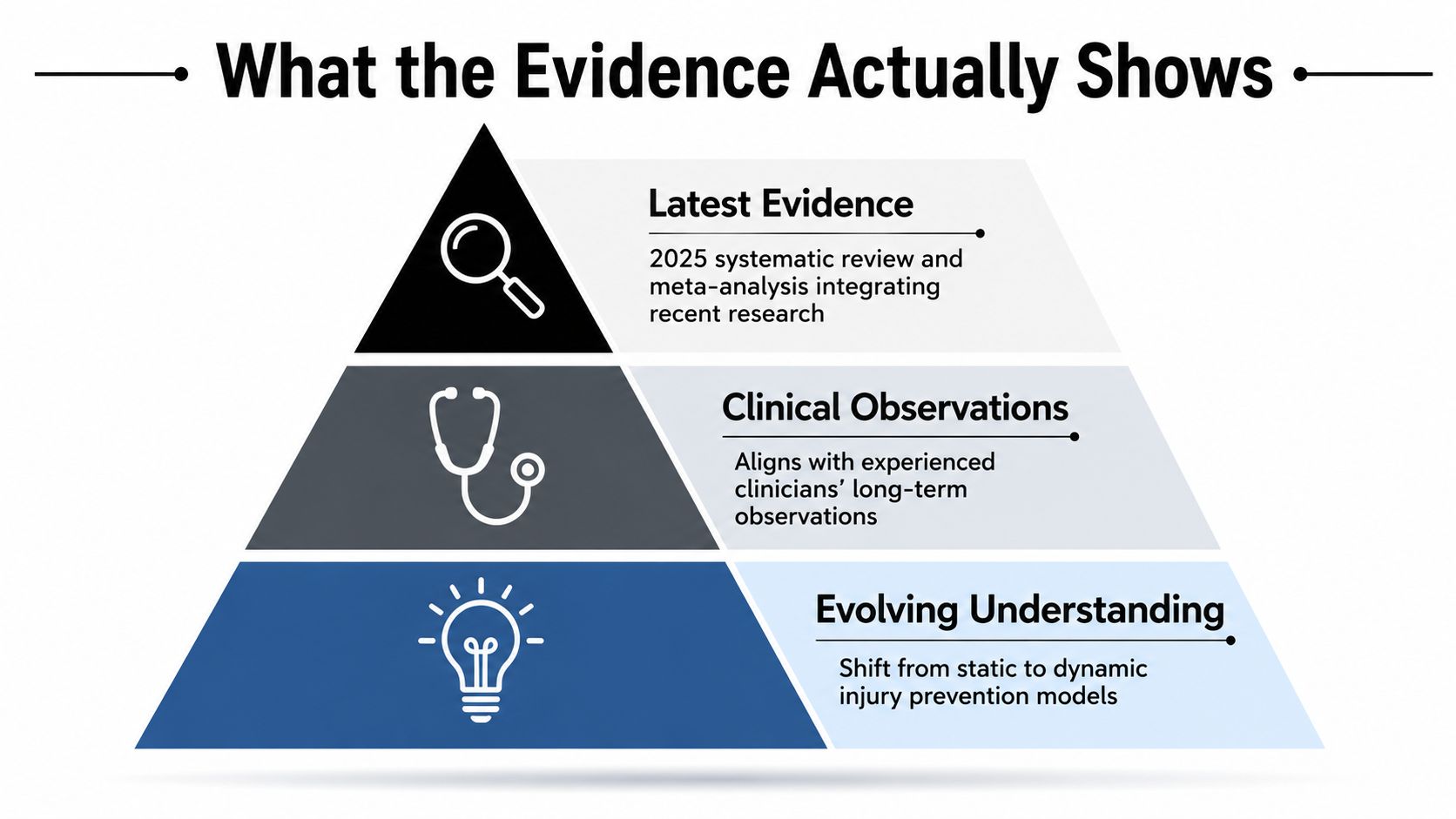
The latest research reinforces a pattern experienced clinicians have seen for years. Strength-based prevention programs help, but the size of the benefit depends on what you combine them with and how well people do them.
A 2025 systematic review and meta-analysis focused on strength-based injury-prevention programs found a pooled relative risk of 0.70, which translates to a 30% reduction in sports injuries overall. It also reported lower risk for specific injury types, including groin, hamstring, knee, and ankle injuries, which tells you the benefit isn't limited to one tissue or one sport. 2025 strength-based meta-analysis
What that means in real life
The strongest programs aren't random circuits. They usually combine strength, balance, and movement control, because a body that can't control load well is more likely to fail when daily activity speeds up or gets awkward. Static stretching, by itself, doesn't build that protection.
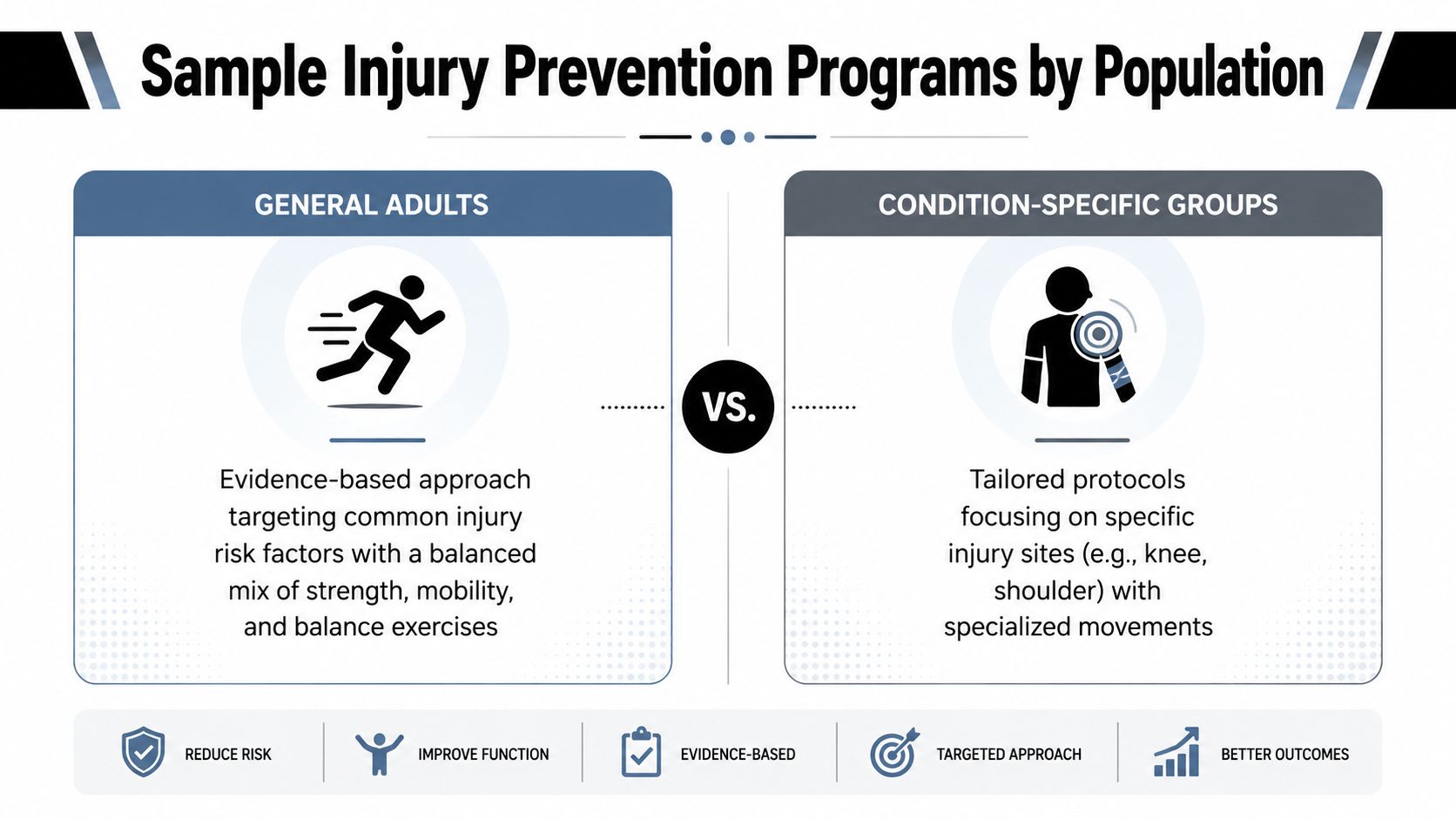
The evidence also supports a more individualized view. For adults with arthritis, old surgical repairs, back pain, or a history of recurring strain, a generic routine can miss the actual driver of symptoms. A program that respects the affected joint, the current capacity, and the movement fault is more useful than a one-size-fits-all plan.
A useful way to filter any online plan is simple:
- Does it progress load? If the exercises never get harder, the body never has a reason to adapt.
- Does it include balance or control? If not, it's missing a major protective ingredient.
- Does it match the joint or tissue at risk? A knee plan should look different from a shoulder plan.
For a practical digital workflow, a coach or clinician building routines for different bodies can organize those variables with a workout program builder for coaches. For patients doing home exercise, the logic is the same, the plan has to fit the person, not the other way around.
The Four Core Components of an Effective Program
An effective injury prevention workout isn't a grab bag of wellness exercises. It's a system that teaches the body to absorb force, control position, and recover from awkward loading without falling apart.
Strength gives the body more margin
Strength training is the anchor. It doesn't require a gym membership or heavy barbells, either. Controlled squats, single-leg bridges, step-downs, and similar bodyweight drills can build meaningful capacity when the form stays clean and the load progresses over time.
Balance and proprioception sharpen corrections
Balance work trains the nervous system to notice where a joint is and react before the movement turns sloppy. Single-leg stands, heel-to-toe walking, and paused lunges all make the body practice stability in a way that casual movement doesn't. That's especially relevant after ankle sprains, knee pain, or any episode where confidence in the leg has dropped.
Mobility should be dynamic, not passive
Static stretching on its own has limited preventive value, so mobility work needs to prepare the exact motion you're about to ask for. Hip circles, ankle alphabet drills, and thoracic rotations are useful because they involve control, not just length. They're best treated as a prep tool, not the whole program.
Eccentric loading builds tissue tolerance
Slow lowering phases matter. Eccentric work, where the muscle lengthens under tension, is useful for hamstrings, calves, and tendon resilience. That can mean slow step-downs, controlled descent in squats, or progressions toward Nordic curl negatives.
A good program leaves you challenged, not wrecked. If the technique falls apart under mild fatigue, the dose is too high or the movement is too advanced.
A simple weekly structure is often enough to start, but not every reader can build that alone. Patients who need a more guided setup can use the core strengthening exercises guide to see how foundational trunk work supports the rest of the body, especially when back symptoms are part of the problem. For adults who want a therapist-led option, MedAmerica Rehab Center also uses individualized exercise plans as part of its care model.
Sample Injury Prevention Programs by Population
A smart prevention plan looks different for a runner, a retiree worried about balance, a post-op patient, and a warehouse worker. The shared principle is the same, but the exercise menu has to match the job the body is trying to do.
General adults and active people
For active adults, the emphasis should be on movement quality under load. A useful session can start with a brief dynamic warm-up, then move into single-leg RDLs, split squats, lateral band walks, and Nordic curl negatives. That mix covers lower-body strength, control, and hamstring resilience.
If you want a gentle off-day mobility complement, a gentle yoga sequence can fit well on recovery days, as long as it doesn't replace the loading work that changes tissue tolerance. The goal isn't to “stretch the problem away,” it's to move well enough to keep training or working without flare-ups.
Seniors and people worried about falls
For older adults, the priorities shift. Sit-to-stand practice, supported single-leg stands, heel raises, and tandem walking can build the balance and lower-body strength that matter for daily safety. A more detailed home routine is laid out in this fall prevention exercises for seniors resource, which aligns well with the same balance-first logic.
Post-operative patients
After surgery, the plan has to follow the surgeon or therapist's restrictions. Early-phase work often includes quad sets, glute bridges, straight-leg raises, and mini-squats to a chair within pain-free limits. The mistake here is trying to rush into “normal” exercise before the tissue is ready.
Workers with physical jobs
People who lift, bend, reach, or carry all day need trunk and shoulder control. Bird dogs, dead bugs, hip hinge drills, and prone Y-T-W raises can help support the back and upper quarter before and after a shift. These movements are simple, but they train positions that show up constantly in real work.
For patients who also use a gentle home recovery routine, the same logic applies, and a simple sequence like The Sleep Consultant yoga guide can be an add-on for relaxation rather than a replacement for strengthening.
How to Implement and Track Your Program
The exercise list matters, but adherence matters more. A prevention plan that looks perfect on paper won't do much if it's skipped, watered down, or done without enough supervision to keep form honest.
A meta-analysis of 44 studies found that supervised injury-prevention programs reduced injury risk by 29%, while unsupervised programs offered no clear direct benefit. Another adherence-focused review found that the highest-adherence groups had a 47% lower injury rate, middle adherence still produced about a 50% reduction, and low adherence only showed a 13% nonsignificant reduction. Supervision and adherence review
Simple tracking keeps the work real
The easiest fix is often the most boring one. Put the sessions on a calendar, check them off, and increase difficulty only when your technique stays stable under mild fatigue. That prevents the common failure mode, which is under-dosing.
A practical benchmark from the literature is 2 to 4 supervised sessions per week, and balance-oriented protocols are often tested as 8 weeks of two 45-minute sessions weekly. That doesn't mean everyone needs that exact schedule, but it does show that prevention takes repeated exposure, not a one-time warm-up.
| Program Type | Adherence Level | Risk Reduction | Key Takeaway |
|---|---|---|---|
| Supervised programs | High | 47% lower injury rate | Consistency and oversight matter |
| Supervised programs | Middle | 50% lower injury rate | Moderate follow-through still helps |
| Supervised programs | Low | 13% nonsignificant reduction | Too little participation weakens the effect |
| Unsupervised programs | Varied | No clear direct benefit | Structure alone isn't enough |
What to watch during the first month
A program is probably too hard if you're missing sessions, getting sore in a way that changes your gait, or losing control on the same movement every time. That's when a clinician or therapist should adjust the dose instead of asking you to push through.
A useful tracking tool for outcome-based care is the outcome measure resource, because it keeps the focus on function rather than just effort. The point is to see whether the body is tolerating life better, not whether you felt productive during the workout.
When to Seek Professional Care
An injury prevention workout is useful when the body is ready for training. It's not a substitute for evaluation when symptoms are already speaking up.
If you're dealing with persistent pain that doesn't settle with rest, a joint that gives way, symptoms that return after a brief improvement, or movements like standing from a chair and climbing stairs that now need compensation, a generic routine may be the wrong tool. Numbness, tingling, or weakness that radiates beyond the main pain site also deserves prompt attention.
That's especially true for adults with arthritis, sciatica, or recovery after surgery. Condition-specific care often works better than one-size-fits-all exercise because it matches the current limitation instead of assuming the same movement plan fits everyone. MedAmerica Rehab Center has provided patient-centered physical therapy, chiropractic care, acupuncture, and advanced shockwave therapy since 1995, and its multidisciplinary team builds individualized plans for back and neck pain, knee and shoulder injuries, arthritis, and recovery after auto or workers' compensation injuries.
If the routine keeps irritating the same joint, it's time to change the plan, not just push harder.
When the path forward isn't clear, an evaluation can save weeks of guessing. A licensed therapist can decide whether you need strengthening, mobility work, balance training, or a staged return to activity, and that's often the difference between a routine that protects you and one that keeps you stuck.
If your pain, balance, or recovery goals make a generic routine feel like a gamble, visit MedAmerica Rehab Center for individualized care that combines hands-on treatment with targeted exercise. Their team can help you build an injury prevention workout that fits your current condition, your daily demands, and your next step back to normal movement.
MedAmerica Rehab · Deerfield Beach
Talk to a clinician about your pain
Physical therapy, chiropractic, acupuncture and shockwave therapy under one roof, since 1995. Same-day appointments are available.
Mon–Thu 8:00 AM – 6:30 PM · Fri 8:00 AM – 3:00 PM