
Cando Resistance Bands: Rehab & Recovery Guide 2026
You've probably got a band in your hand already, a printed home program beside you, and one big question in your head, am I using this the right way or just going through the motions? That's the practical value of CanDo resistance bands in rehab, they're simple enough to use at home, but they're also specific enough to guide real progression when the setup, angle, and resistance are chosen well.
Why Cando Resistance Bands Are a Rehab Staple
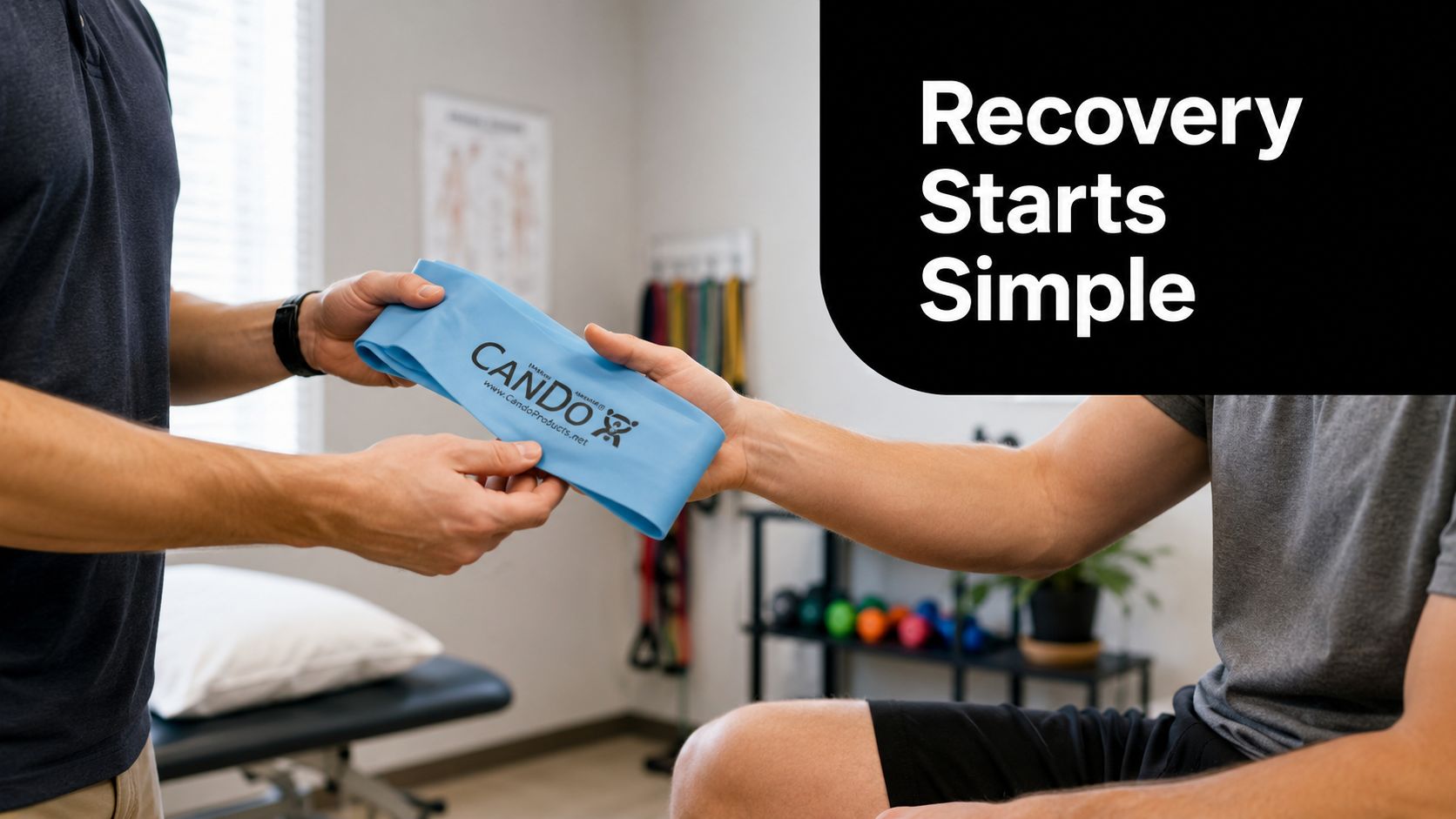
A patient gets discharged after shoulder surgery or a knee flare-up and leaves with a band, a sheet of exercises, and the hope that home work won't set them back. That's where CanDo resistance bands fit in well. They're not a trendy fitness accessory, they're a long-running rehab tool that physical therapists, athletic trainers, and the general public have used since the 1980s, with CanDo latex resistance bands specifically showing up in clinics and fitness programs since 1987 (FEI Retail).
Why that history matters in practice
The brand's staying power says something important. CanDo didn't arrive after resistance bands were already a mainstream home-fitness craze, it entered the market during the period when elastic resistance was moving from a niche rehab tool into standard clinical use. That matters because rehab products survive in clinics when they're practical, reproducible, and easy to teach. CanDo became associated with that workflow early, and it still is.
The bigger story is the evolution of the category itself. Elastic resistance had already been explored in the 1890s, appeared in strength equipment by 1901, returned to structured rehabilitation in the 1960s, and became more standardized in 1978 when therapists repurposed a dental dam into the first flat resistance band. That history helps explain why today's bands feel so clinically familiar. They're the product of a long rehab lineage, not a novelty item (Physical Culture Study).
Practical rule: A rehab band should make progression easy to see and easy to repeat. CanDo's color ladder does that better than random no-name tubing.
For clinicians and patients, the color coding matters because it removes guesswork. A yellow band means one thing, a red or blue band means another, and that shared language makes home programs easier to prescribe and monitor. That's why CanDo resistance bands keep showing up in orthopedics, outpatient therapy, and home exercise plans. They're familiar, scalable, and easy to progress without bringing in bulky equipment.
Understanding the Color-Coded Resistance System
A therapist choosing a CanDo band is not just picking a color, they are deciding how much load the patient will feel at a given setup. CanDo's system uses a fixed 5-inch width with an 8-step color progression, tan, yellow, red, green, blue, black, silver, and gold, and it is sold in 6-yard pre-cut lengths and 50-yard cut-to-size rolls (Vitality Medical). That matters in rehab because the same material can behave very differently once you change the working length, the anchor point, or the amount of stretch built into the exercise.
How to read the band, not just the color
The common mistake is to treat color as the full prescription. In clinic, the better question is how much band is in play. A shorter working length usually increases resistance, while a longer working length reduces it, so the therapist can adjust the dose without changing the exercise itself.
That is one reason the format matters. A 50-yard roll gives a therapist room to cut custom lengths for different body sizes, different stations, or a staged progression from visit to visit. A 6-yard pre-cut band is easier for home use or for a patient who needs a repeatable setup without a lot of adjustment.
Here is the resistance framework that shows why color alone can mislead:
| Band Color | Resistance at 100% Elongation | Resistance at 200% Elongation | Typical Use Case |
|---|---|---|---|
| Yellow | 3 lb | 7.5 lb | Early rehab, low-load activation |
| Black | 7 lb | 17.5 lb | Higher-load strengthening, later progression |
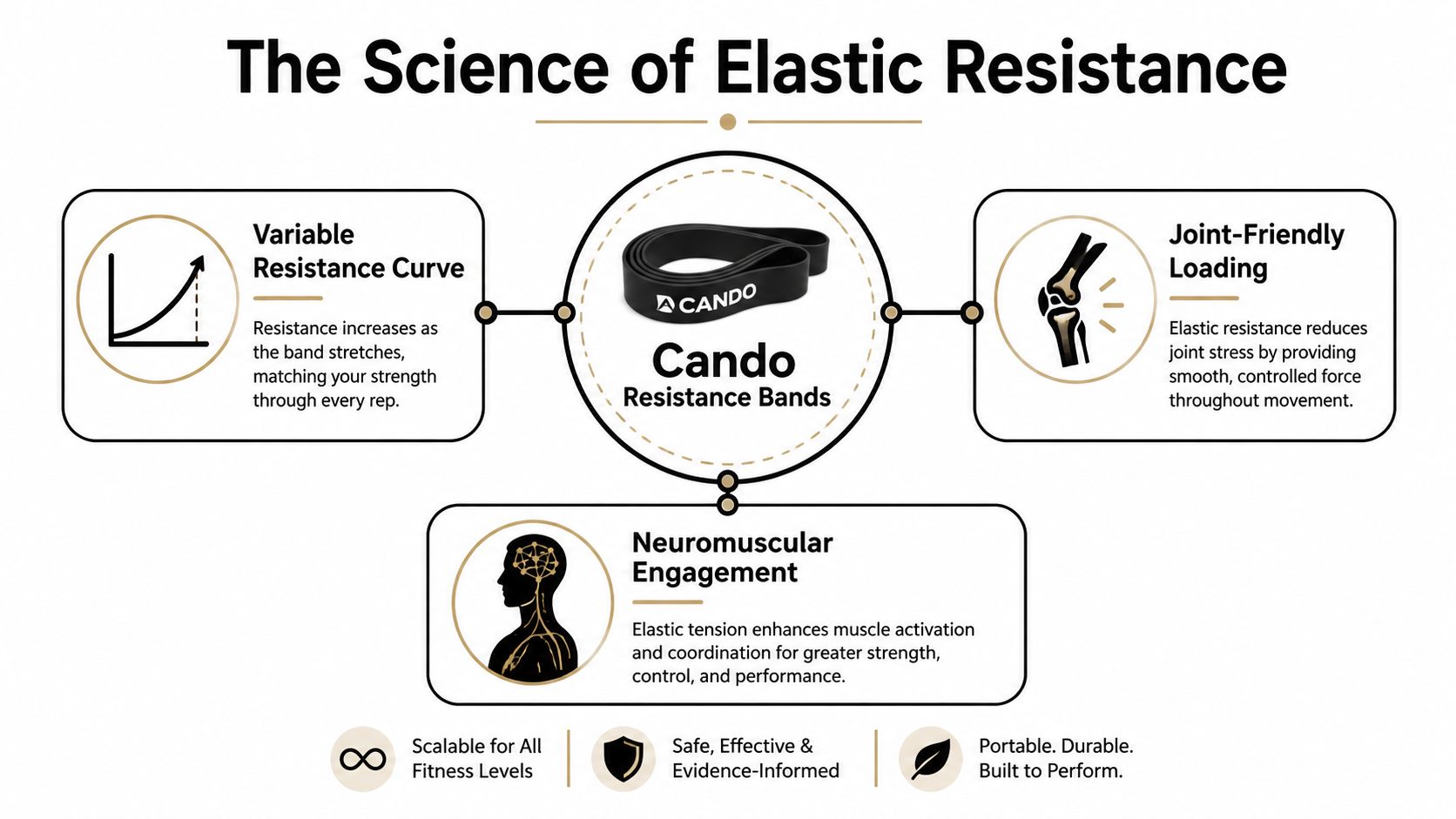
The load does not increase in a straight line, it rises as the band stretches (Orthout). A patient can keep the same band and still create a much harder exercise by stretching farther or changing the start position.
Latex and latex-free choices
CanDo also offers latex and synthetic latex-free versions, and the latex-free formula is designed to mimic natural latex stretch characteristics (Vitality Medical). That choice matters in clinics and home programs where allergy history, skin sensitivity, or shared equipment come into play. Low-powder latex options can also reduce mess in a busy treatment area.
Anchor safety and material choice should be considered together. A band that stretches well is not helpful if the setup slips, twists, or snaps back because the anchor point is weak.
Clinical takeaway: Do not choose by color alone. Choose by color, working length, anchor setup, and material, because each one changes how the band behaves in the hand and on the patient. That is also part of how integrated care improves outcomes when home exercise needs to fit the patient's real setup.
Clinical Benefits of Elastic Resistance Training
Elastic resistance isn't a poor substitute for weights, it's a different loading tool. A band gives you variable resistance, so the farther it stretches, the more resistance the patient feels. In one CanDo loop specification, yellow rises from 3 lb at 100% elongation to 7.5 lb at 200%, and black rises from 7 lb to 17.5 lb over the same stretch range, showing a clear nonlinear load increase (Orthout). That makes the band especially useful when you want lighter loading early and higher challenge near end range.
Why that helps in rehab
The band's resistance curve fits clinical progression well. Early in recovery, patients often need a smaller entry load to reintroduce movement without overdoing it. As the movement becomes more controlled, the same exercise can become more demanding by stretching the band farther or shortening the setup. That's efficient for post-op recovery, tendon work, shoulder rehab, and general strengthening.
The other practical benefit is portability. Patients can use the same tool at home, in a clinic gym, or while traveling. That improves adherence because the program doesn't depend on a rack, a dumbbell set, or a machine. It's also easier to teach a patient how to perform the same movement with the same band across visits.
Why angle and load matter together
Elastic bands work best when the clinician uses them to shape the movement, not just to add resistance. A shoulder exercise done with a band at one angle can feel very different from the same movement done with a different anchor height or body position. That's useful when the goal is to protect a joint early and challenge it later.
For readers who want a broader framework for recovery and behavior change, how integrated care improves outcomes is a useful lens because rehab rarely succeeds on exercise alone. Pain, confidence, sleep, and daily routines all influence whether a band program gets done.
Practical rule: If a patient can only progress by grabbing a heavier band, the program is too limited. A better plan also changes stretch length, angle, and exercise complexity.
The upside of CanDo resistance bands is that they let therapists fine-tune those variables without changing the entire exercise system. That's why they work so well in rehabilitation, they're adaptable enough for progression, but simple enough for patients to use correctly.
Common Rehabilitation Exercises and Progressions
A patient with shoulder pain, a weak hip, or an unstable ankle does not need a random band drill. They need the right movement, the right anchor, and the right angle so the exercise matches the tissue tolerance in front of them.
Shoulder external rotation and angle selection
Shoulder external rotation is one of the clearest examples of why setup matters. Recent evidence shows that shoulder abduction angle and elastic band resistance change muscle activation, with early-stage external rotation at 0 degrees abduction supporting safer supraspinatus activity and later progression to higher abduction angles increasing demand on the supraspinatus, upper trapezius, and serratus anterior (PMC). That level of control matters because the same exercise can be either gentle or overloaded depending on where the band is anchored and how the arm is positioned.
In clinic, I usually start with the elbow tucked and the upper arm close to the body when a shoulder is irritable or still rebuilding control. That position keeps the task simpler and reduces compensation. As motion and tolerance improve, higher angles can be added, but only if the patient can keep the shoulder quiet and the trunk from helping.
Hip, knee, and ankle work
Hip abduction should be done with the pelvis still, because once the trunk starts drifting, the band stops training the hip the way you intended. Knee extension needs a stable anchor and a controlled return so the patient does not let the band snap the leg back into place. Ankle work is often overlooked, yet small movements around the foot and lower leg reveal whether the patient has control or is just moving through the range.
For patients working on motion after stiffness or pain, range of motion exercises often belong before heavier band loading. If the joint cannot move cleanly, the band will usually magnify the fault instead of fixing it.
Useful progression rule: Change one variable at a time, either band color, stretch length, or exercise angle. If all three change at once, it becomes hard to tell what helped and what irritated the joint.
That same cautious approach matters in people returning to safe post-cardiac event workouts. The goal is not to add resistance just because the patient can tolerate it for a few reps. The goal is to keep the work controlled enough that breathing, posture, and symptoms stay within the plan.
A simple progression framework
- Start with position control. Use the angle that allows clean motion without shrugging, twisting, or trunk sway.
- Increase working length carefully. A small change in stretch can raise the load more than patients expect.
- Advance to the next color only when form stays steady. If the wrist, shoulder, hip, or trunk starts substituting, the band is too hard or the setup needs to change.
The practical takeaway is simple. CanDo resistance bands work best when the exercise is chosen for the joint, the anchor is stable, and the angle is progressed on purpose rather than by guesswork.
Safety Precautions and Proper Home Setup
A lot of home band problems start before the first rep. A patient loops a band around a chair leg, a towel rack, or a doorknob, then wonders why the line of pull feels unstable. That kind of setup changes the exercise and can create a fall or recoil risk.
Anchor choice is not optional
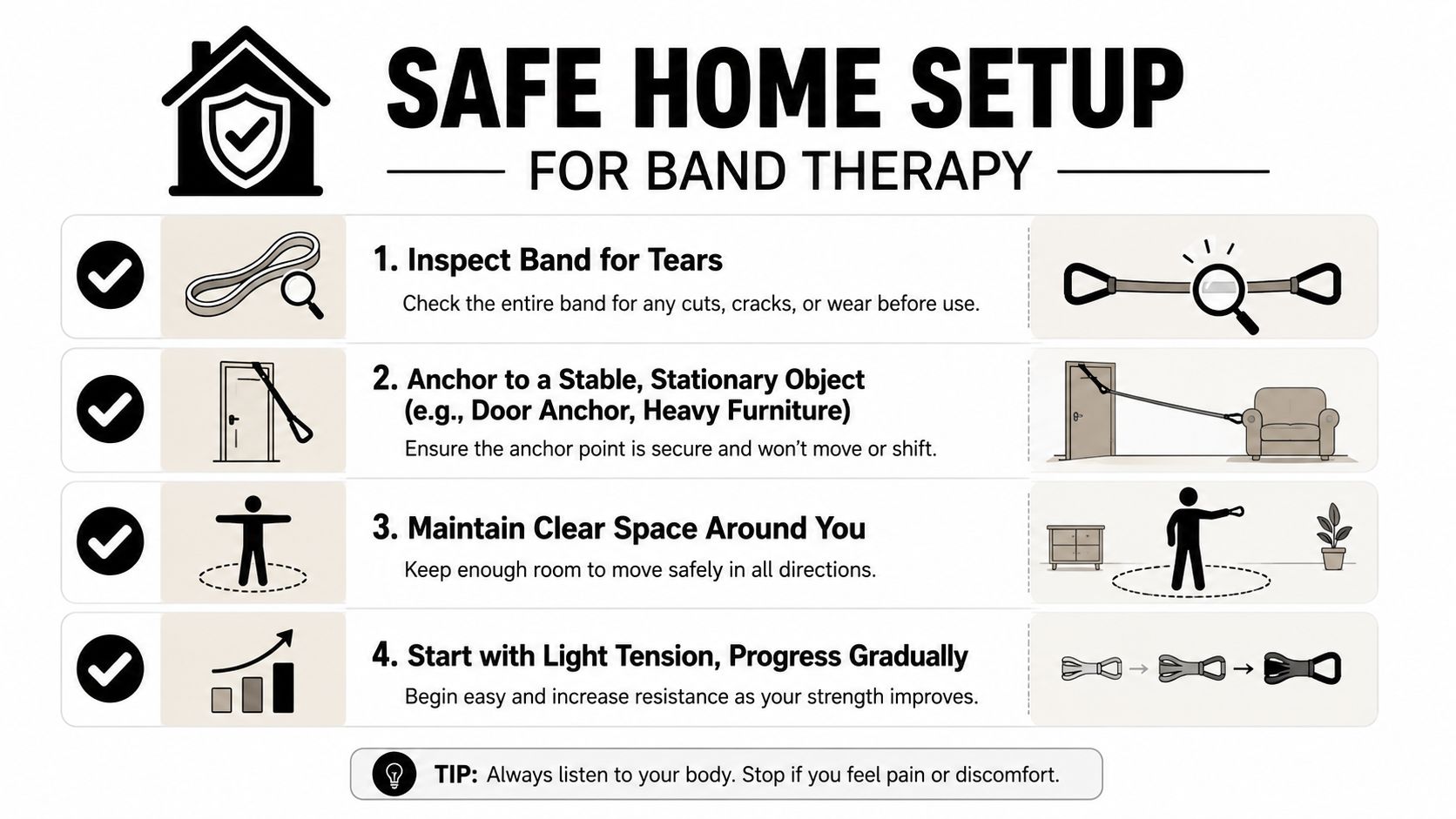
Neutral fitness guidance warns that chairs, towel racks, and doorknobs can move or fail as anchor points, and recommends fixed anchors such as hinge-side doors, racks, columns, or heavy furniture bases (Reshape App). That advice carries over directly to rehab. A moving anchor makes resistance inconsistent, and inconsistent resistance is a problem when someone is trying to regain joint control after injury or surgery.
The safest home setup starts with something that will not shift under load. The band should be anchored to a stable object, the line of pull should be clear, and the patient should have enough space to step away without tripping or twisting awkwardly.
Inspect the band before every use
Wear matters. Look for thinning, sticky spots, surface cracks, or any section that feels uneven. A band that is starting to fail can snap under stretch, and snap-back is especially risky for people with reduced grip strength or slower reaction time.
Practical rule: If the anchor is questionable or the band looks tired, the exercise does not start. Replace the setup first.
Movement speed matters too. A controlled pull and return are safer than a sudden yank or a fast recoil. That matters for older adults, post-surgical patients, and anyone whose balance is not reliable yet. The goal is to train tissue, not to test luck.
A short home checklist
- Inspect the band first. Stop if you see wear, thinning, or damage.
- Use a stable anchor. Fixed objects beat unstable furniture every time.
- Clear the space. No loose rugs, clutter, or trip hazards near the setup.
- Start lighter than you think. Controlled motion matters more than brute force.
For people using a latex-free resistance band, the same setup rules still apply, and the material choice should match allergy concerns or clinic policy (latex-free resistance band). The safest CanDo resistance bands session is the one that feels boring in the best possible way, steady anchor, predictable pull, and no surprises.
How to Choose the Right Band for Your Recovery
A band choice should follow the exercise goal and the patient's current tolerance, not the other way around. A fresh post-op shoulder, a person rebuilding balance, and an athlete returning to sport all need different loading. The practical question is simple, how much resistance can the tissue handle, and at what angle does the movement stay clean?
Match the tool to the rehab goal
For early activation, a lighter color and a longer working length usually make the exercise easier to control. For later strengthening, a shorter setup or a stronger band can fit better because the same motion produces more tension. The choice between latex and latex-free still comes down to allergy concerns, clinic policy, or patient comfort, and the latex-free option is designed to give a similar stretch feel without natural rubber. If that matters for your patient, latex-free resistance band options are worth reviewing before you set up the home program.
The color system helps when the progression is clear. A patient can move from tan through gold without changing the exercise entirely, which makes it easier to judge whether the load is appropriate or whether the problem is the setup. Resistance can also change by altering the arm angle or the working length, so the color is only one part of the decision.
Pre-cut lengths versus rolls
A 6-yard pre-cut band is straightforward for home use and easy to send home after a visit. A 50-yard cut-to-size roll gives more control when the therapist wants custom lengths for different exercises or different body sizes. In clinic settings, rolls can also make it easier to keep the dosing consistent across patients while still adjusting the cut length for the task.
The decision usually comes down to how much control the program needs.
- Early rehab: lighter color, longer setup, fewer moving parts.
- Middle phase: keep the same exercise, then change the angle or increase stretch.
- Later phase: stronger band, shorter working length, more functional movement.
That progression matters because many home programs fail when the patient changes too many variables at once. If the band is harder, the angle shifts, and the anchor moves, it becomes difficult to tell what improved or irritated the tissue.
For patients with sensitivity or clinic sanitation concerns, latex-free choices can also be the safer fit when natural latex is not a good option. Material selection should match the patient, not just the preferred brand or the easiest stock on the shelf.
Clinical takeaway: Band selection is about the patient's stage, the exercise angle, and how tightly you want to control progression.
For post-operative shoulder recovery, chronic hip or knee pain, balance work, or return-to-sport training, the best choice is usually the one that gives the next step with the least guesswork. CanDo resistance bands are useful for that because they let you grade load without forcing a big jump in exercise complexity.
When to Seek Professional Rehabilitation Guidance
Home band work has limits. If the pain isn't settling, the movement still looks compensated, or progress has flattened after a stretch of consistent effort, that's a sign the plan needs a professional eye. A therapist can see whether the problem is the band, the angle, the anchor, or the movement strategy itself.
Signs the program needs adjustment
Persistent pain during or after exercise usually means the dose is off. New symptoms, worsening stiffness, or a feeling that the body is substituting with the neck, trunk, or wrist also point to a setup problem. In those cases, adding more reps rarely fixes the issue.
A licensed physical therapist can screen the whole movement pattern, not just the one exercise. That matters because band work can strengthen a pattern that's already there, but it won't always correct compensation on its own. A patient may need manual therapy, mobility work, balance training, or a different loading sequence before the band program becomes useful.
What a typical physical therapy session looks like gives a good sense of how individualized treatment changes the pace and quality of recovery. The difference is often not intensity, it's precision.
When expert input saves time
Self-guided band programs work best when the diagnosis is clear, the movement is simple, and the patient can follow instructions reliably. They work less well when pain is complex, progress has stalled, or the patient is unsure whether the exercise is helping or irritating the tissue.
That's where professional rehab makes the difference. A clinician can adjust the angle, select the right resistance, and decide when to move from isolation work to functional loading. For many people, that turns a frustrating home program into a plan that moves.
If your band work still feels uncertain, or your recovery has stalled, visit MedAmerica Rehab Center in Deerfield Beach. Their team builds individualized rehab plans that combine hands-on care, targeted exercise, and evidence-based treatment, so you're not guessing at band color, anchor choice, or progression on your own.
MedAmerica Rehab · Deerfield Beach
Talk to a clinician about your pain
Physical therapy, chiropractic, acupuncture and shockwave therapy under one roof, since 1995. Same-day appointments are available.
Mon–Thu 8:00 AM – 6:30 PM · Fri 8:00 AM – 3:00 PM