

Car Accident Physical Therapy Settlement: A 2026 Guide
You walked away from the collision feeling shaken, maybe a little sore, and relieved the car still rolled onto the shoulder. Two mornings later, turning your head to check your blind spot feels like pulling a rusty hinge, and an insurance adjuster is already leaving voicemails asking how you're feeling.
That sequence, feel fine at the scene, hurt days later, is one of the most common patterns in crash injuries, and it shapes how a car accident physical therapy settlement plays out. According to the National Safety Council, an estimated 2,422,195 people were injured in U.S. motor-vehicle crashes in 2024. Behind nearly every one of those injury claims sits a stack of medical paperwork that an adjuster or attorney has to translate into dollars.
The biggest confusion injured drivers carry isn't about stretches or ice packs. It's the belief that therapy is either pure healing or pure strategy for a payout. Neither framing is accurate. Treatment works like building a house: the healing is the structure itself, while the documentation is the inspection record that proves the structure exists and shows what it took to build. A defensible claim depends on keeping three distinct records straight, meaning your clinical progress notes, your functional outcomes, and your itemized billing, because each one answers a different question about what the collision did to your body. One boundary stays fixed throughout: therapists treat injuries and document function, while lawyers and insurers decide what a claim is worth.
How Physical Therapy Supports Recovery and a Settlement
A driver stops at a red light and gets rear-ended at moderate speed. At the scene, adrenaline masks the strain, so the driver declines an ambulance and heads home. Forty-eight hours later, neck stiffness locks down their upper back, headaches throb behind their eyes, and sitting at a desk for an hour feels miserable.
Physical therapy does two separate jobs after that kind of crash. First, it guides soft tissue healing, calms guarded muscles, and restores safe movement so a short-term strain doesn't become a year-long headache. Second, it creates the objective medical record an insurer or personal injury attorney will review months later to verify what the collision caused and how your body responded.
Those two jobs work like the two sides of a scale. Healing is the weight you feel; documentation is the weight a reviewer can measure. One without the other leaves the scale unbalanced.
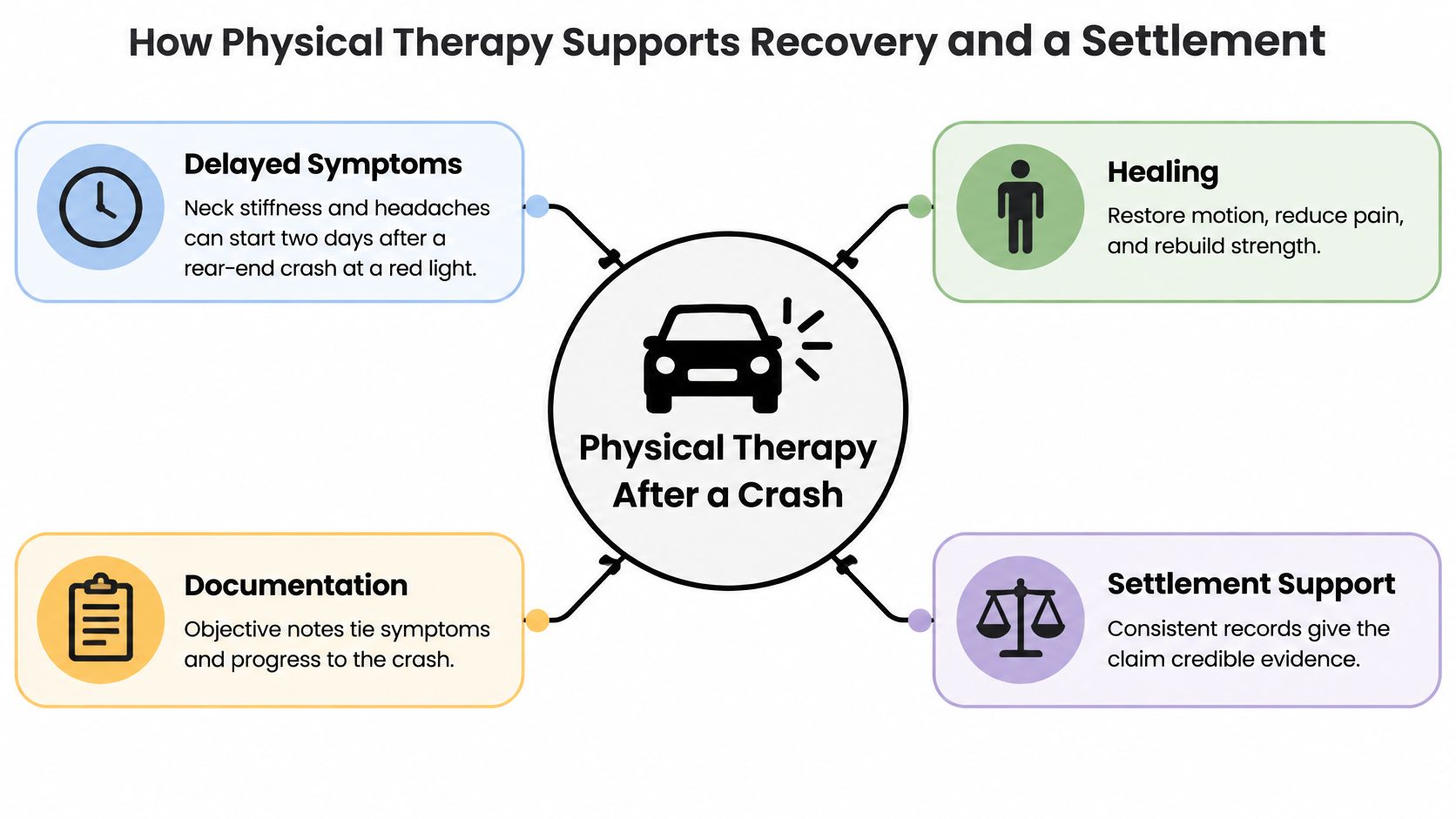
The financial scale of crash injuries explains why adjusters scrutinize these records so closely. Motor-vehicle collisions produce millions of medically consulted injuries in the United States each year, and the combined cost of medical care, lost wages, and related losses runs into the hundreds of billions of dollars annually. With that much money moving through injury claims, insurers don't pay based on a driver saying their neck hurts. They pay based on documented clinical evidence.
What a Claim File Actually Looks For
Before looking at specific records, keep one boundary in mind: settlements are legal and insurance decisions, not medical ones. No physical therapist can promise a dollar figure, calculate pain and suffering, or negotiate with an adjuster on your behalf. What a licensed clinician can give you is clean, contemporaneous evidence mapped to the questions reviewers ask.
That evidence falls into three distinct records. Clinical notes capture what the therapist observed and did at each visit. Functional outcomes capture what your body could and couldn't do, measured in degrees, strength grades, and standardized scores. Itemized billing captures what care cost and why each line was medically necessary. A strong file keeps all three consistent with each other, because adjusters look for gaps where one record contradicts another.
| Record element | Settlement question it answers | What it looks like in therapy |
|---|---|---|
| Accident date and mechanism | Was the collision the cause? | Notes linking symptom onset to the crash date and direction of impact |
| Diagnosis | What injury was diagnosed? | Whiplash-associated disorder, cervical strain, lumbar sprain, radiculopathy |
| Objective exam findings | Is there measurable impairment? | Cervical range of motion in degrees, neurologic screening, tenderness |
| Strength testing | Is function limited? | Manual muscle tests or dynamometry compared with the uninjured side |
| Pain and disability scores | How severe and how improving? | Neck Disability Index, numeric pain rating at each visit |
| Treatment frequency and attendance | Was care consistent and necessary? | Sessions per week, dates kept, cancellations and reasons |
| Response to each intervention | Is treatment working? | Progress or plateau after exercise, manual therapy, or modality |
| Work restrictions | Did the crash affect earning capacity? | Lifting limits, driving tolerance, hours missed |
| Home-exercise adherence | Is the patient participating? | Logged program and reassessment notes |
| Discharge status | Are there residual deficits or future-care needs? | Final range of motion, strength, restrictions, prognosis |
Every row in that table turns a subjective complaint into something a third party can verify. Notice what the table does not contain: any row where a therapist exaggerates symptoms or pads visits to inflate a file. Accurate documentation of medically necessary care is what supports a claim, and improvement along the way does not shrink it. Getting better is the goal of treatment, and a record showing steady, honest progress is often clearer evidence than one showing none.
After a car accident, it's important to be evaluated by a licensed professional as soon as possible, even if the soreness feels mild on day one. Early evaluation protects your body from compensating poorly, and it anchors your timeline to the crash date before memories blur. That first visit starts all three records at once, which is exactly why timing matters more than most injured drivers expect.
What Therapy Looks Like for Whiplash, Back and Shoulder Injuries
Emergency rooms are built to rule out fractures, internal bleeding, and brain trauma, not to guide six weeks of musculoskeletal rehab. CDC transportation safety reporting notes that more than 2.8 million people visited emergency departments for motor-vehicle-crash injuries in 2023. Once an ER clears you of life-threatening trauma, the lingering stiffness in your neck, back, or shoulder usually lands in an outpatient rehab clinic.

The first appointment is the longest. Initial physical therapy evaluations typically run 60 to 75 minutes, because the clinician needs your crash history, a full movement exam, and baseline measurements before any treatment begins. Follow-up sessions usually last 60 minutes, scheduled one to three times per week, and after that first evaluation the clinical team estimates how many sessions you'll likely need based on tissue healing and functional goals.
What happens inside those sessions? Depending on the service, a visit can include manual therapy, strengthening exercises, hot or cold packs, electrical stimulation, stretching, or an adjustment. The ingredients look similar across patients. The recipe does not. What changes from person to person is the progression matched to the injured region.
Three Common Crash Recovery Paths
- Whiplash and cervical strain: Care usually starts with gentle, pain-free range-of-motion drills to calm protective muscle spasms, then advances into postural training and deep neck-stabilization work. Clinicians re-measure cervical rotation, flexion, and extension with a goniometer or inclinometer at set checkpoints so improvement or lingering stiffness is recorded in degrees. Because delayed symptoms often show up days after the crash, watching for hidden injury symptoms after a car accident helps catch cervical irritation before headaches become daily.
- Low back strain and disc irritation: Rehab focuses on graded core and hip strengthening, targeted manual therapy to reduce joint stiffness, and a structured return-to-lifting plan tied directly to your job demands. A warehouse worker who lifts 40-pound cartons needs a very different progression than an accountant who can't tolerate 30 minutes in a desk chair, and a well-run clinic writes those differences into the treatment plan rather than handing everyone the same exercise sheet. For readers researching how spinal injuries get valued on the legal side, Ares outlines typical factors behind back injury settlement amounts after crashes, where documented physical limitations carry major weight.
- Shoulder and rotator cuff strain: Seatbelts save lives, yet the diagonal strap can jam the collarbone or strain the rotator cuff during a sudden stop. Therapy moves from scapular control and pendulum mobility to progressive band and dumbbell strengthening, tracking exact overhead reach angles and lifting tolerances along the way.
Notice the pattern across all three paths: every phase change is triggered by a measurement, not by a calendar date or a pain complaint alone. That distinction matters for your recovery, because progressing too fast re-injures tissue, and it matters for your file, because each measurement becomes a dated entry a third party can read.
Active, measured care gives an adjuster or medical reviewer clear milestones to evaluate, while therapy alone never guarantees a specific settlement value.
The Three Records Behind Every Therapy Claim
Think of an injury claim file as a three-legged stool. Pull out one leg, and the entire argument wobbles when an insurance reviewer starts asking hard questions. Patients often assume "my medical records" are one big PDF, yet adjusters and attorneys read three separate documents for three very different answers.
- Clinical progress notes: These are the clinician's day-by-day charts answering what was diagnosed and how treatment changed over time. A thorough initial note captures the accident date and mechanism, exact symptom onset, any prior comparable conditions, objective exam findings, diagnosis, planned frequency, and clinical reasoning for each phase.
- Functional outcomes: These standardized scores and physical tests answer whether your body is improving and what you still can't do at work or home. Objective tools like FOTO functional outcome measures alongside the Neck Disability Index, grip strength, and work-capacity notes separate measurable impairment from pain complaints alone.
- Billing and itemized expenses: These ledgers, CPT procedure codes, and receipts answer what care cost and whether every charge matches a service documented in the daily notes. If a clinic bills for 30 minutes of therapeutic exercise but the chart only mentions a heat pack, an adjuster flags the mismatch immediately.
Why Active Rehab Outperforms Passive Care on Paper
Evidence on whiplash recovery highlights why active documentation matters. A systematic review summarized by the National Center for Biotechnology Information found moderate evidence that postural exercises reduce pain and time away from work for whiplash-associated disorders, even though evidence that they restore cervical range of motion was absent and findings on neck stabilization were conflicting. A newer meta-analysis in the same evidence summary reported that guided neck-specific exercise produced statistically greater improvements than alternative or unguided exercise, with standardized mean differences of -0.25 for neck pain and -0.35 for the Neck Disability Index, and the strongest results generally occurred in programs lasting more than six weeks with at least two sessions per week.
Contrast that structured progression with a weak claim file: months of passive heat packs, ultrasound, and brief massage repeated on autopilot with zero reassessment numbers. Indefinite passive care looks stagnant to a medical reviewer and invites insurers to cut off reimbursement as medically unnecessary. When a clinician records baseline findings, periodic reassessments, response to each intervention, missed work, and clear criteria for progression or plateau, the chart proves why every visit belonged in the plan.
Practical rule: When you're ready to share your complete file with an attorney or insurer, keeping records legible and properly transmitted matters just as much as collecting them. Following secure medical faxing steps from SendItFax helps protect sensitive health details and prevents missing pages from stalling a claim review.
How to Build a Defensible Therapy Record Step by Step
Good documentation doesn't happen by accident, and you don't need a medical background to protect your own file. Here is the basic workflow that turns clinic visits into clean, verifiable evidence.
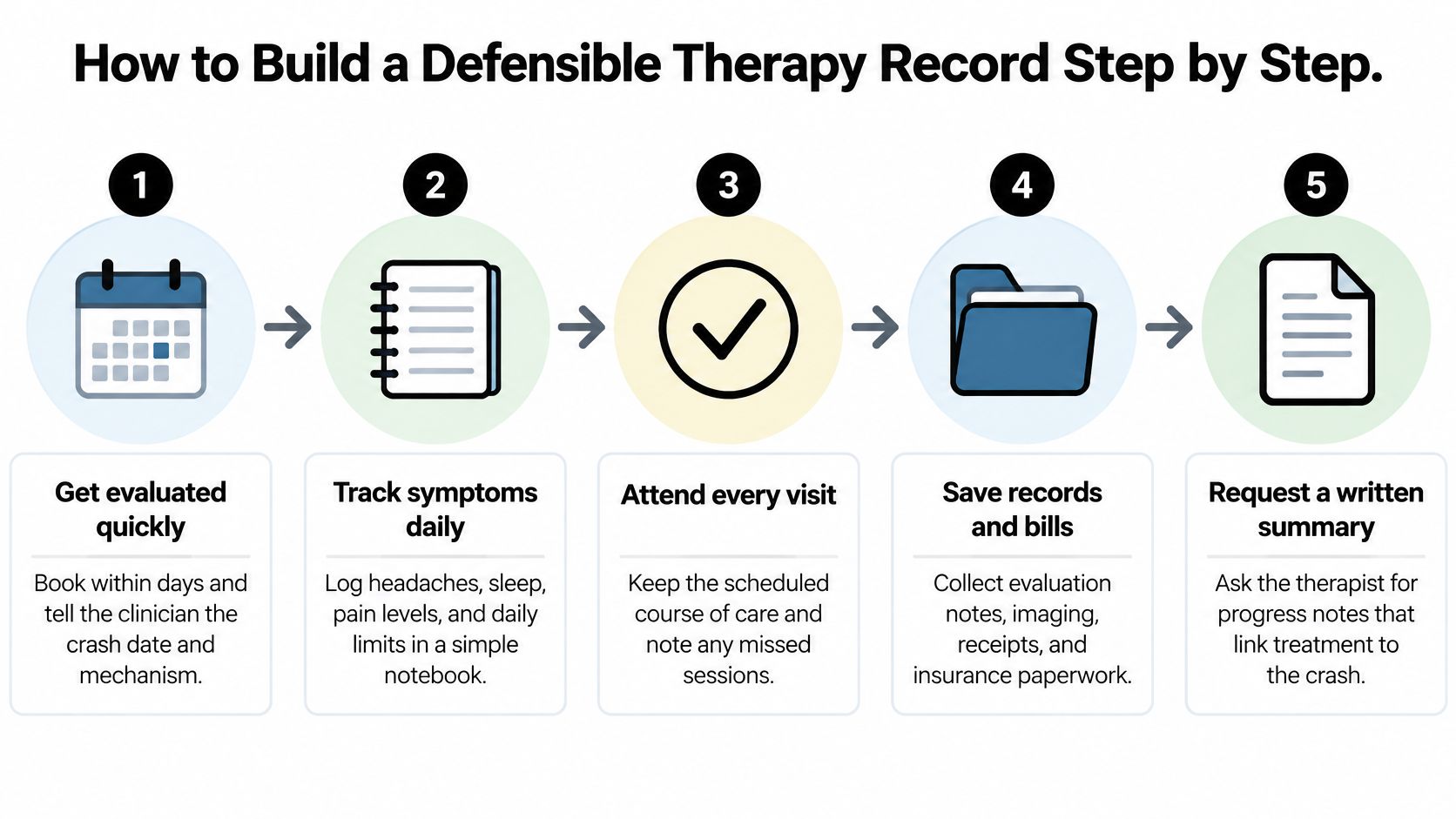
- Get evaluated within days, not weeks. Tell the clinician the exact crash date, whether you were hit from behind or the side, and when each symptom started so causation is anchored early. The common slip is waiting three weeks to see if stiffness fades on its own, which hands the insurer room to argue something else caused your pain.
- Keep a two-minute daily symptom log. Jot down morning stiffness, headaches, disrupted sleep, and practical snags like struggling to check mirrors while driving or lifting groceries. Patients routinely skip the log and try to recall six weeks of symptoms from memory during a reassessment, leaving vague notes in the chart.
- Request clear baseline measurements on day one. Ask your therapist to record initial cervical or lumbar range of motion, strength comparisons, and a standardized pain or disability score before treatment begins. Starting care without baseline numbers makes it almost impossible to prove how much function you lost or regained later.
- Show up consistently and document every cancellation. Attending scheduled visits shows you're taking recovery seriously, and if a sick child or work conflict forces a reschedule, make sure the clinic notes the reason. Unexplained multi-week gaps invite causation doubts that take months to untangle.
Seeing how clinicians connect physical exams to everyday limits makes the next few steps even clearer. This short walkthrough shows how physical therapy evaluations and progress tracking work in practice after a collision.
- Save every financial paper in one dedicated folder. Keep itemized bills, insurance explanations of benefits, prior-authorization letters, and copay receipts together from the first visit onward. Scattering paperwork across emails and glove compartments leads to missed reimbursement items when it's time to total your expenses.
- Check in on your trajectory at reassessment visits. Every few weeks, ask your clinician plainly whether your function is improving, plateauing, or worsening, and confirm that update goes into the progress note. Letting visits roll forward without a formal check-in weakens the clinical rationale for continued care.
- Leave with a written discharge summary. Before your last appointment, ask for a closing note that records any residual symptoms, final range-of-motion and strength readings, home-exercise adherence, and whether future care is medically indicated. Stopping appointments abruptly without a discharge note leaves the file looking abandoned rather than resolved.
You can knock out the hardest part today: schedule a licensed evaluation and label a single physical or digital folder for your crash records.
Florida PIP Deadlines and Who Pays After Benefits Run Out
The coverage rules below apply specifically to Florida; if your crash happened in another state, check your local no-fault or medical-payments statutes, since benefit limits and deadlines vary widely.
Under Florida's no-fault framework, outlined in LWM Personal Injury Lawyers' Florida medical documentation guide, Personal Injury Protection (PIP) generally provides up to $10,000 in benefits, requires initial medical treatment within 14 days of the crash, and commonly covers 80% of medical expenses and 60% of lost wages. What many drivers don't realize until week three is how quickly an emergency room visit, CT scan, and ambulance ride can burn through that $10,000 cap before physical therapy even starts.
What Happens When PIP Runs Out or Health Insurance Steps In
Running out of PIP doesn't mean clinically necessary therapy has to stop, and switching to health insurance doesn't weaken your injury claim. In a settlement review, the decisive questions are whether your treatment was causally related to the crash, reasonable, medically necessary, and backed by objective functional findings, not which payer cut the check. Preserve every explanation of benefits, authorization decision, referral, and balance statement regardless of who pays, and remember that accepting a quick settlement early can legally release future claims before you even know your full prognosis.
| Funding path | Typically covers | Key deadline or limit | What to confirm |
|---|---|---|---|
| Florida PIP | 80% of medical expenses and 60% of lost wages | Treatment within 14 days; up to $10,000 | Whether the full $10,000 is available or an emergency medical condition applies |
| Health insurance | Therapy per plan benefits and network rules | Plan year deductibles and visit limits | Whether prior authorization is required and how claims coordinate with PIP |
| Auto med-pay | Medical bills up to the policy limit | Policy limit and claim window | Whether med-pay is primary or secondary to PIP |
| Letter of protection | Care now, payment from a future settlement | Attorney and provider agreement | The terms, interest, and whether the provider accepts this arrangement |
| Self-pay | All charges out of pocket | None beyond the provider's payment policy | Itemized bills and receipts for later reimbursement |
If you're weighing out-of-pocket options while waiting on coverage coordination, reviewing typical physical therapy costs without insurance helps you budget clearly without letting financial guesswork derail needed care.
When Care Ends and When a Settlement Makes Sense
Patients often ask when it's finally safe to talk numbers with an insurer. Clinically, the key milestone is maximum medical improvement (MMI), the point where your condition has stabilized and further treatment is unlikely to produce meaningful additional change. Only your treating physician or clinician can determine whether you've reached MMI, because feeling "pretty okay" on a quiet Sunday isn't the same as tolerating a 40-hour workweek without flare-ups.
Waiting for medical clarity matters because crash costs aren't limited to a few clinic copays. A CDC analysis of 2012 U.S. nonfatal motor-vehicle injuries estimated 2,519,471 emergency-department visits, $18.4 billion in lifetime medical costs, and $33 billion in lifetime work-loss costs, with roughly 7.5% of those visits resulting in hospitalization. Those lifetime numbers reflect what happens when lingering impairments affect future medical needs and earning power long after the cast comes off or the stiffness settles.
Signs a Settlement Offer Is Too Early
- Changing functional scores: Your therapy charts still show steady gains, recurring flare-ups, or unresolved work restrictions from week to week.
- Pending diagnostics or referrals: You're still waiting on an MRI read, an orthopedic consult, or a neurologist's opinion about nerve symptoms.
- No written prognosis yet: Your clinician hasn't documented whether your condition is expected to resolve fully or leave permanent limits.
- Missing discharge documentation: An insurer puts a check on the table before a formal discharge summary records your final range of motion, strength, residual symptoms, home-exercise adherence, and any medically indicated future care.
Signing a settlement release typically ends your legal right to seek future compensation for the same injury, so always have a personal injury attorney review the release before you sign it.
When an appropriate course of rehab still leaves persistent limitations, clear future-care notes become the centerpiece of the claim file. Attorneys pull those exact prognosis statements, residual deficits, and cost projections together when drafting injury settlement demands through tools and workflows like those detailed by Attorney Assistant. Before your final visit wraps up, ask your clinician directly about your long-term prognosis and any remaining physical restrictions, and store that written answer right inside your folder.
Misconceptions That Can Hurt Your Recovery and Your Claim
Bad advice travels fast after a fender-bender, usually from a well-meaning coworker or a forum thread written for clicks. Clearing up five stubborn myths protects both your body and the credibility of your file.
Five Claims Myths Worth Dropping
More therapy visits automatically create a bigger settlement. Padding the calendar with unnecessary or poorly documented appointments undercuts credibility, because medical reviewers spot stagnant notes and challenge the entire bill. Consistent, goal-driven care carries far more weight than raw visit counts.
Any gap in treatment instantly destroys your claim. Attendance should reflect real medical necessity, not a negotiation stunt. If illness, travel, or an insurance authorization delay pauses your visits, having the clinician document the reason keeps your timeline intact.
Getting better shrinks what your case is worth. In a pilot study of motor-vehicle-crash patients with fractures indexed on PubMed, early rehabilitation improved pain at 12 weeks and produced a significantly better return-to-work rate than control care. Real recovery proves you tried to mitigate your damages, and if residual pain, activity limits, or future-care recommendations remain, those documented deficits still support fair compensation.
Physical therapy sets your settlement value. Rehab notes measure impairment, progress, and functional limits, nothing more. Translating those clinical facts into a legal demand belongs strictly to your attorney, the insurer, and state law.
Using health insurance weakens your injury case. Adjusters evaluate whether care was causally tied to the crash and clinically necessary, not which card you swiped at the front desk. Using available health benefits keeps your recovery moving without forcing you into debt.
Patients sometimes fear discharge because they worry ending visits signals "case closed" at zero value. In truth, a thorough discharge summary recording your final strength, remaining limits, and future-care outlook protects your claim far better than stretching out pointless appointments. Ask your clinician plainly what your prognosis looks like instead of guessing.
Choosing Care and Knowing When to Call a Lawyer
You don't need an attorney for every scratched bumper, yet waiting too long to get legal advice on a complicated crash can cost you dearly. Calling a personal injury lawyer makes clear sense when liability is disputed, the at-fault driver carries a low policy limit, your injuries are serious or involve nerve symptoms, or an adjuster pushes a settlement offer before your prognosis is known.
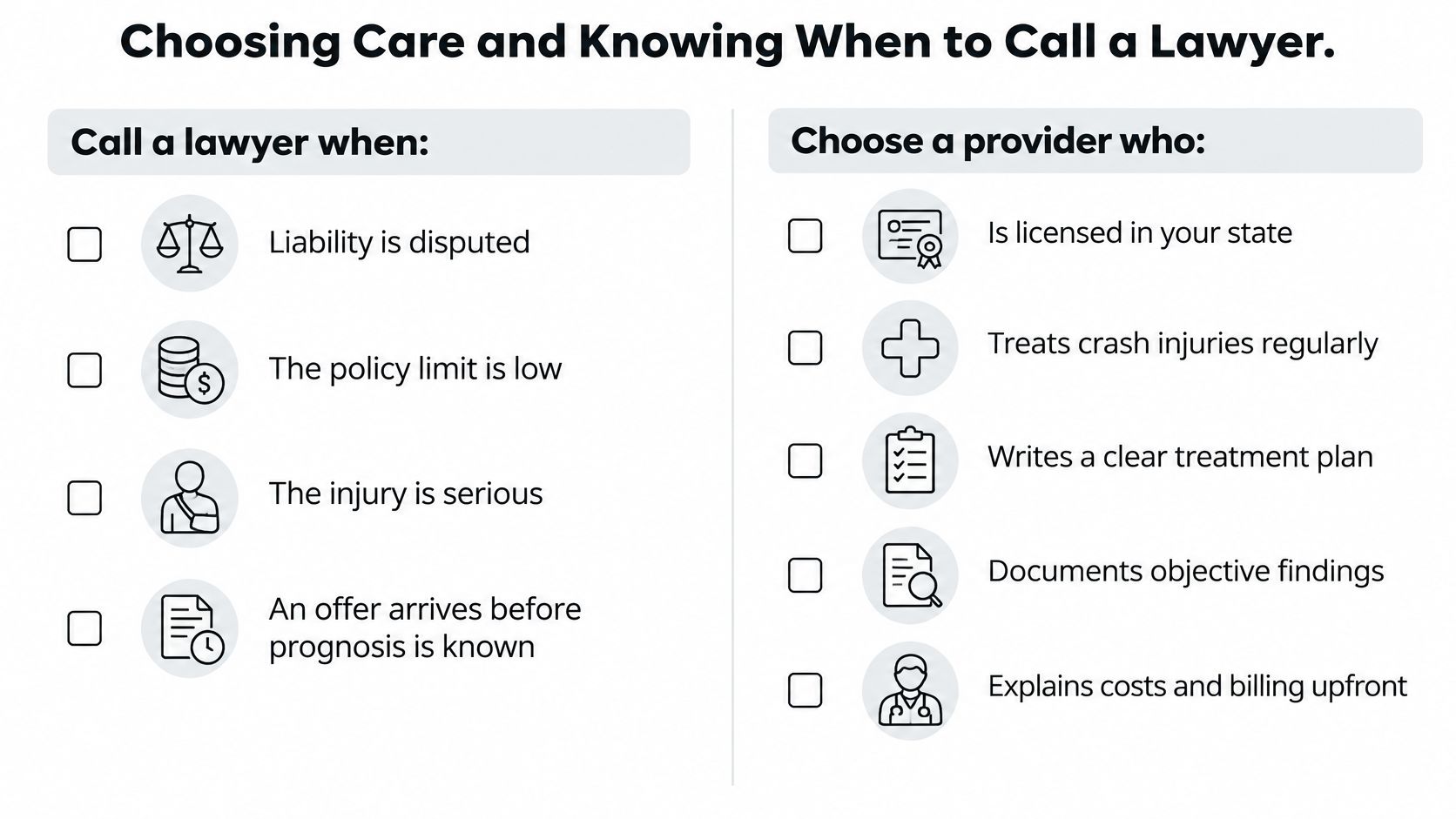
Choosing the right rehab clinic matters just as much for your daily comfort and your medical paper trail. Look for licensed clinicians who treat crash injuries regularly, write an individualized plan with set reassessment checkpoints, bill auto insurance directly, and tell you upfront what your first appointment will involve.
What Thorough Local Rehab Care Looks Like
At MedAmerica Rehab Center in Deerfield Beach, our multidisciplinary clinic provides physical therapy, chiropractic care, acupuncture, and shockwave therapy under one roof, with injury rehabilitation covering car accident injuries, sports injuries, workers' compensation injuries, and pre- and post-surgical rehab. We accept all auto insurances and workers' compensation, alongside Medicare, Aetna HMO/PPO, BCBS PPO/POS, Cigna, Humana HMO/PPO, United Healthcare, Tri-Care Network, Genex, Evercare, and MedRisk, and we offer same-day appointments so you aren't left waiting while stiffness worsens.
Expect clear visit structure from day one. Physical therapy and occupational therapy initial evaluations take place on the first visit and typically last 60 to 75 minutes, while follow-up physical therapy visits last 60 minutes, giving your therapist real time to test movement, track objective progress, and build a written plan for your recovery.
Your next step is straightforward: book your evaluation today and walk in with three things in hand, your crash date, your insurance details, and the start of your daily symptom log.
If you're sorting through post-crash pain in Deerfield Beach or nearby South Florida communities, our team can help you start active, well-documented recovery without guesswork. We offer same-day evaluations, hands-on physical therapy and chiropractic care, and direct coordination with auto insurance so your focus stays on healing while your clinical records stay thorough. Schedule your first evaluation today by visiting MedAmerica Rehab Center.
MedAmerica Rehab · Deerfield Beach
Talk to a clinician about your pain
Physical therapy, chiropractic, acupuncture and shockwave therapy under one roof, since 1995. Same-day appointments are available.
Mon–Thu 8:00 AM – 6:30 PM · Fri 8:00 AM – 3:00 PM