
Ankle Weights Physical Therapy: Guide to Recovery 2026
You notice them on a shelf or wrapped around another patient's leg. They look simple enough. Soft cuffs, a little sand or weight inside, Velcro straps. Then the question comes quickly. “Are ankle weights helpful, or are they just an old-school workout thing?”
In a physical therapy clinic, that's a fair question.
Ankle weights are often seen used the wrong way, typically for long walks, cardio classes, or an attempt to “make exercise harder” without much thought about mechanics. In rehab, we look at them differently. We don't use them because they're trendy or because heavier always means better. We use them when they solve a specific movement problem.
That difference matters.
Used well, ankle weights can help wake up weak muscles after surgery, rebuild control after injury, and add a small, targeted load when bodyweight alone isn't enough. Used poorly, they can change how you move and place stress where you don't want it. That's why ankle weights physical therapy should never feel random. It should feel measured, purposeful, and tied to your recovery goals.
If you've never been to rehab before, it helps to understand what a typical physical therapy session looks like. Every tool in the room has a reason behind it, and ankle weights are no exception.
Introduction Why Ankle Weights Appear in Our Clinic
A patient recovering from knee surgery often reaches the same point in rehab. Early on, just lifting the leg can feel like work. Later, the movement becomes easier, but the muscle still isn't strong enough for stairs, standing from a chair, or walking with confidence. That's where a small external load can help.
Ankle weights show up in clinic for that exact reason. They give us a controlled way to ask a muscle to do a little more work without turning the whole exercise program into a strain session. Think of them less like gym gear and more like a precise tool, similar to using a screwdriver instead of a hammer. Both are useful, but only one fits the task.
They're not a general fitness shortcut
In rehab, we aren't trying to make every movement harder. We're trying to make the right movement harder in the right amount. That could mean helping the quadriceps fully engage during a seated knee extension, or helping the hip muscles regain strength so your pelvis stays level when you walk.
Patients are often relieved when they hear this. The goal isn't to strap on weight and push through discomfort. The goal is to restore function with enough challenge to create change, while still protecting healing tissue, irritated joints, and tired muscles.
In physical therapy, a tool only earns its place if it helps you move better, not just work harder.
Why they spark so much curiosity
Ankle weights look deceptively simple. That's partly why they get misunderstood. A resistance band looks therapeutic. A therapy table looks medical. An ankle cuff looks like something you could buy and use on your own, which makes people assume the rules are the same everywhere.
They aren't.
Inside a clinic, ankle weights are chosen based on your condition, your movement quality, and your stage of recovery. One person may use them for a controlled leg raise on a table. Another may not be ready for them at all. The cuff itself isn't the treatment. The plan is.
How Ankle Weights Work in Physical Therapy
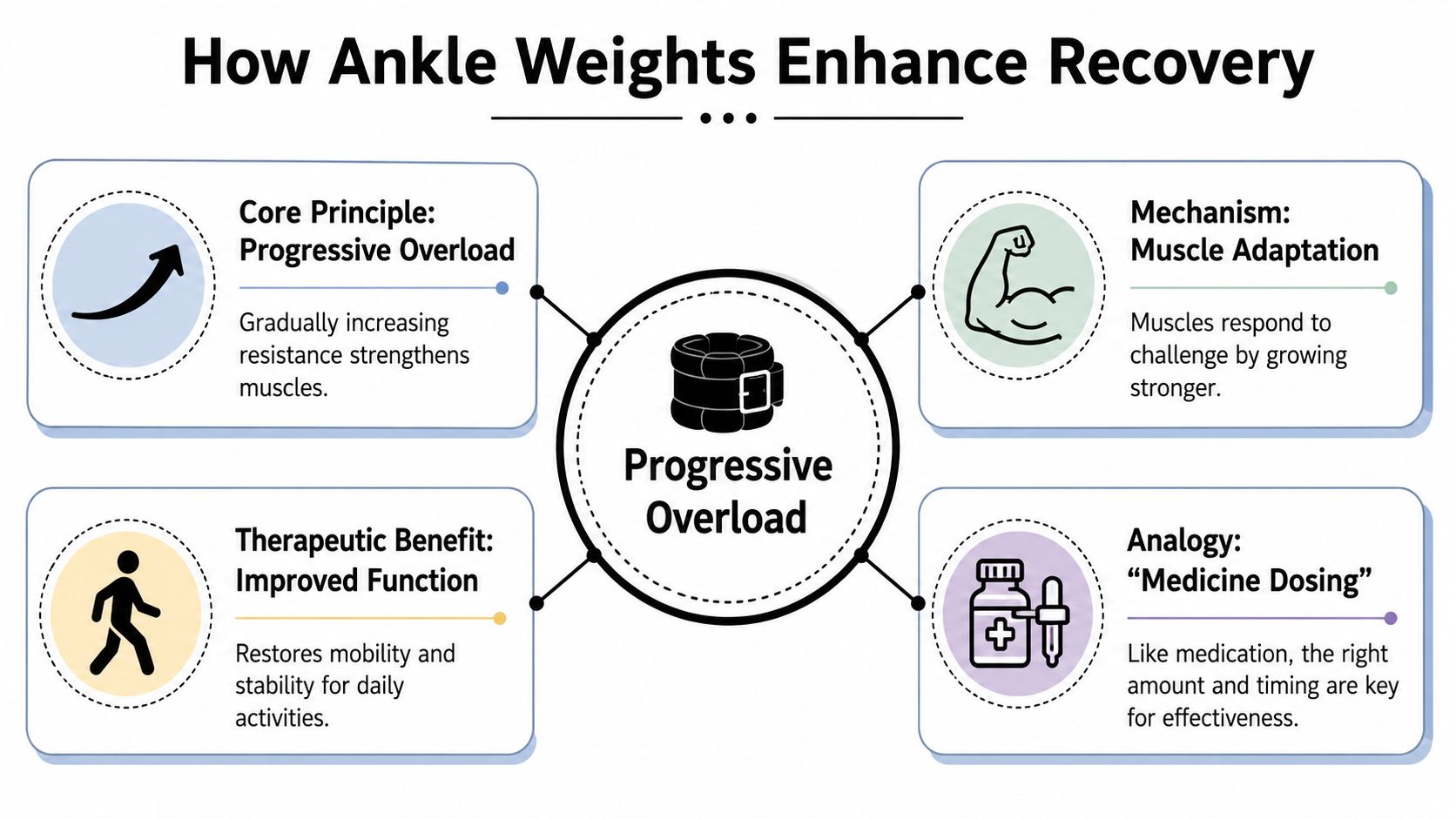
The basic idea is progressive overload. Muscles get stronger when they're asked to handle a little more demand than they're used to. In rehab, we apply that carefully. We don't jump from easy to hard. We add just enough challenge that the body adapts without losing form.
An ankle weight acts like a tiny dumbbell attached to one limb. Because the load sits farther from the hip or knee, the muscle has to work harder to move and control that leg. That's especially useful when we want to target a weak area without loading the entire body.
The load is small, but the effect is specific
If you hold a book close to your chest, it feels manageable. Hold that same book straight out with your arm extended, and it suddenly feels heavier. The weight didn't change. The distance at which it acted did.
That's how ankle weights work in many rehab exercises. Placing the load at the ankle increases the torque demand on the muscles moving the hip and knee. This is one reason ankle weights are most useful in open-chain lower-extremity exercises such as leg lifts, hip abduction, and knee-extension drills. Harvard Health notes that ankle weights increase the load on the targeted muscle group during leg-and-hip exercises, which can increase strength, but warns against using them during walking or aerobic activity because they can shift activation away from hamstrings and increase stress on the ankle, knee, hip, and back joints, as explained in Harvard Health's guidance on wearable weights.
Why that matters in recovery
After injury or surgery, the problem often isn't just weakness. It's selective weakness. One muscle group falls behind, and the body starts compensating. The hip flexors may overwork because the core isn't steady. The low back may tense because the glutes aren't doing their job. The movement still happens, but it happens poorly.
An ankle weight can expose and train that weak link.
What we're trying to improve
- Muscle activation: A lightly loaded leg raise can help a patient feel and use a muscle that has gone quiet.
- Control through range: It's not enough to lift the leg. You need to lower it smoothly and keep alignment.
- Functional carryover: Stronger hip and knee muscles support standing, stepping, climbing stairs, and steady walking.
Practical rule: If the weight makes you swing, twist, hike the hip, or hold your breath, it's too much.
Why this isn't just “more resistance”
A dumbbell can make an exercise harder. An ankle cuff can make a very specific part of a movement harder. That precision is what gives ankle weights physical therapy value. We can dose the challenge to one limb, one pattern, and one stage of recovery.
That's also why two patients with the same diagnosis may use ankle weights differently. One may need them to build strength. Another may need to master the movement first with no added load at all.
Clinical Uses and Evidence for Ankle Weight Training
The best use of ankle weights isn't broad. It's selective. They tend to work well when a therapist needs a light, focused resistance tool for lower-extremity strengthening or gait-focused retraining. They are less useful when the goal is whole-body conditioning or free-form cardio.
Older adults building leg strength for daily function
For many older adults, the primary target isn't “fitness.” It's getting up from a chair more easily, walking with better control, and maintaining independence. In that setting, a simple tool can be valuable if it's safe and practical.
A 2022 randomized study of older community-dwelling adults found that wearing ankle weights for 3 months produced significant gains in lower-limb circumference and in the Chair Stand Test (CS-30), a standard measure of lower-body function. The study also reported no serious accidents or incidents during the intervention period, supporting ankle weights as a low-complexity strengthening strategy in geriatric physical therapy, according to the 2022 randomized geriatric study on ankle weights.
That doesn't mean every older adult should start using them on their own. It means the tool can be appropriate when the plan is structured and the person using it has been screened.
Post-operative and deconditioned patients
After a knee or hip procedure, weakness can linger even when pain starts to settle down. In these cases, ankle weights may help rebuild strength in a controlled way during exercises like straight leg raises, knee extensions, or side leg raises.
The important distinction is that we usually use them to improve a specific deficit. If the quadriceps isn't controlling knee extension well, the cuff may be added there. If the hip abductors can't stabilize the pelvis, the cuff may be used with side-lying or standing abduction work.
A short table makes the clinical logic clearer:
| Recovery goal | Why ankle weights may help | What matters most |
|---|---|---|
| Rebuild quadriceps strength | Adds load during knee extension work | Smooth control, not speed |
| Improve hip stability | Challenges gluteal muscles during leg lifts | No trunk leaning or hip hiking |
| Restore transfer ability | Builds lower-body capacity that supports sit-to-stand tasks | Exercise must match tolerance |
Gait-focused rehabilitation
Some patients need more than table exercises. They need help with timing, limb control, and the feel of walking. In those cases, therapists may use very light loading in movement drills or gait retraining.
The reason to keep this dosing light is simple. Gait is a finely tuned pattern. A small change can help. Too much load can distort the pattern you're trying to restore.
The best rehab tools are often the least dramatic. If a small cuff helps a patient recruit the right muscles and walk with more control, that's enough.
Safe Dosing and Progression with Your Therapist
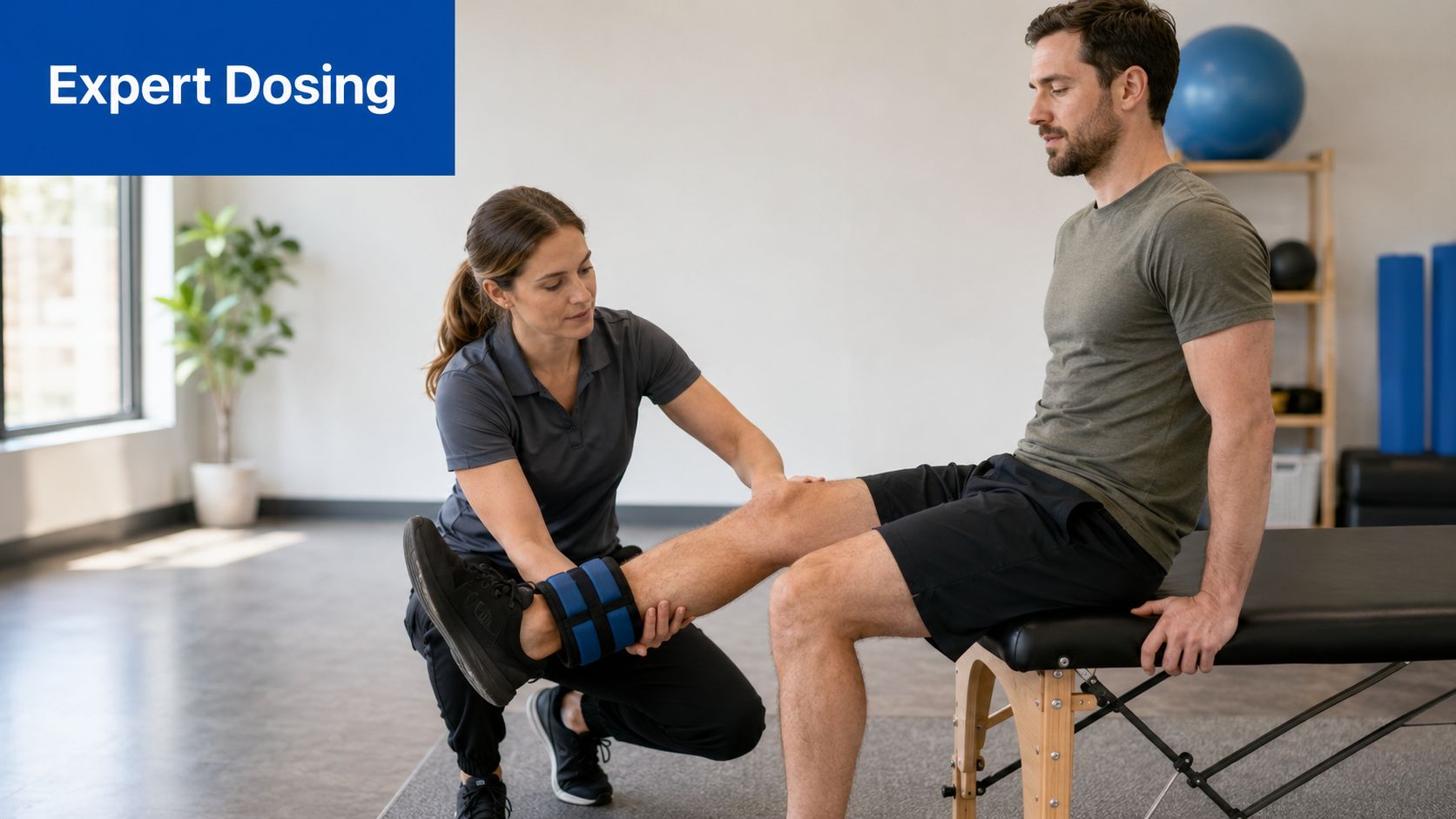
Exercise has a dose, just like medicine. The right amount helps. Too little may do nothing. Too much can create side effects. With ankle weights, the dose includes the weight itself, but also the exercise choice, the number of repetitions, the speed of movement, the rest between efforts, and the stage of healing.
That's why therapists don't just ask, “How much weight can you handle?” We ask, “Can you move well with it?”
Where we usually start
Clinical guidance on wearable weights notes that using 1 to 3 pound ankle weights during exercise can raise heart rate by about 3 to 5 beats per minute and increase oxygen consumption by 5% to 10%. The same guidance warns that improper use can strain the ankle joint and contribute to hip, knee, or back injury, which is why physical therapists typically reserve them for controlled strengthening and gait-focused rehabilitation rather than unrestricted walking or running, as described in WebMD's clinical overview of wearable weights.
Those numbers help explain why ankle weights are useful but modest tools. They can add measurable demand, yet they are not meant to become a constant all-day challenge.
If you want a patient-friendly overview of cuff selection and setup, MedAmerica also has a practical guide to ankle and wrist cuffs.
What progression actually looks like
Progression doesn't always mean adding more pounds. Often, we change one variable at a time.
Common ways a therapist progresses the exercise
Cleaner movement first
The first step is often reducing compensation. A straighter knee, steadier pelvis, or slower lowering phase can be more important than adding load.More range, if tolerated
A patient may lift the leg a little higher or control the return more fully without changing the cuff weight.More volume later
Repetitions or sets might increase when the movement stays solid from start to finish.Weight only when the pattern is ready
If the exercise still looks shaky, adding weight usually makes the wrong muscles work harder.
The problem with guessing
People often assume they'll know if the weight is too heavy because it will hurt. That's not always how compensation shows up. Sometimes the clue is subtle. The torso leans. The neck tightens. The leg swings instead of lifts. The foot turns out. Those changes tell us the target muscle isn't driving the movement the way it should.
A good session doesn't feel random or punishing. It feels specific. You should understand why the cuff is there, what muscle it's targeting, and what sign tells you the exercise is being done well.
Sample Ankle Weight Exercises for Common Conditions
Ankle weights work best when the exercise choice matches the problem. A cuff won't fix poor balance on its own, and it won't replace hands-on therapy, gait work, or mobility training. But in the right movement, it can sharpen the training effect.
Here are common examples used in ankle weights physical therapy.
Seated knee extension for post-knee weakness
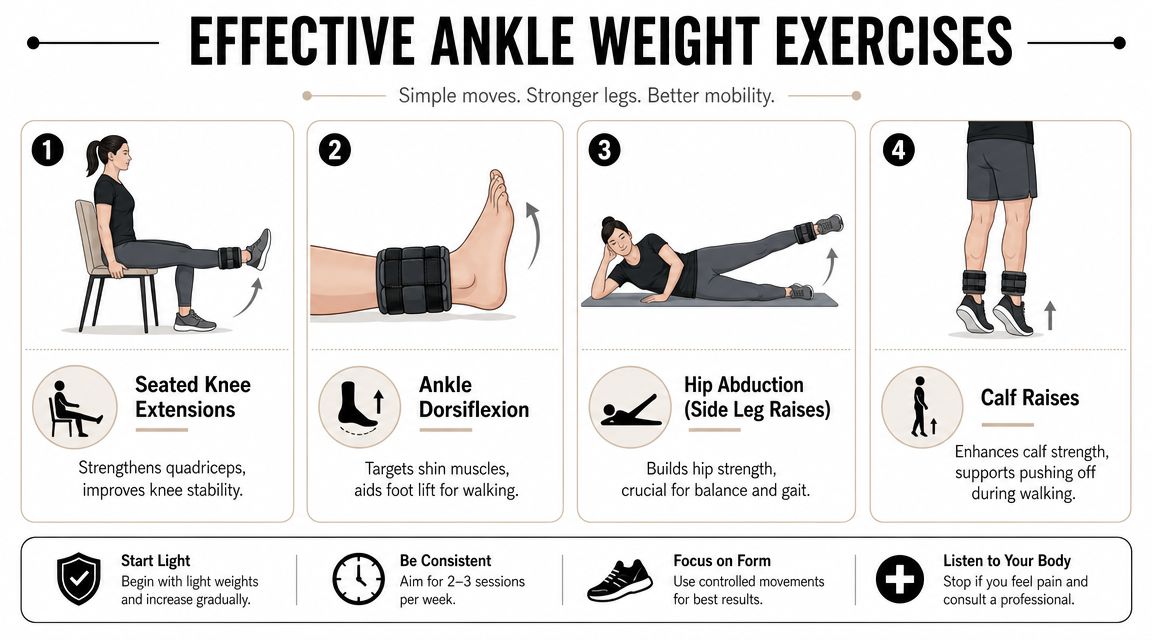
Sit tall in a chair with the cuff secured above the ankle. Slowly straighten one knee, pause briefly, then lower with control. The target is the quadriceps.
This is often useful after knee irritation or surgery when the thigh muscle needs a direct strength challenge without demanding a full standing movement.
- Form cue: Keep the thigh supported and avoid leaning backward.
- Therapist's tip: If the knee snaps straight and drops quickly on the way down, the load may be too much.
Side-lying hip abduction for pelvic stability
Lie on one side with the bottom knee bent for support and the top leg straight. Lift the top leg upward without rolling the trunk backward. Lower slowly. The main target is the hip abductors, especially the gluteal muscles that help stabilize the pelvis during walking.
This is one of the most common and useful ways to apply ankle weights because the movement is controlled and the target is clear.
When a patient says, “I feel that in the side of my hip, not my low back,” that's usually a good sign.
Straight leg raise for hip flexor and quad control
Lie on your back with one knee bent and the other leg straight. Tighten the front of the thigh, then lift the straight leg a short distance and lower it slowly. This drill targets hip flexor and quadriceps control.
It's common in early and mid-stage rehabilitation, but only when the patient can keep the knee straight and the trunk relaxed.
Here's a short movement example to compare with what your therapist may prescribe:
Ankle dorsiflexion for foot lift during gait
With the heel supported and the cuff applied as instructed, pull the foot upward toward the shin, then return slowly. This movement targets the muscles that help lift the front of the foot during walking.
For gait-focused rehabilitation, research on healthy adults found that ankle loading around 1% of body weight improved walking factors, with significant cadence differences observed between the unloaded condition and 1%, 2%, and 0% vs. 2% loading groups. The authors concluded that 1% body-weight loading may improve walking ability and support independent ambulation. This aligns with clinical guidance that ankle weights can be useful for walking-gait retraining and balance work, but generally should be kept light, often 1 to 3 pounds for cuff-style weights, or up to about 1 to 2% of body weight in movement drills, as reported in the study on ankle loading and walking ability.
If you're returning to running rather than basic daily walking, ankle weights aren't the first answer. Mobility, calf strength, foot control, and landing mechanics usually matter more. For that broader foundation, this guide on how to strengthen ankles for running is a useful companion resource.
Risks and When to Avoid Ankle Weights
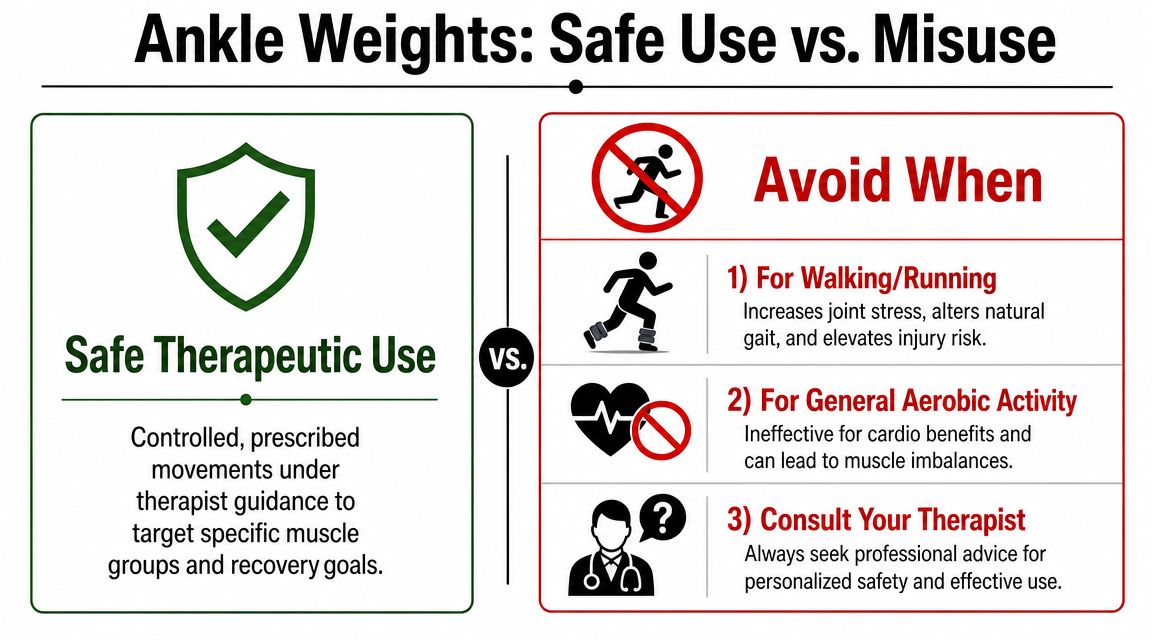
The biggest mistake people make with ankle weights is assuming that if they help during a controlled exercise, they must also help during walking, jogging, or general cardio. That's where the tool gets misused.
In clinic, we're usually looking for a precise strengthening effect. During free walking or aerobic activity, the body has to repeat a complex pattern over and over. Add weight in the wrong setting, and the quality of that pattern can drift.
When they can work against you
Harvard Health warns against using ankle weights during walking or aerobic activity because they can shift activation away from the hamstrings and increase stress on the ankle, knee, hip, and back joints. That's a very different situation from using them in open-chain drills such as leg lifts, hip abduction, and knee-extension work, where ankle weights have stronger support as a targeted strengthening tool.
In plain terms, the problem is not just “extra weight.” The problem is altered mechanics. If the cuff changes how your leg swings, how your foot lands, or how your trunk balances over the leg, you may be practicing a faulty pattern repeatedly.
Situations where extra caution is needed
A therapist may delay or avoid ankle weights when a patient has one of these issues:
- Acute joint irritation: A hot, swollen, or highly painful ankle, knee, or hip usually needs calming down before external load is added.
- Poor movement control: If you can't do the basic motion well without weight, adding a cuff usually magnifies the problem.
- Balance deficits without support: Some people need stable surfaces, hand support, or therapist supervision before any added limb load is appropriate.
- Pain that worsens with loading: Discomfort that lingers, sharpens, or changes your movement is a sign to reassess.
If a device makes you move worse, it isn't helping your rehab, even if it feels challenging.
Don't overlook the foot and shoe side of the equation
Lower-extremity mechanics don't begin at the knee or hip. They start at the foot. If you're curious about how footwear, foot strength, and irritation patterns influence the whole chain, the Peak Performance foot health podcast adds useful context.
If you're recovering from a sprain, fracture, or ongoing instability, a structured ankle injury recovery plan matters more than buying a cuff and experimenting on your own. The right tool depends on the stage of healing.
Your Recovery Plan Beyond Ankle Weights
Ankle weights can be helpful. They are not the centerpiece of recovery.
Improvement often occurs through a combination of strategies. That may include bodyweight drills, resistance bands, manual therapy, balance training, gait practice, mobility work, and gradual return-to-activity progressions. Sometimes the best next step after ankle weights is a band. Sometimes it's a step-up. Sometimes it's no resistance at all, just better control.
The real value is the match between tool and goal
A cuff is useful when it matches the problem. If your quadriceps need a focused load during knee extension, it makes sense. If your issue is poor foot stability, stiff ankle mobility, or fear with single-leg balance, another tool may be better.
That's why good rehab rarely looks flashy. It looks organized. Each exercise has a purpose, and each progression has a reason.
Recovery also depends on what happens after the exercise
Patients often focus on the strengthening tool and forget the rest of the routine. Cool-down work, breathing down the nervous system, and restoring comfortable motion can make the whole program more sustainable. If you want a simple sports-oriented example, these Vanta Sports cool down routines show the kind of recovery habits that support training instead of competing with it.
The bottom line is simple. Ankle weights physical therapy works when the plan is individualized. The cuff itself doesn't create recovery. The right exercise, the right dose, the right timing, and the right supervision do.
If you're dealing with weakness, joint pain, post-surgical stiffness, or balance concerns, start with an evaluation. Once we know what's limiting your movement, we can decide whether ankle weights belong in your program, or whether another approach will move you forward more safely.
If pain, weakness, or an injury is keeping you from walking comfortably, exercising, or getting back to daily life, schedule an evaluation with MedAmerica Rehab Center. A therapist can assess your movement, identify which muscles and patterns need attention, and build a personalized recovery plan that may include ankle weights only if they fit your goals and stage of healing.
MedAmerica Rehab · Deerfield Beach
Talk to a clinician about your pain
Physical therapy, chiropractic, acupuncture and shockwave therapy under one roof, since 1995. Same-day appointments are available.
Mon–Thu 8:00 AM – 6:30 PM · Fri 8:00 AM – 3:00 PM