
Hip Arthritis Stretches: A Safe, Step-by-Step Routine
You've been in the car for forty minutes, you swing your legs out, and the first three steps are a shuffle. Later you reach for a shoe and can't quite get there, or you push up from a low chair with a small grunt. That's usually the moment someone searches for hip arthritis stretches.
Stretching earns its place in that search, though not in the way most lists promise. It won't regrow cartilage, and it isn't automatically the gentlest thing you can do to an angry hip. What it does is restore usable motion so the rest of your plan works: the walking, the strengthening, the stairs. What follows gives you four stretches with starting and target doses, the form that keeps them safe, a color-coded way to judge whether today's discomfort is progress or a flare, and a straight answer about what stretching can't do on its own.
What Stretching Can and Cannot Do for Hip Arthritis
Your hip doesn't need to be badly worn to feel stiff. Hip osteoarthritis is common, with a reported age-standardized prevalence of approximately 0.85% of adults (95% confidence interval 0.74% to 1.02%) cited in the 2017 hip osteoarthritis clinical practice guideline. That's a very large group of people testing the joint before trusting it on a Monday morning.
Here's the honest split. The same guideline describes stretching as one component of a broader exercise program intended to improve hip range of motion and flexibility, usually alongside strengthening. It helps with post-sitting stiffness, the pinched feeling at the front of the hip, and the range you need to reach a sock. It does not repair cartilage degeneration, and nothing in that guidance treats it as a stand-alone cure.
What the trials actually show
Exercise for hip osteoarthritis works, modestly. A review of 18 studies covering 1,368 participants found that exercise versus no treatment, usual care, or limited education reduced pain by 7.19 points on a 0 to 100 scale (95% CI 3.68 to 10.70) across nine studies and improved physical function by 8.79 points (95% CI 5.41 to 12.00) across nine studies, as published in Physical Therapy. Both averages sit below the 12-point pain and 13-point function thresholds that usually define a clinically important change.
The wider evidence base is real, though. A 2023 Lancet Rheumatology meta-analysis of therapeutic exercise for osteoarthritis pooled 31 randomized controlled trials with 4,241 participants, including six trials of hip osteoarthritis alone and seven of hip and knee together, catalogued in the Pain Science research bibliography. Read those numbers as a promise of modest help, not a rebuild.
Stretching is also hard to isolate. Trials bundle it with aerobic work, strengthening, neuromuscular training, manual therapy, or education, so nobody can credit the stretch alone for the improvement.
What to expect: a hip that moves more easily in the first few weeks, not a joint that has been repaired.
A looser feeling right after a stretch is genuine. It is not the same as better walking tolerance, easier stairs, or improved long-term function, and that gap is where unrealistic expectations cause trouble. Doses come next, because how much you do matters more than which stretch you pick.
Hip Arthritis Stretches and How Often to Do Them
Four movements cover the directions an arthritic hip loses first. Start with the low dose and earn your way up.
| Stretch | Muscle group | Starting dose | Long-term target |
|---|---|---|---|
| Kneeling hip flexor stretch | Hip flexors | 1 repetition held 5 to 15 seconds, once daily | 3 to 5 repetitions held 20 to 30 seconds, 3 to 5 days per week |
| Supine hamstring stretch with strap | Back of the thigh | 1 repetition held 5 to 15 seconds, once daily | 3 to 5 repetitions held 20 to 30 seconds, 3 to 5 days per week |
| Supported standing quadriceps stretch | Front of the thigh | 1 repetition held 5 to 15 seconds, once daily | 3 to 5 repetitions held 20 to 30 seconds, 3 to 5 days per week |
| Seated figure-4 stretch | Hip internal and external rotators | 1 repetition held 5 to 15 seconds, once daily | 3 to 5 repetitions held 20 to 30 seconds, 3 to 5 days per week |
The starting dose is deliberately small because an irritable hip tolerates gentleness and frequency before it tolerates duration. One short hold per muscle group, once a day, keeps the joint moving without asking it to sit at end range long enough to protest.
How the starting dose becomes the target
Progress only when the first stretch feels comfortably tolerated: a pull that fades within a few minutes and leaves no soreness the next morning. Add repetitions before you add seconds. Going from one hold to three is easier on the joint than jumping from 10 seconds to 30.
NICE's evidence review of osteoarthritis exercise programmes describes exercise dosing that commonly ranges from 1 to 5 sessions per week for 6 to 12 weeks, with studied programs lasting 30 to 120 minutes and running 1 to 3 times weekly. That's the container your stretches sit inside, not a reason to stretch for two hours.
Practical rule: stretching is a supporting act. Pair it with strengthening rather than running it as a solo session.
Two or three stretches are enough to begin with. Rotator work and hip flexor work cover most stiff hips, and the hamstring or quad choice depends on whether the back or front of your thigh feels tight. Form is where home programs often fall apart, so that's the next thing to get right, and our guide to improving hip mobility walks through the mobility drills that complement these holds.
How to Warm Up and Perform Each Stretch Safely
Form is where most home routines fail, usually in the same four ways: no warm-up, a leaning trunk, a hold pushed to the point of pain, and bouncing to chase depth.
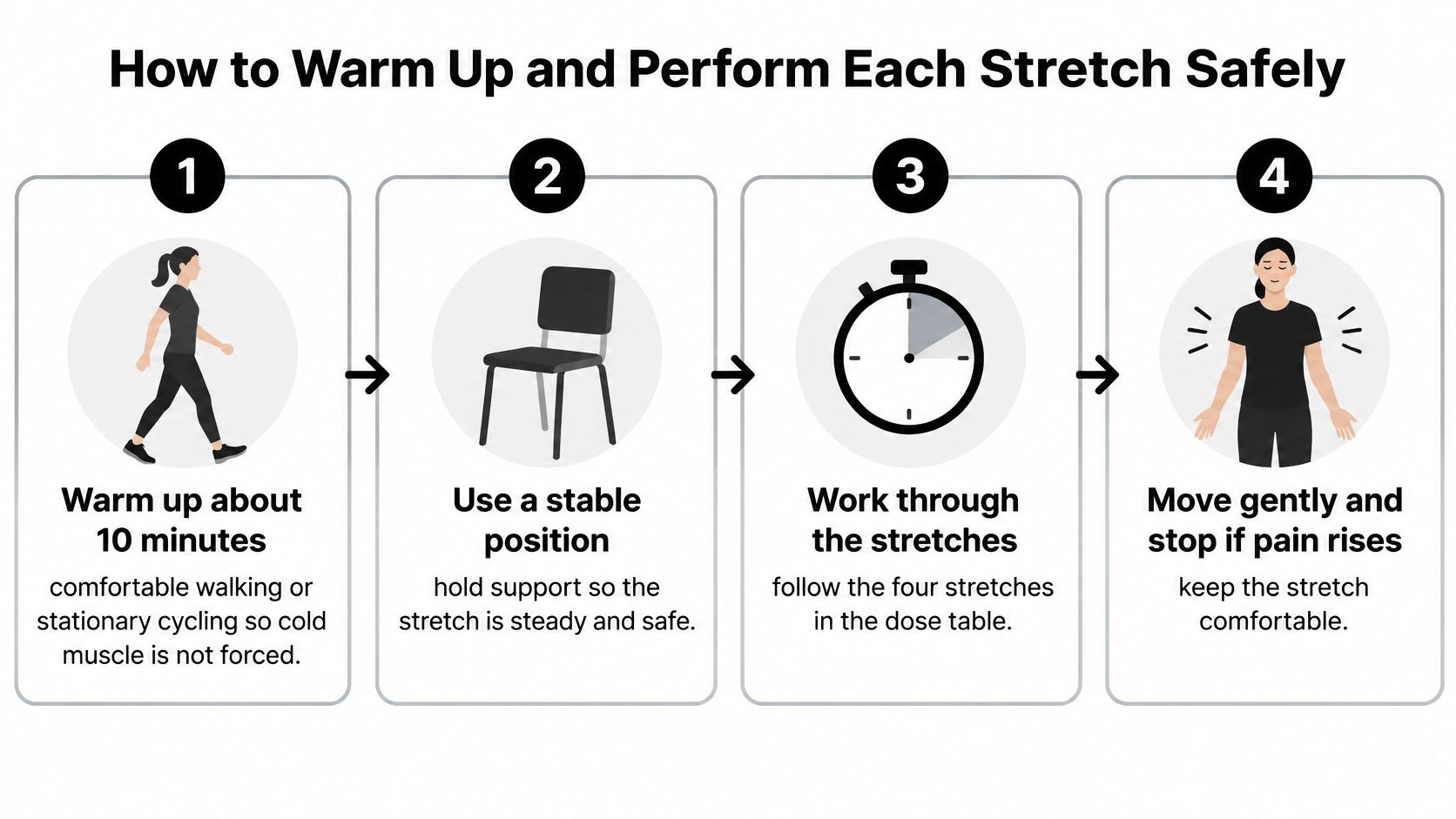
- Warm up for about 10 minutes first. Comfortable walking or stationary cycling raises tissue temperature so a cold muscle isn't forced into range. Skipping this is the most common reason a stretch feels sharper at home than it did in the clinic.
- Build a stable base. Use a chair or wall for support, keep the trunk neutral, and stay square over the hip. Leaning sideways to chase depth hides what the joint is doing and lets you fake range you don't have.
- Move slowly to the first sensation of resistance, then stop. Force nothing past that point, particularly end-range hip flexion, rotation, or abduction. The first pull is the working zone; the last inch is where flares come from.
- Breathe and hold to the clock. Hold only the starting or target time in the dose table. No bouncing, no twisting, no forced internal rotation, because bouncing triggers a protective reflex that makes the muscle resist exactly what you're trying to lengthen. NICE osteoarthritis guidance puts the same points plainly: a stable position, neutral trunk, relaxed breathing, and a sensation that stays a tolerable stretch rather than sharp groin pain, catching, or instability.
- Judge the sensation, not the depth. A broad pull through the front of the hip or the back of the thigh can continue. Sharp groin pain, a catch, or a feeling that the leg might give way means stop that stretch and revisit it on another day.
- Repeat on the other side, then check back later. Note how the hip feels that evening and the next morning before you change anything. Rushing the hold and rushing the progression are the same mistake at different speeds.
If you're stretching as part of a gym session, these gym warm-up ideas cover the cardio and mobility prep that pairs well with the holds above.
Self-check: you should finish looser, with no pain that lingers into the evening.
What you do with the next morning's report is the key skill, and it decides whether you keep the dose, reduce it, or stop.
Adjusting Stretches When Your Hip Pain Changes
The assumption worth challenging is that more stretching is always better. For an arthritic hip, the opposite is often true: the right amount changes week to week, and your job is to read the signal rather than push through it.
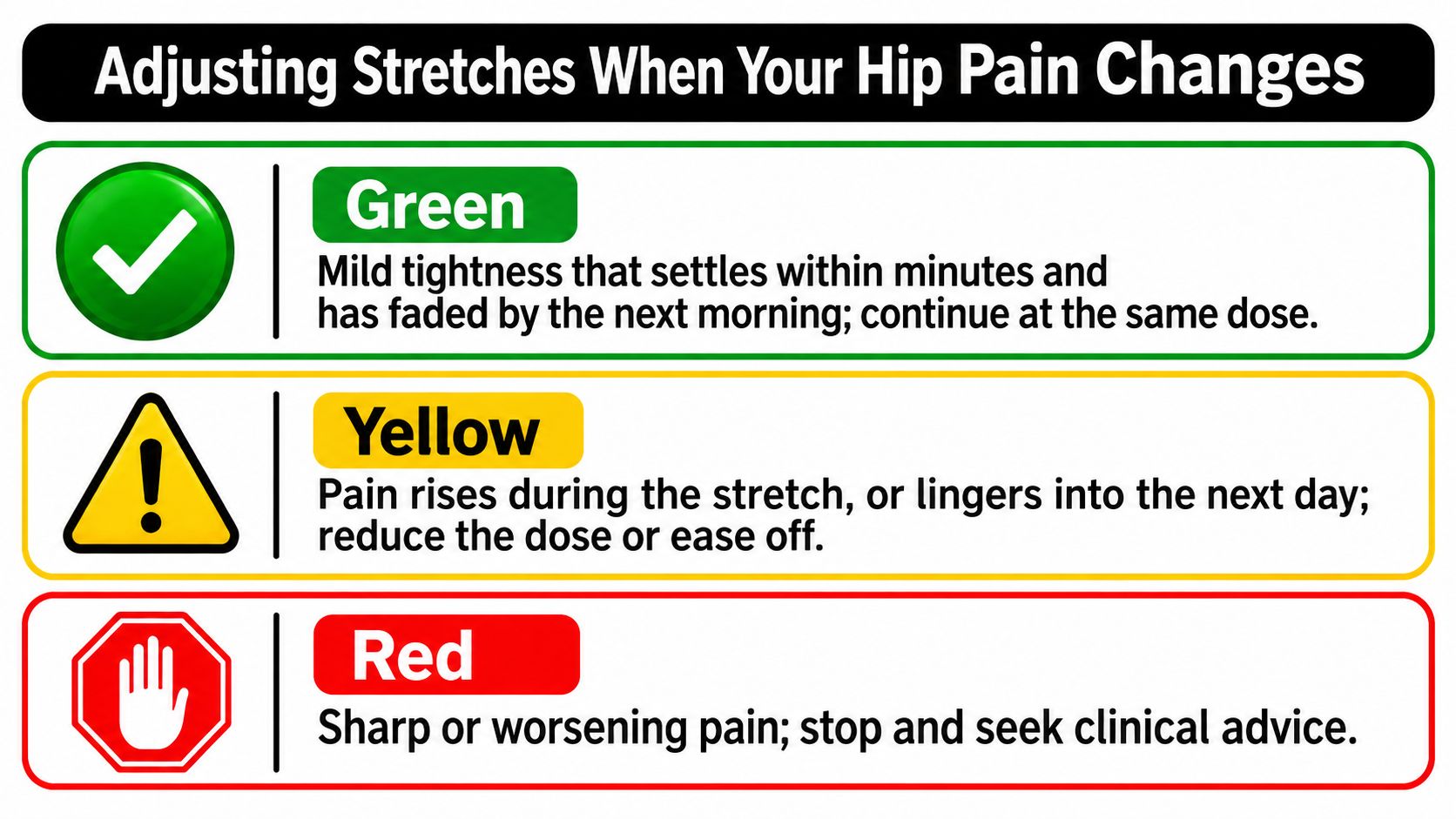
- Green. Mild tightness that settles within minutes and has faded by the next morning. Keep the same dose and keep going.
- Yellow. Pain rises during the stretch or lingers into the following morning. Cut the range, the hold time, or the number of repetitions, and drop to an easier version for a week.
- Red. Severe or persistent pain, night pain, a new limp, inability to bear weight, locking or catching, fever, recent trauma, or a marked loss of motion. Stop stretching and arrange a clinical assessment.
Guidance supports mild discomfort when you start exercising, but severe or persistent pain should send you to a healthcare professional rather than to a longer hold. A 2021 systematic review of therapeutic-exercise trials for hip osteoarthritis found inconsistent adverse-event reporting, including a home program of range-of-motion, stretching, and strengthening exercises that reported no adverse events in one trial yet did not establish a universal safety rule, as summarized in a Military Health System fact sheet on hip and knee osteoarthritis.
Modifications that keep the stretch useful
Hip flexor: shorten the lunge, keep the back knee further under you, and rest a hand on a chair rather than reaching overhead.
Hamstring: bend the knee more, or move the working leg closer to the wall instead of pulling it toward your chest with a strap at full extension.
Quadriceps: swap the kneeling version for standing with a wall for balance, or lie on your side and pull the heel back.
Figure-4: cross the ankle lower on the opposite thigh and support the leg with your hands instead of settling into the deepest position.
Why stretching isn't automatically the safer option
People assume a stretch is gentler than a loaded exercise. Sometimes it's the reverse. Forcing end-range hip flexion, rotation, or abduction can be the wrong choice for someone with more advanced disease, a prior hip replacement, osteoporosis, or balance problems, because those positions concentrate load exactly where the joint has least room.
Practical rule: pain that arrives during a stretch and is gone in five minutes is information. Pain still there at breakfast is an instruction to change the dose.
Name your color for today, then change one variable in response: range, hold time, or repetitions. One change at a time is how you learn what your hip tolerates.
Why Stretching Alone Falls Short and What to Add
Here's the part that changes walking and stairs: load. Strength work is what buys you tolerance for a longer day on your feet, not a looser hamstring.
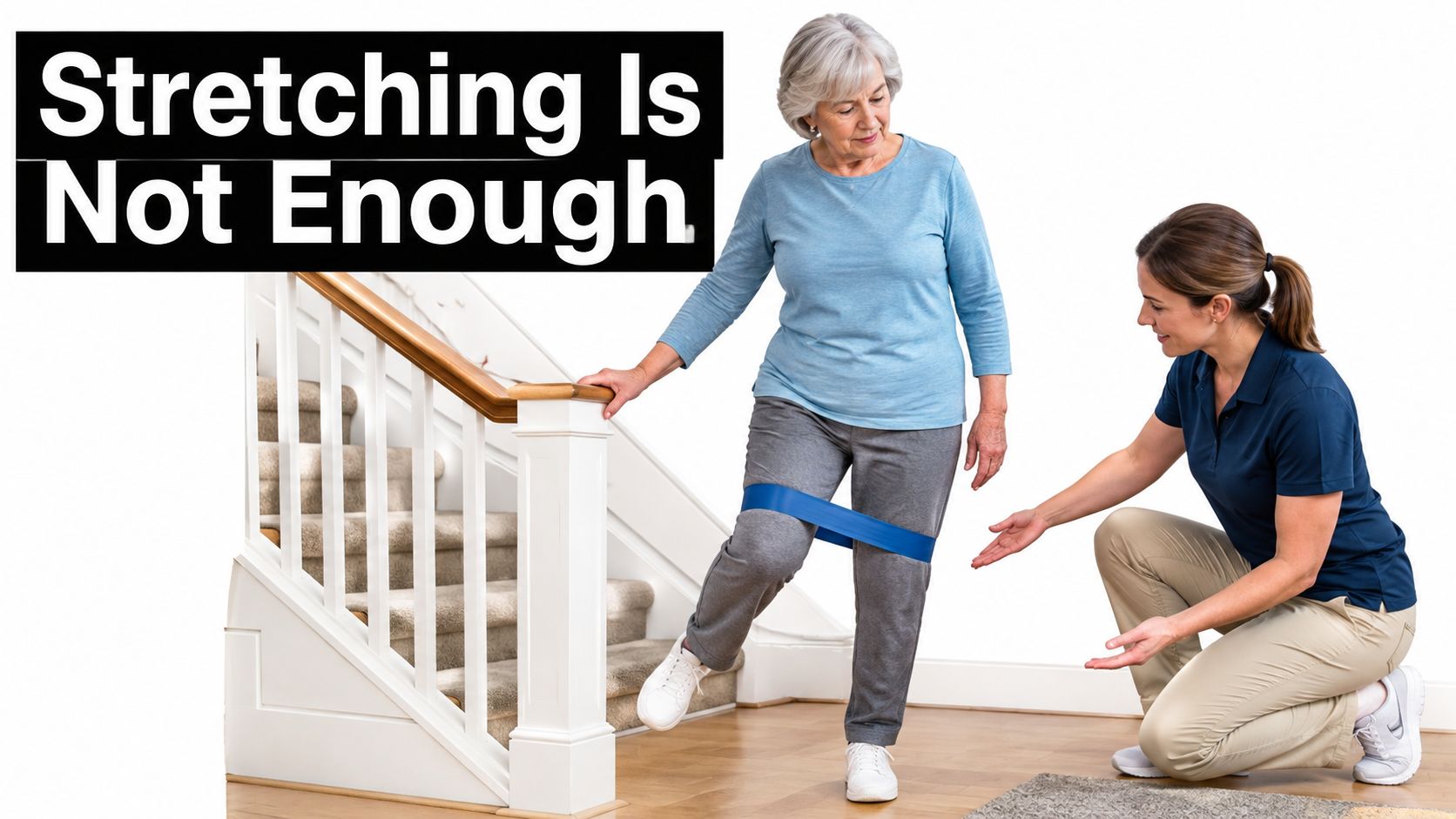
Land-based exercise for hip osteoarthritis produced only a small improvement in pain versus no exercise and no meaningful improvement in self-reported function, according to the VA/DoD osteoarthritis clinical practice guideline, which recommends programs combining joint-specific strengthening, general strength, flexibility, functional training, and progression instead of stretch-only routines. Translation: a person can feel looser after ten minutes on the floor and still struggle with the same flight of stairs.
Three lifts cover most of what a hip needs. Side-lying hip abduction targets the abductors, the muscles that keep your pelvis level when you stand on one leg. Glute bridges load the extensors with the knee bent and the foot flat, which keeps the hip out of deep flexion. Sit-to-stand trains the exact pattern that's become awkward, and you can progress it with a lower chair before you ever touch a weight. Add calf raises if stairs feel weak rather than stiff.
For endurance, walking on flat ground in supportive shoes beats one long march, and stationary cycling works well with the saddle high enough that the hip doesn't close up at the top of each stroke. Water exercise suits people whose hips complain under full body weight.
A week that uses the stretch table
- Stretch on 3 to 5 days. The target dose in the table, after a warm-up.
- Strengthen on 2 to 3 days. Two or three sets of each lift, adding repetitions before resistance.
- Move aerobically most days. Short, frequent walks or easy cycling.
- Block it out for 6 to 12 weeks, with one to three guided sessions weekly once the starting holds feel comfortable.
That structure also answers the common worry that stretching is the safe option while strengthening is risky. Our overview of physical therapy for arthritis explains how the balance shifts as range improves and where strengthening fits for sore joints generally.
For a visual walkthrough of the strengthening side, this short session demonstrates the kind of controlled hip and leg work that pairs with the stretches:
Your goals set the mix. Walking the dog, climbing stairs without a handrail, and getting through eighteen holes ask for different amounts of strength and endurance, and your pain tolerance and preferences decide how fast you build. Add one strengthening exercise this week, keep the stretches where they are, and see how the hip answers.
Decide Whether to Self-Manage or Book a Physical Therapy Assessment
Use your log, not a generic clinic pitch, to make this call. If you've stayed green for weeks, kept to the tolerable-pull rule, and you're gaining motion or finding the stairs easier, self-management is working. Keep going.
Book an evaluation if green symptoms continue for two weeks without better motion or function despite consistent practice. Book sooner if yellow keeps returning even after you shorten holds and switch to supported positions, because that pattern usually means the stretch choice or the starting dose doesn't match your hip. Book now if you hit a red light, since none of those signs improve with more stretching.
At MedAmerica Rehab Center, a therapist can measure range of motion, strength, gait, balance, and pelvic control, then match the starting hold, the progression, and the stretch selection to your disease severity and any prior hip surgery. A follow-up physical therapy or occupational therapy treatment runs 60 minutes, and depending on the service, a visit can include manual therapy, strengthening exercises, hot or cold packs, electrical stimulation, stretching and/or an adjustment.
What makes the visit worthwhile: supervised, long-term exercise, because inconsistent home practice is the usual reason a mobility plan stalls.
Bring a simple log of daily pain and the exact stretches, holds, and days you've already tried. The first visit then updates your plan instead of restarting it, and if you're unsure what to raise, these questions to ask a physical therapist will get you further in the first ten minutes.
MedAmerica Rehab Center has helped people in Deerfield Beach move past stiff, painful joints since 1995, combining hands-on physical therapy with targeted strengthening and mobility work matched to your hip, your goals, and how irritable the joint is this week. If the stretches here have plateaued or your pain keeps crossing into yellow, our team can assess your range of motion, strength, and gait and build a plan that fits your day. Visit MedAmerica Rehab Center to schedule an evaluation and get a routine you can keep.
MedAmerica Rehab · Deerfield Beach
Talk to a clinician about your pain
Physical therapy, chiropractic, acupuncture and shockwave therapy under one roof, since 1995. Same-day appointments are available.
Mon–Thu 8:00 AM – 6:30 PM · Fri 8:00 AM – 3:00 PM