

Does Physical Therapy Help Carpal Tunnel? Yes, with Limits
For mild-to-moderate carpal tunnel, physical therapy can reduce pain and improve daily hand use, but it is a symptom-management option, not a guaranteed cure. The hand may feel better without a matching change in grip strength or nerve-test results.
That distinction helps you judge progress. Sleeping better or holding a coffee cup more comfortably are meaningful gains, but they do not show that pressure on the nerve has resolved. Track both how your hand feels and how well the nerve and muscles are functioning.
What Physical Therapy Reliably Improves in Carpal Tunnel
Physical therapy is a reasonable conservative option for mild-to-moderate carpal tunnel syndrome, especially when symptoms come and go and strength is preserved. Pain relief and easier daily hand use are the most practical goals, not a promise that every symptom or abnormal test will disappear.
The evidence needs a qualification. A Cochrane review of exercise and mobilisation for carpal tunnel syndrome included 16 randomized studies involving 741 participants and found limited, very-low-quality evidence across symptoms, function, quality of life, nerve-conduction measures, and other outcomes. That means improvements are possible, but the size and consistency of the benefit remain uncertain.
Evidence for Physical Therapy by Outcome
| Outcome | Reported result | Evidence note |
|---|---|---|
| Pain | Manual therapy showed substantial immediate relief; nerve gliding also reduced pain | Results apply to the specific protocols studied |
| Symptom severity | Manual therapy improved questionnaire scores; nerve gliding had no statistically significant pooled effect | Results differ across techniques |
| Daily hand function | Both manual therapy and nerve gliding improved reported function | Nerve-gliding evidence was rated very low certainty |
| Grip and pinch strength | Manual therapy did not show a meaningful grip-strength benefit; nerve gliding showed no significant grip or pinch effect | Strength isn't reliably restored by therapy alone |
| Nerve-conduction tests | Manual therapy showed favorable changes in some measures; nerve gliding showed no significant distal motor latency effect | Findings are less consistent than pain relief |
These outcomes aren't interchangeable. The Boston Carpal Tunnel Questionnaire asks about symptom severity and practical hand use. A nerve-conduction test measures electrical signaling, while a grip dynamometer measures squeezing force. Improving one doesn't guarantee improvement in the others.
Practical expectation: Judge treatment by a combination of comfort, sensation, sleep, strength, and useful hand activity, not by pain alone.
Carpal tunnel symptoms also shouldn't be confused with joint stiffness. If you're exploring that separate problem, Pumpernickel Health Foods' resource on can omega 3 help stiff joints offers related reading, but it isn't evidence that a supplement treats median-nerve compression.
A realistic target is less discomfort and better function with ongoing neurological monitoring. Normal nerve tests, restored strength, and avoiding surgery aren't guaranteed outcomes.
How Each Part of a Therapy Plan Works
Physical therapy for carpal tunnel isn't one treatment. It's a selection of tools, chosen according to your symptoms, examination findings, and daily demands. The foundation is activity modification, changing the tasks and positions that repeatedly bring symptoms on.
The diagram illustrates how basic changes support more demanding exercise.
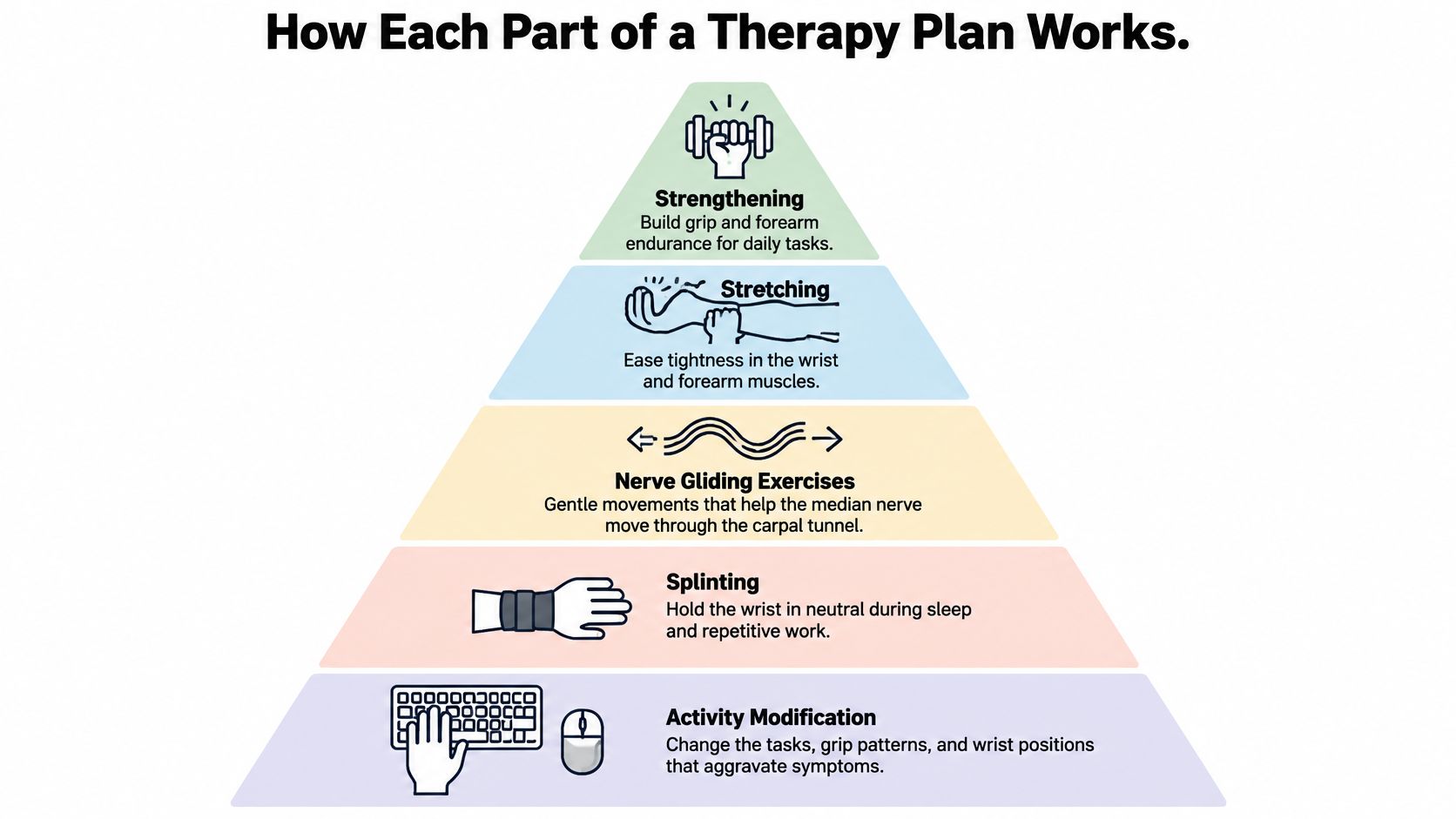
Components of a Carpal Tunnel Therapy Plan
| Component | What it involves | Best suited to | Evidence note |
|---|---|---|---|
| Activity modification | Changing provoking tasks, breaks, and grip habits | The foundation of an individualized plan | Common element of combined treatment |
| Neutral-wrist splinting | A night splint holding the wrist near neutral | Intermittent symptoms with preserved strength | Established conservative tool |
| Manual therapy | Hands-on mobilization around the wrist, forearm, and sometimes neck | Adults with symptomatic carpal tunnel | Promising immediate pain and function findings |
| Nerve gliding | Sequenced movements intended to improve median-nerve mobility | Selected mild-to-moderate cases | Pain and function gains, without clear strength or nerve-test gains |
| Tendon gliding | Finger-position sequences that move the flexor tendons | A tailored mobility program | Included in reviewed exercise programs |
| Strengthening and task retraining | Graded grip, pinch, and work-specific practice | When symptoms permit loading | Functional practice is useful; strength recovery remains uncertain |
| Ergonomic changes | Adjusting tools, workstation layout, and work methods | Repetitive, forceful, or vibration-heavy tasks | Aims to reduce aggravating exposure |
Why Position and Movement Matter
Think of the median nerve as a garden hose passing through a narrow pipe. A bent wrist can increase pressure around that passage; a neutral wrist reduces positional stress. The analogy isn't exact, because a living nerve is more complicated than a hose, but it explains why a night splint can help when your wrist bends unnoticed during sleep.
Nerve gliding aims to help the nerve move relative to surrounding tissue. Tendon gliding moves the finger-flexor tendons through controlled hand positions. Neither should become an aggressive stretch designed to force the tunnel open.
For desk work, practical changes include bringing the mouse closer, avoiding sustained wrist bending, and reducing unnecessary gripping. If keyboard use is a major trigger, Voice Control Pro's carpal tunnel guide is a relevant resource for considering typing habits and alternatives such as dictation. Changing exposure is more useful than repeatedly exercising and then returning to the same provoking setup.
What Hands-On Care and Gliding Actually Show
A 2021 systematic review of manual therapy, covering six randomized trials and 401 patients, reported a large immediate pain reduction versus control or sham treatment, with a standardized mean difference, or SMD, of -2.13. The same review reported symptom-severity and functional-status improvements of SMD -1.67 and -0.89, respectively.
An SMD expresses a difference in standardized units so researchers can combine results from different scales. It isn't a percentage improvement, a pain-score reduction, or a prediction of your individual result. Those findings also don't establish that hands-on care outperforms every other option.
The Journal of Orthopaedic & Sports Physical Therapy review of neurodynamic techniques examined 22 trials involving 1,203 people, finding pooled improvements in pain of SMD -0.54 and function of SMD -0.35, with very-low-certainty evidence. It found no significant benefit for distal motor latency, grip strength, or pinch strength.
A hand physical therapy assessment can help distinguish mobility work from strengthening and task practice. Stop an exercise that brings on or intensifies tingling and have the movement reviewed rather than pushing through it.
How Long Therapy Takes and What to Track
There is no dependable countdown to relief. The treatment, the degree of nerve involvement, and changes to activities that aggravate symptoms can all affect progress. Pain may ease before the hand has fully recovered, so track more than pain alone.
Some people improve with splinting over several months, while others need a different approach. Keep expectations measured: symptom relief and easier daily tasks do not necessarily mean grip strength or nerve function has returned to normal.
Use the timeline below to organize check-ins, not to predict when recovery should happen.
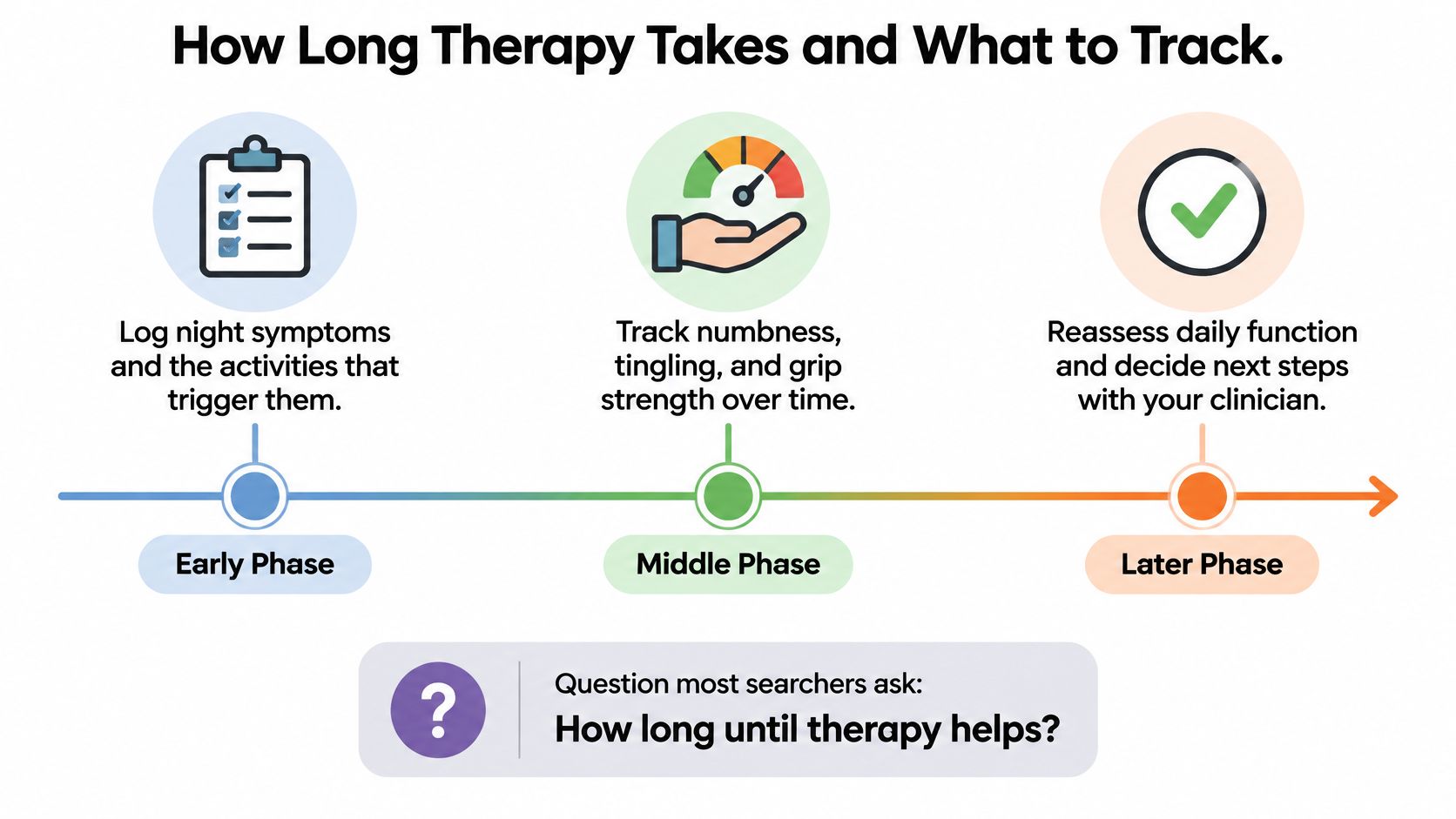
Build a Scorecard Before Treatment Changes
Write down a baseline before starting or substantially changing your plan. Use the same measures each time so you can compare like with like:
- Pain: Record a rating and the activity linked to it.
- Sleep: Note how often hand symptoms wake you.
- Sensation: Mark where numbness occurs and whether it comes and goes or stays constant.
- Strength: Ask your clinician to measure grip and pinch consistently.
- Function: Choose a task that matters to you, such as buttoning a shirt or holding a mug.
A FOTO outcome measure can help track changes in function over time. A questionnaire adds context, but it does not replace checking strength and sensation.
Typical Progress and Warning Signs by Stage
These are illustrative review windows, not guaranteed recovery deadlines.
| Stage | Typical change to look for, not a guarantee | Warning sign |
|---|---|---|
| Weeks 1–2 | Whether neutral positioning changes night symptoms | Symptoms increase despite adjustments |
| Weeks 3–6 | A trend toward better sleep, less tingling, or easier tasks | No improvement in agreed measures |
| Weeks 6–12 | Whether functional gains occur with stable or improving strength | Thumb weakness or spreading numbness |
| After 3 months | Whether the overall conservative-care trial is helping | Persistent deficits needing specialist review |
For example, you and your clinician might set six-week and twelve-week checkpoints. These are suggested times to review progress, not reasons to wait if symptoms worsen.
Use this video as a discussion aid, not as an individualized exercise prescription.
Continue if meaningful measures improve and neurological findings stay stable. If progress stalls, reassess the diagnosis and treatment rather than adding more sessions.
Physical Therapy Versus Injections and Surgery
The decision isn't about finding a treatment that wins for everyone. It's about choosing an option that matches the severity of compression, the condition of the nerve, and your daily requirements.
This comparison highlights the different roles of conservative treatment and procedures.
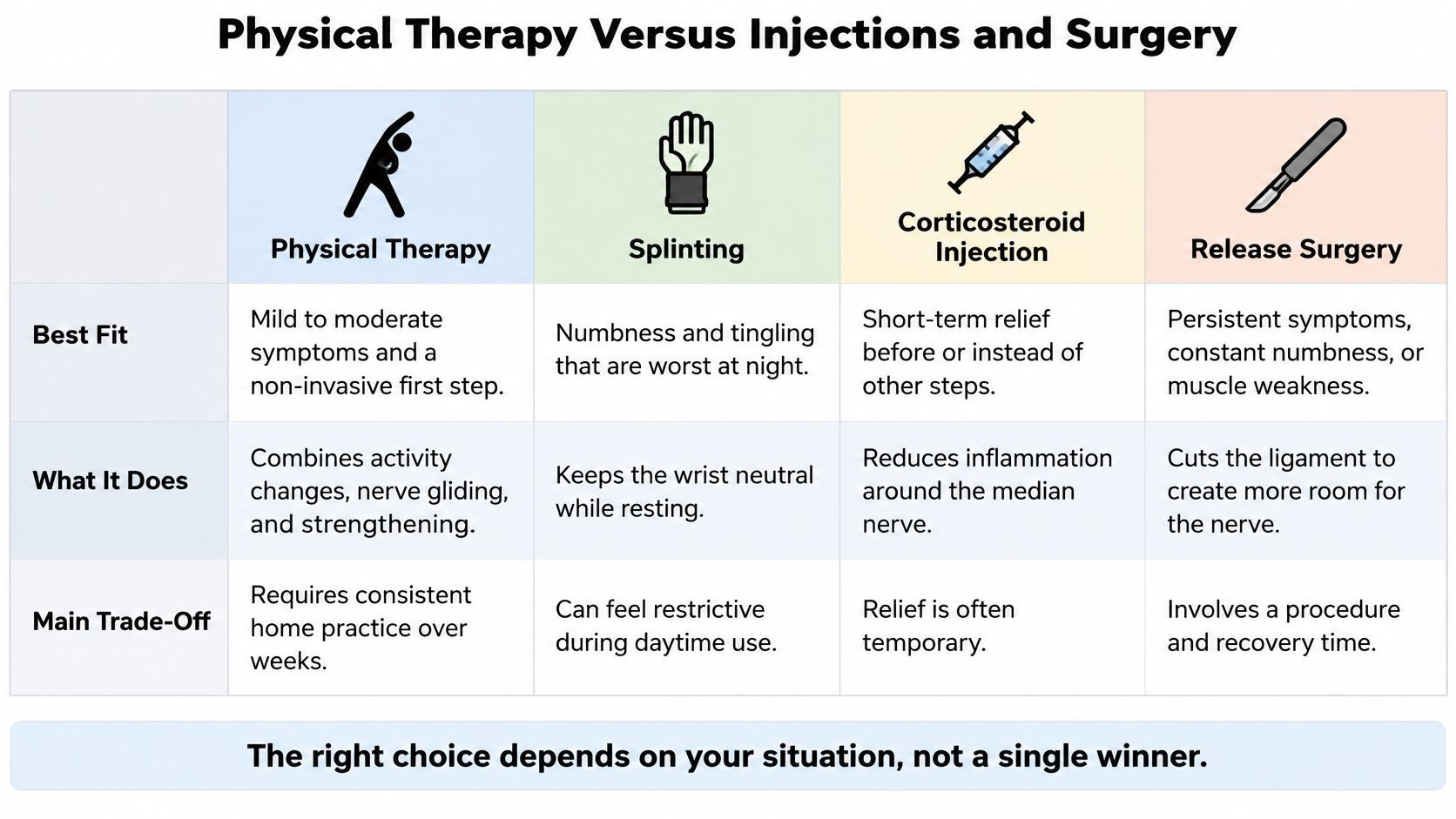
Carpal Tunnel Options Compared by Fit and Trade-Off
| Option | Best fit | Evidence highlights | Main trade-off |
|---|---|---|---|
| Physical therapy with splinting | Mild-to-moderate, intermittent symptoms with preserved strength | Can improve pain and function; doesn't reliably reverse nerve abnormalities | Requires consistent practice and monitoring |
| Corticosteroid injection | A clinician-selected option when additional symptom relief is needed | Pooled symptom and pain results were similar to therapy; some electrical measures favored injection | Relief may not resolve the underlying problem |
| Carpal tunnel release surgery | Severe compression, persistent weakness, or thumb-muscle wasting | Comparisons with splinting don't show a large average symptom advantage in all studied patients | Procedure-related risks and recovery |
A 2023 systematic review and meta-analysis indexed in PubMed found no significant difference between local corticosteroid injection and physical therapy in pooled symptom-questionnaire and pain scores, while distal motor latency and compound muscle action potential favored injection. Those electrical outcomes measure aspects of nerve and muscle signaling, not whether the hand hurts.
The 2024 Cochrane review comparing surgery with nonsurgical care, including 14 randomized studies and 1,231 people, found a symptom-severity difference favoring surgery over splinting of 0.26 points on a 1–5 scale, below its stated 1-point minimal clinically important difference. That supports a conservative starting point for many suitable patients, but it doesn't establish that splinting is sufficient for advanced nerve compression.
What Changes the Decision
Severity and duration matter together. Intermittent tingling that responds to position changes presents a different problem from constant sensory loss. Long-standing symptoms deserve careful assessment even when the pain isn't dramatic.
Neurological findings carry particular weight. Measurable thumb weakness, muscle wasting, and severe electrodiagnostic abnormalities can shift the discussion toward surgical evaluation. An injection shouldn't be treated as an automatic substitute for decompression when motor function is deteriorating.
Work demands and other health conditions affect feasibility. A person using vibrating tools or gripping forcefully may need workplace changes alongside treatment. Diabetes and other conditions affecting nerve health can complicate both diagnosis and the interpretation of persistent numbness.
Response over time helps refine the choice. Improving sleep and task tolerance with stable strength supports continuing a conservative plan. Flat results, worsening sensation, or new motor loss call for a different conversation.
The situation-based verdict is straightforward: intermittent symptoms with preserved strength often suit therapy and splinting first; severe or progressive neurological findings warrant specialist assessment, not an open-ended exercise trial.
When Waiting on Therapy Becomes Risky
Seek prompt clinical reassessment rather than waiting for the next routine appointment if you notice:
- Thumb weakness: Pinching becomes difficult, or you're dropping objects because the hand won't hold them securely.
- Visible muscle wasting: The fleshy area at the base of the thumb looks smaller or hollowed.
- Progressive numbness: Sensory loss becomes constant, expands, or clearly worsens.
- Stalled progress: The measures agreed with your clinician remain unchanged despite an appropriate treatment trial.
- Complicating nerve conditions: Diabetes or another condition affects nerve health and symptoms are persistent or changing.
These signs don't all carry the same urgency. New weakness, wasting, and worsening sensory loss deserve particular attention; diabetes alone doesn't mean you need surgery.
Why Less Pain Doesn't Automatically Make Waiting Safe
A Journal of Orthopaedic & Sports Physical Therapy summary comparing therapy and surgery reported better daily hand function and grip strength after one month with neck-and-median-nerve therapy plus stretching, with similar improvements between groups at 3, 6, and 12 months. That finding supports conservative care in selected patients, not delaying evaluation at every severity level.
Manual workers also need an honest review of exposure. Continuing forceful gripping, repetitive wrist bending, or vibration can make a treatment plan difficult to sustain. Exercises can't compensate fully for an unchanged task that repeatedly provokes symptoms.
A reassessment should include a hands-on examination, objective strength and sensation testing, and a review of work requirements. The clinician may recommend nerve testing or investigate a different source of symptoms; this comparison of carpal tunnel syndrome versus cervical radiculopathy explains why wrist and neck problems sometimes need to be distinguished.
Safety rule: A decision to postpone a procedure should include a monitoring plan and a reason to change course, not just reassurance that the pain is tolerable.
Start With a Carpal Tunnel Assessment This Week
If you're still asking, “Does physical therapy help carpal tunnel?”, the most useful next step is determining whether your symptoms fit a monitored conservative-care trial. You don't need to commit to months of treatment before asking how success will be measured.
Turn Symptoms Into a Clear Plan
Get the diagnosis and severity assessed.
Arrange an examination that considers the hand, nerve function, and possible alternative explanations. Nerve-conduction testing may be appropriate when the diagnosis is uncertain, deficits are present, or findings could change the treatment decision. Bring a description of which fingers feel numb and which activities provoke symptoms.Ask for the reason behind each treatment component.
A plan should explain why you're using a splint, practicing a particular movement, receiving hands-on care, or beginning resistance exercise. Ask which measures will demonstrate benefit and what would lead the clinician to remove or change a treatment. More techniques don't automatically make a better plan.Put review appointments on the calendar.
Agree on a checkpoint schedule suited to your examination findings, using the proposed monitoring windows rather than treating them as mandatory waiting periods. Record your baseline and choose a practical task you want to regain. Make sure the clinician knows about any change between visits.Begin with low-risk changes at home.
Keep the wrist near neutral during sleep and avoid prolonged bent-wrist positions. Move frequently used objects closer, relax unnecessary grip pressure, and change tasks that predictably trigger symptoms. Don't start forceful stretching or repeated squeezing simply because an online exercise is labeled for carpal tunnel.Escalate when the findings call for it.
Contact your clinician promptly for progressive numbness, thumb weakness, or muscle wasting. If your tracked measures stay flat, request a reassessment rather than renewing the same plan without a clear rationale.
Prepare for the First Visit
At MedAmerica Rehab Center, our physical therapy and occupational therapy initial evaluations take place on the first visit and typically last 60–75 minutes. Bring your symptom notes, any previous nerve-test results, and details about the hand tasks you need for work and home.
The decision rule is simple: start conservatively when symptoms are mild-to-moderate and strength is preserved, and seek specialist review when neurological findings worsen or meaningful progress stops.
MedAmerica Rehab Center offers physical and occupational therapy and treats carpal tunnel syndrome, with care directed toward pain, mobility, and useful hand function. Visit MedAmerica Rehab Center to arrange an assessment and discuss a treatment plan with measurable goals and clear reassessment points.
MedAmerica Rehab · Deerfield Beach
Talk to a clinician about your pain
Physical therapy, chiropractic, acupuncture and shockwave therapy under one roof, since 1995. Same-day appointments are available.
Mon–Thu 8:00 AM – 6:30 PM · Fri 8:00 AM – 3:00 PM