
Shoulder Injury Exercises to Avoid and Safer Alternatives
Your shoulder still hurts when you reach for a mug, or it feels fragile weeks after surgery, and a late-night search hands you a tidy list of shoulder injury exercises to avoid. Overhead press, dips, upright rows, anything behind your back. You save the list and treat it like a permanent ban.
That shortcut feels protective. It often isn't. A repaired tendon, an irritated cuff, a fracture, a labral injury, and a shoulder that has slipped out of the socket do not share the same rules. The reach that irritates one shoulder this week can be the exercise another shoulder needs next month.
Most limits are temporary. They follow the tissue that is healing, the phase you are in, and what your surgeon or therapist has cleared. Sorting those limits by injury, and learning how symptoms behave over the next few hours, is more useful than memorizing a blacklist.
Why Generic Shoulder Exercise Lists Fall Short
You find a sore shoulder and a blog that says never go overhead, never lift, never stretch hard. You cancel the movements you use to put away dishes and load the dryer. Three months later the shoulder is stiffer, and you still don't know which rule applied to you.
Think of the shoulder as a busy hinge on a door that also has to hold weight. A hinge that was just reattached needs quiet while the screws set. A hinge that is only squeaky may need gentle use so it doesn't rust shut. A hinge that keeps popping open needs the latch checked before anyone leans on it. One "don't open the door" sign doesn't fit all three.
The same arm raise can be harmful in one injury and useful in another. Generic advice such as avoid overhead movements can be unsafe because restrictions differ substantially among rotator-cuff tendinopathy, acute tears, fractures, labral injuries, AC-joint injuries, and postoperative repairs. The 2025 ACOEM shoulder guideline gives examples of temporary limits, such as avoiding more than 60 degrees of abduction or forward flexion and lifting more than 10 pounds, adjusted for injury severity and what you could do before.

Three ideas that replace a blacklist
Temporarily avoid versus never do. Most cautions expire. A pulley that is wrong at week two can be reasonable much later, once the repair or the unstable joint can tolerate it.
Recovery phase. Early protection, mid-stage strengthening, and return to sport are different jobs. A movement that is off-limits while you are in a sling can become the goal of rehab.
Clinician-directed limits. After surgery, a fracture, or a dislocation, the person who saw the tissue sets the timeline. Online lists can't see tear size, anchors, or bone healing.
Restrictions get reassessed as strength and control return. If you can lift the arm without hiking the shoulder, sleep through the night, and keep symptoms steady the next day, the window usually widens. If pain climbs or the joint feels loose, the window stays narrow.
A copied list is a starting guess, not a diagnosis. Match the caution to the injury you actually have.
Exercises That Strain a Healing Rotator Cuff
After a rotator-cuff repair, the tendon is trying to stick back to bone. That attachment is mechanically weak at first. High muscle effort, a high arm lift, and a hard twist can tug or shear the repair before it has strength of its own.
After rotator-cuff repair, exercises that create high muscle activation or excessive shoulder elevation can jeopardize tendon-to-bone healing. A 2017 systematic review examined electromyographic evidence from 13 active-assisted exercises and found that 9 produced supraspinatus activation at or below 15% of maximum voluntary isometric contraction (MVIC), a level proposed as an appropriate early-loading limit. Bar- or pulley-assisted elevation commonly exceeded 15% MVIC, so those lifts can be a poor fit in the earliest phase. The same review reported that passive external rotation may need to stay below 30 degrees during acute healing, and that passive or active internal rotation can load the repair enough to avoid at the start.
What tends to overload the repair early
Published rotator cuff protocols group the risky patterns this way:
- Aggressive strengthening: Heavy bands, dumbbells, and long lever presses ask the cuff for force it doesn't have yet.
- End-range stretching: Forcing the arm up, across, or behind the back adds tension at the repair.
- Lifting above shoulder height and weight-bearing through the arm: Push-ups, planks, and overhead carries stack compression on top of muscle pull.
- Combined adduction and internal rotation: Reaching across the body and turning the arm in can shear the repair unless your surgeon has cleared it.
Early resisted rotation, when it is allowed, usually stays below shoulder level and uses submaximal effort. If the protocol calls for true passive motion, a pulley you haul yourself isn't a substitute. Pain-free activation and smooth scapular motion come before added resistance. Hiking the shoulder to finish a rep is a sign the load is ahead of control.
Rehab has a familiar order: passive motion first, then active-assisted, then active exercise, with excessive stress kept down for as long as 12 weeks so the tendon can heal to bone. Tear size, repair technique, tissue quality, and the surgeon's protocol change that clock. People who are not having surgery still need a plan matched to the tear. A clear look at rotator cuff tear recovery time without surgery helps separate protection from permanent avoidance. Day-to-day comfort strategies in SunnyBay shoulder recovery advice can sit alongside that clinical timeline, not replace it.
These cautions belong to the protection phase. They are not a lifetime ban on pulleys, overhead work, or rotation.
Overhead and Contact Moves After a Dislocation
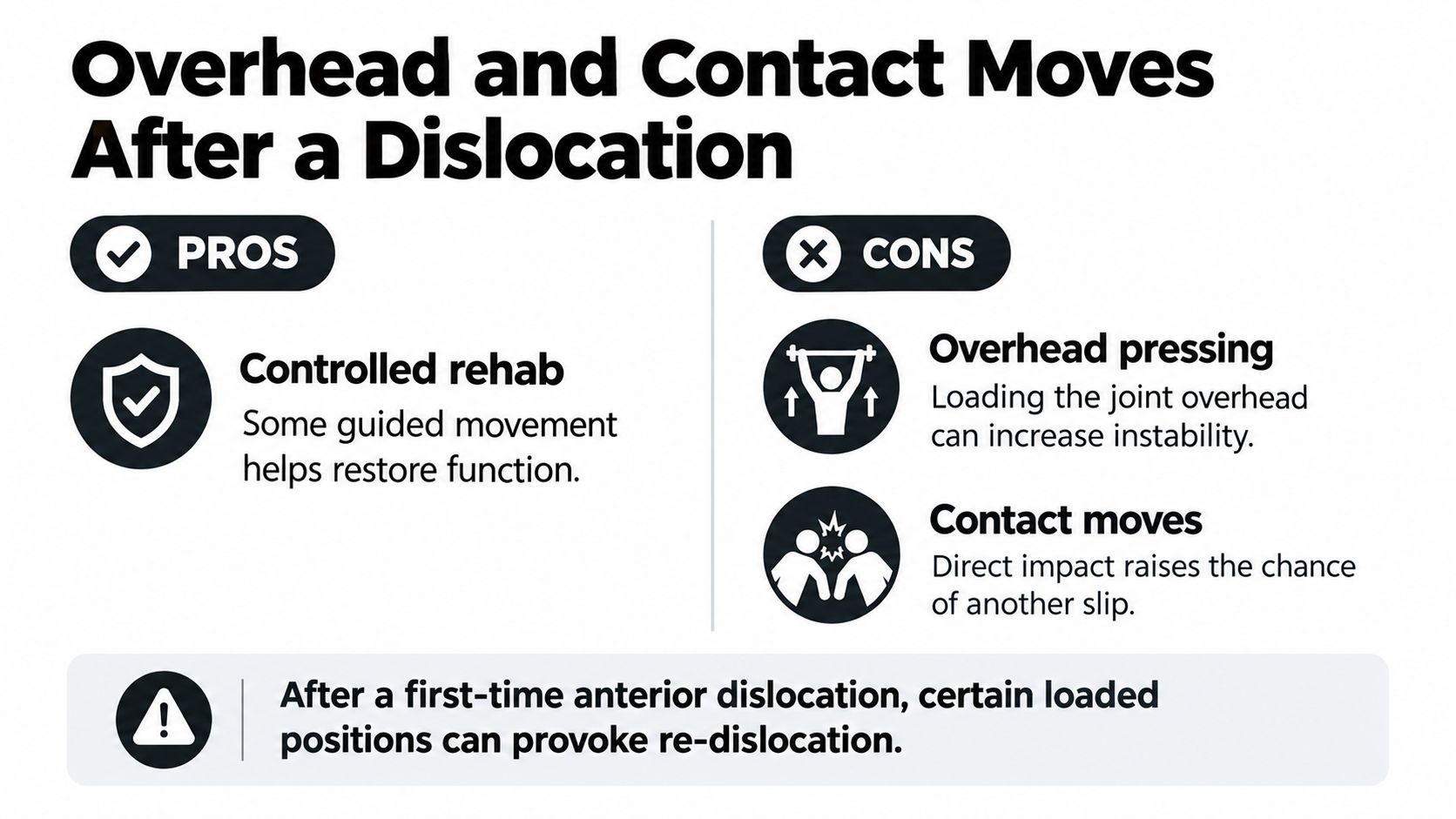
An anterior dislocation means the ball left the socket toward the front. The capsule, labrum, and muscles that normally keep it seated are irritated or torn. Until those restraints are tested, certain loaded positions can let the ball slip again.
Overhead reaches, forceful external rotation, abduction paired with a throwing motion, and contact deserve extra caution. Recurrence after a first-time anterior dislocation isn't rare. A review of first-time anterior dislocations reported recurrence estimates from 14% to 100% across studies, because age, activity, injury severity, and follow-up differ. In one Level I prognostic study, people in contact or collision sports had a 55% redislocation rate after a primary traumatic dislocation, compared with 38% among those who didn't play those sports. Another dataset in that review put 2-year recurrence at 63.3% for contact or overhead-sport participants, 73.3% for non-contact sports, and 46.0% for people who didn't play sports. At 5 years the figures were 62.8%, 33.9%, and 43.9%.
Sort the work before you return
Don't treat every arm motion as forbidden. Sort what you do.
- Leave unsupervised for now. Overhead pressing, rapid throwing drills, wide abduction with the arm turned out, and contact that can knock the arm back belong here until stability and strength are checked.
- Build on purpose. After a short period in a sling, often about 1 to 3 weeks, rehab usually moves through range of motion, then strengthening, then sport-specific work. A dislocated shoulder rehab sequence spells out that order so you aren't guessing from gym videos.
- Retest before sport or heavy work. Controlled motion with a clinician is different from a game, a tackle, or a max bench. Return when the shoulder stays seated under speed and fatigue, not when the calendar says so.
The point is a planned return. A generic forever-ban misses that many people regain overhead and contact capacity once the joint is stable and the cuff is strong. Jumping back because the sling came off is how the high recurrence numbers stay high.
Movements to Limit During Acute Shoulder Pain
A flare is different from a fresh repair or a dislocation. The shoulder hurts at rest or with ordinary tasks, and you still want to train. You don't have to stop moving. You do have to stop the positions that keep poking the sore tissue.
During an acutely painful shoulder condition, temporarily avoid or reduce overhead pressing, heavy lifting, and repetitive overhead exercise. Overhead loading raises demand on the rotator cuff. When the muscles aren't centering the ball, the humeral head can drift upward, narrow the subacromial space, and aggravate tissues that don't like compression. That mechanism is laid out in clinical summaries such as the StatPearls review of shoulder impingement.
A smaller, safer workspace
Keep the arm in a pain-free window in front of the body, about a 2 to 3 foot rectangle. Shelves at eye level, a countertop, a band held in front of the chest. For now, skip overhead locks and reaches behind the back, including deep dips and behind-the-neck pulldowns.
Stop or make the exercise easier if you notice:
- Sharp pain that doesn't fade as you slow down.
- Symptoms that keep building during the set instead of staying flat.
- Shrugging the shoulder toward the ear to finish the rep.
Those signs mean the load is past current control. Drop the range, the weight, or the reps. Don't add a bigger warm-up and push through.
Overhead work comes back as pain settles and the arm moves cleanly, not at last month's sets and loads. Start with a shorter range and lighter resistance, then add one variable at a time. A flare that calms in a day is information. A flare that stacks for a week means you returned too fast.
Seeing the motion helps. This short demo shows how small changes in arm path change shoulder stress.
Reading Pain Signals and Adjusting Your Workouts
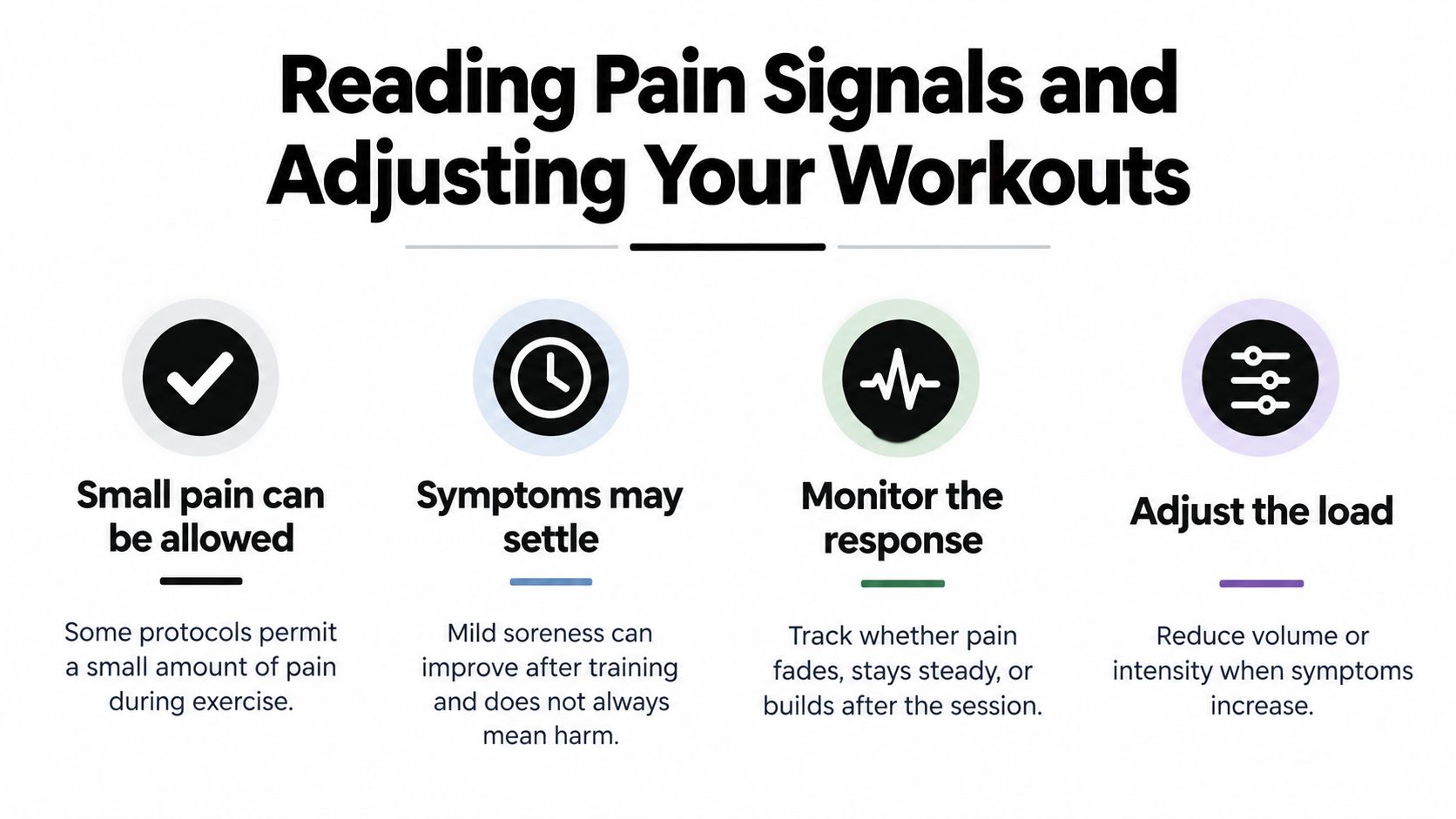
"Stop if it hurts" is easy to remember and too blunt for many painful shoulders. Some soreness during tendon loading is expected. Sharp, spreading, or next-day collapse is not. Treating every sensation as damage keeps people still. Ignoring all of it keeps them injured.
A review of physical-therapy advice found that only three of the included studies described progression in detail. Some protocols allowed pain up to 3 out of 10, or asked that symptoms return to baseline within about 30 minutes. The review also concluded that evidence for each separate piece of advice is still limited. A trial protocol in chronic rotator-cuff tendinopathy has compared pain-avoidance exercise with an approach that allows pain rated 3 to 5 out of 10 during and after exercise. "Pain equals damage" isn't a precise rule for uncomplicated tendinopathy.
Watch the hours after, not only the set
Check symptoms that evening and the next morning. Delayed flare-ups, sleep that breaks because of the shoulder, and a harder time dressing or reaching the next day matter more than a brief ache in the last two reps.
If symptoms settle to baseline within about half an hour and the next day feels the same, hold the plan or add a little range, resistance, reps, or frequency. Change one thing.
If pain lingers for hours, wakes you, or leaves the arm weaker the next morning, cut something. Shorten the range first, then the resistance, then the reps, then how often you train.
If the shoulder is a repair, an acute tear, or unstable, the same 3 out of 10 can mean "stop and call," not "continue." Those injuries need stricter, clinician-set limits than a cranky tendon that has been grumbling for months.
Progression is reasonable when you move without hiking the shoulder, pain doesn't climb across the week, night pain isn't worsening, and daily tasks feel easier. A monitored plan beats a universal blacklist because it tells you what to change on Thursday, not only what to fear forever.
Choosing the Right Care Path for Your Shoulder
Three routes show up once the shoulder hurts. They are not equal, and the right one depends on what is actually wrong.
| Path | What you get | Where it fails |
|---|---|---|
| Self-directed exercise from a saved list | Immediate ideas and no appointment | The list can't tell a repair from a strain, so you may protect the wrong thing or load too soon |
| General fitness or wellness advice | Encouragement to stay active and modify workouts | Coaches rarely have surgical restrictions, imaging, or instability findings |
| Clinician-directed rehabilitation | Limits and progressions tied to your diagnosis, surgery, and how symptoms change | It takes an evaluation, and early sessions may feel slower than a gym plan |
Questions that pick the path
Has anyone diagnosed the shoulder? Tendinopathy, a tear, a fracture, a labral injury, and an AC-joint sprain do not share restrictions. If you don't know which one you have, a list is a guess.
Was there surgery, and what did the surgeon allow? Anchors, tear size, and tissue quality override any article, including this one.
Does the shoulder feel unstable? Slipping, dead-arm moments, or a history of dislocation means strength work waits on a stability check. Details of that process sit with physical therapy for a shoulder injury.
Are symptoms changing? A steady ache that responds to smaller ranges is different from weakness, night pain, or instability that is getting worse.
MedAmerica Rehab Center is one clinician-directed option for people in Deerfield Beach and nearby towns. It is a family-owned clinic that has offered physical therapy, chiropractic care, acupuncture, and shockwave therapy since 1995. Licensed therapists and doctors build individual plans that can include hands-on care, targeted exercise, and support before and after surgery. Same-day appointments and insurance-friendly intake are part of how a first visit is set up, including for sports injuries, auto accidents, and workers' compensation cases.
Online lists stay useful as education. They shouldn't be the only plan when the diagnosis is unclear, the shoulder has been operated on, or the joint doesn't feel reliable.
Red Flags That Need a Clinician and Your Next Step
Some signs mean stop self-directed exercise and get the shoulder examined. A workaround, a lighter band, or another week of rest doesn't answer them.
- Worsening weakness: You could lift the arm last week and now you can't, or the arm feels dead during ordinary reaching.
- Instability: The shoulder slips, clunks with loss of control, or you don't trust it overhead.
- Neurological symptoms: Numbness, tingling, or weakness that spreads down the arm needs a clinician, not another exercise swap.
- Escalating night pain: Pain that increasingly breaks sleep is a reason to be seen, especially after a recent injury.
- Pain that keeps rising even after you shortened range, load, and frequency.
- A new injury after a fall, collision, or car crash. Don't test that shoulder with a workout.
A clinician may set limits from imaging, surgical findings, and the story of how it happened. That is why auto-accident, workers' compensation, and postsurgical patients get into trouble with a permanent "never overhead" list. The restriction might be right for two weeks and wrong for two months.
What to bring to the visit
Write down when the pain started, which movements provoke it, any surgery date and written restrictions, and prior imaging. Note what you changed in training and how the shoulder felt that night and the next morning. Those notes shorten the evaluation.
MedAmerica Rehab Center evaluates shoulder injuries, including workers' compensation and auto accident cases, and can tell you whether protection, gradual loading, or further medical review comes first. Call the clinic or start from the site below rather than adding another unsupervised exercise this week.
If your shoulder is keeping you from work, sport, or ordinary reaching, MedAmerica Rehab Center offers physical therapy and related care that sets injury-specific limits instead of a generic ban list. The team in Deerfield Beach builds plans for painful shoulders, instability, and recovery after surgery. Visit MedAmerica Rehab Center to schedule an evaluation and get a timeline that matches your shoulder.
MedAmerica Rehab · Deerfield Beach
Talk to a clinician about your pain
Physical therapy, chiropractic, acupuncture and shockwave therapy under one roof, since 1995. Same-day appointments are available.
Mon–Thu 8:00 AM – 6:30 PM · Fri 8:00 AM – 3:00 PM