

Upper Neck Pain Treatment and Recovery Guide
You turn to check a blind spot and feel a sharp catch where your neck meets the base of your skull. By bedtime, finding a comfortable position is difficult, and you're wondering whether to stretch, rest, massage the area, or book an appointment.
The safest answer depends on what else is happening. Mild pain that changes with movement may call for a different response than pain after a serious injury or symptoms such as new weakness. Upper neck pain treatment works best as a decision process: first consider warning signs, then match self-care or professional support to your symptoms and how they affect daily life.
Why Upper Neck Pain Needs a Thoughtful Approach
Neck pain can turn an ordinary task into a calculation. You might rotate your whole body to check traffic, prop yourself up to read, or avoid lifting a bag because the movement feels uncertain. A night of interrupted sleep can make concentration and work harder the next day, and pain around the upper neck may occur alongside headaches.
That disruption doesn't automatically mean something dangerous is happening. Neck pain is a broad category that can involve joints, muscles, discs, nerves, and nearby tissues, so the location of the pain alone can't identify its cause. The same sharp catch may settle with a gradual return to movement, while pain accompanied by concerning neurological changes needs medical assessment.
The global burden is substantial: a Global Burden of Disease analysis estimated that 203 million people were living with neck pain worldwide in 2020, with a 95% uncertainty interval of 163–253 million. The age-standardized prevalence was 2,450 cases per 100,000 people, and the age-standardized rate of years lived with disability was 244 per 100,000 (Global Burden of Disease 2021 neck pain analysis). These figures describe neck pain broadly, not upper-neck symptoms alone, but they help explain why treatment should consider function as well as discomfort.
A useful plan asks more than “How much does it hurt?” It considers whether you can turn your head, sleep, drive, work, and take part in usual activities, as well as whether headaches or symptoms in an arm are present. Treatment may then combine education, activity adjustments, exercise, hands-on care, or medical review, depending on the findings.
A steady first move: Check for warning signs before trying to force a stretch or seeking a quick fix.
Understand the Pain Before Treating It
Think of your neck as a mobile tower that supports your head while allowing you to look up, down, and around. Like a suspension bridge, it relies on several connected parts sharing the load. Joints guide movement, muscles provide support and control, discs cushion between vertebrae, and nerves carry signals between the neck and other areas.
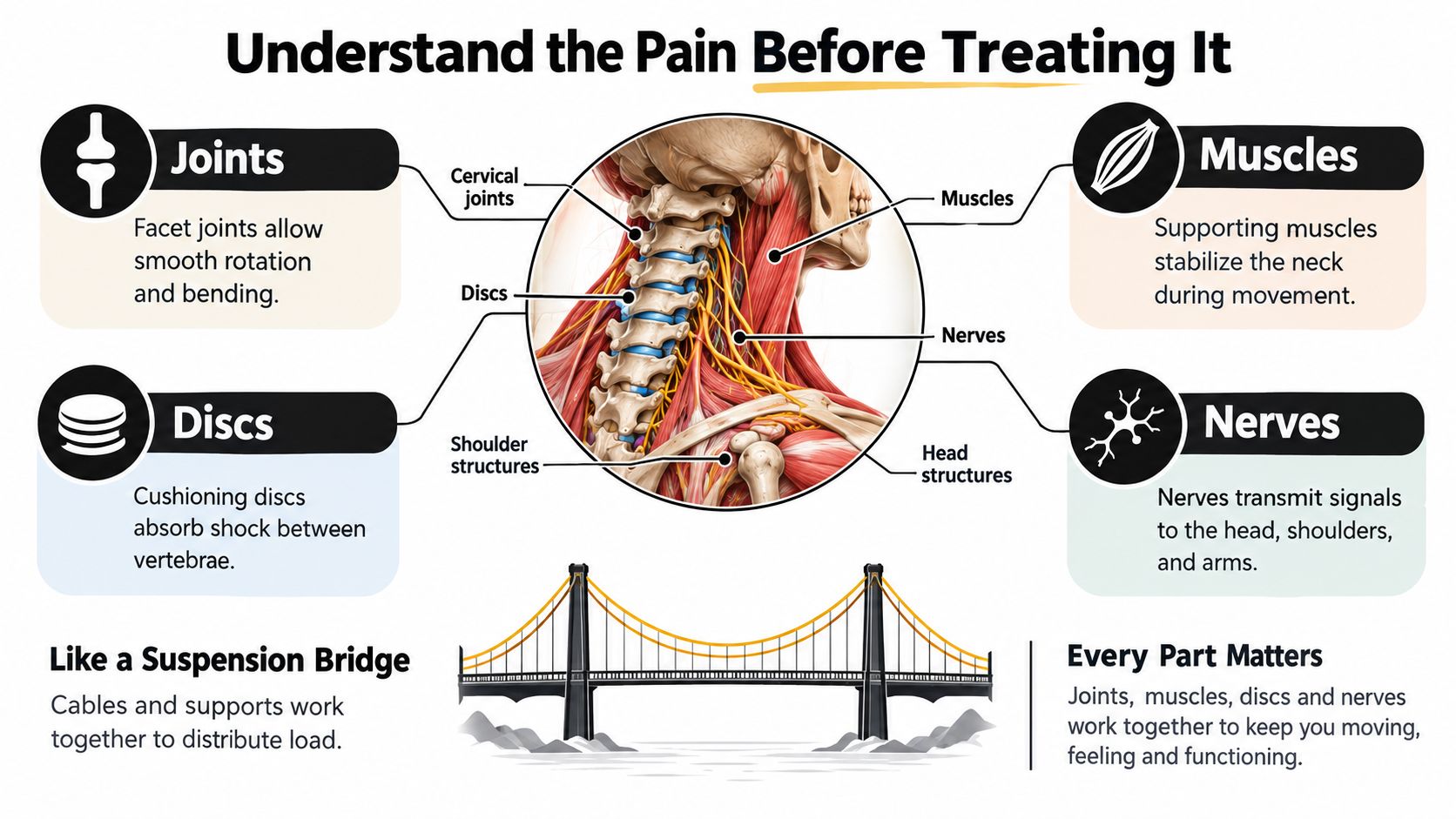
Read the pattern, not just the location
A long drive or extended computer session can hold your neck in one position. A stressful day may leave the shoulders and neck feeling tense; lifting, an awkward sleep position, or a previous injury may also matter. These are possible contributors, not proof of the cause. One person's symptoms may ease after changing position, while another may find that certain movements repeatedly provoke pain.
Pain can stay around the neck or spread toward the shoulder or head. A cervicogenic headache is a headache associated with a problem in the neck, and neck movement or examination may help a clinician assess that possibility. But not every headache that occurs with neck discomfort comes from the neck. Migraine and other headache conditions can overlap, so headache history and the full symptom pattern matter.
If pain, tingling, or numbness travels into a shoulder or arm, it's worth discussing the pattern with a clinician rather than guessing which structure is involved. You can read about the difference between carpal tunnel syndrome and cervical radiculopathy, but an online comparison can't replace an examination.
Set goals beyond pain relief
A clinician may ask about injury history, headaches, sensation, strength, sleep, work demands, and movements that increase or reduce symptoms. Those details help distinguish what needs further assessment from what may respond to a gradual activity plan.
Track practical changes, too. Are you turning more comfortably while driving? Is sleep less disrupted? Can you work or handle household tasks with less limitation? Those measures help show whether a plan is restoring capacity, even if symptoms don't disappear immediately.
Recognize Causes and Warning Signs Early
Persistent pain doesn't automatically mean you need an MRI. The next step depends on symptoms and history, especially whether there was a significant injury or whether neurological changes are appearing or worsening.
Joint irritation, muscle guarding, disc-related symptoms, and headache linked to neck movement are among the possibilities a clinician may consider. They can feel different, but no single sensation proves what's causing the problem. An online guide can help you think through urgency, not diagnose you.
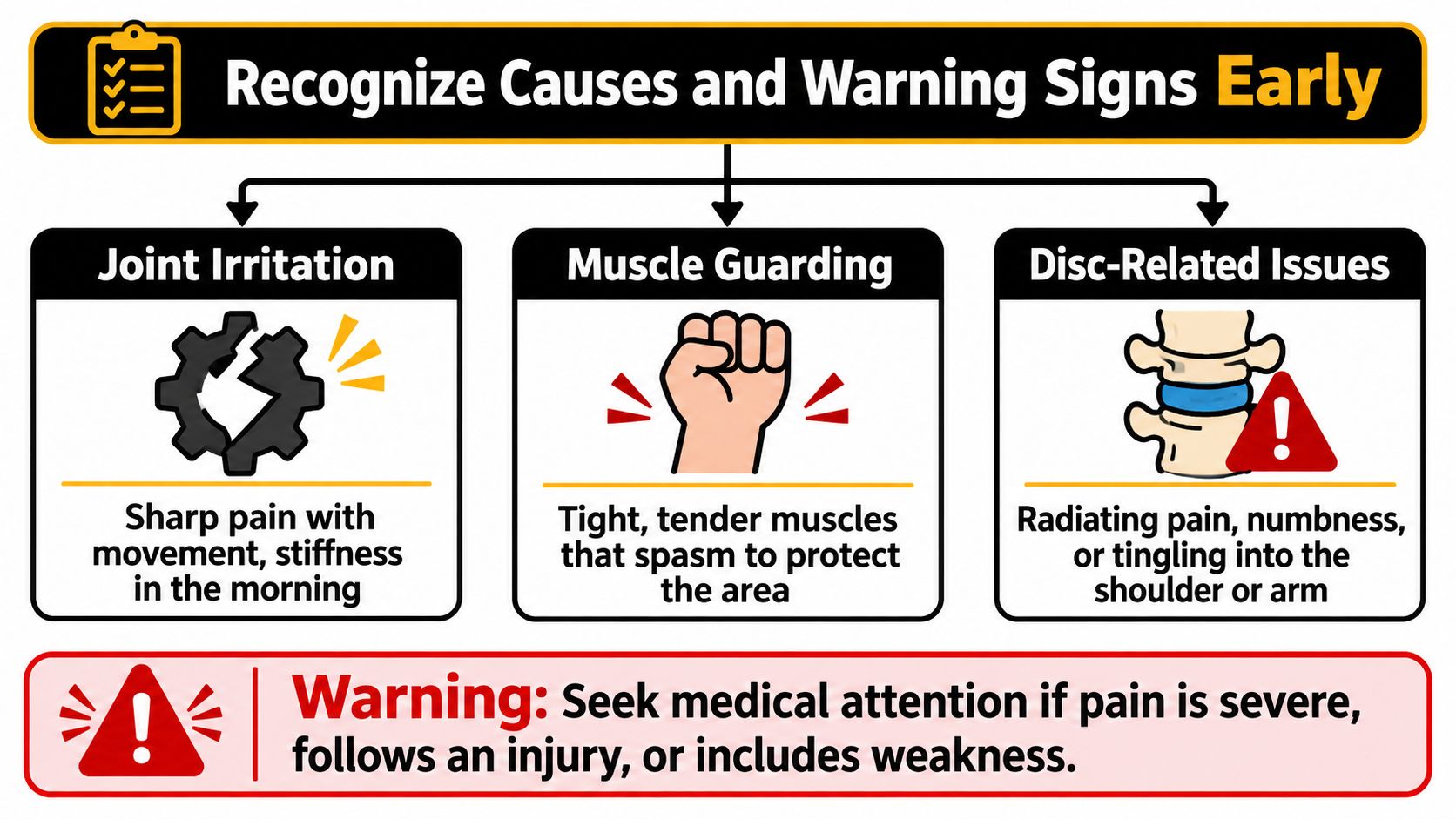
Use a three-level triage check
Emergency symptoms: Seek emergency care for severe neck pain after a significant injury, or for symptoms such as altered consciousness or a sudden, severe headache. Don't try to manage these situations with home exercises.
Prompt medical review: Arrange timely assessment for new or worsening weakness, progressive numbness, problems with balance or coordination, fever, unexplained weight loss, or other concerning neurological changes. Significant trauma also warrants medical evaluation. A 2025 German S3 guideline advises immediate evaluation after trauma and when findings such as motor deficits, gait impairment, or altered consciousness are present (German S3 guideline on neck pain).
Reasonable self-monitoring: If symptoms are mild, linked to movement or sustained positions, and there are no warning signs, gentle activity and observation may be appropriate. Seek professional advice if symptoms persist, worsen, or interfere with daily tasks.
The guideline advises against routine imaging for nonspecific neck pain. That doesn't mean imaging is never useful; a clinician may consider it when the history or examination raises a concern. The decision is about whether a scan is likely to answer a meaningful clinical question, not whether pain has lasted a certain amount of time.
After a crash or other injury, you may also need practical information about neck trauma and legal options. A neck injury attorney in Denver can explain injury-related legal considerations, while medical professionals assess symptoms and treatment needs.
Build an Effective Upper Neck Pain Treatment Plan
When warning signs aren't present, treatment usually progresses from making symptoms manageable to rebuilding comfortable movement and strength. That doesn't mean staying in bed until all discomfort disappears. Adjust activities that aggravate the neck, take breaks from fixed positions, and use a comfortable resting position while keeping daily movement within a tolerable range.
Heat or cold is a personal comfort choice. Try the option that feels better, and stop if it irritates your skin or makes symptoms worse. If you're considering medication, ask an appropriate clinician or pharmacist what's safe for you, especially if you have other health conditions or take other medicines.
Progress from movement to strength
Start with gentle neck movements in a comfortable range, then gradually return to usual activities. As movement becomes more tolerable, a rehabilitation plan may add cervical and shoulder-blade strengthening, coordination work, and adjustments to work or driving positions. The point isn't to hold a perfect posture all day; it's to vary positions and build the ability to handle everyday demands.
Hands-on care may help some people move more comfortably or take part in exercise. It's best viewed as one possible support, not the whole plan. Repeated passive treatment without a path toward active movement can leave the original task or movement challenge unaddressed.
| Situation | Reasonable next step | Escalation signal |
|---|---|---|
| Mild, movement-related discomfort without warning signs | Modify aggravating activities and try gentle movement | Symptoms worsen or begin limiting routine activities |
| Pain that persists or interferes with sleep, work, or driving | Arrange a routine review with a healthcare professional | New neurological symptoms or other warning signs appear |
| Pain after significant trauma, or new weakness, worsening numbness, or balance trouble | Seek urgent medical assessment | Follow emergency guidance if symptoms are severe or rapidly worsening |
Measure useful changes
Record how easily you turn your head, whether headaches are occurring, how you're sleeping, and what you can manage at work or home. If headaches are part of the problem, note their frequency and whether neck movement changes them. These observations give you and your clinician something more useful than a vague sense that the treatment “worked” or “didn't.”
Improvement may take several weeks, and the pace varies. If you're not seeing meaningful gains, or symptoms change in a concerning way, review the diagnosis and plan rather than repeating the same approach indefinitely.
Use Home Exercises and Everyday Movement Safely
Home movement should be controlled, comfortable, and easy to adjust. The aim is to help your neck and shoulders move and work with less effort over time, not to force a dramatic change in one session.
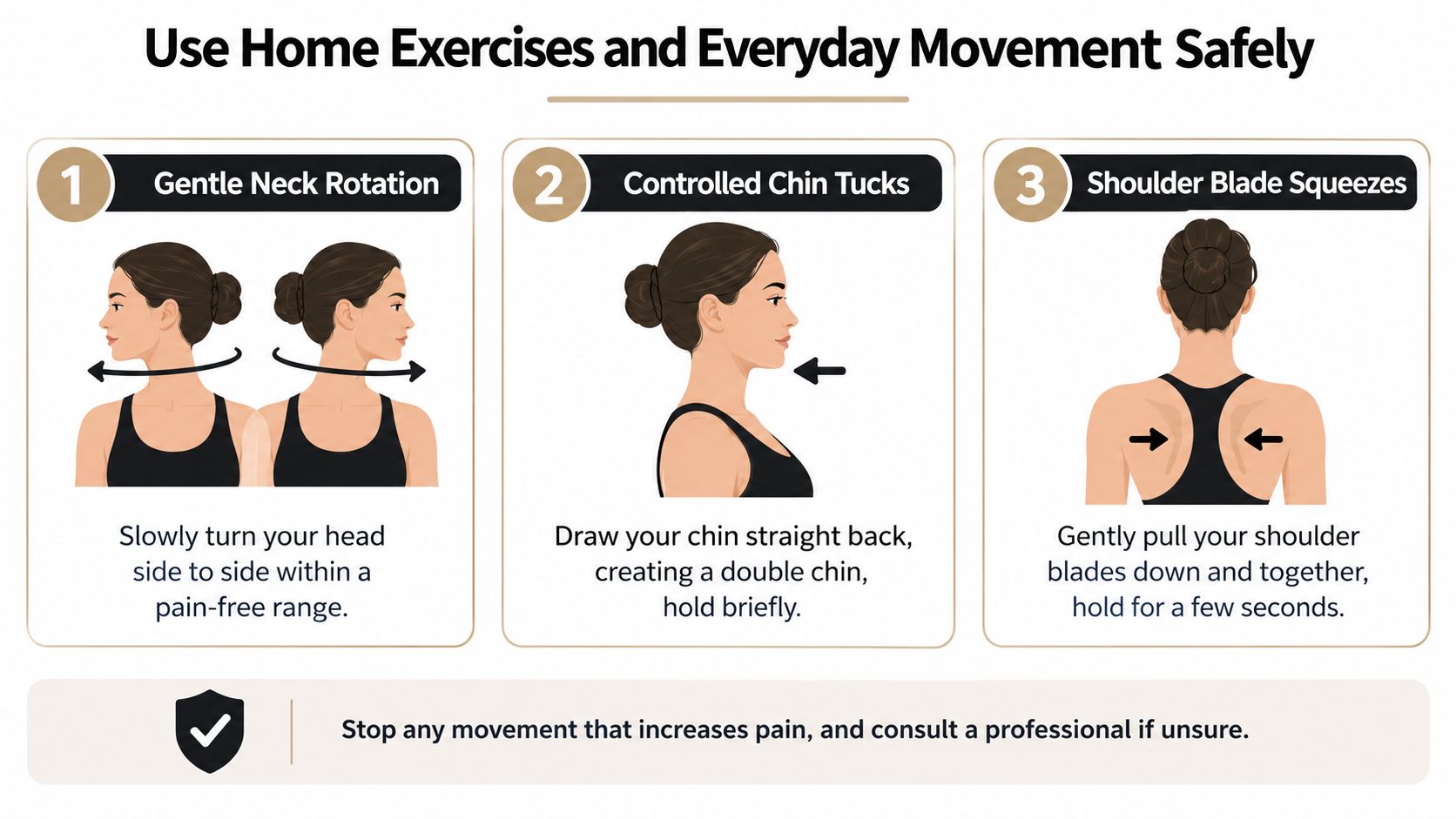
Try a small, adaptable routine
- Gentle neck rotation: Sit or stand comfortably and turn your head slowly to one side, then the other, stopping before a sharp or escalating pain. Begin with a few comfortable repetitions. This practices the movement you need for tasks such as checking traffic.
- Chin retraction: Keep your eyes level and draw your head gently backward, as if making a small double chin. Don't tip your head up or down. Try a few repetitions to practice controlled positioning.
- Shoulder-blade setting: Relax your shoulders, then gently draw the shoulder blades down and toward each other. Hold briefly, release, and repeat a few times. This engages the muscles that support the shoulder area.
- Gentle isometric effort: Place a hand against the side of your head and press lightly into it without letting your head move. Try the same gentle effort at the forehead. Stop if it increases symptoms, and ask a clinician whether this exercise suits your situation.
There's no need to begin with a long routine. If the movements feel manageable during and after practice, add repetitions gradually. For additional ideas, see these neck pain relief stretches. Jaw tension can sometimes accompany neck discomfort; dentist-recommended TMJ exercises may offer relevant information for people also managing jaw symptoms.
Movement should become easier gradually. It doesn't need to produce a dramatic immediate fix.
Make daily tasks easier to repeat
Bring screens closer to eye level when practical, support your arms during computer work, and change position rather than holding one posture for too long. In the car, adjust the seat and mirrors so you can see comfortably without repeatedly reaching or twisting. For sleep, choose a position and pillow arrangement that lets your neck rest comfortably.
If an exercise causes a substantial flare, reduce its range or repetitions, or pause and reassess. Mild, temporary discomfort may be different from escalating pain, but worsening weakness, numbness, balance problems, or other warning signs call for medical guidance rather than continued practice.
Understand Professional Therapies and Timelines
A useful rehabilitation visit starts with questions and an examination, not an automatic neck adjustment. A clinician may ask how symptoms began, what movements affect them, whether you've had headaches or an injury, and how the problem changes sleep and activity. They may assess neck movement, strength, shoulder-blade control, and relevant nerve or neurological signs to decide which treatments are appropriate.
Combine hands-on care with active rehabilitation
For cervicogenic headache, a systematic review of six randomized controlled trials found that cervical manipulation or mobilization combined with cervico-scapular strengthening generally reduced pain and disability and improved function; the combined approach produced the strongest pain outcomes (review of treatment for cervicogenic headache). This supports a practical distinction: manual techniques may help a patient move, while exercise aims to build control and capacity. It doesn't mean every patient needs manipulation, or that a clinician should use it before checking for conditions that make it unsuitable.
A separate network meta-analysis of 34 randomized trials reported short-term headache reductions for selected combinations, including manipulation with dry needling and muscle-energy technique with exercise. The certainty of evidence was low, so these findings don't guarantee a particular result for an individual patient (network meta-analysis of cervicogenic-headache treatments). Treatment should be selected around the person's symptoms, examination, preferences, and response, not because a combination appeared in a study.
Some soreness or a temporary symptom increase can happen after exercise or manual treatment. A 2025 evidence-based recommendation described a protocol of treatment twice weekly for three weeks for selected patients, not indefinite high-intensity care (Harvard Health overview of headache that starts in the neck). That example is not a prescription for everyone. If symptoms escalate, neurological signs appear, or you aren't making meaningful progress, contact your clinician to reconsider the plan.
Neck-directed treatment also won't address every headache mechanism. A person with migraine as well as neck tenderness may need headache-specific assessment alongside rehabilitation. For an overview of how physical therapy approaches pain and function, see this guide to physical therapy for back and neck pain.
The clearest sign of progress is practical change: turning more easily, tolerating work or daily activity better, sleeping more comfortably, or having less headache-related disruption. Your clinician can use those outcomes to decide whether to continue, adjust, or refer you for further assessment.
Plan Your Next Step With MedAmerica Rehab Center
If you're in Deerfield Beach or a nearby community and your symptoms are affecting daily life, a rehabilitation assessment can help translate the problem into specific goals. MedAmerica Rehab Center is a family-owned clinic in Deerfield Beach, Florida, providing physical therapy, chiropractic care, acupuncture, and advanced shockwave therapy since 1995.
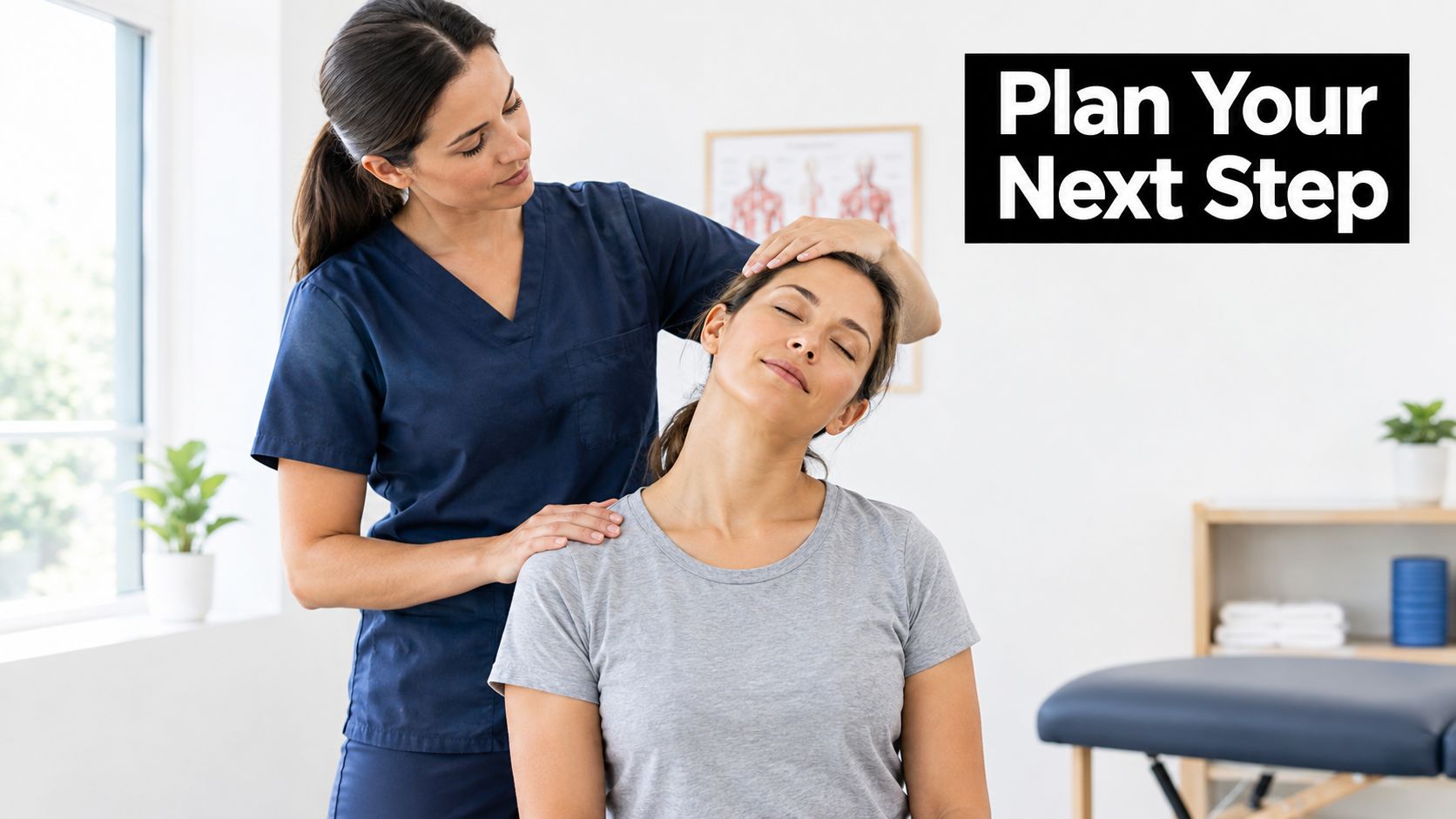
An assessment works like a fork in the road. The clinician asks about your symptoms and history, checks how your neck moves and functions, and discusses what you want to return to. From there, you decide together whether self-care is still reasonable, whether active rehabilitation makes sense, or whether your symptoms call for medical review first.
That decision matters more than any single treatment. A plan built around your examination can be adjusted as you respond, which is exactly how graduated care should work.
The clinic treats acute and chronic conditions, including neck pain and headache, and supports rehabilitation after sports injuries, auto accidents, workers' compensation injuries, and orthopedic surgery. Its services also include balance and gait training. Same-day appointments and insurance-friendly processes may make arranging a visit easier, though urgent symptoms such as new weakness, a severe sudden headache, or significant trauma call for prompt medical evaluation rather than waiting for a routine appointment.
The video below shows how a clinician assesses neck movement and applies gentle manual techniques in a typical rehabilitation session.
If your symptoms are stable but limiting your movement, sleep, or work, contact the clinic to ask about an assessment and what to bring. A clear conversation about your symptoms and goals can help you decide whether rehabilitation is an appropriate next step.
If upper neck pain is making it harder to turn, sleep, or manage your usual activities, MedAmerica Rehab Center offers physical therapy, chiropractic care, acupuncture, and other rehabilitation services in Deerfield Beach. Visit MedAmerica Rehab Center to ask about an individualized assessment and a plan built around your symptoms and goals.
MedAmerica Rehab · Deerfield Beach
Talk to a clinician about your pain
Physical therapy, chiropractic, acupuncture and shockwave therapy under one roof, since 1995. Same-day appointments are available.
Mon–Thu 8:00 AM – 6:30 PM · Fri 8:00 AM – 3:00 PM