
Extracorporeal Shock Wave Therapy vs Ultrasound: Which Helps
You've had heel pain for weeks, gripping a coffee mug irritates your elbow, or a shoulder that once moved freely now limits ordinary tasks. Then you hear two treatment names, extracorporeal shock wave therapy and therapeutic ultrasound, and the decision appears simple: which machine works better?
In practice, the better question is more specific. Are you trying to reduce pain while walking, restore grip strength, improve shoulder movement, prepare a tendon for loading, or settle irritated soft tissue so exercise becomes possible? The answer depends on the diagnosis, the tissue involved, the symptom pattern, and what you need to do again.
When Two Modalities Feel Like One Question
A patient with plantar fasciitis once arrived at a Deerfield Beach clinic ready to choose a device. Morning steps hurt, longer walks were worse, and the patient wanted to know which treatment would “fix” the heel. That question made sense, but the machine alone couldn't answer it. We first needed to confirm that the pain was coming from the plantar fascia, understand whether movement was the main trigger, and assess what the foot could tolerate.
This distinction matters because pain relief and functional recovery aren't interchangeable outcomes. A treatment may lower pain while walking without restoring calf strength, foot control, or tolerance for repeated loading. Conversely, a modality that makes tissue feel looser may be useful before exercise without being the strongest option for stubborn activity-related pain.
The practical framework is:
- Pain during movement: ESWT may deserve priority when a chronic tendon or fascia problem remains painful under load.
- Stiffness or superficial soft-tissue restriction: Therapeutic ultrasound may be used as an adjunct before hands-on treatment or exercise.
- Tissue targeting: Diagnosis and tissue depth influence whether focused or radial shockwave, or a different intervention, makes sense.
- Return to activity: Neither modality replaces progressive strengthening, movement retraining, or a carefully managed increase in workload.
The goal comes before the device
At a clinic that uses both tools, the choice isn't always either-or. A therapist may use one modality first and introduce another later, or combine a modality with manual therapy and therapeutic exercise. The important point is that the treatment should serve a measurable goal rather than turn the appointment into a contest between machines.
If you want to walk farther, grip without pain, lift your arm, or return to sport, tell the clinician that outcome. It gives the treatment plan a direction that a device name alone can't provide.
How Each Modality Actually Works
Extracorporeal shock wave therapy, or ESWT, uses acoustic pressure pulses. A handpiece delivers repeated waves into a targeted area. Depending on the device, the energy may spread across a broader superficial region, as with radial ESWT, or concentrate at a selected depth, as with focused ESWT.
A useful analogy is a controlled series of pressure taps rather than a massage. The stimulus can make a sensitive tendon or fascial attachment temporarily sore, while the body responds to the mechanical signal through changes in local circulation, pain sensitivity, and tissue remodeling. “Microtrauma” shouldn't be interpreted as an injury that the treatment is trying to worsen. It describes a controlled stimulus selected to encourage a healing response in tissue that hasn't adapted well to ordinary loading.
Therapeutic ultrasound uses high-frequency sound waves to create mechanical vibration and, when the settings allow, gentle heating. Continuous ultrasound delivers more sustained thermal input. Pulsed ultrasound reduces the average energy and is selected when the clinician wants mechanical effects with less heating.
Depth and targeting change the clinical conversation
Focused shockwave can be directed toward deeper structures, while radial shockwave disperses energy more broadly and is commonly used for accessible soft tissue. Therapeutic ultrasound is generally suited to superficial or moderately accessible tissues, and the therapist moves the sound head over gel-covered skin to distribute the treatment.
Neither modality "finds" the diagnosis automatically. The clinician has to identify the painful structure through history, movement testing, palpation, and, when appropriate, imaging. If the problem is nerve irritation, a tendon tear, joint pathology, or pain referred from the spine, applying energy to the most tender spot may miss the actual source.
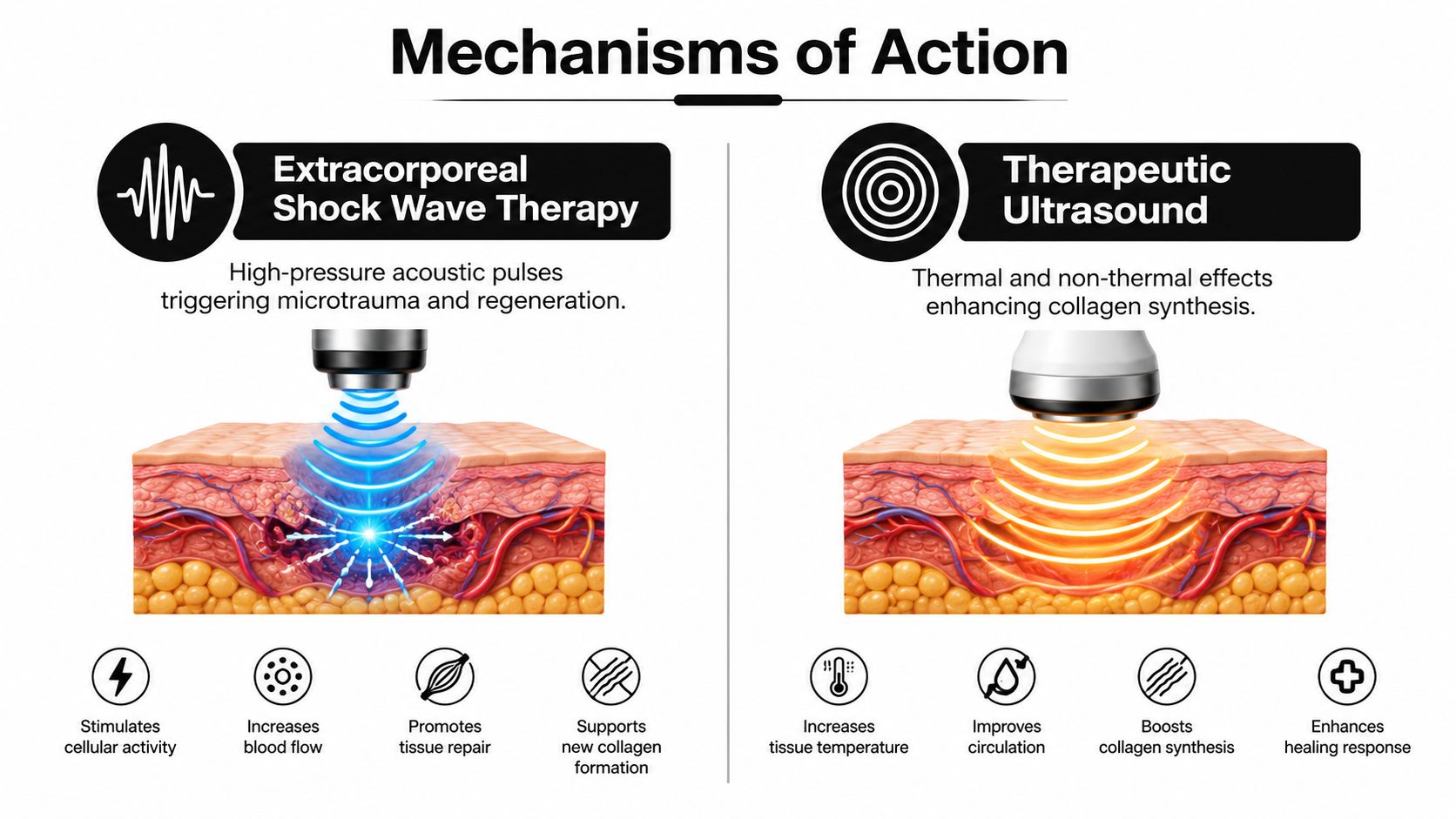
The practical description of shockwave therapy at MedAmerica reflects this targeted approach. The modality is applied to selected tissue, not used as a general-purpose treatment for every pain complaint.
Therapeutic ultrasound often feels like a smooth, warm glide. ESWT can feel more intense, especially over a highly sensitive tendon attachment. Your therapist should adjust the energy, pressure, and treatment area to keep the session tolerable while still providing a meaningful stimulus.
Side-by-Side Comparison at a Glance
The phrase extracorporeal shock wave therapy vs ultrasound hides an important detail: “ultrasound” may mean a therapeutic treatment, while ultrasound imaging may be used only to examine or target tissue. The table below compares ESWT with therapeutic ultrasound, not diagnostic imaging.
ESWT versus Therapeutic Ultrasound at a Glance
| Feature | ESWT | Therapeutic Ultrasound |
|---|---|---|
| Primary mechanism | High-pressure acoustic pulses | High-frequency sound waves creating thermal and mechanical effects |
| Typical targeting | Radial for broader superficial treatment, focused for concentrated depth | Moving sound head over a gel-coupled treatment area |
| Sensation | Tapping, pressure, or sharper discomfort over sensitive tissue | Smooth movement with warmth or mild vibration |
| Main clinical role | Pain-focused treatment for selected chronic tendon or fascia problems | Adjunct for soft-tissue comfort, warming, and preparation for treatment or exercise |
| Session experience | Intensity is adjusted to the tissue response and tolerance | Continuous or pulsed settings are selected according to the treatment goal |
| Frequency | Determined by diagnosis, response, and the wider rehabilitation plan | Determined by tissue response and the wider rehabilitation plan |
| Cost drivers | Device type, clinician expertise, treatment area, and course design | Appointment time, clinician expertise, treatment area, and combined services |
What the table leaves out
ESWT usually feels more assertive because the therapist is delivering pressure pulses to a selected structure. That doesn't mean discomfort proves the treatment is working, and a tolerable session isn't automatically ineffective. The clinician should use your response, examination findings, and progress to adjust the dose.
Therapeutic ultrasound is often less provocative. Its value may come from making movement or hands-on work more comfortable, especially when a warm, prepared tissue response helps the next part of rehabilitation. It generally shouldn't be presented as a stand-alone answer to weakness, poor movement control, or low load tolerance.
Cost also can't be reduced to a universal price comparison. A course may include evaluation, manual therapy, exercise instruction, reassessment, or imaging-related decisions. The relevant comparison is the total rehabilitation plan, not the price of one pass with a handpiece. Other modalities, such as laser therapy for pain, may also be considered when the clinical goal differs.
What the Research Actually Shows
The strongest direct comparisons don't support a universal winner. They show a more useful pattern: ESWT tends to have a clearer advantage for pain in some diagnoses, while functional outcomes are less consistently different.
For plantar fasciitis, a 2022 systematic review and meta-analysis examined 7 studies involving 369 patients. ESWT had a significant advantage for pain during activity, with a mean difference of -1.36 favoring ESWT, P=0.005, while differences in functional impairment, AOFAS score, and morning first-step pain weren't statistically significant (2022 plantar-fasciitis review).
That result changes how I explain the treatment. If walking is the main problem, ESWT may be a reasonable pain-focused option. It doesn't prove that ESWT will automatically restore foot strength, correct gait mechanics, or make every daily activity easier without a rehabilitation program.
Pain scores and function tell different stories
A 2019 meta-analysis of 5 randomized controlled trials found VAS pain scores favored shock-wave therapy by a mean difference of -13.14 points, with a confidence interval from -14.07 to -12.75 and P<0.00001. The AOFAS functional score, however, didn't show a significant difference, with a mean difference of 3.19, a confidence interval from -1.72 to 8.10, and P=0.20 (2019 plantar-fasciitis meta-analysis).
The two reviews point in the same broad direction, but they also show why headlines can mislead. A stronger pain signal doesn't equal universal functional superiority. Function depends on how the patient loads the tissue, how long symptoms have been present, strength deficits, footwear, work demands, and whether the rehabilitation plan addresses those factors.
For lateral epicondylitis, a 2025 systematic review of 9 randomized controlled trials involving 654 people found ESWT reduced pain more than therapeutic ultrasound, with a mean difference of -0.90, a 95% confidence interval of -1.28 to -0.52, and P<0.0001. The PRTEE functional score difference wasn't statistically significant, with a mean difference of -5.28, a 95% confidence interval from -10.61 to 0.04, and P=0.05 (2025 lateral-epicondylitis review).
Clinical interpretation: ESWT may be the better analgesic choice for a selected tendon problem, but pain relief isn't a substitute for grip rehabilitation, progressive loading, or restored work tolerance.
Matching the Modality to the Diagnosis
A patient with heel pain may want two different things. One wants pain settled enough to walk the dog without limping. Another wants to get back to running, which is a higher bar. That difference matters, and so does the diagnosis underneath the symptom label.
“Heel pain,” “elbow pain,” and “shoulder pain” are starting points, not treatment decisions. I match the modality to the tissue involved, the stage of irritability, and the patient's goal. A tool that helps pain in one condition can be a poor fit for another, even in the same body region.
Where ESWT often enters the discussion
ESWT comes up most often when a confirmed tendon or fascial problem stays painful with loading. In practice, that usually means persistent plantar fasciitis, selected Achilles tendinopathies, lateral epicondylitis, and some cases of calcific shoulder tendinopathy. The common thread is not the body part. It is a diagnosis where a more focused mechanical stimulus may help pain and support a stalled rehab plan.
For plantar fasciitis, earlier research discussed in this article showed a clearer signal for pain relief than for functional improvement. That is the key point in clinic. If the patient's short-term goal is less pain on first steps or less pain with daily walking, ESWT may be a reasonable choice. If the goal is durable loading tolerance, it still has to sit beside calf work, foot strengthening, load management, and footwear review.
The same logic applies at the elbow. A patient may report less pain during gripping after ESWT and still be underprepared for repetitive lifting, tool use, or racquet sport. Pain and capacity are related, but they are not the same endpoint.
Where ultrasound can still be useful
Therapeutic ultrasound still has a place, but usually as an adjunct with a narrow job. I use it when the immediate aim is to calm discomfort enough to let someone move better, tolerate manual therapy, or start an early exercise session with less guarding. It can also fit around superficial soft-tissue irritability, trigger points, or local restrictions when there is a clear treatment target.
It is a weaker choice if the main problem is a deconditioned tendon, a weak shoulder, knee osteoarthritis, or function limited by poor strength and movement control. In those cases, progress usually comes from exercise, pacing, mobility work, and condition-specific rehab, not from passive treatment alone.
The diagnosis sets the target. The patient's goal sets the priority.
For shoulder calcification, precise targeting matters more than treating the whole shoulder region. For post-surgical scar restriction, healing stage and surgical precautions come first.
What a Treatment Course Actually Looks Like
A first visit should begin with an examination, not a machine. The therapist reviews symptom behavior, medical history, medications, prior treatment, and the movements that reproduce the problem. That information guides the treatment area, intensity, and whether ESWT or therapeutic ultrasound is appropriate at all.
A typical ESWT appointment
The therapist positions you so the target tissue is accessible, applies coupling gel, and identifies the treatment zone. The device then delivers pulses while the clinician monitors your discomfort and tissue response. Radial and focused systems feel different, and the settings should be adapted rather than copied from another patient's plan.
Mild soreness after ESWT is common, and a 24 to 48 hour period of post-treatment soreness may occur. Plan ordinary movement, but avoid treating the session as permission to test the tissue with an unusually hard workout. Your therapist may pair ESWT with home exercises that build capacity between visits.
A typical ultrasound appointment
For therapeutic ultrasound, the clinician applies gel and moves the sound head over the selected area. Continuous settings are used when gentle heating is desired, while pulsed settings reduce the average energy when heating isn't the priority. Many patients describe a comfortable warming sensation rather than the tapping pressure associated with ESWT.
Session length and visit frequency depend on the diagnosis and the rest of the plan. A clinician may use ultrasound briefly before manual therapy, mobility work, or exercise instead of making the passive modality the entire appointment.
The important question isn't how many visits you'll receive. Ask what should change between visits, which activity you'll practice, and how progress will be measured. In lateral epicondylitis, the research found an ESWT pain advantage over ultrasound, but not a statistically established PRTEE functional advantage, so the exercise plan remains essential (lateral-elbow review).
Safety, Contraindications, and a Common Misconception
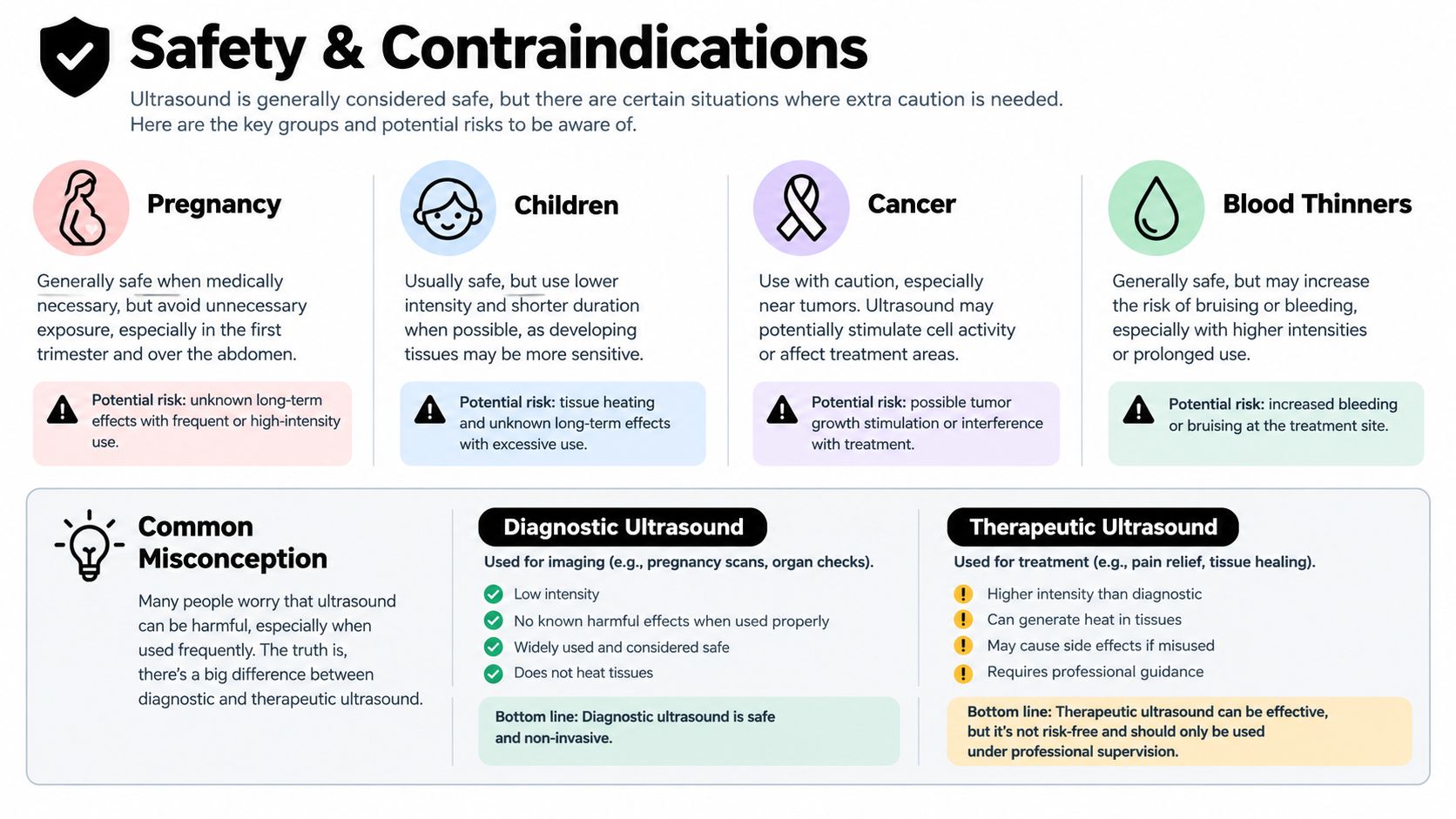
Many people assume therapeutic ultrasound is automatically the safer choice because it feels gentler. That assumption is too broad. A comfortable sensation doesn't remove the need for screening, and ESWT can be appropriate only when the clinician has considered medications, circulation, tissue condition, and the treatment target.
ESWT is generally associated with few adverse effects, but bruising or bleeding can occur, particularly with high-intensity treatment. Common exclusions include bleeding disorders or anticoagulant use, acute infection, pregnancy, treatment over growth plates, and application directly over major nerves or vessels. A 2025 consensus statement also recommends avoiding ESWT with acute thrombosis, active bleeding, malignant tissue, severe coagulation problems, uncontrolled hypertension, and severe anemia (ESWT safety review and consensus discussion).
Ultrasound has two meanings
Patients often use “ultrasound” to describe both therapeutic ultrasound and diagnostic imaging. They aren't the same treatment. Therapeutic ultrasound applies sound energy for a tissue effect. Diagnostic ultrasound creates images, and a clinician may use those images to identify a tendon, deposit, vessel, or nerve before applying another treatment.
That distinction matters for shockwave targeting. A 2025 study found ultrasound-guided ESWT more effective than landmark-based ESWT for shoulder function, pain reduction, and calcific-deposit resorption (safety and targeting review). In that setting, ultrasound guidance isn't competing with shockwave as a therapeutic modality. It helps the clinician locate the target more accurately.
Before treatment, disclose blood-thinning medication, bleeding history, pregnancy, cancer, infection, vascular problems, severe anemia, uncontrolled blood pressure, and recent surgery. If the pain includes numbness, marked weakness, unexplained swelling, or sudden loss of motion, the priority may be further diagnostic assessment rather than either modality.
More detail on situations that may rule out or modify ESWT is available in shockwave therapy contraindications.
Choosing the Right Option for Your Rehab Plan
Start with four decisions:
- Name the functional problem. Is pain stopping you from walking, gripping, reaching, climbing stairs, sleeping, or returning to sport?
- Confirm the structure involved. A therapist should distinguish plantar fascia pain from nerve symptoms, elbow tendinopathy from cervical referral, and shoulder tendon pain from joint restriction.
- Review safety factors. Medication, circulation, infection, pregnancy, healing tissue, and other medical conditions can change the plan.
- Choose the adjunct that supports loading. ESWT may help reduce activity-related pain in selected conditions. Therapeutic ultrasound may prepare tissue for hands-on work or exercise. Neither replaces progressive rehabilitation.
Questions worth asking at the first visit
- What diagnosis are you treating, and what findings support it?
- Is the primary target pain, range of motion, load tolerance, or return to activity?
- What should improve over the next few weeks?
- Which home exercises will accompany the modality?
- How will you change the plan if pain improves but function doesn't?
- Would diagnostic imaging or image-guided targeting alter the decision?
A useful plan connects the modality to an outcome you can observe. For example, a person with tennis elbow might track pain during gripping and tolerance for strengthening. Someone with plantar fasciitis might track walking tolerance, morning symptoms, and the ability to progress calf and foot loading.

The practical answer: ESWT often has the stronger pain signal for selected tendon and fascia problems, therapeutic ultrasound remains a useful adjunct, and the right choice follows the patient's goal, diagnosis, and tolerance rather than the device label.
MedAmerica Rehab Center offers extracorporeal shockwave therapy and therapeutic ultrasound within individualized physical therapy plans, alongside hands-on care and targeted exercise. Visit MedAmerica Rehab Center in Deerfield Beach to discuss which option fits your diagnosis, safety profile, and functional goal.
MedAmerica Rehab · Deerfield Beach
Talk to a clinician about your pain
Physical therapy, chiropractic, acupuncture and shockwave therapy under one roof, since 1995. Same-day appointments are available.
Mon–Thu 8:00 AM – 6:30 PM · Fri 8:00 AM – 3:00 PM