

Belfield Physical Therapy: What to Expect and How to Start
If your neck has stayed stiff long after the original strain, your knee still objects to stairs after surgery, or a back injury keeps interrupting work and sleep, searching for Belfield physical therapy usually isn't an academic exercise. You're trying to decide whether to book now, whether a referral is necessary, and whether the first appointment will involve useful assessment or just a generic treatment routine.
Those questions matter because a clinic visit should begin with a clinical decision, not a sales pitch. A proper evaluation identifies your diagnosis, functional limitations, goals, and whether physical therapy is appropriate, while also making clear when medical assessment or additional testing is needed. The practical details below are designed to help you make that decision with fewer surprises.
Why People Search for Belfield Physical Therapy
A patient may arrive after weeks of putting off care. The original injury seemed manageable, but the shoulder now hurts when reaching into a cupboard. A stiff neck returns after desk work. A deep groin pull changes the way someone climbs stairs. Another patient has completed surgery but still can't dress, drive, sleep, or return to work comfortably.
The word “rehabilitation” hides several different decisions. You may be looking for help with:
- A recent injury: Pain and swelling haven't settled, or movement feels unreliable.
- Post-surgical stiffness: The operation went well, but strength and confidence haven't returned.
- Persistent symptoms: Back pain, arthritis, headaches, or mobility problems keep flaring.
- A local appointment: You need a clinic that can explain coverage and offer a realistic opening.
- A safe next step: You aren't sure whether therapy, imaging, or a physician review comes first.
Belfield is an established suburban community, not a small isolated settlement. The Australian Bureau of Statistics Belfield Census profile recorded 6,555 residents in 2021, living across 2,409 private dwellings, with a median age of 40 years. That mix includes families, working adults, older residents, and people managing long-standing mobility concerns.
Practical rule: Before you compare treatment methods, get clear answers to three access questions: do you need a referral, what will happen at the first visit, and when can the clinic assess you?
A useful local page should answer those questions directly. It should also tell you what to bring, how benefits are checked, and which symptoms need urgent medical attention instead of routine rehabilitation.
About the Belfield Clinic and Its Team
A patient should be able to understand the clinic before choosing a provider. Ask whether the practice includes physical therapists and other rehabilitation professionals, how the clinicians share information, and who remains responsible for coordinating your plan.
A multidisciplinary setting may include physical therapy, chiropractic care, acupuncture, and rehabilitation support. That combination can help when several factors overlap, such as neck pain with headaches, a shoulder problem accompanied by upper-back tension, or an injury complicated by reduced balance. It shouldn't mean that every patient receives every service. A straightforward ankle sprain may need a focused physical-therapy plan rather than several additional appointments.
The therapist should still lead the clinical reasoning for a physical-therapy episode. The evaluation should identify what limits you, establish baseline findings, and set goals that relate to daily life. The APTA standards of practice for physical therapists describe care that combines available evidence, clinician expertise, and the patient's values and circumstances.

What to ask about the team
A good conversation at booking should clarify:
- Your primary clinician: Who performs the evaluation and tracks progress?
- Shared records: How are findings communicated if another discipline becomes involved?
- Treatment philosophy: Does the plan combine manual techniques with active exercise?
- Progress tracking: Which movement, strength, balance, or functional measures will be reassessed?
- Escalation: What happens if your symptoms don't fit a routine musculoskeletal problem?
For more guidance on evaluating a provider, use this practical resource on how to choose a physical therapist. The setting should feel organized and calm, with staff who explain the process rather than assuming you already know how rehabilitation works.
Services Offered at the Belfield Clinic
A service menu helps you identify the type of appointment to request, but it shouldn't determine treatment before an examination. The same shoulder symptom can reflect weakness, restricted movement, nerve irritation, or a problem requiring medical review.
| Service | Description | Best Fit For |
|---|---|---|
| Orthopedic physical therapy | Restores movement, strength, and function after musculoskeletal injury. | Someone recovering from a fracture or joint replacement. |
| Sports rehabilitation | Progresses loading, coordination, and sport-specific movement after injury. | A runner with an overuse problem or an athlete after a sprain. |
| Manual therapy and joint mobilization | Uses hands-on techniques to address selected restrictions and painful movement. | A patient whose joint stiffness limits exercise or daily tasks. |
| Post-surgical rehabilitation | Follows surgical precautions while rebuilding mobility and functional strength. | Someone returning to activity after an orthopedic procedure. |
| Vestibular and balance therapy | Assesses balance, gait, and movement-related dizziness. | An older adult who feels unsteady or avoids walking outdoors. |
| Workplace and ergonomic rehabilitation | Connects symptom management with work tasks, positioning, and safe load progression. | An office worker with neck pain or a worker returning after an injury. |
| Pediatric mobility care | Adapts movement activities and communication to a child's developmental needs. | A child whose mobility or coordination affects participation. |
| Geriatric mobility care | Builds strength, walking confidence, and safer transfers. | An older person managing mobility loss or fall concerns. |
| Complementary care | May include chiropractic care, acupuncture, or shockwave therapy when clinically appropriate. | A patient whose plan requires coordinated support beyond exercise alone. |
Match the request to the problem
For a post-fracture or post-operative concern, tell the scheduler the procedure, date, and current restriction. For dizziness, mention whether symptoms occur with rolling in bed, standing, or walking. For a workplace injury, bring any employer or insurer instructions so the therapist can align documentation with the case.
The right service isn't the one with the longest list of modalities. It's the one that addresses the activity you need to regain and includes a way to judge whether the plan is working.
Your First Visit Step by Step
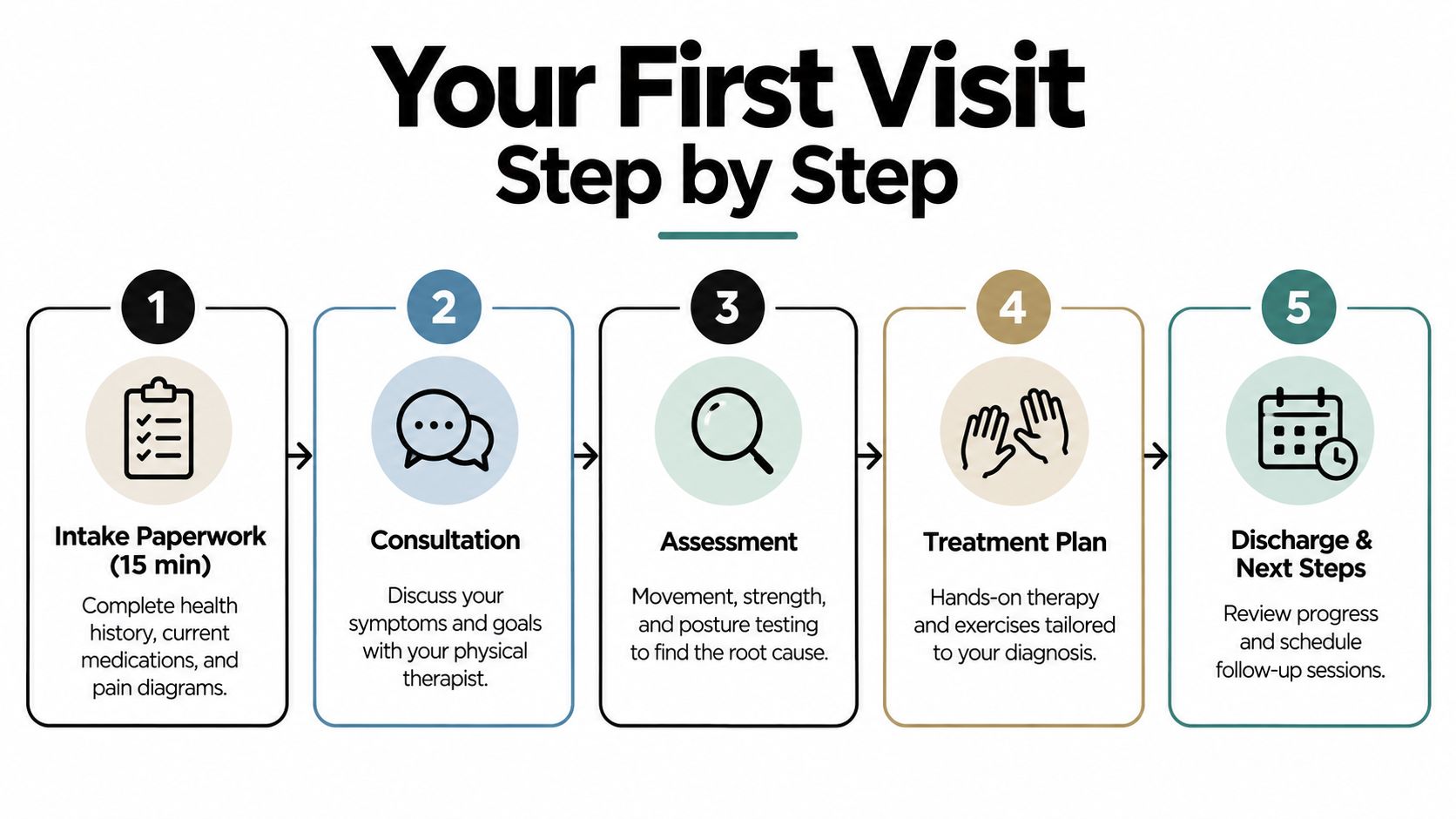
The first appointment should feel like an investigation of how your problem affects movement. Intake questions about health history, medication, previous injuries, surgery, and general symptoms aren't distractions from the injury. They help the therapist identify precautions, relevant medical factors, and signs that another clinician should be involved.
After paperwork, expect a conversation about what changed, what aggravates the problem, what eases it, and what you need to do again. The therapist may then assess posture, walking, balance, joint movement, strength, coordination, and functional tasks such as sitting, standing, reaching, lifting, or using stairs.
What the evaluation should produce
By the end of the assessment, you should understand:
- The working clinical impression: What appears to be contributing to the limitation.
- The functional baseline: Which movements or tasks are restricted today.
- The goals: What you want to resume, such as walking, working, sleeping, or exercising.
- The plan: Which interventions will be used and how progress will be reassessed.
- The safety boundaries: Which symptoms mean you should contact a physician or seek urgent care.
The first treatment may include selected manual techniques, therapeutic exercise, movement retraining, or a modality when it supports the plan. You should also leave with instructions for what to do between visits. Home exercises need to be specific enough that you know the position, repetitions, effort, and stopping point.
Watch the short visual overview below for a simple representation of the intake, evaluation, treatment, and next-step process.
Some soreness after a new exercise can occur, but severe or unfamiliar symptoms deserve a call to the clinic. Ask how long the first appointment is expected to take and whether you should wear clothing that allows the therapist to examine the affected area.
Referrals, Insurance, and What to Bring
Legal access and insurance access are different questions. A state may allow a patient to consult a physical therapist directly, while an insurance plan may still require a referral, authorization, or certified plan of care. Call the clinic and your insurer before the appointment rather than relying on a general statement that no referral is required.
The clinical reason for an initial examination remains the same either way. The therapist must decide whether therapy is suitable, document the findings, and identify when further medical assessment is warranted. The physical therapy without a referral guide can help you prepare questions about direct access and payer rules.
Bring the following:
- Photo identification: Helps the clinic confirm your registration.
- Insurance card: Give the front desk the current payer information.
- Referral or prescription: Bring it if a physician or other authorized clinician issued one.
- Imaging and reports: Include MRI or X-ray reports when they already exist.
- Medication list: Note current medicines and relevant medical conditions.
- Comfortable clothing: Wear garments that allow movement and examination of the affected area.
| Payer Type | Referral Needed? | What to Bring |
|---|---|---|
| Direct-access appointment | Depends on local law and the clinic's rules. | Identification, insurance details, and medical information. |
| Commercial insurance | The plan may require referral or prior authorization. | Insurance card, referral if required, and authorization details. |
| Medicare or similar public coverage | Follow the payer's certification and plan-of-care requirements. | Coverage information and the treating clinician's documentation. |
| Workers' compensation | Case-specific prescriber and claim documentation may be required. | Claim details, employer information, and authorized paperwork. |
| Motor-vehicle or no-fault case | Documentation requirements vary by jurisdiction and insurer. | Claim information, accident records, and available medical reports. |
If records need to be sent securely, ask the clinic which process it accepts. A guide to a HIPAA fax cover sheet may be useful when transmitting medical documents, but it doesn't replace the clinic's privacy instructions.
Hours, Location, and Booking an Appointment
Don't assume that a clinic's hours, parking arrangements, or accessibility details are the same as another practice's. Ask the front desk to confirm the current schedule, the entrance location, parking, and whether the building accommodates your mobility needs.
For a new patient, the most useful booking conversation covers four points:
- Appointment availability: Ask for the earliest evaluation and whether cancellations create an earlier opening.
- Visit format: Confirm the expected length and whether the first appointment includes treatment.
- Clothing: Wear athletic clothing and supportive shoes when movement or walking will be assessed.
- Cancellation policy: Ask how much notice the clinic requests if pain improves or plans change.
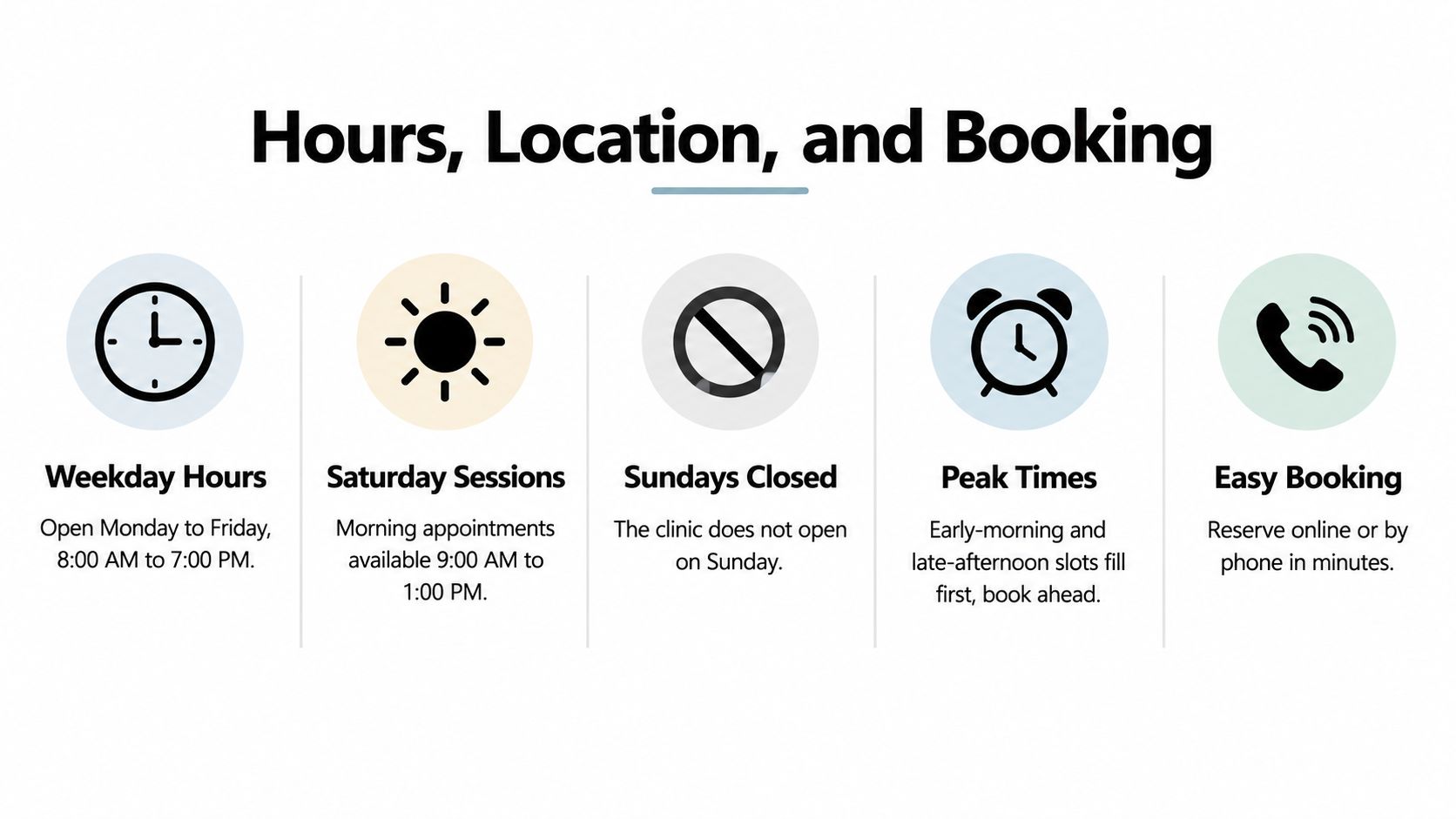
Early morning and late afternoon appointments often suit people commuting to work, so they may be more difficult to obtain. Midday availability can sometimes be easier, but only the clinic can tell you what is open this week. Phone booking may be useful when you need to explain an injury, ask about a referral, or request a same-day cancellation slot. Online booking can suit a non-urgent request when you already know the appointment type.
For general guidance on patient communication and booking rules, focus on the information you need to provide clearly, including your symptoms, preferred times, and any access requirements. Don't walk in expecting an evaluation unless the clinic confirms that walk-ins are accepted.
How Multidisciplinary Care Works in Practice
Multidisciplinary care works when clinicians share a reason for involving one another. It doesn't work when a patient collects disconnected appointments without a clear lead clinician or measurable goal.
Suppose your therapist finds that shoulder pain is aggravated by restricted upper-back movement. A chiropractor may assess a related mobility issue, while an acupuncturist may be considered for symptom management. The physical therapist should then adjust the exercise progression according to the patient's response, rather than leaving each clinician to operate from a separate plan.
When collaboration adds value
Coordination is most useful when symptoms have more than one driver:
- Persistent back pain with nerve-related symptoms: The therapist may need to monitor strength, sensation, movement tolerance, and referral indicators.
- Post-surgical stiffness: Scar sensitivity, restricted joint movement, weakness, and fear of loading may require different parts of one coordinated plan.
- Recurring sports injury: Foot, hip, trunk, training load, and technique may all need review.
- Balance concerns: Strength and gait work may need to be combined with a medical review of dizziness or medication factors.
A simple sprain may not need this level of collaboration. In that case, a focused physical-therapy program can be more efficient.
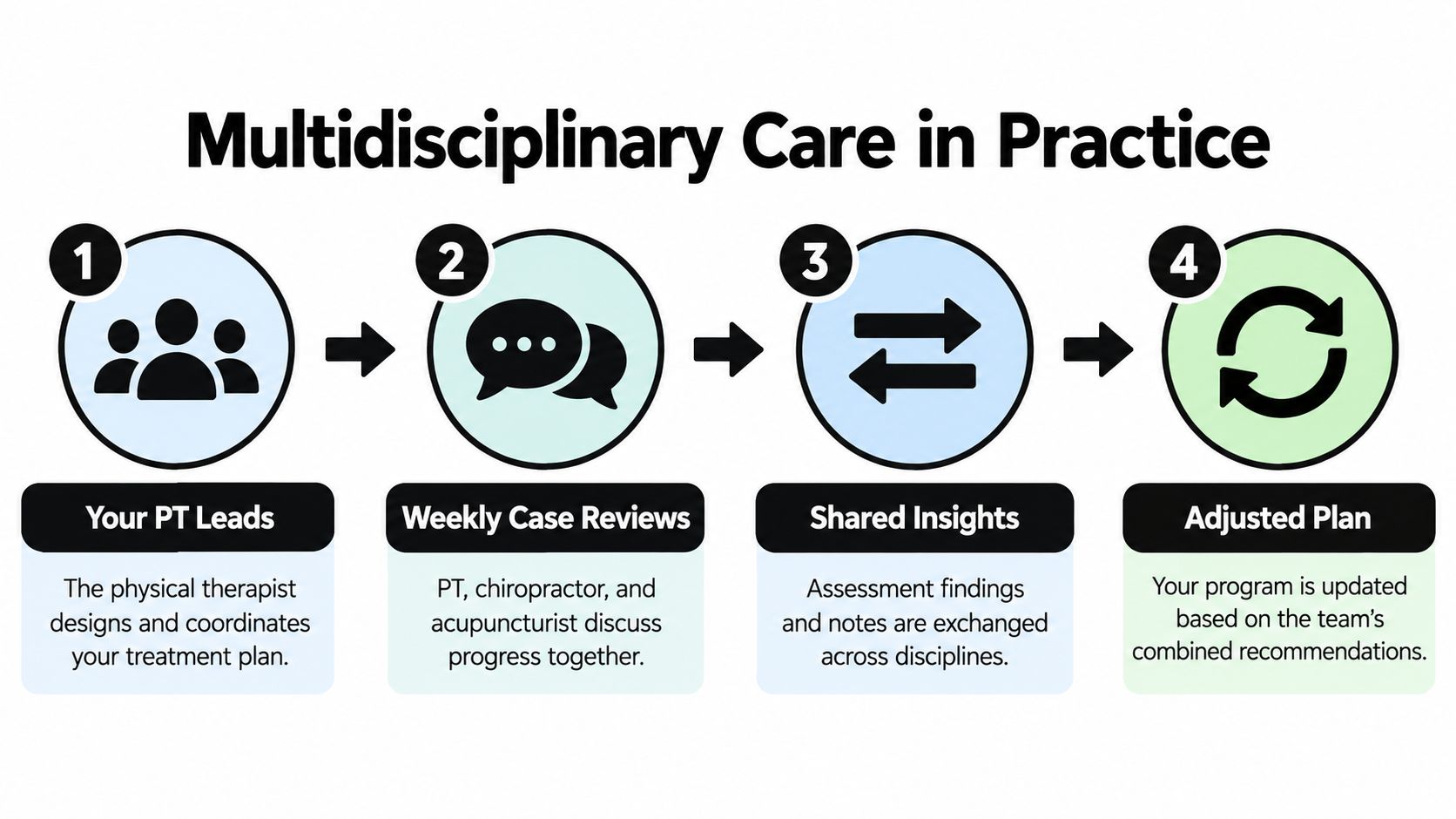
Ask at the evaluation who is responsible for your plan, what information is shared, and why another service has been recommended. More disciplines don't automatically mean better care. Clear coordination does.
Recovery Timelines and Progress Milestones
A recovery timeline should describe progress without pretending that every body follows the same calendar. Age, diagnosis, surgery, sleep, work demands, previous injury, general health, and adherence can all affect the pace of change.
For that reason, a therapist should measure function rather than rely only on pain. Useful measures may include joint movement, strength, walking tolerance, balance, task performance, and a condition-specific questionnaire. Your personal goal matters too. Sleeping through the night or returning to a particular work task may be more meaningful than a small change on a symptom scale.
| Condition Category | Expected Timeline | Progress Milestone |
|---|---|---|
| Acute soft-tissue injury | Varies with tissue damage and irritability. | Less swelling or pain, improved movement, and safer loading. |
| Post-surgical rehabilitation | Follows the procedure, healing restrictions, and surgeon's protocol. | Progression from protected movement to strength and functional activity. |
| Persistent back or neck pain | Often requires gradual changes in capacity and daily habits. | Better tolerance for sitting, walking, sleeping, or work tasks. |
| Arthritis-related limitation | Managed through strength, mobility, pacing, and activity adaptation. | More confident movement and improved participation in daily life. |
| Balance or gait concern | Depends on the underlying cause and safety risk. | More stable transfers, walking, turning, or use of stairs. |
Reassessment should lead to a decision. If the baseline measure improves, the therapist can progress the load. If it doesn't, the plan may need modification, a different clinical hypothesis, or referral. Patients managing an accident or workplace injury may also find injury recovery tips from Bell Law useful when coordinating treatment with work and claim requirements.
Home Exercise, Telehealth, and Hands-On Care
Recovery doesn't happen only on the treatment table. Hands-on care can reduce a restriction or make movement easier, but exercise and daily activity build the capacity you need outside the clinic.
Home programs work best when they are individualized, explained, and adjusted. A therapist should show you the movement, check your technique, state what sensation is acceptable, and tell you when to stop. A long list of exercises that you can't perform correctly is less useful than a focused program you understand.
Telehealth can help with exercise coaching, form review, progress discussions, and follow-up when travel, work, childcare, or post-operative driving restrictions make attendance difficult. It may be less suitable when you need joint mobilization, hands-on assessment, close supervision for a new movement, or support because of balance and fall risk.
Evidence is mixed rather than absolute. A 2025 review of digital rehabilitation for older adults with knee disease found short-term adherence improvement but no significant advantage at mid- or long-term follow-up, with low certainty in the evidence. The practical answer is a hybrid plan when appropriate, with in-person reassessment and remote support chosen according to safety and stage of recovery.
Quick Reference Card for New Patients
Before booking
- Call or use the clinic's booking system: Ask for the earliest evaluation and whether same-day openings exist.
- Confirm access requirements: Check referral, authorization, claim, and accessibility rules.
- Describe the problem clearly: State where it hurts, how it started, and what task you can't do.
Bring
- Photo ID and insurance card.
- Referral or prescription, if one was issued.
- Imaging reports and relevant medical records.
- Current medication information.
- Comfortable clothing and supportive footwear.
At the clinic
- Confirm the address, entrance, parking, and current hours directly with staff.
- Ask how long the evaluation will take and whether treatment begins that day.
- Request a written home program and the next reassessment point.
Seek urgent medical care instead of waiting for routine therapy if you have sudden numbness or weakness, fever with back pain, a fall involving loss of consciousness, or calf swelling with shortness of breath. Tell emergency clinicians about these symptoms clearly.
Common Questions Before You Book
Can I get a same-day appointment? Ask by phone. A cancellation may create an opening, but availability changes throughout the day.
Does the clinic accept walk-ins? Don't assume it does. Confirm before travelling, especially if you need an evaluation rather than a routine follow-up.
What languages are available? Ask which languages front-desk staff and clinicians speak, and request an interpreter if needed.
Can I request another opinion? Yes. Bring your prior notes and ask the therapist to review what has and hasn't changed. These questions to ask a physical therapist can help you prepare.
What if pain worsens overnight? Contact the clinic for advice, but seek urgent care for severe or unfamiliar red-flag symptoms.
Can a caregiver or translator attend? Ask when booking so the clinic can protect privacy and plan the visit.
What if I need to cancel? Give the clinic as much notice as possible and ask about its late-cancellation policy.
MedAmerica Rehab Center provides physical therapy, chiropractic care, acupuncture, and shockwave therapy through individualized rehabilitation plans, with care for musculoskeletal injuries, post-surgical recovery, balance, and accident-related conditions. Visit MedAmerica Rehab Center to review the clinic's services and contact the team about arranging an evaluation.
MedAmerica Rehab · Deerfield Beach
Talk to a clinician about your pain
Physical therapy, chiropractic, acupuncture and shockwave therapy under one roof, since 1995. Same-day appointments are available.
Mon–Thu 8:00 AM – 6:30 PM · Fri 8:00 AM – 3:00 PM