
Meniscus Tear Rehab Without Surgery: A Practical Guide
A soccer player twists during a casual game, feels a pop, and wakes the next morning with a swollen, stiff knee. The MRI report says “medial meniscus tear,” and suddenly every stair, squat, and change of direction feels risky. The immediate question is usually simple: Can I recover without surgery, or am I delaying the inevitable?
Meniscus tear rehab without surgery can be a sensible path, but it isn't the same as resting until the knee feels quieter. The right approach matches the tear pattern, mechanical symptoms, physical demands, and objective progress. This guide explains how to identify a rehab-friendly presentation, build strength in phases, manage symptoms, use physical therapy well, and recognize when a lack of progress deserves a new medical opinion.
A Practical Path Forward Without Going Under the Knife
A 44-year-old recreational athlete comes into the clinic after a pickup soccer game. He twisted while changing direction, felt a pop along the inside of the knee, and stopped playing. Several days later, he can walk, but the knee is swollen, extension feels stiff, and the MRI describes a medial meniscus tear. His main fear isn't only about pain. He worries that resting will accomplish nothing and that exercising without supervision will make the tear worse.
That concern is understandable, but neither complete rest nor random exercise provides a reliable plan. A knee with a stable tear often needs carefully controlled motion and progressively heavier loading. At the same time, a knee that repeatedly locks, gives way, or becomes more swollen after basic activity may need a closer orthopedic assessment before rehabilitation continues.
Start with the knee in front of you
The MRI matters, but it doesn't make the decision by itself. A clinician also needs to assess:
- Motion: Can you fully straighten the knee, and is bending improving?
- Swelling: Does the joint settle after activity, or does it repeatedly refill?
- Loading: Can you bear weight without a persistent limp?
- Mechanics: Does the knee catch, lock, buckle, or just feel stiff?
- Function: Can you control a step, squat, or single-leg position?
Structured exercise has become a credible first-line option for many degenerative tears. In a multicenter randomized trial involving 351 adults aged 45 and older, physical therapy produced a mean WOMAC improvement of 18.5 points at six months, compared with 20.9 points after surgery, a between-group difference of 2.4 points. The result supports a practical conclusion, not a promise that every tear responds the same way: many patients can reasonably try rehabilitation before arthroscopy. Read the randomized trial and its reported WOMAC results.
Progress must be visible
A good conservative plan has checkpoints. Pain should gradually become less intrusive, swelling should become easier to control, motion should return, and strength should improve. You should also move with less compensation, rather than just learning to tolerate the same weak, guarded pattern.
Practical rule: Conservative care earns more time when the knee is objectively improving. It shouldn't continue indefinitely on the basis of hope alone.
The roadmap below separates degenerative and acute traumatic tears, outlines four rehabilitation phases, and uses measurable signs to distinguish a productive recovery from a stalled one.
Which Meniscus Tears Actually Respond to Rehab
Not all meniscus tears behave alike. Degenerative tears often develop in a knee that already has age-related cartilage changes and may appear during imaging performed for pain that built gradually. Acute traumatic tears occur after a twist, pivot, deep loaded squat, or contact event. The mechanism matters, but the tear's stability and the knee's symptoms matter more than the label alone.
A rehab-first approach is more reasonable when the tear is small and stable, especially when it sits partly in the meniscus's better-vascularized outer region. Stable longitudinal patterns and partial-thickness injuries without displacement may tolerate progressive loading. A medial tear can also be managed nonoperatively when it isn't blocking movement or producing persistent mechanical symptoms.
Match the symptoms to the tear
A knee that's irritated but still functional often has a more favorable starting profile. Typical features include:
- Localized tenderness: Pain is concentrated near the joint line rather than spreading through the entire knee.
- Intermittent swelling: The knee becomes puffy after excess activity but settles with appropriate load reduction.
- Catching without a block: You may feel a brief click or catch, but the knee still straightens and bends.
- Weight-bearing ability: Walking is possible, even if you temporarily need to reduce distance or use support.
The 2024 evidence for younger adults with traumatic tears also supports a structured rehabilitation option. In a randomized trial of patients aged 18 to 45, standardized physical therapy with optional delayed surgery was not inferior to early arthroscopic partial meniscectomy at 24 months. The protocol used 16 supervised sessions over eight weeks, and the current EU-US consensus identifies nonoperative care as first-line for degenerative lesions, generally over three to six months when appropriate. Review the consensus and traumatic-tear trial context.
Know when the pattern is different
A true locked knee is not the same as stiffness. A displaced bucket-handle tear can physically block extension. A large unstable flap may repeatedly catch and prevent normal flexion. Associated ACL rupture, rapidly worsening effusion, repeated giving-way, or an inability to bear weight also changes the decision.
| Tear features that favor rehab vs. surgery | Favors rehab | Suggests surgery may be needed |
|---|---|---|
| Motion | The knee can straighten and gradually regain flexion | Extension or flexion is physically blocked |
| Mechanical symptoms | Occasional, non-progressive catching | True locking or repeated sharp catching |
| Stability | The knee feels generally secure during daily loading | Repeated buckling or major ligament injury |
| Swelling | Intermittent swelling that responds to load reduction | Rapid or persistent effusion |
| Tear behavior | Small, stable, non-displaced pattern | Displaced fragment or unstable flap |
| Activity response | Symptoms improve with a graded program | Basic rehab repeatedly provokes the same mechanical problem |
Before committing to surgery or a long self-directed program, ask three questions: Which zone is involved? Is the tear mechanically stable? Is there another structural injury? A practical resource on how to care for a meniscus tear can help you organize day-to-day questions, but it can't replace an examination.
The Four Phases of a Non-Surgical Rehab Program
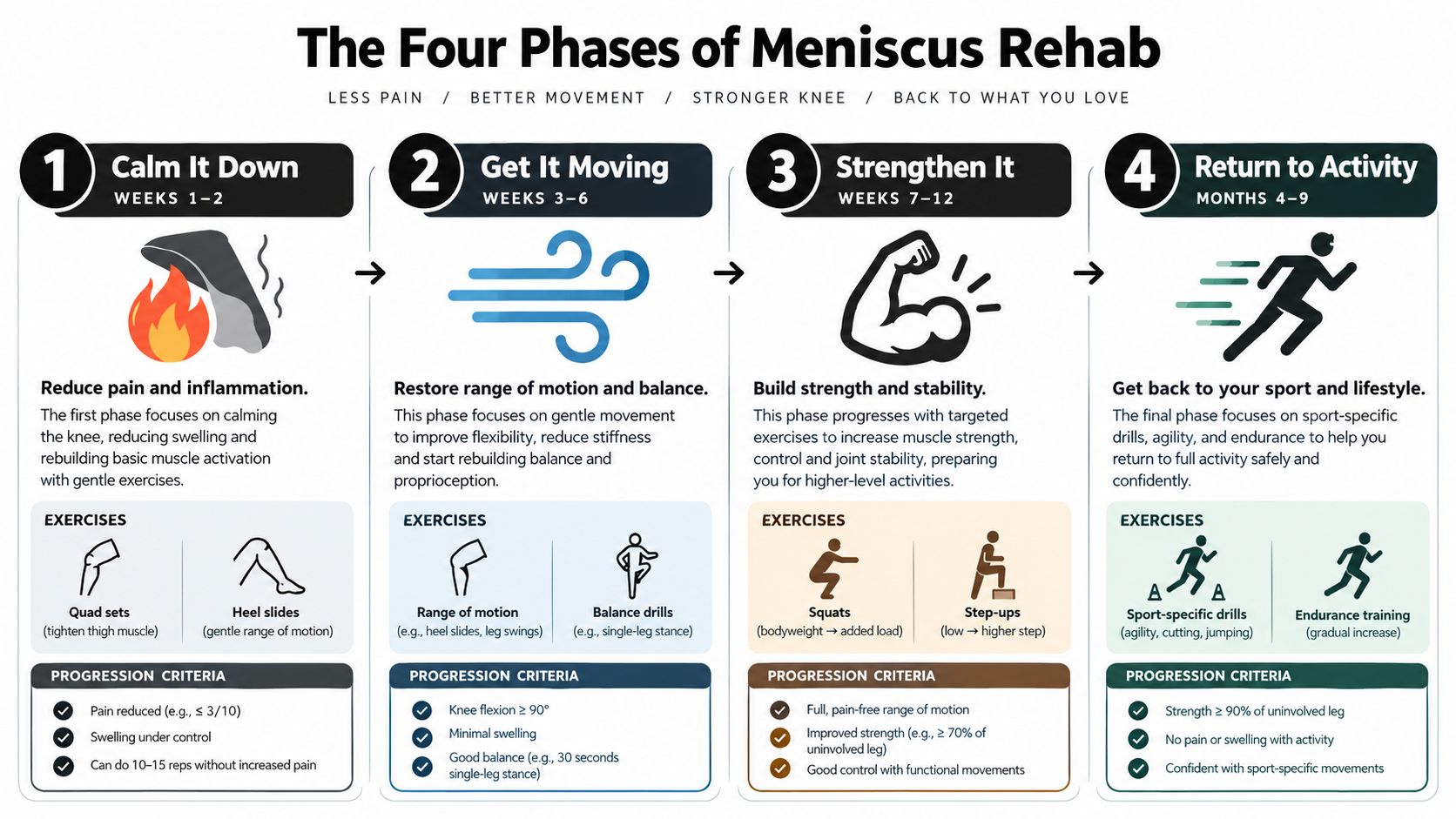
Rehabilitation works best as a progression, not as a fixed list of exercises. The knee should become quieter and more capable before the program adds depth, speed, rotation, or impact. Exercise selection also changes with the person's symptoms, strength, work demands, and sport.
Phase 1, calm it down
During the first one to two weeks, the priorities are swelling control, comfortable motion, quadriceps activation, and a cleaner walking pattern. Useful options include quad sets, heel slides within a tolerated range, ankle pumps, and an unloaded stationary bike if bending allows it. Walk daily within tolerance, but reduce distance if each walk produces more swelling or a more pronounced limp.
The knee should feel no worse later that day or the following morning. Crutches can be appropriate temporarily when walking without them causes a limp. The aim isn't to protect the knee from every load. It's to remove the loads that keep irritating it while preserving manageable movement.
Phase 2, restore motion and control
As irritability decreases, restore full-range heel slides, gentle prone knee-flexion hangs, and stationary cycling with light resistance. Supported mini-squats can begin in a shallow range, and single-leg balance on a stable or moderately unstable surface can rebuild confidence.
Progress when extension is full, flexion is improving, swelling is controlled, and the person can perform the exercise without shifting away from the involved side. Don't force deep flexion just because the knee feels stiff. A controlled range that produces no rebound swelling is more useful than an aggressive range that sets the joint back.
Phase 3, build strength
The strengthening phase adds meaningful force through the quadriceps, hamstrings, hips, and trunk. Depending on capacity, a program may include Bulgarian split squats, Romanian deadlifts, controlled step-downs from a low step, side planks, band-resisted hamstring curls, and loaded carries.
The therapist should adjust resistance, range, tempo, and volume based on movement quality and next-day response. A knee that tolerates a set but swells substantially afterward needs a dosage change, not necessarily a complete exercise change. Strength work should make stairs, walking, and single-leg loading more controlled.
Phase 4, return to activity
The final phase introduces the demands that caused the original concern. A controlled jogging progression can precede lateral shuffle drills. Plyometric box drops can progress toward jump landings, followed by planned agility-ladder patterns and then sport-specific reaction work.
Do not advance just because the calendar says it's time. Before adding higher demand, you should have pain-free full extension, no meaningful effusion, and quadriceps strength that is reasonably symmetrical. The same criteria apply when moving from planned drills to cutting, pivoting, or fatigue-based sport practice.
A useful video can provide a visual example of movement and exercise concepts, but it shouldn't replace individual assessment.
Pain Management and Supportive Modalities That Help
Pain control has a role, but it shouldn't become the treatment. The best modality is the one that helps you walk, sleep, or complete an appropriate exercise session without hiding a worsening mechanical problem.
Use symptom tools for a defined reason
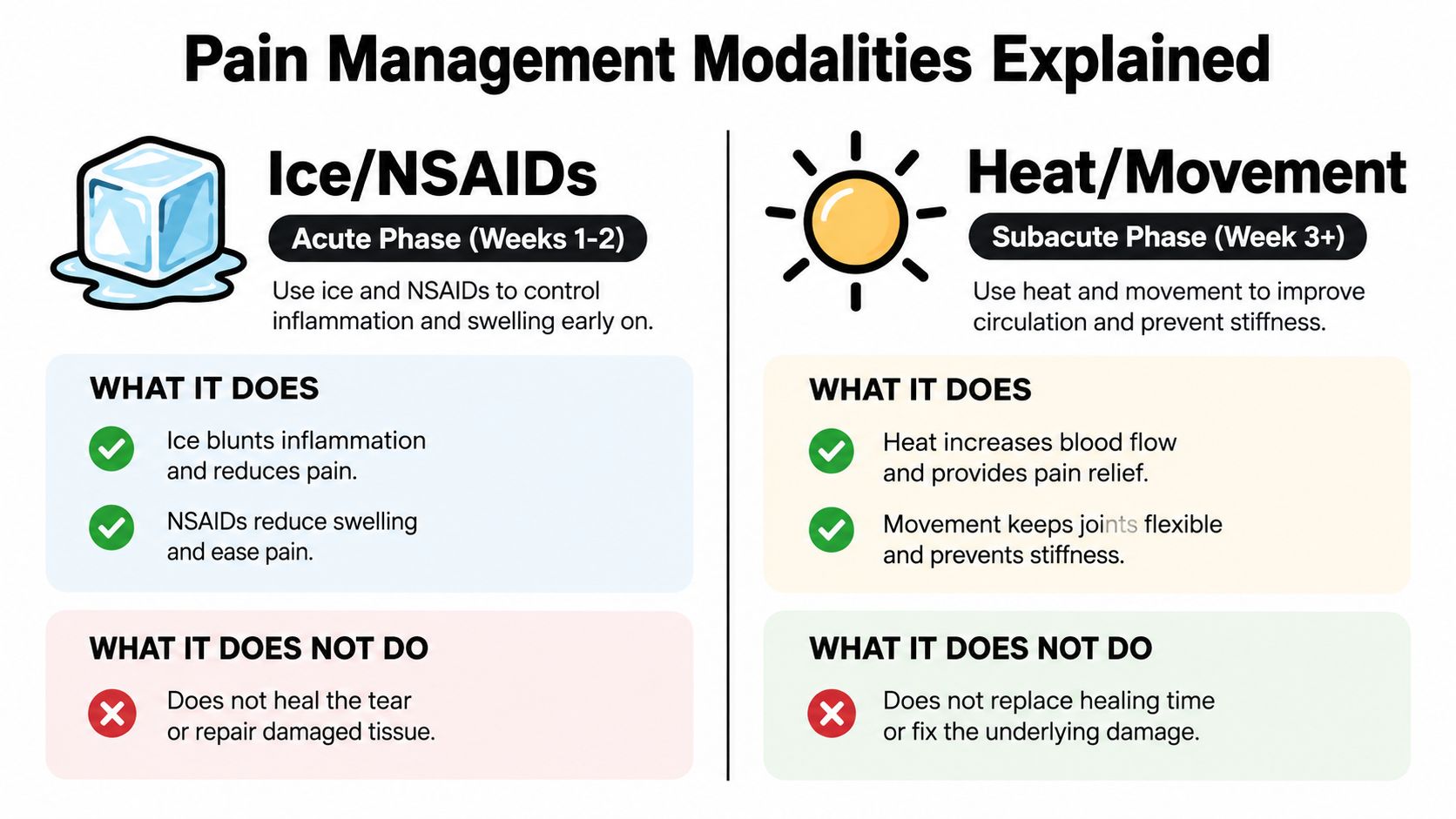
Ice can reduce the sensation of acute pain and help settle swelling during the early irritable period. Nonsteroidal anti-inflammatory drugs may also reduce inflammatory pain when a physician or pharmacist confirms they're appropriate for you. Neither option repairs a displaced fragment or restores lost strength, and relying on them indefinitely can distract from the loading work that improves function.
Compression sleeves can reduce the feeling of fullness during walking. An unloader brace may shift pressure away from a particular compartment in selected cases, but brace fit and diagnosis matter. A brace shouldn't become permission to continue pivoting through swelling.
Manual therapy can help a clinician improve tibiofemoral or patellofemoral mobility and reduce protective stiffness without forcing the knee into painful positions. Shockwave or low-level laser may be considered for selected chronic or degenerative presentations, particularly when pain or synovial irritation is limiting exercise. These tools are accessories, not the engine of recovery.
Manage the total load
A knee often reacts to the sum of walking, stairs, work, exercise, and sport. Temporarily replacing running or court work with cycling or another tolerable low-impact option may maintain conditioning while reducing repeated impact. Pacing is more useful than alternating between total rest and an ambitious workout.
Sleeping with a pillow between the knees may reduce twisting discomfort for side sleepers. Ice is usually more useful after an activity-related flare, while gentle heat can help stiffness before movement once acute swelling has settled. Taper pain medication according to medical guidance, while continuing to monitor walking quality, swelling, and exercise tolerance.
For a practical cold-support option, you can review the Freeze Sleeve knee support. Use any device because it serves a clear symptom-management purpose, not because it promises to heal the tear on its own.
Realistic Timeline and Milestones to Measure Success
A calendar can organize rehabilitation, but it can't determine readiness by itself. Tear location, degenerative changes, age, baseline strength, activity demands, and adherence all influence the pace. The useful question isn't “Should I be healed by this date?” It's “What objective change should be visible by this checkpoint?”
Early checkpoints
During weeks one and two, look for better swelling control, more comfortable weight-bearing, and less dependence on crutches or other support. Full extension is especially important because a persistent flexed-knee gait can increase compensation through the hip and ankle. A knee that grows more swollen after basic walking needs a lower load or a clinical review.
Between weeks three and six, a practical benchmark is full extension, at least 120 degrees of flexion, a normalized gait without a limp, and a straight-leg raise without extension lag. These markers don't prove that the tear has structurally healed. They show that the knee is regaining the motion and quadriceps control needed for progressive loading.
Measure the response, not just the exercise. A session that feels acceptable but produces a swollen, stiffer knee the next morning was too demanding.
From weeks seven to twelve, closed-chain strengthening can become more substantial. Mini-squats, step-ups, Romanian deadlifts, and proprioceptive drills should improve control rather than produce repeated flare-ups. By week twelve, single-leg squat symmetry, a hop-test distance within 10 percent of the uninvolved side, and no effusion provide useful minimum standards before running is advanced.
| Rehab timeline and objective milestones | Week range | Key milestones |
|---|---|---|
| Settle and protect | 1 to 2 | Swelling is more manageable, walking is safer, extension is improving, and activity can be modified without complete immobilization |
| Restore motion and gait | 3 to 6 | Full extension, at least 120 degrees of flexion, normalized gait, and straight-leg raise without extension lag |
| Build capacity | 7 to 12 | Better closed-chain strength, improved single-leg control, and no repeated swelling after progressive exercise |
| Test higher demand | 12 and beyond | Symmetrical single-leg movement, hop performance within 10 percent of the other side, no effusion, and gradual running readiness |
These are decision points, not guarantees. If the knee has not meaningfully improved at a checkpoint, refine the diagnosis, review the imaging with the examination findings, or seek an orthopedic referral. The meniscus tear recovery timeline guide can provide additional planning context, but a stalled knee deserves individualized reassessment.
What a Good Physical Therapist Actually Does for Your Knee
A home program can cover basic motion and strengthening. It can't always identify why the knee keeps getting overloaded. A skilled physical therapist watches how the hip, ankle, foot, trunk, and opposite leg contribute to the movement problem.
Assessment comes before exercise selection
The evaluation should examine gait, swelling, joint motion, quadriceps activation, hip strength, ankle mobility, balance, and task-specific mechanics. A patient may describe knee pain, but the visible problem may include a hip that drops during a step-down, an ankle that won't dorsiflex, or a quadriceps that shuts down after swelling.
The therapist also compares the MRI description with the clinical picture. A dramatic-sounding report may not explain the person's symptoms, while a relatively modest finding may matter if it matches a true mechanical block. That interpretation helps prevent both unnecessary alarm and misplaced reassurance.
Treatment should change as you change
Hands-on treatment can address joint accessory motion or protective muscle tension that you can't effectively mobilize yourself. Exercise prescription then builds on that improved movement. The therapist decides when to increase resistance, reduce support, change range, add instability, or introduce running and rotation.
Look for:
- Specific goals: The plan connects to stairs, work, running, lifting, or sport.
- Clear progression rules: You know what earns the next exercise.
- Active treatment: Exercise and movement carry more weight than passive modalities.
- Individual dosing: Resistance and volume change with your response.
- Medical communication: The therapist is willing to coordinate with your physician or refer you when progress stalls.
A clinic that offers only generic bands, passive treatment, or the same sequence for every tear is missing important clinical reasoning. A useful explanation of what a typical physical therapy session looks like can help you judge whether a proposed visit includes evaluation, hands-on care, exercise progression, and reassessment.
Common Myths, Smart Habits, and Your Next Step
Three beliefs regularly derail recovery.
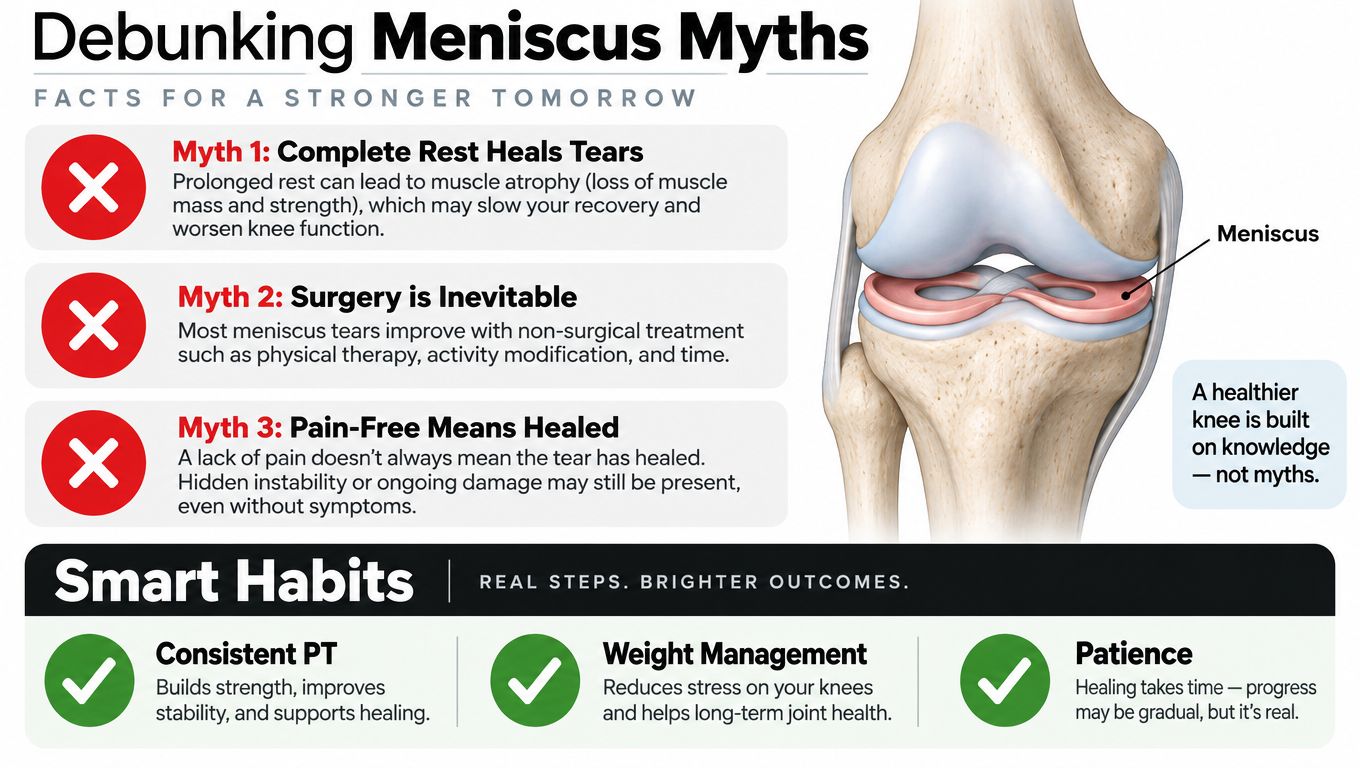
Myth one, complete rest heals the tear. Rest can reduce irritation during an acute flare, but prolonged inactivity weakens the quadriceps and makes ordinary loading harder. Graded exercise gives the knee a chance to regain motion, strength, and control.
Myth two, surgery is inevitable. It isn't. Structured rehabilitation matched the outcomes of early surgery in several important trial settings. In a randomized trial with five-year follow-up, exercise-based physical therapy was not inferior to arthroscopic partial meniscectomy for meniscal tears. IKDC knee function improved by 25.1 points in the PT group and 29.6 points in the surgery group. Review the five-year randomized trial findings.
Myth three, pain-free movement means the knee is healed. Less pain is encouraging, but it doesn't confirm restored strength, balance, or tolerance for rotation. Return to running or sport requires control under increasing demand, not only comfort during daily walking.
Habits that make the plan easier to follow
- Check motion in the morning: Note whether extension and flexion are better, unchanged, or worse.
- Use a comfortable sleep position: Support the legs if turning during sleep irritates the knee.
- Eat consistently: Protein-forward meals support general recovery and help maintain muscle while activity is restricted.
- Complete home exercises: The non-clinic days are where capacity is built.
- Log symptoms: Record swelling, walking tolerance, exercise response, and next-day stiffness so trends become visible.
Start with a clinical examination if the diagnosis is uncertain, especially after an acute twist. Ask whether the tear is stable, identify the symptoms that should stop self-directed rehabilitation, establish your first motion and strength benchmarks, and schedule a reassessment if progress is not objective by the six-to-twelve-week window.
MedAmerica Rehab Center offers individualized physical therapy for knee injuries, including strengthening, mobility, balance, and symptom-management strategies that can support meniscus tear rehab without surgery. If your knee remains swollen, weak, stiff, or unreliable, visit MedAmerica Rehab Center for an evaluation and a progression plan built around your current findings and activity goals.
MedAmerica Rehab · Deerfield Beach
Talk to a clinician about your pain
Physical therapy, chiropractic, acupuncture and shockwave therapy under one roof, since 1995. Same-day appointments are available.
Mon–Thu 8:00 AM – 6:30 PM · Fri 8:00 AM – 3:00 PM