

Shockwave Therapy Contraindications: What You Should Know
You've booked shockwave therapy for stubborn heel pain, but one question on the intake form makes the therapist stop: Are you pregnant, taking a blood thinner, living with a pacemaker, or being treated near a tumor? That pause isn't unnecessary bureaucracy. It's the safety check that determines whether acoustic energy is suitable for your body and the exact area being treated.
Shockwave therapy contraindications depend on more than the diagnosis. The device type, energy level, treatment depth, anatomy, medications, and current health all matter. A patient with plantar fasciitis may be an appropriate candidate, while the same treatment could be unsafe if the shockwave field crosses vulnerable tissue or if bleeding risk hasn't been reviewed.
Why Shockwave Therapy Contraindications Matter Before Your First Session
A warehouse supervisor with chronic plantar fasciitis arrives expecting a routine session. During intake, he mentions that he takes a blood thinner for a heart condition. The therapist pauses before preparing the applicator and checks the medication, the reason for treatment, and the planned energy level.
That pause protects the patient. Shockwave therapy delivers mechanical energy into tissue, and pulses that may help stimulate repair can also aggravate bleeding risk or interact with vulnerable structures. The International Society for Medical Shockwave Treatment guidelines distinguish safety concerns according to the treatment field, device type, and energy level.

Screening is part of treatment
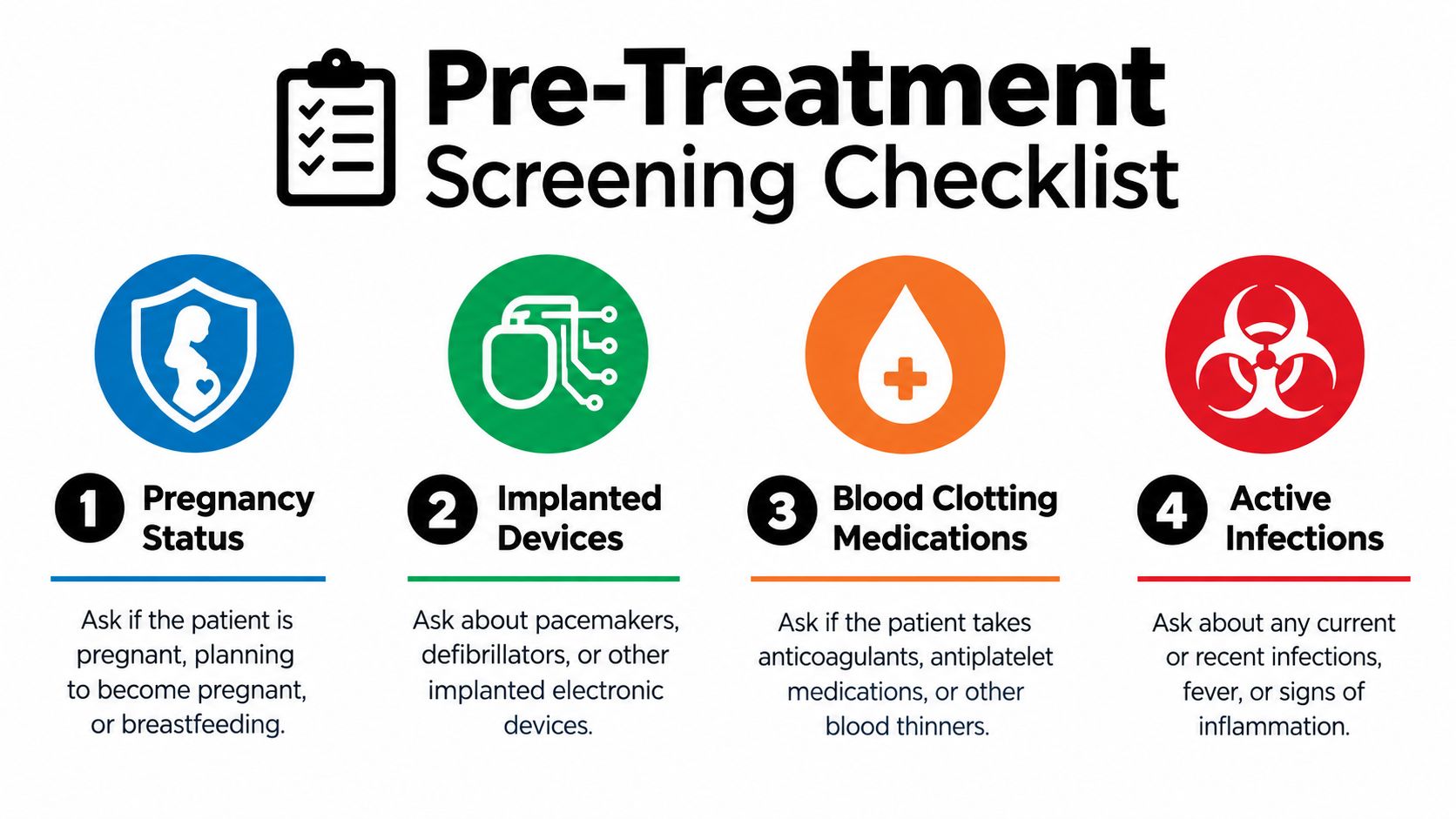
A careful clinician should ask about pregnancy, active infection, cancer near the target, implanted electronic devices, clotting problems, medications, recent injections, skin condition, and previous surgery. These questions help the clinician decide whether to treat, modify the protocol, postpone the session, or choose another modality.
The issue often isn't the diagnosis by itself. It's whether the acoustic energy would intersect tissue that could respond badly. A pacemaker located far from the treatment zone may require a different discussion from a cardiac device directly in the planned field. Likewise, anticoagulant use may call for medication review rather than an automatic refusal.
Practical rule: Don't hide a medication or medical condition because the treatment seems local. The treatment area may be small, but the safety decision depends on your whole clinical picture.
Understanding how shockwave devices deliver energy makes these distinctions easier to follow. Focused and radial systems don't place energy in exactly the same way, so their risk questions aren't identical.
What Shockwave Therapy Does and Why Energy Level Changes the Risk
Extracorporeal shockwave therapy, or ESWT, uses a handheld applicator to send acoustic pulses through the skin toward a painful structure. Clinicians use these pulses to create a mechanical stimulus that may support cellular repair, influence local circulation, and affect stiff or irritated soft tissue.
The label “shockwave” can describe different technologies. Focused shockwave therapy concentrates energy at a selected depth, making it useful when the target lies deeper. Radial pressure wave therapy spreads pressure outward from the applicator and is commonly used for more superficial musculoskeletal problems.
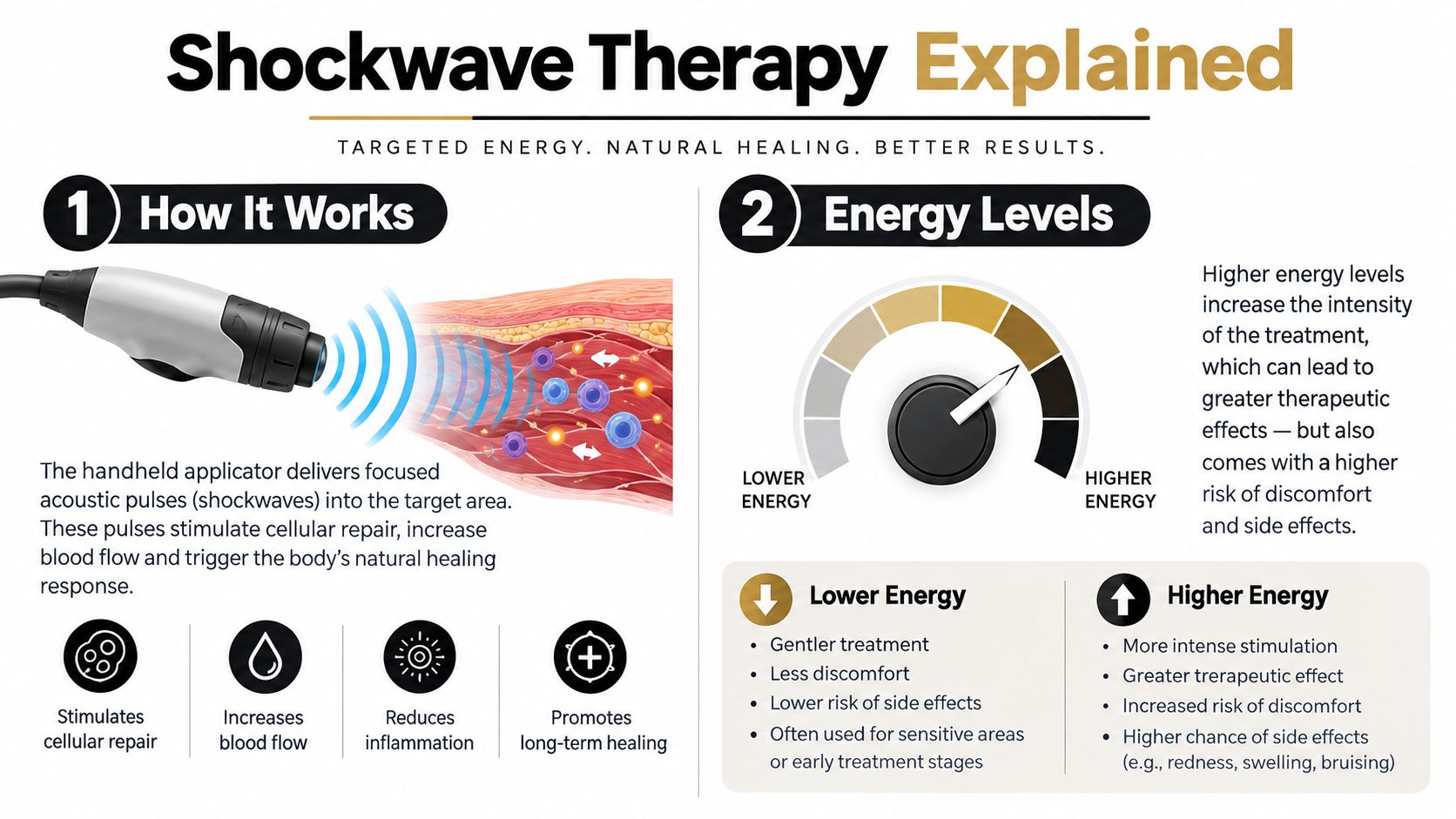
Focused and radial devices ask different safety questions
A focused device can direct greater energy into a precise location. That precision can be clinically useful, but it also means the clinician must pay close attention to structures such as lung tissue, the brain, the spine, growth plates, major vessels, and an implanted rhythm device in the treatment field. The 2022 evidence-based review of ESWT contraindications describes these restrictions particularly in relation to high-energy treatment.
Radial devices generally distribute energy across a broader, more superficial area. That doesn't make them automatically safe in every situation. Pregnancy, active infection, malignancy near the treatment area, significant bleeding risk, and damaged skin still require careful assessment.
The treatment plan also varies by energy level. Lower-energy protocols may be appropriate for some soft-tissue presentations, while high-energy focused treatment creates a stricter safety margin. This is why a clinician may ask a younger patient about open growth plates or review a recent injection before selecting a protocol.
For a plain-language overview of the treatment itself, patients can review MedAmerica's shockwave therapy information. The central principle is simple: every contraindication relates to a tissue, condition, device, or medication that may respond poorly to mechanical energy.
Universal Contraindications for Shockwave Therapy
Some situations should stop treatment in the planned field rather than trigger a minor adjustment. The ISMST consensus established a core group of exclusions in 2016, and its later guideline update continued to identify hazards including a fetus, malignant tumor, and an implanted pacemaker or defibrillator in the shockwave field. For high-energy focused sources, the guidance also highlights lung tissue and significant coagulation disorders.
| Condition | Why ESWT Is Excluded |
|---|---|
| Pregnancy or fetus in the treatment field | Fetal safety hasn't been established for acoustic energy directed into that area. |
| Malignant tumor in or near the treatment field | Mechanical stimulation shouldn't be applied over known malignancy. |
| Pacemaker or defibrillator in the treatment field | Device location and energy delivery may create a safety concern. |
| Active infection or osteomyelitis at the target | Treatment can aggravate an already infected area. |
| Severe coagulopathy | Mechanical pulses may increase bleeding or hematoma risk. |
| Lung tissue in a high-energy focused field | Concentrated energy shouldn't be directed into lung tissue. |
| Brain, spinal cord, or growth plate in restricted treatment fields | These structures require avoidance, particularly with high-energy focused treatment. |
The main exclusions
Pregnancy is treated conservatively, especially when the fetus or embryo would fall within the treatment area. The PMC review identifies pregnancy as a consistently cited contraindication across evidence summaries.
Cancer near the target is another hard stop. A known malignant tumor in the treatment area, or immediately adjacent to it, shouldn't receive shockwave energy. The concern is the treatment field and the vulnerable tissue beneath it, not merely a remote history of cancer.
Active infection, open wounds, and broken skin also change the decision. Reviews repeatedly identify active infection, including osteomyelitis, as a reason to avoid ESWT at that site. A clinician may need to address the infection or wound before considering any mechanical treatment.
Bleeding risk deserves a medication-specific conversation. Severe coagulopathy is especially important for high-energy focused therapy, while anticoagulant use requires review of the drug, dose, treatment site, and individual risk. Patients researching bone health may also benefit from reading about osteoporosis causes and symptoms, but a bone-density concern alone doesn't answer whether shockwave therapy is appropriate.
These exclusions are uncommon in otherwise healthy adults with localized musculoskeletal pain, but they're important enough that a clinic should ask about them every time.
Pre-Treatment Screening Questions Every Patient Should Expect
A proper screening conversation should feel routine, not accusatory. The clinician isn't looking for a reason to deny care. They're identifying details that could change the treatment field, timing, energy setting, or choice of modality.
Questions about immediate safety
Expect questions such as:
- Could you be pregnant? The clinician needs to know whether the fetus could be in or near the planned field.
- Do you have a pacemaker, defibrillator, or other implanted electronic device? The location matters, especially when focused energy is being considered.
- Do you take a blood thinner or have a clotting disorder? Bring the medication name and dose rather than saying only “a heart medication.”
- Do you have an open wound, rash, cellulitis, or other infection over the target? Skin condition can determine whether treatment must wait.
- Have you had cancer near this area? A remote cancer history and active malignancy near the target aren't the same situation, so the clinician needs the details.
- Have you had surgery or had metal hardware placed nearby? The hardware's position and the device's energy path can affect planning.
A younger patient may also be asked about skeletal maturity and growth plates. A patient being considered for focused therapy may receive more anatomy-specific questions than someone receiving radial treatment over a superficial tendon.
Bring useful information
Bring a current medication list, recent imaging if you have it, injection records, surgical details, and an implanted-device card when applicable. You can also use questions to ask a physical therapist to prepare for the consultation.
After screening, the clinician should explain the expected sensation, alternatives, and relevant risks. You'll typically review consent, identify the most painful point, and establish a baseline pain description before the applicator touches your skin. That workflow gives both patient and clinician a clear reference for safe treatment.
Relative Contraindications and Special Cases Worth Discussing
Not every risk factor creates an automatic ban. Some require a modified protocol, a different treatment site, extra monitoring, or a delay while the body recovers. The clinician's decision should reflect the device, energy, anatomy, medication, and condition together.
Anticoagulant therapy is a good example. Severe coagulopathy is a major concern for high-energy focused treatment, but anticoagulation itself isn't always an automatic exclusion. The NHS safety material emphasizes careful assessment of clotting disorders, cardiac devices, infection, and recent steroid injections, while more recent guidance separates severe coagulopathy from medication use that may be manageable with clinical judgment.
| Condition or Factor | Proceed With Caution (modified settings) | Delay or Avoid Treatment |
|---|---|---|
| Anticoagulant use | Review the medication, bleeding history, field, and energy level. | Avoid or postpone when bleeding risk is clinically significant. |
| Pacemaker or defibrillator | Consider only when the device is clearly outside the treatment field and the clinician approves. | Do not direct shockwaves through the implanted device. |
| Controlled diabetes | Check skin integrity and monitor healing carefully. | Delay when infection, poor wound healing, or uncontrolled complications are present. |
| Recent corticosteroid injection | Wait until the treating clinician confirms adequate timing. | Delay when the injection was recent or the tissue remains vulnerable. |
| Open growth plates | Consider age-appropriate, lower-risk approaches only under specialist judgment. | Avoid high-energy focused treatment across the growth plate. |
| Nearby metal hardware | Map the implant and target before selecting the device. | Avoid treatment when hardware or vulnerable tissue lies in the energy path. |
Why timing matters
Recent corticosteroid injections deserve particular attention. Many clinics postpone shockwave therapy after an injection because the tissue may need time before receiving another mechanical stimulus. The exact timing depends on the body region, injection, tissue condition, and clinician assessment, so patients shouldn't set a universal timetable for themselves.
A pacemaker far from a foot or elbow treatment field may lead to a different decision than a device near the chest or shoulder target. Controlled diabetes may be compatible with treatment, but skin condition and healing need closer observation.
The practical boundary: Relative contraindications become hard stops when several risks stack together. The treating clinician should make that call after reviewing the whole picture.
Possible Side Effects and Risks When Treatment Is Appropriate
Passing screening doesn't mean you'll feel nothing. Shockwave therapy intentionally delivers mechanical pulses, so temporary local reactions can occur even when the treatment is appropriate and carefully performed.
The most familiar response is localized soreness at the applicator site. You may also notice mild bruising, temporary redness, tenderness, or a short-lived increase in pain. These reactions are generally self-limiting, and the clinic may recommend hydration, activity modification, or a simple comfort measure such as ice when appropriate.
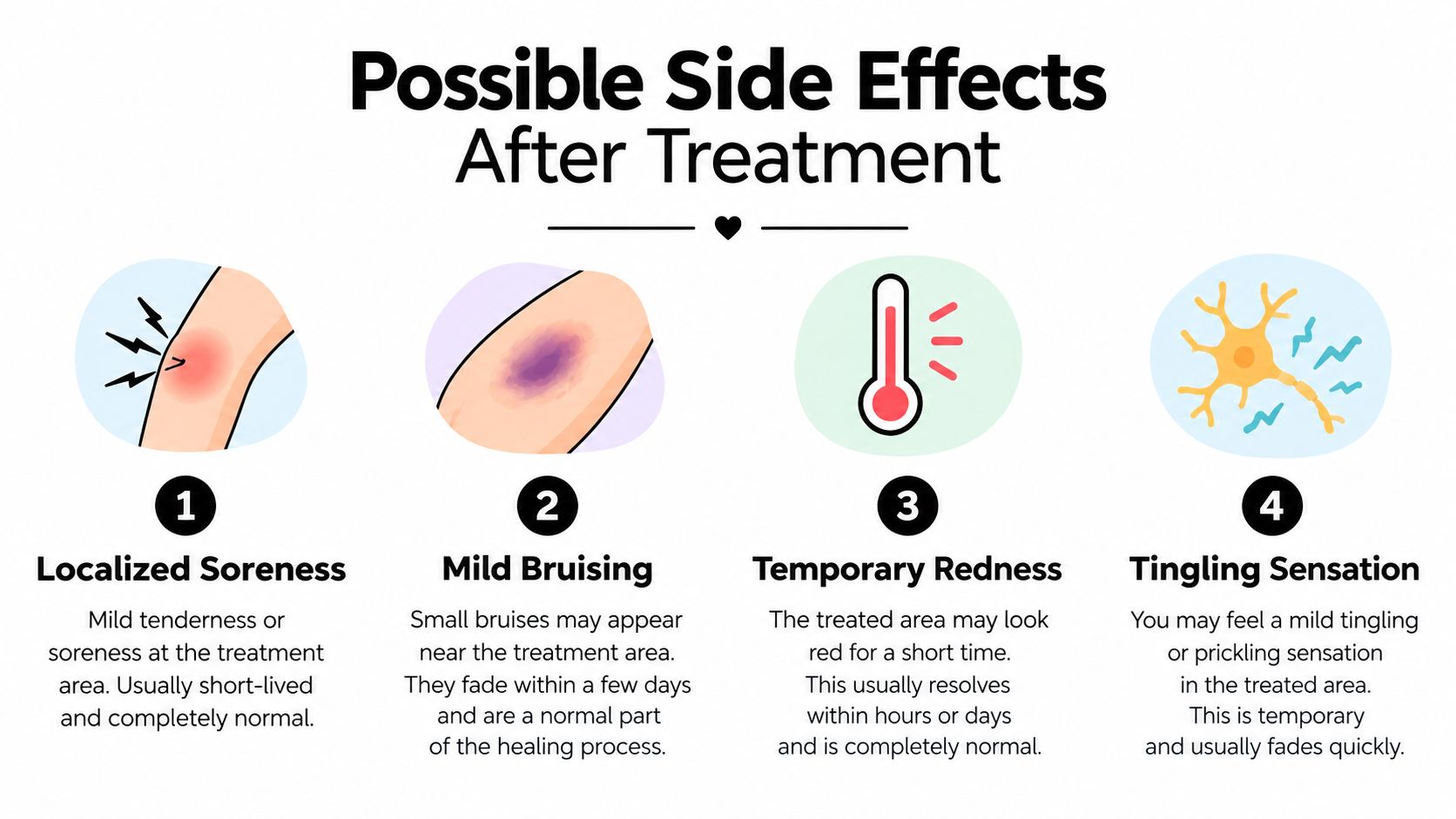
Expected discomfort versus a warning sign
A tender treatment area doesn't automatically mean something went wrong. The important details are the intensity, duration, location, and whether symptoms are improving.
| Usually expected | Contact the clinic |
|---|---|
| Local soreness after treatment | Swelling that continues or worsens |
| Mild bruising or redness | Spreading redness, warmth, drainage, or fever |
| Temporary tenderness | Numbness, weakness, or nerve symptoms that persist |
| Short-term sensitivity near the target | Severe or escalating pain |
Less common effects can include pinpoint skin bleeding called petechiae, a superficial hematoma, or temporary numbness when treatment occurs close to a superficial nerve. These possibilities reinforce why medication review and accurate treatment mapping matter.
Follow the clinic's instructions rather than self-adjusting medication or activity. Call promptly if you develop signs of infection, persistent swelling, a rapidly enlarging bruise, marked weakness, or nerve symptoms that don't settle. Transparency helps you distinguish an ordinary local response from a symptom that needs assessment.
Alternative Treatment Options When Shockwave Is Not Recommended
Being screened out of shockwave therapy doesn't leave you without options. The right alternative depends on the problem being treated, the tissues involved, your functional goals, and the reason ESWT wasn't suitable.
For plantar fasciitis, tendinopathy, or joint-related pain, a therapist may build a plan around progressive strengthening, mobility work, manual therapy, and activity modification. These approaches target load tolerance and movement habits without sending acoustic pulses into the treatment field.
Other modalities may fit different presentations:
| Alternative Modality | Best For | Typical Session Count | Notes for Screened-Out Patients |
|---|---|---|---|
| Manual therapy | Joint stiffness, soft-tissue restriction, and mobility limits | Determined individually | Avoids shockwave energy and can be adjusted around wounds or implants. |
| Targeted exercise prescription | Tendinopathy, weakness, balance problems, and return to activity | Progressed over the rehabilitation plan | Builds capacity gradually and remains central to many care plans. |
| Therapeutic ultrasound | Selected superficial soft-tissue complaints | Determined individually | Requires separate screening for the target area and treatment method. |
| Laser therapy | Some pain and soft-tissue presentations | Determined individually | Patients can review laser therapy for pain as one non-shockwave option. |
| Neuromuscular electrical stimulation | Muscle activation and weakness | Determined individually | Device and sensation screening still matter. |
| Instrument-assisted soft-tissue work | Local soft-tissue restriction and myofascial complaints | Determined individually | The clinician adapts pressure to skin, bruising, and tissue tolerance. |
An integrated plan may combine hands-on care, therapeutic exercise, education, and an appropriate modality. MedAmerica Rehab Center offers physical therapy and related rehabilitation services that can be organized around the patient's condition when shockwave therapy isn't recommended.
The alternative isn't a consolation prize. It's a safer route when the acoustic-energy risk outweighs the expected benefit.
Quick Safety Checklist and Next Steps at MedAmerica
Before a screening appointment, write down the information your clinician will need:
- Medication list: Include anticoagulants, antiplatelet drugs, steroids, and other relevant prescriptions.
- Injection dates: Record recent corticosteroid injections and the body area treated.
- Medical history: Mention pregnancy, cancer near the target, infection, diabetes, clotting disorders, and implanted devices.
- Surgical details: Bring implant information and device cards when applicable.
- Imaging reports: Provide recent scans or reports if they relate to the painful area.
- Current symptoms: Note wounds, bruising, swelling, numbness, weakness, or changes in pain.
Before treatment, ask which device will be used, where the energy will travel, what energy level is planned, and what alternatives exist. After treatment, call the clinic about persistent or worsening swelling, spreading redness, drainage, fever, severe pain, or ongoing nerve symptoms.
The central safety measure is screening, not the modality alone. A qualified clinician should decide whether shockwave therapy is appropriate, whether the protocol needs modification, or whether another treatment makes more sense.
At MedAmerica Rehab Center, a pre-treatment evaluation can review your health history, medications, implanted devices, recent procedures, and treatment goals before a clinician makes a go or no-go decision.
MedAmerica Rehab Center offers individualized physical therapy, rehabilitation care, and shockwave therapy evaluations for patients in Deerfield Beach and nearby communities. Visit MedAmerica Rehab Center to request a screening consultation and discuss a safe treatment plan with a qualified clinician.
MedAmerica Rehab · Deerfield Beach
Talk to a clinician about your pain
Physical therapy, chiropractic, acupuncture and shockwave therapy under one roof, since 1995. Same-day appointments are available.
Mon–Thu 8:00 AM – 6:30 PM · Fri 8:00 AM – 3:00 PM