

Carpal Tunnel Treatment Near Me: A Patient Guide
You wake up at 3 a.m. with your hand buzzing, shake it hard, and wait for the feeling to return. By morning, you're dropping keys, struggling with a coffee cup, or rubbing your wrist under the desk while searching for carpal tunnel treatment near me.
That search shouldn't send you straight to surgery, or leave you trying random exercises for months. The sensible path starts with identifying the symptom pattern, using low-risk care, measuring whether you're improving, and referring to a hand surgeon when the nerve is clearly under pressure. MedAmerica Rehab Center can serve as the conservative-care stop on that path, while a qualified specialist remains available when the evidence points beyond rehabilitation.
Spotting the Symptoms Worth Acting On
A hand that wakes you at night, improves when you shake it, and starts dropping keys is giving you a reason to book an evaluation. The pattern matters more than one sore wrist. Tingling in the thumb, index finger, middle finger, and thumb-side half of the ring finger points toward median-nerve irritation, especially when sleep or everyday hand use suffers.
Carpal tunnel syndrome results from compression of the median nerve at the wrist. A 2019 clinical practice guideline reported an 8.0% lifetime prevalence of self-reported or physician-diagnosed carpal tunnel syndrome, while confirmed carpal tunnel syndrome affected 7.8% of the U.S. working population in the cited data (JOSPT clinical practice guideline).
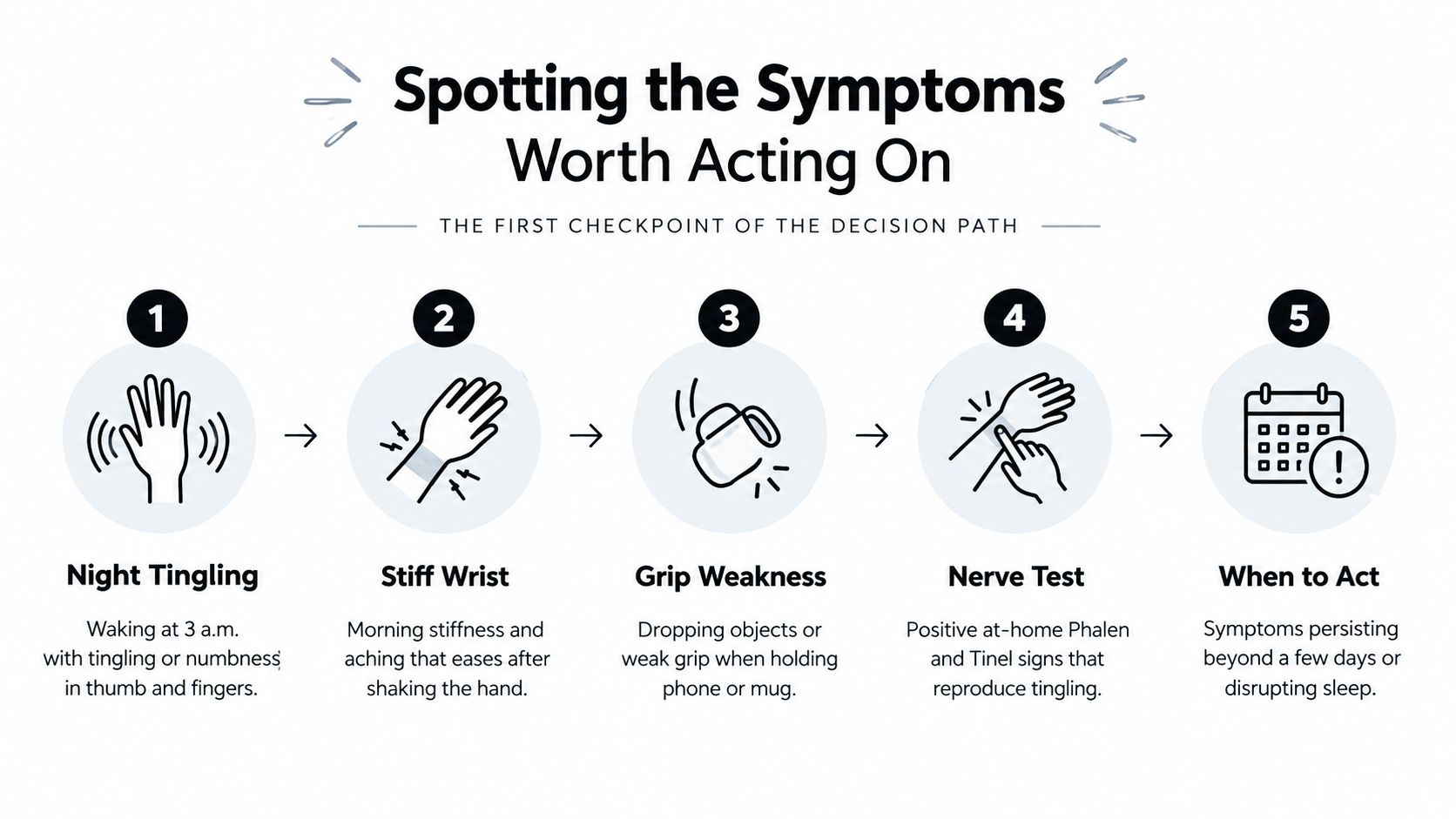
The quick symptom checklist
Use this cluster to decide whether an appointment should move up your list:
- Night symptoms: Tingling or numbness wakes you, and shaking your hand brings temporary relief.
- Median-nerve distribution: Sensations center on the thumb, index finger, middle finger, and thumb-side half of the ring finger.
- Grip changes: Holding a mug, phone, or car keys feels less secure.
- Fine-motor trouble: Buttons, zippers, handwriting, or small tools become awkward.
- Progression: Symptoms occur more often, last longer, or begin during the day.
The location and timing also help separate carpal tunnel from similar problems. Cubital tunnel usually involves the ring and little fingers, with pressure near the elbow. Tendonitis more often causes localized pain during movement than a repeating numbness pattern. Cervical radiculopathy may start in the neck and travel down the arm, with neck movement changing the symptoms. This comparison of carpal tunnel syndrome and cervical radiculopathy helps organize what you notice, but an examination is needed to identify the cause.
Constant numbness, visible wasting at the base of the thumb, repeated dropping of objects, or symptoms that wake you multiple nights a week warrant prompt evaluation. Before contacting a local clinic, record when symptoms began, how often they occur, which fingers are affected, what triggers them, and whether shaking your hand helps. That information helps a PT, chiropractor, or physician decide whether conservative care fits or a hand-surgeon referral deserves consideration.
What Self-Care You Can Start Before Your Appointment
Self-care is reasonable while you arrange an evaluation, particularly when symptoms are intermittent and you don't have weakness or constant numbness. It should reduce irritation while you wait, not become an excuse to ignore a deteriorating nerve.
Start with a neutral-position wrist splint at night. Choose a brace with a metal or rigid plastic stay that keeps the wrist straight rather than bent forward. A practical trial is two to four weeks of overnight wear, as reflected in the patient guidance used for carpal tunnel splinting (Center for Bone and Joint Disease treatment overview).
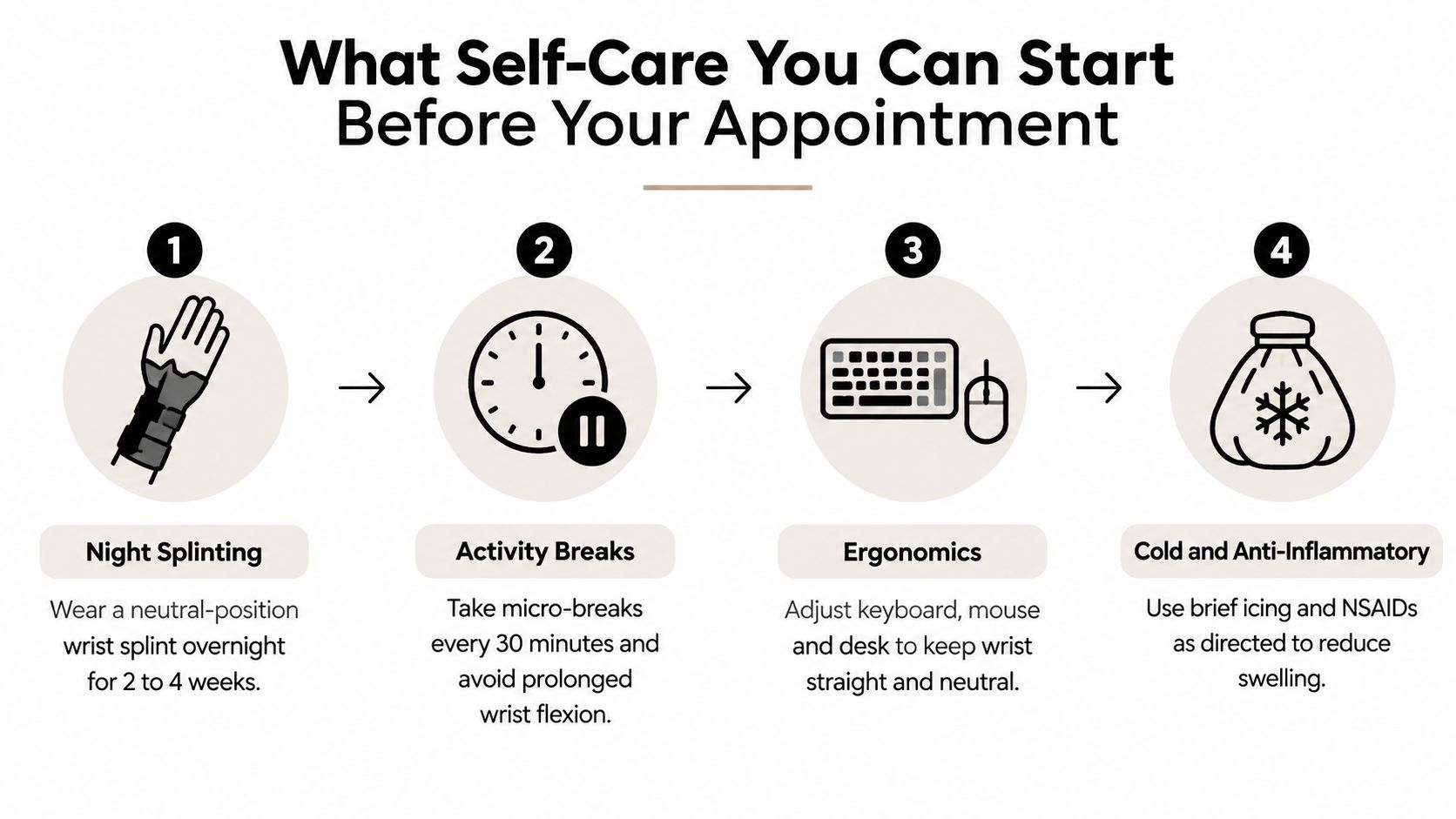
Four useful adjustments
- Change the position: Keep the wrist straight while typing, driving, reading, or sleeping. Don't strap the brace on so tightly that your fingers swell or change color.
- Interrupt repetition: During keyboard, phone, or tool use, take brief breaks about every twenty to thirty minutes. Relax your grip and let the hand rest rather than stretching forcefully.
- Remove sustained pressure: Avoid prolonged wrist flexion, hard gripping, and vibrating tools when they reliably provoke symptoms.
- Calm a flare: Use a brief cold application wrapped in cloth. Over-the-counter anti-inflammatory medication may be appropriate for some people, but check with a physician or pharmacist first if you have medical conditions, take other medication, or have been advised to avoid these drugs.
Don't immobilize the wrist all day unless a clinician specifically directs you to. Don't aggressively stretch into tingling, and don't assume daytime comfort means the nerve is fine. Night symptoms often reveal the problem before daytime function clearly declines.
Write down the result each day. Note sleep interruptions, numbness duration, objects dropped, and which activities bring symptoms on. If you want a structured way to add gentle hand strengthening later, review this guide to hand exercise putty rather than squeezing aggressively during an active flare.
The evidence supports a staged approach, but it also has limits. A review of conservative care found that splinting alone has limited or low-certainty short-term benefit, while adding nerve or tendon gliding may improve pain and function in some patients, with mixed evidence quality (evidence review of non-surgical care). Self-care buys time. It isn't the destination if numbness persists.
Conservative Treatment Options a Local Clinic Can Offer
A local clinic should do more than provide a brace or a routine adjustment. It should assess the wrist, hand, elbow, and neck, identify activities that aggravate symptoms, set a treatment target, and schedule a clear reassessment. I would not recommend an open-ended course of any treatment because the clinic offers it.
Physical therapy may combine median-nerve and tendon-gliding exercises, wrist and forearm mobility work, ergonomic changes, and gradual strengthening after irritability settles. A qualified provider can tailor hand physical therapy to sensation, grip, sleep disruption, and work demands. Chiropractic care can be reasonable when it addresses mobility around the wrist, elbow, and cervical region, with targeted nerve-glide work. I would avoid indefinite adjustment plans that never measure sensation, grip, or daily function.
Acupuncture may provide short-term relief for pain or altered sensation. Focused or radial shockwave therapy can be discussed for persistent symptoms, but ask what result will be measured and when the clinic will stop if improvement does not occur. A properly fitted splint can help during aggravating periods, especially sleep, while periodic reassessment confirms whether it is still serving a purpose.
| Option | What It Does | Typical Course | Best For |
|---|---|---|---|
| Physical therapy | Combines mobility work, gliding, ergonomic changes, and progressive strengthening | Layered care over several weeks | Mild to moderate symptoms with activity or movement limitations |
| Chiropractic care | Addresses wrist, elbow, and cervical mobility with targeted manual techniques | Short, measured trial | Patients whose symptoms include regional stiffness or mechanical restriction |
| Acupuncture | May reduce pain and altered sensation in the short term | A defined trial, often several visits | Pain-sensitive patients seeking a non-drug adjunct |
| Shockwave therapy | Uses acoustic energy as an adjunct for persistent symptoms | Clinician-defined course with outcome checks | Selected cases that haven't responded to basic care |
| Splinting | Holds the wrist in a neutral position during aggravating periods, especially sleep | Night use and periodic reassessment | Night-dominant, intermittent symptoms |
| Ergonomic coaching | Changes keyboard, mouse, phone, tool, and work habits | Implemented immediately, reviewed during visits | Symptoms linked to repetitive work or sustained wrist positions |
Typing can keep the wrist in one position for long periods. Voice input reduces that demand, and Voice Control Pro for wrist pain relief explains how dictation can support a broader activity-modification plan.
Judge conservative care by measurable change, not by the number of appointments. Track symptom frequency, severity, sleep interruption, grip, and everyday tasks over the agreed treatment window. Conservative care can buy time, but persistent numbness, declining function, or objective weakness requires a new decision rather than another unmeasured treatment cycle.
When Conservative Care Is Not Enough and Surgery Enters the Picture
Surgery shouldn't be the automatic first move for mild or moderate symptoms. It also shouldn't be treated as a failure when the nerve remains compressed after an honest trial of conservative care.
I'd refer a patient toward a hand surgeon when numbness remains function-limiting after a defined course of splinting and therapy, when symptoms become constant, when the thenar muscles visibly weaken or waste, or when nerve-conduction testing shows severe compression. A clinician may shorten that trial when objective weakness or denervation is already present.
Use checkpoints, not guesswork
Set the checkpoints before treatment starts:
- Initial assessment: Document sensation, grip and pinch function, symptom frequency, and provocative findings.
- Treatment trial: Use splinting, activity changes, and targeted rehabilitation for a defined period when the condition is suitable for conservative care.
- Re-test: Compare grip, sensation, sleep disruption, and daily function rather than relying on a general feeling of “a little better.”
- Escalate: Refer promptly when the patient fails the agreed checkpoint or develops weakness, wasting, or persistent numbness.
Carpal tunnel release works by dividing the transverse carpal ligament, the structure forming the roof of the tunnel, so the median nerve has more room. Open release uses a palm incision, while endoscopic release uses a camera-assisted approach through smaller incisions. Evidence summarized in a contemporary meta-analysis found similar long-term symptom relief between approaches, with endoscopic surgery mainly offering earlier function and a longer operative time (best-evidence analysis of mini-open release).
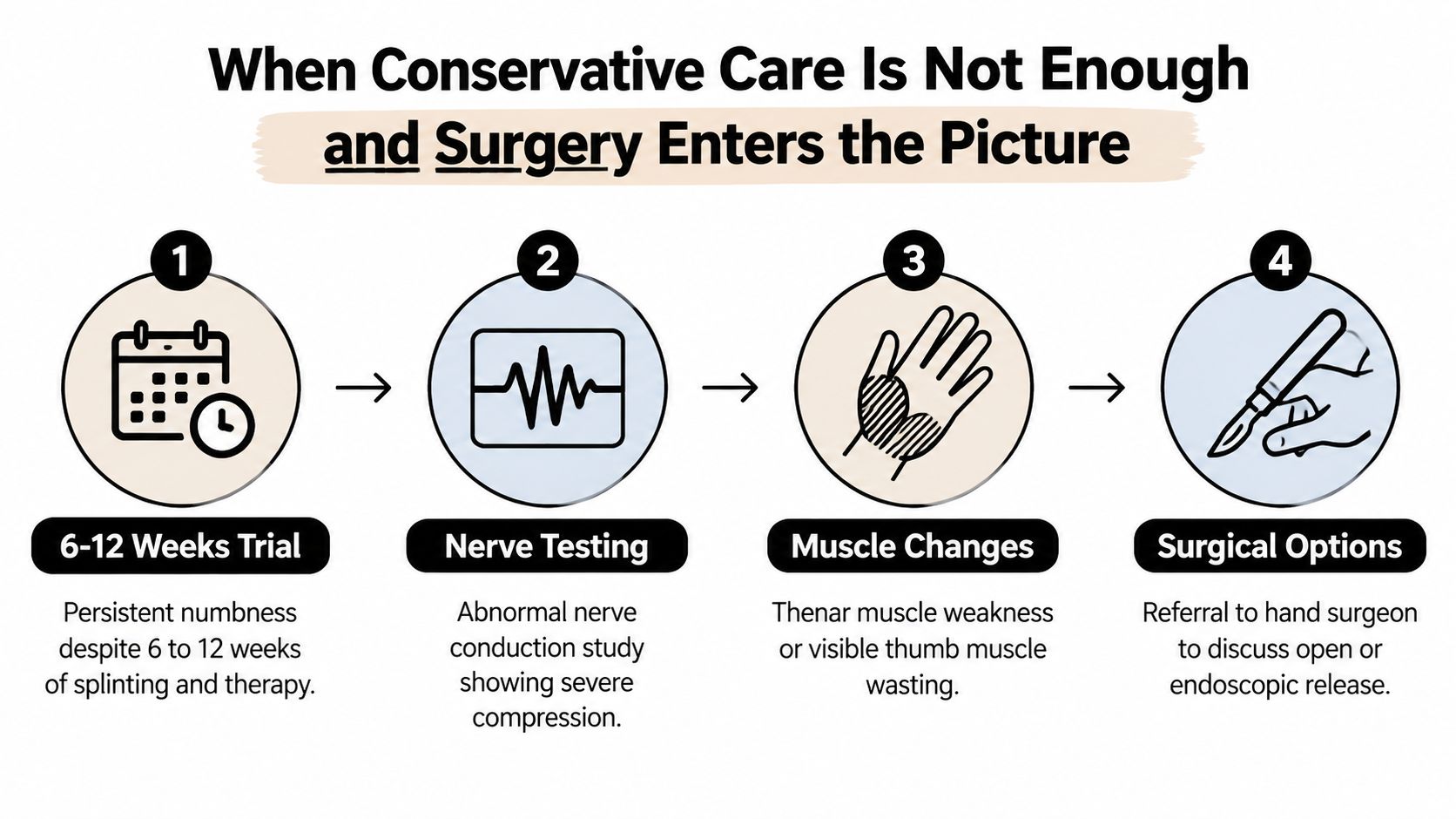
Surgery remains the most thoroughly documented definitive milestone in modern carpal tunnel care. Cochrane's 2024 review found improvement at long-term follow-up in 93% of surgical patients compared with 60% of splinting patients, although individual outcomes depend on diagnosis, severity, and nerve condition (Cochrane review record). A local rehabilitation team can support pre-operative conditioning and post-operative mobility, including scar care when appropriate, while the surgeon manages the operation and surgical restrictions.
How to Choose the Right Provider Close to Home
Don't choose a clinic solely because it's the closest result on Google. Call first and ask questions that reveal whether the provider can manage the whole decision path.
Ask before you book
- Case experience: Does the clinic treat carpal tunnel cases regularly, or does it see them only through occasional referrals?
- Diagnostics: Who performs nerve-conduction testing, and does a neurologist or physiatrist interpret it?
- Available tools: Are ultrasound, shockwave therapy, custom splinting, and hand-specific rehabilitation available in-house, or outsourced?
- Specialist access: Does the clinic have an established referral relationship with a board-certified hand surgeon?
- Handoff process: Will the therapist send records and coordinate the referral, or will you have to start over?
- Practical access: Is the clinic in-network, and can it offer a timely appointment for an acute flare?
A qualified therapist should be able to explain why a particular treatment fits your symptom pattern and what would count as failure. Ask whether the clinician holds a Certified Hand Therapist credential, an occupational therapy qualification, or hand-specific continuing education. Those credentials don't guarantee the right diagnosis, but they help you identify a provider who works with hand conditions routinely.
Be cautious with clinics that promise a permanent fix from one modality, recommend a long program without objective reassessment, or dismiss constant numbness as ordinary soreness. The provider you want can explain conservative options, recognize mimics, and make a surgical referral without treating that referral as a loss.
What Your First Visit at MedAmerica Rehab Center Looks Like
At MedAmerica Rehab Center, the first visit should feel practical rather than mysterious. You check in, complete an intake focused on symptom duration, dominant hand, work demands, sleep disruption, and treatments you've already tried, then discuss what brought you in and what you need your hand to do.
The therapist performs a targeted examination. That may include Phalen and Tinel provocation tests, grip and pinch measurements, sensory testing such as two-point discrimination, and a brief cervical screen to look for a possible neck contribution or double-crush pattern. The point isn't to force every wrist symptom into a carpal tunnel label.
A plan you can understand
If the presentation fits conservative care, the clinician can outline a same-day plan. That may include a neutral wrist splint, ergonomic corrections, gentle home exercises, hands-on treatment, and a schedule for reassessing function. If testing or a specialist opinion is needed, the team should explain why instead of burying the recommendation in jargon.
Insurance questions also belong at the beginning. Coverage verification, expected out-of-pocket costs, and authorization requirements should be discussed before billing surprises appear. The clinic's published service information describes physical therapy, chiropractic care, acupuncture, shockwave therapy, and support for orthopedic rehabilitation, so ask which option is appropriate for your specific findings rather than requesting every available modality.
For an acute flare, ask about same-day or same-week availability when you call. If a surgeon or physician needs to order electrodiagnostic testing or imaging, a coordinated clinic can help transfer the relevant examination findings and treatment history. That continuity matters because you shouldn't have to repeat the entire story at every stop.
Putting It All Together and Taking the Next Step
The decision path is straightforward:
- Log symptoms tonight: Record the fingers involved, nighttime awakenings, triggers, duration, grip problems, and whether shaking helps.
- Schedule a local evaluation this week: Choose a clinic that can distinguish wrist, elbow, neck, tendon, and nerve causes.
- Commit to a defined conservative trial: For appropriate mild or moderate symptoms, follow the splinting, activity, and therapy plan rather than trying one visit and quitting.
- Reassess objectively: Compare grip, sensation, sleep, and daily tasks at the agreed checkpoint.
- Refer when the red lines appear: Constant numbness, thenar wasting, objective weakness, severe nerve-conduction findings, or failed conservative care justify a hand-surgeon discussion.
This staged approach protects you from both extremes. You don't rush a manageable condition into surgery, and you don't spend months repeating exercises while a damaged nerve loses function. Surgery is a tool for persistent or severe compression, not a judgment about whether you tried hard enough.
MedAmerica Rehab Center can function as the coordinated conservative-care entry point for patients in Deerfield Beach and nearby communities. Bring prior imaging, nerve studies, splints, and medication information if you have them, and describe when symptoms occur, not just how painful they feel.
Call MedAmerica Rehab Center to arrange a carpal tunnel evaluation, discuss physical therapy, chiropractic care, acupuncture, or shockwave options, and learn whether your symptoms warrant a referral. Visit MedAmerica Rehab Center to schedule care and take the next step with a local team that can measure progress and coordinate escalation when needed.
MedAmerica Rehab · Deerfield Beach
Talk to a clinician about your pain
Physical therapy, chiropractic, acupuncture and shockwave therapy under one roof, since 1995. Same-day appointments are available.
Mon–Thu 8:00 AM – 6:30 PM · Fri 8:00 AM – 3:00 PM