
Knee Injury Recovery Time: A Practical Guide by Stage
Your knee is swollen after a twist, the scan report is in your hand, or you're several weeks into rehabilitation and wondering why stairs still feel difficult. Searching for knee injury recovery time usually produces a single number, but a knee doesn't heal according to a universal countdown.
The realistic timeline depends on the structure involved, the injury's severity, whether you had surgery, your starting strength, how quickly you regain movement, and how consistently you load the joint. Daily walking may return well before running, cutting, jumping, kneeling, or full work duties. Improved symptoms and full functional recovery aren't the same milestone.
This guide gives you a practical map. You'll see how the four rehabilitation phases work, what timelines commonly look like for ACL, meniscus, collateral ligament, and patellar injuries, why two people with similar imaging can progress differently, and which tests matter before you return to sport or physically demanding work. If you're new to therapy, this guide to a typical physical therapy session can also help you understand what happens during an appointment.
What Recovery Actually Looks Like After a Knee Injury
Knee recovery starts with a question that sounds simple: “When will I be normal again?” In practice, the answer has at least two parts. First, when can you perform basic tasks such as walking, standing, dressing, and using stairs? Second, when can the knee tolerate the speed, force, repetition, and unpredictability of your job or sport?
Those milestones can be separated by months. NHS patient guidance notes that many everyday activities can resume within a few months after ACL reconstruction, while sport may take up to a year. Modern guidance commonly places return to full sport after ACL reconstruction at 9 to 12 months, although some sources describe full recovery in the 6 to 9 month range and competitive sport taking as long as 12 months (ACL reconstruction review).
A 2020 cohort study makes the distinction even clearer. At six months, only 3% of participants with an ACL injury reported that their knee function was fully recovered, compared with 23% of participants with other acute knee injuries (acute knee injury cohort study). Pain can settle while strength, confidence, coordination, and tolerance for activity remain behind.
Recovery is a sequence of decisions
Your clinician will usually adjust the plan according to swelling, range of motion, strength, gait, and the demands you need to resume. A person with a mild MCL sprain and a desk-based job may return to ordinary work quickly, while a recreational soccer player with the same grade of injury needs more preparation for sprinting and contact.
Use recovery as a staged process rather than a countdown:
- Protect the injured tissue while controlling swelling and maintaining safe movement.
- Restore motion and basic strength before adding demanding resistance.
- Build capacity through progressive loading, balance work, and controlled single-leg tasks.
- Rehearse real demands before unrestricted sport, heavy work, or rapid changes of direction.
Practical rule: If the knee swells repeatedly after ordinary exercises, the next step isn't automatically more intensity. It's a reassessment of load, technique, and tissue tolerance.
The Four Phases Every Knee Goes Through
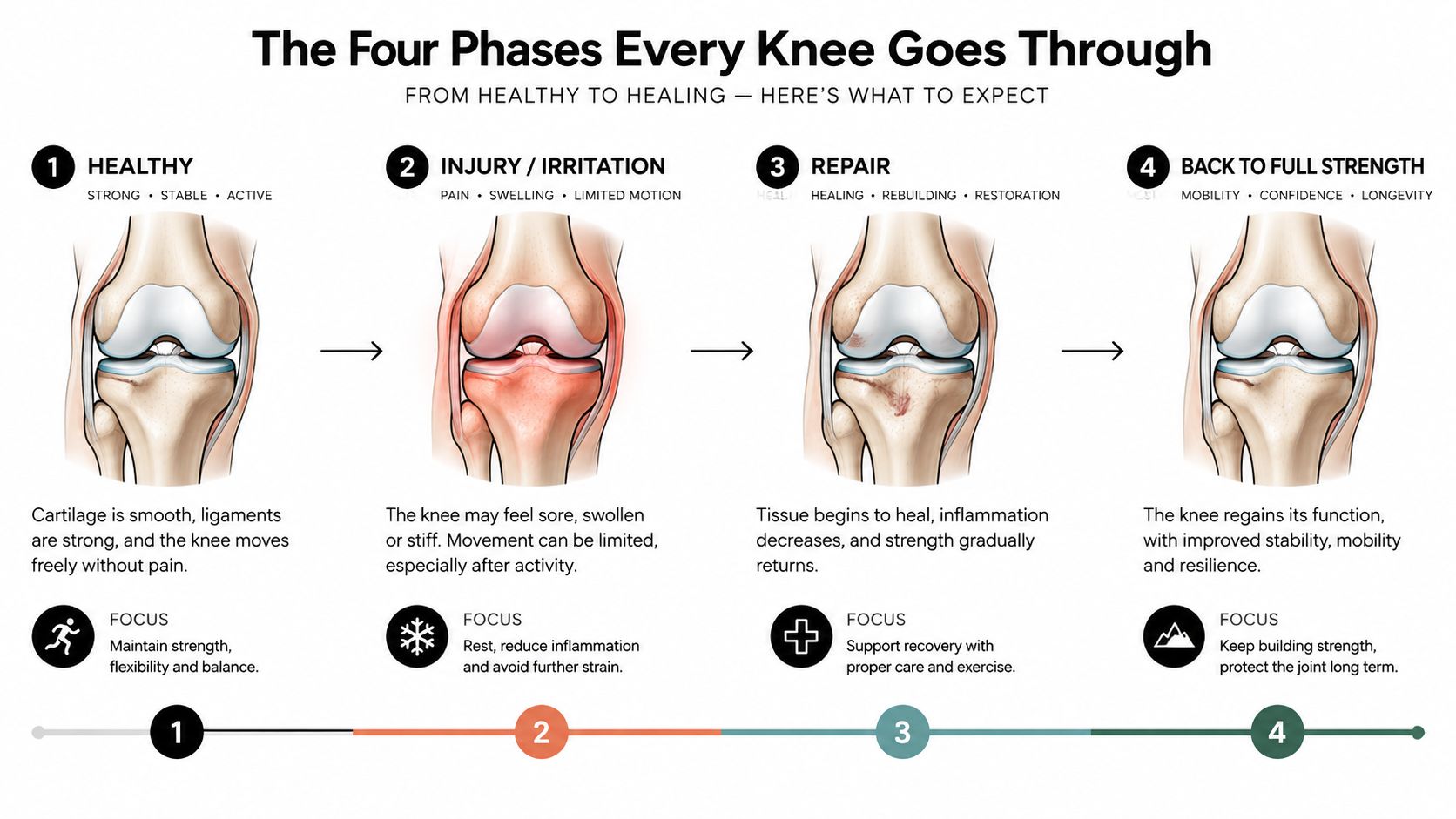
Think of rehabilitation as rebuilding a house. You wouldn't install the roof while the foundation is unstable. The knee follows the same logic. Each phase prepares the joint for the next demand, and progression should depend on what the knee can demonstrate rather than on the calendar alone.
Phase one protects and calms the tissue
The acute phase focuses on reducing irritation, protecting a repair or healing ligament, and preventing unnecessary stiffness. Treatment may include activity modification, bracing when prescribed, elevation, gentle range-of-motion work, and carefully progressed weight-bearing.
A key early target is regaining full passive knee extension. A knee that stays slightly bent can alter walking mechanics and make quadriceps activation harder, so “I can bend it” isn't enough if you still can't straighten it fully.
Phase two restores movement and baseline control
The subacute phase begins when swelling and pain are more manageable. Heel slides, quad sets, controlled walking, and basic balance exercises help restore motion and the ability to accept load.
Progression should reflect movement quality. You should be able to walk with improving control, activate the quadriceps, and perform prescribed exercises without a substantial swelling response afterward. For complex injuries or post-operative care, physician-led PM&R care can help coordinate medical assessment and rehabilitation decisions.
Phase three rebuilds loading capacity
Strengthening is not just about making the quadriceps tired. It means improving the knee's ability to handle repeated force through squats, step-downs, bridges, split-stance work, and eventually single-leg loading.
The therapist may compare sides using strength testing and observe whether the pelvis, knee, and foot stay aligned. Persistent weakness or poor control means the knee hasn't built a reliable foundation for running or jumping.
Phase four prepares you for real activity
Return-to-activity work adds acceleration, deceleration, landing, pivoting, agility, job simulations, or sport-specific drills. Objective testing may include a hop-test battery, movement analysis, and psychological readiness measures.
Skipping this phase often creates a false sense of recovery. A patient may walk comfortably but still lack the control needed to cut, land, lift, or react under fatigue.
Typical Recovery Timelines for the Most Common Knee Injuries
Recovery estimates are useful only when you attach them to a task. “Back to activity” might mean walking around the house, returning to a desk, lifting at work, jogging, or competing in a contact sport. Those are different endpoints, and the same injury can reach them at different times.
| Injury | Return to Daily Activity | Return to Sport / Full Duty |
|---|---|---|
| ACL reconstruction | Everyday activities often resume within a few months, depending on surgical instructions and function | Commonly 9 to 12 months for full sport, with longer timelines possible for younger athletes and high-demand activity (ACL reconstruction review) |
| ACL managed without reconstruction | Variable, based on stability, strength, symptoms, and goals | Often several months for daily function, while pivoting sport requires demonstrated stability and testing |
| Meniscus repair | Gradual walking and daily tasks as movement and weight-bearing restrictions allow | Commonly several months, often longer than a partial meniscectomy |
| Partial meniscectomy | Daily activity may return relatively quickly when swelling and gait improve | Light activity may resume within weeks, while running and cutting require strength and control |
| MCL grade I or II sprain | Walking and ordinary tasks often improve over weeks | Commonly 2 to 6 weeks, depending on grade and activity demands |
| MCL grade III sprain | Protected loading may be needed before normal walking | Commonly 8 to 12 weeks, with longer rehabilitation for instability or combined injury |
| LCL or combined ligament injury | Daily function varies substantially with stability and surgical needs | Often several months, particularly when multiple ligaments are involved |
| Patellar tendinopathy | Symptoms may settle with load management and progressive strengthening | Often several weeks to months before jumping and repeated sprinting are tolerated |
| Patellar dislocation | Walking and range of motion improve progressively with stability work | Commonly several months before unrestricted sport |
| Patellar fracture or post-operative realignment | Mobility depends on fixation, precautions, and quadriceps recovery | Often several months before full-duty or sport demands |
ACL reconstruction is the clearest example of why a short answer can mislead. Expert guidance emphasizes strength, jump performance, range of motion, and psychological readiness, not time alone. Rehabilitation of at least nine months is commonly recommended before return to sport because earlier return can leave biological graft remodeling and neuromuscular control incomplete (ACL rehabilitation guidance).
A 2025 systematic review reported a mean return-to-play time of 263.2 days after ACL reconstruction. Its subgroup covering 2022 through 2025 averaged 295.1 days, compared with 203.5 days in the 2011 through 2016 subgroup, suggesting that modern practice has become more conservative rather than faster (2025 ACL systematic review). The same review discussed delaying strenuous sport for 18 to 24 months in some younger athletes because graft remodeling can lag behind conventional rehabilitation milestones.
For meniscus injuries, the treatment choice changes the pathway. Repair preserves tissue but requires protection while it heals, whereas meniscectomy may allow faster early activity but doesn't create the same repair-healing timeline. For a more detailed treatment-specific discussion, see this meniscus tear recovery timeline.
Why Two Patients With the Same MRI Heal Different Timelines
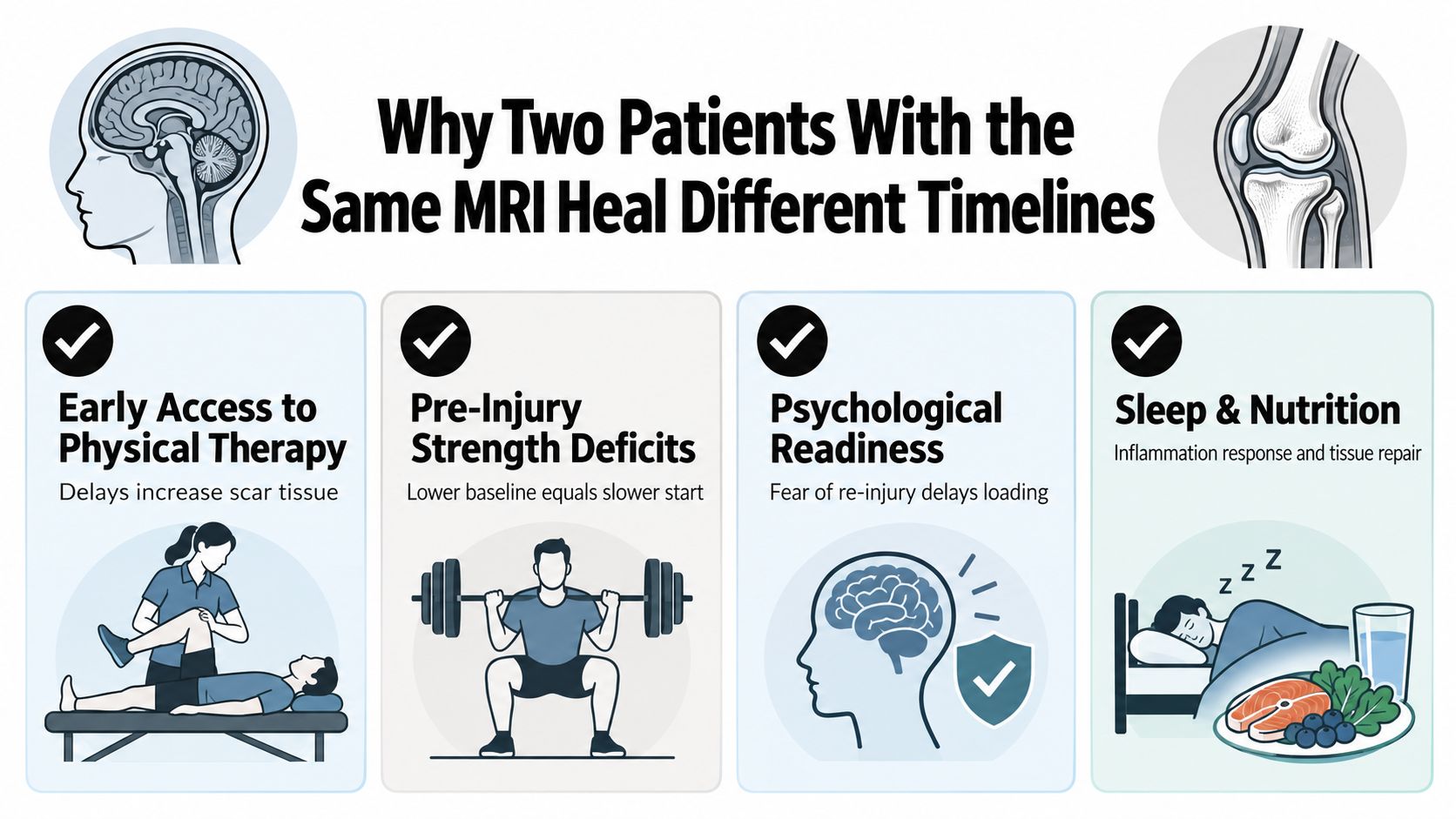
An MRI describes anatomy. It doesn't fully describe how a person walks, loads the knee, sleeps, responds to pain, or follows a rehabilitation plan. Two people can have similar imaging but different strength reserves, work demands, access to therapy, movement habits, and confidence.
The first month often sets the direction
Delayed physiotherapy can allow stiffness, weakness, and protective movement patterns to persist. A systematic review of acute hamstring injuries identified delayed access to physiotherapy, an active knee extension deficit, pain during contraction, imaging-confirmed injury, and recurrent injury history as factors associated with prolonged recovery (systematic review of prolonged recovery factors).
The same principle applies to knee rehabilitation. Early care doesn't mean forcing a painful joint. It means identifying safe movement, controlling swelling, restoring extension, and loading the right tissues at the right level.
A desk worker with a grade II MCL sprain may return to work while still avoiding rapid lateral movement. A pivoting athlete must rebuild deceleration, single-leg control, and contact tolerance before the knee is ready for competition. Their MRI might look similar, but their required endpoint isn't.
Modifiable barriers can stretch the timeline
- Strength deficits: Low pre-injury strength leaves less reserve when rehabilitation begins. The quadriceps often needs deliberate retraining after swelling or surgery.
- Pain with movement: Pain changes how you load the limb. If you keep guarding, the knee and hip may lose useful movement patterns.
- Swelling behavior: A knee that repeatedly swells after exercise is giving you information about excessive load or incomplete recovery.
- Access and consistency: Missed appointments, unclear home instructions, or long gaps between progress checks can slow decision-making.
- Fear of reinjury: Confidence affects how much force and speed you're willing to produce, especially during landing and cutting.
- Sleep, nutrition, and medical conditions: Poor recovery habits and conditions that affect tissue health can complicate rehabilitation and should be discussed with your healthcare team.
What you can change now: Keep a simple record of swelling, walking tolerance, exercise response, and sleep. Bring it to therapy so the program reflects how your knee behaves between appointments, not just how it feels on the treatment table.
A 2023 review of non-operative knee injuries shows why the label alone isn't enough. Grade I MCL and LCL injuries may recover in 2 to 4 weeks, grade II injuries in 4 to 6 weeks, and grade III injuries in 6 to 8 weeks, while ACL recovery can take several months to a year (NIH review of knee injury recovery). Severity, stability, and functional demands still determine the individual path.
If you're researching delayed wound healing or broader tissue-repair considerations, this Hyperbaric business solutions guide offers additional context, but it shouldn't replace an orthopedic or rehabilitation assessment for a knee injury.
Rehab Protocols and Home Exercises That Move Things Forward
Good rehabilitation is specific to the tissue and the current phase. A safe exercise for one knee can be inappropriate for another, particularly after ligament reconstruction, meniscus repair, fracture, or patellar realignment. Follow the restrictions from your surgeon or therapist before changing weight-bearing, resistance, or range of motion.
Early control comes before heavy strengthening
During the acute phase, the priorities are swelling control, quadriceps activation, and comfortable movement. Quad sets involve tightening the front thigh while the leg is supported. Heel slides encourage gradual bending without forcing the joint. Short, controlled walks may be useful when your clinician has cleared weight-bearing.
As motion improves, closed-chain exercises such as mini squats, supported step-ups, bridges, and stationary cycling can build strength without immediately demanding high-speed movement. A therapist may add hands-on techniques to address mobility restrictions and adjust the exercise dose according to swelling later that day or the next morning.
| Phase | Clinical Focus | Sample Home Exercises | MedAmerica Therapy |
|---|---|---|---|
| Acute | Protect tissue, reduce swelling, restore safe motion | Quad sets, heel slides, ankle pumps, prescribed walking | Physical therapy assessment, edema strategies, gentle manual therapy |
| Subacute | Improve range, gait, and baseline strength | Mini squats, bridges, step-ups, stationary bike | Targeted exercise progression and hands-on therapy |
| Strengthening | Increase force, balance, and single-leg control | Split squats, resisted knee extension when appropriate, balance drills | Progressive strengthening, movement analysis, selected modalities |
| Return to activity | Rehearse work or sport demands | Hops, landing drills, agility, task-specific lifting | Return-to-sport testing, pre- and post-operative rehabilitation, sport-specific exercise |
ACL milestones need flexibility
Post-operative ACL programs often use checkpoints around two, six, twelve, and twenty weeks, but these are decision points, not automatic permissions. Early work may emphasize extension, swelling control, gait, and quadriceps activation. Later sessions can add closed-chain strengthening, balance, controlled single-leg loading, and eventually running or plyometric preparation when the knee meets the required criteria.
For practical exercise examples and precautions, use this knee surgery recovery exercise guide. The useful question after every session is not “Did I work hard enough?” It's “How did the knee respond later today and tomorrow?”
Hold steady or contact your therapist if pain becomes sharp, swelling increases substantially, your gait worsens, or the knee loses motion after progression. Tendon-related pain, including patellar irritation, may sometimes be addressed with progressive loading and selected treatments such as shockwave therapy, but the diagnosis and treatment choice need to match the presentation.
How to Know You Are Really Ready to Return
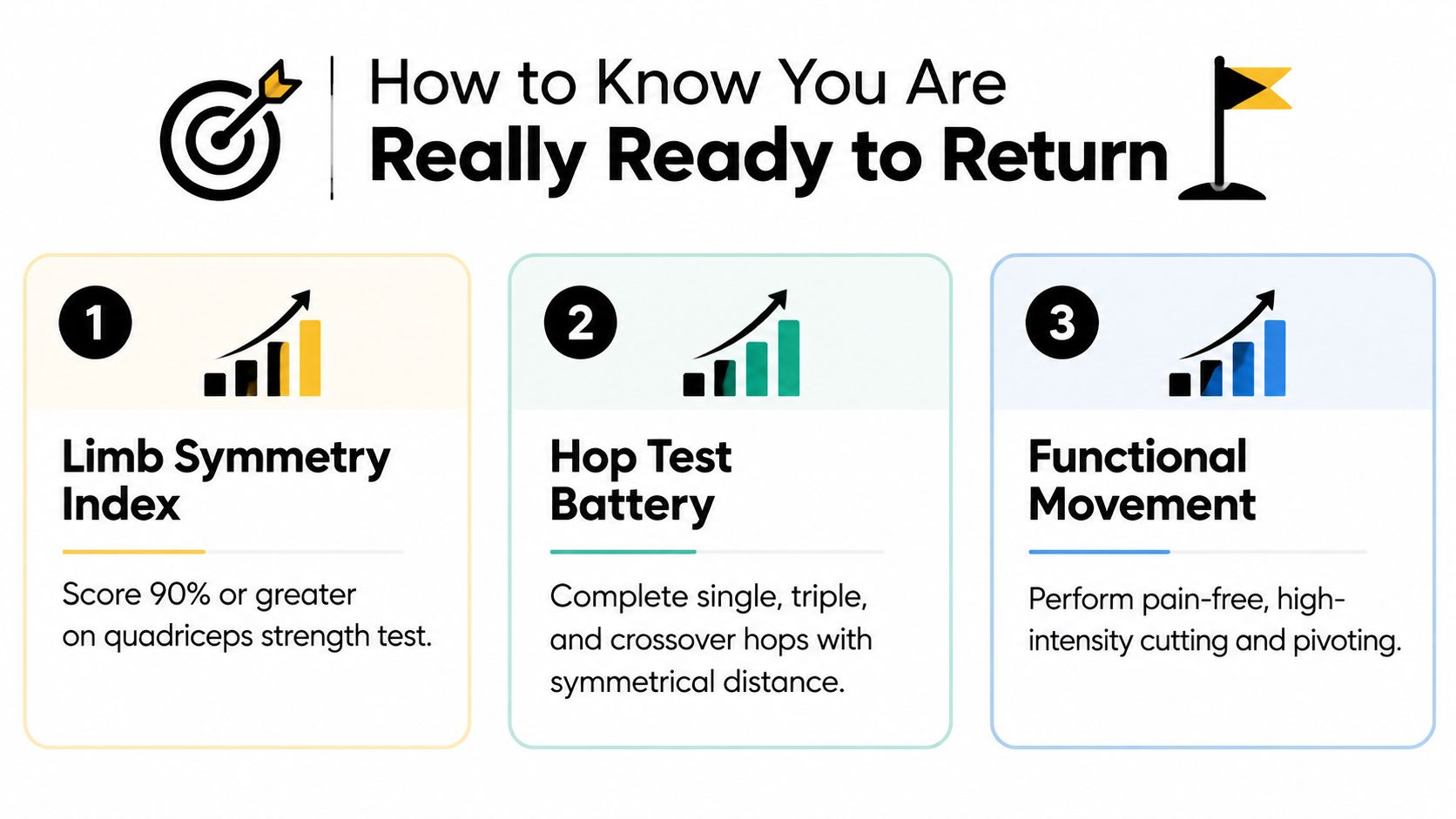
The calendar can tell you how long you've been injured. It can't tell you whether your knee can tolerate your sport or job. Return-to-sport decisions should combine healing status, strength, movement quality, task-specific performance, and psychological readiness.
Use measurable criteria
Common testing categories include:
- Quadriceps strength: A limb symmetry index of 90% or greater is commonly used as a return criterion, with the involved leg compared against the uninvolved side (ACL rehabilitation guidance).
- Hop performance: Single, triple, and crossover hop tests assess distance and control. The involved side should perform within 10% of the uninvolved side in commonly used testing frameworks (ACL rehabilitation guidance).
- Movement quality: You should control landing, deceleration, pivoting, and cutting without pain, giving way, or visible collapse of the knee.
- Psychological readiness: Tools such as the ACL-RSI help identify fear, confidence, and emotional readiness, which strength testing alone can't capture (ACL rehabilitation guidance).
A return at six months may feel reasonable because walking is comfortable, but it can miss graft remodeling, neuromuscular control under fatigue, and confidence during unpredictable cutting. Sport-specific training should come before unrestricted competition, not begin after you're already back in the game.
Watch the accompanying return-to-sport movement video as a visual aid, then have a qualified clinician assess your own technique rather than copying a test without supervision. Clear visual education can make complex movement criteria easier to understand, and resources such as how 2026 trial visuals boost comprehension discuss the role of animations and illustrations in presenting technical information.
Red Flags and When to Get Professional Support
Some soreness after a new exercise is expected. It should generally settle as the knee adapts, while warning signs tend to persist, worsen, change your gait, or appear with swelling and loss of function.
Stop progressing home exercises and seek professional guidance if you notice:
- Mechanical locking: The knee catches or becomes stuck, especially if you can't fully straighten it.
- Giving way: The joint suddenly buckles during weight-bearing.
- Recurring swelling: Swelling returns after it had substantially settled, particularly after modest activity.
- Calf symptoms: Deep calf pain or swelling that isn't clearly coming from the knee requires prompt medical assessment.
- Infection signs: Fever, increasing redness, or unusual warmth around a surgical site or joint needs urgent attention.
- Nerve symptoms: Numbness or tingling that travels below the knee should be evaluated.
- Night pain or worsening symptoms: Persistent night pain, pain that worsens instead of leveling off by the third week, or an inability to bear weight warrants same-day evaluation.
Don't try to “push through” a knee that repeatedly loses motion or stability. A therapist can distinguish expected post-exercise discomfort from a load response that suggests the program needs changing, while a physician may need to assess the joint, order imaging, or discuss surgical options.
Book a knee evaluation at the Deerfield Beach clinic if your progress has stalled or any red flag is present. MedAmerica's therapists can assess movement and swelling, help clear the joint for safe loading, and refer you for imaging or surgical consultation when findings exceed the scope of conservative rehabilitation.
MedAmerica Rehab Center provides individualized physical therapy, chiropractic care, acupuncture, shockwave therapy, and pre- and post-surgical rehabilitation for knee injuries in Deerfield Beach. Visit MedAmerica Rehab Center to schedule an evaluation and replace guesswork about recovery time with a plan based on your knee's actual function.
MedAmerica Rehab · Deerfield Beach
Talk to a clinician about your pain
Physical therapy, chiropractic, acupuncture and shockwave therapy under one roof, since 1995. Same-day appointments are available.
Mon–Thu 8:00 AM – 6:30 PM · Fri 8:00 AM – 3:00 PM