
Slip and Fall Injury Treatment: A Deerfield Beach Guide
You slip near a wet entrance, reach out to protect yourself, and then sit still for a moment trying to understand what hurts. Your wrist may throb, your hip may feel stiff, or your back may tighten as the initial shock fades. Even when you can stand, that doesn't prove you're uninjured.
Slip and fall injury treatment should address more than pain at the spot where you landed. A careful plan identifies hidden injuries, restores safe movement, rebuilds strength, and reduces the chance that fear or weakness will limit your daily life. For Deerfield Beach residents, MedAmerica Rehab provides a local pathway that can coordinate physical therapy, chiropractic care, acupuncture, shockwave therapy, and fall-prevention training according to the person's findings and goals.
Falls severe enough to require medical attention occur about 37.3 million times worldwide each year, according to the World Health Organization's falls fact sheet. That reality has made fall assessment and rehabilitation planning a longstanding part of injury care, especially when pain, reduced balance, or weakness affects walking.
You'll find practical guidance here, from the first hours after a fall through diagnostic evaluation, non-surgical treatment, functional recovery, and prevention. If you're unsure what to expect from therapy, reviewing what to expect from physical therapy can make your first appointment feel more manageable.
The Shock of a Sudden Fall and Your First Step Forward
A sudden fall often leaves people embarrassed as well as hurt. You may tell yourself it was only a slip, stand up quickly, and continue with your day. That response is understandable, but adrenaline and the urgency of the moment can make it difficult to judge an injury accurately.
Your first step forward is not pushing through pain. It's creating enough calm to assess what happened. Notice where you landed, whether you struck your head, and whether you can move each limb without sharp or escalating pain. If you can't safely stand, ask someone nearby for help rather than trying to pull yourself up using a chair, railing, or unstable object.
Practical rule: A fall that changes the way you walk deserves attention, even if the skin is unbroken.
At a Deerfield Beach rehabilitation clinic, the recovery process begins with the person rather than a generic exercise sheet. The clinician considers the fall mechanism, current symptoms, prior injuries, medications, balance, walking pattern, and the activities you need to resume. A person who slipped while turning may need reactive balance work, while someone who landed on an outstretched hand may first need protection and a medical assessment for the wrist.
Recovery is a coordinated process
Early care may focus on pain and swelling, but rehabilitation must eventually address mobility, strength, coordination, and confidence. Ignoring weakness can leave you using one side of the body differently, which may place extra stress on the back, hip, knee, or opposite leg. Ignoring fear can also lead to inactivity, deconditioning, and less stable walking.
MedAmerica Rehab's multidisciplinary model can bring different tools into one recovery plan. Physical therapy may guide gait and strengthening, chiropractic care may address selected musculoskeletal restrictions, acupuncture may support symptom management, and shockwave therapy may be considered for appropriate persistent soft-tissue problems. These services should complement, not replace, medical evaluation when a fracture, head injury, or other serious condition is possible.
The useful question isn't, “How do I make the pain go away?” It's, “What needs to improve so I can walk, work, climb stairs, sleep, and participate in life safely again?”
What to Do in the First 48 Hours After a Fall
The first two days are a period for protection, observation, and appropriate medical decision-making. Don't test an injured joint repeatedly just to see whether it's better. Move only as much as you can without worsening symptoms, and arrange help with transportation if walking or concentrating feels unsafe.
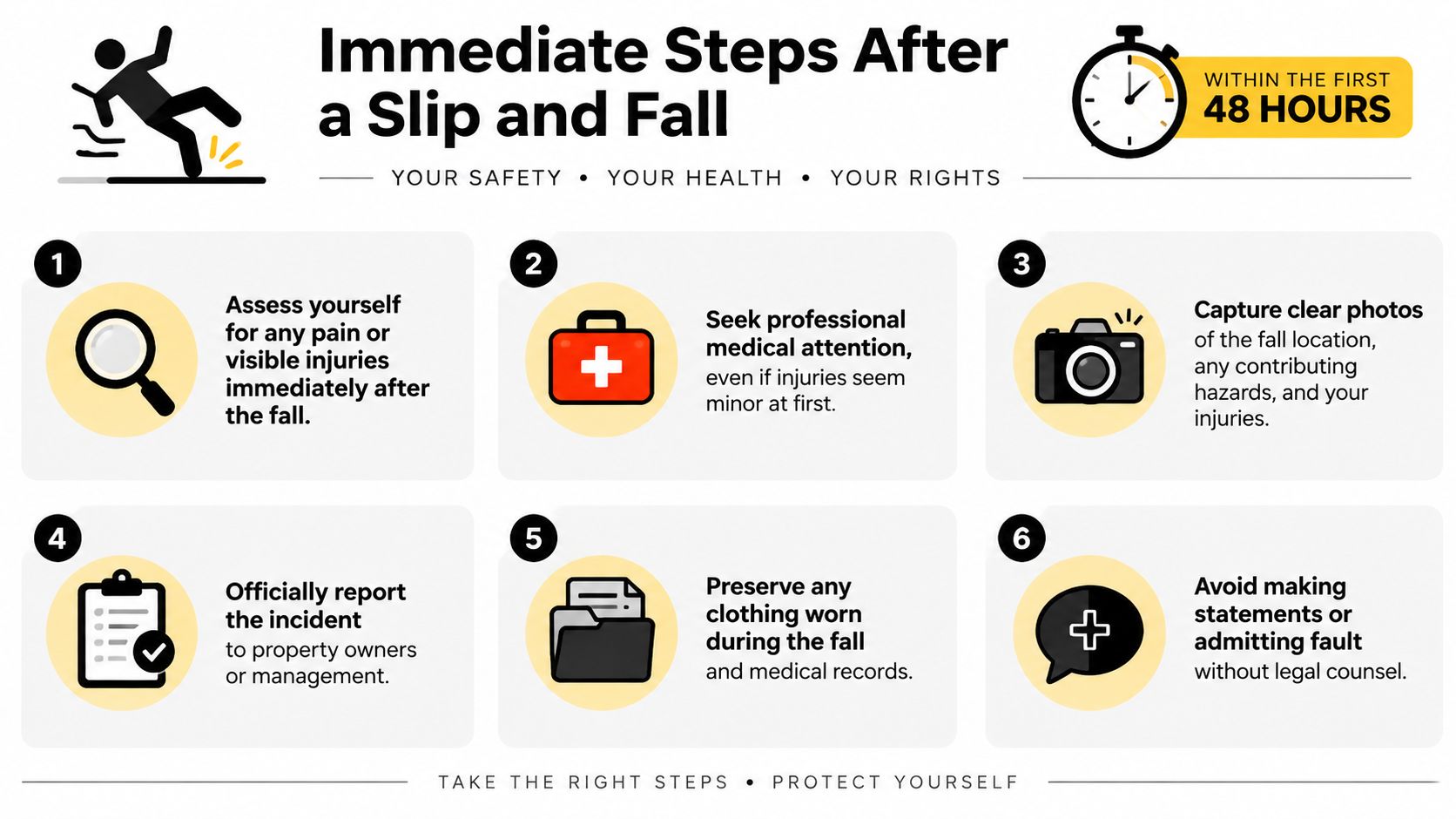
A safe immediate checklist
- Assess your condition. Look for visible swelling, bruising, bleeding, unusual joint position, or difficulty moving. Notice whether you hit your head or lost consciousness.
- Get professional guidance. A seemingly minor injury can become clearer as pain and stiffness develop. Contact a healthcare professional if symptoms persist, interfere with walking or daily tasks, or worsen.
- Protect the injured area. Rest from activities that increase pain. If a soft-tissue injury is suspected and no clinician has told you otherwise, cold therapy can help manage discomfort. Use a barrier between the cold source and your skin, and learn safe application through guidance on cold packs in physical therapy.
- Document the incident. If the fall occurred on another person's property or at work, take clear photographs of the area, the hazard, and visible injuries when it's safe to do so.
- Report what happened. Notify the property owner, manager, employer, or other responsible party. Keep the clothing worn during the fall and preserve medical records.
- Communicate carefully. Describe the facts, but don't speculate about fault or make statements you don't understand. If the incident may involve a legal claim, seek legal advice before giving detailed opinions.
When emergency care is the safer choice
Go to an emergency department or call emergency services when you have a visible deformity, uncontrolled bleeding, severe pain, inability to bear weight, new weakness or numbness, chest symptoms, or trouble breathing. A head impact followed by confusion, fainting, repeated vomiting, a worsening headache, or unusual sleepiness also requires urgent medical attention.
If you can move safely but remain sore, swollen, or limited, schedule an evaluation rather than waiting indefinitely. Older adults, people taking medication that affects bleeding, and anyone with osteoporosis or significant medical conditions should use a lower threshold for prompt assessment.
Rest can be useful, but prolonged inactivity isn't a complete treatment plan. The right next step depends on what the examination shows.
Common Injuries and Red Flags You Should Not Ignore
A fall can affect several tissues at once. A bruised hip may coexist with a strained back. A wrist that appears swollen may have a fracture rather than a simple sprain. Pain can also shift as you compensate, so the place that hurts most later isn't always the place that absorbed the original impact.
Soft-tissue injuries include bruises, muscle strains, ligament sprains, and tendon irritation. They often cause tenderness, swelling, stiffness, or pain with specific movements. Fractures are more concerning when pain is sharply localized, swelling develops quickly, or weight-bearing and gripping become difficult. The wrist, ankle, hip, shoulder, ribs, and spine all deserve attention after a forceful landing.
Head injuries can be subtle. Dizziness, confusion, visual changes, nausea, unusual fatigue, or a persistent headache may develop after the initial event. Don't use the absence of a visible cut as proof that the head is fine.
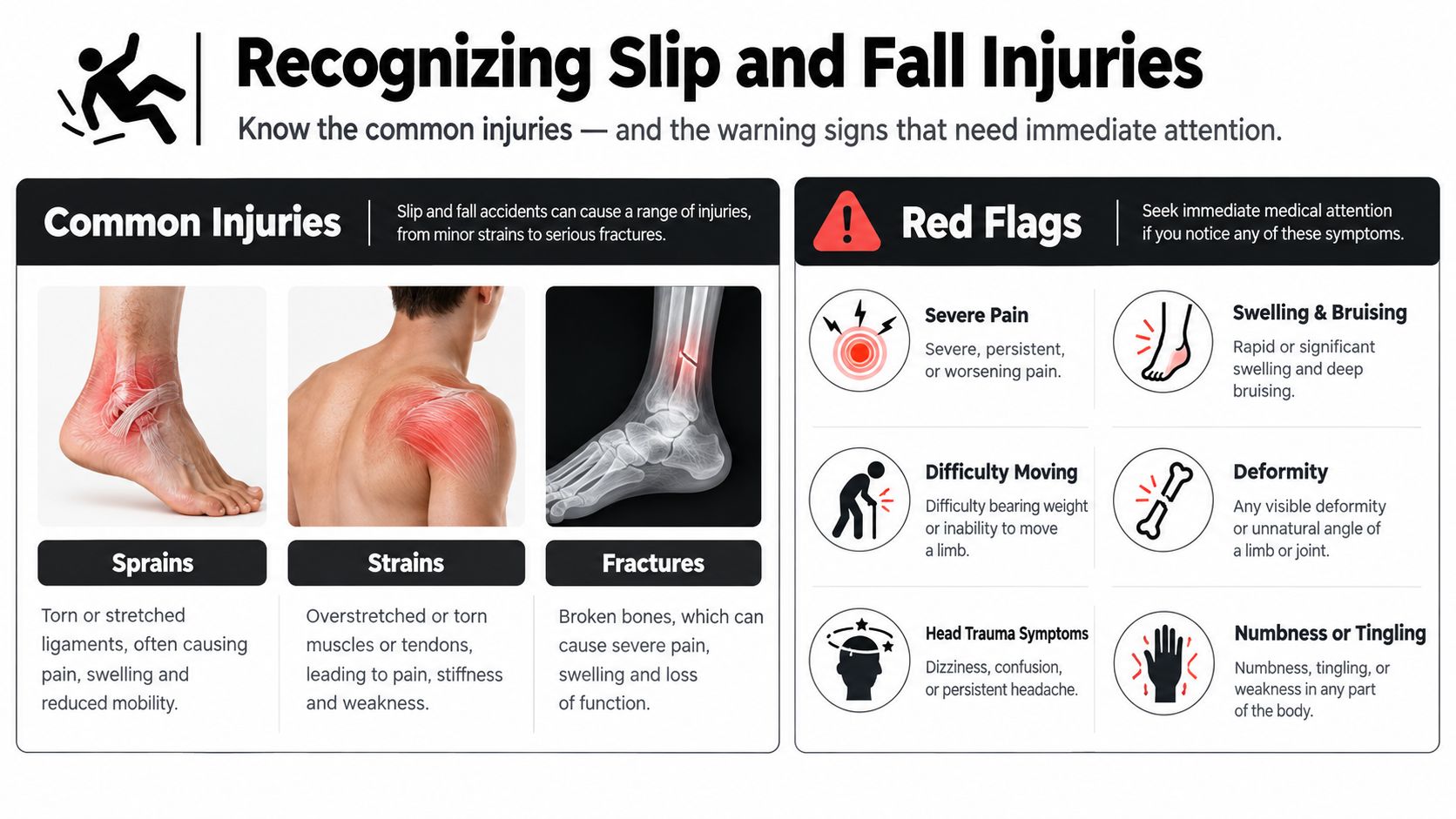
Seek urgent medical attention if you have:
- Severe or worsening pain, especially when it doesn't settle with rest.
- Rapid swelling or deep bruising around a limb or joint.
- Difficulty bearing weight or inability to move an arm, leg, hand, or foot.
- A visible deformity, unnatural angle, or joint that looks out of place.
- Head-trauma symptoms, including confusion, dizziness, or a persistent headache.
- Numbness, tingling, or weakness in any part of the body.
Older adults need particular caution. The CDC attributes about 3 million emergency department visits and 1 million hospitalizations each year in the United States to falls, and reports that 37% of older adults who fall sustain an injury requiring medical treatment or restricting activity for at least one day. These figures from the CDC falls data and statistics support a careful approach, especially after a hip, head, or back impact.
When symptoms are unclear, imaging may help answer the right question. Understanding when an MRI or X-ray may be appropriate can help you discuss the next step with your physician or rehabilitation provider.
The video below offers a visual overview of injury warning signs and immediate concerns.
Your Diagnostic Journey at MedAmerica Rehab
A good evaluation turns a frightening event into a set of manageable decisions. At the first visit, the clinician will ask how the fall happened, what surface you landed on, whether you twisted or struck your head, and which symptoms appeared immediately or later. Bring a list of medications, previous injuries, relevant medical records, and any imaging reports you already have.
The physical examination may include observation of posture and walking, joint range of motion, muscle strength, tenderness, swelling, balance, coordination, and functional tasks. The therapist may watch you rise from a chair, turn, step over an obstacle, or use a cane. These details show how the injury affects real movement, not only how it feels while you're sitting.
Imaging has a specific role
Rehabilitation providers don't use imaging as a substitute for examination. A physician may recommend an X-ray when a fracture or joint alignment problem is suspected. An MRI may be useful when the clinical question involves certain soft tissues, the spine, or an injury that isn't adequately explained by an X-ray. The choice depends on symptoms, examination findings, medical history, and the suspected structure.
The treatment plan should also account for practical demands. A retiree who wants to walk safely around the neighborhood, a worker who must use stairs, and a caregiver who needs to transfer another person all require different functional targets.
Clear communication matters throughout the process. If you're building a clinic's public education or patient communication materials, professional growth services can help organizations present complex healthcare information in a more useful way. For the patient, the equivalent principle is simple: you should understand what the clinician found, what you're doing, and what change would justify reassessment.
Evidence-Based Non-Surgical Treatment Options
Non-surgical care works best when each modality has a defined job. A painful joint may need short-term symptom relief, but long-term recovery requires restored movement, strength, balance, and confidence. The treatment plan should change as your abilities change.
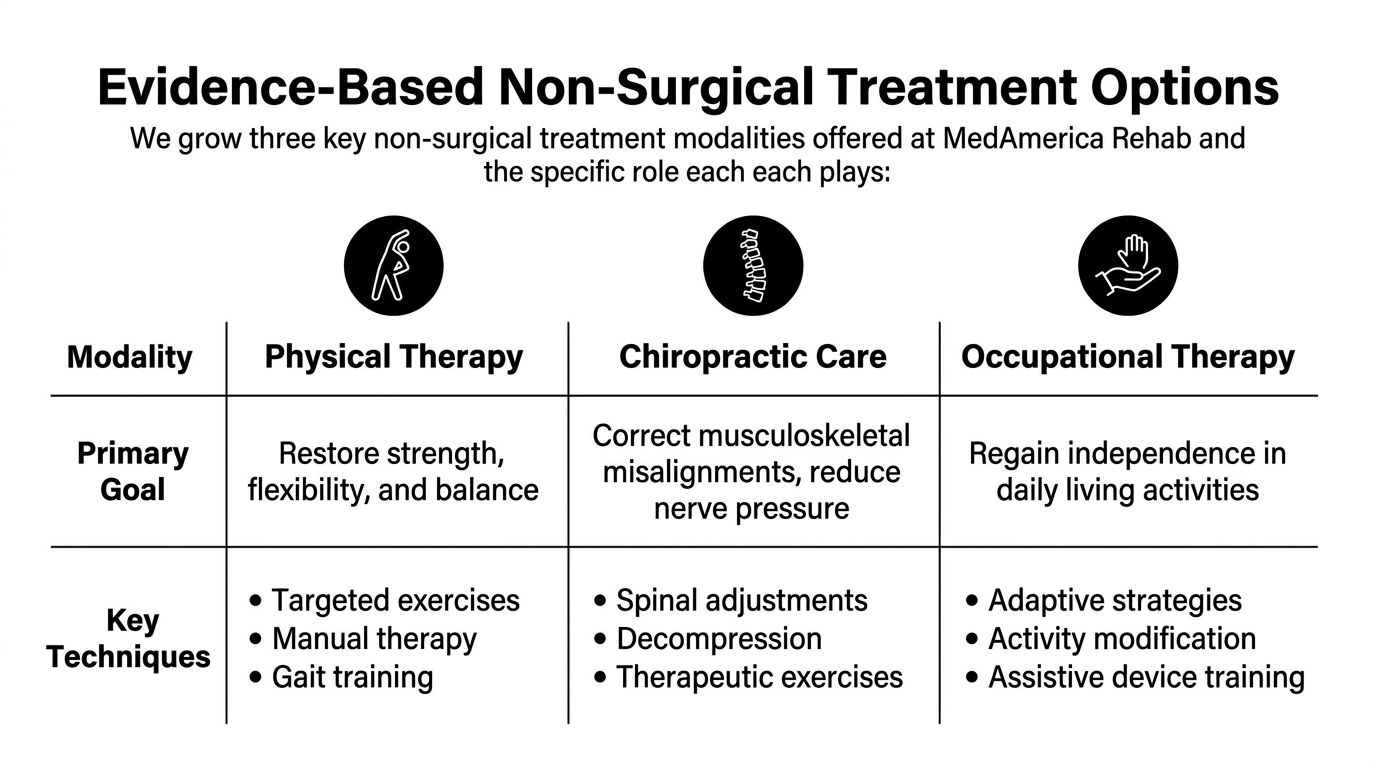
Physical therapy rebuilds usable movement
Physical therapy typically forms the functional foundation of recovery. Early sessions may use gentle range-of-motion work, manual techniques, gait education, and symptom-modifying strategies. As tolerance improves, the program can progress to lower-limb strengthening, sit-to-stand practice, stair work, walking drills, and balance challenges.
The exercise selection matters. High-certainty evidence shows that programs emphasizing balance, functional gait, and lower-limb strengthening reduce fall rate by 24% overall, while programs combining balance and resistance training reduce fall rate by about 34%, according to the British Journal of Sports Medicine review. Those findings support progressive, targeted exercise rather than unstructured activity.
Chiropractic care may address selected mechanical problems
Chiropractic assessment can be useful when a fall leaves joint restriction, muscle guarding, or mechanical pain in the spine or extremities. Depending on the evaluation, care may include manual adjustments, mobilization, decompression strategies, and therapeutic exercise.
The trade-off is that hands-on treatment should not become the entire plan. Temporary relief is valuable, but it needs to support improved movement and participation in strengthening or functional training. High-velocity techniques aren't appropriate for every patient, particularly when fracture, instability, severe osteoporosis, or neurological symptoms remain possible.
Acupuncture and shockwave therapy have narrower roles
Acupuncture may help some patients manage pain and muscle tension while they participate in active rehabilitation. It can be considered when pain limits exercise or sleep, but it shouldn't replace assessment of a suspected fracture or neurological problem.
Shockwave therapy may be considered for selected persistent tendon or soft-tissue conditions after the acute injury has been evaluated. It isn't a universal treatment for every bruise, swelling pattern, or new pain after a fall. The clinician should identify the target tissue and explain why the modality belongs in the plan.
Occupational therapy protects independence
Occupational therapy focuses on the activities that make up daily life, such as dressing, bathing, cooking, reaching, transferring, and using tools. Adaptive strategies, activity modification, and assistive-device training can reduce risk while strength and balance recover.
A coordinated plan may combine these services without giving every patient every treatment. More treatment isn't automatically better. The strongest approach is the one tied to the person's specific deficit, medical status, home environment, and functional goals.
Recovery Timelines and Returning to Your Life Safely
Recovery rarely moves in a perfectly straight line. One day you may walk comfortably across the room, then feel more stiffness after a longer outing. That doesn't automatically mean you've caused new damage, but a meaningful increase in pain, swelling, weakness, or instability should be reported.
During the acute phase, the priorities are protection, symptom control, and medical clarification. You may use shorter walks, a prescribed assistive device, supported transfers, and positions that reduce irritation. The aim isn't complete inactivity. It's avoiding unnecessary stress while maintaining safe movement.
Progress becomes more functional
In the next phase, the focus shifts toward joint mobility, walking quality, strength, and daily tasks. A therapist may ask you to practice controlled sit-to-stands, step-ups, turning, reaching, and changes of direction. Your progress is measured by what you can do with better control, not only by whether the pain score has changed.
For persistent instability, generic strengthening may not be enough. Evidence summarized in the NCBI Bookshelf supports task-specific work that trains responses to slips and trips, including obstacle negotiation and single-leg stance progressions. A clinician may introduce these challenges gradually, using hand support or supervision before increasing complexity.
A safe progression feels deliberate, not dramatic. You should finish exercises feeling appropriately challenged, not fearful that your leg will buckle.
Returning to work, driving, exercise, or beach walks should follow functional readiness. You need enough strength to perform the task, enough balance to respond to an unexpected movement, and enough symptom control to complete it without compensating heavily. Your therapist can modify distance, speed, surface, footwear, and rest breaks rather than forcing an all-or-nothing return.
Confidence usually returns after repeated successful practice. That's why a durable recovery plan continues beyond the point when basic walking becomes possible.
How to Prevent Future Falls in Deerfield Beach
Prevention is part of treatment, not an afterthought. A fall may reveal a correctable combination of weakness, poor lighting, unsafe footwear, medication effects, vision changes, or an environmental hazard. Addressing only the painful joint leaves the rest of the risk unchanged.
Start at home. Remove loose rugs and clutter, secure cords, keep frequently used items within easy reach, and improve lighting along hallways, stairs, entrances, and outdoor paths. In Deerfield Beach, wet sidewalks, tracked-in water, uneven pavement, and changing outdoor surfaces deserve attention after rain or around pool areas.
Build prevention into your routine
- Choose stable footwear: Wear shoes with secure support and non-slip soles instead of walking in loose slippers or smooth socks.
- Train balance and strength: Continue prescribed exercises for the legs, trunk, and postural control, even after pain improves.
- Use equipment correctly: A cane or walker helps only when it's fitted and used properly.
- Review health factors: Ask your physician or pharmacist to review medications that may contribute to dizziness or unsteadiness, and keep vision care current.
- Support basic needs: Hydration and regular nutrition can help reduce weakness or lightheadedness.
- Respect changing surfaces: Slow down on wet walkways, uneven pavements, transitions, and poorly lit areas.
A 2025 systematic review of post-fall care proposed an uninterrupted five-step pathway: initial triage, medical workup, interdisciplinary planning, restoration of function through therapy, and continued prevention support. That model reflects what patients often need in real life. Recovery doesn't end when the bruise fades. It ends when you can move more safely and know how to manage the risks that contributed to the fall.
MedAmerica Rehab Center offers coordinated physical therapy, chiropractic care, acupuncture, shockwave therapy, and balance and gait training for people recovering from slip and fall injuries in Deerfield Beach. Visit MedAmerica Rehab Center to request an evaluation and take the next practical step toward safer mobility.
MedAmerica Rehab · Deerfield Beach
Talk to a clinician about your pain
Physical therapy, chiropractic, acupuncture and shockwave therapy under one roof, since 1995. Same-day appointments are available.
Mon–Thu 8:00 AM – 6:30 PM · Fri 8:00 AM – 3:00 PM