

Herniated Disc Recovery Without Surgery: A Practical Guide
You wake up with low-back pain, try to stand, and feel an electric line run through your buttock and leg. Sitting at work becomes difficult, your sleep position keeps changing, and an MRI report adds intimidating words such as “herniation” or “nerve compression.” The first question is often immediate: Can a herniated disc recover without surgery?
For many people, yes. A 2013 clinical follow-up found that 72 of 89 patients, or 81%, improved without surgery, while 17 ultimately required an operation. Among those treated conservatively, 84.7% had a good or excellent result at 2 years (clinical follow-up of conservatively treated ruptured lumbar discs). A systematic review also found that spontaneous regression can occur in 60% to 90% of herniated lumbar discs, while a later meta-analysis reported that advice-based conservative care was as effective as microdiscectomy at long-term follow-up (systematic review and meta-analysis).
That doesn't mean you should ignore severe symptoms or wait indefinitely. Successful herniated disc recovery without surgery depends on screening for danger signs, staying active at the right level, rebuilding capacity, and knowing when progress has stalled.
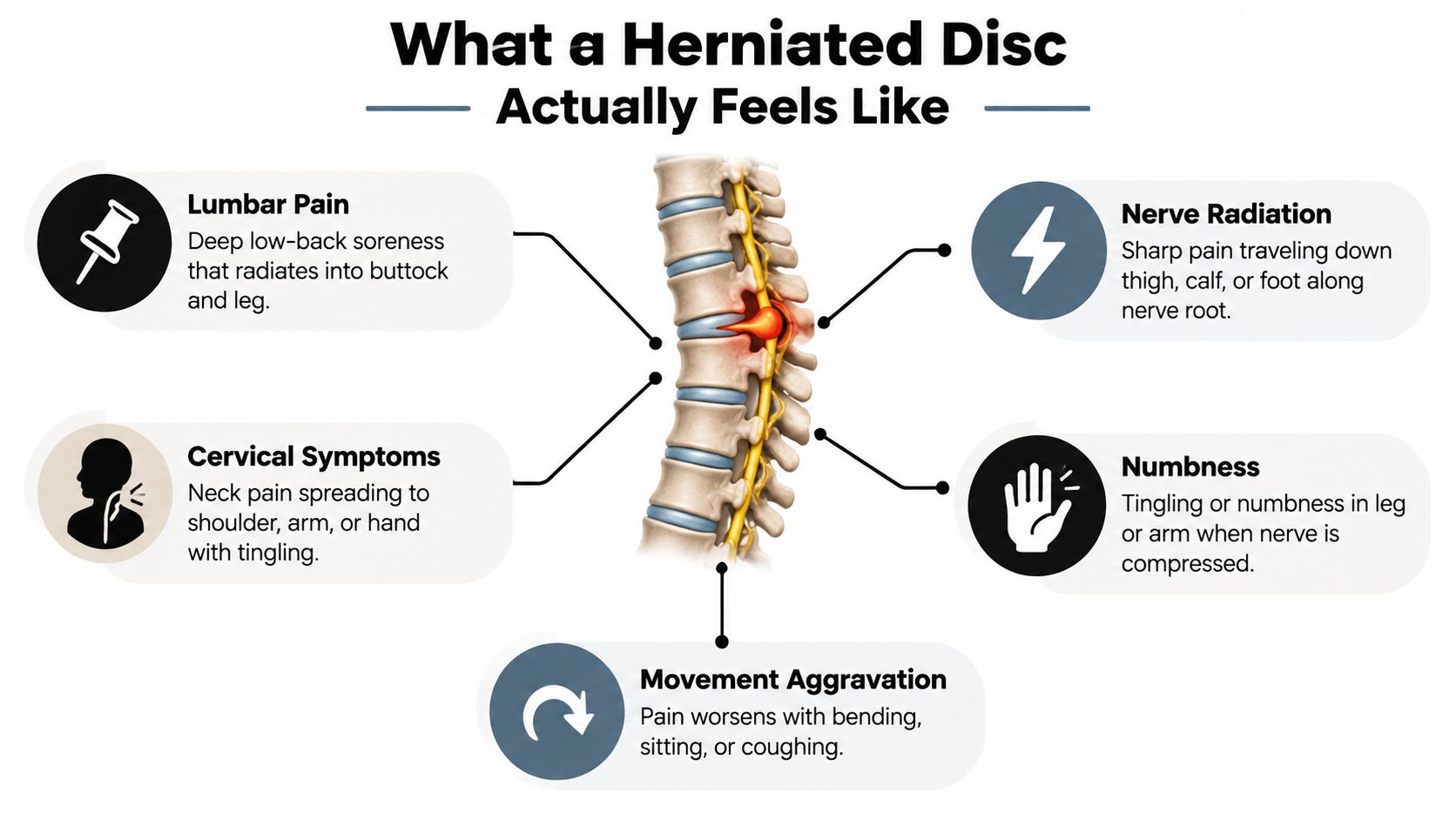
What a Herniated Disc Actually Feels Like
A common patient arrives describing what sounds like a back problem but feels more like a leg problem. The low back may ache, yet the symptom that dominates is sharp, burning, or electric pain traveling through the buttock, thigh, calf, or foot. That pattern often reflects irritation of a nearby nerve root rather than a simple muscle strain.
Lumbar symptoms can include tingling, numbness, or weakness in the leg. Cervical disc problems more often produce neck or shoulder pain that travels down the arm and sometimes into the hand. The exact pattern depends on which nerve is irritated, not on which disc appears most abnormal on an MRI.
Symptoms that change with movement
Coughing, sneezing, bending, lifting, prolonged sitting, or holding one position can increase nerve-related symptoms. Walking, changing position, or lying down may help, although there isn't one universal comfort position. I pay close attention to whether symptoms move farther down an arm or leg, or retreat toward the spine.
That change is clinically useful. If leg or arm pain becomes more centralized and function improves, the irritated nerve may be tolerating movement better. If symptoms spread farther away from the spine, numbness increases, or weakness develops, the exercise or activity dose needs reassessment.
Why the MRI isn't the whole diagnosis
Disc bulges and herniations can appear on MRI in people who don't have pain. A useful evaluation combines the symptom history, movement testing, strength, sensation, reflexes, and imaging when it's warranted. Patients often find the discussion of what causes sciatica nerve pain helpful because radiating symptoms can have more than one source.
The encouraging point is that pain with movement doesn't automatically mean you're causing more damage. A structured plan can reduce irritation, restore mobility, and rebuild strength while gradually returning you to work, exercise, and daily life. Avoiding every movement usually leaves the back, hips, and nervous system less prepared for normal demands.
Red Flags to Rule Out Before Starting Rehab
Conservative care is appropriate only after a basic safety screen. Most back and neck pain isn't an emergency, but certain changes require prompt medical evaluation rather than a home exercise program.
Seek emergency care for:
- Bowel or bladder changes: New loss of bowel or bladder control needs urgent assessment.
- Saddle-area numbness: Numbness around the groin, inner thighs, or saddle region can signal serious nerve compromise.
- Rapidly worsening weakness: A leg that repeatedly buckles, new foot drop, or rapidly declining arm strength shouldn't be managed by pushing through exercise.
- Serious systemic or traumatic symptoms: Fever, unexplained weight loss, a history of cancer, major trauma, or relevant medical illness requires a clinician's review.
- Severe night pain: Constant, intense pain at night that isn't relieved by rest deserves medical evaluation.
These warning signs don't prove that a herniated disc is the cause. They help clinicians consider nerve compression, infection, fracture, inflammatory disease, or another condition that needs a different response. Before beginning rehabilitation, a clinician may review medications, previous injuries, osteoporosis risk, immune suppression, and unexplained illness.
A simple self-check before exercise
You shouldn't try to diagnose yourself, but you can notice meaningful changes. Compare each side for the ability to walk normally, rise from a chair, lift the front of the foot, push the foot down, grip with the hand, and raise the arm. Pay attention to new balance problems, spreading numbness, or weakness that's clearly worsening.
Safety rule: Mild aching or intermittent tingling may be suitable for supervised therapy. Changing neurologic findings are a reason to refer, not a reason to increase the exercise challenge.
A physical therapist can screen sensation, reflexes, and strength and determine whether treatment is appropriate or whether you need medical imaging, medication review, or specialist referral. If you're unsure whether an MRI or an X-ray is appropriate, this guide to when you need an MRI and when you need an X-ray explains why the two tests answer different questions.
In Deerfield Beach, don't wait for a routine rehabilitation visit if function is declining quickly. Same-day medical guidance is more appropriate when weakness, saddle numbness, bowel or bladder changes, or severe systemic symptoms appear.
The First Two Weeks of Non-Surgical Recovery
The first two weeks aren't about finding a magic stretch or forcing a disc back into place. They're about calming nerve irritation while keeping enough movement to prevent fear, stiffness, and deconditioning from taking over.
Start by identifying what reliably increases arm or leg symptoms. Shorten sitting periods, change positions often, and temporarily reduce repeated bending, twisting, or lifting. Complete bed rest usually creates more problems than it solves, so use brief, comfortable walks as a starting point when walking is safe.
Build a tolerable baseline
Try an easy walk for five to ten minutes, then add a few minutes on later days if symptoms remain manageable. That walking prescription is a starting point, not a test of toughness. A flare that lasts into the next day, increases numbness, or reduces strength means the dose was too high.
Ice may help muscle guarding, while heat may ease stiffness. Choose the option that improves comfort, and ask a clinician or pharmacist whether over-the-counter medication fits your medical history and current prescriptions.
Gentle movement can include:
- Pelvic tilts: Move through a small, comfortable range without forcing the low back.
- Trunk rotation: Rotate gently while lying or seated if the movement doesn't increase radiating pain.
- Cat-camel motion: Use a small range to reduce stiffness, not to stretch aggressively.
- Cervical retraction: Draw the head gently backward without creating arm symptoms.
Performing an exercise once isn't the objective. The useful question is whether repeated, controlled movement leaves you more comfortable and more capable afterward.
Track three practical measures
Write down your walking duration, how long you can sit before symptoms rise, and how far symptoms travel down the arm or leg. Those measures are often more useful than pain intensity alone.
For example, a patient may still report pain but notice that it now stops at the buttock instead of reaching the calf, sitting lasts longer, and walking feels steadier. That's meaningful progress. If numbness or weakness increases, stop advancing and arrange a reassessment.
For a gentle visual demonstration, review the movement sequence below, but don't copy an exercise that reproduces sharp or radiating symptoms.
By the end of the early phase, success means improved irritability, better tolerance for ordinary activity, and a clearer idea of which movements can be reintroduced. It doesn't require complete pain relief.
Building Strength and Stability Through Progressive Loading
Once symptoms are less reactive, rehabilitation has to move beyond protection. The spine needs a gradual exposure to force, and the hips and trunk need to share that work. Exercise novelty matters less than the right dose, direction, and progression.
Phase one focuses on control
Begin with low-load isometric work:
- Abdominal bracing: Gently tighten the lower abdomen while breathing normally.
- Modified dead bug: Keep the movement small and stop before the back or neck loses control.
- Glute setting: Contract the buttock muscles without pushing into pain.
A practical starting range is sets of 8 to 15 repetitions, adjusted by the treating clinician. Keep effort moderate, and avoid holding your breath. The exercise should leave you feeling that you practiced control, not that you challenged the irritated nerve.
Phase two adds the hips
Progress to bridges, bird-dog variations, supported hip hinges, and eventually suitcase carries. A hip hinge teaches you to bend from the hips while keeping the trunk organized, which is more useful for lifting a laundry basket than trying to maintain a rigid posture all day.
Use a two-day soreness rule. If symptoms return to baseline within that period and strength or function improves, the load may be appropriate. If pain spreads farther down the limb, numbness increases, or weakness appears, reduce range, resistance, or repetitions.
Phase three addresses neural mobility
Nerve glides are not aggressive hamstring stretches. Seated slump sliders and supine sciatic flossing alternate gentle nerve tension with release. The leg should move smoothly, without forcing a strong stretch or reproducing lingering electric pain.
When symptoms centralize, a clinician may carefully progress directional exercises, including controlled lumbar extension for people who respond well to it. Peripheralization, meaning symptoms travel farther into the limb, calls for less intensity or a different direction.
Cervical patients may progress from chin tucks to scapular rows and graded cervical retraction holds. The same principle applies: improve tolerance without provoking expanding arm symptoms.
Manual therapy can reduce guarding or make movement easier, but it shouldn't replace active loading. The lasting goal is a stronger, more confident person who can manage daily demands independently. These core-strengthening exercises can support that process when they're selected and dosed for your presentation.
Realistic Timelines and Milestones to Track
Recovery timelines vary, but progress should still be measurable. A patient who says “I'm a little better” may be improving, yet we need clearer evidence before increasing lifting, work, or sport demands.
At the early checkpoint, look for improved walking, less frequent symptom spikes, longer sitting tolerance, and symptoms that don't travel as far. By the middle phase, sleep and transfers should become easier, and repeated movement testing may show centralization. Later, the focus shifts from pain control to work capacity, lifting tolerance, and sport-specific movement.
The following table provides a practical framework. These are clinical targets, not guarantees, and they must be modified when weakness, numbness, or worsening symptoms appear.
Recovery Milestones by Week
| Timeframe | Pain Target | Functional Milestone | Clinical Sign |
|---|---|---|---|
| Early phase | Symptoms are less irritable and don't spread as readily | Short walks and position changes are more tolerable | Strength and sensation are stable |
| Around 6 weeks | Meaningful reduction in arm or leg pain | Easier sitting, standing, sleep, and sit-to-stand transfers | Symptoms centralize with appropriate repeated movement |
| Around 12 weeks | Pain is no longer the main limit on ordinary activity | Work and household tasks resume with controlled lifting | Strength, reflexes, and function are improving |
| Around 24 weeks | Occasional symptoms are manageable and predictable | Higher-demand recreation or lifting is reintroduced gradually | Load tolerance continues to rise without neurologic decline |
A guideline-based conservative trial commonly lasts 6 to 12 weeks when significant neurologic deficits are absent. Reported symptom resolution is about 60% to 80% within 6 to 12 weeks, with 80% to 90% over the long term (guideline-based review of conservative management).
Structural recovery can take longer than symptom relief. Reviews describe disc material shrinking or resorbing over 3 to 6 months, and biological changes don't always match the day pain disappears (review of healing without surgery). A plateau matters more than a calendar date. If walking, sitting, sleep, pain distribution, and neurologic findings aren't improving, reassess the diagnosis and plan rather than repeating the same exercises.
When Conservative Care Stops Working
“Try physical therapy” should not mean waiting indefinitely. Conservative care is a reasonable first-line approach when strength is preserved and there is no cauda equina syndrome or major motor deficit. The plan needs to change when neurologic function worsens, daily function declines, or a well-designed program reaches a clear plateau.
Some presentations are less likely to respond fully without surgery. Large extrusions with progressive weakness, foraminal narrowing at the level of the herniation, persistent severe sciatica, and substantial fear of movement can slow recovery. Workers' compensation cases may add delayed care, demanding job tasks, or uncertainty about work capacity. These factors do not determine the outcome, but they call for closer review rather than repeated treatment without a new assessment.
Escalation triggers
Arrange prompt medical or surgical evaluation for:
- Foot drop or worsening quadriceps weakness
- Progressive wrist or arm weakness in a cervical presentation
- Saddle anesthesia
- New bowel or bladder changes
- Intractable night pain or rapidly declining function
These findings can justify urgent imaging or referral instead of finishing a routine rehabilitation block. A recent review states that conservative care is first-line when cauda equina syndrome and major motor deficits are absent, while surgical criteria vary across studies (review of surgical indications).
What a surgical consultation means
A consultation does not commit you to an operation. The surgeon considers the symptom pattern, neurologic examination, imaging, duration and response to treatment, and the effect on work and daily activities.
A microdiscectomy removes a focal disc fragment compressing a nerve root, so it is commonly considered when one nerve root matches the symptoms and imaging. A laminectomy removes part of the bony covering to create access or more room, making it more relevant when central stenosis or multi-level compression contributes to the problem. The procedure should match the compression pattern, not merely the presence of a herniation on a report.
Surgery often reduces severe radiating pain faster early on, while longer-term outcomes may converge with non-surgical care. That trade-off supports a structured 6 to 12 week trial when neurologic function remains stable. If chronic pain has become emotionally exhausting, practical education about coping with chronic pain naturally may complement medical and rehabilitation care.
A previous comparison of advice-based conservative care and microdiscectomy found similar long-term results. That finding does not dismiss surgery. It means the decision should reflect neurologic risk, symptom severity, functional loss, and measurable response to treatment. When those measures stop improving, or red flags appear, reassessment is more appropriate than extending the same plan.
Returning to Activity and Preventing Future Flare-Ups
Feeling better on a quiet day isn't the same as being ready for a long drive, a full shift, a golf round, or heavy deadlifts. Return to activity should follow objective capacity rather than pain alone. You're ready to advance when symptoms remain stable during the task, settle afterward, and don't produce worsening numbness or weakness.
Use a simple symptom behavior rule. During activity, mild local discomfort may be acceptable if it doesn't travel farther down the limb and returns to baseline in a reasonable period. Reduce the range, load, or duration when symptoms peripheralize, sleep worsens, or the next day's function drops.
A tiered return for South Florida activities
Beach walking is often the first outdoor goal. Begin on a firm, predictable surface and progress distance only when your walking pattern remains steady and symptoms don't spread.
Pickleball adds quick stops, reaching, and rotation. Before returning, practice controlled side steps, split-stance reaches, and low-level direction changes without a symptom increase later that day.
Golf requires repeated bending and trunk rotation. Start with putting and partial swings, then increase the swing range after you can hinge, rotate, and recover to standing without radiating symptoms.
Gym lifting comes last for many patients. Practice unloaded hip hinges, then add a light resistance such as a kettlebell or dumbbell, and only later return to heavier deadlift patterns under supervision. Keep the load close, brace before lifting, and stop if weakness or spreading nerve symptoms appears.
Self-tests that guide progression
Before advancing, check whether you can walk briskly, perform repeated sit-to-stands, hold a controlled bridge, hinge with a neutral trunk, and complete the movement pattern required by your activity. For cervical symptoms, assess head turning, chin-tuck control, scapular rows, and reaching without increasing arm symptoms.
Maintain a program two to three times weekly that includes hip and thoracic mobility, deep trunk endurance, glute strength, and hip-hinge practice. This doesn't need to be elaborate. Consistent, tolerable loading is more valuable than an impressive exercise list performed sporadically.
Ergonomics matter because repeated exposure accumulates. Break up sitting, place frequently used objects within easy reach, and use a sleep position that allows relaxed breathing and minimal symptom spread. Side-lying with support between the knees or back-lying with the knees supported can be useful starting options, but comfort and symptom behavior should guide the final choice.
Flare-ups can still happen after a successful recovery. A flare usually signals a mismatch between current capacity and recent demand, not automatic structural failure. Scale back temporarily, return to the last comfortable level, and rebuild instead of abandoning movement altogether.
A movement screen can identify the gap between symptom relief and real-world readiness. A supervised return-to-sport or return-to-lifting program is particularly helpful when your work, recreation, or training involves repeated bending, rotation, carrying, or high loads. Periodic re-checks can confirm that strength, sensation, movement control, and confidence are progressing together.
MedAmerica Rehab Center provides individualized physical therapy, chiropractic care, acupuncture, and other non-surgical rehabilitation options for herniated disc symptoms in Deerfield Beach. Visit MedAmerica Rehab Center to schedule a movement evaluation, review your recovery milestones, and build a supervised plan for returning to work, exercise, and daily activities.
MedAmerica Rehab · Deerfield Beach
Talk to a clinician about your pain
Physical therapy, chiropractic, acupuncture and shockwave therapy under one roof, since 1995. Same-day appointments are available.
Mon–Thu 8:00 AM – 6:30 PM · Fri 8:00 AM – 3:00 PM