
Ergonomic Training Programs: A Practical Guide
A single ergonomic training session won't make workplace pain disappear. It may teach a worker how to adjust a monitor, recognize a strained posture, or take a better movement break, but it can't redesign a demanding task, restore lost strength, or treat an irritated joint by itself. Ergonomic training programs work best as one part of a broader prevention and rehabilitation system, especially when education is paired with workstation changes, active movement, and individualized care.
Why Ergonomic Training Alone Is Not Enough
Individuals seeking ergonomic training programs often hope for a rapid solution. They look for a video, workshop, or checklist that will resolve neck pain, back pain, or repetitive-strain symptoms without altering how work is structured. This expectation is reasonable, but it doesn't align with the evidence.
A large systematic review identified 15 studies involving 2,165 participants and found no clear evidence that training or multifaceted interventions reduced upper-limb pain or discomfort in every workplace setting (systematic review of workplace ergonomic interventions). That doesn't mean training is useless. It means awareness and posture instruction don't consistently overcome a workstation, tool, schedule, or task that continues to load the same tissues.

What training can change
Good instruction can help someone identify awkward posture, excessive repetition, forceful exertion, contact pressure, or poor workstation positioning. It can also make early symptoms easier to recognize and report. Those changes matter because workers who understand the source of discomfort are more likely to adjust a task before symptoms become persistent.
But posture coaching has limits. Training won't lengthen a restricted muscle, improve joint mobility, rebuild deconditioned muscles, or correct a movement pattern that developed after an injury. It also can't make an undersized desk, poorly positioned equipment, or a repetitive production line fit the worker.
Practical rule: If the worker must return to the same aggravating setup after training, the program hasn't addressed the full risk.
Why multicomponent programs perform better
The stronger approach combines education with job-specific controls, physical activity, workstation redesign, and rehabilitation when symptoms already exist. A 2012 review of 13 randomized controlled trials found mixed evidence for training alone, with low or very low evidence quality for many training-based interventions (review of workplace ergonomic design and training).
For an office worker, that may mean adjusting chair height, keyboard position, and monitor placement while adding movement practice and treatment for restricted neck or shoulder motion. For a warehouse employee, it may mean changing material height, improving handling methods, rotating demanding tasks, and strengthening the body for the actual job.
Readers in Deerfield Beach can also use practical guidance on preventing repetitive strain injury as part of a larger plan. The key question isn't which training module sounds most polished. It's whether the program changes exposure, improves physical capacity, and gives the worker a clear response when pain appears.
Measurable Benefits of Well-Designed Programs
Ergonomic training earns its value through measurable changes, not attendance alone. When instruction matches real work conditions and is paired with equipment or task changes, organizations can track symptoms, knowledge, workstation behavior, and, in some settings, financial results.
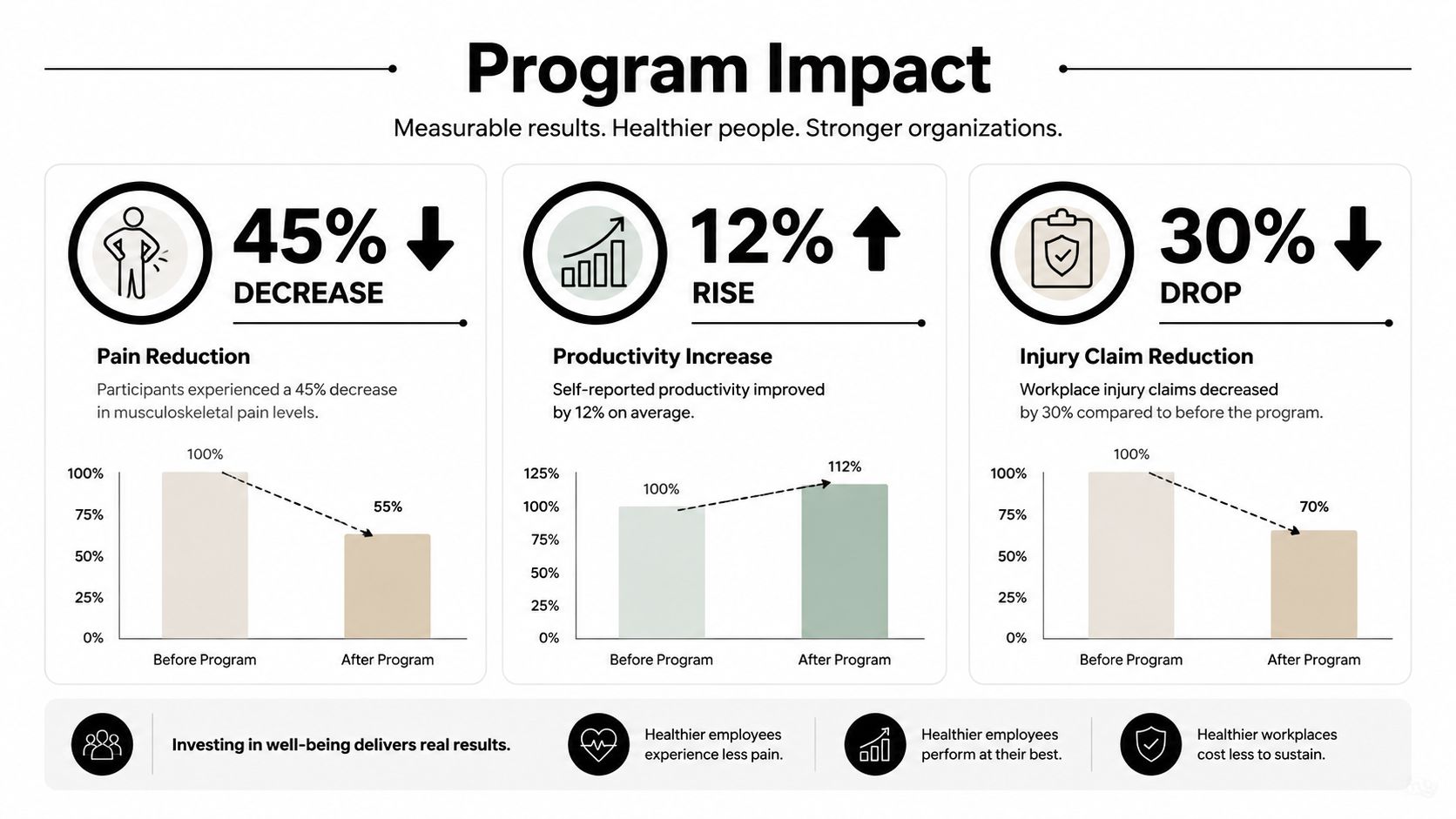
An office-worker study found that the share of employees reporting moderate pain or worse at least monthly fell from 20% to 16% after the program began (office ergonomics program findings). The study also reported that 69% of respondents took part in repetitive-strain-injury training and 56% received workstation assessments. Those figures show program reach, not a guaranteed response for every participant.
Knowledge is useful, but behavior matters more
An applied ergonomics program reported ergonomic knowledge rising from 73% at baseline to 86% at follow-up, while 97% of workers made at least one positive crew change. It also reported no cart-handling injuries after the first program change and an ROI of 1.99 (controlled ergonomic training findings).
These outcomes explain why evaluation should extend beyond course completion. Attendance confirms exposure to information. It does not confirm that a worker adjusted the workstation, changed a handling method, reported symptoms early, or maintained the change during a busy shift.
Pain outcomes vary by body region
A 2025 systematic review and meta-analysis found that ergonomic interventions significantly reduced work-related musculoskeletal pain compared with controls, with moderate-quality evidence supporting clinical relevance. Within combined ergonomic and physical-activity interventions, the reported 38% reduction applied to neck pain, while the 37% reduction applied to hand and wrist pain (2025 systematic review and meta-analysis).
Those findings apply to specific regions, not the whole body. A separate review reported reductions involving the lower back, upper back, neck, wrist, and ankle, but found no significant effects for the shoulders, elbows, arms, thighs, or knees, along with no clear improvement in functional disability (review of region-specific outcomes). The evidence therefore supports targeted expectations rather than a blanket promise of pain relief.
Employers should measure several outcomes: knowledge, task behavior, discomfort in targeted regions, aggravating exposures, and work function. Pain reduction is valuable, but it isn't identical to restored function.
Core Components of Effective Ergonomic Training
A superficial program tells workers to sit up straight and lift carefully. An effective program examines the work itself, gives people a chance to practice changes, and keeps supervisors involved after the formal instruction ends.
Start with the task, not the template
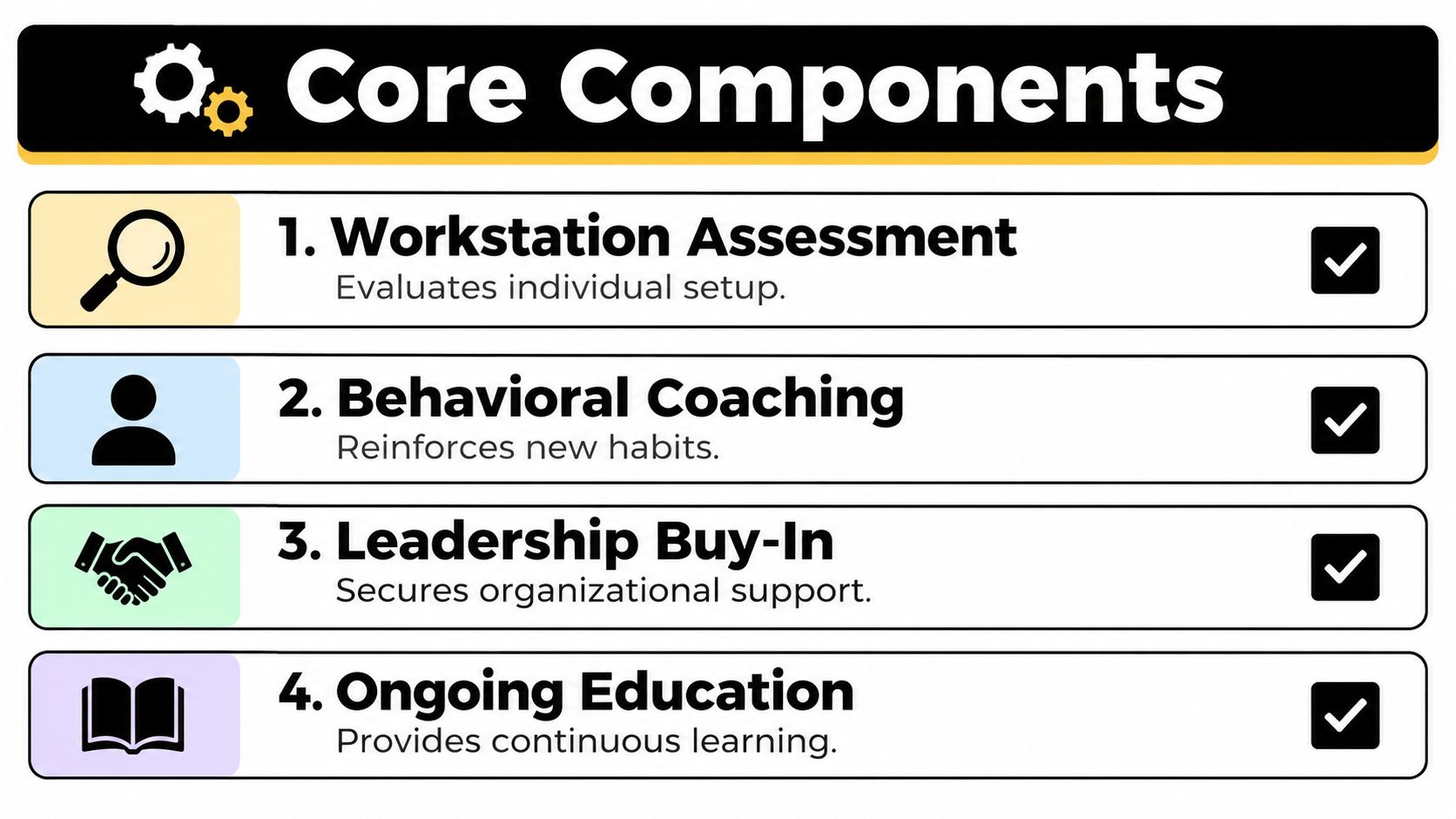
A workstation assessment should look at the individual, the equipment, and the demands of the job. For desk work, review chair support, screen position, keyboard and mouse reach, foot support, and the worker's actual sitting habits. For physical work, observe reaching, lifting, pushing, pulling, gripping, vibration, kneeling, and sustained positions.
Workers should participate in the assessment. They know which parts of a task cause fatigue, where a tool forces the wrist into an awkward angle, and when discomfort usually begins. A formal observation is more useful when it's combined with the worker's report.
Make people practice the change
Passive education has a narrow role. A video can introduce principles, but it can't confirm whether the employee can apply them at the workstation or on the job floor.
A participatory session might include:
- Workstation coaching: Adjust the setup while the worker is present, then have the worker repeat the process.
- Movement strategies: Practice brief mobility, position changes, and task-specific strengthening rather than relying on a generic stretch list.
- Hazard controls: Identify whether the task needs a layout change, tool modification, load adjustment, or scheduling change.
- Early reporting: Give workers a clear pathway for reporting numbness, tingling, weakness, or escalating pain.
For desk workers, these posture improvement strategies can support daily self-management, but they're most useful when adapted to the person's symptoms and job.
Reinforce the lesson
Behavior changes when supervisors notice it, equipment supports it, and workers can repeat it without slowing the job to an unrealistic degree. Use brief check-ins, follow-up assessments, and reminders connected to actual tasks. Leadership must also address controls that workers can't implement independently.
Training should answer three questions: What is stressing the body? What can change today? What requires the organization to act?
Audit the program before calling it complete
A practical audit asks whether the program includes:
- An assessment of real tasks and workstations.
- Worker participation in identifying problems.
- Hands-on practice.
- Controls beyond instruction.
- Supervisor reinforcement.
- Region-specific symptom tracking.
- Follow-up after implementation.
This structure keeps ergonomic training focused on behavior and exposure, not just course completion.
Choosing the Right Delivery Format
Delivery format affects how much a program can scale, how closely it fits the worker, and whether the lesson survives beyond the training event. No single format wins in every setting.
| Format | Best For | Personalization | Scalability | Long-Term Retention |
|---|---|---|---|---|
| Onsite workshop | Teams that need shared language and task-specific demonstrations | Moderate, especially when held near the work area | Moderate | Stronger when supervisors reinforce the lesson |
| Hands-on individual assessment | Workers with symptoms, unusual tasks, or complex workstation needs | High | Limited | Strong when the worker practices and receives follow-up |
| Online module | Basic awareness, orientation, and distributed teams | Low unless paired with feedback | High | Variable without observation and reinforcement |
| Hybrid program | Organizations balancing reach with individualized support | Moderate to high | High | Better when in-person follow-up verifies application |
Onsite workshops
An onsite workshop works well when several employees face similar hazards. The instructor can demonstrate lifting, tool positioning, workstation setup, or movement strategies in the same environment where workers perform the task. The limitation is that a group session may not catch one person's specific symptoms, mobility restriction, or workstation mismatch.
Individual assessments
A hands-on assessment is the better choice when pain is already present or when the job has unusual physical demands. The assessor can observe the person's movement, modify the setup, and test whether the change reduces strain. This format requires more time and coordination, but it offers the most direct feedback.
Online modules
Online learning is convenient for onboarding and geographically dispersed teams. It can establish terminology and basic hazard recognition, but it can't verify whether someone's desk, tool, or lifting technique works in practice. A module should be treated as an entry point, not the complete program.
Hybrid delivery
A hybrid model often gives organizations the most practical balance. Employees complete foundational education online, then receive onsite observation, individual assessment, or supervisor coaching. HR teams can scale the information while reserving hands-on resources for higher-risk jobs and workers who report symptoms.
For a small business in Deerfield Beach, individual coaching may be more useful than a broad module. For a multi-location employer, online education paired with local assessments can preserve consistency without sacrificing relevance.
Pairing Training with Rehabilitation and Movement
Ergonomic education builds awareness. Rehabilitation restores capacity.
A worker may understand that a keyboard is too far away and still have neck pain because the cervical joints are restricted, the shoulder muscles fatigue quickly, or the person has developed a guarded movement pattern. Someone may learn proper lifting mechanics but remain unable to tolerate the job because of weakness, poor hip mobility, or an unresolved back injury.
What rehabilitation adds
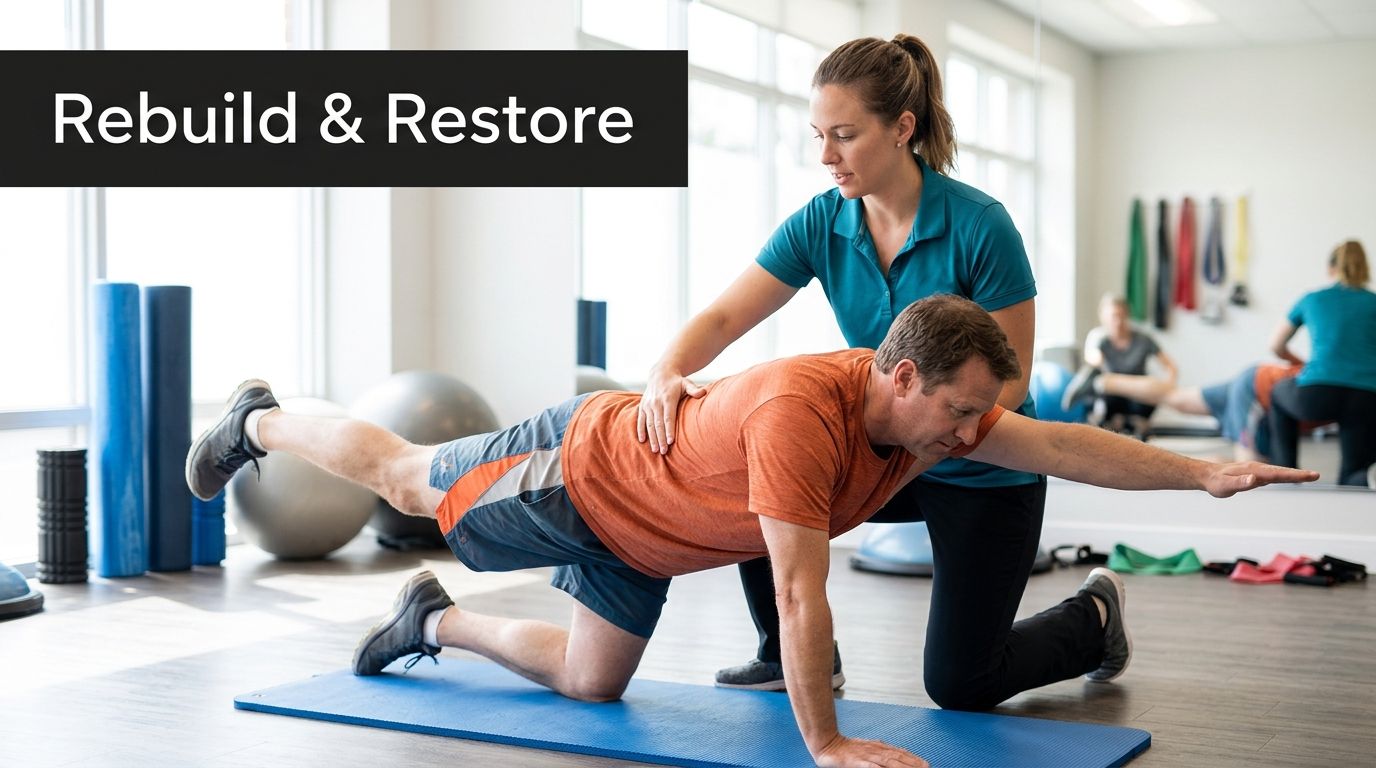
A physical therapist can examine movement, identify contributing impairments, and progress exercises as tolerance improves. Hands-on treatment may address painful or restricted areas, while targeted strengthening helps the worker manage the physical demands that remain after the workstation or task is changed.
A broader clinical plan may also include chiropractic care, acupuncture, or shockwave therapy when appropriate to the condition and treatment goals. The point isn't to substitute one passive treatment for another. It's to combine symptom management with active recovery and practical changes at work.
Workers recovering from an auto accident or workers' compensation injury often need this combination. Ergonomic education can reduce aggravating exposure during a return-to-work plan, while structured rehabilitation addresses the injury's effect on strength, mobility, balance, and tolerance.
Movement must match the job
Generic exercise is easy to prescribe and easy to abandon. A useful program connects movement to the worker's demands. A desk worker may need frequent position changes, thoracic mobility, and progressive endurance. A technician who kneels, reaches, and grips may need different mobility and strengthening priorities.
The 2025 evidence summarized earlier favors combined ergonomic and physical-activity approaches over education alone. That fits clinical experience: workers retain changes more reliably when they understand the reason for an adjustment and have the physical ability to perform it.
This video demonstrates how movement-based therapy can complement ergonomic advice:
A workplace program should also define when education is no longer enough. Persistent pain, progressive weakness, numbness, loss of grip, or declining work tolerance warrants a professional assessment rather than another generic training module.
Implementing and Measuring Your Program
A useful rollout begins with a baseline tied to the work itself. Ask workers where discomfort occurs, which tasks provoke it, what changes they have tried, and whether symptoms affect their capacity. Record workstation observations and task exposures with the survey responses. A symptom without context rarely identifies the right control.
Build the rollout around actual risks
Use a sequence that connects findings to action:
- Identify priority tasks: Select workstations, tools, and activities linked to recurring discomfort or clear exposure.
- Assess with participation: Observe the task and ask the worker what feels difficult, fatiguing, or painful.
- Apply controls: Change the setup, equipment, task design, schedule, or movement strategy. Education should support the control, not stand in for it.
- Coach in context: Have workers demonstrate the revised method at their workstation.
- Reassess: Check whether the change is being used and whether symptoms, tolerance, or task quality have shifted.
- Document decisions: Record attendance, findings, recommendations, assigned owners, and follow-up actions.
A workplace safety consulting resource can help organizations organize assessments and connect recommendations with practical workplace controls.
Choose metrics that reflect real outcomes
Knowledge scores indicate whether workers understood the material, but they do not show whether the program changed daily work. Track discomfort by body region, early symptoms, completed workstation or task changes, observed behavior, work restrictions, absenteeism, and productivity measures that fit the operation.
The field still lacks clear long-term evidence linking training with sustained behavior change and musculoskeletal outcomes. Productivity, absenteeism, job satisfaction, and safety outcomes also remain difficult to compare across programs, as noted earlier. Some office-worker effects faded by 12 weeks, according to the PubMed evidence summarized in the provided research brief (study on ergonomic training follow-up).
Set review points before training begins. Compare the baseline with observations after workers have had time to use the new methods, then investigate gaps rather than assuming that attendance produced safer behavior. If the organization is also measuring commercial operations, how Lynkro.io enhances sales may inform that separate review, while health, safety, and behavior measures remain the basis for judging ergonomic performance.
Follow-up assessments are therefore necessary to determine whether behavior change is sustained beyond the initial training period.
Local Support from MedAmerica Rehab Center
For Deerfield Beach workers, the practical starting point may be a workstation problem, but the underlying issue can involve more than posture. Neck pain may coexist with shoulder weakness. Low-back pain may involve reduced hip mobility or poor load tolerance. Repetitive hand symptoms may need both task modification and clinical evaluation.
MedAmerica Rehab Center provides physical therapy, chiropractic care, acupuncture, and shockwave therapy as part of individualized care. The clinic also works with people recovering from auto accidents and workers' compensation injuries, where ergonomic education can support a structured return to work rather than asking someone to resume full duties before their movement and strength are ready.
The most useful plan is specific. A clinician should identify what movement or task is aggravating symptoms, determine what the worker can safely do now, and progress treatment as function improves. Ergonomic adjustments then become practical tools that protect the gains made in rehabilitation.
Same-day appointments and insurance-friendly processes can make it easier to seek help before discomfort becomes a larger interruption. If back, neck, sciatica, arthritis, or repetitive-strain symptoms are affecting your work, don't rely on a training video alone.
MedAmerica Rehab Center combines ergonomic guidance with hands-on physical therapy, chiropractic care, acupuncture, shockwave therapy, and targeted exercise for Deerfield Beach patients. Visit MedAmerica Rehab Center to schedule an evaluation and build a recovery plan that addresses both your symptoms and the work demands contributing to them.
MedAmerica Rehab · Deerfield Beach
Talk to a clinician about your pain
Physical therapy, chiropractic, acupuncture and shockwave therapy under one roof, since 1995. Same-day appointments are available.
Mon–Thu 8:00 AM – 6:30 PM · Fri 8:00 AM – 3:00 PM