
Workplace Safety Consulting: A Guide for Florida Employers
You may be dealing with this right now. A team member tweaked a back lifting inventory, slipped on a wet floor, or started complaining that their wrist goes numb halfway through a shift. At first it feels manageable. Then schedules get rearranged, coworkers cover extra tasks, paperwork starts piling up, and the injured employee enters a world of medical visits, restrictions, pain, and uncertainty.
From a rehabilitation perspective, that moment matters more than most employers realize. Once someone is hurt, the conversation changes. It's no longer only about compliance or operations. It's about whether that person can sleep through the night, pick up a child, drive without pain, or return to work without reinjury. That's why workplace safety consulting matters. Done well, it prevents the kind of injuries that can take months to calm down and much longer to fully recover from.
Why Workplace Safety Is More Than a Checklist
A workplace injury rarely stays contained to one incident.
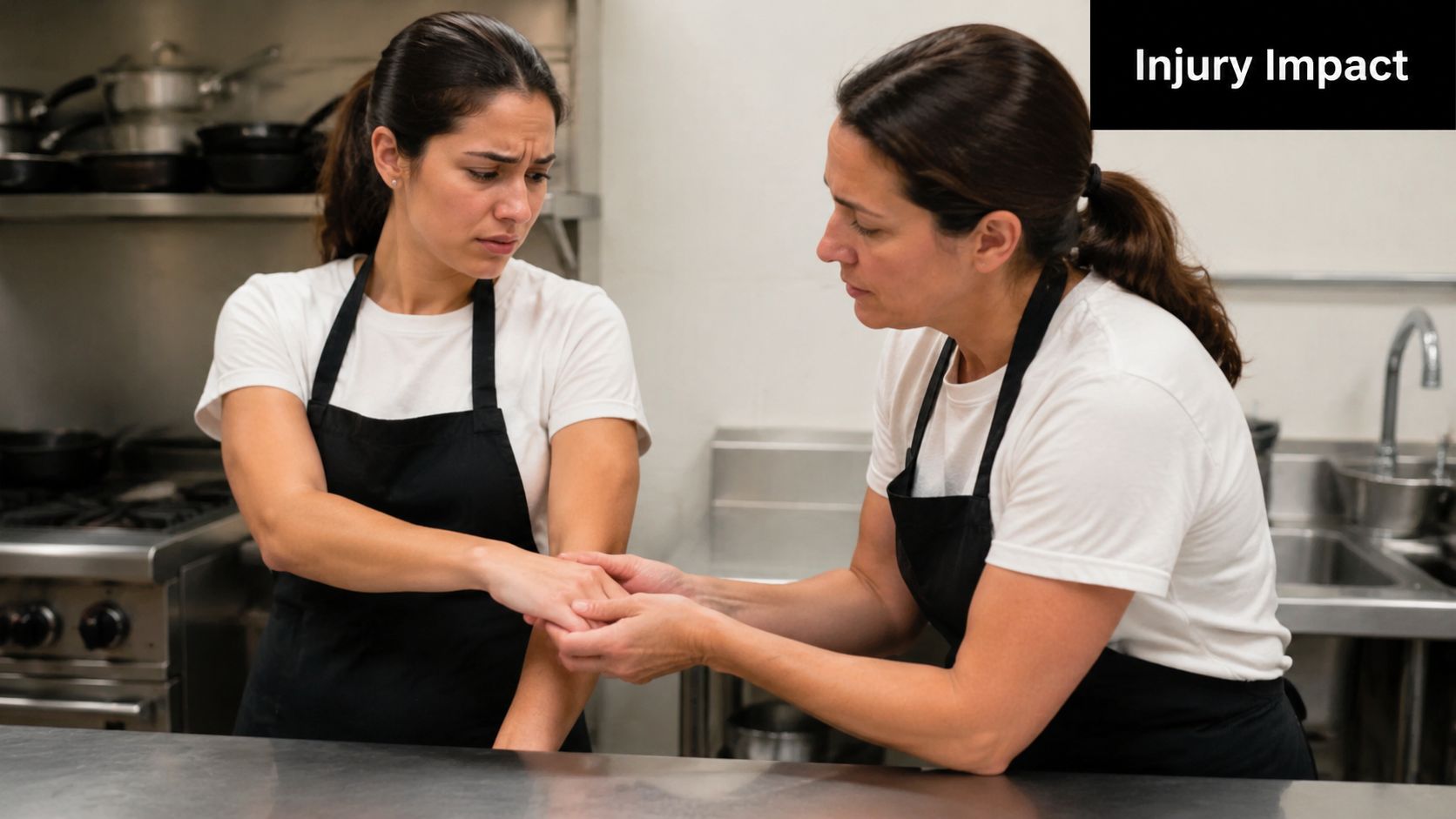
In a small restaurant, one hand laceration in the kitchen can disrupt prep, slow service, rattle the rest of the crew, and leave the owner juggling staffing, reporting, and customer demands at the same time. In a warehouse, a back strain can look minor on day one and become a long recovery if the worker keeps trying to push through pain. In an office, repetitive overuse can build so gradually that nobody treats it seriously until typing, gripping, and sleeping all become difficult.
That's the part checklists miss. A written policy can exist on paper while real work happens in a completely different way on the floor. People hurry. Supervisors improvise. Equipment gets used for tasks it wasn't meant for. New hires copy shortcuts from experienced staff. Repetitive strain issues accumulate until someone needs treatment. Employers looking for practical prevention often benefit from reviewing common early warning signs, such as those covered in this guide on preventing repetitive strain injury.
The human cost shows up before the paperwork does
When an employee gets hurt, the first consequences are physical and personal. Pain changes how people move, sleep, concentrate, and interact with their families. Some workers feel embarrassed that they got injured. Others worry they'll be seen as unreliable if they report symptoms early.
Practical rule: If workers feel they have to choose between speaking up and keeping their standing at work, hazards stay hidden until they become claims.
The business side matters too, but it shouldn't be separated from the human side. The same weak safety system that leads to disruptions, retraining, and claims also creates harder recoveries. When an employer catches hazards earlier, injuries are often less severe, treatment is simpler, and return-to-work planning is more realistic.
This is a widespread risk, not a rare event
This isn't a niche problem. In the U.S., employers reported 2.6 million nonfatal workplace injuries and illnesses in 2023, and there were 5,283 fatal work injuries that same year, equal to 3.5 fatalities per 100,000 full-time equivalent workers, according to these workplace safety figures summarized from OSHA data. The same source notes that worker deaths have fallen from about 38 per day in 1970 to about 15 per day in 2023, and injuries and illnesses declined from 10.9 incidents per 100 workers in 1972 to 2.4 per 100 in 2023.
That improvement matters. It also doesn't mean the work is finished.
Workplace safety consulting earns its value when it helps employers move from “we have the required documents” to “we know where people can get hurt, why it happens, and what controls actually work in daily operations.” That shift protects schedules and budgets. More importantly, it keeps people out of the treatment room in the first place.
What a Workplace Safety Consultant Actually Does
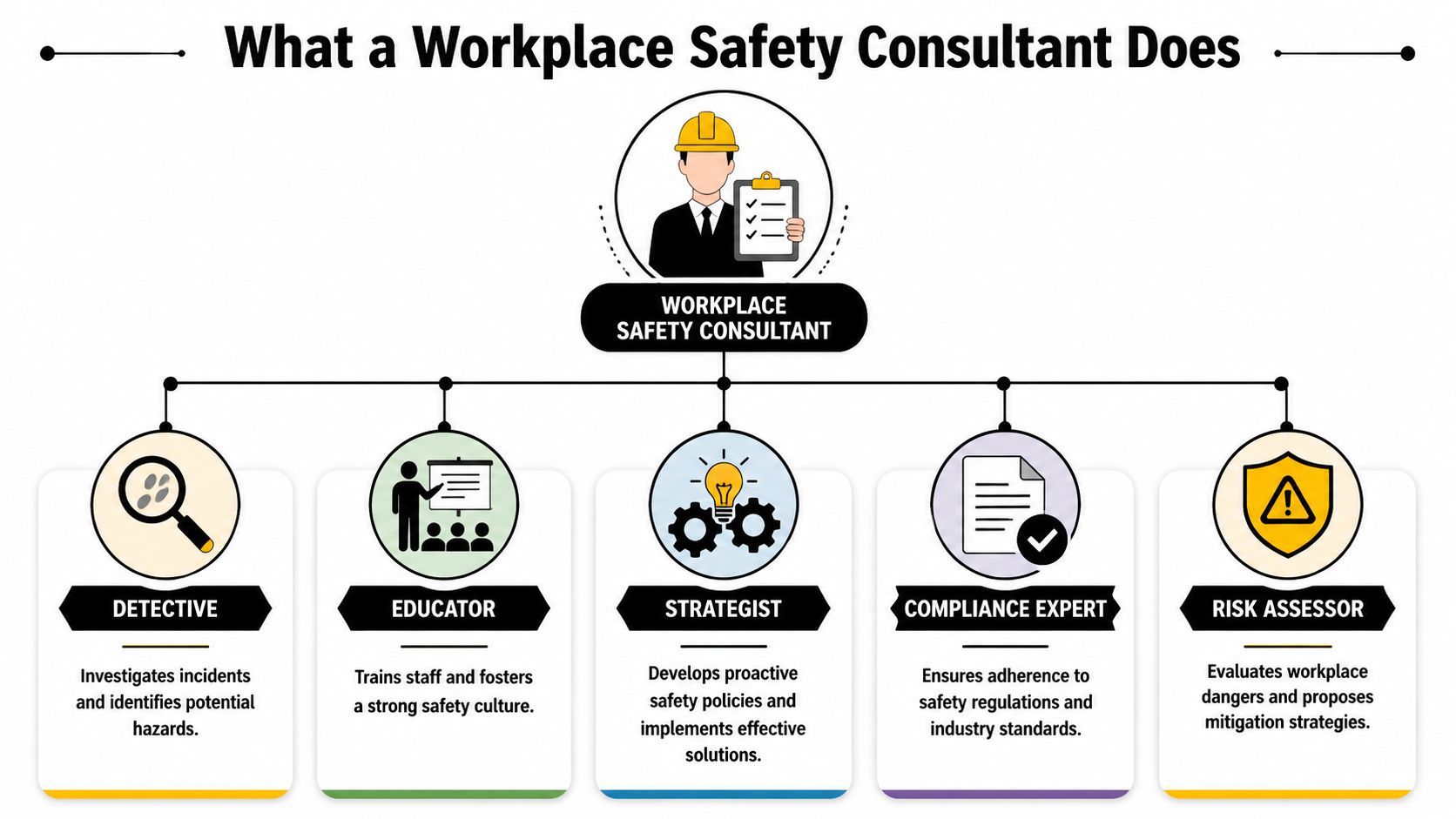
A good consultant isn't just an OSHA translator.
They're part analyst, part trainer, and part strategist. The best ones spend less time admiring binders and more time watching how work is really done. They notice who reaches too far, who bypasses a guard, where traffic patterns create collision risk, and which tasks depend on memory instead of clear systems.
They start with the job, not the policy manual
A rigorous engagement often begins with a job hazard analysis, sometimes called a JHA or JSA. The point is simple. Break a task into steps, identify the hazards in each step, evaluate existing controls, and decide what still needs to change. That approach is described in this overview of how workplace safety consultants use JHA and risk registers.
That matters because injuries don't happen in abstract categories. They happen during a transfer, a lift, a repetitive reach, a ladder climb, a machine cleanout, a rushed turn in a tight stockroom, or a patient assist at the end of a long shift.
Their best deliverable is a usable risk register
Most employers don't need more generic advice. They need a list they can act on.
A strong consultant usually leaves behind a prioritized risk register that connects each hazard to a specific corrective action, assigns ownership, and sets a verification date. That's where consulting becomes operational instead of theoretical.
For example, instead of “improve housekeeping,” a useful recommendation might break out into actions such as:
- Receiving area floor controls: assign spill response supplies to a named location and shift lead
- Manual handling fixes: change how bulk items are stored so staff don't lift from ankle height
- Training gap correction: retrain new supervisors on safe coaching and incident reporting
- Verification step: schedule a follow-up walkthrough to confirm the change stuck
A consultant adds the most value when they can tell you not only what's wrong, but who should fix it, by when, and how you'll know it was fixed.
They train for the task people actually perform
Many programs fail when training gets delivered once, everyone signs a sheet, and management assumes the hazard is handled. It isn't.
Useful training is targeted. A consultant should tailor it to the tasks, tools, pace, and literacy level of your workforce. If your business has employees coming back from injury or restricted duty, it also helps when leadership understands functional progression. Many employers find it useful to understand work hardening therapy because it shows what structured, job-related recovery and work readiness can look like after an injury.
They investigate patterns, not just incidents
A strong consultant looks for recurring conditions:
- Repeated strains in the same department: that often points to workflow or ergonomics, not bad luck
- Near misses during busy periods: pace and staffing may be part of the hazard
- Injuries among newer employees: onboarding may be too vague or too rushed
- Rules that nobody follows: the rule may be unrealistic for actual production demands
The practical difference is this. Weak consulting produces a nicer safety binder. Strong workplace safety consulting changes the way work gets done so the same person doesn't walk into the same risk next week.
The Real ROI of Safety Consulting From Premiums to People
For many employers, the first question is financial. That's fair. Safety decisions affect claims, staffing, downtime, and insurance costs.
But in clinical practice, the most important return often appears somewhere else. It shows up in the employee who never has to learn how hard recovery can be.

The financial case is straightforward
High-performing consulting helps organizations shift from reactive compliance to proactive, data-driven safety systems that turn inspections and incident trends into concrete controls like targeted training and verified follow-up, according to the National Safety Council's consulting perspective. In plain terms, that means fewer surprises and better decisions.
When employers consistently identify hazards early, respond to near misses, and verify corrective actions, they put themselves in a better position to control the factors that drive claim frequency and severity. If you're trying to understand how those patterns can influence costs over time, this resource on how to lower workers comp X-mod offers a useful business-side explanation.
The same logic applies to operations. An employee out with a shoulder injury or lumbar strain doesn't only create a medical file. Someone else works overtime. A supervisor spends time documenting. A replacement may not know the job well. Production quality can dip because experienced workers are covering too many roles at once.
The clinical return is often bigger than the accounting return
A preventable injury can become a long story. First comes pain. Then guarded movement. Then deconditioning, frustration, and fear of making it worse. Some workers recover quickly. Others start protecting the injured area so much that neighboring muscles and joints begin to hurt too.
That's why prevention has a clinical payoff that isn't always obvious in spreadsheets.
What works: redesigning the task, coaching the supervisor, and fixing the workflow before tissue damage occurs.
What doesn't: waiting until someone is already in treatment and then calling the injury “unavoidable.”
Workers also recover better when employers stay organized after an incident. Clear restrictions, realistic modified duty, and timely communication reduce confusion. Employees who are already in the system often ask practical questions about timelines, and employers do too. Articles like this overview of how long workers comp takes can help frame those expectations.
A short educational video can help reinforce that prevention mindset across leadership teams and supervisors.
The culture effect is real
Employees notice whether management treats safety as a monthly speech or a daily operating principle. They notice whether concerns are welcomed, whether fixes happen, and whether supervisors model the same rules they enforce.
The companies that get the most from workplace safety consulting usually do three things well:
- They act on findings quickly: not every fix is expensive, but delay teaches workers that reporting hazards isn't worth it.
- They involve supervisors: front-line leaders decide whether safe procedures survive a busy shift.
- They follow up: a recommendation isn't complete until someone confirms the risk dropped.
That's the ultimate return. Fewer disruptions, fewer painful recoveries, and a workplace where people don't feel disposable.
Understanding OSHA Compliance and Florida Safety Rules
Compliance can feel intimidating, especially for smaller employers who don't have a dedicated safety department. In practice, the first step is simpler than many people think. Identify the hazards tied to the work you do, then document how you control them, train for them, and review them.
Florida employers generally operate under federal OSHA requirements. For day-to-day decision making, that means you can't treat safety as an afterthought once a hazard is recognized. If a task creates a known risk, leadership needs a reasonable plan to address it through equipment, workflow changes, training, supervision, or some combination of those controls.
Small and midsize employers have a practical option
One of the most useful resources available is OSHA's On-Site Consultation Program. For small and midsize employers, it is a no-cost, confidential service completely separate from OSHA enforcement, designed to help businesses find and fix hazards without fear of fines, as described on OSHA's consultation program page.
That matters because many businesses don't ignore safety out of indifference. They delay action because they assume help will be expensive, punitive, or overly bureaucratic. This program addresses that concern directly.
Use outside help before you're under pressure. Safety planning is easier when it's not happening in the middle of an injury, complaint, or staffing shortage.
Compliance is broader than one agency
Workplace risk also overlaps with leave management, documentation, return-to-work issues, and internal policy consistency. Employers trying to tighten that side of operations may benefit from guidance that connects those dots. For example, teams reviewing absences, policy administration, and risk procedures can learn about compliance with LeaveWizard as part of a broader management process.
What Florida employers should do first
A useful starting framework is basic and practical:
- Walk the site with fresh eyes: focus on tasks, pinch points, repetitive motions, wet surfaces, traffic flow, and rushed workarounds.
- Review your training reality: ask whether people can explain and demonstrate the safe method, not just whether they signed attendance sheets.
- Check supervisor habits: if a procedure only works on a calm day, it isn't dependable enough.
- Create a simple correction list: assign responsibility, set dates, and verify completion.
For many Florida businesses, especially in hospitality, retail, healthcare, light industrial work, and construction support, the challenge isn't knowing that safety matters. It's turning good intentions into a working system. That's where workplace safety consulting and no-cost consultation resources can make compliance feel manageable instead of abstract.
How to Hire a Workplace Safety Consultant for Your Business
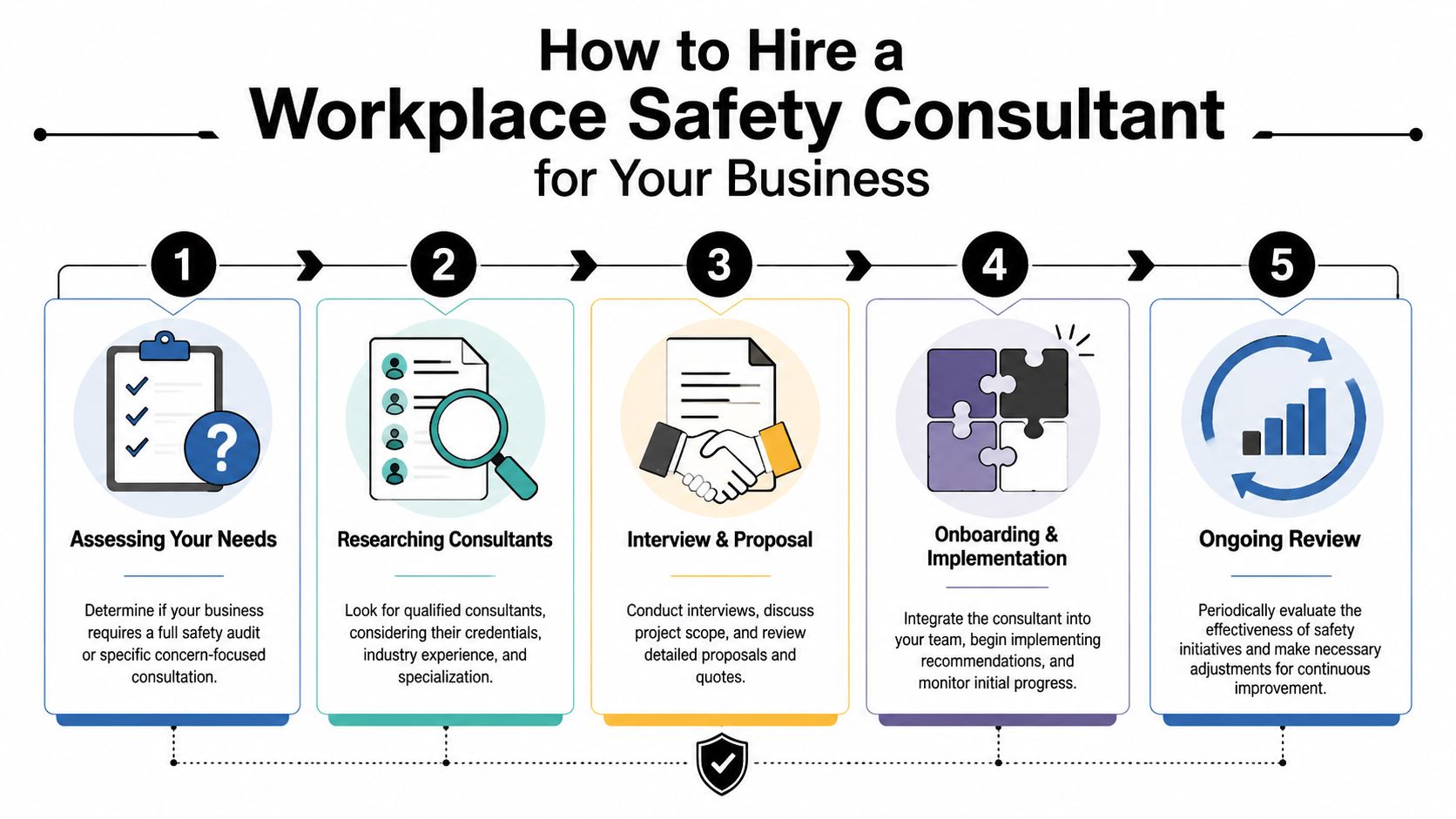
Hiring the right consultant starts with honesty about what your business can and can't handle internally. Some companies need a full-site assessment. Others need help with one department, repeated lifting injuries, machine safety, onboarding gaps, or return-to-work coordination.
The mistake is hiring based on a polished proposal alone. Safety consulting only works when the consultant can understand your workflow, communicate with your team, and help leadership implement changes after the report is delivered.
Start with your actual pain points
Write down what keeps recurring. Not broad goals like “improve safety culture.” Name the specific problems. Wrist pain at packing stations. Near misses in receiving. Slips around the dish area. Shoulder complaints after stocking. New hires getting hurt early.
That list helps you separate consultants who understand operations from those who speak only in generalities.
A strong initial scope often includes:
- Task observation for the jobs where injuries or complaints keep surfacing
- Document review for training records, incident logs, and written procedures
- Supervisor interviews to identify where production pressure collides with safety expectations
- Corrective action planning that fits your staffing and budget reality
Ask better interview questions
Many employers ask about credentials first. Credentials matter, but they don't tell you how the consultant works on the floor.
Ask questions that reveal judgment:
- How do you conduct a job hazard analysis in a live workplace?
- What do you do when a written rule conflicts with how the job is being done?
- How do you prioritize corrective actions if we can't fix everything at once?
- How do you train supervisors, not just hourly staff?
- How do you handle language access and culturally adapted training for a diverse workforce?
That last question is especially important. Effective consulting needs to consider the full workforce, including vulnerable populations. Guidance on underserved workers emphasizes issues such as workers' rights, language access, retaliation fears, and culturally adapted training, because individual-only hazard training is often not enough when structural barriers exist. That perspective is discussed in this white paper on approaches to education and training for underserved populations.
If workers can't safely report concerns, can't fully understand the training, or fear retaliation, your safety program has a structural weakness.
Compare in-house management with outside help
Some employers can build safety capacity internally. Others need an outside specialist to create structure, momentum, and accountability.
| Factor | In-House Safety Lead | External Safety Consultant |
|---|---|---|
| Day-to-day familiarity | Knows staff, pace, and routines well | Needs time to learn operations |
| Objectivity | May normalize long-standing shortcuts | Brings fresh eyes to recurring risks |
| Specialized expertise | Depends on the individual's background | Often stronger for audits, hazard analysis, and program design |
| Speed to launch | Faster if the person already has authority | Faster if no capable internal lead exists |
| Training reach | Can reinforce expectations regularly | Can build targeted training and coach leaders |
| Cost structure | Ongoing payroll commitment | Project or retainer-based engagement |
| Follow-through risk | Can stall if overloaded with other duties | Can stall if leadership doesn't act on recommendations |
Evaluate the proposal for implementation, not just price
A weak proposal sounds impressive but stays vague. A strong one tells you what will happen, who will be involved, what deliverables you'll receive, and how follow-up will work.
Look for signs of substance:
- Clear site activity: walkthroughs, observations, interviews, and task-level analysis
- Defined outputs: risk register, training recommendations, action plan, and review cadence
- Workforce fit: multilingual or adapted training methods when needed
- Leadership expectations: what managers must do during and after the engagement
Price matters, but the cheapest option can be expensive if it produces generic documents nobody uses. The right consultant should leave your business safer in practice, not just better documented.
Building a Safer Deerfield Beach Workplace
In Deerfield Beach, the industries may differ, but the pattern is familiar. Construction and field service teams deal with falls, lifting, heat, and vehicle movement. Hospitality staff face slips, burns, cuts, and fast repetitive work. Retail workers handle stocking strains, ladder use, and awkward carrying. Healthcare and rehab settings manage transfers, prolonged standing, and high repetition.
The local lesson is simple. Safety systems have to match the job. A front-desk binder won't solve a back injury trend in a stockroom. A one-time talk won't fix rushed patient handling. Generic reminders won't prevent the same kitchen burn from happening on another weekend shift.
What stronger local safety looks like
The most effective employers tend to share a few habits:
- They watch the task live: they don't assume the written process matches the actual one.
- They respond early to discomfort reports: especially with strains, numbness, and repeated soreness.
- They coach supervisors to correct risk in the moment: not only during formal audits.
- They treat recovery and prevention as connected: every injury becomes a lesson for redesign.
That mindset helps businesses protect both continuity and people. It also makes outside expertise more useful. If you're reviewing the consultant side of risk management itself, including coverage considerations for professionals who advise businesses, this Schneider Insurance guide for consultants is a practical companion read.
Prevention is still the best clinical plan
From a rehab standpoint, the best outcome is the injury that never happens. No therapy schedule replaces avoiding the tissue damage, pain cycle, sleep disruption, work restrictions, and emotional strain that follow a preventable incident.
Workplace safety consulting is at its best when it keeps employees from needing care at all. When that doesn't happen, people still need skilled treatment, a clear path back to function, and a team that understands both recovery and return to work. But the first job is prevention. That's where safer workplaces begin, and it's still the most humane choice an employer can make.
If you or someone on your team is dealing with a work injury, MedAmerica Rehab Center provides patient-centered care in Deerfield Beach for workers' compensation rehabilitation, physical therapy, chiropractic care, acupuncture, and recovery support designed to help people move better, heal well, and return to daily life with confidence.
MedAmerica Rehab · Deerfield Beach
Talk to a clinician about your pain
Physical therapy, chiropractic, acupuncture and shockwave therapy under one roof, since 1995. Same-day appointments are available.
Mon–Thu 8:00 AM – 6:30 PM · Fri 8:00 AM – 3:00 PM