
Back Surgery Rehabilitation: Your Complete Recovery Guide
You're home after surgery, the incision is dressed, the pain is different than it was before, and the big question hits fast, what now? Many individuals expect the operation to be the finish line, then discover that the primary work is learning how to move again without irritating the repair, provoking nerve symptoms, or losing confidence every time they stand up.
Back Surgery Rehabilitation is the part of recovery that turns pain relief into usable function. The surgeon handles the structural problem, but rehab restores walking tolerance, bed mobility, posture, lifting mechanics, and the confidence to get back to daily life without guessing.
What to Expect After Back Surgery
The first few days after back surgery can feel strangely mixed. Many patients notice relief from the original pressure, but they also feel stiff, tired, guarded, and unsure about every movement. A patient I'd expect to see in clinic often says, “The pain I had before is gone, but now I'm scared to bend, twist, or even get out of bed the wrong way.” That fear is normal, and it's exactly why back surgery rehabilitation starts with simple, protected movement instead of waiting for discomfort to disappear on its own.
Early recovery is about motion, not rest alone
Surgery fixes a mechanical problem, but it doesn't automatically rebuild strength, gait, or body confidence. The evidence behind active rehab after lumbar procedures helped move the field toward graded movement and away from prolonged rest, with exercise-based rehab starting 4 to 6 weeks after surgery showing small short-term improvements in pain and disability after lumbar disc surgery, and active rehab after lumbar spinal stenosis surgery improving function in the short term in a review of 3 randomized trials involving 340 people (Cochrane review on lumbar disc surgery rehabilitation).
That doesn't mean everyone should do the same thing at the same time. It means the plan has to match the procedure, the tissue healing stage, and your surgeon's precautions. A resource like physical therapy after surgery is useful when you want to understand how post-op care usually gets organized into a structured plan instead of random exercise advice.
Practical rule: if a movement feels “small but clean,” that's usually a better sign than trying to prove you're strong too soon.
The emotional side matters too
Back surgery recovery can feel frustrating because progress doesn't always show up in a straight line. Some days you'll walk farther, then wake up the next morning feeling tighter. That doesn't mean something is wrong, it often means the spine, muscles, and nervous system are recalibrating.
If you're handling paperwork, lost time from work, or a complicated injury history, a legal resource such as 3-level lumbar fusion settlement may be relevant for understanding how serious fusion recovery can be in real life. Clinically, though, the takeaway is simpler, surgery starts the repair, rehab teaches the body how to use that repair safely.
The Phased Timeline of Spine Recovery
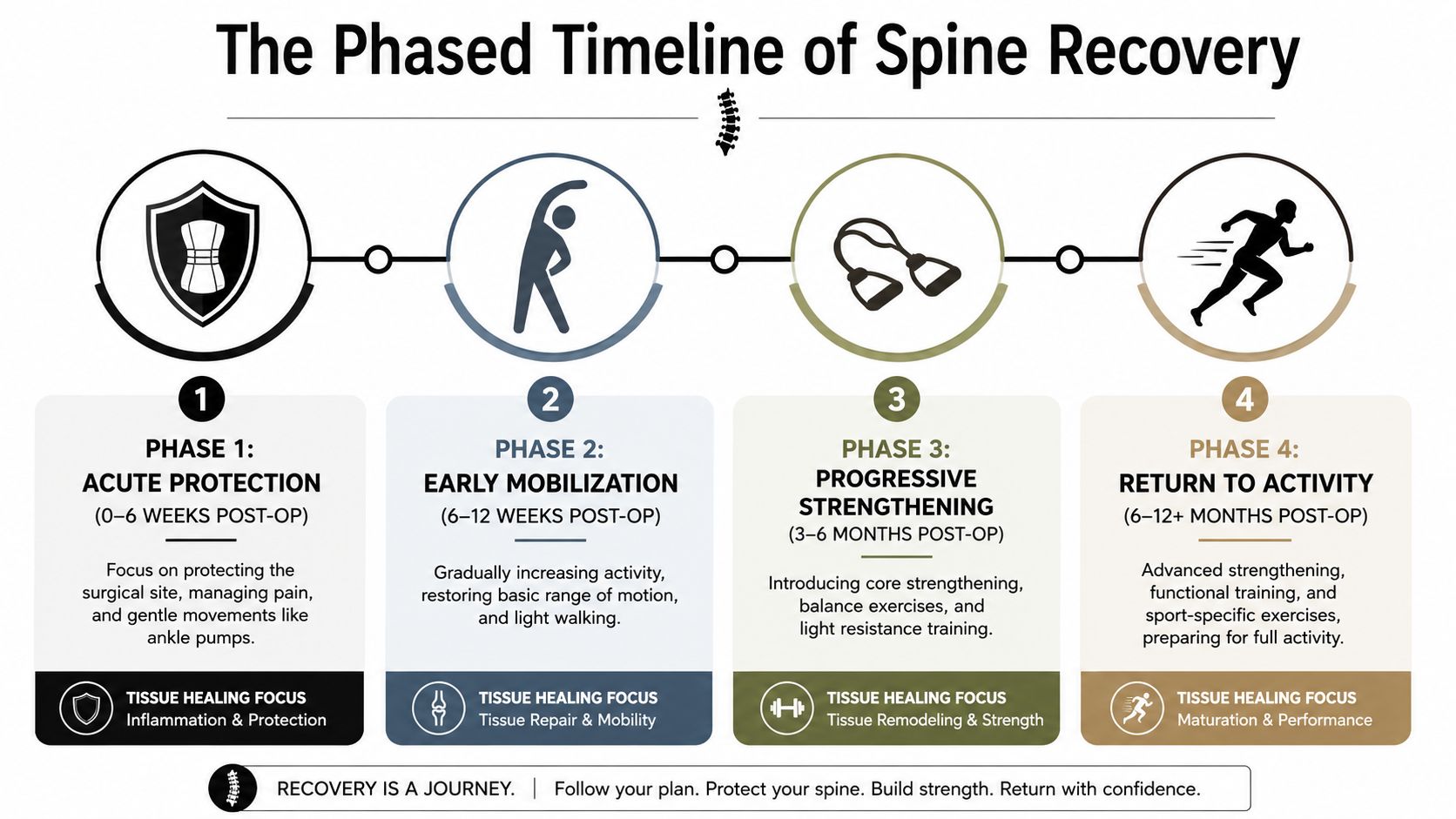
The healing timeline matters because spinal tissues don't all heal at the same speed. In the earliest phase, the goal is to protect the surgical site and reduce irritation. Later, the goal shifts toward restoring movement quality, then building strength, then loading the spine for work, sport, and daily demands.
Phase 1 and Phase 2
The first phase, often the 0 to 6 week window, is about acute protection. That usually means walking short distances, changing positions often, using safe bed mobility, and keeping movement gentle. One review notes that many formal rehab programs begin 4 to 6 weeks after surgery, while more conservative fusion frameworks may wait longer, sometimes 6 to 12 weeks or about 12 weeks after fusion once imaging is reviewed (timing and tissue-healing review). Early cognitive-behavioral rehab with education and gradual mobilization can start right away, which is why the first phase focuses on confidence and basic activity tolerance.
The second phase, roughly 6 to 12 weeks, adds early mobilization. During this time, walking gets longer, movement patterns get cleaner, and simple range-of-motion work becomes more useful. The point isn't to chase fatigue, it's to restore the ability to move without bracing every muscle in the torso.
A lot of patients compare this stage to recovery after other surgeries, but the tissue rules are different. For example, if you're also looking at finding postpartum recovery exercises, you'll notice the same broad theme of graded progression. The details, though, are specific to spinal healing and to whether a fusion, decompression, or disc procedure was done.
Phase 3 and Phase 4
The next stage, generally 3 to 6 months, is when progressive strengthening makes sense. That's when trunk endurance, balance, and controlled resistance work can begin to matter more because the body can tolerate more load without constantly flaring symptoms. Evidence from lumbar disc surgery rehabilitation shows postoperative physical therapy improves pain, disability, and quality of life, and exercises targeting back-muscle endurance, flexibility, and strength are generally beneficial (systematic review of 55 randomized trials, 4,311 patients).
The final phase, often 6 to 12+ months, is return to activity. That's where sport-specific drills, work simulation, heavier lifting mechanics, and more demanding conditioning fit. If someone jumps into this phase too soon, the spine usually reminds them the hard way.
Therapeutic Modalities Used in Post-Surgical Rehab
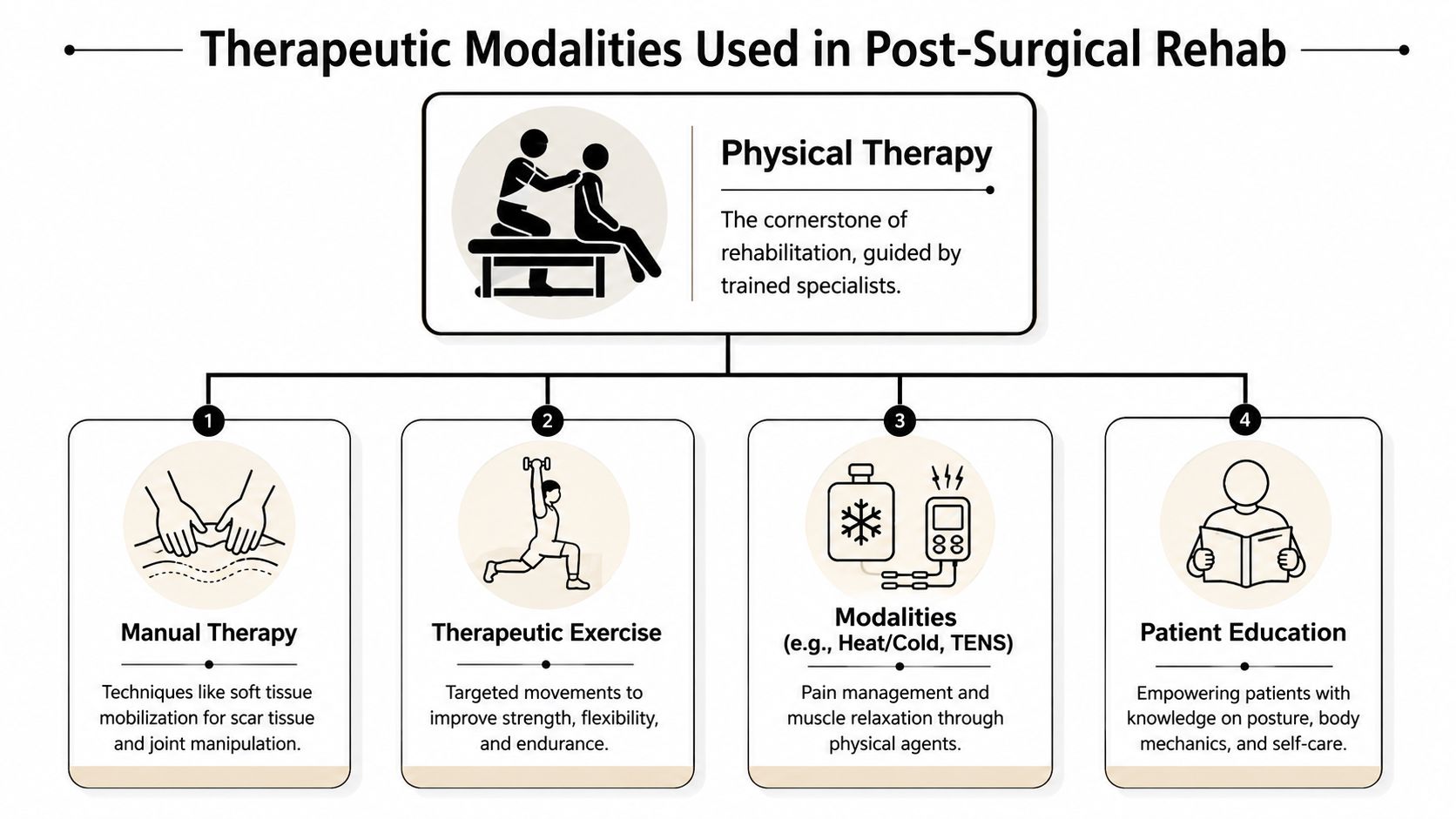
A good rehab plan after spine surgery is usually built around physical therapy, then adjusted with other tools depending on pain, mobility, scar sensitivity, and tolerance for exercise. The main goal is not to pile on treatments. It's to choose the few things that help you move better without provoking the surgical site.
What usually belongs in the plan
Physical therapy is the foundation because it connects evaluation, exercise, gait training, and education into one process. That's the part that helps a patient relearn safe movement, which is why it shows up in almost every evidence-based post-op plan. In practice, the session often includes walking drills, posture work, bed mobility practice, and a home program that changes as you progress.
Manual therapy can help with soft-tissue tightness, nearby joint stiffness, and scar mobility once the surgeon clears the area. It should feel targeted, not aggressive. Hands-on work can support motion without replacing exercise.
Therapeutic exercise is the part most patients recognize, but it has to be timed correctly. Early on, that means low-load activation and movement control. Later, it becomes endurance, balance, and strengthening. If you want a clearer framework for retraining movement patterns, what is neuromuscular reeducation is a useful concept because it explains why coordination work matters after surgery.
Modalities like heat, cold, or electrical stimulation can help with symptom control, especially when pain makes it hard to participate in movement. They're support tools, not the core of recovery. Acupuncture and shockwave therapy may also be used in some multidisciplinary settings for pain modulation or soft-tissue pain when symptoms linger, but they should fit the overall plan rather than distract from it.
A treatment only earns its place if it helps you walk better, move better, or recover with less irritation.
A clinic may also offer a hybrid approach, with in-person care for manual work and form correction, plus home-based progressions when travel or scheduling get in the way. That's often more realistic than trying to force every patient into the same weekly template.
Progressive Exercises and Precautions by Phase
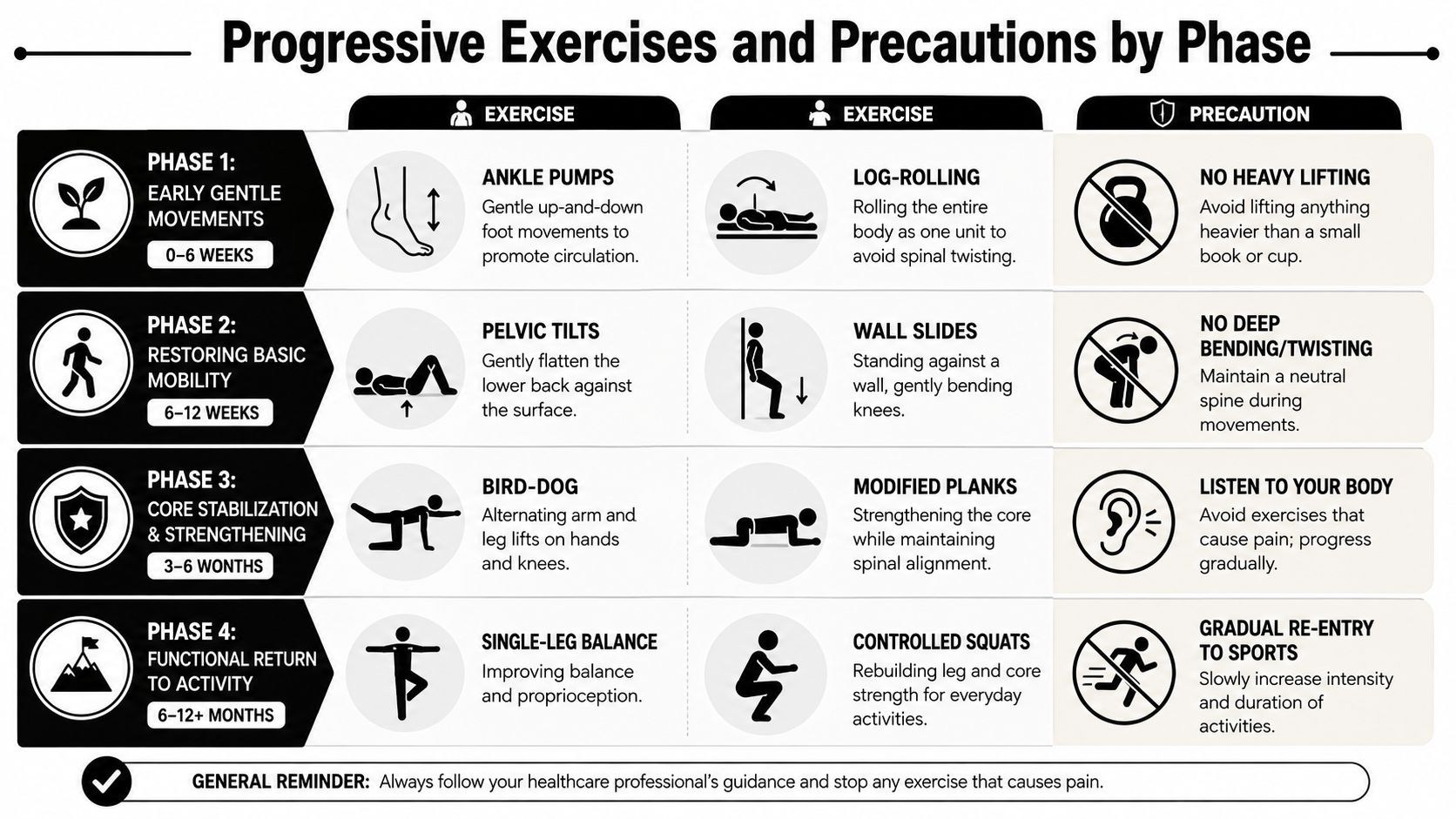
The safest exercise plan after surgery is usually the simplest one that matches your current healing stage. I'd rather see a patient do three well-controlled movements every day than copy a long list from the internet and flare the back for a week.
Early gentle movements
In the 0 to 6 week phase, the most useful movements are often the least dramatic. Ankle pumps help circulation, log-rolling protects the spine when getting out of bed, and walking in short bouts keeps stiffness from taking over. The key precaution is to avoid heavy lifting, because bending and carrying a load at the same time can increase stress before the tissues are ready.
Restoring basic mobility
From about 6 to 12 weeks, more patients can tolerate pelvic tilts and wall slides as long as the spine stays neutral and the motion stays controlled. The goal is to reconnect the hips, trunk, and breathing pattern without forcing range. A major precaution here is no deep bending or twisting, especially when fatigue sets in and form starts to collapse.
Core stabilization and strength
In the 3 to 6 month range, bird-dog work and modified planks become useful because they train the trunk to resist motion instead of creating it. That shift matters for return to lifting, longer walks, and more demanding daily tasks. The precaution is simple, listen to your body and back off from anything that produces sharp, escalating, or lingering pain.
Functional return to activity
By the 6 to 12+ month phase, single-leg balance and controlled squats help rebuild coordination and real-world strength. These drills matter because life doesn't happen on a treatment table, it happens while carrying groceries, stepping off curbs, or rising from a low seat. The main precaution now is gradual re-entry to sports, because tissue tolerance and confidence still need time to catch up.
Returning to Work and Daily Activities
One of the hardest questions after surgery is still the same. When can you get back to normal life? The answer depends on the procedure, the job, and how well you can sit, stand, walk, and move without compensation. Analyses of return-to-work outcomes show that recovery is measurable, but it is rarely immediate, and the timeline varies a lot by surgery type and job demands.
Return depends on the job, not just the surgery
Desk work usually comes back sooner than lifting, carrying, or repetitive bending. Sedentary workers in a return-to-work analysis had a high return rate by 1 year, while fusion patients returned more slowly than non-fusion patients, which fits what we see in clinic. Those patterns do not tell an individual patient exactly when to go back, but they do show why fusion recovery is often more cautious.
| Activity | Decompression/Discectomy | Lumbar Fusion |
|---|---|---|
| Sedentary work | Often possible earlier if sitting is tolerated and pain meds don't impair focus | Usually later, after the spine is stable enough for sustained sitting |
| Driving | Usually after the patient can turn safely, brake quickly, and is off sedating medication | Often later, because stiffness and reaction time can lag behind pain relief |
| Light lifting | Begins only after the surgeon or therapist clears the motion pattern | More conservative, especially early while bone healing is still underway |
| Full-duty physical work | Depends on symptom control, mechanics, and endurance | Usually slower, because repeated loading stresses the fusion site |
For physically demanding roles, a phased return is usually smarter than jumping back at full workload. A work hardening therapy program can bridge the gap between basic rehab and the actual demands of the job, especially when a person has to tolerate longer shifts, repeated lifting, climbing, or awkward positions. It also helps to talk directly with an employer about restrictions, temporary duty changes, and the need for breaks or lifting limits.
A practical benchmark is simple. If you cannot sit comfortably, get in and out of a car safely, or lift light household items without guarding, you are probably not ready for full work demands yet. Rushing back too soon can turn a good surgical result into a long irritability pattern. For people whose jobs are physically demanding, a gradual plan with job-specific conditioning is often more realistic than a straight return to full duty.
Red Flags and Recovery Mistakes to Avoid
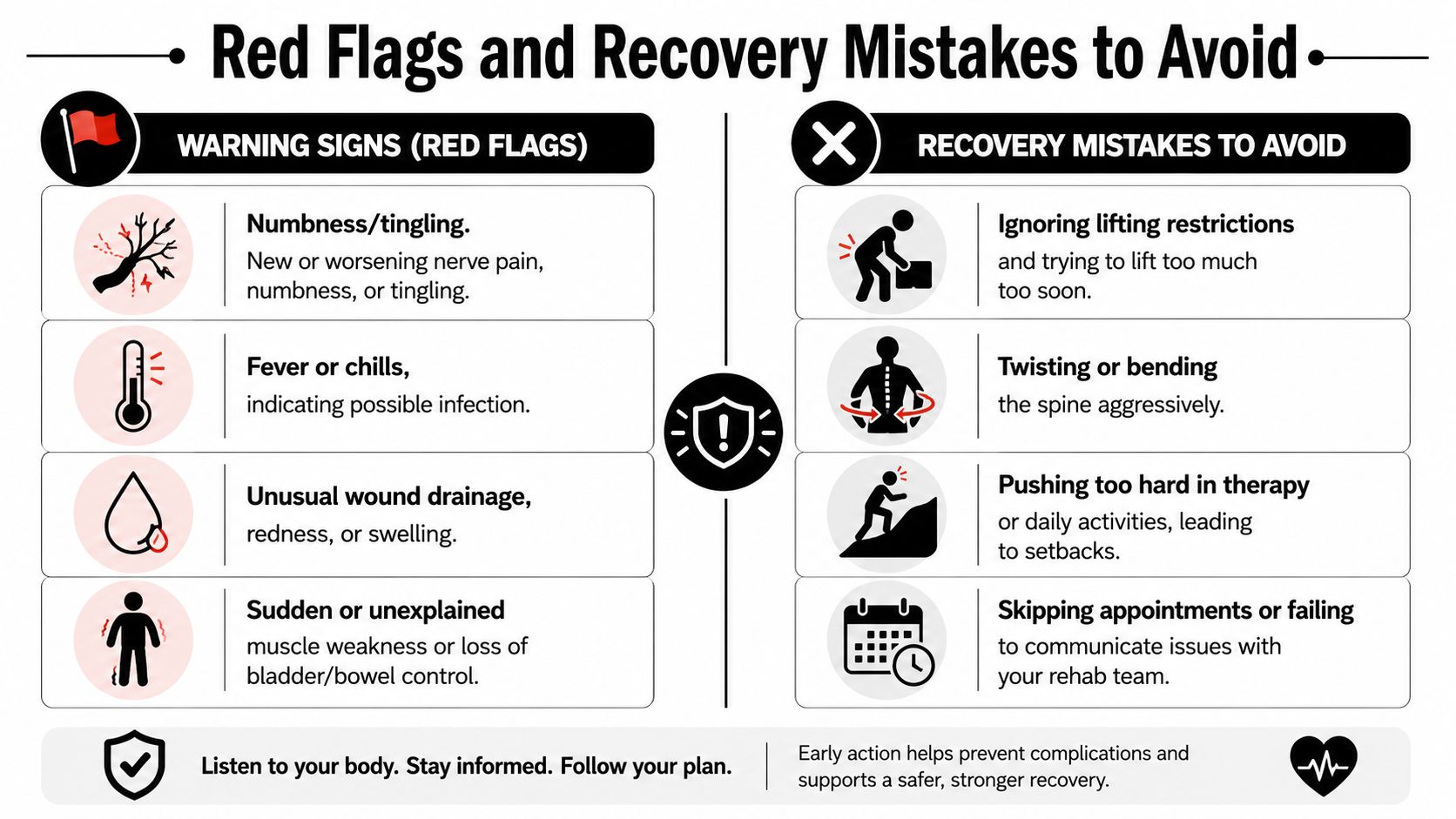
Some pain is part of healing. Some symptoms are not. If you develop new or worsening nerve pain, fever, wound drainage, sudden weakness, or loss of bowel or bladder control, that needs prompt medical attention, not a wait-and-see approach. A plain warning sign is worth taking seriously even when you're hoping it'll settle overnight.
What slows people down
A lot of setbacks come from avoidable choices. The most common ones are doing too much too soon, skipping prescribed exercises, and comparing your progress with someone who had a different surgery. That last one causes more anxiety than most patients admit, especially when a fusion timeline gets compared with a decompression timeline.
There's also a quieter mistake, treating discomfort as failure. Persistent pain doesn't automatically mean the surgery “didn't work.” It can mean the rehab plan needs to change, which is one reason failed back surgery syndrome is often managed with physical therapy and a different movement strategy rather than with panic or avoidance. A major academic center's approach, reflected in the evidence base, keeps rehab individualized rather than one-size-fits-all (Cochrane lumbar surgery references).
Practical rule: if your symptoms are steadily getting louder instead of gradually settling, don't push through and hope for the best.
How to respond early
Don't wait until a flare becomes a full setback. If the wound looks wrong, symptoms spread, or weakness changes suddenly, call your surgical team. If the issue is more about soreness, stiffness, or fear of moving, bring it to rehab early so the program can be adjusted.
The best recovery plans are honest ones. They protect healing tissue, but they also keep you moving enough to rebuild confidence, which is the part many people underestimate.
Overcoming Barriers to Consistent Rehabilitation
A patient can know the plan and still miss rehab because daily life gets in the way. Transportation, cost, work hours, family responsibilities, and provider access all disrupt follow-through, especially for people in rural areas or patients from racially or ethnically minoritized groups. A recent systematic review of telehealth-delivered physical therapist interventions found that gaps between recommended rehab and actual care are still common in those groups, and a 2024 qualitative study on postsurgical rehab barriers pointed to structural obstacles more than exercise choice as the main reason people miss care (telehealth and rehab access review).
What helps when real life gets in the way
Hybrid care gives the therapist a practical way to split the work. In-person visits can focus on hands-on treatment, gait checks, scar and movement assessment, and correcting form, while remote check-ins can track home exercise progress and symptom changes. That approach fits patients who have trouble traveling or who only need a few targeted visits after the first post-op phase.
Some recoveries also stall because the patient keeps replaying every ache and twinge. That is where how to stop overthinking can support the rehab process, because recovery anxiety can make normal healing feel more alarming than it is. Education helps, but it works best when it sits alongside clear supervision and a plan that tells the patient what is expected at each stage.
A clinic setting can also reduce friction. MedAmerica Rehab Center in Deerfield Beach offers post-surgical physical therapy, chiropractic care, acupuncture, and shockwave therapy in one setting, which can simplify follow-up for patients who need more than exercise alone. Same-day appointments, insurance-friendly processes, and a coordinated team can make it easier to stay on track when time, travel, and scheduling are already tight.
The same principle applies when a patient is trying to return to normal activity too early or waiting too long out of fear. A good rehab plan should match tissue healing, symptom response, and daily demands, then adjust as tolerance changes. If you are unsure whether a setback is a normal flare or a problem that needs attention, ask the therapist to review the load, movement pattern, and recovery pace before guessing on your own.
If you are recovering from spine surgery and want a plan that matches your healing stage, your job demands, and your surgeon's precautions, schedule a visit with MedAmerica Rehab Center. Their team can help you move from protected recovery to stronger, safer function with a practical program that fits real life.
MedAmerica Rehab · Deerfield Beach
Talk to a clinician about your pain
Physical therapy, chiropractic, acupuncture and shockwave therapy under one roof, since 1995. Same-day appointments are available.
Mon–Thu 8:00 AM – 6:30 PM · Fri 8:00 AM – 3:00 PM