
Fall Prevention Program: A Complete Guide for Safer Mobility
Falls are not a niche problem. The World Health Organization estimates 684,000 fatal falls each year, and more than 80% of those deaths happen in low- and middle-income countries, while another 37.3 million falls are severe enough to need medical attention annually (WHO falls fact sheet). In the U.S., the CDC reports about 3 million emergency department visits and about 1 million hospitalizations each year among older adults because of falls, and the National Safety Council reported 41,400 deaths among people age 65+ in 2023 from preventable falls (WHO falls fact sheet).
That scale is why a real fall prevention program is a clinical pathway, not a handout or a few balance drills. A strong program starts with screening, then identifies the drivers of risk, then matches treatment to the deficit, and finally tracks whether the plan is changing fall rates. If a clinic skips any of those steps, it's usually offering advice, not prevention.
What a Fall Prevention Program Is
A fall prevention program is a structured clinical service that connects assessment to action. The goal is to identify why a person is falling, which parts of that risk can be changed, and how to tell whether the plan is working. That is different from a generic class that only teaches exercises or a checklist that only names hazards.
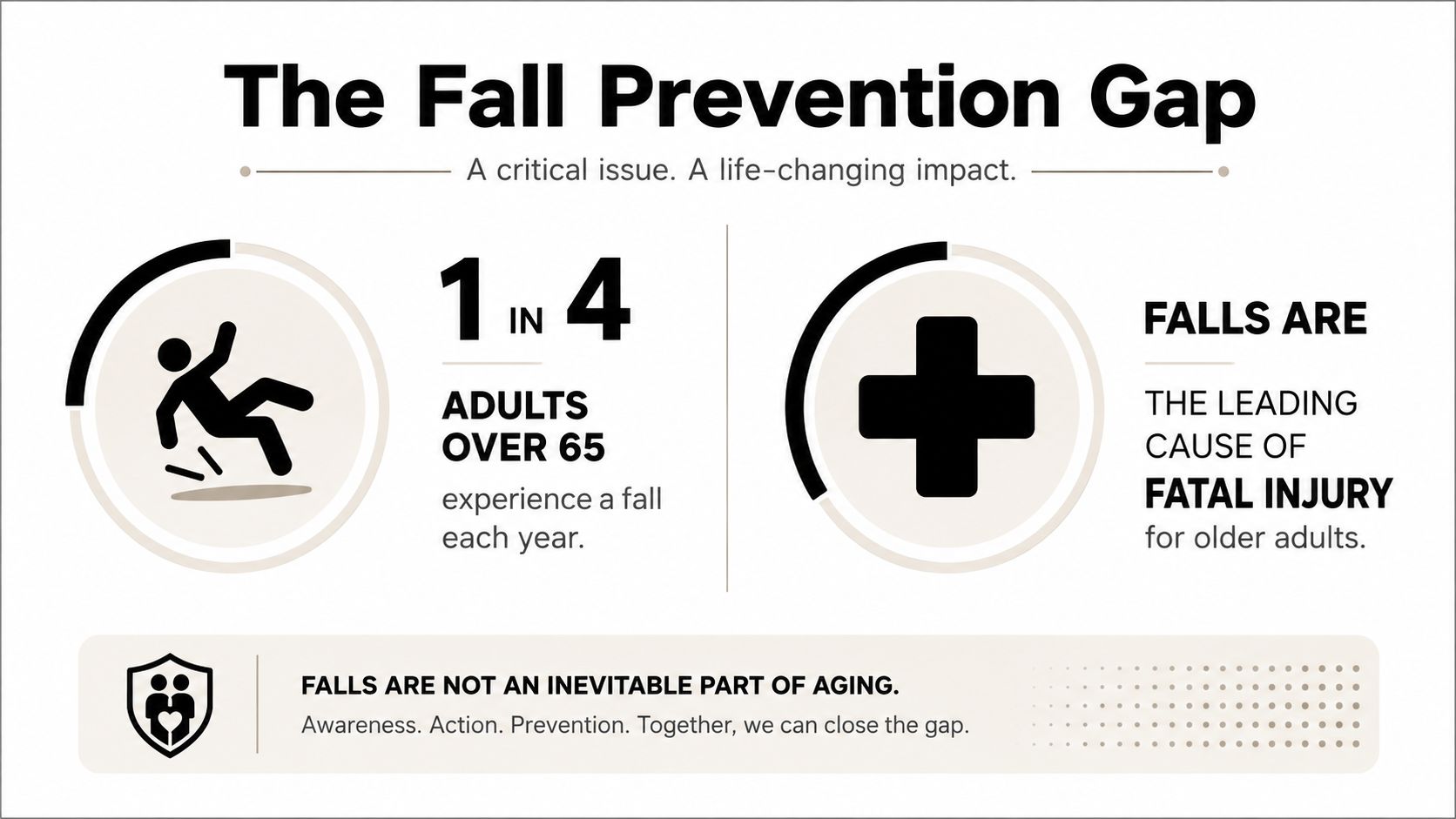
A patient should remember one sentence, a fall prevention program finds the cause of falling risk and treats that cause directly. In practice, that means screening, a focused risk-factor assessment, targeted interventions, and outcome tracking. The work is clinical because falls are often multi-causal, and the plan has to account for that complexity.
Why the label matters
A program earns the name only when it goes beyond general advice. It should assess gait and balance, vision, medications, footwear, home hazards, and comorbidities, because missing any of those pieces leaves gaps in the plan. CDC STEADI recommends annual fall-risk screening with a brief questionnaire, then a deeper review of the modifiable drivers, including gait and balance, vision, medications, home hazards, footwear, and comorbidities (CDC STEADI guidance).
That is the practical distinction I look for in clinic. A true program does not hand every patient the same advice. It identifies whether the main issue is neuromuscular, sensory, medication-related, or environmental, then matches the intervention to that finding.
Practical rule: if the plan does not change after the assessment, the assessment was not clinically useful.
For readers in Deerfield Beach, that matters because active older adults often keep pushing through instability until a fall forces the issue. A formal program catches those problems earlier and gives the care team a way to measure whether function is improving instead of guessing.
The Risk Factors That Drive Falls
A fall prevention program starts by sorting out the risks that drive falls. Muscle weakness, balance deficits, prior falls, vision loss, medication effects, unsafe footwear, home hazards, osteoporosis, and cognitive changes often overlap, and that overlap is exactly why single-tip prevention fails. A person may think the issue is “just clumsiness,” when the problem is a mix of gait change, dizziness, and poor lighting.
Modifiable risks first
The most useful part of a fall prevention workup is identifying what can be changed. Strength deficits can be trained. Balance deficits can be retrained. Medication timing can be reviewed. Home hazards can be removed. Vision can be checked. Those are the areas where a program can move the needle.
The next step is a targeted review of gait and balance, vision, medications, footwear, home hazards, and comorbidities. A clinic should tie the referral path to the problem it finds, since a patient whose main issue is medication-related needs a different plan than someone whose risk comes from poor postural control. For a closer look at how that review is organized, see this fall risk assessment for older adults.
Non-modifiable risks still matter
Age, prior fractures, and a history of falling can't be erased, yet they still shape the plan. They tell the clinician how aggressive the intervention needs to be and which compensations matter most. A person with repeated falls and osteoporosis needs a more careful plan than someone with a single trip on a loose rug.
The critical mistake is assuming a high-risk label solves the problem. It doesn't. The label only tells the team to look harder and intervene sooner.
Some patients don't need more motivation. They need a plan that matches the actual cause of the fall.
That matters in Deerfield Beach, where many people stay active longer and miss subtle changes in gait or endurance. Self-directed prevention usually misses the small but important patterns, like near-falls during turns, unsteadiness after standing, or hesitation on stairs.
How Clinicians Assess Fall Risk
A fall prevention program starts with measurement, not guesswork. The first visit usually feels like a movement exam. Clinicians combine a questionnaire, a gait-and-balance test, and direct functional observation because each one shows a different part of the problem. One tool may point to slow transfers, another to poor turning control, and another to weakness or environmental strain.
The common tests and what they tell you
The Timed Up & Go test is one of the quickest ways to see how smoothly someone stands, walks, turns, and sits back down. The 4-Stage Balance Test checks progressively harder stances to show where balance starts to fail. The 30-Second Chair Stand looks at lower-body strength and how well the legs handle repeated sit-to-stand work. CDC STEADI includes these as validated tools for gait and balance screening, and they fit well into a clinic workflow focused on practical fall prevention.
A clinic may also use the Berg Balance Scale for a broader view of static and dynamic balance. Some teams add instrumented gait analysis when walking mechanics need a closer look. Using more than one tool matters because a patient can hold a still stance well and still struggle with turning or rising from a chair. Another patient may walk fine on level ground but lose stability during transitions.
What happens during the visit
The first visit usually feels like a movement exam. The clinician watches how the patient rises, turns, walks, and responds to simple balance challenges. That observation is often more useful than a long explanation because it shows what happens in real time. The team then decides whether the next step should be physical therapy, vision care, medication review, or a home-safety evaluation.
The goal is to identify the mechanism of risk, not just assign a label.
If you've had a recent fall or you feel unsteady walking, ask which tools were used and what the score means. That is a fair question. It tells you whether the visit produced a usable plan or merely a chart note.
For a closer look at how this kind of review is organized, see this fall risk assessment for elderly guide.
Core Interventions That Reduce Fall Risk
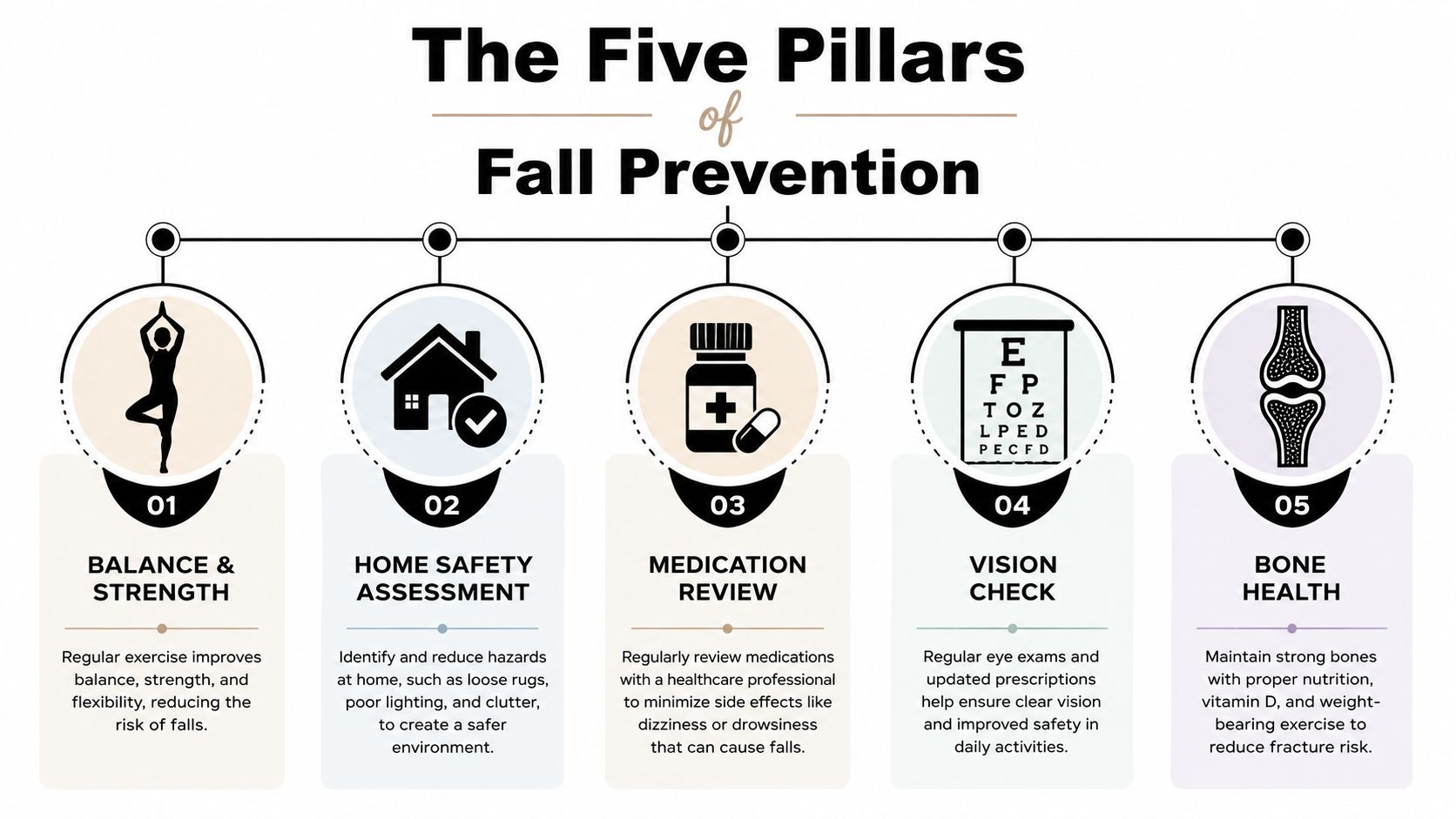
The strongest fall prevention plans do not rely on one fix. They combine balance and strength work, environment changes, medication review, and sensory correction, then match each piece to the patient's actual deficits. That is what turns prevention from a slogan into a treatment plan.
The pillars that matter most
Balance and strength training is usually the foundation. If the legs are weak or the person is unstable on turns, therapy has to address that directly. A patient who cannot rise from a chair repeatedly will not get safer just by being told to be careful. For many patients, the right home program starts with the basics, then builds toward more demanding tasks under supervision, much like the progression described in this fall prevention exercises for seniors resource.
Assistive devices matter when they are fitted and used correctly. A cane that is too short, a walker that is too tall, or a device that does not match the gait pattern can create new risks. Proper fitting and gait training are part of the intervention, an essential part of the intervention.
Home safety changes are often the fastest win. Grab bars, brighter lighting, and removing loose rugs may sound basic, but they remove hazards that patients deal with every day. For people in multi-level homes or older buildings, this part often matters more than they expect.
Medication review should happen with the prescribing clinician or pharmacist when sedatives, sleep medicines, blood pressure agents, or other fall-promoting drugs are involved. The goal is to catch timing problems, dose issues, and interactions that worsen dizziness or slowed reactions.
Vision referral belongs in a fall program whenever glasses are outdated or cataracts are suspected. A balance problem and a visual problem can look the same in daily life, so separating them matters.
A good clinic does not ask, “What exercise should everyone do?” It asks, “What deficit caused this person to fall?”
That is where emerging devices like wearables or bionic balance tools fit. They may have a place as supports, but they do not replace the core clinical work of assessment, training, and home modification. The best programs still lead with the basics because the basics address the biggest modifiable risks.
If you want a home exercise reference that fits into a broader plan, this fall prevention exercises for seniors resource can help patients understand what therapy homework often looks like.
Clinics that also manage spine or lifting-related complaints may refer patients to the ProMed Certifications back injury guide when body mechanics need separate attention.
For patients who like to learn by watching, this video can also help frame the topic in plain language.
What a Program Timeline Looks Like in Practice
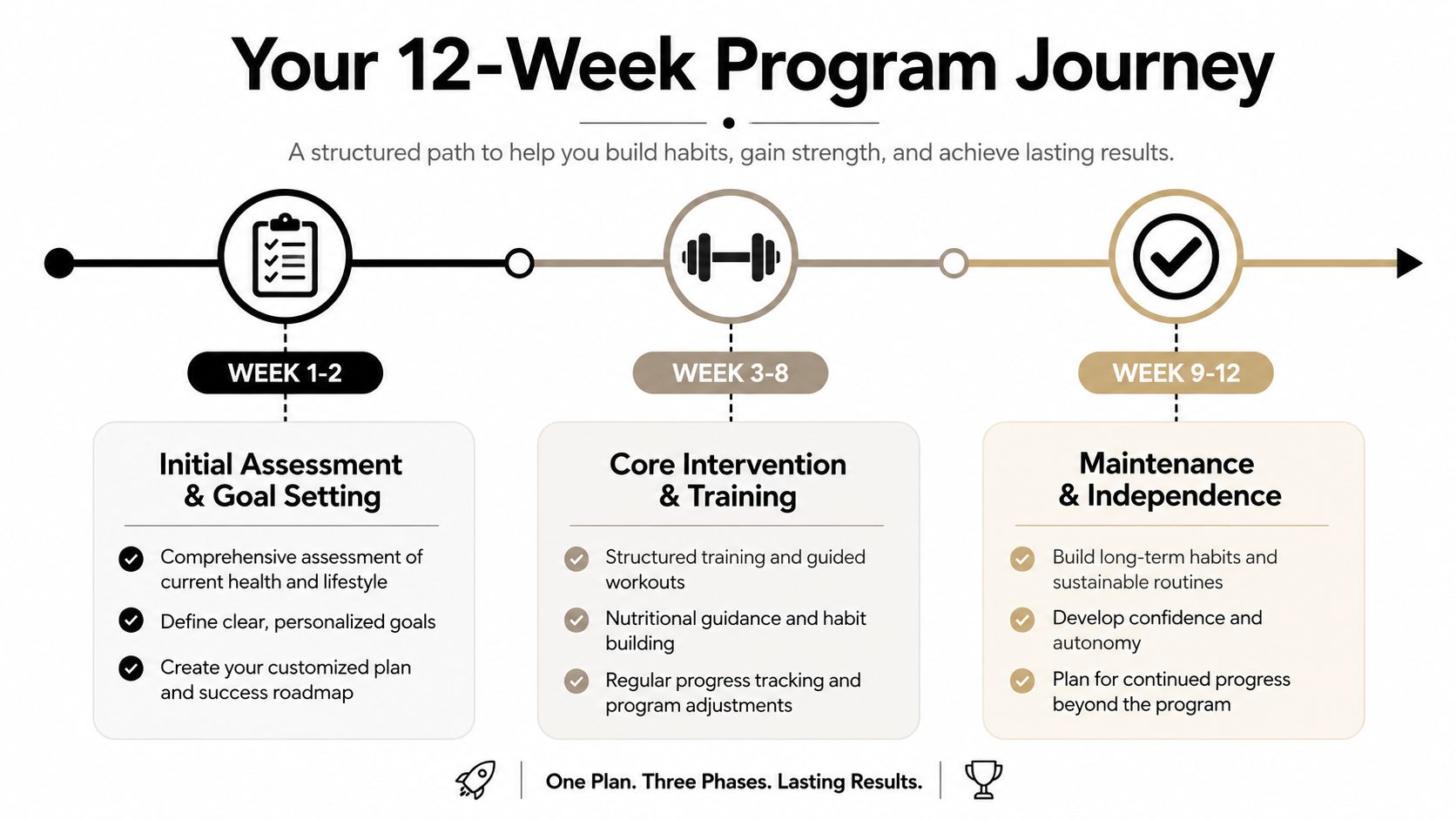
A useful program has a beginning, a middle, and a discharge plan. It shouldn't feel open-ended. Most patients do better when they know what's being measured, how often they'll be seen, and what changes should show up first.
A realistic 12-week flow
The first phase is evaluation and goal setting. The clinician documents baseline function, reviews the fall history, and chooses the tests that best describe the problem. The second phase is active intervention, usually with recurring therapy visits and a home program that gets practiced between sessions. The third phase is maintenance, where the plan shifts toward independence, self-monitoring, and fewer supervised visits.
What counts as progress
Clinics often track fewer near-falls, steadier walking, faster transfer times, and better balance-test performance. Evidence-based programs should also track outcomes in a structured way. Guidance commonly uses a rate-based measure such as fall rate = (number of falls / bed days of care) × 1000, plus baseline and repeated post-implementation data points to confirm trend change (Measuring Success guide).
That matters because a patient may feel “fine” while still falling at home, or a program may look successful just because the caseload changed. Rate-based tracking helps separate real improvement from guesswork.
If you're comparing clinics, ask how they measure outcome change and when they reassess. A program that can't answer that question clearly is usually not tracking enough.
I'd also point readers to ProMed Certifications back injury guide as a useful complement for people whose instability overlaps with pain, posture change, or fear of movement. It's not a substitute for fall care, but it fits the same practical mindset of reducing preventable injury.
The Evidence and What Outcomes to Expect
The evidence base is strong enough to justify this work, but it doesn't guarantee perfect outcomes. Multifactorial and exercise-based programs reduce falls, especially when the patient follows the home plan and when more than one risk factor is addressed at once.
The CMS review of 20 randomized clinical trials found fall prevention programs reduced the risk of experiencing a fall by 11% and the monthly rate of falling by 23%. The USPSTF found multifactorial interventions reduced the number of falls in 20 RCTs (n=22,115) with an incidence rate ratio of 0.84, and exercise interventions reduced falls in 29 RCTs (n=14,475) with an incidence rate ratio of 0.85 (CMS evidence review).
What that means clinically
Those numbers support a very practical takeaway. Patients usually do best when therapy is paired with at least one other intervention, such as medication review, home changes, or vision care. Exercise helps, but isolated exercise is less complete when the cause of falls includes more than strength or balance.
Some selected interventions in the CDC STEADI compendium reported 46% fewer falls, 34% fewer fall injuries, and a 65% lower fall rate, and a patient-centered hospital toolkit study of 37,231 patients found a 15% reduction in overall falls and a 34% reduction in injurious falls after implementation. For clinics planning a real-world program, those findings point in the same direction: assess the full risk profile, dose the intervention to the deficit, and keep tracking whether the patient is falling less.
| Program Type | Trials / Sample | Reported Outcome |
|---|---|---|
| CMS review of fall prevention programs | 20 randomized clinical trials | 11% lower risk of experiencing a fall, 23% lower monthly falling rate |
| USPSTF multifactorial interventions | 20 RCTs, n=22,115 | Incidence rate ratio 0.84 |
| USPSTF exercise interventions | 29 RCTs, n=14,475 | Incidence rate ratio 0.85 |
| Selected CDC STEADI interventions | Compendium summary | 46% fewer falls, 34% fewer fall injuries, 65% lower fall rate |
| Patient-centered hospital toolkit | 37,231 patients | 15% reduction in overall falls, 34% reduction in injurious falls |
A realistic expectation
A good patient should expect better confidence, steadier movement, and fewer risky moments before expecting dramatic long-term change. When the home program is followed and the intervention matches the deficit, outcomes improve. When adherence drops, the benefit fades.
For clinics that want closer follow-up, a practical tool like call center SMS for modern practices can support reminders and visit adherence without making the process feel complicated. It helps clinics keep patients engaged between visits, and that same follow-through matters when a program is trying to reduce preventable injury.
Getting Started in Deerfield Beach
The first step is simple, schedule a multifactorial evaluation instead of asking for a generic balance visit. Bring a medication list, a short history of any falls or near-falls, and comfortable shoes. If you've had prior imaging or surgeries, bring that too, because it helps the clinician decide whether the issue is strength, gait, pain, or something else.
What local clinics usually handle
In a Deerfield Beach setting, fall prevention is often part of routine senior care rather than a specialty add-on. That means you should expect screening, a therapy plan, and home-program instructions that fit your ability level. If insurance coverage is a concern, ask the front desk to verify it before the first visit so there aren't surprises.
For medically underserved patients, trust, cost, and autonomy can shape whether home-modification work gets done, so plain language matters. Programs that use clearer instructions, culturally representative visuals, and group support tend to be easier to accept and follow (Gerontologist study).
If you'd like a local physical therapy starting point, this physical therapy Deerfield Beach seniors page can help you understand the kind of care often used for balance, mobility, and fall risk.
Common Questions and Next Steps
A fall prevention program is safe for individuals, including many who've already fallen, because the whole point is to lower future risk. It also helps people with arthritis or post-surgical weakness when the plan is adjusted to the person's current capacity. Family members can and should attend when memory, hearing, or confidence are part of the barrier.
Results usually start with better awareness and steadier movement before they turn into fewer falls. The strongest predictor of success is still adherence to the home program, because the clinic visit alone can't retrain daily movement habits.
The simplest next steps are these. Schedule an evaluation. Commit to the home plan. Reassess at 12 weeks. If the clinic can't explain its assessment tools, intervention plan, and outcome tracking, keep looking until you find one that can.
MedAmerica Rehab Center helps Deerfield Beach adults with physical therapy, balance and gait training, and structured fall prevention care that starts with assessment and ends with measurable follow-up. If you're worried about instability, recent falls, or getting around safely at home, visit MedAmerica Rehab Center to ask about a multifactorial fall prevention program and set up a first visit.
MedAmerica Rehab · Deerfield Beach
Talk to a clinician about your pain
Physical therapy, chiropractic, acupuncture and shockwave therapy under one roof, since 1995. Same-day appointments are available.
Mon–Thu 8:00 AM – 6:30 PM · Fri 8:00 AM – 3:00 PM