
Best Walker Seat Cushion: Comfort & Pain Relief 2026
A lot of people don't think much about the seat on a walker until they need it. Then the problem becomes obvious. The standard seat feels hard, narrow, and unforgiving, and after even a short rest break, your hips, low back, or surgical area may feel worse instead of better.
That matters more than most product pages admit. If sitting on your rollator feels unstable or painful, you're less likely to take needed breaks, less likely to walk as far, and more likely to rush sitting down or standing up. A good walker seat cushion isn't just about softness. It supports safer rest, better pressure relief, and more confidence during daily movement.
The Overlooked Key to Walker Comfort and Stability
The seat built into many walkers and rollators is practical, but it usually isn't designed around pressure relief or long-term comfort. For seniors, people recovering from surgery, and anyone with arthritis or back pain, that hard surface can turn a helpful mobility aid into something they tolerate rather than trust.
A walker seat cushion changes that in a very direct way. It adds padding and can reduce pressure on sensitive areas, improve sitting tolerance, and create a more secure surface when you shift your weight to sit or stand. That's often the difference between taking a calm, controlled break and feeling like you're perching on a slippery platform.
Why the seat matters more than people expect
The walker seat is often used during exactly the moments when stability matters most. You've walked to the mailbox, made it through a medical appointment, or crossed a parking lot, and now your legs are tired. That's not the time for a seat that slides, tips your pelvis, or concentrates pressure on one spot.
A better cushion helps in three practical ways:
- It improves comfort during rest breaks so you're not avoiding the seat.
- It supports safer weight transfer when you lower down or push back up.
- It can help you stay active longer because rest breaks become useful instead of painful.
Practical rule: If a walker seat feels unstable, too firm, or leaves you sore after a short sit, that's not a minor annoyance. It's a mobility problem.
Families often focus on baskets, trays, and handles first. Those accessories can help, but comfort at the seat level often has a bigger effect on daily use. For a broader look at simple mobility and comfort tools that support independence at home, Cream Home Care's living aids guide is a helpful companion resource.
What works and what usually doesn't
A thin pad that bunches up or slides around usually doesn't solve much. It may feel softer at first touch, but if it shifts during transfers or compresses too quickly, it creates a new safety issue.
What tends to work better is a cushion that fits the walker seat closely, stays in place, and supports the person's actual needs. That might mean pressure relief for fragile skin, a firmer surface for easier standing, or better contouring for a painful hip or low back.
Who Benefits Most from an Upgraded Walker Cushion
The people who benefit most usually aren't looking for luxury. They're trying to make everyday movement less punishing.
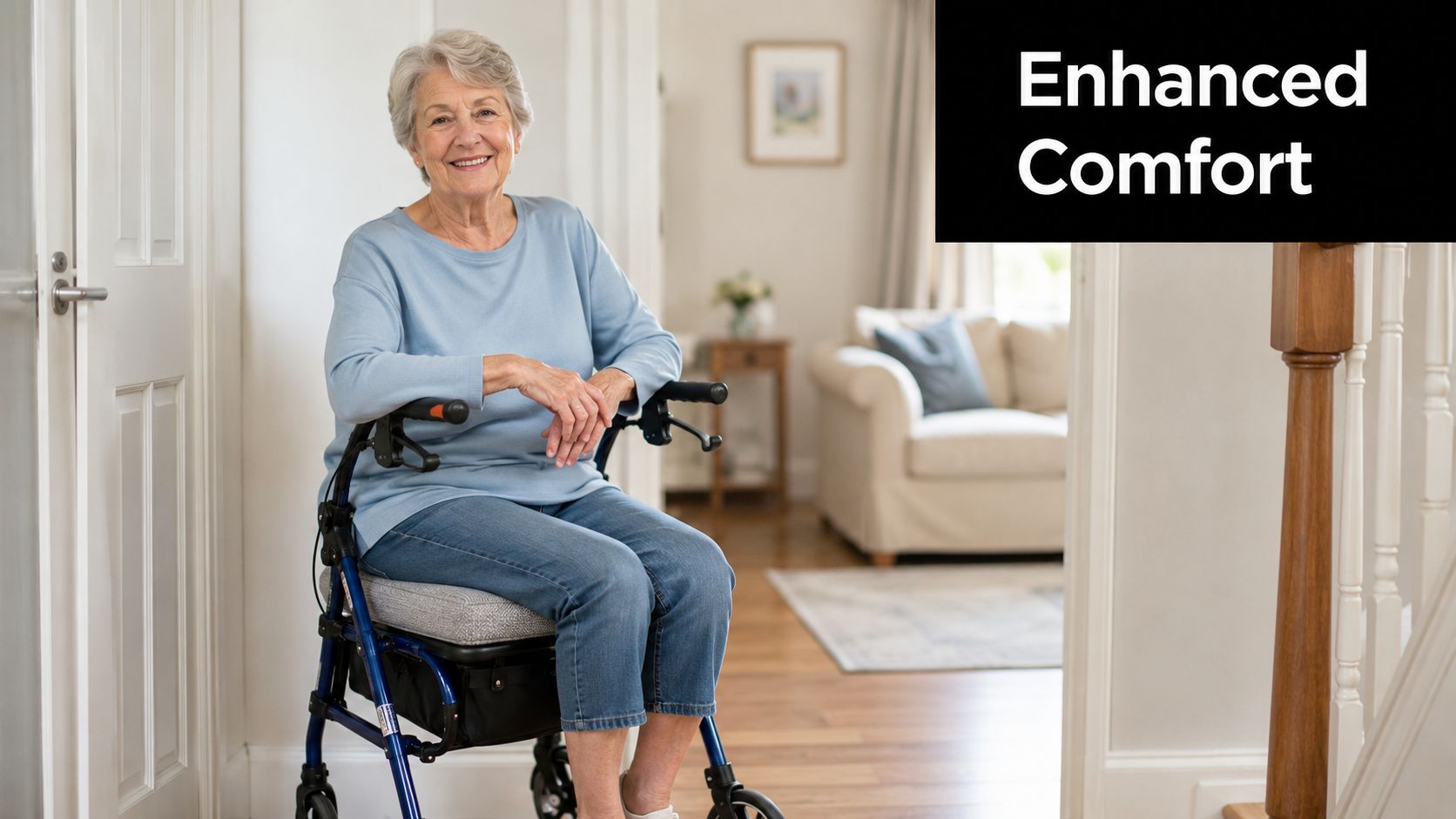
Seniors who need safer rest breaks
Many older adults do well walking short distances, but they fatigue quickly and need dependable places to pause. A hard seat can make them sit down abruptly or avoid the seat entirely. Neither pattern is ideal.
An upgraded cushion gives the seat a more usable surface. That matters for comfort, but also for confidence. If you're helping an older adult who also struggles with unsteadiness, this guide on how to improve balance in elderly adults explains why small mobility changes can have a big effect on daily safety.
For families navigating age-related mobility concerns more broadly, Specialized care for older adults offers a useful overview of what clinicians watch for in real life, including endurance, transfers, and fall risk.
Post-operative patients who can't afford a bad sitting surface
After joint replacement, spine procedures, abdominal surgery, or lower-extremity surgery, the seat on a walker becomes more than a convenience. It becomes part of recovery. Patients often need short, frequent rest breaks, but the sitting surface has to feel stable and predictable.
A cushion can help by reducing direct pressure and making those breaks more tolerable. It can also reduce the urge to twist, lean, or half-sit, which are common habits when the surface feels too hard or too narrow. Those compensation patterns are where people get into trouble.
People with chronic neck and back strain
Not every walker user has surgery in the background. Many are dealing with chronic low back pain, arthritis, sciatica, or generalized deconditioning. In those cases, prolonged static sitting can feed discomfort.
One reason dynamic support matters is that posture isn't supposed to stay frozen. A peer-reviewed study found that using a dynamic seat cushion for a 6-month period significantly reduced the risk of developing neck pain by 81% and lower-back pain by 84% among high-risk individuals, with the benefit linked to postural shifts and improved trunk muscle performance, as reported in PubMed Central.
A cushion is most helpful when it matches the reason the seat hurts. Pressure relief, stability, and support aren't the same thing.
Users with skin sensitivity or pressure concerns
This group often gets overlooked. If someone has fragile skin, reduced sensation, or spends a lot of time seated during outings, a better cushion may help distribute pressure more evenly and reduce irritation from a hard seat surface.
These users need more than “soft.” They need a cushion that keeps its support under load, doesn't trap moisture excessively, and doesn't create sharp pressure points at the edges.
How to Choose the Right Cushion Material and Features
Most online guides stop at a simple list of foam, gel, and air. That isn't enough. Material matters, but the better question is how the cushion behaves when your full weight is on it.
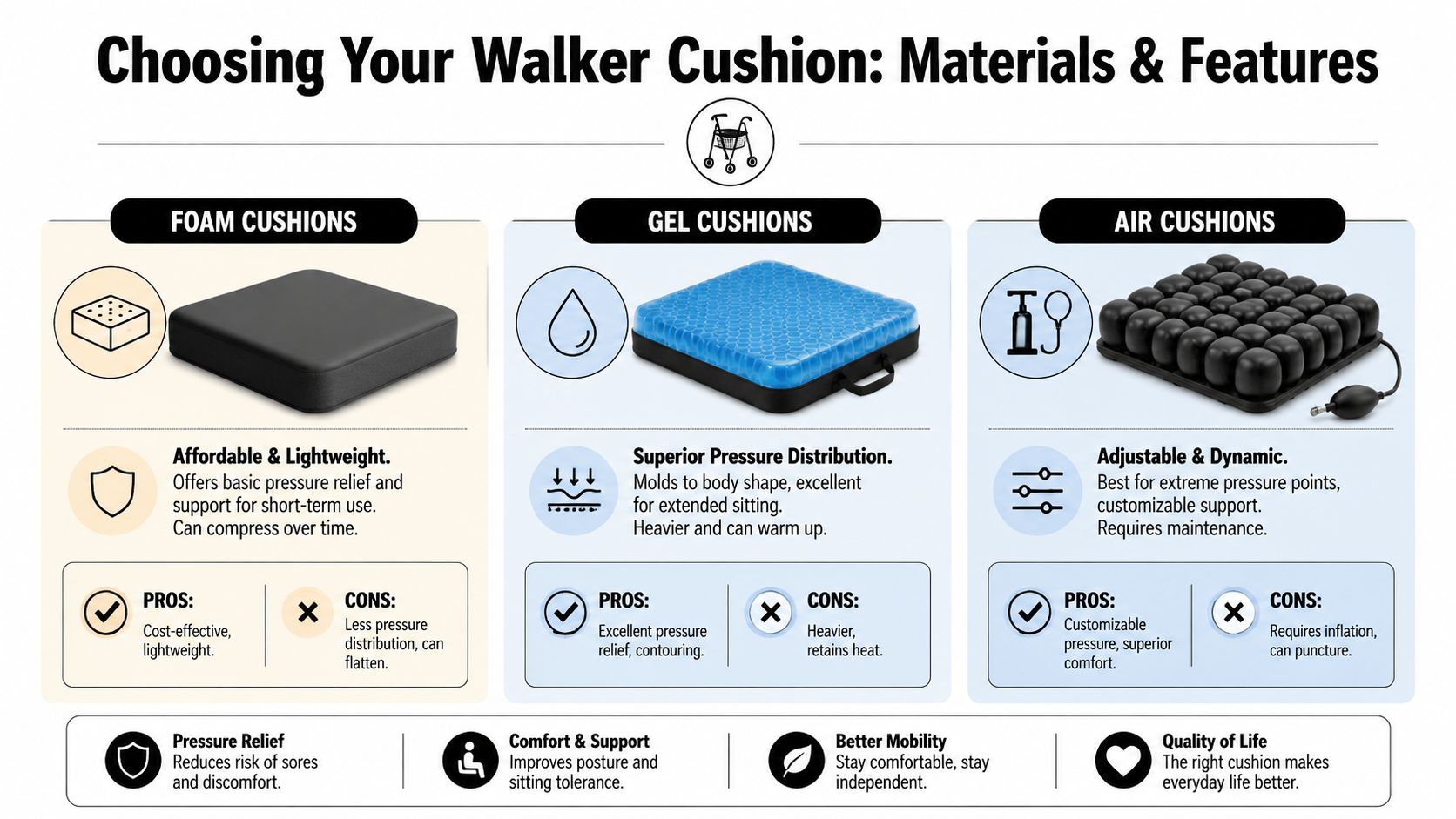
Walker Cushion Material Comparison
| Material | Best For | Considerations |
|---|---|---|
| Foam | Everyday comfort, lighter weight, simpler setup | Can compress over time and may provide less contouring |
| Gel | Users who need better contouring and pressure distribution | Heavier, can feel warmer, and may be less convenient to move |
| Air | People with more pronounced pressure concerns or who need adjustability | Requires maintenance and correct inflation |
What each material does well
Foam is usually the easiest starting point. It's lighter, simpler, and often easier for seniors to manage. In pressure redistribution research, a 5 cm foam cushion without an anterior wedge was identified as the most effective method for minimizing sitting surface pressure, and shape-enveloping cushions showed lower pressures and higher satisfaction than less enveloping designs, according to PubMed Central.
Gel cushions tend to contour better than basic foam. They can feel more forgiving for users who notice sharp pressure at the seat bones. The trade-off is weight and heat. Some people love the feel. Others stop using them because the cushion feels bulky or warm.
Air cushions can work well for highly sensitive pressure needs because they allow more adjustability. The downside is upkeep. If inflation isn't right, the cushion won't perform the way you expect.
The bottoming-out test most shoppers never get taught
This is the part most consumer guides miss. A cushion can look thick and still fail under body weight.
Clinical guidance around orthopedic seat cushions notes that immersion below 1 inch of material indicates cushion failure and increased pressure injury risk, and it specifically highlights the gap in consumer education around the bottoming-out check in this pressure injury prevention guide.
Here's the practical version many clinicians teach:
- Sit on the cushion the way you normally would. Don't test it unloaded on a table.
- Use the elbow simulation method. With your hand under or near the loaded area, use your elbow or hand pressure to mimic the prominence of a bony point and feel how much protective material remains.
- Check for near-contact with the hard base. If you can tell the cushion has almost no support left under load, it's not doing its job.
- Retest after a few minutes. Some materials feel fine at first and then compress further.
Clinical takeaway: A cushion that bottoms out isn't a comfort issue alone. It becomes a pressure and skin protection issue.
Features worth paying for
Material isn't the whole decision. Shape and design features matter just as much.
For users who need ischial tuberosity relief at the seat bones, clinical guidance describes an adult relief well dimension of 200 mm x 200 mm with a 35 mm well height, structured to help the seat bones rest just within the well instead of on a hard rim, as outlined in Physio-Pedia's cushion guidance.
Useful features to look for include:
- Contoured or enveloping shape that supports the body instead of forcing pressure onto one point
- Stable edges that don't fold when you transfer
- A cover that stays smooth without wrinkling under the thighs
- Enough firmness for standing up if weakness makes rising difficult
If you're comparing options with a pressure-relief lens, best seat cushions for pressure injury gives a helpful overview of what to prioritize beyond simple softness.
Ensuring a Secure Fit Proper Sizing and Attachment
A good cushion becomes a hazard if it doesn't fit the seat properly. Many people often make a well-meaning mistake: they buy a “universal” cushion, set it on the walker, and assume that's enough.
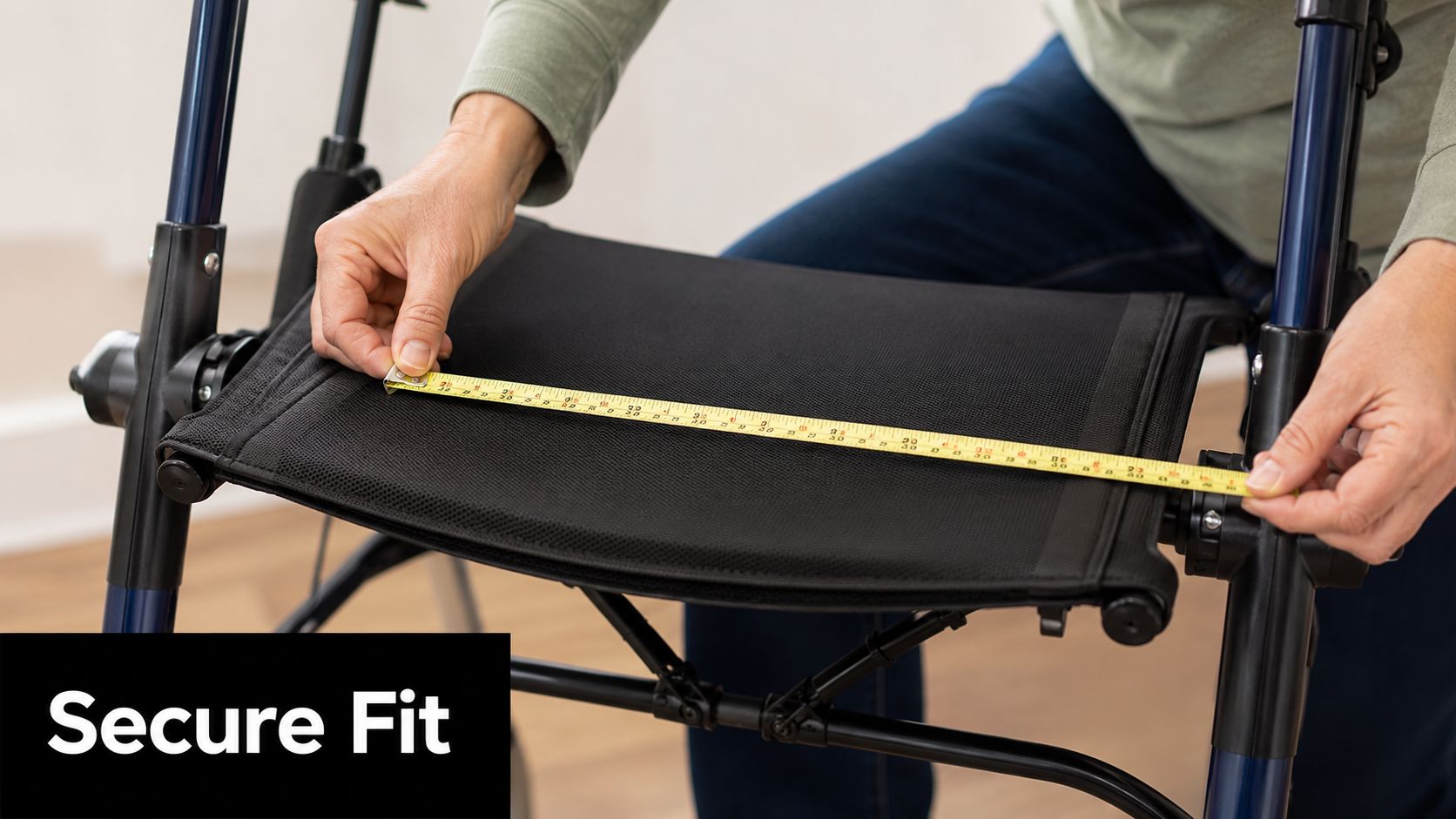
Measure the seat before you buy
Take a tape measure to the actual walker seat, not just the product listing. You want the cushion to sit fully on the seat without overhang and without leaving unstable gaps.
Check these areas:
- Seat width so the cushion doesn't spill over the sides
- Seat depth so the back edge and front edge both stay supported
- Folding clearance if the walker folds with the seat in place
- Attachment points for straps, hook-and-loop fasteners, or non-slip pads
If you want examples of seat styles and attachment setups, this page on seat options for a walker helps show what different rollator seat designs look like in practice.
Attachment matters during weight transfer
This is the most important safety point. People don't sit straight down with perfect symmetry every time. They shift, reach, and lean. That's exactly when a loose cushion can slide.
High-performance walker seat cushions should use waterproof, non-slip materials to prevent the 15–20 mm lateral shift that can occur during weight transfer, which raises fall risk for users with balance deficits, according to Evolution Walker's product guidance.
What to look for:
- Non-slip bottom surfaces that grip the seat
- Secure straps or attachment tabs that keep the cushion centered
- Water-resistant or waterproof covers that are easier to keep clean
- Minimal bunching once attached and sat on
A quick demonstration can help you see what secure setup and transfer mechanics should look like in daily use.
A simple home safety check
After attaching the cushion, test it before regular use:
- Sit down slowly and then stand back up.
- Shift your weight side to side.
- Check whether the cushion migrates, lifts, or wrinkles.
- Try the walker on the same flooring where it's usually used.
If the cushion moves during this test, fix the attachment or choose a better-fitting model. Don't assume it will “settle in” with use.
Cleaning Your Cushion and Knowing When to Replace It
A walker seat cushion is a medical support item in practical terms, even if it's sold like an accessory. It needs routine cleaning and honest inspection. That's especially important for seniors with delicate skin, post-op patients, and anyone using the seat frequently during appointments or outings.
Cleaning without damaging the cushion
Always follow the cover instructions first, but a few general habits help:
- Wipe waterproof covers regularly so moisture, sweat, and residue don't build up
- Use mild soap and water instead of harsh cleaners that can stiffen or crack the surface
- Let the cushion dry fully before putting it back on the walker
- Check the underside and straps because debris there can reduce grip
Foam inserts usually shouldn't be soaked unless the manufacturer specifically allows it. Gel and air styles also need gentle handling, especially around seams and valves.
Keep the sitting surface clean enough that you'd be comfortable using it in lightweight clothing. That standard is usually more realistic than waiting until it looks dirty.
Signs the cushion is no longer doing its job
Replace the cushion if you notice any of the following:
- Visible flattening that doesn't rebound after use
- Cracks, tears, or split seams in the cover
- Lumps or uneven support that create pressure points
- Sliding that wasn't happening before
- A clear drop in comfort or sitting tolerance
If you can feel the hard base through the cushion during your bottoming-out check, that's the clearest sign to stop using it. At that point, the cushion may still look acceptable from the outside, but functionally it's worn out.
When a Cushion Is Not Enough Next Steps at MedAmerica
Sometimes the seat is only part of the problem. If pain continues even after you've improved the cushion, or if you're still nervous every time you sit down or stand up, the issue may be bigger than the accessory.
Signs you need more than a cushion
Watch for these red flags:
- Persistent pain during short sitting periods
- Increasing fear of falling when using the walker seat
- Difficulty standing up even from a properly cushioned surface
- Noticeable leaning, twisting, or one-sided weight shift
- Balance loss during turns or transfers
A cushion can improve comfort and reduce some pressure-related problems. It can't correct gait mechanics, restore leg strength, or address a poorly fitted walker. Those issues need hands-on evaluation.
The Medicare question many families ask
Coverage is another area that causes confusion. Many people assume that if Medicare covers the walker, it automatically covers the cushion attached to it. That isn't always how it works.
A significant patient concern is whether Medicare covers walker cushions. While the walker itself is often covered, therapeutic-grade cushions may be excluded, creating financial ambiguity, as explained in this Medicare rollator coverage guide.
That doesn't mean you should guess. It means you should ask specific questions about how the item is coded, whether it's treated as part of the walker, and whether separate documentation is needed.
Why an in-person mobility review can save frustration
When someone's struggling with walking endurance, transfer safety, or confidence on a rollator, the most useful next step is often skilled assessment. That may include seat height review, walker fit, standing mechanics, pressure concerns, and training on how to move more safely with the device.
If walking itself has become uncertain, gait training in physical therapy can help explain how therapists address the mechanics behind instability rather than only the equipment.
The right cushion can make a good walker better. It can't make a poorly fitted device or an unsafe movement pattern suddenly safe.
If you're dealing with pain, unsteady walking, post-surgical recovery, or concerns about safe walker use, MedAmerica Rehab Center can help you sort out what's equipment-related and what needs treatment. Their team works with seniors, post-op patients, and adults with balance or mobility limitations to improve gait, reduce fall risk, and make daily movement feel safer and more manageable.
MedAmerica Rehab · Deerfield Beach
Talk to a clinician about your pain
Physical therapy, chiropractic, acupuncture and shockwave therapy under one roof, since 1995. Same-day appointments are available.
Mon–Thu 8:00 AM – 6:30 PM · Fri 8:00 AM – 3:00 PM