

What to Do After a Minor Car Accident: A 2026 Guide
The impact was small. The bumper looks scuffed. Everyone is standing. You're shaken, but you're also tempted to tell yourself it was nothing and get on with the day.
That's how people fall into trouble after a minor crash.
As a physical therapist, I've seen the same pattern many times. A person feels mostly fine at the scene, goes home, wakes up the next day with a stiff neck or low back pain, then waits a little longer because it still “doesn't seem serious.” By the time they seek care, the pain is worse, daily movement is harder, and the insurance company starts asking why there was a gap before treatment.
The most important thing to understand about what to do after a minor car accident is this: the first problem isn't always visible damage. Often it's the Delayed Pain Trap, the stretch of time when adrenaline masks symptoms and soft-tissue injuries begin to show themselves.
Your Calm Checklist for a Minor Car Accident
Right after a minor collision, individuals often run through the same mental loop. Is everyone okay? Do I need to call someone? Should I move the car? Am I overreacting if I get checked out?
A calm checklist helps because stress narrows attention. Instead of making decisions in a fog, you follow a sequence that protects your body, your documentation, and your claim.
In 2024, approximately 6.18 million car accidents occurred in the United States, with a significant portion classified as minor collisions, and medical guidance still emphasizes professional evaluation within 24 to 72 hours because symptoms such as whiplash or sciatica may not appear right away, as noted in this car accident overview.
What matters most right away
Your priorities are simple:
- Get safe first: Move out of active traffic if the vehicle can be moved safely.
- Check bodies before bumpers: Look for pain, dizziness, confusion, or stiffness in yourself and passengers.
- Create a record: Take photos, exchange information, and make sure the basic facts are documented.
- Report carefully: Speak in facts, not guesses.
- Get evaluated even if you feel okay: That's the step people skip most often.
Practical rule: If the crash was strong enough to jolt your body, it was strong enough to justify medical screening.
For a legal perspective on the early decisions people often second-guess, CAINE LAW's accident steps guide is a useful companion resource.
If your soreness, neck stiffness, or back pain starts later, care related to auto accident injuries is often more effective when it starts early instead of after symptoms have settled in.
What to Do in the First 15 Minutes
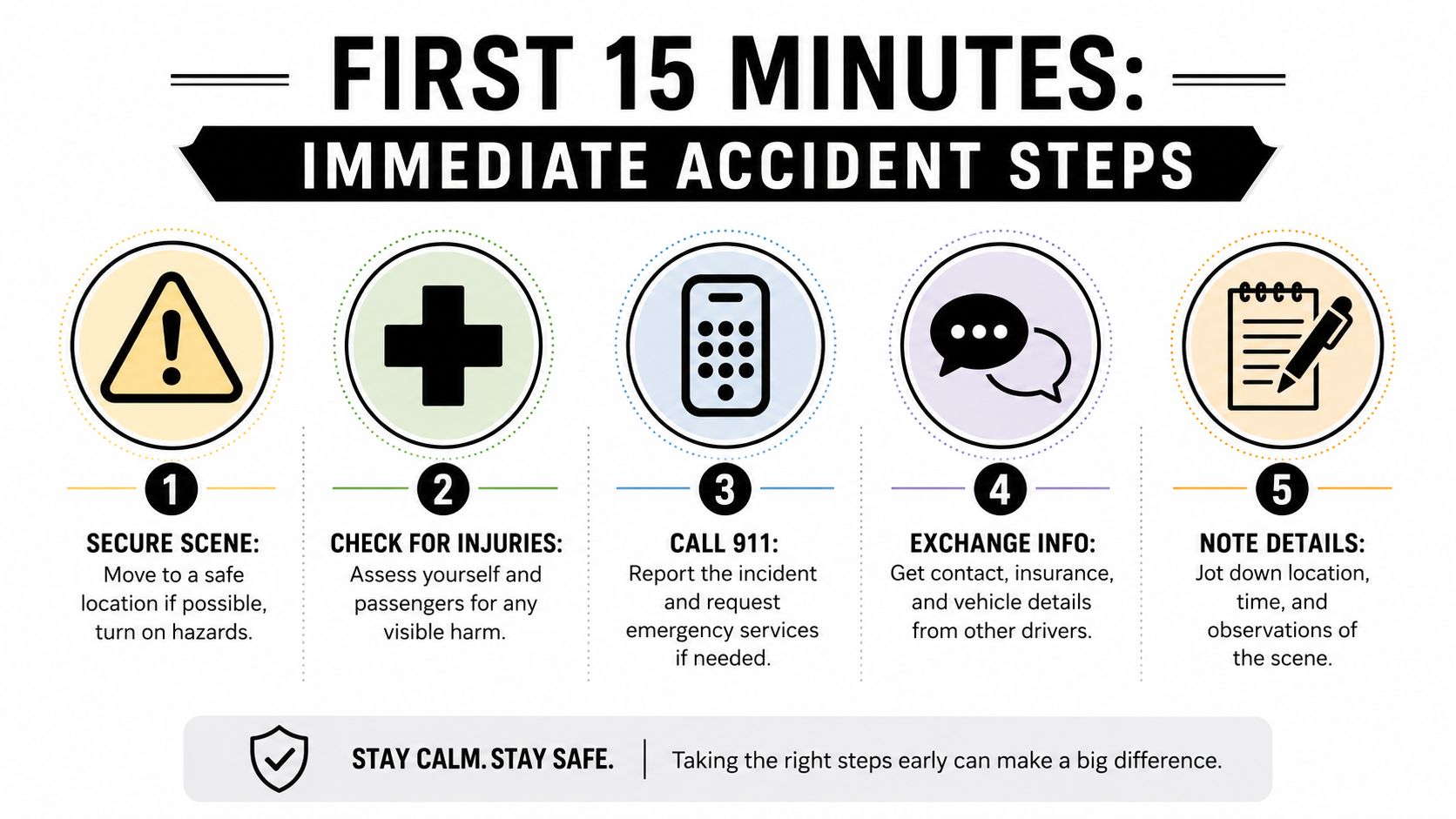
The first 15 minutes are about safety and clean decision-making. Don't rush to explain the crash. Don't argue. Don't apologize out of politeness if you don't yet know what happened.
Secure the scene
If the cars are drivable and you can move safely, get to the shoulder or a nearby parking area. Turn on hazard lights. If the vehicles can't be moved, stay alert to traffic and avoid standing where another car could strike you.
Leaving the scene entirely is a different issue. Stay present and handle the exchange properly.
Check for injury before you talk details
Do a quick body scan. Notice neck tension, headache, dizziness, tingling, low back tightness, jaw pain, or pain across the chest from the seat belt. Ask passengers how they feel, but remember that “I'm okay” in the first minutes isn't final.
If anyone appears injured, disoriented, or unstable, call 911.
If you feel shaky, sit down before you start making calls or taking photos. A rushed, upright posture often makes neck and back symptoms harder to notice.
What to say and what not to say
Keep your words factual:
- Say where you are: Give the street, nearest intersection, or landmark.
- Say how many vehicles are involved: Keep it simple and direct.
- Say whether anyone needs medical help: If you're unsure, say you want responders to assess the scene.
Avoid statements like these:
- “I'm sorry, this was my fault.” You may only be trying to be polite.
- “I'm not hurt.” You don't know that yet.
- “It's just a scratch.” Visible damage doesn't tell the whole story.
Capture the scene, not just the cars
One of the biggest mistakes after a minor collision is incomplete documentation. A key problem is failing to record skid marks, traffic signs, and weather conditions along with vehicle damage. Those environmental details matter for fault analysis, and omitting them can reduce claim success rates by 30% when accident reconstruction is required, according to this step-by-step accident documentation guide.
Write down the time, direction of travel, lane position, and anything unusual you noticed. Fresh notes beat memory every time.
Document Everything Before You Leave
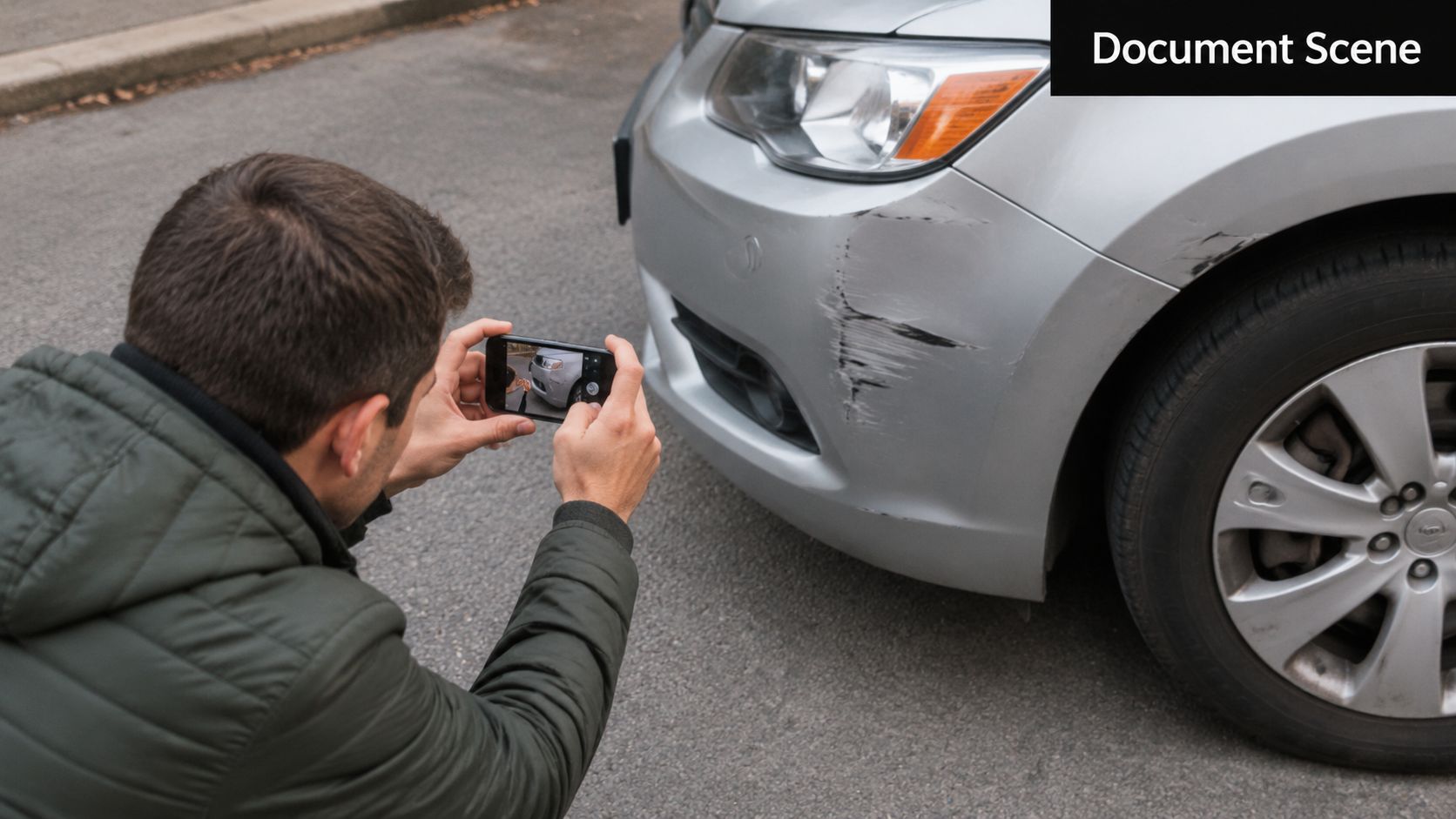
Once everyone is safe, your phone becomes one of your most important tools. The goal isn't to take a few quick bumper photos. The goal is to leave with a complete record that makes the scene understandable to someone who wasn't there.
What to photograph
Start wide, then move closer.
- Wide scene shots: Capture the full roadway, vehicle positions, lane markings, nearby intersections, and traffic controls.
- Medium shots: Show each car from multiple angles so the damage has context.
- Close-ups: Photograph dents, scratches, broken lights, cracked trim, license plates, and any debris.
- Environmental details: Include road surface, weather, visibility, signage, and anything relevant around the scene.
- Personal evidence: If you have redness, bruising, or marks from the seat belt later that day, photograph those too.
A useful pattern is to take more photos than you think you need, then sort them later. You won't get a second chance at the original scene.
What to exchange
You need clean, accurate information from the other driver. Don't rely on memory.
Collect:
- Full name and phone number
- Driver's license number
- Insurance company and policy details
- License plate number
- Vehicle make, model, and color
If there are passengers or witnesses willing to help, ask for their names and contact information. Independent witnesses can make a disputed story much easier to resolve.
Write down what the other driver says, but don't debate it. Your job is to preserve information, not settle fault on the roadside.
What people often miss
Many drivers forget the basics once the tension drops. They get the insurance card photo, then leave without recording the intersection name, the exact time, or the direction each vehicle was traveling.
Before you go, pause and review:
| Item | Why it matters |
|---|---|
| Photos of both vehicles | Shows relative damage and impact points |
| Street signs and signals | Helps establish location and traffic control |
| Witness contacts | Supports your account if stories change |
| Your written notes | Preserves details before memory fades |
If you can't answer “What happened, where, and under what conditions?” from your notes alone, gather a little more before leaving.
Making the Right Calls to Police and Insurance
A minor accident still benefits from an official record. People often avoid calling the police because they don't want to “make it a big deal,” but that record can become important if symptoms appear later or the other driver changes their story.
When you speak to police
When officers respond, give a straightforward account of what you observed. Stick to sequence and facts: where you were, what direction you were traveling, what you saw, and what happened next.
Don't fill silence with guesses. If you didn't see something clearly, say that. If you're unsure about speed, distance, or fault, say you're unsure.
A police report doesn't solve every dispute, but it creates a neutral time-stamped record. That matters.
When you call your insurer
Report the accident promptly. Give the essentials:
- Date, time, and location
- The vehicles involved
- The other driver's insurance information
- A short factual description of the collision
- Whether you've noticed any symptoms or are planning medical evaluation
Keep the conversation concise. Don't minimize the crash just because the damage looks small, and don't exaggerate either. Accurate, calm language is what protects you.
Fault is often less obvious than drivers think
After a low-speed crash, people tend to assume responsibility is obvious. It often isn't. Lane position, visibility, timing, driver behavior, and local fault rules all shape how a claim gets evaluated.
If you want a plain-language explanation of how fault can be assigned in one state system, NC fault determination guidance gives a practical example of why casual roadside admissions can cause problems later.
Give facts early. Save opinions for later, after the report, photos, and scene details are in front of you.
The Hidden Dangers of Seemingly Minor Injuries
This is the part many people underestimate. They focus on the car because the car is visible. The body is less obvious.
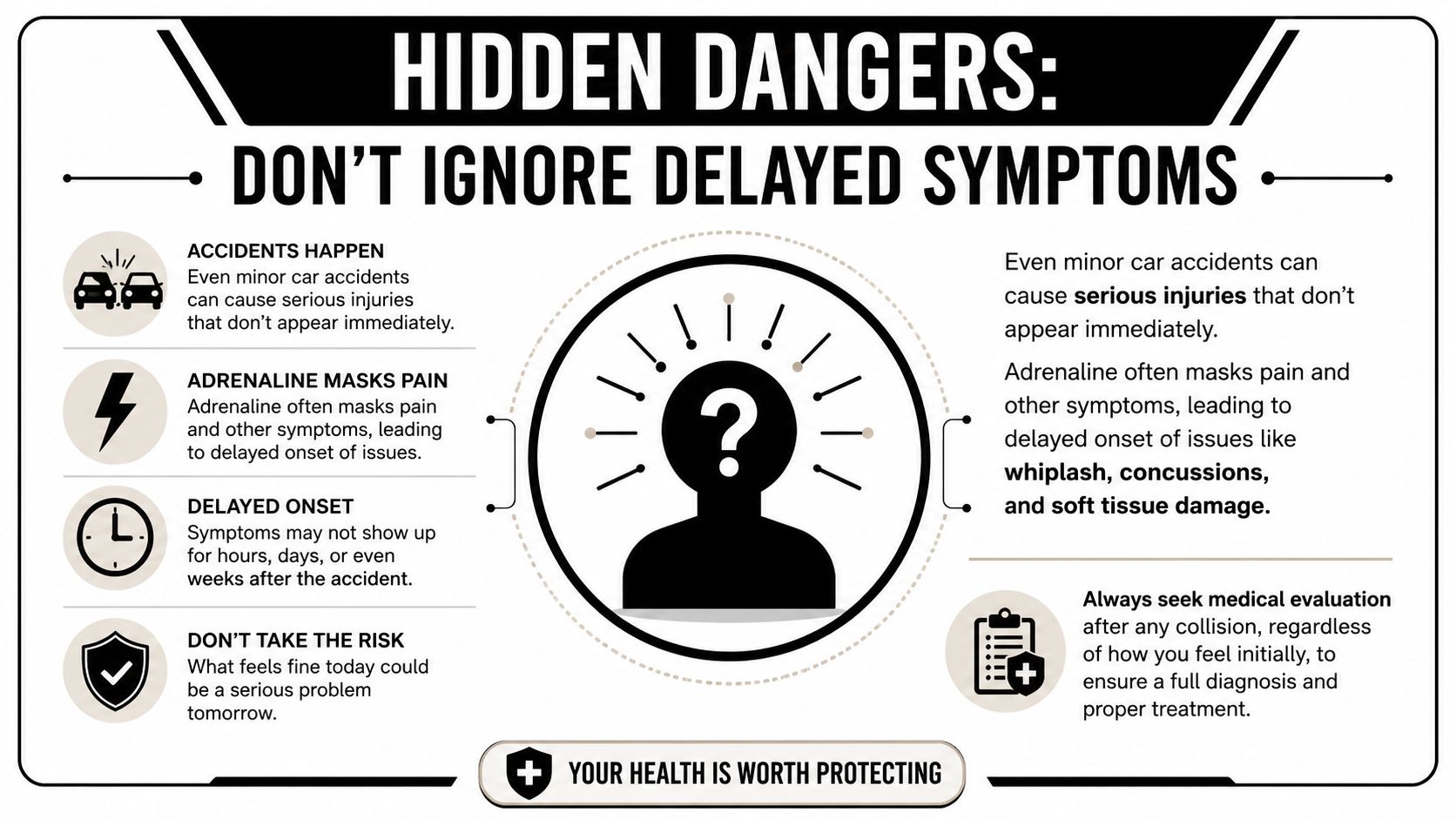
After a minor collision, your nervous system may keep you moving long before your tissues tell the truth. That's why someone can drive home, unload groceries, go to sleep, and wake up with a neck that won't turn normally.
Why delayed pain happens
Soft tissues don't always react on your schedule. Muscles tighten. Ligaments become irritated. Joints stiffen. Headaches build gradually. A mild concussion may not feel dramatic at first.
That delay matters because delayed-onset soft tissue injuries account for 60% of auto-accident-related claims, and securing immediate medical documentation leads to a 92% success rate for injury claims, while delaying consultation beyond 72 hours correlates with a 65% reduction in settlement value due to the “gap in treatment” argument used by insurers, according to this post-accident medical documentation guidance.
Symptoms people dismiss too quickly
Watch for symptoms that seem minor but tend to grow over the next day or two:
- Neck stiffness: Especially when turning your head while driving.
- Headaches: Often starting at the base of the skull or behind the eyes.
- Low back pain: Sometimes local, sometimes spreading into the hip or leg.
- Tingling or numbness: In the arm, hand, leg, or foot.
- Dizziness or fogginess: Even if you didn't hit your head directly.
- Jaw, shoulder, or rib discomfort: Common after bracing during impact.
These symptoms don't always announce themselves immediately. That's why “I felt fine at the scene” doesn't mean you were uninjured.
What works and what doesn't
What works is early evaluation, clear symptom reporting, and follow-through if a clinician recommends treatment.
What doesn't work is waiting until the pain is severe, assuming soreness will spontaneously disappear, or trying to push through normal activity while your body is guarding around an injury.
A useful next step is to read about hidden injury symptoms after a car accident, especially if your pain started after the first day.
The best time to document an injury is when it first appears, not after you've spent several days hoping it will go away.
From a rehabilitation standpoint, delayed care can make recovery harder. Early treatment often focuses on calming inflammation, restoring gentle motion, reducing muscle guarding, and preventing a short-term strain from becoming a longer, more stubborn pain pattern.
Your Next Steps for Recovery and Resolution
Once the scene is over, the essential follow-through begins. Here, people either keep the process organized or end up scrambling for paperwork, repair details, and treatment dates weeks later.

The week after the crash
A simple system works best.
- Keep one accident file: Store claim numbers, photos, repair records, receipts, and medical paperwork in one folder.
- Track symptoms daily: Note where it hurts, what activities aggravate it, and whether sleep, sitting, driving, or lifting are getting harder.
- Get repair estimates carefully: If your insurer requests comparisons, provide them. Choosing a shop with current training matters, and I-CAR-certified repair guidance and estimate advice can help you understand parts of the insurance process drivers often overlook.
- Attend recommended care: If a clinician prescribes treatment, show up consistently and keep records.
Recovery is medical and administrative
People tend to separate healing from paperwork, but after an accident the two are connected. Your progress notes, appointment dates, and symptom history help tell a coherent story of what happened and what it affected.
If physical symptoms are part of the aftermath, physical therapy after a car accident can be an important part of restoring movement and reducing lingering pain.
A minor crash can stay minor if you respond well. That means protecting your body early, documenting thoroughly, and following through until both the pain and the paperwork are resolved.
If you're dealing with neck pain, back pain, stiffness, headaches, or delayed soreness after a collision, MedAmerica Rehab Center can help you get evaluated and start a clear recovery plan. Their team provides patient-centered physical therapy and related care for auto accident injuries, with a focus on relieving pain, restoring mobility, and helping you move forward with confidence.
MedAmerica Rehab · Deerfield Beach
Talk to a clinician about your pain
Physical therapy, chiropractic, acupuncture and shockwave therapy under one roof, since 1995. Same-day appointments are available.
Mon–Thu 8:00 AM – 6:30 PM · Fri 8:00 AM – 3:00 PM