

Sciatic Nerve Pain Calf: Expert Guide to Relief 2026
You wake up, step out of bed, and feel a sharp pull deep in your calf. Or you stand up from your desk after a long stretch of sitting and get a burning, electric pain that makes you stop mid-step. It doesn't feel like the usual sore-muscle ache. You didn't sprint. You didn't twist awkwardly. Your calf just suddenly hurts, and the sensation is strange enough to make you wonder if something more is going on.
That confusion is common. Calf pain often gets blamed on a strain, cramp, or overuse. Sometimes that's true. But sometimes the calf is only where you feel the problem, not where the problem starts. When the sciatic nerve is irritated, pain can show up in the calf even if the actual source is in the low back.
If you're dealing with sciatic nerve pain in the calf, the most helpful first step is learning how to tell nerve pain apart from a local muscle injury. Once you know which pattern you're dealing with, your next steps get much clearer, and a lot less frustrating.
That Sharp Pain in Your Calf Might Not Be Your Calf
A lot of people describe the same moment. They expect a cramp or a pulled muscle, but the pain doesn't behave like either one. It may feel sharp, burning, zapping, or oddly deep. Some notice it while walking. Others feel it most when sitting, driving, or bending forward. A few have almost no back pain at all, which makes the calf symptom even more misleading.
That's where people often lose time. They stretch the calf harder, rub the sore spot, rest for a day or two, then try to get back to normal. If the pain is coming from nerve irritation, that approach often doesn't help much. In some cases, it makes things angrier.
Practical rule: If your calf pain feels electric, travels, comes with tingling, or changes with sitting and spinal position, don't assume it's just a tight calf.
A true calf strain usually gives you a more local story. You can often point to the exact area that hurts. The pain tends to show up during push-off, jumping, stairs, or after a specific activity. Sciatic calf pain is different. It often feels less predictable, more sensitive, and harder to pin down.
Three clues raise suspicion for nerve-driven pain:
- The sensation feels unusual. Burning, tingling, buzzing, or shooting pain points more toward nerve irritation than muscle tissue.
- The pattern moves. Pain may start near the buttock or thigh, or seem to shift down the leg into the calf.
- The triggers don't match a strain. Sitting, slouching, coughing, or bending may provoke symptoms more than calf loading does.
That doesn't mean every odd calf pain is sciatica. It means the calf shouldn't be judged in isolation. When the symptom and the behavior don't fit a muscle injury, it's smart to think higher up the chain.
How a Problem in Your Back Causes Pain in Your Calf
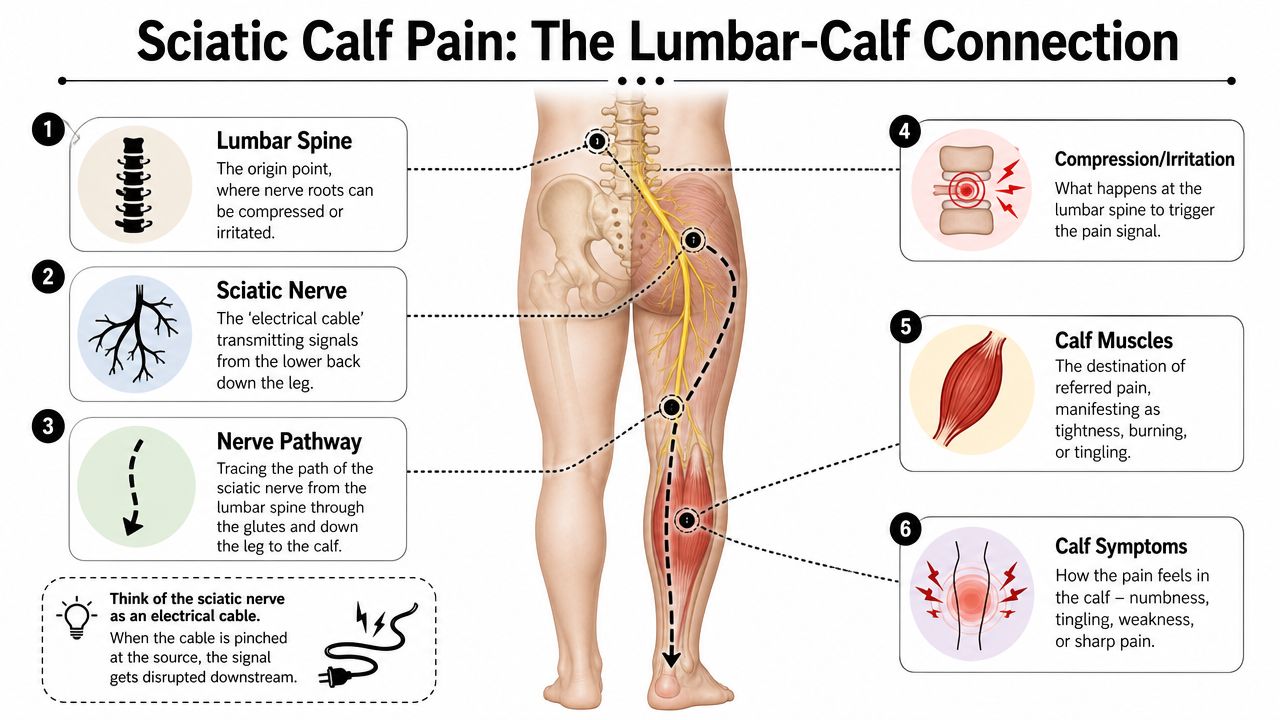
The easiest way to understand this is to think of the sciatic nerve like a long electrical cable. It begins in the lower spine, travels through the buttock, runs down the back of the leg, and sends signals into the lower leg and foot. If that cable gets irritated near its origin, the message can become distorted anywhere along the line.
The nerve pathway matters
The calf isn't disconnected from the spine. The tibial division of the sciatic nerve directly innervates the gastrocnemius and soleus muscles, which help with plantar flexion. When the nerve is compressed at the lumbar spine, including with disc problems around L4-L5 or L5-S1, those signals can become dysregulated and show up as sharp, burning, or electric calf pain. That pattern is part of radicular sciatica, which is different from local muscle pain because the problem starts proximally and has a neuropathic feel, as described in this clinical overview on sciatic calf pain and nerve involvement.
What compression feels like in real life
A disc issue or narrowing around the nerve root can act like a kink in a garden hose. The hose still exists from end to end, but the flow gets disrupted at one point. With the sciatic system, that disruption can produce pain, tingling, numbness, or weakness farther down the leg than is often realized.
That's why someone can say, “My calf is the problem,” while the underlying cause is in the low back.
Common signs that support this pattern include:
- Pain with sitting because flexed postures may increase nerve sensitivity
- Pain that runs or refers rather than staying in one small spot
- A sense of tightness that doesn't improve with local stretching
- Calf weakness or a heavy-leg feeling during walking or push-off
When a nerve is irritated, the body often interprets normal movement as threat. That's why simple positions can feel surprisingly intense.
This also explains why treatment has to address the source, not just the symptom. Calf massage can feel good temporarily. It rarely solves a lumbar-driven nerve problem by itself. The better strategy is to calm the irritated nerve, improve spinal and hip mechanics, and rebuild tolerance with movement.
For people who want to understand the exercise side of back-related symptoms, these strength drills for back pain are a useful example of how trunk and hip control support recovery. If you want a more clinic-focused explanation of rehab for spinal pain, this guide on how physical therapy helps with back and neck pain adds helpful context.
Is It Sciatica or a Simple Calf Strain
This is a key question that often needs to be answered first. The fastest way to sort it out is to compare the behavior of the pain, not just the location.
Sciatic calf pain vs muscle pain
| Symptom | Sciatic Nerve Pain | Muscular Calf Strain |
|---|---|---|
| Sensation | Burning, electric, tingling, shooting, or deep nerve-like discomfort | Achy, sore, tight, pulled, or sharp with direct muscle use |
| Location | May run from buttock or thigh into calf, or feel diffuse and hard to pinpoint | Usually localized to one part of the calf muscle |
| Onset | Can begin after sitting, bending, lifting, or without a clear calf-specific event | Often starts during exercise, push-off, sprinting, jumping, or a sudden movement |
| Touch | Pressing the calf may not fully reproduce the pain | The sore spot is often tender to press |
| Movement triggers | Sitting, slouching, bending, coughing, or certain back positions may aggravate it | Walking uphill, stairs, jumping, or stretching the calf muscle often aggravate it |
| Associated symptoms | Tingling, numbness, weakness, radiating symptoms | Local tightness, guarding, and pain with calf contraction |
| Response to stretching | Aggressive stretching may irritate it | Gentle muscle stretching often feels like the right area is being addressed |
| Pattern through the day | Can flare with static posture and ease when position changes | Often worse after activity that loads the calf |
A simple self-check at home
You don't need to diagnose yourself perfectly. You do need to notice patterns.
Ask yourself:
- Can I point to one exact sore spot? If yes, that leans more muscular.
- Does the pain feel nervy? Tingling, burning, buzzing, or electric pain leans more sciatic.
- Does sitting make it worse? That often points away from a simple calf strain.
- Did it start during a calf-heavy movement? Sprinting, jumping, and forceful push-off lean more muscular.
- Do I feel anything in the buttock, hamstring, or foot too? That wider pattern raises suspicion for nerve involvement.
What often misleads people
One of the biggest traps is assuming that any “tight” calf needs more calf stretching. If the tissue is guarding because the nerve is irritated, hard stretching can provoke more symptoms. Another trap is dismissing the problem because you don't have back pain. Sciatic symptoms can show up mostly in the leg.
If the pain pattern is odd, changing, or radiating, treat it like a nerve question until proven otherwise.
A muscle strain usually improves in a straightforward way. It may be sore, but the rules make sense. Load it too much and it hurts. Let it recover and strengthen gradually, and it settles. Sciatic calf pain often behaves less logically unless you look at the spine, hip, and nerve together.
When people get stuck, it's usually because they've been treating a nerve problem like a muscle problem.
Red Flag Symptoms You Should Never Ignore
A calf strain can hurt. Sciatic calf pain can hurt more. The difference is that a routine muscle injury rarely causes loss of function, spreading numbness, or changes in bladder and bowel control. Those signs point to a nerve problem that needs prompt medical attention.
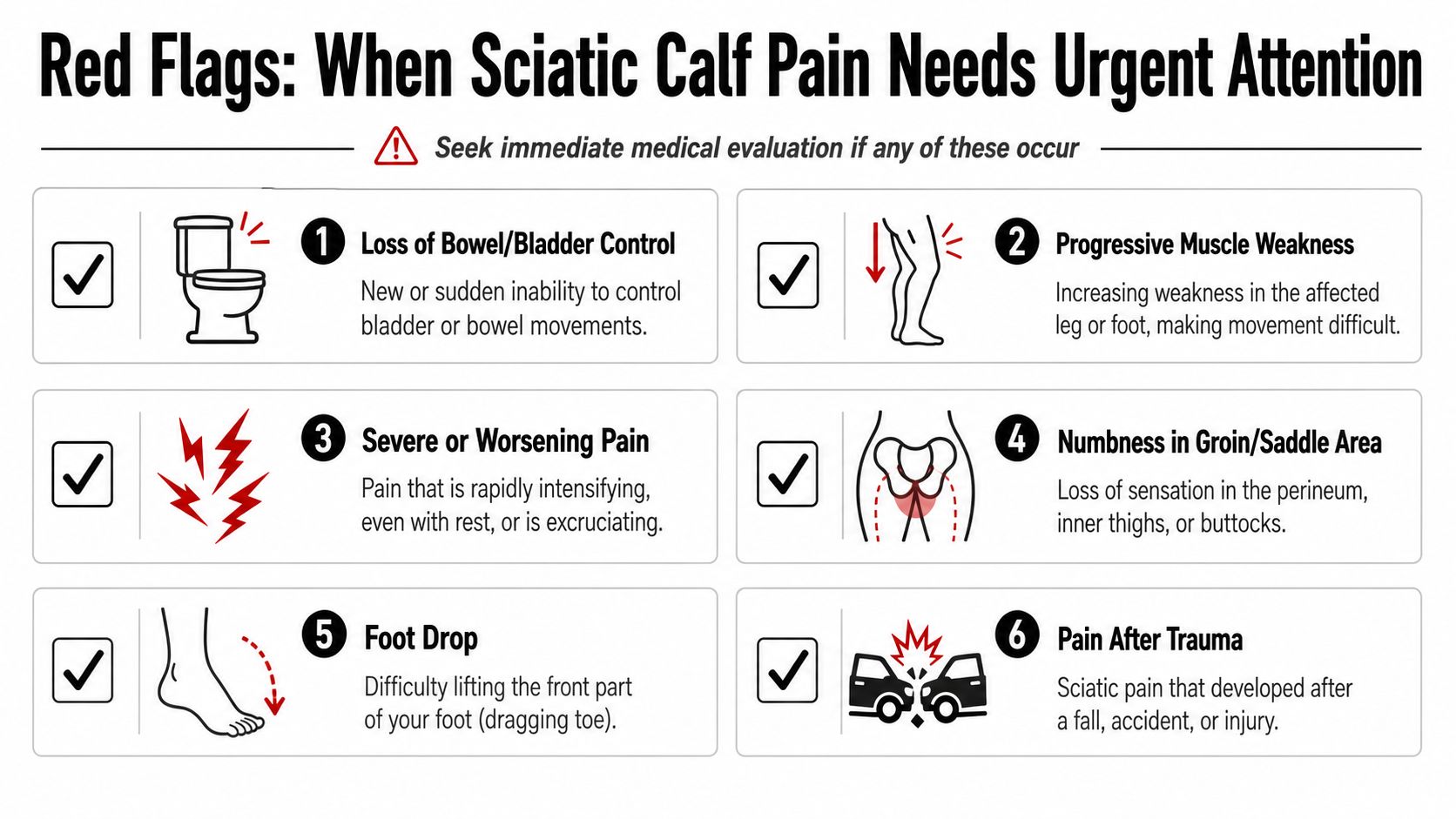
Get urgent medical evaluation if you notice any of these
- New bowel or bladder changes. Loss of control, trouble starting urination, or a sudden change in normal function needs same-day care.
- Numbness in the groin or saddle area. Reduced sensation in the inner thighs, genitals, or sitting area is a major warning sign.
- Progressive leg weakness. Pain alone is one thing. A leg that is clearly getting weaker over hours or days is different.
- Foot drop. If you cannot lift the front of the foot normally, the nerve may be under significant pressure.
- Severe pain after trauma. A fall, car accident, or other forceful injury changes the risk level.
- Rapidly worsening pain at rest. Pain that ramps up quickly, wakes you repeatedly, or becomes hard to control deserves urgent assessment.
In the clinic, I tell patients to pay close attention to strength, sensation, and control. Those are the findings that separate a painful but manageable flare from a problem that should not wait.
One practical example. A tender calf after a workout usually hurts when you walk, push off, or stretch the muscle. It does not usually make your toes slap the floor, create numbness around the groin, or cause your leg to give way. If those symptoms are present, stop treating it like a simple soft-tissue issue.
Until you are evaluated, avoid aggressive stretching, hard massage, or heavy foam rolling directly into a painful calf if the symptoms feel nerve-related. Gentle position changes and short walks are usually safer. If you want light self-care for surrounding muscle tension, use a foam roller with controlled pressure and symptom-guided pacing, not repeated deep work into a worsening nerve pattern.
These scenarios are not the norm, but they are the exceptions that matter most. Early evaluation can protect strength, sensation, and recovery options.
At-Home Stretches and Care for Sciatic Calf Pain
A common pattern I see is this: the calf feels tight, so the person keeps stretching the calf harder, but the leg feels more irritated by the end of the day. That usually means the calf is reacting to a sensitive nerve, not asking for a stronger stretch.
Home care works best when symptoms are mild, stable, and clearly improving. The goal is to calm nerve irritation, keep the leg moving, and avoid treatments that keep provoking the system.

Start with the right mindset
Nerves usually respond better to gentle, repeated motion than to long, forceful holds. I tell patients to use a symptom-guided approach. If a stretch eases the leg during or shortly after, it may be a good fit. If it creates sharper calf pain, more tingling, or a lingering flare later, the dose was too high.
Conservative care helps many people with acute sciatica, as noted earlier. That tends to include activity modification, targeted exercise, and patience. Recovery is often gradual, which is frustrating, but it is also common.
A practical starting point:
- Keep moving gently instead of staying in bed
- Reduce any stretch that reproduces zinging or burning
- Change positions often if sitting increases the calf pain
- Look for steady improvement over days and weeks, not a dramatic result in one session
Gentle seated nerve glide
Sit near the edge of a chair with your chest upright. Slowly straighten the affected knee until you feel a mild pull, then ease back down. You can add a small head movement by looking up as the leg straightens and relaxing as the leg returns.
This drill is meant to help the nerve move with less sensitivity. It should feel mild and controlled.
- Why it helps: It encourages motion through the nerve pathway without a strong tug
- What you should feel: Light tension is acceptable
- When to stop: Sharp pain, increased tingling, or symptoms that spread farther down the leg
Figure-four piriformis stretch
Lie on your back with both knees bent. Cross the ankle of the painful side over the opposite knee, then draw the opposite thigh toward your chest until you feel a stretch in the buttock.
This can be useful when hip stiffness is adding pressure around the sciatic pathway. The target is the buttock and outer hip. A jolt into the calf means you should ease off.
Supported hamstring stretch with a soft knee
Lie on your back and lift the affected leg with your hands behind the thigh or a strap around the leg. Keep a small bend in the knee and let the ankle stay relaxed. Raise the leg only to the point of a light stretch.
That bent-knee position matters. It gives the back of the leg some length without putting as much tension through the nerve as a hard straight-leg pull.
A short demonstration can help you picture the pacing and form:
Heat, ice, and activity choices
Use heat when the low back, hip, or upper leg feels stiff and guarded. Use ice if symptoms feel irritated after activity. Either option is meant to settle the area enough so you can move better. Neither one changes the source of nerve irritation by itself.
Walking is often one of the better home strategies. Keep it short at first. Several brief walks usually work better than one long walk that leaves the calf burning afterward.
Be careful with self-treatment tools. If you want help with pressure and pacing, this guide to using a PE foam roller safely and strategically is a better starting point than digging hard into the sorest part of the calf. With sciatic calf pain, aggressive rolling often irritates the tissue that is already reacting to the nerve.
The main trade-off with home care is simple. Do enough to keep the leg from stiffening up, but not so much that you keep stirring the symptoms up. That balance is what helps the calf settle while the primary driver of the pain starts to calm down.
When to Seek Professional Treatment at MedAmerica Rehab
Home care is appropriate for many mild cases. It's time to get professional help when the pattern stops improving, keeps recurring, or is limiting basic life.
That usually looks like this:
- The pain is hanging on despite sensible self-care
- You're avoiding walking, driving, work, or sleep positions
- The calf pain keeps returning every time activity increases
- You aren't sure whether it's nerve, muscle, or something else
What a good professional plan should include
A strong treatment plan doesn't start by chasing the sorest spot. It starts by finding what is driving the symptom. With sciatic nerve pain in the calf, that often means assessing the lumbar spine, hip mobility, nerve sensitivity, walking pattern, strength, and symptom triggers together.

Several treatment approaches can play a role, depending on the person:
- Physical therapy can guide nerve mobilization, trunk control, hip mobility work, gait correction, and progressive strengthening.
- Chiropractic care may help when spinal joint mechanics are contributing to ongoing irritation.
- Acupuncture is often used to help modulate pain and reduce guarding.
- Shockwave therapy may be useful when there's a stubborn soft-tissue component layered on top of the nerve issue.
The trade-off matters here. Too much passive treatment can make people dependent on appointments. Too little hands-on care can leave them too irritated to move well. The sweet spot is a combination of symptom relief and active rehab.
Where integrated care helps most
A coordinated clinic can make a difference. MedAmerica Rehab Center offers physical therapy, chiropractic care, acupuncture, and shockwave therapy, which allows treatment to be adjusted based on whether the main driver is nerve compression, movement dysfunction, protective muscle guarding, or a mixed presentation.
A good rehab plan should answer three questions clearly. What's driving the pain, what movements are safe right now, and how do we keep this from coming back?
In some cases, calf symptoms also coexist with trigger points or deep hip tension. Techniques such as dry needling may be considered as part of a broader plan. If you want a plain-language overview, this explanation of what dry needling is in physical therapy is useful.
The right time to seek help isn't when the pain becomes unbearable. It's when your own efforts are no longer changing the pattern.
Your Next Step Toward a Pain-Free Life
Calf pain can be deceptive. The sore spot may be in your lower leg, while the underlying issue sits higher up in the spine or along the sciatic pathway. Once you recognize that possibility, the whole problem becomes easier to manage.
That's the key message. Sciatic nerve pain in the calf is treatable, but it usually responds best when you stop treating it like a simple muscle strain. Smart movement, gentle nerve-friendly exercises, and the right level of professional guidance can change the direction of recovery.
If you've been living with recurring leg symptoms, it also helps to understand the broader context of long-term pain patterns. This roundup of chronic pain data is a useful background read for people trying to make sense of why pain can linger and disrupt daily life.
If you're in Deerfield Beach or nearby and you want clarity, the next practical step is a full evaluation. A hands-on assessment can tell you whether your calf pain is coming from the calf itself, the low back, or a mix of both, and what to do next.
Frequently Asked Questions About Sciatic Calf Pain
Can sciatica cause pain only in the calf
Yes, it can. Some people expect sciatica to always include obvious low back pain or a dramatic line of pain from the buttock down the leg. In real practice, symptoms don't always present that neatly. A person can feel the problem mostly in the calf, especially when a specific part of the nerve pathway is irritated. That's one reason these cases get mistaken for strains.
Should I walk or run with sciatic calf pain
Walking is often reasonable if it doesn't increase symptoms during the walk or leave you worse afterward. Short walks are usually better than pushing through a long outing. Running is more individual. If every stride increases burning, tingling, or leg heaviness, running usually isn't the right test right now.
A better sequence is: calm symptoms first, restore motion, rebuild strength, then test impact gradually. If you want a general consumer-friendly overview, this page on sciatica symptoms and treatment may help you compare your pattern with common presentations.
How is sciatic calf pain different from a calf cramp
A cramp is usually a sudden muscle contraction. The calf feels hard, seized, and locally painful. It often improves with position change, gentle stretching, massage, hydration review, or time.
Sciatic calf pain is different. It often feels burning, shooting, tingling, or radiating, and it may change with sitting, spinal position, or nerve tension rather than just local muscle use. A cramp is usually very clearly in the muscle. Nerve pain often feels stranger than that.
Why do calf stretches sometimes make it worse
Because you may not be stretching muscle. You may be tensioning an irritated nerve. If the back of the leg feels tight because the nerve is sensitive, a hard stretch can provoke more symptoms. That's why gentle nerve glides and modified hamstring work often help more than aggressive toe-touching.
Is recovery possible without surgery
Yes, often it is. Many people improve with conservative care, especially when they get the diagnosis right and stop doing the things that keep the nerve aggravated. Surgery is usually a later consideration for specific situations, not the first step generally.
If your calf pain feels suspiciously nerve-like, a thorough evaluation can save you weeks of guessing. MedAmerica Rehab Center can help you sort out whether the pain is coming from the calf, the spine, or both, and build a treatment plan that fits what your body needs.
MedAmerica Rehab · Deerfield Beach
Talk to a clinician about your pain
Physical therapy, chiropractic, acupuncture and shockwave therapy under one roof, since 1995. Same-day appointments are available.
Mon–Thu 8:00 AM – 6:30 PM · Fri 8:00 AM – 3:00 PM