
Knee Surgery Recovery Exercises: Complete Guide 2026
The first day home after knee surgery often feels the same. The incision is sore, the leg feels heavy, the walker is suddenly part of every trip to the bathroom, and the biggest question is simple: Am I doing the right things, at the right time, without overdoing it?
That uncertainty is normal. Recovery rarely feels dramatic from one day to the next. It feels slow, repetitive, and sometimes frustrating. But the patients who do well usually stop waiting for the knee to “just get better” and start following a clear plan. That plan matters whether you've had a total knee replacement, a ligament procedure, or another knee operation that left you stiff, weak, and cautious about moving.
At our clinic in Deerfield Beach, we see the same turning point again and again. Progress starts when exercises stop feeling random and begin fitting into a sequence. If you've never been through rehab before, it helps to know what a typical physical therapy session looks like so the process feels less intimidating and more practical.
Your First Steps on the Road to Recovery
The knee doesn't need heroic effort in the beginning. It needs consistent, accurate movement.
Early on, most patients are balancing two competing instincts. One says, “Move it so it doesn't get stiff.” The other says, “Protect it because it hurts.” Good rehab respects both. You don't force your way through the first few weeks, but you also don't let the knee become a passenger.
What usually works best
A strong recovery starts with a few simple rules:
- Move often, not aggressively. Short, repeated sessions usually go better than one long workout.
- Chase quality before intensity. A clean heel slide or quad set does more than a rushed set with poor control.
- Expect soreness, not sharp warning pain. Muscles waking up can ache. Joint irritation, loss of motion, or a major swelling spike usually means the dose needs adjusting.
Practical rule: Recovery responds better to steady daily work than occasional “catch-up” sessions.
Patients often tell me they thought rehab would begin later, once pain settled down. In reality, the opposite is usually true. The first exercises are part of pain control, swelling management, circulation, and muscle reactivation. They aren't extra work added onto recovery. They are recovery.
Why this guide is different
A lot of online lists give you exercises without giving you progression. That's where people get stuck. They either stay too easy for too long or they advance before the knee is ready. A better plan ties each exercise to a purpose:
- reduce swelling
- restore motion
- rebuild quadriceps control
- return to stairs, walking, and balance
- adapt the plan when obesity, diabetes, cardiovascular limitations, or fall risk change the pace
That's the lens to use for all knee surgery recovery exercises. Every drill should answer one question: What does this help me do better in real life?
Understanding the Three Phases of Knee Recovery
Patients do better when they stop judging recovery day by day and start seeing it in phases. Some days the knee will feel looser. Some days it will feel stubborn. That doesn't mean you're failing. It usually means you're in the middle of a normal progression.
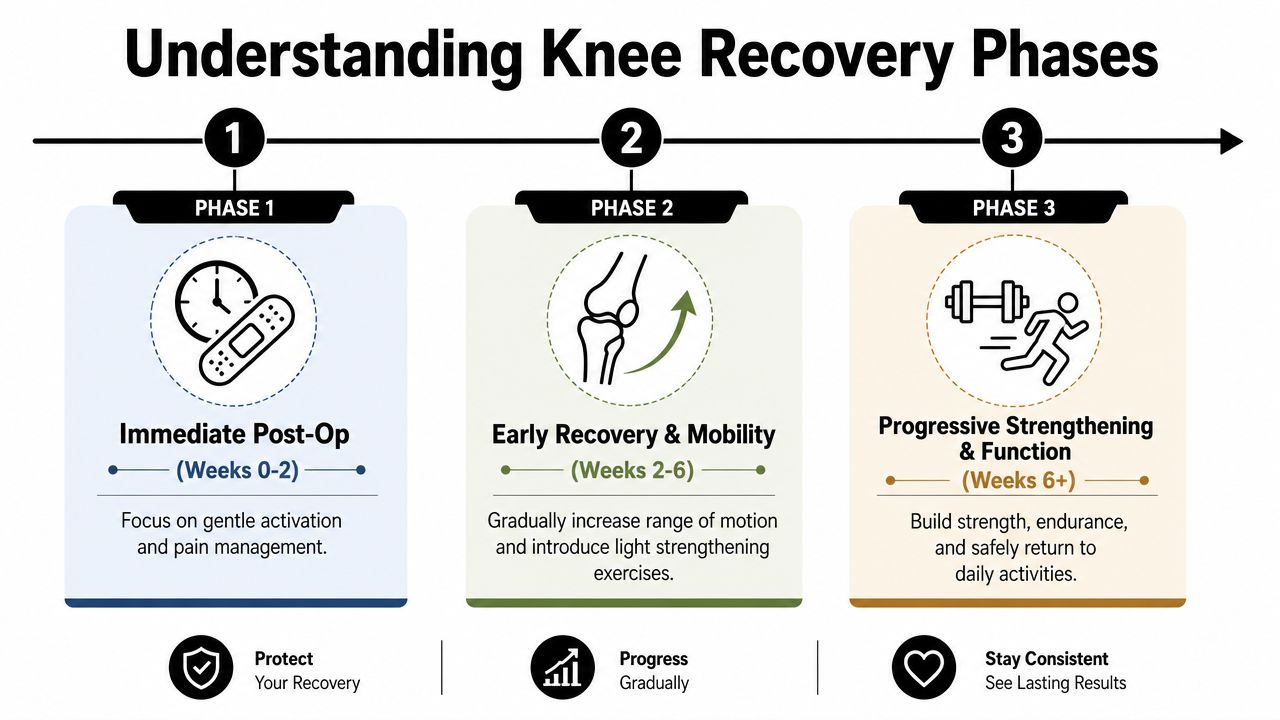
Phase 1 is about calming things down
In Weeks 0 to 2, the knee is healing from surgery, swelling is high, and the quadriceps often don't fire well. The work here is deceptively simple. You focus on circulation, gentle range of motion, basic muscle activation, walking with the right device, and keeping the joint from getting guarded and stiff.
This phase feels modest, but it's not optional. Poor habits here tend to show up later as limping, extension loss, and trouble with stairs.
Phase 2 is where mobility starts to return
In Weeks 2 to 6, the knee needs more motion and more controlled loading. This is the stage where many patients feel impatient because they're improving, but not yet moving naturally. Sitting down, getting up, and walking longer distances are easier, but stairs and prolonged standing still expose weakness.
The focus shifts toward active bending, better straightening, gait quality, and light strengthening that the knee can tolerate without flaring.
Phase 3 builds function you can actually use
From Weeks 6 to 12 and beyond, rehab becomes more task-based. The knee may look better before it performs better. This is when people learn that strength, balance, endurance, and single-leg control are what let them descend stairs, walk uneven ground, and trust the leg again.
A knee can have decent motion and still feel unreliable. That usually points to strength and balance deficits, not a lack of effort.
Knee Surgery Recovery Phases at a Glance
| Phase | Typical Timeline | Primary Goals | Key Focus |
|---|---|---|---|
| Phase 1 | Weeks 0 to 2 | Control swelling, restore gentle motion, activate muscles | Ankle pumps, quad sets, heel slides, safe walking |
| Phase 2 | Weeks 2 to 6 | Improve mobility and begin light strengthening | Knee flexion work, gait correction, sit-to-stand patterns |
| Phase 3 | Weeks 6 to 12+ | Build functional strength and confidence | Step training, cycling, balance drills, daily activity tolerance |
What patients often get wrong
A common mistake is trying to “graduate” too early from the basics. Another is doing the right exercise with the wrong dose. The timeline helps prevent both. If swelling rises after every session, your knee is telling you the progression is ahead of the tissue. If movement is too cautious for too long, stiffness can become the bigger problem.
The most effective knee surgery recovery exercises match the phase you're in, not the phase you wish you were in.
Phase 1 Exercises for Early Healing Weeks 0 to 2
The first two weeks set the tone for everything that follows. Clinical guidance says patients usually begin gentle range-of-motion and muscle-activation work such as ankle pumps and quad sets within the first 24 hours after surgery, with daily exercise sessions of about 20 to 30 minutes, often split into 2 to 3 shorter sessions. The same source notes that patients who reach at least 90° of passive knee flexion by day 7 have a 20 to 30% lower risk of prolonged rehabilitation according to this postoperative rehab overview.
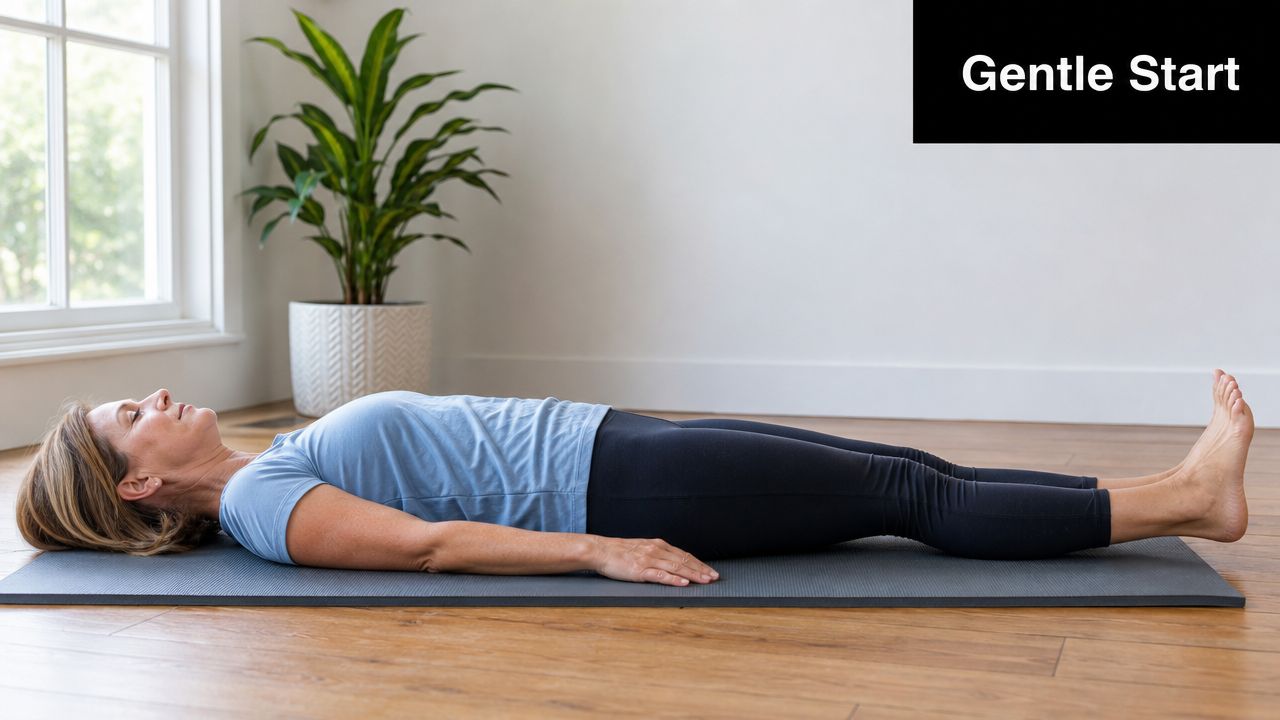
Ankle pumps and quad sets
These are usually the first drills because they do two different jobs.
Ankle pumps help circulation. Lie on your back or recline with the leg supported, then pull the foot up toward you and point it away in a smooth rhythm.
- Dose: 10 to 15 repetitions, repeated often through the day
- Why it helps: circulation, swelling control, and reducing the “stagnant” feeling in the leg
Quad sets wake up the front thigh. With the leg straight, tighten the quadriceps by pressing the back of the knee gently downward into the bed or towel roll. Hold, then relax.
- Dose: 10 to 15 repetitions per set
- Why it helps: early quadriceps activation, better knee support, and less lag when you try to lift the leg
If you can't see the kneecap move or feel the thigh tighten, the set is too weak.
Heel slides done correctly
Heel slides are one of the most important early knee surgery recovery exercises because they teach the knee to bend again without forcing it. Slide the heel toward the buttocks while keeping the leg in line. Don't let the hip roll outward or the pelvis tip to “fake” the motion. At the end range, hold briefly, then return to straight.
According to the AAOS exercise guide, a common protocol progresses from 5 to 10 repetitions every 2 hours while awake, moving toward 3 to 4 sets of 10 with 30-second end-range holds by week 2 to 3.
Common fix: If the knee won't bend smoothly, use a towel or strap to add gentle overpressure at the end, but only within a tolerable range.
Straight-leg raises and bed mobility
Not every patient is ready for a straight-leg raise right away. If the knee bends when you lift the leg, the quadriceps still need more quad-set work first. Once you can keep the knee straight, lift slowly, pause, and lower with control.
- Start with: 10 repetitions
- Why it matters: transfers, getting in and out of bed, and preparing the leg for walking
Cold therapy also matters in this phase because a hot, swollen knee doesn't move well. If you're not sure how to use icing safely, this guide on physical therapy cold packs is a useful starting point for timing and setup.
A short demonstration can help you clean up technique before habits set in.
What not to do in this phase
- Don't skip sessions because the knee feels stiff. Gentle motion is often what reduces that stiffness.
- Don't force deep bending through sharp pain. Aggressive stretching usually creates more guarding.
- Don't judge progress by swelling alone. Many patients are improving even while the knee still looks puffy.
Early recovery is less about intensity and more about repetition, alignment, and follow-through.
Phase 2 Exercises for Restoring Mobility Weeks 2 to 6
By this stage, the knee should be moving more and reacting less. It may still swell after activity, but the work now becomes more active. Clinical guidance suggests that around 2 weeks after total knee replacement, patients should aim for roughly 80 degrees of active knee flexion, progressing to around 100 degrees by 7 weeks, based on this Yale Medicine recovery article.
Those benchmarks matter because walking, sitting comfortably, and using stairs all depend on enough bend and enough control.

Seated knee flexion and assisted bending
Sit on the edge of a sturdy chair or bed and let the foot slide back under you as far as you can tolerate. Hold briefly, then return.
- Start with: 10 to 15 repetitions
- Progress by: holding the end position a little longer
- Why it helps: improves the bending needed for chairs, toilets, car transfers, and stair use
If the motion is sticky, place the non-surgical foot over the operated ankle to assist the bend gently. The movement should feel like stretching and pressure, not jamming.
Hamstring curls and mini-squats
Standing hamstring curls help the back of the leg contribute to knee control again. Hold a counter, bend the operated knee, pause, then lower.
- Dose: 10 to 15 repetitions
- Why it matters: gait recovery and better leg control during swing phase
Mini-squats reintroduce load in a useful way. Stand with hands on a counter, feet hip-width apart, and sit back a small amount as if you're about to sit in a chair. Keep the knees aligned and the weight even.
- Start shallow
- Why it works: builds early strength for standing up, lowering down, and controlled walking
Most patients do better with a smaller, cleaner squat than a deeper squat with trunk collapse and knee drift.
Gait quality and supported endurance
This is also the time to stop accepting a limp as “good enough.” If you're using a cane or walker, use it in a way that improves your pattern rather than just gets you through the house. Many people need cueing for heel strike, knee straightening in stance, and avoiding the fast step with the non-surgical leg.
Some patients also benefit from reduced joint load while building motion and walking tolerance. If land-based sessions keep flaring the knee, physical therapy in a pool can be a practical option once your surgeon says the incision is ready for water exposure.
Signs you're ready to progress
Use these markers instead of guessing:
- Motion is improving: bending comes easier and the knee straightens more naturally during walking.
- Swelling settles predictably: the knee may puff up after exercise, but it recovers with rest and icing.
- Basic tasks feel smoother: standing from a chair, getting into bed, and short community walking feel less guarded.
This phase is where consistency starts paying visible dividends. The knee is no longer just healing. It's learning to move again.
Phase 3 Exercises for Functional Strength Weeks 6 to 12+
At this point, most patients don't need more random exercise. They need exercises that transfer to real life. That means stairs, single-leg control, balance, and endurance.
Walking farther is useful, but walking alone won't rebuild everything the knee needs. People often learn that the hard part isn't going up stairs. It's coming down with control.
Step-ups and step-downs
Weight-bearing step work commonly begins around 4 to 6 weeks post-op in appropriate patients. Research summarized in this step-training discussion notes that patients who perform step-downs 3 to 4 times per week show 12 to 18% better stair-ascent speed at 12 weeks than those who only walk on flat surfaces. The same source reports that correct technique, with the knee aligned over the second toe, produces 30 to 40% higher quadriceps activation.
Start with a low step. Place the operated foot on the step, shift weight onto it, and step up without pushing excessively through the trailing leg. For step-downs, slowly lower the non-surgical leg toward the floor while the surgical leg controls the descent.
- Begin with: 3 to 5 repetitions per leg
- Progress toward: 2 sets of 10 as tolerated
- Key technique: knee tracks over the second toe, pelvis level, trunk upright
Stationary bike and strengthening progressions
A stationary bike is useful because it adds repetitive motion without the impact of walking on uneven ground. Early on, some patients rock the pedals until the knee tolerates full revolutions. Later, the bike becomes an endurance and warm-up tool.
For added resistance work, light dumbbells can help with sit-to-stands, split-stance drills, and supported squats once your therapist clears it. If you need a simple overview of weight options and setup, Granted Solutions' dumbbell guide is a practical reference for home exercise planning.
Balance that actually transfers
Many standard rehab handouts miss the mark. A stronger leg still needs to respond to shifting weight, turning, and uneven surfaces.
Useful beginner drills include:
- Supported weight shifts: move side to side and front to back while holding a counter
- Tandem stance: one foot slightly in front of the other, with fingertip support if needed
- Single-leg loading prep: stand more fully on the surgical leg for short holds without collapsing at the hip
Better balance usually doesn't come from “trying harder.” It comes from slower movement, cleaner alignment, and enough support to practice safely.
What works better than just walking
Walking is necessary. It's just not complete. Patients who only walk often regain distance before they regain control. They can cover ground, but stairs, curbs, and quick direction changes still feel shaky.
Functional knee surgery recovery exercises fix that gap. They ask the quadriceps to work eccentrically, the hips to stabilize, and the nervous system to trust the leg again.
Your Guide to a Safe and Personalized Recovery
Generic rehab advice breaks down fastest in two groups. The first is patients with chronic conditions such as obesity, diabetes, or cardiovascular limitations. The second is older adults who need balance work early, not as an afterthought.
Many public guides still give broad repetition ranges without telling people how to adjust when swelling lingers, fatigue is higher, or stamina is limited. That's where a personalized approach matters most.
How to progress when your knee is not the only issue
If you're carrying more body weight, the joint often tolerates volume differently. You may need shorter bouts, more frequent rest, and stricter attention to swelling after exercise. If you have diabetes or cardiovascular disease, fatigue patterns and tissue response can change the pacing too.
A safer approach is to use symptom-guided progress:
- If the knee is mildly sore but settles by the next day, the dose was probably reasonable.
- If swelling keeps building across several sessions, reduce either the reps, the range, or the number of loaded exercises.
- If your walking form worsens during a session, stop before fatigue teaches the wrong pattern.
For local patients who need hands-on progression and monitoring, MedAmerica Rehab Center provides post-surgical physical therapy that includes supervised knee exercise instruction, progression of range-of-motion and strengthening work, and balance and gait training.
Why seniors need balance training sooner
Balance shouldn't wait until the knee is “strong enough.” Public exercise guides often underplay this, even though older adults face higher fall risk in the first 3 to 6 months after surgery. According to Alberta Health's knee recovery guidance, supervised programs that combine strength with progressive balance and gait training reduce fall risk and improve confidence more than strength-only programs in older knee-replacement patients.
Practical early balance work for seniors can include:
- Counter-supported weight shifts: useful when standing still feels uncertain
- Mini side steps along a kitchen counter: builds lateral control that helps prevent falls
- Chair-to-stand practice with alignment cues: strengthens the legs while rehearsing a daily task
If you want more ideas for long-term exercise habits after formal rehab, this resource on how to strengthen your knees for lasting relief can complement your home routine.
Good pain versus warning pain
Patients need this distinction clearly.
Soreness in the muscles, stretching discomfort, and temporary post-exercise stiffness are common. Sharp joint pain, a major loss of motion, or sudden swelling that keeps worsening are not things to push through.
Call your surgeon or therapist if you notice:
- Calf pain or unusual calf swelling
- Fever or signs of illness
- Drainage, redness, or increasing warmth around the incision
- A sudden drop in your ability to bear weight
- A sharp increase in pain that doesn't settle with rest
The recovery mindset that helps most
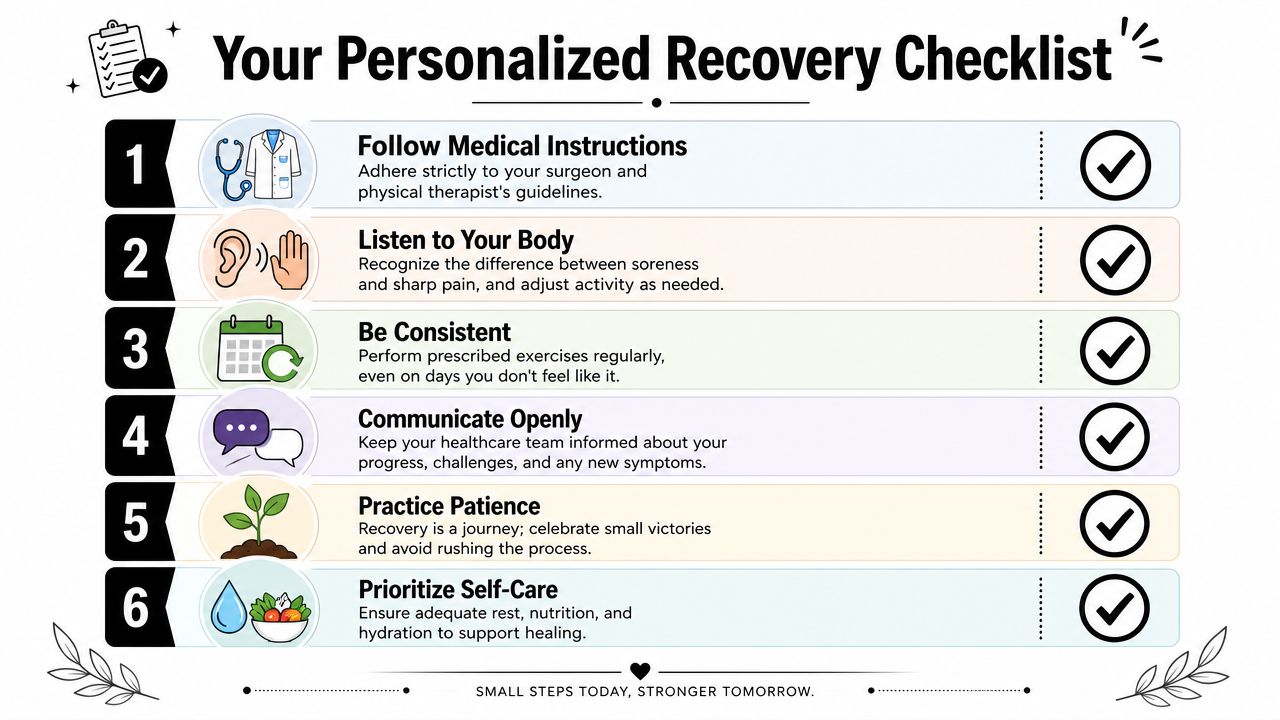
The strongest recoveries usually come from patients who stay patient enough to be consistent. They don't test the knee every day with unnecessary challenges. They build trust through repetition.
That's especially true in Deerfield Beach, where people want to get back to walking outside, shopping without leaning on a cart, climbing stairs confidently, and keeping up with family. Those goals are realistic. They just depend on matching the exercise to the phase, the body, and the person doing the work.
If you need a structured recovery plan after knee surgery, MedAmerica Rehab Center can help you build one that fits your procedure, mobility level, and health history. A focused physical therapy program can guide your range-of-motion work, strength progressions, gait training, and balance practice so you're not guessing your way through recovery.
MedAmerica Rehab · Deerfield Beach
Talk to a clinician about your pain
Physical therapy, chiropractic, acupuncture and shockwave therapy under one roof, since 1995. Same-day appointments are available.
Mon–Thu 8:00 AM – 6:30 PM · Fri 8:00 AM – 3:00 PM