

Physical Therapy Cost Without Insurance: A 2026 Guide
Physical therapy without insurance usually costs $75 to $350 per session in 2026, and the first visit is typically higher at $150 to $400. If you're in Deerfield Beach and trying to decide whether you can afford care, the central question usually isn't just “What does one visit cost?” but “What will the whole plan cost, and do I have options?”
That's the stressful part for many patients. Your back is flaring up, your knee still isn't right after surgery, or sciatica is making it hard to sit through work. You know physical therapy could help, but paying out of pocket feels like stepping into a process with no price tag.
The good news is that physical therapy cost without insurance is often more manageable when you know how clinics structure pricing, what affects your bill, and which options can lower it. In Deerfield Beach, that local context matters. South Florida pricing can look very different from a small-town clinic, and the right questions can save you frustration before you book your first appointment.
Navigating Your Recovery When Insurance Is Not an Option
A lot of uninsured patients wait too long because they assume they need to either pay a huge amount upfront or skip treatment entirely. That usually leads to a more expensive problem later. A stiff back turns into limited walking. A shoulder strain becomes months of guarding and lost sleep. An ankle injury changes how you move, and now your hip hurts too.
The more practical approach is to treat this like a budget decision, not a blind commitment. Start with the first visit. Ask what the evaluation includes, whether there's a self-pay rate, and how many visits are likely in the early phase of care. If a clinic can't explain those basics clearly, that's useful information by itself.
What people often need most
Most readers in this situation need three things:
- A realistic starting price so they know whether they can book an evaluation this week.
- A way to compare care options without calling ten clinics and getting ten vague answers.
- A local plan that fits Deerfield Beach life, including work schedules, traffic, and the fact that South Florida care often costs more than people expect.
When cost is the barrier, clarity matters almost as much as treatment.
Some people also need help finding nontraditional care paths first, especially if they're between jobs or dealing with a sudden injury. If you're still sorting through basic access to care, this guide to finding community clinics and hospital aid can help you map out lower-cost medical support beyond PT alone.
A better way to think about out-of-pocket care
Paying without insurance doesn't always mean paying the highest number on a website. Clinics may offer different self-pay structures, and some plans make more sense for short-term injuries than for longer recovery. The key is to ask before treatment starts, not after several visits have already happened.
That's especially important in a place like Deerfield Beach, where patients may be balancing work, family, commuting, and recovery all at once. A clear plan lowers financial stress, and lower stress makes it easier to stay consistent with treatment.
Understanding the Price Tag What to Expect Per Session
A Deerfield Beach patient paying out of pocket usually sees two separate prices at the front desk. One price covers the initial evaluation. The other covers the follow-up treatment visits that come after the therapist identifies the problem and builds the plan.
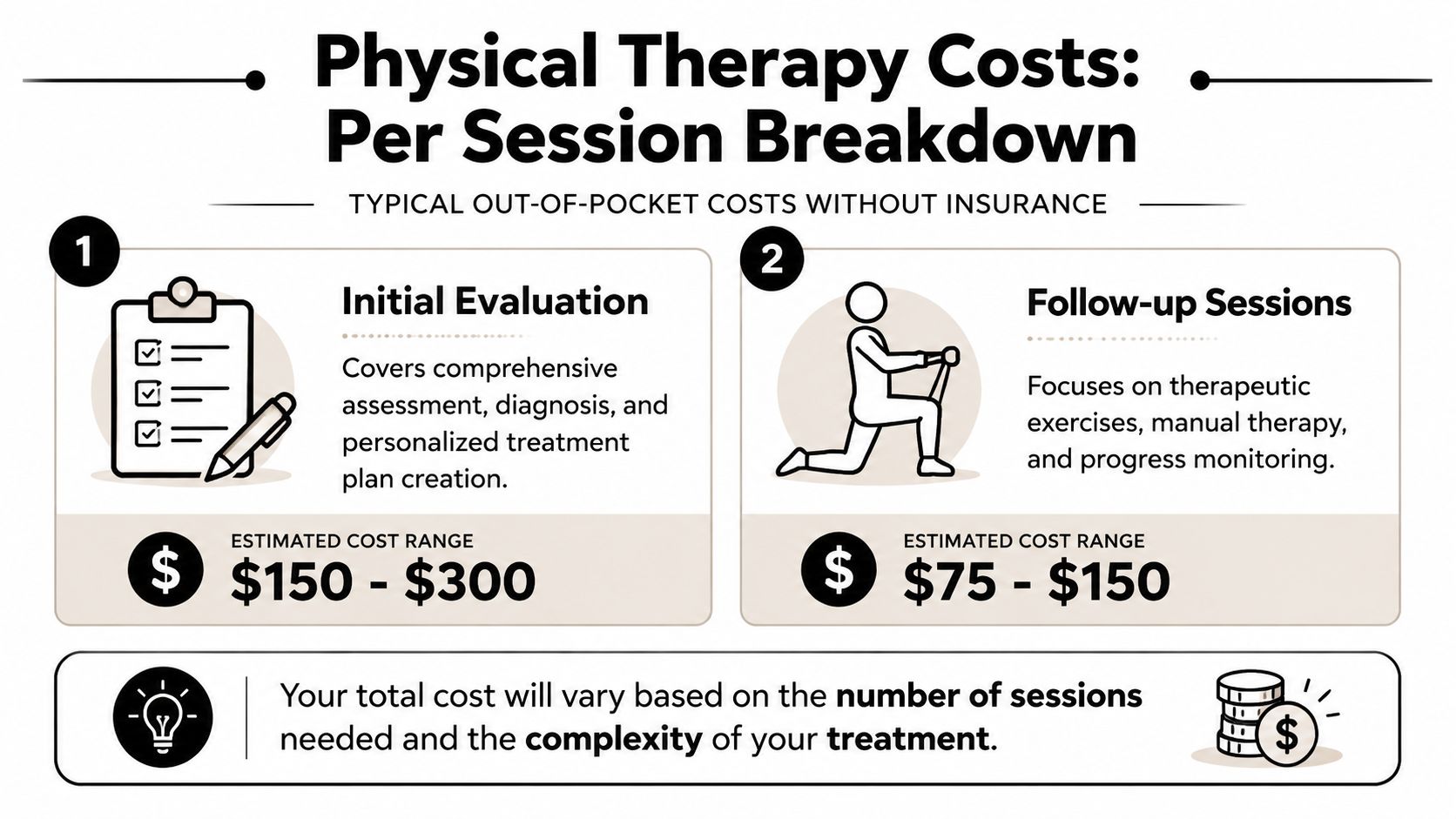
According to Miracle Rehab Clinic's 2026 pricing overview, physical therapy without insurance typically costs $75 to $350 per session, while initial evaluations average $150 to $400 because they include a thorough assessment and treatment plan development.
Those national ranges are useful, but they do not answer the question most local patients ask first. What should I expect here in South Florida? In Deerfield Beach, self-pay rates often feel higher than people expect, so it helps to ask for the evaluation fee, the follow-up fee, and the likely number of visits before you schedule.
Why the first visit costs more
The evaluation is the working visit where the therapist figures out what is driving the pain, stiffness, weakness, or loss of function. That usually means reviewing your health history, checking movement patterns, measuring strength and mobility, discussing what daily activities are limited, and deciding whether PT is appropriate right now.
If you have never been to PT before, this guide to what a typical physical therapy session looks like can help you see how the first appointment differs from a standard treatment visit.
A good evaluation can save money later. It helps prevent the common self-pay mistake of starting care without a clear goal, timeline, or plan for progress.
What follow-up visits cover
After the evaluation, treatment visits are usually narrower in scope and more focused on doing the work. These appointments may include:
- Therapeutic exercise for strength, flexibility, stability, or balance
- Manual therapy when hands-on treatment fits the condition
- Progress checks to measure change in pain, movement, or function
- Home exercise updates so treatment continues between visits
That is why the follow-up rate is often lower than the first appointment. You are paying for treatment and progression, not the full intake process.
Practical rule: Judge PT by the full plan, not by one session. The evaluation tells you what kind of plan you are buying.
Think in terms of the full course of care
One visit may help a minor flare-up, but it rarely resolves a long-standing problem. Shoulder pain that has been building for six months, sciatica that keeps coming back, or recovery after surgery usually requires a series of visits, not a one-time appointment.
The same pricing overview noted that a longer treatment schedule can add up quickly for uninsured patients. That is why I tell self-pay patients to ask one direct question early: based on my condition, am I likely looking at a short course, a moderate course, or a longer recovery plan?
That conversation matters. It gives you a clearer picture of the total cost before you commit, and it helps you compare clinics in Deerfield Beach on more than the posted visit rate alone.
Why Physical Therapy Prices Vary
Two people can both say they're getting physical therapy and still receive bills that look nothing alike. The easiest way to understand that is to think of PT pricing like building a monthly household budget. The final number isn't one thing. It's several cost layers added together.

A 2026 report on physical therapy price variation found that costs vary significantly by geography, and urban centers are often substantially higher than rural areas because of operating costs and demand. That matters in South Florida. Deerfield Beach patients may see rates that sit above what they'd find in smaller inland communities.
Location changes the baseline
Local rent, staffing costs, and demand shape the starting point before a therapist even begins treatment. The same report found median evaluation service rates ranging from $151 to $215 depending on state location, and it also noted that price differences between hospitals and clinics can be greater than the differences within a single facility type.
That means “where” you go can matter as much as “what” you're being treated for.
Treatment complexity matters
A straightforward muscle strain doesn't usually require the same care plan as post-operative rehab, advanced balance work, or a condition that needs specialized manual treatment. More complex cases tend to require more therapist time, more planning, and sometimes specialized modalities.
Costs can also rise when treatment needs are less routine, such as:
- Post-surgical recovery with tighter timelines and more progression checks
- Neurologic or balance concerns that require closer supervision
- Hands-on specialty care where the therapist's time is the main service
Experience and setting affect the bill
Some uninsured patients are surprised that a private-pay visit can cost more at one clinic than another even within the same area. Therapist experience, clinic structure, and business model all play a role. The Powers Health summary also reported that about 60% of rates negotiated with insurance companies are lower than cash prices paid by uninsured patients, which helps explain why out-of-pocket patients often feel they're paying a premium.
There are also costs beyond the visit itself. The same report highlighted hidden expenses such as travel, parking or rideshare costs, home exercise equipment, and lost wages averaging $560 during a 12-week treatment course for missed work.
A lower session rate isn't always the lower total cost if the clinic is far away, hard to schedule with, or forces you to miss more work.
For Deerfield Beach patients, that trade-off is real. A clinic that's easier to reach, easier to book, and clearer about treatment planning may be the better financial choice even if the sticker price isn't the absolute lowest.
Your Payment Options Beyond a Standard Insurance Claim
Paying out of pocket doesn't mean you have only one way to buy care. In practice, uninsured patients often have more room to shape the financial side than they expect.
The first option is simple. Ask whether the clinic offers a cash-pay or self-pay rate. Many do. Some clinics also offer prepaid bundles, which can lower the per-visit price if you know you'll need a block of treatment rather than one or two appointments.
When packages make sense
According to SpryPT's 2026 review of PT pricing, many clinics offer cash-pay packages that reduce per-session rates by 20% to 40%. Their example shows a visit priced at $150 individually dropping to $100 to $120 when purchased as part of a 12-session bundle.
That kind of structure works best when your treatment plan is fairly predictable. Sciatica, arthritis flares, post-surgical rehab, and longer mobility programs often fit that model better than a single evaluation for a minor issue.
Buying a package too early can backfire if you don't yet know whether you'll need that many visits. Ask what happens if your plan changes.
If you're trying to start care quickly without adding another medical appointment first, direct access can help. In many cases, patients can begin care without a referral. This page on physical therapy without referral explains how that option can remove an extra step and an extra bill.
Payment option comparison
| Feature | Pay-Per-Visit | Treatment Package |
|---|---|---|
| Best for | Short-term issues, uncertain diagnosis, trying one or two visits first | Longer plans, recurring pain, post-op recovery, predictable rehab |
| Upfront cost | Lower at the start | Higher at the start |
| Flexibility | High, because you decide visit by visit | Lower, because you commit to a block |
| Per-session value | Usually less favorable | Often better when discounts apply |
| Risk | Total cost can creep up if visits add on slowly | You may overbuy if your plan changes |
| Good question to ask | “What is your self-pay rate per visit?” | “If I improve faster than expected, what happens to unused visits?” |
Other ways to lower the total bill
Not every clinic advertises these, but they're worth asking about:
- Payment plans that spread the cost over time instead of requiring a large upfront payment
- Sliding-scale consideration when income limits what you can pay
- Modified frequency where the therapist spaces visits out and gives a stronger home program
- Bill negotiation if the quoted cost feels out of reach
For readers who want a practical script for those conversations, this guide on My Policy Quote on bill negotiation is a useful companion.
One local option to ask about is MedAmerica Rehab Center, which offers self-pay physical therapy for patients when insurance isn't accepted. The important part isn't the name of the clinic. It's whether the clinic gives you transparent pricing, a realistic visit plan, and room to discuss cost before treatment starts.
Lower-Cost Alternatives to Traditional Physical Therapy
Private outpatient PT isn't the only route. If cost is the main barrier, it makes sense to compare other settings and delivery models, especially if your condition is stable and you don't need intensive hands-on work every visit.

Telehealth for the right cases
Sword Health's discussion of PT pricing models notes that telehealth physical therapy can cut costs by 30% to 50% per session, with visits often ranging from $50 to $100. The same source states that in-home therapy carries a 25% to 50% premium, which is why home visits are usually less budget-friendly unless travel or mobility limits make them necessary.
Telehealth can work well for exercise progression, mobility coaching, posture review, and some chronic pain management. It's less useful when the patient needs hands-on care, manual assessment, balance guarding, or close in-person supervision.
Other alternatives worth considering
A lower-cost provider isn't always a lower-quality provider. It depends on your needs, how closely you'll be supervised, and whether the format matches your condition.
- University clinics can be a smart option when student clinicians work under licensed supervision. These settings may suit straightforward orthopedic cases and patients who can be flexible with scheduling.
- Community health centers sometimes offer rehab services or can point patients toward local low-cost networks.
- Hospital-based aid programs may help with related medical costs even if PT access itself is limited.
- Home programs with periodic check-ins can reduce visit frequency when a patient is reliable and the condition is improving steadily.
The trade-off that matters most
Many individuals focus only on price per visit. That's understandable, but it can be shortsighted. The better question is whether the format gives you the level of guidance you need to improve safely and stay consistent.
A telehealth visit may cost less, but if your main problem is gait instability after surgery, in-person care may still be the better value. A cheaper option that doesn't fit your condition can drag recovery out and increase the total cost in time, frustration, and missed activity.
Choose the least expensive option that still gives you the right level of clinical support.
How MedAmerica Rehab Center Makes Care Accessible in Deerfield Beach
Deerfield Beach patients don't need a generic national answer. They need a local clinic that understands South Florida scheduling, common injury patterns, and the fact of paying for care while trying to keep life moving.

MedAmerica Rehab Center has served Deerfield Beach since 1995 with physical therapy, chiropractic care, acupuncture, and shockwave therapy. For patients paying directly, the practical advantage is straightforward. One location can coordinate care for back pain, neck pain, sciatica, arthritis, post-surgical rehab, balance training, and accident-related recovery without sending the patient through a fragmented process.
What accessible care looks like in real life
Accessible care isn't only about offering a self-pay option. It's also about reducing confusion.
That usually means:
- Clear first-visit expectations so patients know what evaluation day involves
- Realistic treatment planning based on symptoms, function, and budget
- Same-day appointment availability when pain can't wait two weeks
- A comfortable local setting that makes repeat visits easier to sustain
For local readers comparing providers, the clinic's physical therapy services in Deerfield Beach show the range of conditions and rehab goals commonly treated there.
Why operations matter to patients
Patients don't always think about the behind-the-scenes side of a clinic, but smooth scheduling and communication can lower the hidden cost of care. A practice that runs efficiently is less likely to waste your time or delay treatment. For anyone curious about that operational side, this article on virtual support for independent medical practices offers a useful look at how clinics improve responsiveness and patient coordination.
The main takeaway for Deerfield Beach residents is simple. Affordable care isn't just the lowest posted number. It's care you can start, understand, and stick with.
Frequently Asked Questions About PT Costs
Is it cheaper to skip the evaluation and just book treatment?
Usually no. The evaluation is where the therapist determines what's causing the problem and what kind of plan makes sense. Skipping that step often leads to inefficient care.
Should I choose the cheapest clinic I can find?
Not automatically. A lower rate can be a good fit, but it's worth asking about scheduling availability, treatment style, and whether the clinic gives you a clear estimate for the likely plan of care.
Are cash-pay packages always the best deal?
They can be, especially for longer recovery plans. But they make the most sense when your condition is predictable enough that you're likely to use the visits.
Is telehealth enough for back pain or arthritis?
Sometimes. It can work well for exercise instruction, mobility work, and progress monitoring. It's less appropriate when you need hands-on treatment or close in-person supervision.
What should I ask before I book?
Start with these:
- What does the first visit cost?
- What is your self-pay rate for follow-up visits?
- Do you offer packages or payment plans?
- How many visits do you typically recommend at the start?
- Can I start without a referral?
Can physical therapy still be worth it if I'm uninsured?
Yes, if the plan is targeted and financially realistic. The best out-of-pocket care plans are clear, focused, and built around both your symptoms and your budget.
If you're dealing with pain and trying to make a smart financial decision, MedAmerica Rehab Center is a local Deerfield Beach option where you can ask about self-pay care, first-visit expectations, and practical treatment planning before you commit.
MedAmerica Rehab · Deerfield Beach
Talk to a clinician about your pain
Physical therapy, chiropractic, acupuncture and shockwave therapy under one roof, since 1995. Same-day appointments are available.
Mon–Thu 8:00 AM – 6:30 PM · Fri 8:00 AM – 3:00 PM