

Expert Neuro Physical Therapy in Deerfield
You may be dealing with something that doesn’t make sense yet. Your leg feels heavy, but you didn’t injure it. You stand up and drift to one side. Your hand works for some tasks but seems to forget how to do others. Maybe this started after a stroke, a concussion, a spinal issue, an illness, or a long stretch of weakness and imbalance that has slowly chipped away at your confidence.
That kind of change is unsettling because it doesn’t behave like a simple muscle strain. Rest alone doesn’t fix it. Pushing harder often makes it worse. The problem can feel invisible to everyone else while it disrupts walking, driving, showering, working, and even getting out of a chair.
Neuro physical therapy exists for exactly this situation. It helps when the issue isn’t just strength or flexibility, but the communication between the brain, spinal cord, nerves, and muscles. The work is specific, measurable, and practical. The goal isn’t to “exercise more.” The goal is to retrain movement so your body becomes more reliable again.
Reconnecting Your Brain and Body
A common story in the clinic starts with a small moment. Someone reaches for a coffee mug and misses the handle. Someone else turns too quickly in the kitchen and has to grab the counter. Another person finishes formal medical care after a stroke or neurological event, then realizes the hardest part is now daily life.
What all of these people share is uncertainty. They often say the same thing in different words: “I can move, but I don’t trust my body.”
That’s where neuro physical therapy changes the conversation. Instead of asking only whether a joint is stiff or a muscle is weak, it asks better questions. How is your nervous system organizing movement? Which signals are getting through cleanly, and which aren’t? What task breaks down first, and under what conditions?
When movement feels unfamiliar
Neurological symptoms can look inconsistent from the outside. You may walk well down a hallway, then freeze when turning. You may have enough strength to lift your arm, but not enough control to button a shirt. That mismatch frustrates people because it feels unpredictable.
In practice, these problems are often trainable. The nervous system can learn through repetition, feedback, and the right level of challenge. That’s the same principle behind neuromuscular re-education. The body isn’t just being strengthened. It’s being taught.
Practical rule: If a symptom changes with attention, position, speed, or environment, it usually deserves a neurological movement assessment, not guesswork.
What patients usually need first
Many patients and caregivers do not require a lecture on the nervous system. They need to know three things:
- What’s happening: Their symptoms have a pattern, even if that pattern isn’t obvious yet.
- What can improve: Balance, coordination, walking, transfers, and confidence often respond to targeted training.
- What the work looks like: Recovery usually comes from guided practice, not passive treatment alone.
That’s why good neuro PT feels less mysterious than people expect. It turns a frightening problem into a series of observable tasks. Sit to stand. Turn. Reach. Step over something. Walk while looking left and right. Regain control one function at a time.
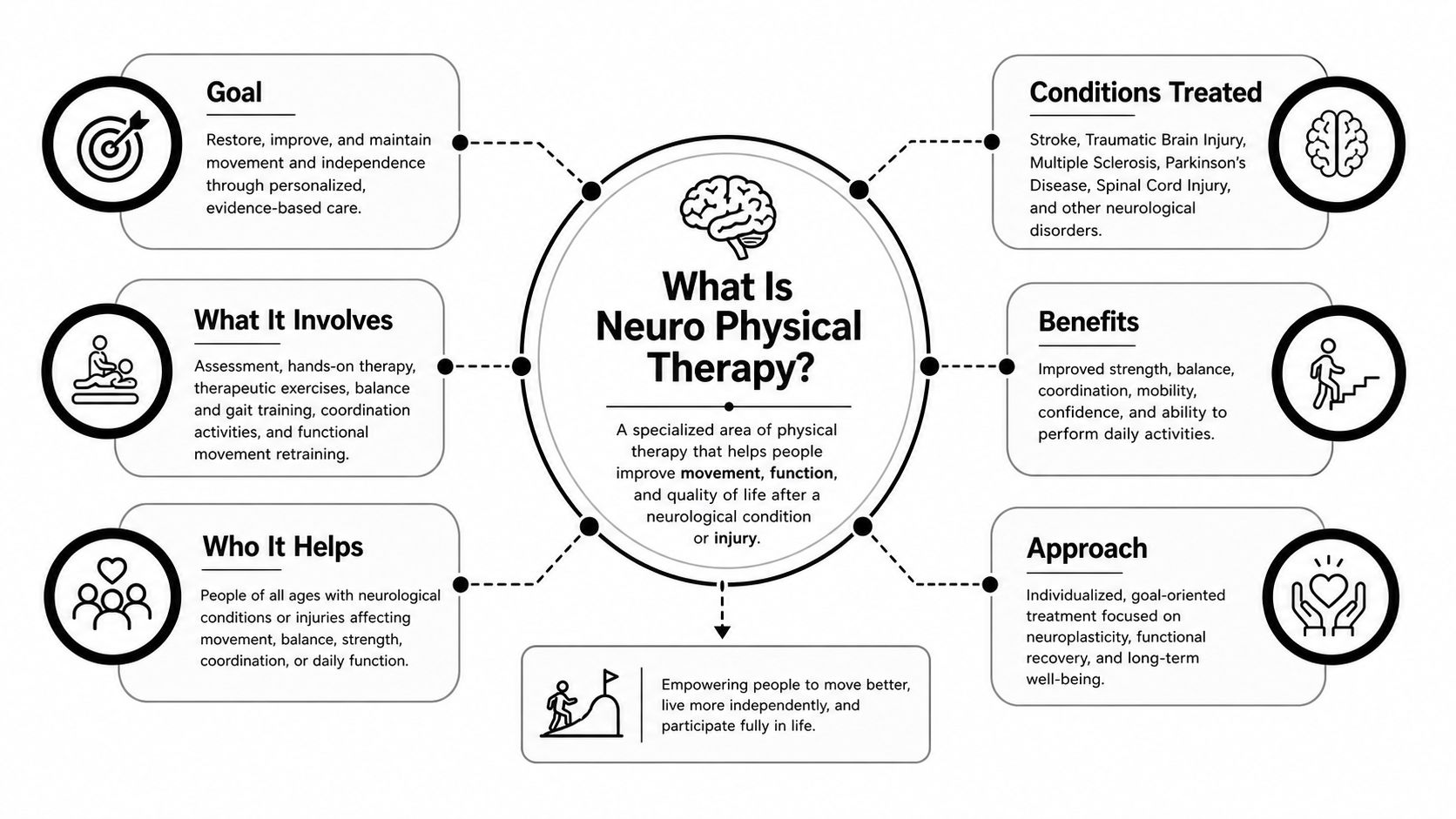
What Is Neuro Physical Therapy
Neuro physical therapy is physical therapy focused on the nervous system. If orthopedic rehab often deals with the body’s hardware, joints, tendons, post-surgical tissues, neuro rehab deals with the software that tells the body how to move. Both matter. They solve different problems.
An easy analogy is this: a neuro physical therapist works a bit like an electrician tracing a faulty circuit. The light bulb may be fine, but if the wiring is disrupted, the light still flickers. In the body, the muscle may still exist, but if the signal from the brain or spinal cord is poorly timed, weak, or disorganized, movement becomes inefficient, unsafe, or exhausting.
What makes it different
Neuro physical therapy uses repetition, sensory input, task practice, and movement problem-solving to support neuroplasticity, the brain’s ability to reorganize pathways. That concept didn’t appear overnight. The field became more defined over decades, and the formal recognition of neurologic physical therapy as a specialty in 1985 marked a significant milestone, enabling specialized certification and elevating standards for treating neurological conditions according to this history of physical therapy specialization.
That matters for patients because it means this isn’t a vague wellness service. It’s an established specialty with a specific clinical framework.
Conditions neuro PT commonly addresses
Neuro physical therapy can help people dealing with a wide range of movement problems tied to the nervous system, including:
- Stroke-related deficits: Weakness, foot drag, arm dysfunction, balance loss, and gait changes
- Parkinsonian movement issues: Slowed movement, shuffling, turning difficulty, freezing, and postural instability
- Vestibular disorders: Dizziness, motion sensitivity, and balance problems
- Spinal cord and nerve-related dysfunction: Mobility loss, coordination changes, and transfer difficulty
- Brain injury and concussion-related symptoms: Balance issues, sensory overload, and movement control problems
- Post-viral or post-COVID neurologic complaints: Fatigue, poor endurance, and coordination changes
Some people also come in for pain conditions that have a neurological component, such as sciatica, gait decline after a fall, or weakness after an accident. In those cases, neuro PT may overlap with orthopedic care, but the treatment focus is still on restoring cleaner movement patterns.
What good care should feel like
A strong neuro PT plan shouldn’t feel random. It should connect exercises directly to a life task you care about.
The best sessions don’t just make you tired. They make a daily activity easier.
If you want a broader outside perspective on how this kind of retraining is approached, Orange Neurosciences neurorehabilitation offers a useful overview of the principles behind neurological recovery.
How Neuro Physical Therapy Techniques Work
Neuro PT works best when treatment matches the specific movement problem in front of you. That sounds obvious, but it’s where many people get off track. Generic stretching, random strengthening, or machines without a functional purpose often leave patients working hard without changing the fundamental task.
The techniques below are common because they connect directly to function. They target walking, transfers, reaching, balance reactions, head movement tolerance, and task control.
Four techniques that matter in practice
One of the most useful tools is gait and balance training. This includes weight shifting, stepping strategies, turning practice, obstacle negotiation, uneven-surface work, and cueing for posture and foot placement. It helps people who feel unsteady, rush because they’re afraid of falling, or can’t manage changes in direction.
Another key method is neuromuscular re-education. This is structured practice that retrains timing, coordination, and muscle recruitment. A person may have enough raw strength to lift a leg, but still fail to clear the foot during walking because the pattern is off. Re-education focuses on the pattern, not just the muscle.
Vestibular rehabilitation is different again. It helps when dizziness, visual motion sensitivity, and head movement throw off balance. Treatment often uses gaze stabilization, positional work, and progressive exposure to motion that the brain has started to interpret poorly.
Then there is task-specific training. This is exactly what it sounds like. If you need to get up from a low chair safely, therapy should include low-chair practice. If you need to reach into a cabinet without losing balance, that exact task belongs in treatment.
Where PNF fits
Proprioceptive Neuromuscular Facilitation (PNF) is especially useful in neuro rehab because it uses diagonal movement patterns and multi-sensory input to improve motor control. According to Physio-Pedia’s overview of neurology treatment techniques, PNF has been shown in studies to outperform other methods in improving gait speed and reducing spasticity after a stroke.
That matters because human movement rarely happens in straight lines. Reaching for a seat belt, pulling a shirt over your head, stepping into a bathtub, or turning while carrying groceries all involve rotation and coordinated patterns. PNF gives therapists a way to train those real-world motions.
A useful sign of progress is when a movement that once needed step-by-step concentration starts to happen with less effort and fewer corrections.
Core Neuro Physical Therapy Techniques
| Technique | What It Is | Helps With Conditions Like… |
|---|---|---|
| Gait and balance training | Practice for stepping, turning, weight shifting, posture, and fall recovery strategies | Stroke, Parkinson’s, fall risk, post-concussion imbalance, general neurologic gait decline |
| Neuromuscular re-education | Training to improve timing, coordination, and muscle activation patterns | Weakness after stroke, nerve-related movement loss, post-injury coordination problems |
| Vestibular rehabilitation | Exercises for gaze control, dizziness, head motion tolerance, and sensory integration | Vertigo, vestibular disorders, concussion-related dizziness, motion sensitivity |
| Task-specific training | Rehearsing meaningful daily activities under therapist guidance | Transfers, stair climbing, reaching, dressing, kitchen tasks, work-related movement demands |
| PNF | Diagonal movement patterns with tactile, visual, and verbal input | Hemiparesis, spasticity, impaired reaching, gait deficits, motor control problems |
What usually doesn’t work
Three things commonly slow recovery:
- Too much passive care: Hands-on treatment can help, but it can’t replace active practice.
- Exercises that are too easy: The nervous system needs meaningful challenge to adapt.
- Exercises that are too hard or too fast: If form collapses, the body practices the wrong pattern.
The sweet spot is targeted repetition with enough support to be safe and enough challenge to require change.
Your Treatment Journey and What to Expect
The first visit is usually the point where things become less intimidating. Instead of trying to describe your symptoms in general terms, you and the therapist start measuring what your body is doing under specific conditions. That creates a baseline. It also gives you a way to see progress that isn’t based on guesswork.

What happens at the evaluation
A neuro PT evaluation usually looks at walking, balance, transfers, posture, coordination, sensation, and how symptoms change with attention or fatigue. Therapists also use standardized tests to make the picture clearer.
The Core Outcome Measures Clinical Practice Guideline recommends tools such as the Berg Balance Scale, Functional Gait Assessment, 10 Meter Walk Test, 6 Minute Walk Test, and 5 Times Sit to Stand for many neurologic patients. The guideline notes that a Berg Balance Scale score below 45/56 indicates significant fall risk, which gives treatment a concrete target to work toward, as outlined in the ANPT Core Outcome Measures guideline.
These tests matter because they translate symptoms into something observable. “I feel off balance” becomes “turning right is less stable than turning left.” “I get tired quickly” becomes a measurable walking endurance issue. That precision makes treatment better.
What the plan often looks like
Neurological recovery usually asks for patience. The history of the field shows that recovery timelines for neurological conditions often span months to years, while many orthopedic problems may resolve in 6 to 12 weeks, as discussed in this history of physical therapy and neurorehabilitation. That doesn’t mean progress is slow every day. It means the path is usually steadier than people expect, not instant.
A treatment plan often includes:
- Repeated task practice: Sit to stand, turning, stepping, reaching, stair work
- Balance progression: Stable surfaces first, then more complex environments
- Walking work: Speed control, symmetry, foot clearance, endurance, and direction changes
- Home carryover: A short program that matches the clinic goals
If you’re wondering what the rhythm of care feels like from session to session, this overview of what a typical physical therapy session looks like helps set expectations.
A realistic local example
A common Deerfield Beach patient profile is a senior who hasn’t fallen yet, but has started avoiding walks because curbs, crowds, and quick turns feel risky. At the evaluation, the person may score below the fall-risk threshold on the Berg Balance Scale, move cautiously during the 10 Meter Walk Test, and need extra time for sit-to-stand transitions.
Treatment doesn’t start with advanced drills. It starts with safe transfers, weight shifting, stepping reactions, and walking tasks that expose the specific breakdown. Over time, the person often moves from “I don’t want to go out alone” to “I can walk at the park again if I pace myself and use the strategies we practiced.”
Progress in neuro rehab often shows up first as confidence. Then the confidence allows more movement, and the movement builds capacity.
Continuing Progress with Your Home Exercise Program
Clinic sessions create the framework. Home practice is what helps the nervous system keep that work. Without carryover, it’s common for people to perform well in treatment but lose consistency in daily life.
That doesn’t mean a home program should be long, complicated, or exhausting. In fact, the best plans are usually simple enough to repeat regularly and specific enough to connect with your actual limitations.

What a useful home program includes
A strong home exercise program often includes a mix of mobility, control, and functional repetition. Depending on the condition, that might mean:
- Supported balance work: Standing with a stable counter nearby while practicing weight shifts or controlled head turns
- Transfer practice: Repeated sit to stand with attention to foot position and momentum
- Walking drills: Short bouts focused on step length, foot clearance, or pacing
- Reach and coordination tasks: Guided arm patterns, object transfer, or cabinet-height reaching
The point isn’t to fill time. The point is to repeat the exact signals you want the nervous system to recognize and keep.
Why hybrid care works well
This matters even more in long-term conditions. For Post-COVID syndrome, where 30 to 50 percent of survivors have ongoing neuro symptoms, home-based maintenance is critical. Emerging hybrid home-clinic models have been shown to improve adherence by 40 percent and reduce falls by 25 percent in similar chronic neurological populations, according to this outpatient neuro rehab overview.
That hybrid model works because people need both things. They need skilled progression in the clinic, and they need a realistic structure at home. One without the other often falls short.
What patients often get wrong at home
The biggest home-program mistakes aren’t laziness. They’re usually design problems.
- Doing too much: Fatigue changes movement quality. More reps aren’t better if the pattern falls apart.
- Doing the wrong task: General fitness has value, but it won’t automatically improve a specific gait or balance deficit.
- Stopping once symptoms ease: Early gains are fragile if the pattern hasn’t stabilized.
A good therapist adjusts the home plan as your body changes. Early on, you may need very supported drills. Later, the same program may shift toward dual-task balance, longer walks, or community-level movement demands.
Getting Started with Neuro PT in Deerfield Beach
People often wait because they aren’t sure where to begin. They wonder whether they need a referral, whether insurance will cooperate, whether the clinic sees their type of problem, or whether it’s “too early” or “too late” to start. Those delays are understandable, but they can also keep a treatable movement problem in place longer than necessary.
What makes the first step easier
Finding a Neurologic Clinical Specialist can be difficult in some areas, and access barriers often slow care. For Deerfield Beach patients, the practical advantage is local access. As noted by ANPT patient resources for finding a neurologic physical therapist, timely access matters, and local expert care helps patients avoid delays that can affect recovery for conditions ranging from stroke to sciatica.
If you’re ready to act, keep the first step simple:
- Call and describe the main problem clearly. Say what changed first. Balance, walking, dizziness, weakness, coordination, or recovery after a neurological event.
- Have your practical details ready. Bring insurance information, referral information if you have it, medication lists, and any recent imaging or discharge paperwork.
- Name the life task you want back. Not just “less pain.” Think “walk safely in the grocery store,” “get out of bed without help,” or “return to work with better balance.”
What to expect from the first conversation
A good clinic call should reduce confusion, not add to it. You should leave knowing how scheduling works, what to bring, and what the evaluation is likely to focus on. If you want to review local options ahead of time, the page for physical therapy in Deerfield Beach gives a practical overview.
The most important point is this: if your body no longer feels dependable, that is enough reason to ask for a neurological movement assessment.
Frequently Asked Questions
Do I need a doctor’s referral for neuro physical therapy in Florida
That can depend on your insurance plan and your medical situation. Some patients can start with direct access, while others need a referral for coverage or care coordination. The safest move is to call the clinic and ask what applies to your case before the first visit.
Will neuro PT only help if I’ve had a stroke
No. Stroke is one common reason for referral, but neuro physical therapy also helps with dizziness, balance loss, gait decline, post-concussion issues, nerve-related weakness, Parkinsonian movement problems, spinal cord involvement, and post-viral neurologic symptoms.
Is neuro PT the same as regular physical therapy
Not exactly. Standard physical therapy often centers on joints, tissues, pain, and orthopedic recovery. Neuro PT focuses more directly on movement control, coordination, sensory processing, balance, and the communication between the brain, nerves, and muscles.
How long does treatment usually last
It depends on the condition, severity, and goals. Some people need a shorter focused plan. Others need a longer progression, especially when balance, walking endurance, or neurologic recovery has been affected for a while.
Does insurance usually cover it
Coverage varies by plan, diagnosis, and referral requirements. Medicare, commercial insurance, auto accident claims, and workers’ compensation cases can all follow different rules. It’s worth verifying benefits before the first appointment so there are no surprises.
Why do patients choose MedAmerica Rehab Center
Patients often want one place that can evaluate movement problems carefully, explain them clearly, and build a plan that feels practical. MedAmerica Rehab Center offers multidisciplinary, patient-centered care in Deerfield Beach, with physical therapy, chiropractic care, acupuncture, and advanced treatment options designed to help people move better without unnecessary medication or surgery. If you’re dealing with balance issues, weakness, post-accident symptoms, or lingering neurologic movement changes, reaching out is a straightforward way to get answers and a plan.
MedAmerica Rehab · Deerfield Beach
Talk to a clinician about your pain
Physical therapy, chiropractic, acupuncture and shockwave therapy under one roof, since 1995. Same-day appointments are available.
Mon–Thu 8:00 AM – 6:30 PM · Fri 8:00 AM – 3:00 PM