
Work Hardening Therapy: Safe Return to Work
You may be in a frustrating spot right now. Your pain is better, your doctor may be saying the injury has healed enough, and yet the thought of going back to a full shift still feels risky.
That feeling is common. A lot of people aren't stuck because they’re lazy or because they’ve “failed” rehab. They’re stuck because there’s a big difference between doing okay in a clinic for an hour and handling a real workday with lifting, standing, twisting, reaching, pacing, repetition, deadlines, and the simple pressure of having to trust your body again.
That’s where work hardening therapy fits. It’s the bridge between basic recovery and real job readiness.
What Is Work Hardening and How Does It Help You
A patient with a back injury often tells me the same thing in different words: “I’m better, but I’m not ready.” They can walk. They can do some exercises. They may even have less pain than they did a few weeks ago. But they still can’t picture themselves loading boxes, climbing in and out of a vehicle, standing at a station all day, or doing repetitive overhead work without flaring up.
That gap matters.

Work hardening therapy is a structured return-to-work program designed to rebuild the physical ability, stamina, and confidence needed for your actual job. It isn’t just exercise. It’s targeted training that uses work-like tasks, measured progression, and a team-based approach to prepare you for a safe return to duty.
The real purpose
Think of it as a training camp for your job. The goal isn’t to make you “good at therapy.” The goal is to help you handle the actual demands waiting for you at work.
A foundational 1991 demographic study on work-hardening and work-adjustment programs described how these programs grew into a core part of rehabilitation for injured workers, using multidisciplinary teams and equipment that could replicate workplace tasks. That matters because injured workers usually don’t need generic exercise alone. They need a plan that connects treatment to the job they’re expected to do.
Why people need it even after regular rehab
Standard rehab helps reduce pain, improve mobility, and restore basic strength. But many jobs ask for more than “basic.” They ask for repeat lifting, awkward postures, pushing, pulling, crouching, climbing, sustained standing, or steady hand use for hours.
Work hardening fills that final gap by helping you practice those demands in a controlled setting before you face them on the clock.
Practical rule: If you can complete exercises in therapy but still doubt you can finish a shift safely, that’s often where work hardening becomes useful.
What it changes for you
Work hardening helps in three ways at once:
- Physical readiness: You rebuild strength, endurance, and movement tolerance for job tasks.
- Mental readiness: You test your body in a safe setting, which helps reduce fear of reinjury.
- Functional readiness: You stop guessing whether you’re ready and start measuring it.
That last point is important. People usually feel less anxious when progress becomes concrete. Instead of asking, “Will I make it through work?” you start asking better questions, like, “Can I lift this safely?” or “How close am I to the demands of my position?”
Inside a Work Hardening Program The Key Components
A strong program isn’t random. It has a structure, and every part should tie back to what your job requires.
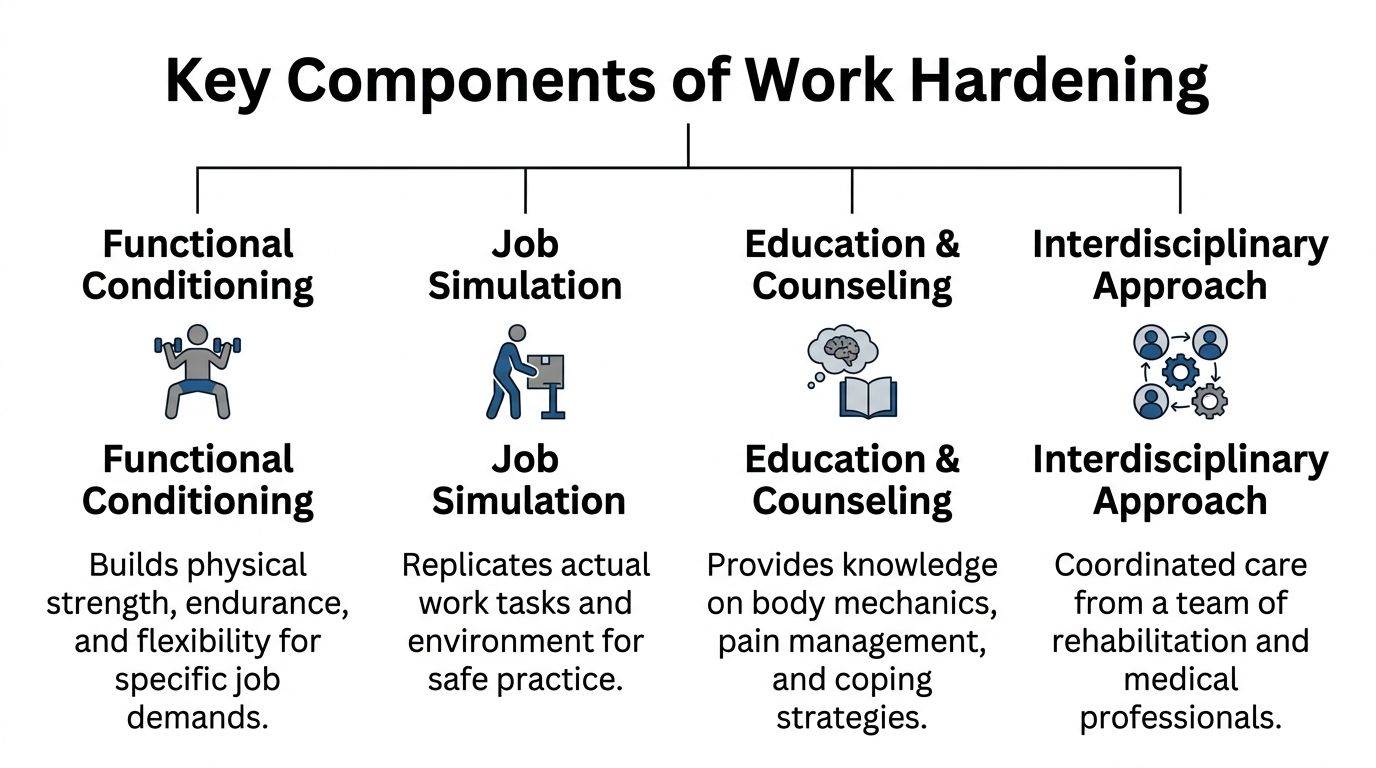
Work hardening uses a data-driven progression model. It starts with an individual baseline, applies medium to high intensity conditioning, and pairs that with stretching, mobility work, and job-task simulation matched to the worker’s job classification, as described in this overview of job-task simulation in work hardening. That’s one reason return-to-work decisions are stronger when they’re based on function instead of guesswork.
Functional conditioning
This is the physical engine of the program. You rebuild the capacity that fades when you’ve been off work, protecting an injury, or avoiding certain movements for too long.
A typical session may include:
- Strength training: Lifting, carrying, pushing, pulling, and controlled resistance work based on your job demands.
- Cardiovascular conditioning: Treadmill work, bike intervals, or sustained movement to rebuild workday endurance.
- Tolerance training: Practicing standing, walking, reaching, kneeling, or sitting for longer periods.
This part works best when it’s specific. If your job requires repeated waist-level lifting, your plan should train that. If you sit for long periods and then need to stand and move quickly, that should be part of the progression too.
Job simulation
This is the heart of work hardening therapy. It’s where rehab starts to look like work.
Instead of doing only generic strengthening, you practice the movements, positions, and task sequences your body will face on the job. That may include lifting from floor to waist, carrying objects across set distances, pushing carts, bending into low spaces, using hand tools, reaching overhead, or moving through repeated task cycles.
The best simulation doesn’t just copy the motion. It also copies the pace, posture, and fatigue that make the job hard in real life.
That’s why broad strengthening alone often falls short. A patient may be stronger in the clinic but still struggle when a task requires twisting while carrying, repeated stooping, or sustained grip over time.
When rehab includes both physical training and practical occupational therapy support, patients usually understand their own work mechanics better. They stop seeing movement as dangerous and start seeing it as trainable.
Flexibility and mobility work
Mobility doesn’t get enough attention until a person returns to work and realizes they can’t move efficiently enough to keep up.
This part of the program focuses on restoring the range and quality of movement needed for safe body mechanics. Depending on the injury and the job, that can include hip mobility, spinal mobility, shoulder motion, ankle flexibility, and movement sequencing.
Here’s what flexibility work should do in a work hardening plan:
- Improve access to safe positions so you aren’t compensating through painful or weak areas.
- Reduce strain during repetitive tasks by making movement more efficient.
- Prepare the body before higher-load simulation so training is safer and more productive.
Education and coaching
A lot of reinjury risk comes from poor pacing, poor body mechanics, and poor decision-making under fatigue. Education helps with all three.
This part often includes:
- Body mechanics training: How to lift, carry, pivot, push, and pull with less strain.
- Pain response coaching: How to tell the difference between effort, soreness, and warning signs.
- Pacing strategies: How to build tolerance without overdoing it on a “good” day.
- Work habit retraining: How to set up your movement, posture, and workflow more safely.
Not every patient needs long lectures. Most need short, practical coaching that applies immediately. The most effective instruction sounds less like a classroom and more like this: adjust your stance, bring the load closer, break the task into steps, breathe, reset, and go again.
How Work Hardening Differs From Other Therapies
People often assume work hardening is just “more physical therapy.” It isn’t. It’s a different level of rehabilitation with a different target.
Traditional physical therapy usually focuses on healing tissue, reducing pain, restoring motion, and improving basic strength. That’s necessary early on. But if your job is physically demanding, standard PT may not fully prepare you for the repeated load and duration of a workday.
The biggest difference is scope
Work hardening uses a multidisciplinary, team-based approach and typically starts at 4-hour sessions, 5 days per week, then progresses toward 8-hour daily sessions over 4 to 8 weeks, according to this description of work hardening program structure. That higher intensity is meant to address whole-body deconditioning and psychosocial barriers, not just one injured body part.
Standard PT usually doesn’t try to replicate a shift. Work hardening does.
Side-by-side comparison
| Attribute | Standard Physical Therapy | Work Conditioning | Work Hardening |
|---|---|---|---|
| Primary goal | Reduce pain, improve motion, restore basic function | Build physical tolerance for work activity | Restore full work capacity with physical and psychological readiness |
| Main focus | Injury-specific treatment | Physical reconditioning | Job simulation plus conditioning plus behavioral support |
| Typical intensity | Lower and shorter sessions | Moderate progression | Higher-intensity progression that can build toward a full workday |
| Team involvement | Often one discipline | Usually rehab-focused | Interdisciplinary team, often including physical and psychosocial input |
| Job simulation | Limited or general | Some work-related activity | Central feature of the program |
| Return-to-work decision | Often based on healing and general function | Based on improving work tolerance | Based on objective work-capacity performance and task readiness |
Where work conditioning fits
Work conditioning sits in the middle. It’s more work-focused than standard PT, but it usually concentrates on physical restoration rather than the broader return-to-work picture.
That means work conditioning can be a good fit when someone mainly needs strength and endurance. Work hardening tends to fit better when the person also needs task simulation, tolerance to longer sessions, and support around fear, confidence, pacing, or inconsistent performance.
When standard PT isn't enough
A desk worker recovering from a mild strain may do well with traditional rehab alone. A warehouse worker, nurse, driver, mechanic, construction worker, or anyone whose job involves repeated physical demand often needs more.
That’s the practical trade-off. Standard PT is efficient for early recovery. It’s not designed to test whether you can safely handle a demanding shift. Work hardening is.
For patients who are trying to understand where these services overlap and where they separate, this overview of physical therapy, chiropractic therapy, and occupational therapy differences helps clarify the broader rehab picture.
If your question is “Has my injury improved?” standard rehab may answer it. If your question is “Can I do my job again, safely and consistently?” work hardening is built for that.
Is Work Hardening Right for You? The Referral Process
You may be at the point where the injury is healing, but work still feels uncertain. You can get through basic daily tasks, then hit a wall when you picture lifting, pushing, reaching, climbing, standing for hours, or keeping pace through a full shift. That gap is often where work hardening enters the plan.

I explain it to patients this way. The referral is not just a form that sends you to another clinic. It is a decision that your recovery now needs to be tested against your actual job. At MedAmerica, that matters because the program is built around more than the injured body part. We look at physical capacity, pacing, fear of re-injury, consistency from day to day, and whether you can perform work tasks with enough confidence to return safely.
Work hardening may be appropriate after a workers’ compensation injury, surgery, an auto accident, or a long stretch of back, neck, shoulder, or joint pain. The question is simple: does your current function match what your job requires?
Signs you may be a candidate
Several patterns come up again and again in the clinic:
- You have improved, but a full workday still feels out of reach. Home activity is easier, yet job tasks still seem too heavy, too repetitive, or too long.
- Your job has clear physical demands. Healthcare workers, warehouse staff, drivers, mechanics, tradespeople, and similar roles often need job simulation, not just symptom reduction.
- Your performance changes too much from one day to the next. A good day is not the same as dependable work readiness.
- Someone needs objective answers. Your physician, employer, adjuster, or case manager may want clearer information about what you can safely do now.
There is also a psychological side that patients often underestimate. If you have started guarding, avoiding certain movements, or worrying that one wrong task will set you back, that deserves attention. A strong program addresses that directly instead of pretending recovery is only about strength.
How the process usually works
The referral path is usually straightforward.
Your provider identifies a work-readiness gap.
That may happen when progress has stalled in standard rehab, or when the medical team sees that symptom improvement has not yet translated into job capacity.Your current abilities are measured.
Many cases begin with a functional capacity evaluation (FCE), which looks at lifting, carrying, positional tolerance, movement quality, endurance, and other work-related abilities.The case is reviewed and authorized if needed.
In workers’ compensation cases, the physician, adjuster, nurse case manager, or employer may all be part of that discussion. If you are dealing with a claim, this guide to workers’ compensation rehabilitation can help you understand the process.The therapy team builds the program around your job.
That includes your injury, your current tolerance, the tasks your job requires, and the barriers that could keep you from returning with confidence.
The trade-off is straightforward. Starting too early can flare symptoms and reinforce fear. Waiting too long can lead to more deconditioning, more doubt, and a harder return. Good referrals happen when healing is far enough along for work-focused training, but function is still short of job demand.
Questions to ask before you start
Ask direct questions before the first session:
- Which job tasks will be simulated, and how closely do they match my work?
- How will you measure progress week to week?
- What do you do if symptoms increase after training?
- Who updates my doctor, employer, or case manager?
- How do you address fear, hesitation, or inconsistent effort if those are part of the problem?
Those answers tell you a lot. A strong program should connect medical recovery, work simulation, and return-to-work planning in a way that feels organized and realistic.
A short video overview can also help make the process less abstract before you begin:
The best referrals set up more than treatment. They set up a safer return to work, with clearer expectations, better communication, and fewer surprises once you are back on the job.
What to Expect Timeline Outcomes and Lasting Results
Individuals typically seek the same answers at the outset: how long will this take, and what am I likely to gain from it?
The honest answer is that progress depends on the injury, the job, and how much deconditioning has happened. Still, work hardening therapy follows a recognizable pattern. Programs commonly run for 4 to 8 weeks, starting around 4-hour sessions and progressing toward 8-hour days, based on tolerance and job demand, as reflected in the work hardening descriptions discussed earlier.
What the progression often feels like
Early on, the program usually feels more tiring than painful. That surprises people. They expect the main challenge to be their injured body part, but the bigger issue is often overall work tolerance.
As the weeks go on, you should notice clearer patterns:
- Tasks feel less threatening
- Recovery after activity improves
- Movement becomes more efficient
- Confidence stops swinging as much from day to day
That doesn’t mean every session feels easy. In fact, if the program is appropriate, it should challenge the exact capacities you’ll need at work.
What the evidence shows
A retrospective study published in 2005 looked at 312 clients in a work hardening setting and found statistically significant improvements across all six outcome measures, including disability, depression, pain, lifting, carrying, and Waddell’s Sign, according to the published PubMed summary of the study. The same study reported measurable gains such as improved lifting capacity by 20% to 50% over 2 to 8 weeks, and successful completion was associated with return-to-work rates that often exceeded 60% for full-duty roles in optimized clinics.
Those numbers matter, but the underlying clinical value is what they represent. Work hardening can improve more than one variable at a time. Better lifting often goes with lower pain, better carrying tolerance, and improved confidence in the body’s ability to perform.
Recovery isn’t just “less pain.” It’s being able to do more with less hesitation and more control.
What lasting results depend on
Short-term success is one thing. Staying successful after discharge is another.
The patients who do best long term usually keep a few habits:
- They continue some form of strength and mobility work
- They apply the pacing and body mechanics they practiced
- They respect warning signs without becoming fearful of movement
- They ease back into workload when possible instead of trying to prove too much on day one
What doesn’t work is treating discharge like a finish line where all structure disappears. The program builds capacity. You still need to use it well once you’re back on the job.
Why Choose MedAmerica for Your Work Hardening Therapy
A work hardening program only works as well as the team running it. The plan has to be specific, the communication has to be clean, and the progression has to reflect the demands of the patient’s job.
That’s where many patients get frustrated elsewhere. They’re given exercise, but not enough simulation. They get activity, but not enough guidance. Or the clinic treats the injury while ignoring the fear, hesitation, and work-specific barriers that keep a person from returning confidently.
What good work hardening should look like
The right setting for work hardening therapy should offer more than equipment. It should provide coordinated care across disciplines, clear objective testing, and a practical understanding of how injured workers move, compensate, and sometimes lose trust in their bodies.
That includes:
- Individualized planning: The program should match the person’s job, not a generic diagnosis.
- Interdisciplinary input: Physical and functional issues rarely exist in isolation from stress, fear-avoidance, and confidence problems.
- Work-focused progression: Patients need a bridge back to tasks, not just better gym performance.
- Administrative support: Workers’ compensation cases move better when the clinic communicates well with physicians, carriers, and case managers.
Why that matters in real life
Patients don’t experience rehab in separate categories. They experience it as one problem: “Can I get back to work without getting hurt again?”
A clinic that understands musculoskeletal pain, post-accident recovery, orthopedic rehab, and workers’ compensation logistics can make that process feel much less fragmented. That’s especially important when someone is balancing paperwork, physician updates, employer expectations, and transportation while also trying to recover physically.
Operational consistency also matters more than people realize. In healthcare settings, tools such as employee scheduling software for healthcare show how much smooth coordination affects the patient experience. When staff schedules, handoffs, and treatment timing are organized well, care tends to feel less chaotic and more reliable. Patients feel that difference immediately.
Why MedAmerica stands out
MedAmerica Rehab Center brings together several qualities that matter in work hardening care:
- Longstanding workers’ compensation experience: The clinic has served injured patients in Deerfield Beach since 1995.
- Multidisciplinary care under one roof: Physical therapy, chiropractic care, acupuncture, and related rehab services support a broader treatment plan.
- Patient-centered communication: Clear expectations help reduce the anxiety that often slows return-to-work progress.
- Insurance-friendly process: Administrative help matters when a patient is already carrying enough stress.
- Convenient access: Same-day appointments can shorten the delay between referral and action.
A patient doesn’t need hype. They need a clinic that can measure function, train the right deficits, and communicate clearly enough to move the case forward.
For someone recovering from a back injury, sciatica flare, repetitive strain problem, orthopedic surgery, or workers’ compensation claim, that kind of setup can make the difference between vague progress and a focused return-to-work plan.
Frequently Asked Questions About Work Hardening
A question I hear often is simple: “How will I know if this is helping me get back to work?” That is the right question. Work hardening should connect directly to your job, your confidence, and your ability to handle a real workday without guessing.
Will work hardening make my pain worse
Some soreness is common, especially in the first phase, because your body is doing more than it has been tolerating. Soreness alone does not mean you are causing new injury.
What matters is the pattern. We look at how long symptoms last, whether they settle as expected, and whether your movement quality stays solid. In a good program, the load changes based on your response so you build tolerance without losing ground.
What should I wear to sessions
Wear clothes you can move in easily and shoes with stable support. That gives you the safest starting point for lifting, carrying, kneeling, pushing, and other task-based work.
If your job depends on boots, a tool belt, floor transfers, overhead work, or repeated bending, tell your therapist early. Those details help shape the later stages of treatment so the training feels more like your real work and less like generic exercise.
Bring anything that helps us understand the job itself, such as a written job description, photos of your workspace if permitted, or a list of the tasks that give you trouble.
What if I can't return to the exact same job
That can happen, and it still gives your care team useful answers.
One of the benefits of work hardening is objective clarity. If testing shows you can safely perform work at a certain level but not at your previous demand, your doctor, employer, and case manager can make decisions based on function instead of assumptions. That may lead to restrictions, modified duty, a slower return, or a different role. Clear limits are safer than returning too early and repeating the injury cycle.
How are flare-ups handled during the program
Flare-ups are handled by examining the cause, not by stopping everything or pushing through blindly. We look at the task that triggered it, the volume, your body mechanics, your recovery time, and whether fear or guarding started to change how you move.
Sometimes the answer is less load. Sometimes it is better pacing, different body position, or breaking one job task into smaller parts before building it back up. In an integrated program, we also address the mental side of a flare-up, because anxiety after pain can be just as limiting as the pain itself.
What helps prevent reinjury after the program ends
There is no perfect formula that guarantees you will never have another flare-up. The better goal is to leave with a plan you can keep using.
At MedAmerica, that usually means keeping a basic strength routine, staying mobile in the joints your job stresses most, using the lifting and pacing strategies you practiced, and responding early when warning signs show up. Long-term success also depends on confidence. If you understand what your body can handle, and you have already practiced real work tasks in a controlled setting, you are less likely to tense up, avoid movement, or overload yourself on the first hard week back.
For a useful overview of how work rehab programs are structured, guidance on work conditioning and work hardening explains common program goals and typical treatment timelines.
How do I know if the program is working
Look for changes in specific job-related abilities.
You may notice that lifting feels more controlled, standing lasts longer, carrying is less aggravating, or you recover faster after a busy day. Another strong sign is reduced hesitation. If you are moving with less fear, handling tasks with better form, and feeling more certain about what your body can do, the program is doing its job.
Progress is not only about strength. It is also about consistency, endurance, body mechanics, and confidence under real-world demands.
If you're dealing with a work injury, lingering back or joint pain, or you're not sure whether you're ready to return to work safely, MedAmerica Rehab Center can help you understand your options and take the next practical step toward recovery.
MedAmerica Rehab · Deerfield Beach
Talk to a clinician about your pain
Physical therapy, chiropractic, acupuncture and shockwave therapy under one roof, since 1995. Same-day appointments are available.
Mon–Thu 8:00 AM – 6:30 PM · Fri 8:00 AM – 3:00 PM