
How to Strengthen Legs for Seniors Your Guide to Better Mobility
When it comes to staying mobile and independent as we age, nothing is more important than leg strength. It’s not about heavy lifting or intense gym sessions. It’s about a steady, safe routine of gentle strength training, balance drills, and most importantly, consistency. This is your foundation for a safer, more active life.
Why Strong Legs Are Your Key to Independent Aging
As the years go by, our bodies naturally lose muscle mass. This condition, called sarcopenia, can sneak up on you.
It might start small—you need an extra push to get out of a deep sofa, or you pause before tackling a flight of stairs you used to take two at a time. These aren't just little annoyances. They’re early signals that your leg strength is starting to fade.
This loss of lower body power directly impacts your day-to-day life. Think about carrying in the groceries, playing with grandkids, or just enjoying a walk around the block. All of these simple pleasures rely on a strong, stable base.
The Critical Link Between Leg Strength and Safety
Weak legs are one of the biggest reasons for falls in older adults, and a bad fall can change everything, leading to serious injuries and a lasting fear of movement.
When your quadriceps, hamstrings, and glutes aren't strong enough, your body can’t react quickly to a stumble or an uneven patch of sidewalk. This is exactly why we're digging into how to strengthen legs for seniors, focusing on the importance of strengthening and muscle development.
To get a clearer picture, look at how leg strength—or the lack of it—affects key areas of health.
The Impact of Leg Strength on Senior Health
| Health Aspect | Impact of Weak Legs | Benefit of Strong Legs |
|---|---|---|
| Mobility | Difficulty walking, climbing stairs, and getting out of chairs. | Easier movement for daily tasks and recreational activities. |
| Balance | Higher risk of stumbles and falls due to poor stability. | Improved stability and quicker reactions to prevent falls. |
| Bone Density | Increased risk of fractures from falls due to lower bone mass. | Weight-bearing exercises help maintain or improve bone density. |
| Independence | Greater reliance on others for shopping, cleaning, and personal care. | Confidence to live independently and manage daily life safely. |
| Metabolism | Slower metabolism and increased risk of weight gain and diabetes. | More muscle mass helps regulate blood sugar and maintain a healthy weight. |
This table makes it plain to see: strong legs are about so much more than just getting around. They are fundamental to your overall health and quality of life.
In fact, the connection between leg power and longevity is truly staggering.
Astonishingly, studies show that seniors with lower quadriceps strength face a 51–65% higher risk of earlier death. Those who take longer than 15 seconds to perform five simple chair stands are nearly three times more likely to die early and 84% more likely to be hospitalized. You can Discover more insights about these findings at Confluent Health.
This isn't just data; it's a call to action. Building strength in your legs is one of the most powerful things you can do for your long-term health.
Rebuilding Your Foundation One Step at a Time
Here's the good news: it is never too late to get stronger. With a smart, non-surgical plan, seniors can make incredible gains in strength and function.
Since 1995, our team at MedAmerica has guided thousands of people in the Deerfield Beach community as they rebuild their power, one safe and effective step at a time. The secret is knowing how the right exercises translate into real-world abilities.
For example, when you strengthen your legs, you directly improve your:
- Mobility: Getting in and out of the car, walking up a ramp, or navigating a crowded store becomes easier and less tiring.
- Balance: Your body becomes better at correcting itself, drastically reducing your risk of a fall.
- Independence: You gain the physical confidence to live life on your terms, without having to ask for help with basic movements.
This journey isn’t about turning you into a bodybuilder. It's about giving you back the functional strength you need to live a full, vibrant life.
Foundational Leg Exercises You Can Do From Home
You don’t need a fancy gym or complicated equipment to build real-world leg strength. In fact, some of the most effective movements are the simple ones you can do right in your own home.
This is all about getting back the power and confidence to move through your day, whether it's walking up a flight of stairs or getting out of your favorite armchair.
We’ll walk through a few core exercises that build a solid foundation. I'll explain how to do them, but more importantly, I’ll show you why they matter for staying active and independent. We'll cover modifications for every fitness level to make sure you can get started safely.
The Power of the Chair Squat
The ability to stand up from a chair without pushing off with your hands is a huge indicator of lower body strength and independence. The chair squat trains this exact motion. It’s one of the most practical exercises you’ll ever do.
Here's how to do a Chair Squat:
- Stand in front of a sturdy chair (a dining chair without arms is perfect) with your feet about shoulder-width apart.
- Reach your arms straight out in front of you. This will help you keep your balance.
- Keeping your chest lifted, slowly bend your knees and push your hips backward as if you’re about to sit down.
- Lower yourself until you just tap the chair—try not to put your full weight on it.
- Without pausing, push through your heels to stand back up, squeezing your glutes at the top.
Safety First: If you feel wobbly, just hold onto the back of another chair or a countertop in front of you for support. You can also start small by only lowering a few inches and go deeper as you get stronger.
Aim for 8-12 slow, controlled repetitions. If you can only do 5 with good form, that’s a fantastic starting point.
This one movement builds the functional strength you need for dozens of daily activities.
Seated Leg Lifts for Quadriceps Strength
Your quadriceps—the big muscles on the front of your thighs—are critical for walking, climbing stairs, and keeping your knees from giving out. Seated leg lifts target these muscles perfectly without putting any strain on the knee joints.
How to Perform a Seated Leg Lift:
- Sit up tall in a sturdy chair, with your back straight and feet flat on the floor.
- Slowly straighten one leg out in front of you, focusing on squeezing your thigh muscle.
- Hold it there for 2-3 seconds.
- Gently lower your leg back down.
- Now, do the same with the other leg. That’s one full rep.
Want more of a challenge? Once this feels easy, you can add a light ankle weight. A 1-2 pound weight is plenty to start. Only add weight if you can keep perfect form without any discomfort.
This move is a great way to stabilize the knee joint. If you're looking for more ways to support your knees, check out our guide on exercises you can do to strengthen your knees.
Standing Calf Raises for Ankle Stability
Your calves and ankles often get overlooked, but they are absolutely vital for your balance. Strong calves help you navigate uneven ground and can prevent a stumble from turning into a fall.
How to do a Standing Calf Raise:
- Stand tall behind a countertop, a wall, or a sturdy chair, holding on lightly for balance. Place your feet hip-width apart.
- Slowly rise up onto the balls of your feet, lifting your heels as high as you comfortably can.
- Pause for a second at the top. You should feel your calf muscles working.
- Slowly lower your heels all the way back to the floor.
This simple lift directly improves your "push-off" power with every step you take, making your walking feel stronger and more efficient.
Glute Bridges to Support Your Back and Hips
Your glutes are the powerhouse of your lower body. When they're weak, your lower back has to pick up the slack, which is a common cause of aches and pains. Glute bridges fire up your glutes and hamstrings, giving your entire backside the support it needs.
Let's try a Glute Bridge:
- Lie on your back on a firm but comfortable surface, like a carpeted floor or a yoga mat.
- Bend your knees and plant your feet flat on the floor, about hip-width apart. Your heels should be close enough that you can touch them with your fingertips.
- Press your palms into the floor alongside your body.
- Tighten your core and squeeze your glutes to lift your hips off the floor. Your body should form a straight line from your shoulders to your knees.
- Hold this position for 3-5 seconds, making sure you don't arch your back.
- Slowly lower your hips back down to the floor.
Beginner's Tip: Only lift your hips as high as you can without straining your back. Even a small lift is doing great work, especially when you're just starting.
Seated Marching for Hip Flexors
Your hip flexors are the muscles you use to lift your knees. Keeping them active is key for a normal, healthy walking pattern. Seated marching is a safe, low-impact way to engage these muscles.
How to Perform a Seated March:
- Sit tall on the edge of a sturdy chair, keeping your feet flat on the floor.
- Pull in your abs to keep your back straight and supported.
- Slowly lift one knee up toward your chest, like you’re marching in place. Only go as high as feels comfortable.
- Lower that foot back to the floor and immediately lift the other knee.
- Keep alternating legs at a steady pace. You can even pump your arms to get your heart rate up a bit more.
This is a perfect warm-up or a great way to get your blood flowing on days when you’re feeling a little less energetic. Try doing it for 30-60 seconds at a time, always focusing on good, tall posture.
Building a Routine That Lasts
Doing a few exercises here and there is a start, but real, lasting leg strength comes from consistency. This is where a simple weekly plan makes all the difference. It’s not about pushing yourself to exhaustion every day; it’s about working smart.
A good routine gives your muscles the time they need to repair and grow stronger. Aim to do your leg strengthening exercises two to three times per week, but never on back-to-back days. Spacing them out—say, on a Monday and a Thursday—is what lets the real magic happen during recovery.
How to Structure Your Week
Think of your week in terms of "work" days and "active rest" days. For example, if you do your chair squats and leg lifts on a Tuesday, take Wednesday off from formal strength work. You can absolutely still go for a walk or do some gentle stretching, but let those bigger leg muscles recover.
A simple schedule might look something like this:
- Monday: Strength Day (Chair Squats, Calf Raises)
- Tuesday: Active Recovery (A gentle walk or stretching)
- Wednesday: Rest or light activity like marching in place while seated
- Thursday: Strength Day (Glute Bridges, Seated Leg Lifts)
- Friday: Active Recovery (Walking or Tai Chi)
- Saturday: Fun Activity (Gardening, a walk with family)
- Sunday: Rest
To keep things interesting, why not take your active recovery days outdoors? Exploring the local scenery is a great way to stay motivated. You can find some of the best walking trails and parks for seniors to mix things up and complement your strength days.
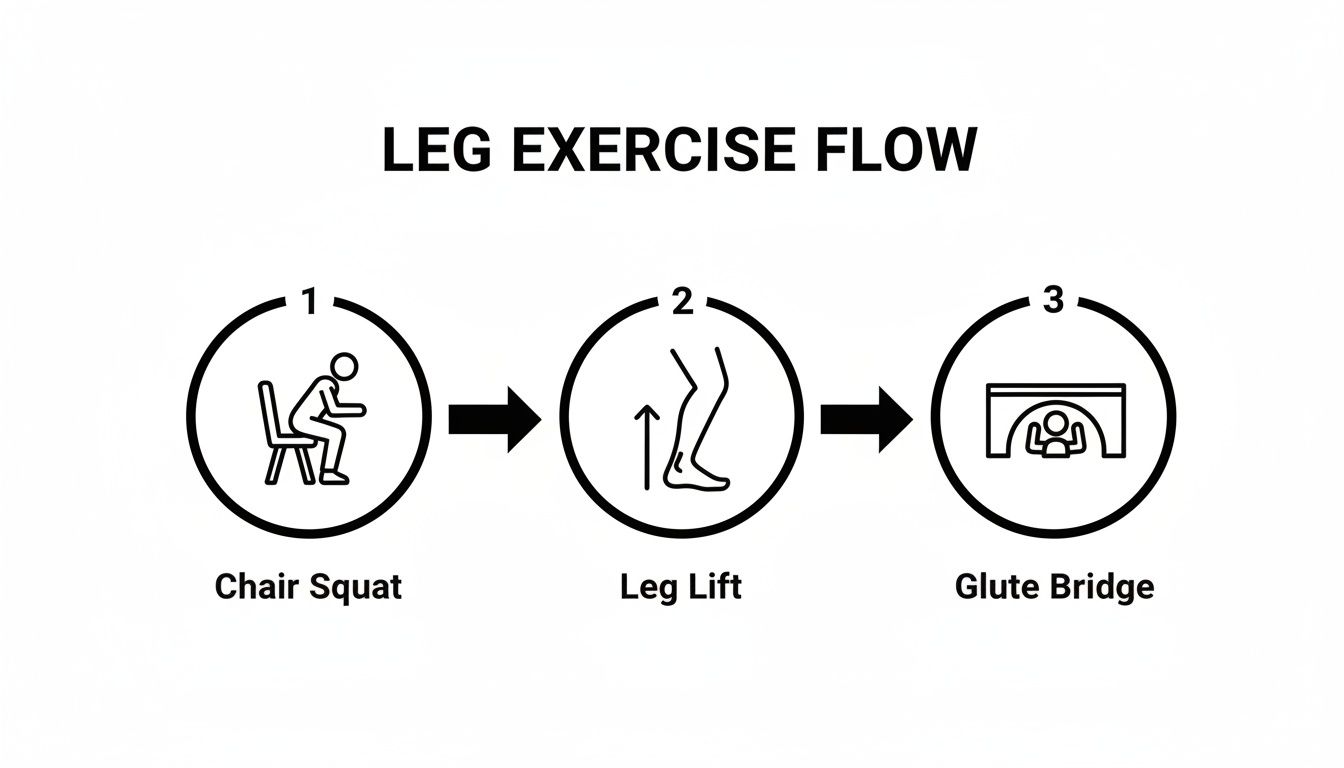
Combining a few key movements like these ensures you’re working all the major muscles for balanced, functional strength that you can feel in your daily life.
Knowing When to Step It Up
Starting slow is crucial, but you won't build new strength by staying in the same place forever. Progress is all about gently challenging your muscles. When you first begin, maybe you can only do 8 repetitions of an exercise with good form. That’s perfect.
Once you can comfortably complete 12 repetitions without feeling totally gassed, it's a sign that your body is ready for a little more.
Here’s how you can progress:
- Add More Reps: Work your way up from 8 to 10, and then from 10 to 12.
- Add Another Set: When 12 reps feel easy, rest for a minute, then do a second set of 8-12 reps.
- Add Light Resistance: For exercises like seated leg lifts, consider adding a light ankle weight (1-2 lbs). A little goes a long way.
Don't be afraid to challenge yourself safely. Research has shown that seniors who engaged in a year-long program of heavier resistance training retained up to 50% more leg strength four years later compared to those who only did lighter training. The long-term effects are powerful.
Are You Listening to Your Body?
We hear the advice "listen to your body" all the time, but what does that actually mean in practice? It comes down to learning the difference between two very distinct feelings: healthy muscle fatigue and pain that's a warning sign.
Muscle Fatigue: This is that warm, tired, or slightly burning sensation you feel in the muscle you're working. This is a good thing! It means you're creating the stimulus needed for the muscle to get stronger. It should fade soon after you stop the exercise.
Pain: This is different. It’s often a sharp, stabbing, or shooting sensation, especially in or around a joint. If you feel this, stop the movement immediately. Pain is your body’s alarm bell telling you something is wrong.
Never, ever push through sharp pain. It's far better to stop, rest, and try again another day, maybe with a smaller range of motion or no resistance.
The Importance of a 5-Minute Warm-Up and Cool-Down
Jumping straight into your exercises when your muscles are cold is asking for trouble. A quick warm-up gets your blood flowing and prepares your body for movement. Likewise, a cool-down helps you recover safely and can reduce next-day soreness.
Your 5-Minute Warm-Up:
- Gentle Marching: March in place for a minute or two to get your heart rate up slightly.
- Arm Circles: Do 10 slow circles forward and 10 backward.
- Ankle Rotations: While seated, lift one foot and rotate your ankle 10 times in each direction. Switch feet.
Your 5-Minute Cool-Down:
- Hamstring Stretch: Sit on the edge of your chair. Extend one leg straight out with your heel on the floor. Gently lean forward from your hips until you feel a light stretch in the back of your thigh. Hold for 30 seconds, then switch legs.
- Calf Stretch: Stand facing a wall for support. Step one foot back, keeping it straight. Gently press that back heel toward the floor until you feel a stretch in your calf. Hold for 30 seconds and switch.
These simple routines bookend your workout, making every session safer and much more effective.
Adapting Exercises for Common Health Conditions
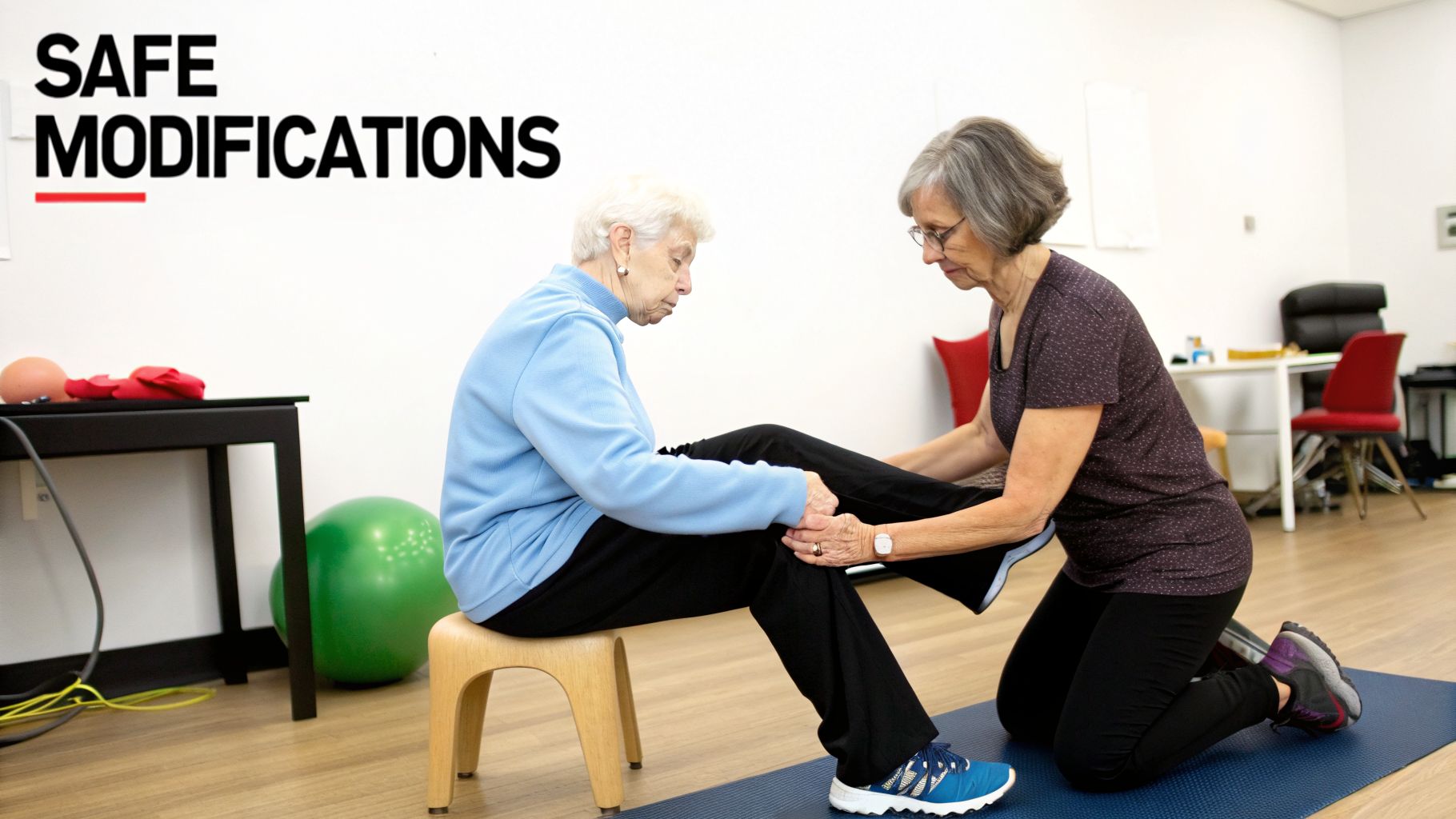
Living with a chronic health condition doesn’t mean you have to stop getting stronger. In fact, smart, targeted exercise is often one of the best things you can do. At MedAmerica Rehab, we see it every single day: the right modifications make leg strengthening safe and effective, even with arthritis or after a joint replacement.
It's all about working smarter, not just harder. With the right adjustments, nearly everyone can build strength, improve balance, and get back to doing more of what they love.
Navigating Leg Strengthening with Arthritis
Arthritis pain can make the thought of exercise intimidating, but movement is often the best medicine for stiff, achy joints. The trick is to strengthen the muscles around the joints without causing a flare-up. Listening to your body is everything.
Your guiding rule should always be to work within a pain-free range of motion. If a full squat sends a sharp pain through your knee, only go as low as you can without discomfort. Even that smaller, controlled movement builds muscle and helps protect the joint.
This isn't just a hunch; it's backed by solid research. Studies show that for seniors with osteoarthritis, leg power training dramatically improves how well they can function day-to-day. And here’s a powerful motivator: every meaningful increase in your knee extensor power can slash the likelihood of disability by 27–42%. You can learn more about these powerful findings on leg power and arthritis directly from the research.
A fantastic option for arthritic joints is exercising in the water. The natural buoyancy supports your body weight, which dramatically reduces impact. This allows you to move with greater freedom and far less pain.
Many of our patients see incredible progress with aquatic therapy. For anyone looking for a low-impact solution, exploring physical therapy in a pool can be a game-changer for managing arthritis while you build strength.
Exercising After a Knee or Hip Replacement
Once you've healed from surgery and graduated from your initial physical therapy, the work isn't over. Continuing to strengthen your legs is crucial for the long-term success of your new joint. Your new hip or knee is strong, but the muscles supporting it need to keep up.
After getting the green light from your surgeon and PT, you can shift your focus to exercises that build stability and real-world strength.
Safe Exercise Choices Post-Replacement:
- Glute Bridges: These are perfect for strengthening your hips and glutes without putting any direct stress on a new knee or hip.
- Seated Leg Lifts: This move isolates the quadriceps—a key muscle for knee stability—with absolutely zero impact.
- Standing Calf Raises: A safe and simple way to build lower leg strength, which is essential for good balance.
Always steer clear of deep squats, twisting movements, or any high-impact activities unless your medical team specifically clears you for them. The goal here is to build on the great foundation your initial therapy provided.
Modifications for Neuropathy and Balance Concerns
Peripheral neuropathy can cause numbness, weakness, or tingling in the feet and legs. This creates a unique challenge because that loss of sensation increases the risk of falls. When we're strengthening legs for seniors with neuropathy, safety is always priority number one.
The best strategy is to perform as many exercises as you can from a seated position. This gives you a stable, secure base, so you can focus on working your muscles without worrying about losing your balance.
- Seated Marching: Simply lift your knees one at a time to strengthen your hip flexors.
- Seated Heel and Toe Raises: Great for improving ankle flexibility and lower leg strength.
- Seated Leg Lifts with a Resistance Band: This adds a safe, effective challenge for your thigh muscles.
When you do stand up for an exercise, make sure you have a sturdy support to hold onto, like a kitchen counter or the back of a heavy, stable chair. A safe, predictable environment is the key to building both strength and confidence when balance is an issue.
When to Seek Professional Physical Therapy
While the home exercises we've covered are a fantastic way to build and maintain leg strength, sometimes a DIY approach just isn’t enough. It's crucial to know when to ask for help from an expert.
Think of a physical therapist as a specialized personal trainer for your health—someone who can guide you past plateaus and make sure every movement you do is safe and effective. Recognizing the signs that you need a professional eye is a key part of strengthening your legs the right way.
Red Flags That Signal It's Time for a PT
Certain signals from your body shouldn't be ignored. If you notice any of these, it’s a clear sign that a professional assessment is your best next step.
Persistent Pain During or After Exercise: A little muscle fatigue is normal, but sharp, stabbing, or lingering joint pain is not. If an exercise consistently hurts, a physical therapist can figure out why—whether it's poor form or an underlying issue—and find a safer way forward.
A Recent Fall or a Sudden Increase in Stumbles: A fall is a serious event, even if you didn’t get hurt. It's a major red flag that your balance and strength aren't meeting your body's needs. A PT can run specific tests to pinpoint the weakness and design a targeted fall-prevention program.
Significant Balance Problems: If you feel constantly unsteady, find yourself avoiding activities for fear of falling, or have a condition like vertigo, a therapist is essential. They use specialized drills to retrain your body's balance system from the ground up.
Lack of Progress After Several Weeks: Have you been doing your exercises consistently for 4-6 weeks with absolutely no improvement? If you don't feel any stronger or more stable, it's time for an expert opinion. A therapist can identify why you've stalled and adjust your routine to get you back on track.
Don't guess with your health. Trying to "push through" pain or ignoring worsening balance can lead to more significant problems down the road. Seeking a professional opinion is a sign of strength, not weakness.
The MedAmerica Advantage: A Personalized Approach
Stepping into a physical therapy clinic like MedAmerica Rehab is completely different from following a guide online. A licensed physical therapist does far more than just show you exercises; they perform a detailed assessment to understand your unique body. You can learn more about what a typical physical therapy session looks like to get a better feel for what to expect on your first visit.
At our clinic, we focus on hands-on, individualized care. Here’s what a professional can do for you:
Identify Subtle Imbalances: You might be overcompensating with one side of your body without even realizing it. A therapist is trained to spot these little imbalances that can lead to pain and injury over time.
Create a Truly Custom Plan: We never use a one-size-fits-all approach. Your program will be designed around your specific goals, your health history (like that knee replacement from five years ago), and your current fitness level.
Utilize Advanced Tools: Our therapists might use hands-on manual therapy to improve joint mobility or modalities like electrical stimulation to help activate weak muscles. These tools can accelerate your progress in ways you simply can't achieve at home.
Build Your Confidence: Perhaps most importantly, working with a professional gives you peace of mind. Knowing you're performing exercises with correct form under expert supervision removes the fear and uncertainty that often hold people back.
Your journey to stronger legs is personal. If you're struggling with pain, balance issues, or a lack of results, let our expert team at MedAmerica guide you.
Your Questions About Leg Strengthening, Answered
As you start a new exercise routine, it's natural to have questions. In fact, asking questions is one of the best things you can do! Getting clear, reliable answers builds the confidence you need to stick with it and feel the real-world benefits.
We hear a lot of the same questions from seniors at our clinic. Here are the answers we give every day to help put minds at ease and make sure everyone moves forward safely.
How Long Until I Actually Feel a Difference?
This is usually the very first thing people ask, and for good reason. While every body is unique, most people who stick with their exercises consistently start to feel a real, noticeable change within 4 to 6 weeks.
This doesn't mean you'll feel like you can run a marathon overnight. The first changes are often more subtle, but they're incredibly important.
- You might notice you can get out of your favorite armchair without pushing off with your hands.
- Climbing a flight of stairs might feel less like a major chore.
- You could feel just a bit more steady on your feet when you're walking or making a quick turn in the kitchen.
The key here is consistency. Sticking with your routine, even on days you don't feel 100%, is far more powerful than doing a really intense workout once a week. Your body will thank you for it.
Is It Normal for My Muscles to Be Sore?
Learning the difference between "good" muscle soreness and "bad" pain is one of the most important skills you can develop. A little bit of muscle soreness is completely normal—it’s actually a good sign!
This mild ache, often called Delayed Onset Muscle Soreness (DOMS), means you've successfully challenged your muscles. They're now in the process of repairing and getting stronger. It usually shows up 24 to 48 hours after you exercise and feels like a general tightness in the muscles you worked.
What you should never feel is sharp, stabbing, or shooting pain, especially right in a joint. That's not soreness; that's a warning signal from your body. If you feel that, stop the exercise right away. Good soreness is a sign of progress, but sharp pain is a red flag.
Can I Still Strengthen My Legs if I Use a Walker?
Absolutely! A walker or a cane is a tool for stability, not a barrier to getting stronger. In fact, strengthening your legs is one of the best things you can do to improve your balance and potentially reduce how much you rely on your walker over time.
You just need to be smart about how you exercise. The safest and most effective approach is to focus on exercises you can do while seated.
Great seated exercises to start with include:
- Seated Leg Lifts: These directly target the big muscles on the front of your thighs.
- Seated Marches: A fantastic way to get your hip flexors firing.
- Seated Heel and Toe Raises: Perfect for improving circulation and ankle strength.
When you do standing exercises, like a simple calf raise, make sure you're holding onto your walker or a sturdy kitchen counter for support. Safety always, always comes first.
At MedAmerica Rehab Center, our physical therapists are experts at creating programs that are tailored to your specific situation, including working with any mobility aids you use. We can help you build strength safely and with confidence. Start your journey with us today!
MedAmerica Rehab · Deerfield Beach
Talk to a clinician about your pain
Physical therapy, chiropractic, acupuncture and shockwave therapy under one roof, since 1995. Same-day appointments are available.
Mon–Thu 8:00 AM – 6:30 PM · Fri 8:00 AM – 3:00 PM