
Upper Back Pain Relief Exercises: A Guide for Fast Relief
Typically, by the time a search begins for upper back pain relief exercises, the discomfort has already been present for a while. It starts as tightness between the shoulder blades, then turns into a dull ache when you sit at your desk, check your phone, cook dinner, or drive more than a few minutes. You stretch a little, roll your shoulders, maybe ask someone to press on the sore spot, and the relief never seems to last.
That pattern is frustrating, but it usually isn't random. The upper back often hurts because it has been doing too much of the wrong kind of work and not enough of the right kind. The answer usually isn't to stay still. It's to move better, then build strength where your body needs support.
This guide is built around that idea. Not just what to do, but how to tell whether an exercise is helping, how to scale it, and when pain is a normal part of waking up a stiff area versus a sign to stop. If your symptoms also feel tied to whole-body tension or recovery habits, some people also explore lifestyle support such as natural support for inflammatory response alongside movement, sleep, and hydration.
Finding Relief from Nagging Upper Back Pain
Upper back pain often shows up in ordinary moments. You stand up from your chair and feel a pulling sensation between your shoulder blades. You turn your head while backing out of the driveway and notice stiffness along the base of your neck into the mid-back. By evening, your posture has collapsed, your shoulders have drifted forward, and your upper back feels tired even though you haven't done anything athletic.
That kind of pain can make people feel stuck. Many try one stretch, get temporary relief, then assume the problem is just something they have to live with. In practice, that usually isn't true. A lot of nagging upper back pain responds well when you combine gentle mobility with targeted strength and a better understanding of your pain signals.
What this kind of pain usually feels like
Some descriptions come up again and again:
- Aching between the shoulder blades that builds during computer work
- Stiffness after sitting that eases a little once you move around
- Tension into the neck and shoulders after looking down at a phone or laptop
- Pain during long drives when the upper back stays in one position too long
These patterns matter because they point toward a mechanical problem. Muscles and joints in the thoracic spine area often get stiff, while the muscles that should support the shoulder blades don't do enough.
Upper back pain is often less about one damaged spot and more about a body region that has lost variety in how it moves.
Relief usually starts when you stop chasing the sore spot alone and start restoring motion, posture control, and endurance. The best results come from simple movements done consistently, not from forcing aggressive stretches for a day or two and then quitting.
The shift that helps most
The first useful shift is this. Don't judge an exercise only by whether it feels magical in the moment. Judge it by whether it helps you move more freely, sit more comfortably, and recover better over time. That mindset keeps people from bouncing between random tips and helps them build a routine that lasts.
Why Your Upper Back Hurts A Brief Anatomy Lesson
A common pattern shows up in the clinic. Someone points between the shoulder blades and says, "That spot is the problem." Often, that sore area is only part of the story.
Your upper back, or thoracic spine, is built to give you stability while still allowing rotation and extension. It works closely with the ribs, shoulder blades, and neck. The trapezius, rhomboids, and other muscles around the shoulder blades help keep your shoulder girdle organized while your arms move and your head stays balanced over your trunk.
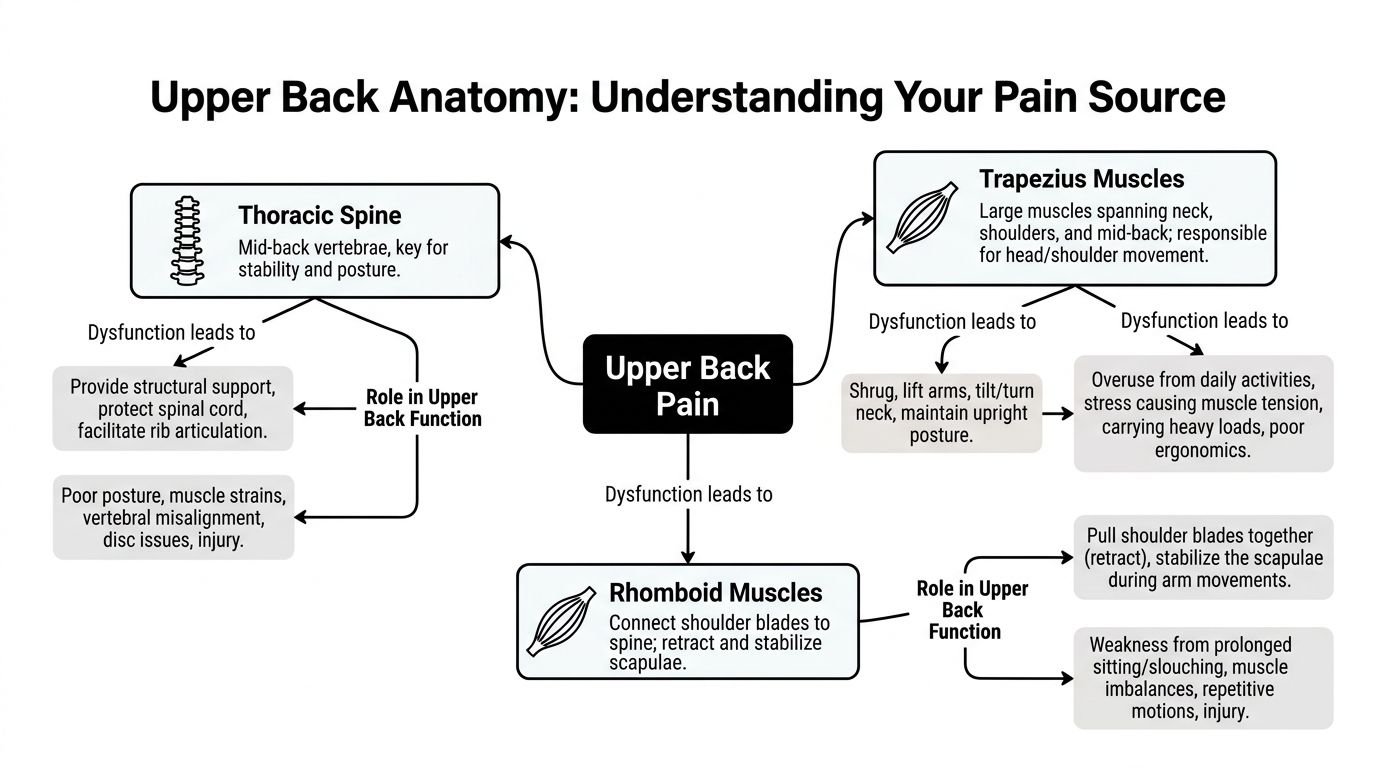
Problems start when that system loses options. If the thoracic spine gets stiff, the neck and shoulders often do extra work. If the muscles that guide the shoulder blades fatigue, smaller tissues stay under tension longer than they should. That is why people often describe the area as tight, tired, and weak all at once.
The structures that usually matter most
| Area | What it does | What happens when it struggles |
|---|---|---|
| Thoracic spine | Provides mid-back stability and rotation | Stiffness, pain with sitting upright, trouble extending |
| Trapezius muscles | Help move and stabilize neck, shoulders, and shoulder blades | Neck tension, shoulder hiking, soreness after desk work |
| Rhomboids | Pull shoulder blades back and support posture | Ache between shoulder blades, fatigue with prolonged sitting |
Upper back pain is not always just "muscle knots." Sometimes the main driver is poor movement through the thoracic spine. Sometimes it is reduced control around the shoulder blades. Sometimes the neck contributes to symptoms that are felt lower down. The treatment choice should match the pattern, which is why random stretching helps one person and irritates another.
Listening to your symptoms matters. A local ache or pulling sensation that eases as you warm up often points to stiff joints or deconditioned muscle. Burning, tingling, numbness, or pain that travels into the arm raises more concern for nerve or neck involvement.
Muscle pain versus nerve involvement
Muscle-driven pain is usually more predictable. It often changes with posture, builds during static positions, and improves with movement or rest. Nerve-related symptoms are less forgiving. They may shoot, radiate, or come with pins and needles, weakness, or a sense that the arm just is not working normally.
That distinction helps you judge exercise response. Mild effort, stretch, or fatigue during a drill can be productive if symptoms settle quickly afterward. Sharp pain, spreading pain, or symptoms that linger and intensify are signals to back off and reassess.
If your symptoms include arm numbness, weakness, or pain that shoots rather than aches, basic stretching may not be the right starting point. A broader clinical exam helps sort out posture, joint stiffness, muscle control, and possible nerve irritation. MedAmerica's guide on how physical therapy helps with back and neck pain explains how those pieces are assessed together.
The painful spot is not always the source. In upper back pain, the thoracic spine, shoulder blade muscles, and neck often affect each other.
Gentle Mobility Exercises for Immediate Relief
When the upper back feels guarded, start with motion, not force. The goal is to calm the area down, reduce stiffness, and remind your body that this region can move safely. These aren't strength drills yet. Think of them as the on-ramp.

If you already enjoy yoga-based movement, a resource like AloeCure's guide to joint health yoga can give you additional gentle ideas that pair well with thoracic mobility work.
Cat-Cow for spinal motion
This is one of the simplest upper back pain relief exercises, and it's often one of the most useful.
- Start on hands and knees.
- As you inhale, lift your chest gently and let your upper back extend.
- As you exhale, round through the upper back and let the shoulder blades spread apart.
- Move slowly. Don't force the end range.
Why it helps: Cat-Cow gives the thoracic spine repeated, low-threat movement. That can reduce guarding and improve body awareness, especially if you've been holding one posture all day.
A practical rule: if you feel a stretch or mild effort that eases as you continue, that's usually a good sign. If the pain sharpens or spreads, back off.
Thoracic extension over a foam roller
A foam roller can help restore extension in a stiff upper back, but the setup matters more than force. Place the roller across your upper back, support your head with your hands, and gently lean back over the roller. Move segment by segment rather than dropping into one spot.
Use slow breaths. Pause where you feel stiffness, then return to neutral.
For people who don't already have one at home, this overview of a PE foam roller shows the type of tool commonly used for controlled thoracic extension work.
Why it helps: Many upper backs live in flexion all day. Extension over a roller counters that shape and can make upright sitting feel easier afterward.
Thread the needle
Start on hands and knees. Slide one arm underneath your body, letting your upper back rotate. Reach only as far as you can without holding your breath or collapsing. Come back up and repeat before switching sides.
This movement is especially useful if your pain feels more like stiffness during turning, reaching, or backing up the car.
Move into stiffness. Don't slam into it. The upper back usually responds better to repetition than to aggression.
If you'd like a visual walkthrough before trying these movements, this demonstration can help:
How to use mobility work well
A simple way to make these exercises more effective is to match them to your day:
- After desk work use Cat-Cow first because it reintroduces movement gently.
- When you feel compressed or slouched try foam roller extension.
- If turning is restricted use Thread the Needle to restore rotation.
Mobility drills should leave you feeling looser, warmer, or easier to straighten up. They shouldn't leave you flared up for the rest of the day.
Strengthening Exercises to Build a Resilient Back
You can loosen a stiff upper back in a few minutes. Keeping it that way usually takes strength and endurance.
For many people, pain returns because the muscles between the shoulder blades fatigue long before the day is over. Then the neck takes over, the shoulders creep up, and the upper back settles back into the same stressed position. Strength work helps you hold a better position without constantly thinking about it.
The goal is not to chase fatigue. The goal is to teach the right muscles to do their share.
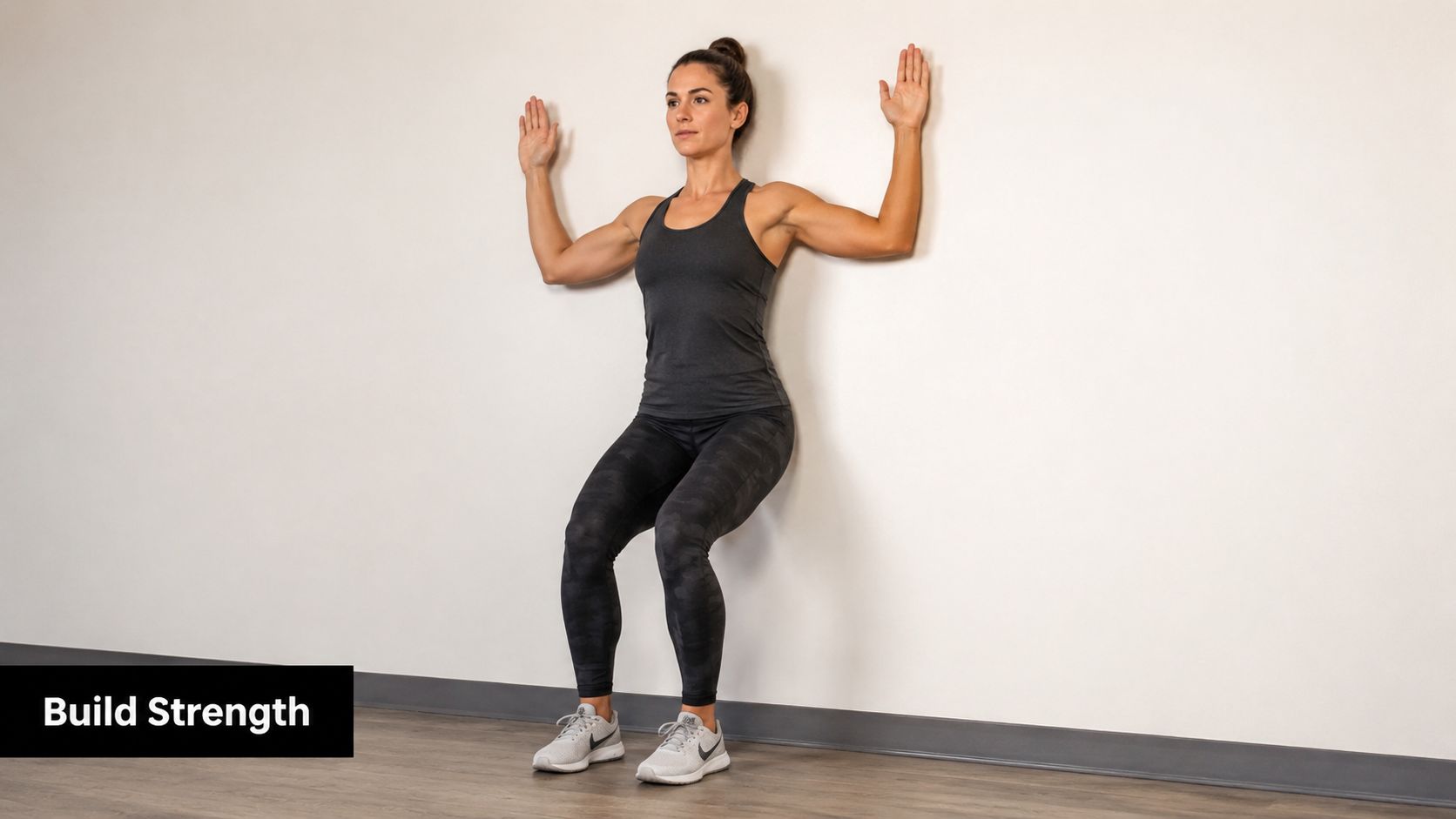
Wall angels
Stand with your back against a wall. Keep your ribs relaxed, chin level, and arms bent in a goalpost shape. Slide your arms upward as far as you can without your low back arching or your shoulders shrugging. Lower with control.
Why it helps: Wall angels train upward arm movement while the upper back stays organized. That matters because many people with upper back pain do not lack effort. They lack control. This drill exposes common compensations early, especially rib flare, neck tension, and shoulder hiking.
Use a smaller range if needed. A shorter, clean motion is more useful than forcing your hands higher on the wall.
Seated resistance band rows
Sit tall with a resistance band anchored in front of you or looped securely around your feet, depending on the setup. Pull your elbows back, pause briefly, then return slowly. Let the shoulder blades glide. Do not pinch them hard together.
Why it helps: Rows strengthen the mid back muscles that counter a rounded posture and support the shoulder blades during reaching, typing, and lifting. They also build endurance, which is often the missing piece in people who feel fine in the morning and tight by midafternoon.
A useful test during rows is location of effort. Work in the muscles between the shoulder blades is expected. Sharp pain, joint pinching, or neck strain taking over means the setup or resistance needs to change.
Y-T-W sequence
Lie face down on a bed, bench, or firm surface, or hinge forward with a neutral spine if that position is more comfortable. Lift your arms into a Y, then a T, then a W shape. Move slowly and keep each lift small enough that your neck stays relaxed.
A single visual guide for these patterns can help with setup and arm position if you need it. The rehab exercise video summary shows the sequence clearly.
Why it helps: Y-T-W variations target the lower trapezius, rhomboids, and other postural muscles that help anchor the shoulder blades. These muscles are often weak, but more often they are underused. This drill teaches them to join the job again.
This exercise should feel harder than it looks. If you feel it mostly in the neck, stop and reset. In the clinic, I usually cue people to make the movement smaller, lengthen through the back of the neck, and lower the shoulders before the next rep.
How to progress without overdoing it
Progress by quality first. Then by load.
A simple sequence works well:
- Build control first by slowing the lowering phase and pausing briefly in the hardest part of the rep
- Add resistance next with a slightly stronger band or very light hand weights
- Increase range last once you can move without shrugging, rib flare, or low back arching
This is also where listening to your body matters. Mild muscle effort, local fatigue, and a gentle burn that settles soon after the set are usually acceptable. Pain that sharpens with each rep, spreads into the neck or arm, or lingers for hours is a sign to reduce the range, lighten the resistance, or stop for the day.
If posture is part of your pain pattern, this collection of easy exercises you can do at home to improve your posture pairs well with rows and wall angels.
A stronger upper back is built through repeatable reps your body can trust. That is how strength becomes relief that lasts.
Safety First Know When to Stop and When to Get Help
You start a few reps, feel a pull between the shoulder blades, and immediately wonder whether to keep going or shut it down. That decision matters more than the exact exercise.
In the clinic, I tell patients to judge a movement by what the symptoms do during the set and in the hours after, not by whether they feel anything at all. A mild stretch, muscle effort, or brief ache can be part of normal loading. Pain that sharpens, spreads, or leaves you worse later is a different signal.
What acceptable exercise discomfort usually feels like
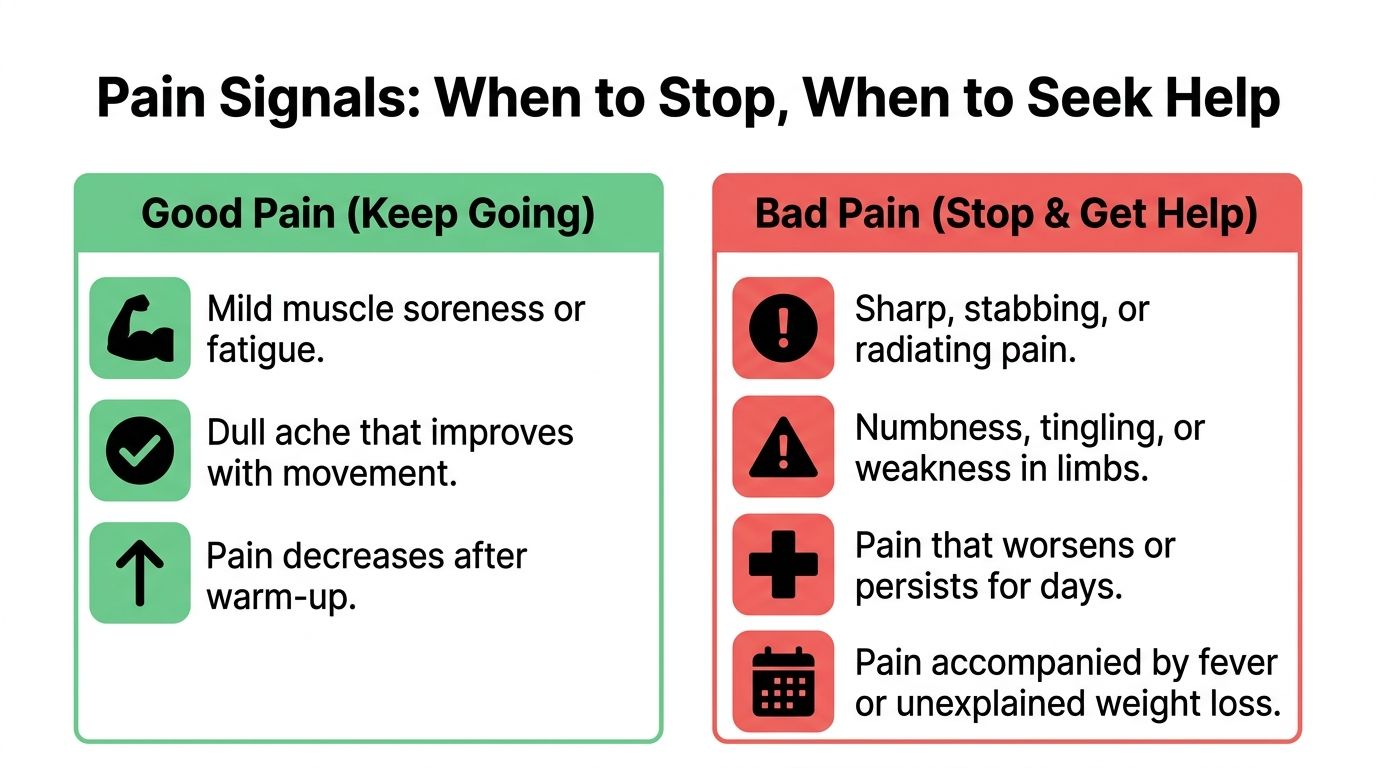
Helpful exercise discomfort is usually local, mild, and temporary. It often feels like tight tissue starting to move or muscles working in an area that has been doing too little for too long.
You can usually continue if you notice:
- A mild ache or stretch that stays near the upper back
- Stiffness that eases after a few repetitions
- Muscle fatigue between the shoulder blades without the neck taking over
- Symptoms that return to baseline soon after the set
That last point is important. The body often tolerates a small, controlled challenge better than complete rest, but only if it settles afterward.
What harmful pain usually feels like
Concerning pain tends to be sharper, more intense, or less predictable. It often means the exercise is too aggressive, the setup is off, or the pain may not be coming only from the upper back.
Stop the exercise and get evaluated if you notice:
- Pain shooting into the arm or hand
- Numbness, tingling, or new weakness
- Pain that increases with each rep
- Symptoms that last for hours or are worse the next day
- Chest pain, shortness of breath, fever, or unexplained weight loss along with back pain
If a movement changes your breathing, makes you brace hard, or creates symptoms away from the area you are trying to train, treat that as a warning sign.
A simple decision guide
| Sensation | Likely meaning | Best response |
|---|---|---|
| Mild ache that improves as you move | Stiff tissue warming up | Continue gently |
| Muscle fatigue between shoulder blades | Normal exercise effort | Rest, then repeat |
| Sharp, stabbing, or electric pain | Irritated tissue or nerve involvement | Stop |
| Tingling, numbness, or weakness | Neurologic warning sign | Seek assessment |
The goal is not to push through everything. The goal is to test, observe, and adjust. That is how you learn the difference between productive work and a pain signal that deserves respect.
When You Need a Personalized Plan for Your Back Pain
A home program works well for many cases of upper back pain, but only when the exercises match the problem in front of you. If one movement eases stiffness while another creates pain that lingers into the evening, that difference matters. It tells us your body is giving useful feedback, and your plan should respond to it.
This is the point where a generic routine often falls short.
Upper back pain does not always come from the upper back alone. I often see pain driven by a mix of thoracic stiffness, shoulder blade weakness, neck irritation, breathing mechanics, desk posture, and training habits. Two people can point to the same spot between the shoulder blades and need very different programs. One needs mobility first. Another needs load tolerance. A third needs fewer exercises, done with better control.
A personalized plan answers a few practical questions. Which movements calm symptoms within minutes? Which ones create a productive muscle effort that settles quickly? Which ones reproduce sharp pain, arm symptoms, or next-day flare-ups? Once those patterns are clear, progression gets safer and much less frustrating.
Some people do better with a written routine instead of guessing from day to day. Even a general structured workout plan can help you track symptoms, sets, and recovery. That kind of structure is useful. It is not the same as clinical reasoning.
If your pain is not improving, keeps returning, started after an injury, or seems tied to the neck, ribs, or nerves, get assessed. A good exam can sort out whether the main issue is joint mobility, muscle endurance, movement coordination, nerve sensitivity, or a combination. That saves time. It also helps you stop doing exercises that feel active but are not helping.
If upper back pain keeps interrupting work, sleep, driving, or exercise, MedAmerica Rehab Center can help you get a plan that fits your body, not just a generic routine. Their team in Deerfield Beach provides individualized physical therapy, chiropractic care, acupuncture, and other non-surgical treatments designed to reduce pain, restore mobility, and help you move with confidence again.
MedAmerica Rehab · Deerfield Beach
Talk to a clinician about your pain
Physical therapy, chiropractic, acupuncture and shockwave therapy under one roof, since 1995. Same-day appointments are available.
Mon–Thu 8:00 AM – 6:30 PM · Fri 8:00 AM – 3:00 PM