
Concussion Vestibular Therapy: Regain Balance & Heal
Some people notice the dizziness right away. Others feel it later, when they turn their head backing out of the driveway, walk through a grocery store aisle, or try to read a screen and realize their eyes can't keep up. You may not look injured, but you know something is off. Your balance feels unreliable, your concentration fades fast, and simple movement can make you feel overstimulated, nauseated, or strangely disconnected from your body.
That experience is frustrating because concussion symptoms often seem inconsistent. One day you feel almost normal. The next day, a quick head turn or a busy room sets everything off again. Many patients start to wonder whether they're anxious, overreacting, or just supposed to wait it out.
You're not overreacting. Post-concussion dizziness is real, and in many cases it responds well to a structured plan. Concussion vestibular therapy gives that plan shape. Instead of vague advice to “take it easy,” it matches specific symptoms to specific exercises and progresses them carefully so your brain can relearn how to process motion, vision, and balance.
The Unsettling World After a Concussion
A lot of people arrive in clinic describing the same thing in different words. “I feel floaty.” “I'm not spinning, but I'm not steady.” “I can't explain it, I just don't feel like myself.” That uncertainty can be one of the hardest parts of recovery.
Sometimes the concussion came from sports. Sometimes it followed a fall. Sometimes it happened in a crash that didn't seem serious at first. If your injury came after a vehicle collision, resources like Martin Hernandez, P.A. can help explain how a concussion can happen even when there's no dramatic external injury. That matters, because many people dismiss their symptoms early and lose time before getting the right care.
When symptoms don't make sense
A typical day after concussion can feel oddly unpredictable:
- You turn your head quickly and the room seems to lag behind.
- You walk into a busy store and the lights, shelves, and motion feel overwhelming.
- You try to work or read and your eyes fatigue faster than they used to.
- You stand up or move around the house and feel cautious, even if you haven't fallen.
None of that means you're weak. It usually means the systems that coordinate balance and visual stability aren't communicating smoothly.
You don't have to wait until symptoms become severe to take dizziness seriously.
A path that feels more organized
Vestibular therapy after concussion isn't a mysterious treatment. It's an exercise-based process that helps retrain the systems involved in gaze stabilization, postural stability, dizziness, and day-to-day function. The goal isn't to push through symptoms blindly. The goal is to challenge the right system, at the right dose, in the right order.
That structure often brings relief before the exercises do. Once patients understand why certain movements trigger symptoms, recovery starts to feel less random. Instead of asking, “Why is this happening to me?” they can start asking, “What is this symptom telling us, and what do we do with it?”
That shift matters. Hope is easier to hold onto when the plan makes sense.
Why You Feel Dizzy and Unsteady After a Concussion
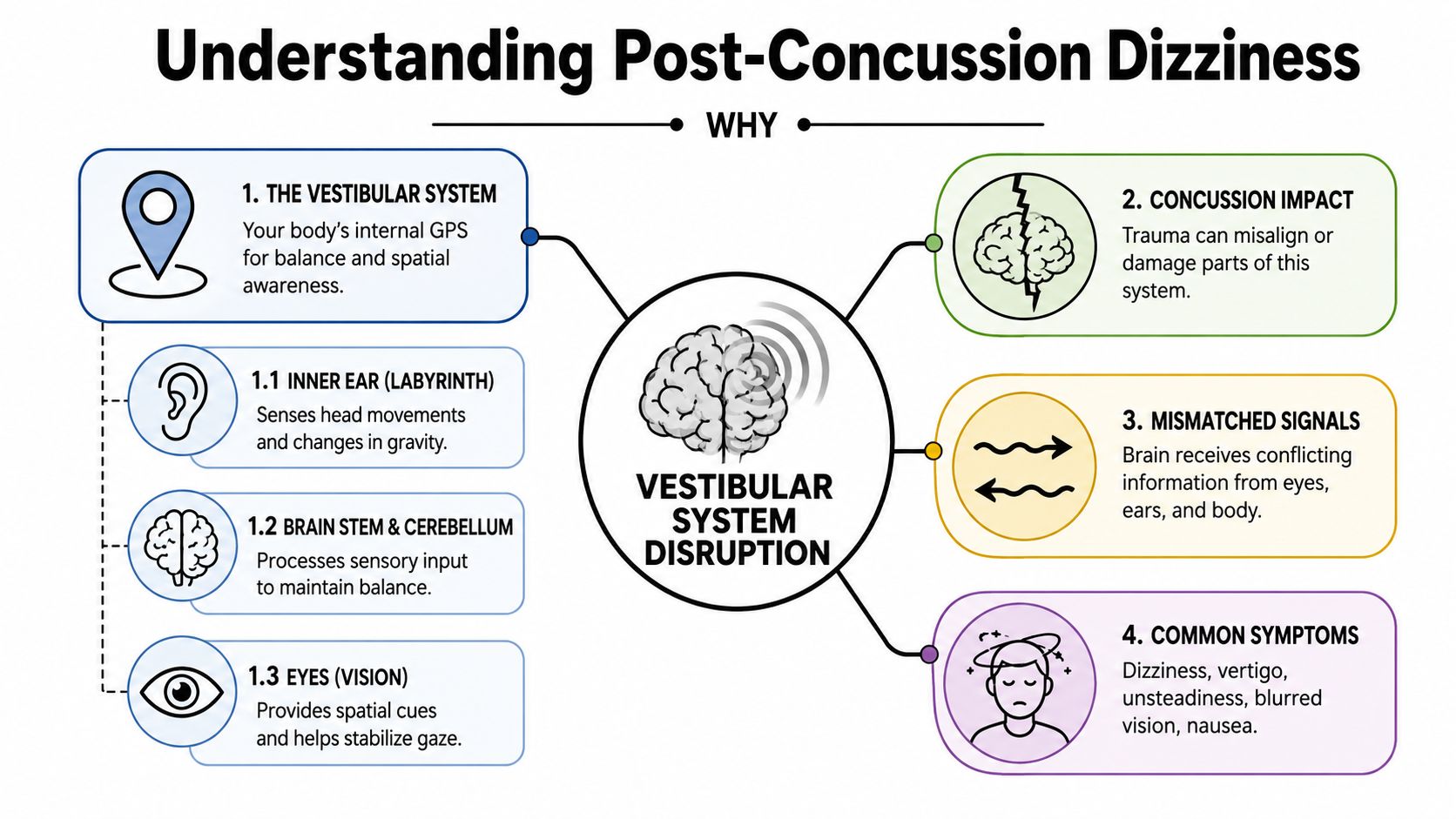
Your balance doesn't come from one body part. It depends on teamwork between your inner ear, eyes, and the information your body sends from muscles and joints. Your brain acts like the coordinator, comparing those signals and deciding where you are in space.
After a concussion, that coordination can get scrambled. The easiest way to think about it is a GPS signal problem. Your internal GPS still exists, but the signals don't line up cleanly. One system says you're moving. Another says you're still. Your brain has to sort out the mismatch, and dizziness is one common result.
What each system contributes
Here's the simple version of the job description:
| System | What it does | What you may notice when it's not syncing well |
|---|---|---|
| Inner ear | Detects head motion and gravity | Dizziness with turning, bending, or quick movement |
| Eyes | Help fix your gaze and interpret the environment | Blurring, eye strain, difficulty in busy settings |
| Body awareness | Tells the brain where your body is | Unsteadiness, clumsy steps, feeling off-balance |
When those signals conflict, ordinary tasks become harder. Walking through a patterned floor, riding in a car, scrolling on a phone, or tracking moving people in a room can all feel more intense than they should.
Why symptoms show up in certain places
Patients often ask why a grocery store feels worse than their living room. The answer is visual load. A calm, predictable environment asks less of your system. A crowded store, school hallway, gym, or traffic scene forces your brain to sort through much more motion and visual input.
If eye movement itself feels uncomfortable, it can help to understand related causes of visual pain and strain. This overview of South Florida eye pain expertise gives useful context for symptoms that overlap with post-concussion visual discomfort.
For a broader look at how concussion affects this system, MedAmerica's guide on the vestibular system and concussion is a helpful patient-friendly reference.
Practical rule: If head motion, visual motion, or busy environments trigger symptoms, that pattern often points to a vestibular component rather than “just stress.”
That's why therapy isn't random. The symptom pattern usually tells us which part of the system needs the most attention first.
What to Expect During a Vestibular Therapy Evaluation
The first visit is less dramatic than many patients expect. There's usually no intimidating machine and no painful procedure. A good vestibular evaluation is a structured conversation followed by movement-based testing that helps identify what is and isn't provoking your symptoms.
The interview matters as much as the testing
The appointment often starts with details that may seem small but are clinically useful. When did the dizziness begin? Is it spinning, rocking, lightheadedness, or a vague off-balance feeling? Does it happen with turning in bed, walking in public, reading, driving, or looking up?
Your therapist also wants to know what your day looks like now compared with before the concussion. The gap between those two versions of your life helps shape the treatment plan. A parent managing a household, an office worker on screens all day, and an athlete returning to practice may all need different progressions even if their symptoms sound similar.
Common parts of the physical exam
Most evaluations include a mix of the following:
- Eye movement testing to see how smoothly your eyes track a target, shift between targets, or stay focused.
- Head movement testing to check whether motion changes your symptoms or disrupts visual clarity.
- Balance testing in standing, sometimes with different foot positions or surfaces.
- Walking assessment to observe gait, turning, pace, and how you respond when movement gets more complex.
- Neck screening because stiffness, pain, and cervicogenic dizziness can overlap with vestibular complaints.
None of these tests are there to “catch” you failing. They're there to identify your starting point.
A vestibular evaluation should leave you feeling understood, not judged.
Why the therapist may bring on mild symptoms
This part surprises some people. During testing, your therapist may ask you to perform motions that briefly increase symptoms. That isn't because the goal is to make you miserable. It's because treatment has to target the problem accurately.
A useful evaluation looks for patterns:
- Symptoms with quick head turns may point toward gaze stabilization deficits.
- Symptoms in visually busy spaces may suggest visual-vestibular overload.
- Symptoms in standing or walking may show postural control problems.
- Symptoms linked to neck motion or posture may indicate a cervical contribution.
The result should be a plan that feels personalized, not generic. If two patients both say “I'm dizzy,” they still may need very different exercise programs.
The Core Components of Vestibular Rehabilitation
A common question quickly arises: What exactly do the exercises do? The answer is that each category targets a different reason you feel off. Good concussion vestibular therapy doesn't hand out a random sheet of drills. It matches the exercise to the symptom pattern.
A simple visual helps organize the treatment pillars.
Gaze stabilization for blurry or jumpy vision
If your vision feels unstable when your head moves, therapists often start with gaze stabilization. This retrains the connection between head motion and eye control.
A classic early exercise is VOR x1. You keep your eyes fixed on a target while moving your head side to side or up and down. It looks simple. It often doesn't feel simple at first. That's because the exercise is asking your system to restore a skill that should normally happen automatically.
Patients with reading fatigue or trouble shifting focus may also work on saccades and smooth pursuits. Those target how the eyes jump between points or follow a moving object.
A systematic review in athletes reported that expert protocols commonly start with low-dose gaze stabilization, including VOR x1, saccades, smooth pursuits, and balance retraining, then progress as symptoms allow. The same review noted that beginning vestibular rehabilitation 10–14 days post-concussion does not appear detrimental and may reduce symptom severity and duration. An included study found the vestibular-treatment group recovered 1.99 times faster than controls and was estimated to have 55% more participants cleared for return to sport within 8 weeks (systematic review in the International Journal of Sports Physical Therapy).
Habituation for motion sensitivity and overwhelm
Habituation sounds technical, but the idea is straightforward. If certain movements or environments trigger mild dizziness, controlled exposure can help your brain become less reactive to them over time.
That may include repeated, symptom-guided practice with:
- Positional movements like looking up, bending, or rolling
- Visual motion such as patterned environments or moving backgrounds
- Functional transitions like turning, pivoting, or changing directions
The key is dosage. Too little challenge won't change much. Too much can flare symptoms and reduce confidence. Therapy works best when the exposure is deliberate and repeatable.
Here's a short demonstration that helps many patients picture what vestibular retraining looks like in practice.
Balance and gait training for unsteadiness
When patients say, “I feel okay sitting still, but walking feels weird,” balance and gait work usually becomes a larger part of treatment. This starts with simple tasks and becomes more realistic over time.
Examples often include:
- Narrow base positions such as tandem stance
- Surface changes like standing on foam
- Head movement during standing or walking
- Visually complex challenges once basic control improves
If walking itself feels less automatic, gait training in physical therapy can be part of the bigger recovery picture, especially when turning, pacing, and visual attention all affect stability.
Mild symptom provocation during exercises can be appropriate. A symptom spike that lingers and derails the rest of your day usually means the dose was too high.
What doesn't work well
Several approaches tend to stall progress:
- Complete rest for too long when vestibular findings are present
- Doing advanced drills too early because they look easy on paper
- Changing exercises constantly before the brain has time to adapt
- Pushing until symptoms explode and calling that productive
The best programs are steady, specific, and adjusted based on your response, not your frustration level.
Your Recovery Timeline and What to Expect
Recovery rarely feels linear from the inside. Patients often improve in one area first, then notice another challenge that only becomes obvious once the first symptom calms down. That doesn't mean therapy isn't working. It usually means the system is recovering in layers.
What recovery is actually training
Vestibular rehabilitation after concussion is an exercise-based intervention designed to drive adaptation, substitution, and habituation in the vestibulo-ocular and postural systems, with goals of improving gaze stabilization, postural stability, dizziness, and daily function. In a 2023 systematic review, the acute-phase studies found vestibular rehabilitation was effective in reducing time to return-to-sport, and a meta-analysis cited in the review found dizziness improved in the short term (systematic review on vestibular rehabilitation after concussion).
That description matters because it explains why the process takes repetition. You aren't receiving a passive fix. You're retraining how the brain interprets movement and stabilizes vision.
What progress often looks like
A practical way to think about recovery is by milestones, not by one perfect symptom-free day.
| Stage of progress | What patients often notice |
|---|---|
| Early change | Less symptom intensity with basic home exercises |
| Middle phase | Better tolerance for walking, screens, or daily errands |
| Functional return | More confidence with work, driving, exercise, or sport-specific movement |
Some people improve quickly once the right system is targeted. Others need a longer course because symptoms involve more than one contributor, such as vestibular dysfunction plus neck pain, headaches, visual strain, or reduced activity tolerance.
What helps and what slows things down
Recovery tends to go better when patients do three things consistently:
- Follow the home program instead of saving all the work for clinic visits
- Report symptom patterns accurately so the program can be adjusted
- Progress gradually rather than testing limits every good day
What slows recovery is usually not lack of effort. It's misdirected effort. Patients often either avoid all symptom-provoking movement or push too hard on good days and pay for it later.
Improvement is often measured first by what you can do with less fear, not just by whether dizziness has vanished completely.
Success isn't only “I never feel dizzy again.” A better marker is returning to normal life with confidence, clear strategies, and enough reserve that movement doesn't dominate your attention.
The MedAmerica Rehab Center Approach to Vestibular Therapy
When concussion symptoms affect balance, vision, neck comfort, and daily function at the same time, care works better when the plan looks at the whole picture. That's one reason a multidisciplinary clinic can be useful. The patient doesn't just need exercises. They often need coordination between providers, consistent education, and a plan that adjusts as symptoms change.
At MedAmerica Rehab Center, vestibular care fits into that broader rehab model. The clinic's physical therapy and chiropractic services can address different contributors to post-concussion symptoms, including movement sensitivity, balance deficits, and related neck stiffness that may complicate recovery.
What that model means for a patient
In practical terms, a patient-centered approach usually includes:
- One-on-one assessment so symptom triggers are identified clearly
- Individualized exercise dosing rather than a standard handout for everyone
- Hands-on care when needed for associated cervical tightness or mobility limits
- Education throughout treatment so you understand why each exercise matters
That last point is easy to underestimate. Patients usually do better when the program makes sense to them. If you know an exercise is meant to reduce motion sensitivity while shopping, or sharpen visual stability while walking, the work feels purposeful instead of repetitive.
Why collaboration matters
Concussion recovery often goes smoother when the therapist listens for patterns beyond dizziness alone. Neck pain, headaches, visual overload, poor sleep, and fear of movement can all shape how someone tolerates treatment. A collaborative environment helps those pieces get addressed instead of treated like separate unrelated complaints.
For patients in Deerfield Beach, that kind of coordinated care can make the process feel less fragmented. The goal isn't just to get through a checklist of exercises. It's to help you move through your day with more stability, less apprehension, and a better understanding of how to manage flare-ups if they happen.
Frequently Asked Questions About Concussion Rehab
Is it ever too late to start vestibular therapy
No. It's better to be evaluated earlier when symptoms persist, but people can still benefit even if dizziness has been hanging around for a while. The key question isn't how much time has passed. It's whether the current symptoms still match a treatable vestibular pattern.
Can I do these exercises on my own at home
Home exercises are a major part of recovery, but they work best when they're prescribed specifically for your symptom pattern. General online exercises can miss the underlying problem or overload the wrong system. Early guidance matters because dosage, speed, posture, and symptom response all change whether an exercise helps.
What red flags should I report right away
Tell your therapist and medical provider about symptoms that are new, worsening, or don't fit the pattern you've been working on. Examples include:
- Severe symptom escalation that doesn't settle after stopping activity
- New neurological changes such as major weakness, unusual numbness, or marked confusion
- Vision changes that are sudden or dramatic
- Frequent falls or a sudden drop in balance confidence
- Headache patterns that feel notably different from what you've been experiencing
If headaches are becoming a bigger part of the picture, this guide to treatment for post-concussion headaches can help you understand how they fit into rehab planning.
How do I know if my dizziness is from my neck or my vestibular system
You usually can't tell with confidence on symptoms alone. Neck-related dizziness often overlaps with vestibular complaints. A clinician sorts this out by looking at what provokes symptoms, how your eyes and balance respond to testing, and whether neck movement, posture, or muscle tension changes the picture.
Will therapy make me dizzy on purpose
Sometimes, yes, but only in a controlled way. Many vestibular exercises work because they create mild, brief symptoms that the brain learns to handle better over time. That is different from overwhelming the system. Productive therapy should challenge you without wiping you out.
What if I've been told to just rest
Rest can help early after concussion, but prolonged inactivity usually isn't the full answer when vestibular symptoms remain. Once you've been medically evaluated, a symptom-guided rehab plan often gives the brain the input it needs to recover more efficiently than waiting alone.
If dizziness, visual motion, or balance problems are still interfering with daily life, MedAmerica Rehab Center offers evaluation and rehabilitation options that can help turn vague post-concussion symptoms into a structured recovery plan. The right starting point is a clear assessment, followed by exercises that match your specific triggers and goals.
MedAmerica Rehab · Deerfield Beach
Talk to a clinician about your pain
Physical therapy, chiropractic, acupuncture and shockwave therapy under one roof, since 1995. Same-day appointments are available.
Mon–Thu 8:00 AM – 6:30 PM · Fri 8:00 AM – 3:00 PM