
Joint Pain Relief Exercises: 8 Gentle Moves to Try in 2026
Your knees ache when you stand up from the couch, so the morning walk drops off the list. Two weeks later the stairs feel steeper, the ache hangs on after you sit, and you need a hand on the armrest to stand. The joint did not fail in those two weeks. Your tolerance did.
Joints need movement to stay fed. Synovial fluid circulates when the joint moves, and cartilage picks up nutrients through that cycle of load and unload. The muscles crossing the joint stay strong enough to absorb force only if you keep using them. A day or two of rest can settle a flare. Stretch that rest into a month and the muscles weaken, the stiffness deepens, and the walk you used to take becomes the thing you avoid.
I recommend eight low-stress options, some for the knee and hip, others for the back and neck. Each one includes a modification ladder (easier, standard, progressed) and a pause-and-check rule, so a pain spike tells you to shorten the range or lighten the load instead of quitting. Use them to support joint comfort and mobility while you rebuild tolerance, and let a clinician set the dose to your joint, your fitness, and your goals.
1. Low-Impact Aerobic Exercise (Walking and Stationary Cycling)
Aerobic work is the foundation of every joint program, and walking is the version you can start today. Stationary cycling does the same job for anyone whose knee complains on uneven pavement.
The load is low and repetitive, which is exactly what cartilage and the surrounding muscles need. Movement circulates synovial fluid, reduces morning stiffness, and builds the endurance that makes everything else in your day easier. The American College of Rheumatology treats regular aerobic exercise as a core treatment for knee and hip osteoarthritis, not an optional add-on.
The payoff shows up in real numbers. The CDC reports that physical activity can reduce pain and improve physical function by about 40% for people with arthritis, and recommends at least 150 minutes of moderate-intensity activity per week when medically appropriate. Most adults with arthritis aren't close to that: only 36.2% met aerobic physical-activity guidelines, according to the CDC's arthritis surveillance data.
Here's walking in practice, done well.
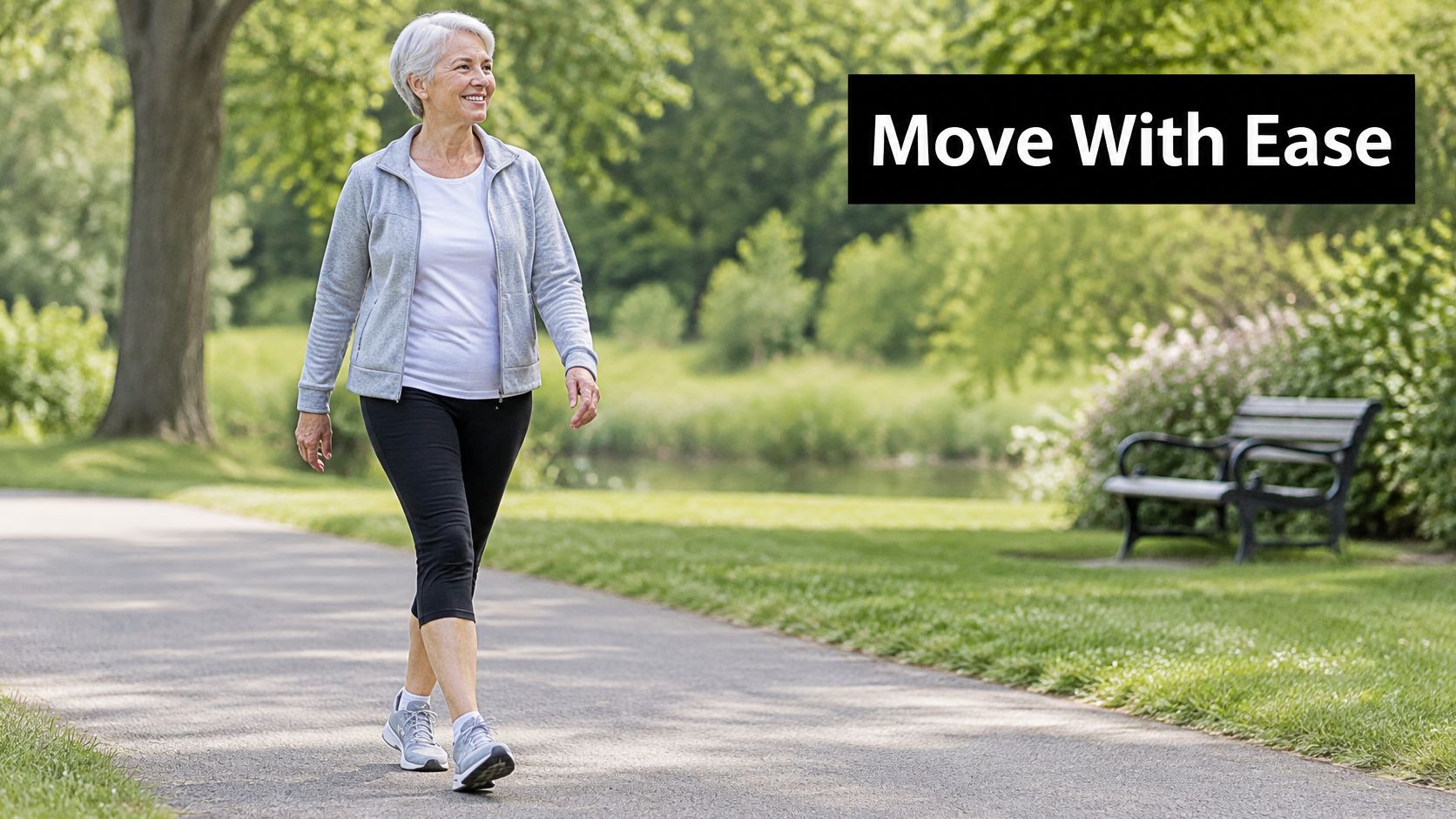
Modification ladder
- Easier: two 5-minute walks on flat ground, or 5 minutes on the bike with resistance at zero.
- Standard: 10 to 20 minutes continuous at a pace where you can speak in short sentences but not sing.
- Progressed: add roughly 10% more time each week. Someone with knee osteoarthritis might start at 10 minutes and reach 30 minutes over six to eight weeks. Someone recovering from knee replacement often starts on a stationary bike with light resistance inside a supervised rehabilitation program, then moves to walking.
Pause and check: mild muscle soreness that fades within a day is normal. Joint pain that's sharper at the end of the walk than at the start, or still worse the next morning, means cut the session by a third and rebuild from there.
Wear supportive shoes, choose even pavement, and save the hilly route until the flat one feels easy.
2. Aquatic Exercise (Water-Based Therapy)
A person who stops after one block on the sidewalk can often keep moving once the water reaches the waist. Buoyancy supports most of the body weight. The water still resists every step, so the muscles work without the same joint load. A warm pool, typically between 83 and 88 degrees Fahrenheit, also eases muscle guarding that makes a cold morning walk feel unsafe. That mix is a practical option for sharp pain on land, poor balance, or a recent surgery.
Start shallow rather than heading for the deep end, and use the rail until you know how your knee or hip responds. Chest-deep water unloads more of the joint, but it also hides fatigue and makes balance feel easier than it will on land. If swelling has been the problem, trade that comfort for a shorter first session.
Someone with hip arthritis might attend a supervised water class twice a week to build strength and confidence, then add land-based balance work once the pool movements feel easy. After surgery, water walking and gentle trunk movement often come first, under a physical therapist's direction, because the water lets movement start earlier without loading the incision site. When a group class stays generic and the joint is specific, pool-based physical therapy can structure the water work around that joint.
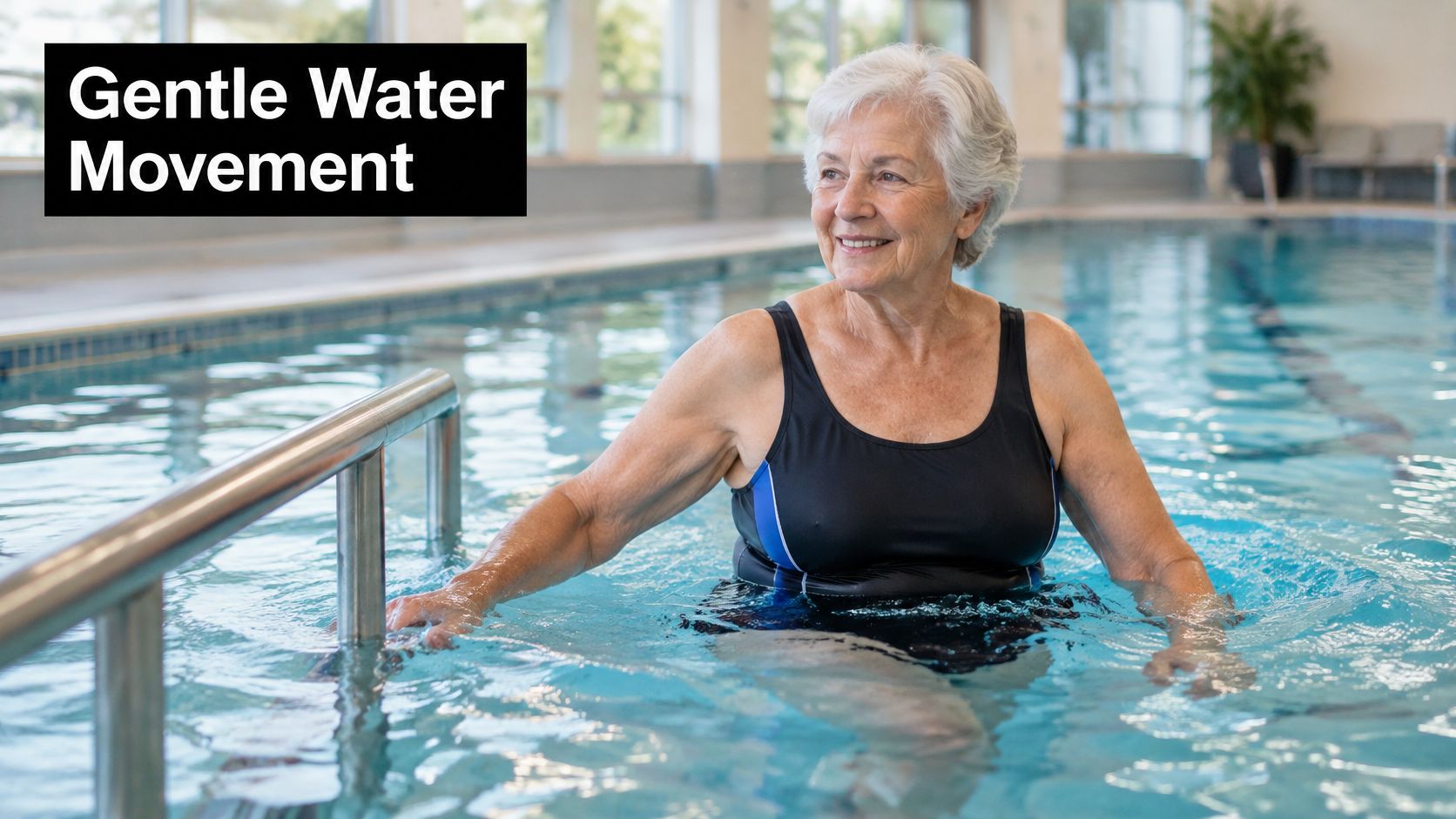
Where pool classes fall short on dose
Two pool classes a week are a useful start. They are not a full activity plan. A 2025 analysis of 199 studies covering 266 exercise interventions for knee osteoarthritis found that only 1 study (0.5%) met every component of the World Health Organization's adult physical-activity recommendations, while 16 interventions (6.0%) hit the aerobic target and 12 (4.5%) hit the muscle-strengthening target, as reported in the 2025 review of exercise dosing. Research protocols under-dose, and home programs copied from them inherit the gap. Pair the pool with short land walks so the week still includes aerobic time.
Easier: waist-deep water, one hand on the rail, 10 minutes of slow walking and side steps.
Standard: 20 to 30 minutes of water walking, leg lifts, and hip movements in chest-deep water.
Progressed: add a noodle or hand paddles for resistance, or move the balance work onto dry land.
Pause and check: Warm water masks fatigue. Judge the session by the next 24 hours. If stiffness or swelling is worse the day after, shorten the pool time before you shorten the walk.
Enter slowly with the rails, rinse off afterward, and drink water. You sweat in a pool without noticing.
3. Tai Chi for Joint Pain and Balance
Tai Chi looks too gentle to count as exercise until you've held a single-leg stance for 30 seconds while someone counts. The slow weight shifts train balance, ankle control, and hip strength at the same time, which is why it suits people whose main fear is falling rather than walking.
The evidence supports it as a legitimate low-intensity option. A 2025 systematic review found that low-intensity activities, including walking, Tai Chi, and Baduanjin, significantly improved knee osteoarthritis symptoms and could be delivered through cost-effective community programs, per the 2025 review of low-intensity exercise. The Arthritis Foundation runs a structured Tai Chi program built specifically for people with arthritis, and community centers and hospitals across the country offer classes.
Here's the movement pattern in practice, with the slow weight transfer and controlled arm arcs.
Easier, standard, progressed
- Easier: a seated or chair-supported version, 10 minutes, focusing on breathing and arm movement without the weight shift.
- Standard: standing form with a chair or wall within reach, 15 to 20 minutes, three days a week.
- Progressed: longer sequences, lower stances, and balance holds without hand support once the standard form feels stable.
A class you attend twice a week beats a home routine you abandon in ten days. Pick the format you'll actually keep, and if confidence or transport is the barrier, ask about community classes before you give up on the idea.
The pause rule here is simple. Wobbling is expected and useful. Sharp knee pain on a twist, or a loss of balance that happens more than once in a session, means step back to the supported version and get the instructor's eyes on your form.
4. Quadriceps Strengthening (Straight Leg Raises and Terminal Knee Extensions)
The quadriceps are the shock absorbers of the knee. When they're weak, every step lands harder on the joint, which is why strengthening sits at the center of knee arthritis care and post-surgical recovery. Straight leg raises and terminal knee extensions build that strength without deep bending.
The evidence is unusually solid. A Cochrane review of 44 randomized trials found land-based therapeutic exercise reduced pain by an average of 12 points on a 0 to 100 scale (95% confidence interval 10 to 15) immediately after treatment, improved physical function by 10 points (8 to 13), and improved quality of life by 4 points (2 to 5) across 13 studies, as detailed in the Cochrane review of exercise for knee osteoarthritis. Results like that usually arrive faster than people expect. A 2024 randomized controlled trial reported a 58.3% response rate after just four weeks of exercise rehabilitation in adults aged 45 to 70 with moderate-to-severe knee osteoarthritis, published in the 2024 trial on early exercise response.
Say your knee aches on stairs. You'd start with quad sets, pressing the back of the knee into a rolled towel for 5 seconds, ten times, twice a day. Once that's easy, move to straight leg raises.
How to run the ladder
- Easier: quad sets with a towel under the knee, 10 reps, no leg lift.
- Standard: straight leg raises, lying down, 2 to 3 sets of 8 to 12 reps, lifting slowly and lowering with control.
- Progressed: terminal knee extensions with a resistance band, keeping the knee slightly bent rather than locked straight, then adding a light ankle weight.
A mild ache at the front of the thigh is the muscle working. Sharp pain under the kneecap, or the knee giving way, is your cue to stop and get assessed before adding load.
5. McKenzie Prone Press-Ups for Low Back Pain
The McKenzie Method is a classification system, not a single stretch, and that distinction matters. Prone press-ups are an extension exercise for a specific pattern of back pain, usually disc-related pain that travels into the buttock or leg. Done on the right person, they work quickly. Done on the wrong one, they irritate the spine.
The underlying idea is centralization. As you press up while lying face down, pain that was radiating down the leg should retreat toward the spine. If it does, you've found a direction your spine tolerates. If it travels further down the leg, you've found the opposite, and you should stop.
Learn the movement with a licensed therapist before you make it a nightly habit. The pattern that helps one back can aggravate another, and the difference is in the direction, not the effort.
When to regress, when to progress
- Easier: lie prone on your elbows for a minute or two and see how the leg feels, without pushing up.
- Standard: press up through the arms while the hips stay relaxed on the floor, 5 to 10 reps, checking where the pain sits after each one.
- Progressed: standing extension, or press-ups through a fuller range, once the lying version keeps pain central and settles within minutes.
The centralization rule: leg pain that moves up toward the spine, or stays put while the back eases, means continue. Leg pain that moves further down, numbness that spreads, or new weakness in the foot means stop and call a clinician the same day.
Track the location of the pain, not just its intensity. That's the signal this exercise runs on.
6. Bird Dog Exercise for Core Stability
Bird dog trains the muscles that hold your trunk still while your arms and legs move. That's the job your core does when you carry groceries, climb stairs, or catch your balance. It loads the spine far less than a sit-up and teaches control rather than force.
Set up on hands and knees, hands under shoulders, knees under hips. Brace lightly, then reach one arm forward and the opposite leg back without letting the hips rotate. Hold for a few seconds, return, and switch sides.
Ladder and form
- Easier: reach just the arm, or just the leg, and hold for 2 seconds. A folded towel under the knees takes pressure off the kneecaps.
- Standard: full opposite arm and leg, 3 sets of 8 with a 3-second hold, which is the version often prescribed for chronic low back pain.
- Progressed: extend the hold to 5 to 8 seconds, add a light ankle weight, or draw small circles with the extended hand.
Form check: imagine a glass of water resting on your lower back. If it would spill, you've reached too far. Range isn't the goal here, control is.
Pain that stays in the center of the back and eases when you stop is acceptable. Pain that shoots into the buttock or leg, or a back that sags every rep, means drop back a rung and rebuild. Slow, steady breathing matters more than people think. If you're holding your breath, you're bracing too hard.
7. Chin Tuck Exercise for Neck Pain
Hours at a laptop or a phone pull the head forward of the shoulders, and the deep muscles at the front of the neck switch off while the ones at the back work overtime. The chin tuck, also called cervical retraction, reactivates the deep neck flexors and puts the head back over the shoulders where it weighs less to carry.
Sit or stand tall, keep your chin level, and glide your head straight back as if making a double chin. Hold 3 to 5 seconds, repeat 8 to 10 times. A mirror helps, because the movement is small and easy to fake by tilting the chin down instead of sliding back. For a fuller routine you can pair it with neck pain relief stretches between work blocks.
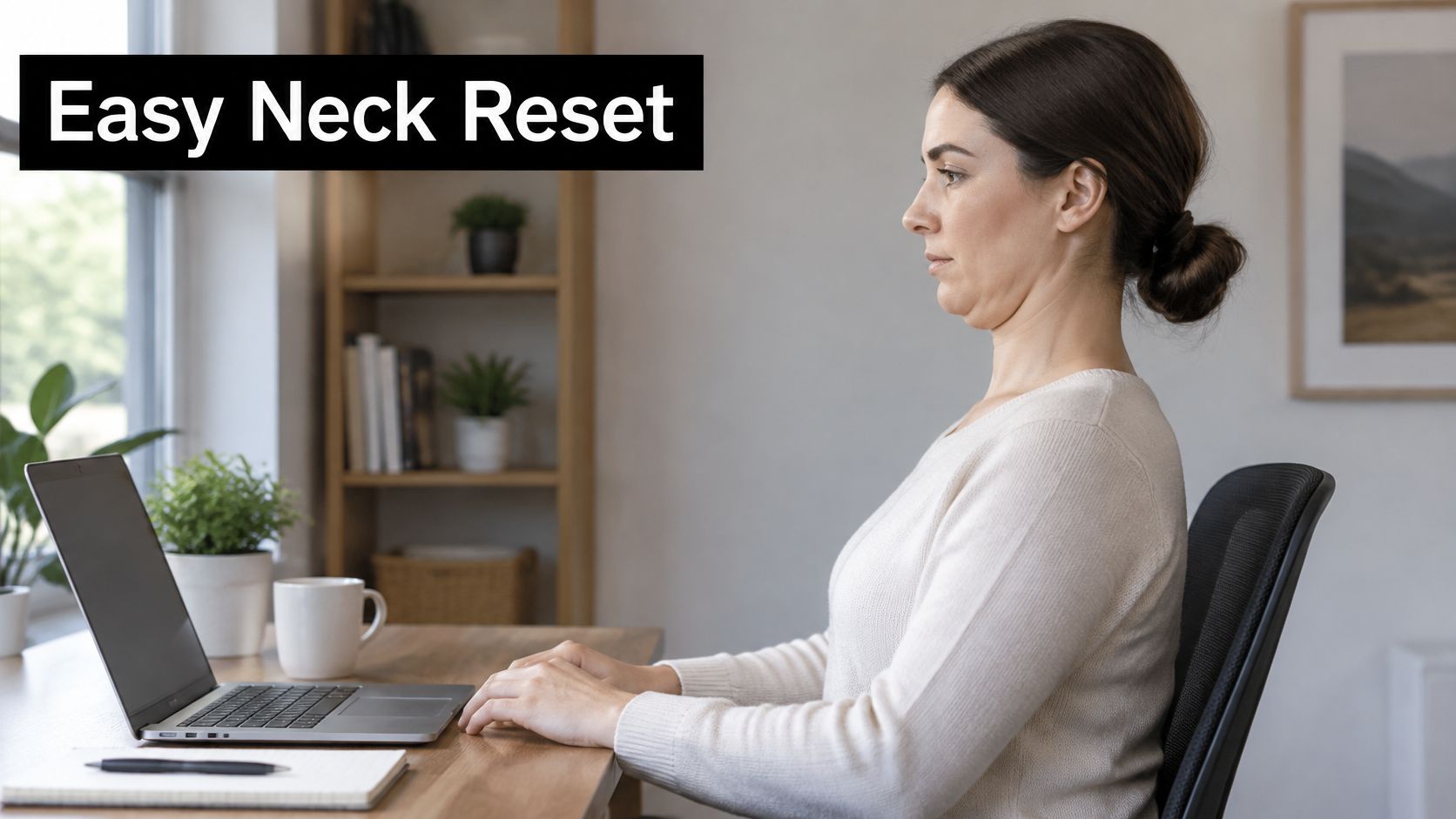
An office worker with recurrent stiffness does best with frequency, not intensity. Ten seconds every hour beats a heroic 20-minute session on Sunday.
Desk-day progression
- Easier: lie on your back and nod gently, or press the back of the head into a wall, no movement at all.
- Standard: seated chin tuck, 8 to 10 reps, held 3 to 5 seconds, done every hour or two.
- Progressed: hold the tuck while walking or during a light band pull, so the position survives movement.
The pause rule is different from the knee rules, and worth respecting. Stop immediately if you feel dizzy, lightheaded, numb, or if the headache intensifies rather than eases. Those symptoms point away from a simple posture problem, and they warrant an assessment rather than more reps.
8. Otago Exercise Programme for Fall Prevention and Balance
Balance is the category people skip until after a fall. The Otago Exercise Programme, developed at the University of Otago in New Zealand, is a structured home-based plan that combines progressive leg strengthening with balance challenges and a walking component. It's the version physical therapists reach for most with older adults because it was designed to be done at home between visits.
The design matters more than any single exercise. Movements get harder in small steps, so the body keeps getting challenged without a jump that causes a fall. Community fall-prevention classes across several countries use Otago-based exercises for the same reason.
Building the program
- Easier: sit-to-stand from a firm chair with both hands on a counter, plus heel raises holding support.
- Standard: one hand on support for tandem stance and side steps, with repeated sit-to-stand and walking turns.
- Progressed: no hands, backward walking, and stair practice once the standard set feels controlled.
Progression follows a simple logic. Each rung adds either less hand support, a smaller base of support, or more movement of the head and arms. Only one variable changes at a time. Changing two at once is how people end up on the floor during a program meant to keep them off it.
OARSI recommendations00888-3/fulltext) give the practical frame for dosing any therapeutic exercise: select the exercise after a baseline assessment, tie it to the patient's goals, deliver enough frequency and intensity to matter, and adjust using follow-up and adherence support. Regular practice at a tolerable level beats occasional hard sessions, and regular practice of any kind beats inactivity.
Structure and feedback carry some of that adherence. A 2024 pilot randomized controlled trial found that a 12-week sensor-assisted, app-based exercise program produced a statistically significant pain reduction with an effect size of 0.76 in people with knee osteoarthritis, reported in the JMIR trial of app-supported exercise. For a home balance program, the equivalent feedback is simple: a written schedule on the fridge, a tally of completed sessions, and a family member or clinician checking in weekly.
Setup before the first session:
- A counter or sturdy chair within arm's reach at all times.
- Loose rugs, cords, and clutter cleared from the practice path.
- Flat, supportive shoes rather than socks or slippers.
- Good lighting, since most home falls happen in dim hallways and bathrooms.
Clinicians screening older adults can use a fall risk assessment guide for clinicians to decide where to begin, and structured fall prevention exercises build from there.
The pause rule for balance work is about control, not pain. If you can't hold a position for 10 seconds without grabbing support, that is the rung you stay on. Stop the session entirely if you feel dizzy, lightheaded, or unsteady in a way that persists after you sit down, or if a movement produces sharp joint pain rather than muscle effort. Muscle fatigue in the legs is the goal. A wobble you can't correct is the signal to step back a rung, and recurrent dizziness warrants a clinician's assessment before you continue.
How the eight gentle joint exercises compare
| Exercise | Impact Level | Equipment Needed | Best For | Typical Setting |
|---|---|---|---|---|
| Low-Impact Aerobic Exercise (Walking and Stationary Cycling) | Low | Supportive shoes or stationary bike | Joint mobility, endurance, and cardiovascular fitness | Outdoors, home, or gym |
| Aquatic Exercise (Water-Based Therapy) | Very low | Warm pool; optional flotation aid | People with pain, limited mobility, or balance concerns | Pool or aquatic therapy program |
| Tai Chi for Joint Pain and Balance | Low | None; sturdy chair or wall for support | Balance, flexibility, and gentle joint strengthening | Home, community class, or hospital |
| Quadriceps Strengthening (Straight Leg Raises and Terminal Knee Extensions) | Low | None or light resistance band or ankle weight | Knee strength and stability | Home or physical therapy |
| McKenzie Prone Press-Ups for Low Back Pain | Low | None | Some types of low back pain or sciatica, with clinician guidance | Home or physical therapy |
| Bird Dog Exercise for Core Stability | Low | Exercise mat; optional knee cushion | Core stability and trunk coordination | Home, physical therapy, or sports rehabilitation |
| Chin Tuck Exercise for Neck Pain | Low | None; optional mirror | Neck posture and muscle activation | Home, workplace, or physical therapy |
| Otago Exercise Programme for Fall Prevention and Balance | Low to moderate | Sturdy chair or counter; minimal equipment | Older adults seeking improved strength, balance, and fall prevention | Home or supervised community program |
Start Slowly, Track Your Response, and Know When to Call a Clinician
Pick one or two exercises from this list, not eight. Choose by joint and by the goal that matters this month: walking to the mailbox without stopping, standing up from a low chair, or turning your head to reverse the car. Run the easier rung for a week before you judge whether it's working.
Dose is where errors happen in both directions. Walking at least 151 minutes per week was associated with 15% to 28% lower odds of moderate arthritis-related joint pain and 23% to 30% lower odds of severe pain compared with walking less than 150 minutes weekly, and 301 to 450 minutes per week was associated with substantial pain reduction in older adults, according to a 2025 review of walking dose and joint pain. The same evidence carries a caution, because a separate 2025 meta-analysis reported limited evidence that exceeding international physical-activity guidelines may increase osteoarthritis risk, with a relative risk of 1.18 (95% CI, 1.02 to 1.35).
Log two numbers: pain on a 0 to 10 scale during the session, and pain the next morning. A rise of one or two points that settles overnight is a green light to repeat the session. A rise that's still there 24 hours later means drop back a rung for a week, then try again.
Stop and get assessed if pain is sharp rather than dull, spreads down a limb or into new territory, or comes with swelling, a joint that gives way, numbness, or pain that wakes you at night. Those signs point to something other than normal exercise soreness and deserve a hands-on exam rather than another week of guessing.
At MedAmerica Rehab Center in Deerfield Beach, our physical therapists and chiropractor build individualized pain management and prevention plans for joint pain, arthritis, and knee, shoulder, and ankle concerns, including balance and gait work for people whose confidence has eroded along with their strength. We'd rather adjust your starting dose than have you abandon a program that was pitched too hard.
Joint pain that's been building for months rarely resolves on a generic routine, and the right starting point depends on which joint is irritated, how much load it tolerates, and what your week looks like. MedAmerica Rehab Center assesses strength, movement, and symptom response, then builds a plan that pairs hands-on therapy with exercises you can continue at home, from pool-based sessions to balance and fall-prevention work. Visit MedAmerica Rehab Center to talk through which of these exercises fits your condition and how to progress without a flare.
MedAmerica Rehab · Deerfield Beach
Talk to a clinician about your pain
Physical therapy, chiropractic, acupuncture and shockwave therapy under one roof, since 1995. Same-day appointments are available.
Mon–Thu 8:00 AM – 6:30 PM · Fri 8:00 AM – 3:00 PM