
Therapy for Hand Injury: A Practical Guide to Recovery
A knife slips while you're making dinner, and a sharp pain shoots through your finger. Or you wake with tingling in your hand and find that opening a jar feels harder than it did yesterday. The immediate questions are practical: should you rest it, keep moving, book an appointment, or ask for imaging?
For adults in Deerfield Beach, therapy for hand injury should start with the structure involved and the task you need to get back to. Tendons, nerves, ligaments, and bones heal differently, and the right amount of movement for one injury may be unsafe for another. A certified hand therapist can assess function, guide protected movement, and help coordinate care with your surgeon or physician.
When a Hand Injury Changes Your Day
A person who has just cut a finger may be focused on the wound, while someone with a wrist injury may be more concerned about lifting a coffee cup. Both have a hand problem, but they may need different assessments and different next steps. A therapist's first job is to understand what happened, what has changed, and which movements or daily tasks are now difficult.
Hand therapy isn't a set of exercises. It can involve protecting a healing structure with a splint, managing swelling, restoring movement in a controlled way, and practicing tasks that matter at home or work. After surgery, the therapist also follows the surgeon's instructions about what the repair can safely tolerate.
Practical rule: Don't assume that less pain means the hand is ready for unrestricted use. Follow the restrictions set for your specific injury or repair.
The difference between acute care and ongoing rehabilitation matters. A recent injury may call for protection and an assessment of whether imaging or surgical review is needed. Later, treatment may shift toward motion, coordination, strength, and the demands of your job, sport, or daily routine.
This guide gives you a way to think through the injury category, why timing changes the plan, what therapy may involve, and how to judge progress. It also addresses the logistics that shape whether a plan is realistic, including transportation, work schedules, insurance, and access to specialized care.
The Four Main Types of Hand Injury
The injury category helps determine what therapy is trying to protect or restore. A therapist may assess more than one structure, especially after a crush injury, fall, or laceration, so the categories are a useful starting point rather than a diagnosis.
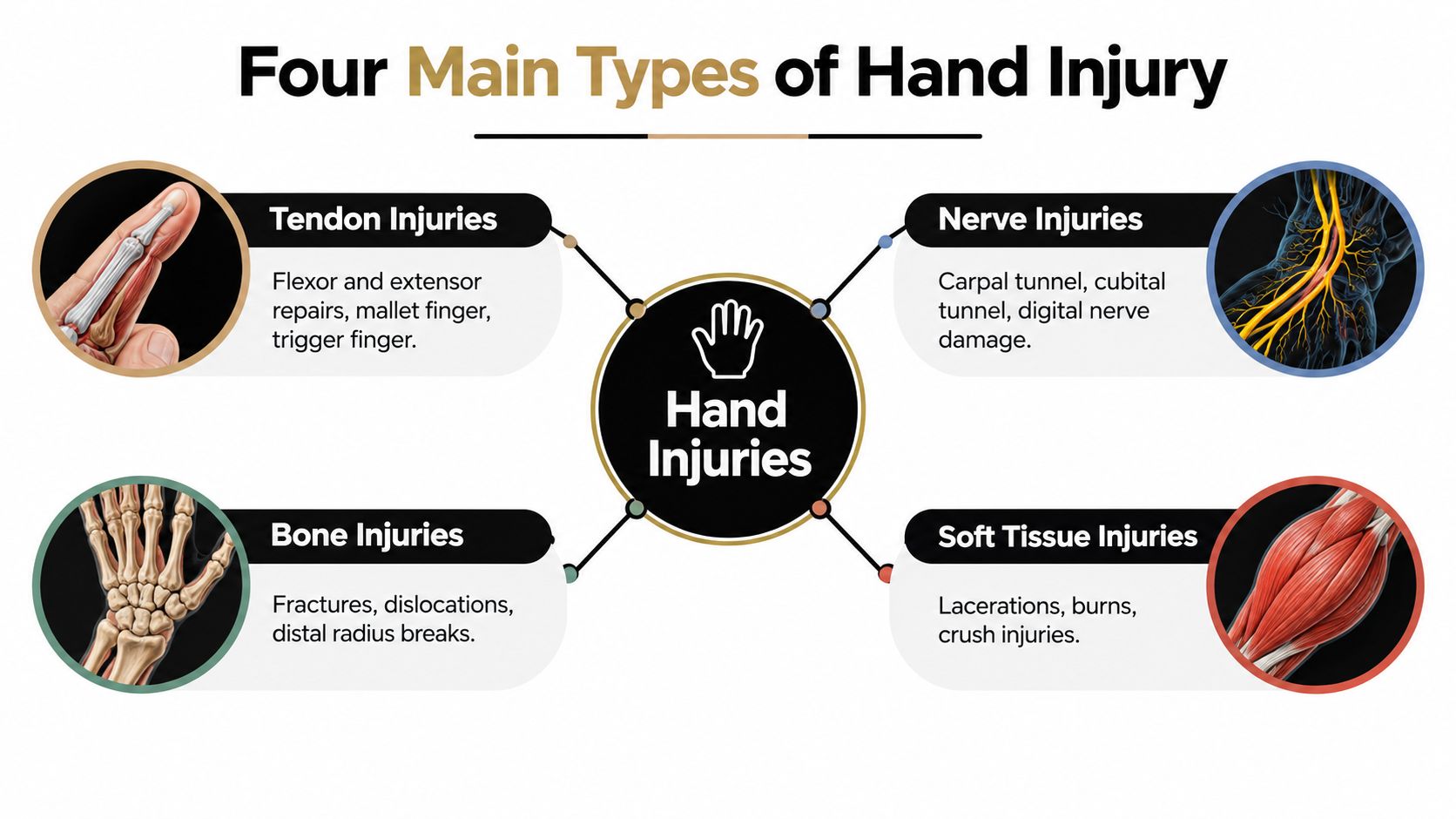
Tendon injuries
Tendons connect muscle to bone and transmit the force that bends or straightens a finger. A cut can damage a flexor tendon, which bends a finger, or an extensor tendon, which straightens it. A mallet finger involves difficulty straightening the fingertip, while trigger finger can make a finger catch during bending and straightening. After a tendon repair, therapy aims to protect the repair while helping the tendon move without excessive force.
Nerve injuries
Nerves carry sensation and help control muscle activity. Carpal tunnel involves pressure on a nerve at the wrist; cubital tunnel affects a nerve near the elbow, and a deep cut can injure a small digital nerve in a finger. Depending on the problem, therapy may address comfortable positioning, activity changes, sensation, and safe use of the hand.
Ligament and soft-tissue injuries
Ligaments connect bones and help stabilize joints. A skier's thumb, for example, affects a ligament at the base of the thumb. The volar plate is soft tissue that supports a finger joint, and an injury there can follow a forceful bend backward. Therapy aims to protect the joint while restoring useful movement and stability.
Bone injuries
A fracture may involve a finger, a wrist bone, or the distal radius near the wrist. A scaphoid fracture is another wrist injury that needs appropriate medical assessment. After immobilization or fixation, therapy may address stiffness, swelling, motion, and function, following the treating clinician's guidance.
Quick reference: Tendon injuries affect movement, nerve injuries can affect sensation or muscle control, ligament injuries affect joint support, and bone injuries require attention to fracture stability as well as mobility.
Acute Versus Chronic Hand Injury Pathways
Timing can change the advice completely. A newly repaired tendon needs protection and only the movement prescribed for that repair. A long-standing overuse problem may instead call for changes to irritating tasks and a gradual return to appropriate loading. The symptom may be “hand pain” in both cases, but the tissue's condition and risk are different.
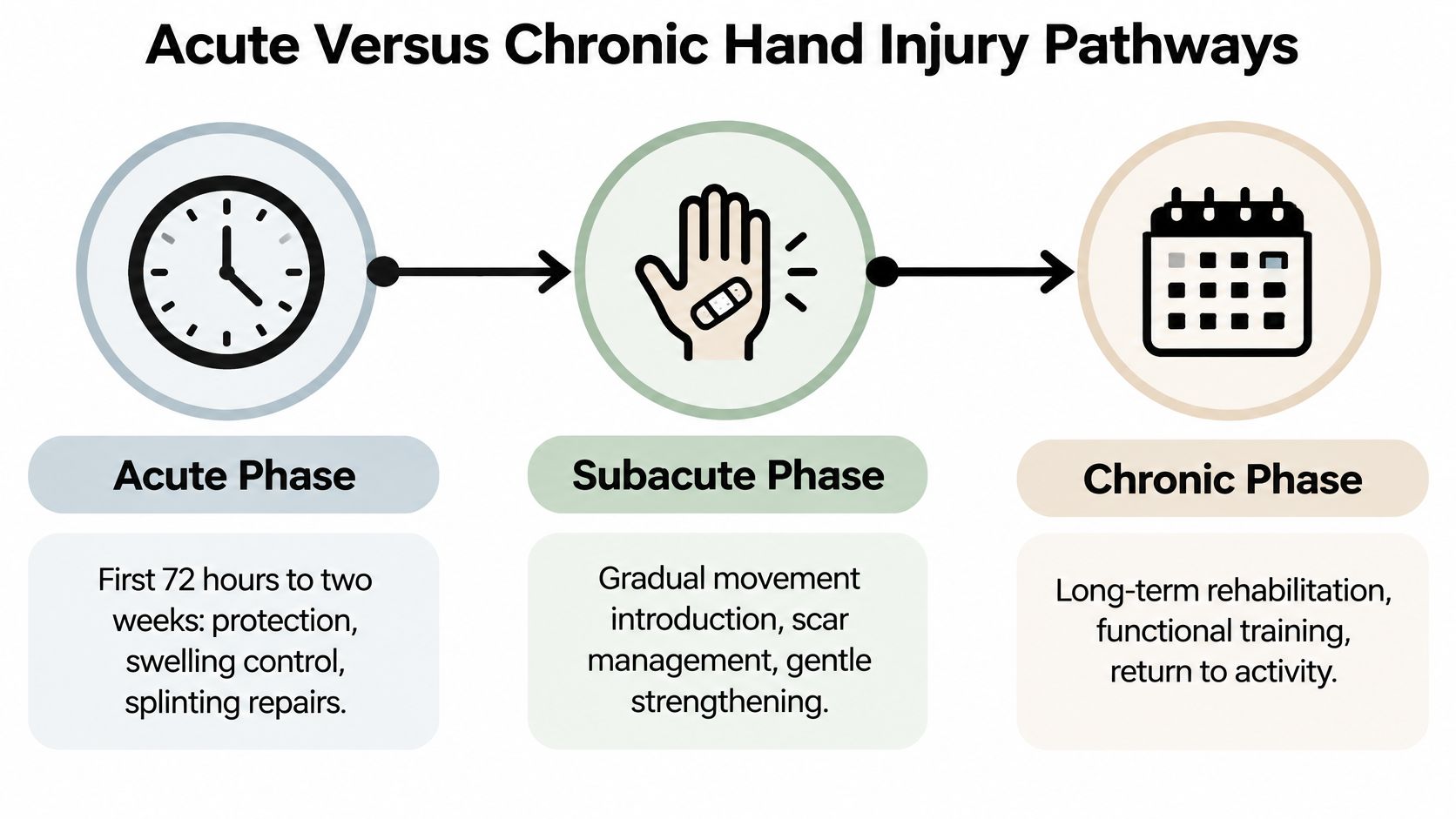
Early care and protected motion
Soon after an injury, care may focus on protection, swelling management, and deciding whether a clinician needs to assess the hand. If a fracture or tendon repair is involved, the splint and movement limits should match the medical plan. Don't borrow exercises from a friend or online video when the injury hasn't been identified.
As healing progresses, a therapist may add carefully selected movement and scar or soft-tissue care. The timing depends on the diagnosis, the stability of the repair or fracture, and the treating clinician's instructions. “Move it so it doesn't get stiff” isn't safe advice for every injury.
Long-standing symptoms and gradual loading
With a persistent overuse problem, avoiding every hand task indefinitely can leave you less prepared for the activities you need to resume. A therapist can help identify which tasks provoke symptoms and adjust the amount or type of loading. The goal is to find a tolerable progression, not to test the hand with a sudden return to full demand.
For symptoms that may involve carpal tunnel, conservative options and activity changes depend on the person's presentation. The clinic's overview of ways to treat carpal tunnel without surgery can help you understand the kinds of non-surgical approaches that may be discussed with a clinician.
Core Techniques Used in Hand Therapy
A first session usually starts with questions and measurements, not treatment. A therapist checks swelling, active and passive motion, sensation, scar sensitivity, and the way you use the hand for a task that matters to you, whether that is turning a key, gripping a steering wheel on a commute, or getting back on a job site. What shows up in that first hour shapes everything after.
Hand therapy is a sequence of choices. The plan changes as tissue heals and function improves, and a technique that fits week two can be wrong for week six.
Splints, swelling care, and movement
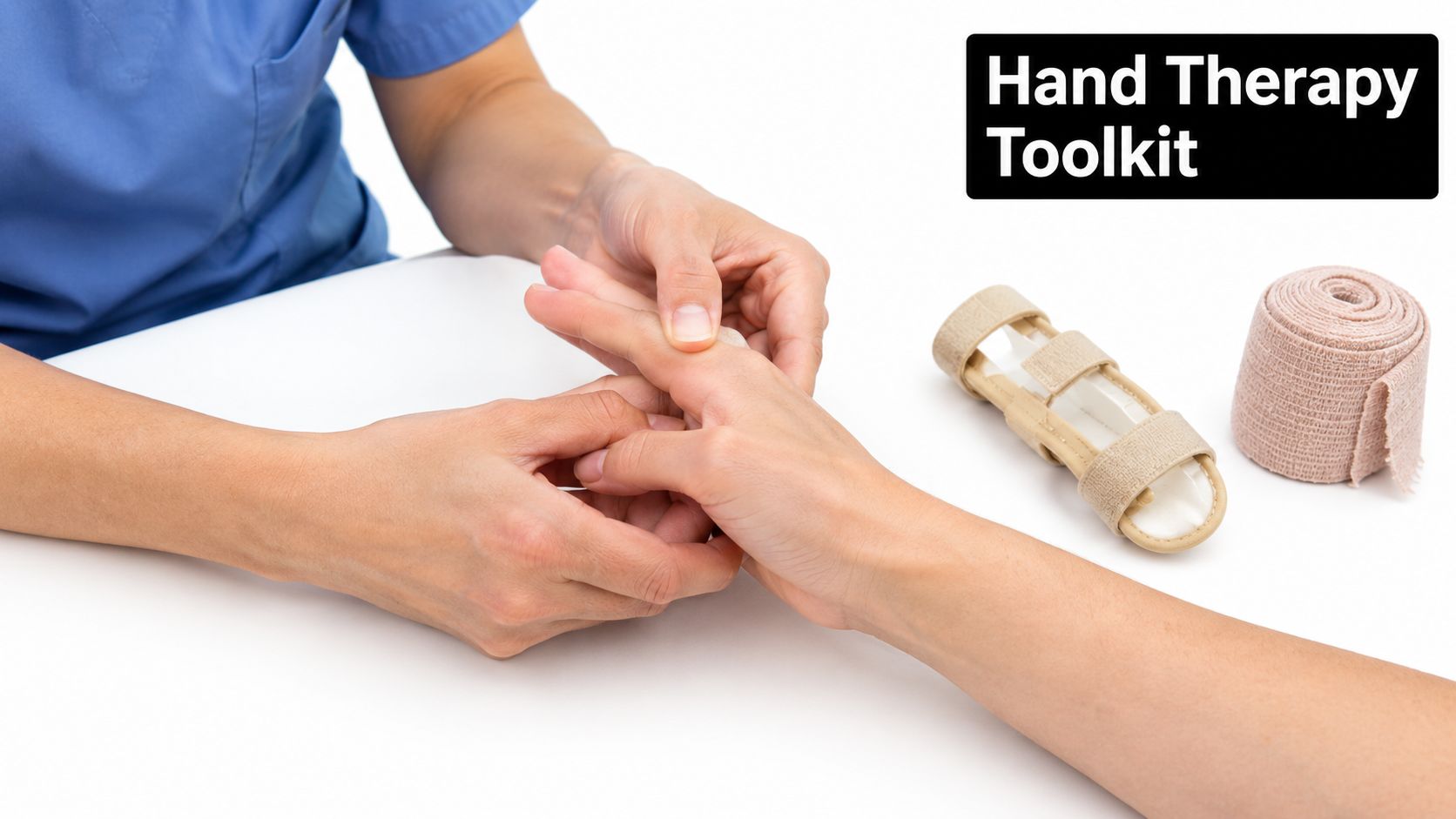
A custom or prefabricated splint may protect a repair, support a joint, or position the hand for a particular activity. Fit and wearing schedule matter. A splint that is too restrictive interferes with the intended movement plan, and one that protects poorly leaves the injury exposed to avoidable strain. Splints get remolded regularly in the early weeks for a simple reason: a swollen hand shrinks.
Elevation and compression may be used for swelling when appropriate. Exercises can include tendon glides, joint blocking, or carefully graded wrist and finger movement, selected for the structure involved and the treating clinician's restrictions rather than pulled from a generic sheet.
After extensor tendon repair in hand zones V and VI, controlled early movement produces faster recovery of finger motion than static immobilization in the short term. The working principle is dose-controlled tendon excursion: prescribed movement limits adhesions and stiffness while keeping force within safe bounds, and long-term outcomes tend to converge with immobilization by roughly three months (research on mobilization after extensor tendon repair). In practice, that means the tendon moves on a schedule and under supervision. Free use of the hand and strengthening come later, on the surgeon's timeline.
Strength, function, and treatment tools
Once the clinician confirms that progression is safe, therapy adds grip and pinch work, dexterity tasks, and practice with the work and household activities you need to resume. Therapy putty can be used as one tool for graded hand exercises (see our guide to hand exercise putty), but the resistance and task should fit the stage of recovery. MedAmerica Rehab Center uses individualized hand rehabilitation that may include movement, strengthening, coordination, and functional training.
After volar plate fixation of a distal-radius fracture, a randomized trial of 57 patients found that structured hand therapy improved early function, pain, and wrist and forearm motion compared with instruction alone; functional differences were no longer significant at six months (the distal-radius hand-therapy trial). That result supports attention to early recovery, while also showing why supervised visits can taper once a safe home program is working.
Modalities such as ultrasound, paraffin, electrical stimulation, or shockwave may be considered in some care plans. Diagnosis-specific movement, protection, and functional practice do the heavier lifting. A therapist should be able to explain what a modality is intended to add and how the plan will be adjusted if it stops helping.
A demonstration can help you see how controlled movement differs from forcing a stiff or healing hand. Treat any video as general context; the instructions for your own injury come from your treating team.
Typical Rehab Timelines by Injury Type
There isn't one reliable return date for every hand injury. A tendon repair, a stable fracture, a nerve injury, and a ligament sprain each have different biological and functional demands. Your clinician can give you checkpoints based on the actual injury and healing status, rather than a generic promise that the hand will be “normal” by a certain date.
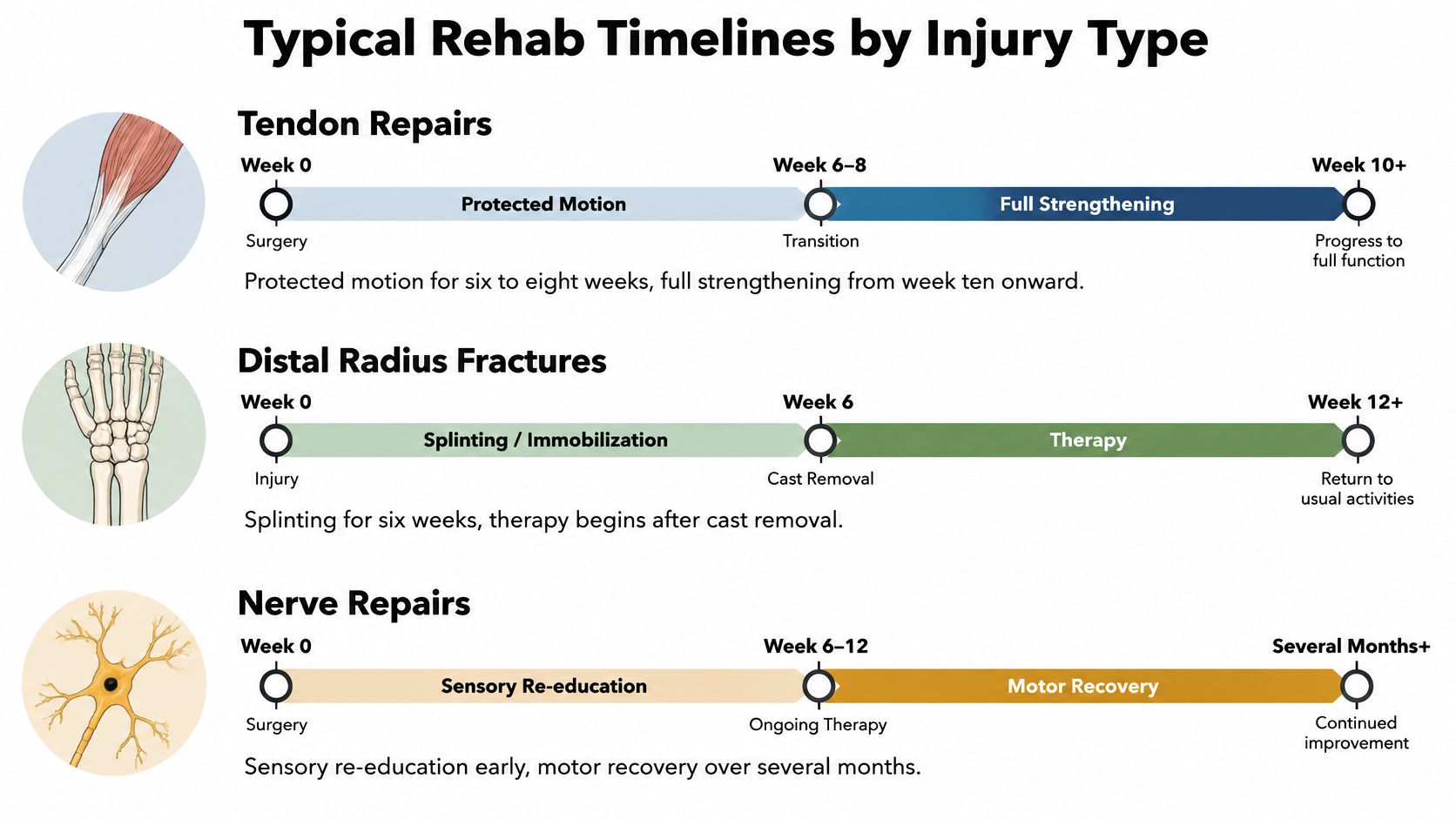
Tendon repairs need a protected progression. Early movement may be prescribed, but the repair can't be treated like an uninjured tendon. Strengthening and heavier tasks should wait until the surgeon and therapist consider them appropriate.
Fractures may be managed with immobilization or fixation, depending on the injury. After a distal-radius fracture, a person may regain basic movement before they're ready for lifting, forceful gripping, or repeated wrist loading. Imaging that shows healing doesn't automatically mean the hand is ready for every work task.
Nerve injuries can involve changes in sensation, muscle control, or both. Recovery expectations depend on where and how the nerve was injured, so a therapist may monitor sensation and function over time rather than using pain alone as the measure.
Ligament sprains vary from injuries that can be managed with protection and progressive movement to tears that need surgical assessment. A person who types for work may manage a task sooner than someone whose job requires lifting, tool use, or sustained grip. Athletes also need to demonstrate control and tolerance for sport-specific demands before returning.
A useful checkpoint is task-based: Can you do the activity your day requires with appropriate control, without breaking your medical restrictions or provoking a worsening response?
For athletes balancing healing with sport demands, a practical sports injury recovery guide offers broader context on planning a gradual return. Apply any general guidance alongside the instructions for your particular hand injury.
Measuring Progress Beyond Pain Relief
Pain is important, but it doesn't tell the whole story. A hand can hurt less while still having limited motion, poor grip, altered sensation, or insufficient control for work. The reverse can happen too: a hand may remain somewhat sensitive while useful function is steadily returning.
A 2025 analysis of more than 6,700 flexor tendon repairs identified only 50% of patients as receiving hand therapy. Utilization varied by geography and Medicare coverage, and peaked around postoperative week four (the 2025 hand-therapy utilization analysis). Those findings make it especially important to ask what progress should look like for your injury, rather than relying on whether symptoms feel better.
A practical milestone table
| Milestone | Typical window | What it signals |
|---|---|---|
| Protected motion follows the prescribed plan | As directed by the surgeon and therapist | The hand is moving within its specific safety limits |
| Swelling is managed without worsening | During recovery, with timing set by the injury | The current activity and care plan are tolerable |
| Finger or wrist motion improves | Tracked at clinical reassessments | Stiffness is changing in a useful direction |
| Grip, pinch, or dexterity tasks become easier | When strengthening is cleared | The hand is regaining capacity for daily demands |
| Sensation and coordination are monitored | According to the nerve injury or symptoms | Changes are being noticed and communicated |
| Work or sport tasks are tested progressively | Before resuming full demands | Function is being judged against real activities |
The therapist should explain which milestones apply and how they'll be assessed. Ask for a clear baseline and a practical next goal, such as managing a fastener, holding a light object, or completing a work task within the allowed restrictions.
New or increasing pain during prescribed exercises, swelling that is getting worse, a loss of motion, or new sensory changes are reasons to contact the therapist or treating clinician for guidance. Don't respond by forcing through the exercise or adding resistance on your own.
Accessing Hand Therapy in South Florida
A recommended plan only works if you can attend and follow it. In-person hand therapy may be needed regularly for a period, and transportation, missed work, caregiver availability, appointment times, and insurance limits can all affect consistency. For Deerfield Beach patients, it's worth discussing those constraints at the start rather than discovering later that the schedule is unmanageable.
The geographic gap can be substantial in some communities. In the United States, rural residents travel an average of 38.75 miles to a certified hand therapist compared with 13.55 miles for urban residents, with estimated travel costs of $26.00 and $9.10, respectively. A 2025 Mississippi study reported an average round trip of 55.2 miles and $36.98 per visit, while patients in the most remote county faced 172.8 miles and $115.78 per visit (research on access to hand therapy). These figures describe the studies' settings, not the cost or travel distance for every South Florida patient.
Build a workable care plan
Ask the clinic and insurer about visit coverage, authorization requirements, copays, scheduling, and whether a home program with periodic check-ins is suitable for your injury. A therapist can help decide which exercises are safe to perform independently and what needs hands-on assessment. Telehealth or an app may support instruction and follow-up, but it can't be assumed to replace an in-person examination.
Remote assessment and 3D scanning are emerging tools that may help extend specialized evaluation in underserved areas. They're options to discuss, not guarantees that every hand injury can be assessed remotely.
Seek prompt hands-on assessment for suspected tendon rupture, worsening numbness or color change, a fracture that may be unstable, severe swelling, or a new deformity. Those concerns shouldn't be handled by increasing the home exercises or waiting for a routine remote check-in.
When to Refer Out and What to Expect Next
A first visit should produce more than a list of exercises. The therapist needs to understand the injury, review any relevant medical or surgical instructions, assess how the hand moves and functions, and agree with you on practical goals. If the findings suggest that the injury needs imaging or surgical review, rehabilitation should be coordinated with the appropriate medical clinician.
Bring these questions to the appointment:
- What structure is injured, and what movements should I avoid?
- Do I need a splint, and when should I wear it?
- Which exercises are safe at home, and how should I respond if symptoms worsen?
- What milestones will we use to track motion, strength, sensation, and daily function?
- How will the plan fit my work, transportation, insurance, and schedule?
A surgeon or physician may need to reassess the hand when symptoms, examination findings, or healing concerns suggest that therapy alone isn't enough. Don't delay asking for that review if you suspect a rupture, have worsening sensory or circulation changes, or have a fracture or deformity that hasn't been evaluated. Injury-related work and life changes can also create practical questions beyond treatment; for general context, read about the shift after a serious accident.
Hand therapy, physical therapy, and other services have different roles, and a clinician can help you understand how they may fit together. This overview of the differences between physical therapy, chiropractic therapy, and occupational therapy can help you prepare for that conversation. For your next step, book an evaluation, ask whether a custom splint or home program is appropriate, clarify coverage and scheduling, and request milestones that make progress measurable.
If a hand injury is making work or daily tasks harder, contact MedAmerica Rehab Center in Deerfield Beach to ask about an individualized hand rehabilitation plan. The clinic offers therapy focused on mobility, grip and pinch strength, coordination, and return to activity, with scheduling and insurance questions addressed as part of planning care.
MedAmerica Rehab · Deerfield Beach
Talk to a clinician about your pain
Physical therapy, chiropractic, acupuncture and shockwave therapy under one roof, since 1995. Same-day appointments are available.
Mon–Thu 8:00 AM – 6:30 PM · Fri 8:00 AM – 3:00 PM