

Cervicogenic Headache Physical Therapy: A 2026 Guide
Cervicogenic headaches originate in the neck rather than the head, and physical therapy is a proven, non-surgical way to reduce pain by addressing that mechanical problem. In trials, manipulation plus dry needling improved headache intensity by a mean difference of -4.87 and frequency by -3.09 versus control.
You may be sitting at your desk with pain behind one eye, a tight upper shoulder, and the sinking feeling that another migraine is beginning. You take your usual steps, but the headache keeps returning because the painful signal may be traveling upward from a stiff or irritated part of your neck.
That mystery is what makes cervicogenic headache physical therapy different from generic headache care. The pain is real, and it can feel remarkably similar to migraine pain, but the treatment target may be the cervical spine, shoulder girdle, and movement habits rather than the head alone.
Why Your Headache Starts in Your Neck
A patient may describe the pattern like this: the pain begins at the base of the skull after a long period of looking down, then creeps toward the temple or behind one eye. Turning the head makes it worse. A night in an awkward sleeping position can leave the neck stiff and the headache active by morning.
That doesn't mean every headache with neck pain is cervicogenic. It means the neck deserves careful examination instead of being dismissed as a secondary annoyance. Cervicogenic headache is a secondary headache disorder, meaning the head hurts because a problem elsewhere, in this case the cervical region, is contributing to the pain.

The referred-pain puzzle
Think of the neck as the wiring behind a wall and the head as the light fixture. A fault in the wiring can make the light flicker even though the visible problem appears at the fixture. Similarly, irritated cervical joints, muscles, or other neck structures can refer pain into the head.
The diagnosis rests on neck-related clinical evidence, not on a scan alone. Major classification frameworks emphasize reduced cervical range of motion, headache provoked by neck movement or sustained posture, and temporary relief after a diagnostic blockade of cervical structures. These criteria have been refined over time, and modern clinical summaries continue to use cervical signs and evidence of causation as the foundation for identifying appropriate rehabilitation candidates (clinical classification and treatment overview).
Why daily habits matter
Desk work, driving, phone use, and sleep position can keep the neck in one demanding posture. Your pillow doesn't need to be marketed as a cure, but side sleepers may find it useful to review principles of alignment in this guide to a side sleeper spinal alignment pillow.
People with age-related cervical changes may also have questions about how neck structure affects daily comfort. A resource on living with degenerative disc disease in the neck can provide broader context, but it shouldn't replace an individual evaluation. The central point is simple: the symptom is in your head, while the treatable driver may be lower down.
Recognizing the Signs of a Cervicogenic Headache
Start with the relationship between the headache and your neck. A cervicogenic pattern becomes more plausible when the headache changes with cervical movement or with a sustained position, such as working at a screen with the head held forward.
Use these questions to describe the pattern accurately:
- Where does it begin? Does pain start around the upper neck or base of the skull before spreading into the head?
- What provokes it? Does turning, looking up, looking down, or holding one posture reproduce or intensify the headache?
- What moves poorly? Do you notice reduced cervical range of motion or stiffness at the same time as the headache?
- Can the pain be reproduced? During an examination, can a clinician reproduce your familiar headache by assessing cervical structures?
These clues matter because diagnosis depends on causation, not just location. Pain behind the eye, for example, can come from several sources. Head and face pain can also overlap with jaw disorders, so understanding why TMJ pain radiates to the crown may help explain why a careful clinician asks about more than the neck.
What separates it from a typical migraine
A migraine is a neurological condition, while a cervicogenic headache has a neck-related mechanical component. The two can overlap, and neck symptoms don't automatically rule migraine in or out. A physical therapist should therefore avoid promising a diagnosis from one symptom, one posture, or one home test.
Your symptom history should include the side of the pain, neck stiffness, movements that trigger it, recent injury, and whether prolonged sitting or sleeping position changes the pattern. Bring a simple headache record to an appointment. Note what you were doing before the pain started and whether neck movement altered it.
Practical rule: A headache that repeatedly follows a neck position deserves a cervical assessment, not an assumption that every episode is the same type of headache.
A qualified clinician also screens for symptoms outside routine musculoskeletal care. Sudden severe onset, a headache after significant trauma, fever, vision changes, slurred speech, or one-sided numbness requires prompt medical evaluation rather than self-directed exercises.
How Physical Therapy Addresses the Root Cause
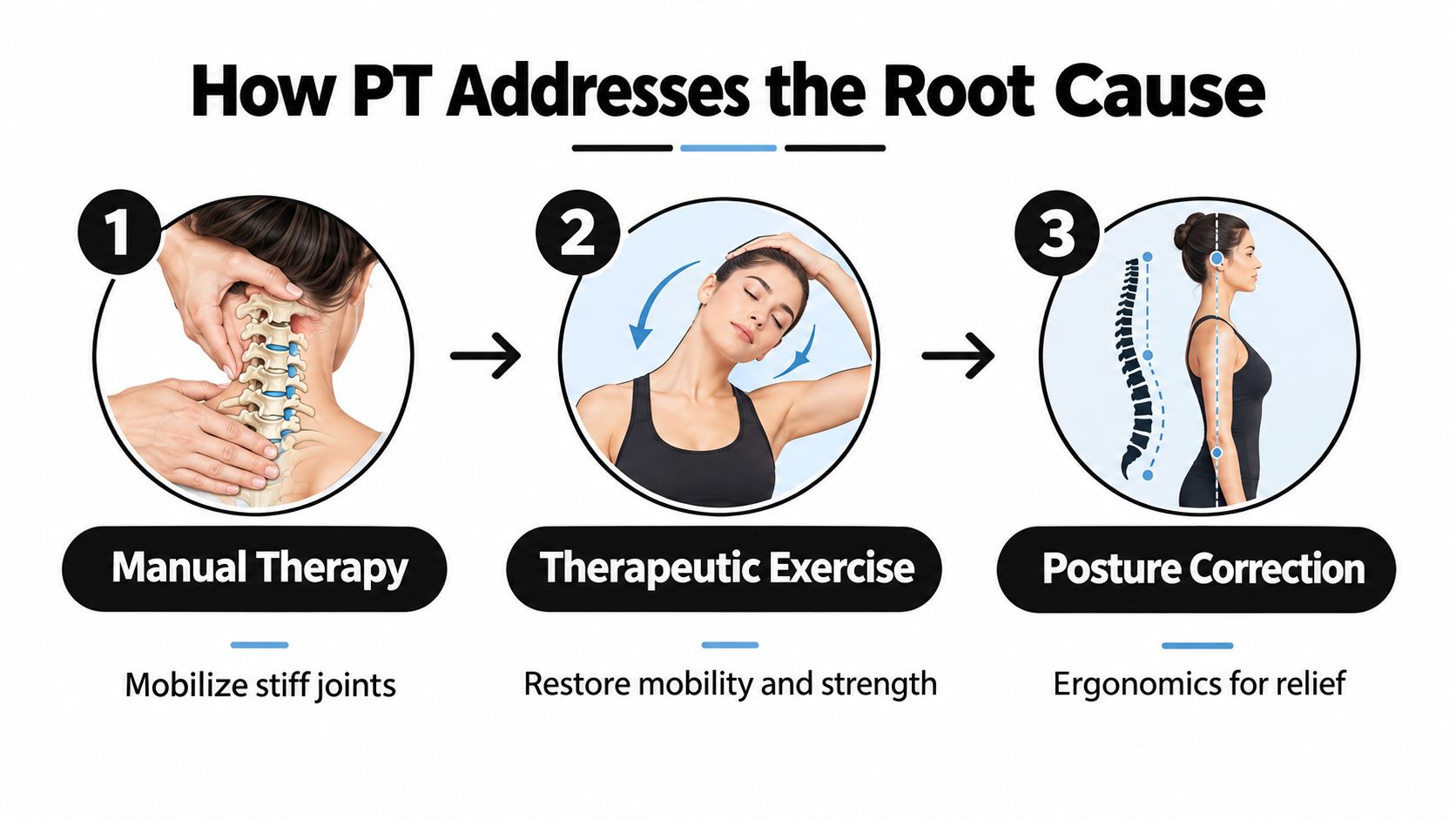
Effective care usually combines hands-on treatment with active retraining. Manual therapy can help a stiff area move more comfortably, while exercise teaches the neck and shoulder girdle to control that movement during work, sleep, and ordinary activity.
Three parts of a targeted plan
Manual therapy may include cervical mobilization, soft-tissue work, or carefully selected manipulation. The purpose isn't to force the neck into a new position. It is to assess how particular joints and muscles behave, reduce movement restrictions where appropriate, and create a more comfortable starting point for active rehabilitation.
Therapeutic exercise often addresses deep cervical flexor control, neck range of motion, upper-back strength, and shoulder-blade coordination. These smaller stabilizing muscles act like the guy wires supporting a mast. If they don't coordinate well, larger muscles may work harder and the neck may become less tolerant of sustained positions.
Posture and activity training connects the clinic to your real day. A therapist may adjust screen height, sitting support, phone use, lifting technique, or sleep habits. The aim isn't to demand perfect posture every minute. It is to give your neck more movement variety and less uninterrupted loading.
For readers comparing hands-on professions, this chiropractic vs physical therapy guide can help clarify differences in assessment, treatment scope, and exercise-based rehabilitation. The right choice still depends on the examination findings and your medical history.
A session should leave you understanding what was tested, what was treated, and what you can practice safely at home. Watch the following educational video as general background, not as a substitute for individualized assessment.
Evidence-Backed Treatments That Deliver Results
The evidence doesn't support treating every cervicogenic headache with the same exercise sheet. Research has compared manual therapy, mobilization, manipulation, dry needling, exercise, and combinations of these approaches. The clearest practical pattern is that multimodal care often performs better than relying on one passive or active technique alone.
A 2012 systematic review concluded that physiotherapy and spinal manipulative therapy might be effective. A later overview identified 6 systematic reviews covering 34 randomized controlled trials and concluded that manipulation and mobilization were effective for reducing pain and functional disability (systematic review evidence).
What the rankings suggest
A higher-level synthesis ranked spinal joint manipulation plus dry needling as the strongest short-term option, with a mean reduction of 4.87 points in headache intensity and 3.09 episodes in headache frequency compared with control (network review of physical therapist interventions). Other combinations with favorable results included muscle-energy technique plus exercise, soft-tissue techniques plus exercise, and dry needling plus exercise.
Those rankings don't mean every patient needs dry needling or manipulation. They show why a clinician should match treatment to the person's findings, tolerance, preferences, and safety profile. Someone with substantial movement restriction may need a different starting point from someone whose main limitation is poor motor control.
| Approach | How to interpret it |
|---|---|
| Manual therapy alone | May reduce symptoms and improve movement, especially early in care |
| Exercise alone | Builds control and capacity, but may not address a painful restriction immediately |
| Manual therapy plus exercise | Combines symptom modulation with active skill development |
| Dry needling as an adjunct | May be considered when muscular sensitivity or trigger points are relevant |
For a closer explanation of hands-on options, see this guide to manual physical therapy techniques. The best plan is not the one with the most techniques. It is the one that explains why each technique fits your examination.
Long-Term Relief vs Short-Term Gains
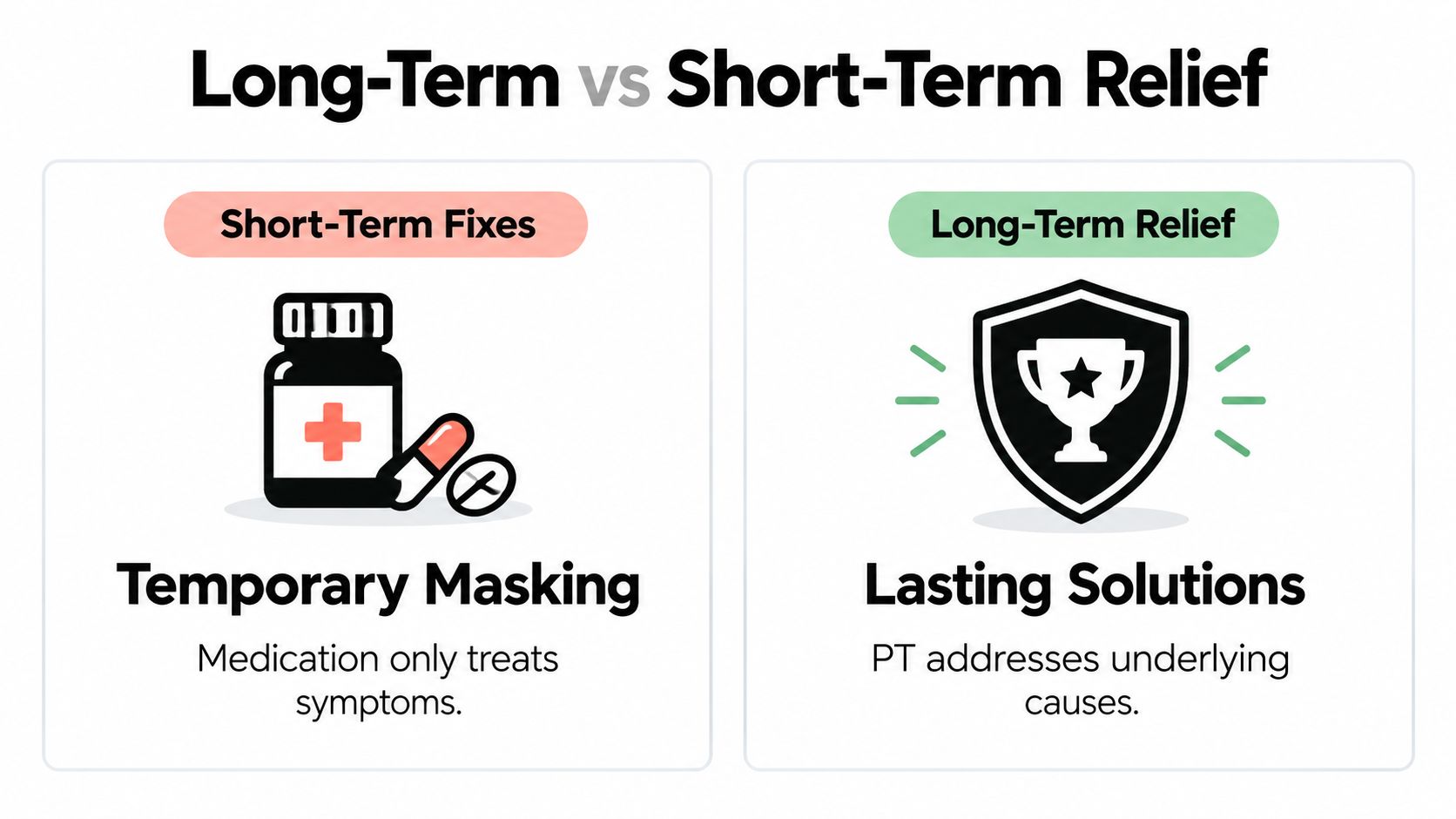
Patients often ask a fair question: Will physical therapy fix this, or will the headache return when treatment stops? The honest answer is that the evidence is stronger for short-term improvement than for durable prevention.
A 2025 systematic review found that manual therapy reduced headache intensity compared with sham treatment during the first 0 to 2 weeks, with a standardized mean difference of -1.60 and a 95% confidence interval of -2.40 to -0.79, based on 5 randomized controlled trials and 144 participants. At 12 months, that effect was not present, with a standardized mean difference of 0.09 and a 95% confidence interval of -0.59 to 0.76, based on 2 trials and 265 participants (2025 systematic review of manual and exercise therapy).
What that evidence means for your plan
Manual therapy can create a useful window in which pain settles and movement improves. That window matters, but it isn't proof that the underlying problem has been permanently corrected. If the neck remains unable to tolerate work, sleep, or repeated movement, symptoms may return.
Exercise therapy alone may help compared with usual care, but the same review found that its effects weren't statistically significant at 1 to 3 months or at 12 months. The authors also concluded that the added benefit of combining manual therapy and exercise remains unclear. That uncertainty should change how clinicians communicate, not eliminate reasonable rehabilitation.
Relief during the first few visits is encouraging. It isn't the same as evidence of long-term prevention.
A durable plan should therefore include reassessment, progressive exercise, activity modification, and a strategy for future flare-ups. Your therapist should tell you which improvements are expected soon, which require practice, and when a different medical opinion is appropriate.
When to Seek Professional Care in Deerfield Beach
Book an evaluation when headaches repeatedly connect with neck movement, sustained posture, or cervical stiffness, especially if self-management hasn't clarified the pattern. A physical therapist can help determine whether the neck is contributing and can refer you to a physician when the symptoms don't fit a musculoskeletal presentation.
Seek urgent medical care instead of routine physical therapy for a sudden, extreme headache, a new headache after significant trauma, or headache with fever, major vision changes, slurred speech, confusion, or one-sided weakness or numbness. These warning signs need medical assessment before exercises or manual treatment.

What happens at the first visit
Expect questions about the headache's location, onset, triggers, duration, injury history, sleep, work demands, and associated symptoms. The clinician may then assess:
- Cervical movement: How far and comfortably your neck bends, rotates, and extends.
- Joint and soft-tissue behavior: Whether specific areas are stiff, tender, or reproduce your familiar pain.
- Strength and coordination: How the deep neck muscles, upper back, and shoulder girdle support movement.
- Safety indicators: Whether your history suggests referral for medical or neurological evaluation.
Treatment should be explained before it begins. You should know whether the session will include mobilization, manipulation, soft-tissue work, exercise, education, or a combination, and what response would prompt a change in plan.
For practical guidance on evaluating credentials, communication, treatment fit, and experience, review this guide to choosing a physical therapist. In Deerfield Beach, ask about appointment availability, insurance procedures, and how the clinic coordinates care if your headache needs another type of evaluation.
Your Path to a Headache-Free Life
The most useful shift is to stop treating “headache” as a complete diagnosis. Your pain may feel as though it lives in the head, but a clinical examination can reveal whether restricted neck motion, posture tolerance, muscle coordination, or another cervical feature is part of the mechanism.
Physical therapy offers a structured way to investigate that possibility without surgery. The clinician first identifies whether your symptoms match a neck-related pattern, then combines appropriate hands-on care with exercises that build movement control and capacity. That approach is more thoughtful than prescribing random chin tucks, and more useful than promising that one technique will work for everyone.
A realistic recovery mindset
Track function as well as pain. Can you turn your head more comfortably? Can you work without provoking the familiar pattern? Do you recover faster after a demanding day? These questions help distinguish a meaningful change in neck tolerance from a brief reduction in symptoms.
The evidence supports measured optimism. Short-term improvements are documented, while long-term prevention remains less certain. A good therapist won't hide that gap. Instead, they'll use reassessment to decide whether the plan is helping, whether exercises need progression, and whether another healthcare professional should join your care.
You don't have to diagnose yourself from a symptom list. Write down your headache triggers, bring your questions, and arrange an evaluation with a licensed physical therapist who can examine the neck and screen for conditions that need medical attention.
MedAmerica Rehab Center offers individualized physical therapy for headache-related neck dysfunction, including hands-on care and targeted exercise for cervical mobility and deep neck flexor control. Visit MedAmerica Rehab Center to learn about care in Deerfield Beach and request an evaluation for your cervicogenic headache symptoms.
MedAmerica Rehab · Deerfield Beach
Talk to a clinician about your pain
Physical therapy, chiropractic, acupuncture and shockwave therapy under one roof, since 1995. Same-day appointments are available.
Mon–Thu 8:00 AM – 6:30 PM · Fri 8:00 AM – 3:00 PM