

Arthritis Pain Knee Treatment Guide That Works
You wake up, swing your legs over the side of the bed, and pause before standing. Your knee feels stiff, sore, and unreliable. By the time you reach the kitchen, it may loosen slightly, but stairs, a long walk, or getting out of a low chair can bring the ache right back. If this sounds familiar, you're probably looking for more than a list of painkillers. You want to know which arthritis pain knee treatment fits your symptoms, your mobility, and your goals.
A useful plan usually follows a sequence. First, identify what's driving the pain. Then restore movement and strength, reduce unnecessary joint load, add targeted support when needed, and consider injections or surgery only when the earlier steps don't provide enough relief.
Understanding Knee Arthritis Pain and Why It Lingers

Think of the knee as a moving hinge with a built-in cushion. Smooth cartilage covers the ends of the bones, while muscles, tendons, ligaments, and joint fluid help the knee absorb force and move in a controlled way. With osteoarthritis, that cushioning system changes. The joint may become less smooth, the surrounding tissues can become irritated, and ordinary activities can place more stress on sensitive areas.
That helps explain why symptoms vary. Morning stiffness can make the first few steps uncomfortable. Walking farther than usual may lead to swelling or aching later in the day. Grinding, clicking, or crackling can occur as the joint surfaces and surrounding tissues move, although a sound by itself doesn't determine how severe the arthritis is.
Knee osteoarthritis is a major reason people seek long-term care for chronic knee pain. A global analysis found a pooled prevalence of 16.0% among people aged 15 and older and 22.9% among people aged 40 and older, and identified the knee as the most common osteoarthritis site globally in 2020, with 4,307.4 cases per 100,000 population. These findings are reported in the global analysis of osteoarthritis prevalence.
Pain isn't the same as damage
Two people can have similar X-ray findings and very different experiences. One may walk comfortably, while another struggles with stairs because weakness, swelling, altered gait, sleep disruption, or fear of movement has become part of the problem. That's why a good treatment plan measures function, not just pain.
Your practical targets might include walking around the block, standing from a chair, climbing stairs, returning to gardening, or sleeping with fewer interruptions. The aim isn't to promise a quick cure. It's to improve how the knee handles daily demands and to give you tools for managing flare-ups.
A useful mindset: The knee may have chronic changes, but your strength, movement habits, confidence, and symptom control can still improve.
Modern guidelines generally place exercise, education, self-management, weight management when appropriate, and selected pain-relief medicines ahead of surgery. That sequence gives the joint more support before more invasive options enter the discussion.
How Knee Arthritis Is Diagnosed Without Guesswork
Knee pain has several possible causes, so diagnosis starts with your story rather than an automatic scan. A clinician will ask where the pain sits, when it began, what activities trigger it, whether the knee swells, and whether it locks, gives way, or feels unstable. They'll also ask about previous injuries, other painful joints, medical conditions, and the medicines you already use.
The pattern matters. Pain that builds with walking and improves with rest may suggest a load-related problem. Warmth, marked swelling, or symptoms in several joints may point toward inflammation or another condition. Sudden pain after a twist can require a different evaluation than gradually increasing stiffness.
What the physical examination adds
During the examination, the clinician may compare both knees and check:
- Range of motion: Whether the knee bends and straightens fully.
- Tenderness and swelling: Which structures react when touched or moved.
- Alignment: Whether the leg position changes how force travels through the knee.
- Strength: Especially in the quadriceps, hips, and muscles that control the leg.
- Walking pattern: Whether you shorten your stride, limp, or shift weight away from the painful side.
- Stability: Whether ligaments or the kneecap contribute to the symptoms.
An X-ray can show changes in the joint space, bone shape, or alignment. It may help confirm a suspected diagnosis and rule out other structural concerns, but the image still has to match your symptoms and examination. An MRI gives more detail about soft tissues such as menisci, ligaments, and cartilage, yet it isn't automatically necessary for every knee ache. This guide to choosing between an MRI and an X-ray can help you understand why the choice depends on the clinical question.
When to seek faster evaluation
Arrange prompt medical assessment for a hot, very swollen knee, fever with joint pain, an inability to bear weight, a major injury, a newly locked knee, or rapidly worsening symptoms. These signs don't prove a serious problem, but they deserve more than routine self-care.
At an appointment, ask what the clinician believes is causing the pain, what the examination showed, whether imaging will change treatment, and how progress will be measured. Those answers make the treatment plan more specific and reduce the temptation to chase every new procedure.
Your First Line Defense for Knee Arthritis Pain
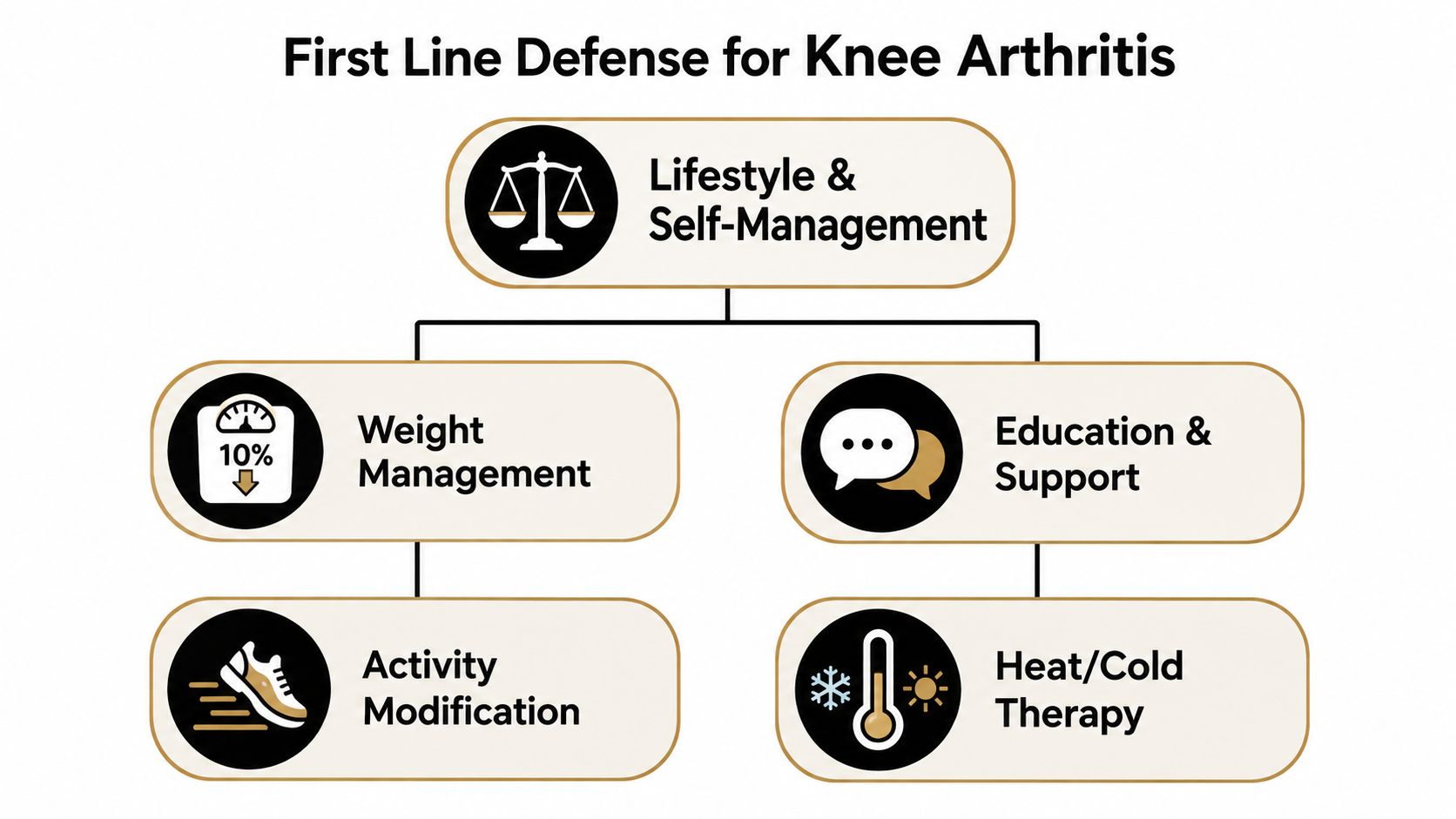
A painful knee often tempts you to stop moving. A better starting point is supported movement, combined with education and practical symptom control. The American Academy of Orthopaedic Surgeons recommends supervised, unsupervised, and aquatic exercise over no exercise to improve pain and function. It also recommends sustained weight loss for people with knee osteoarthritis who are overweight or obese. These recommendations appear in the AAOS clinical practice guideline for knee osteoarthritis.
Build the foundation before adding layers
Match the activity to your pain pattern and daily goals. A short, level walk may suit someone whose knee hurts after sitting, while gentle cycling or pool exercise may feel better when impact triggers symptoms. Chair-based strengthening can provide a controlled starting point. Repeated stair climbing and deep squats can wait if they consistently provoke a flare.
Your baseline strength, balance, swelling, and confidence all affect the right starting dose. The goal is repeatable practice, like giving the knee manageable rehearsal for the tasks you want to keep doing.
Education helps prevent the common swing between overdoing activity on a good day and avoiding movement after a painful day. A therapist can help separate normal exercise effort from a warning sign, adjust repetitions, and schedule recovery without turning rest into inactivity.
Topical NSAIDs are strongly recommended for knee osteoarthritis across major professional guidelines. They apply anti-inflammatory treatment near the painful area with lower systemic exposure than oral NSAIDs, although you should follow product directions and ask a clinician or pharmacist whether they are appropriate for you. The evidence and guideline discussion appear in this review of topical NSAIDs for osteoarthritis.
Core principle: Movement helps the knee practice useful tasks. Medication can make that practice more comfortable, but it does not replace strength and mobility work.
Heat may loosen stiffness before activity, while cold can feel helpful after a flare or demanding session. Neither changes the underlying joint condition, but both may help you stay with your plan. If you are considering complementary comfort products, revive blends and barrels may offer another self-care resource. They should not replace evaluation, exercise, or prescribed treatment.
The foundation is progressive exercise for capacity, education for consistency, load management for tolerance, and topical pain relief when suitable. Bracing or injections may later fit particular pain patterns, but they work best when they support this daily base rather than substitute for it.
Physical Therapy Exercise and Supportive Strategies That Restore Movement
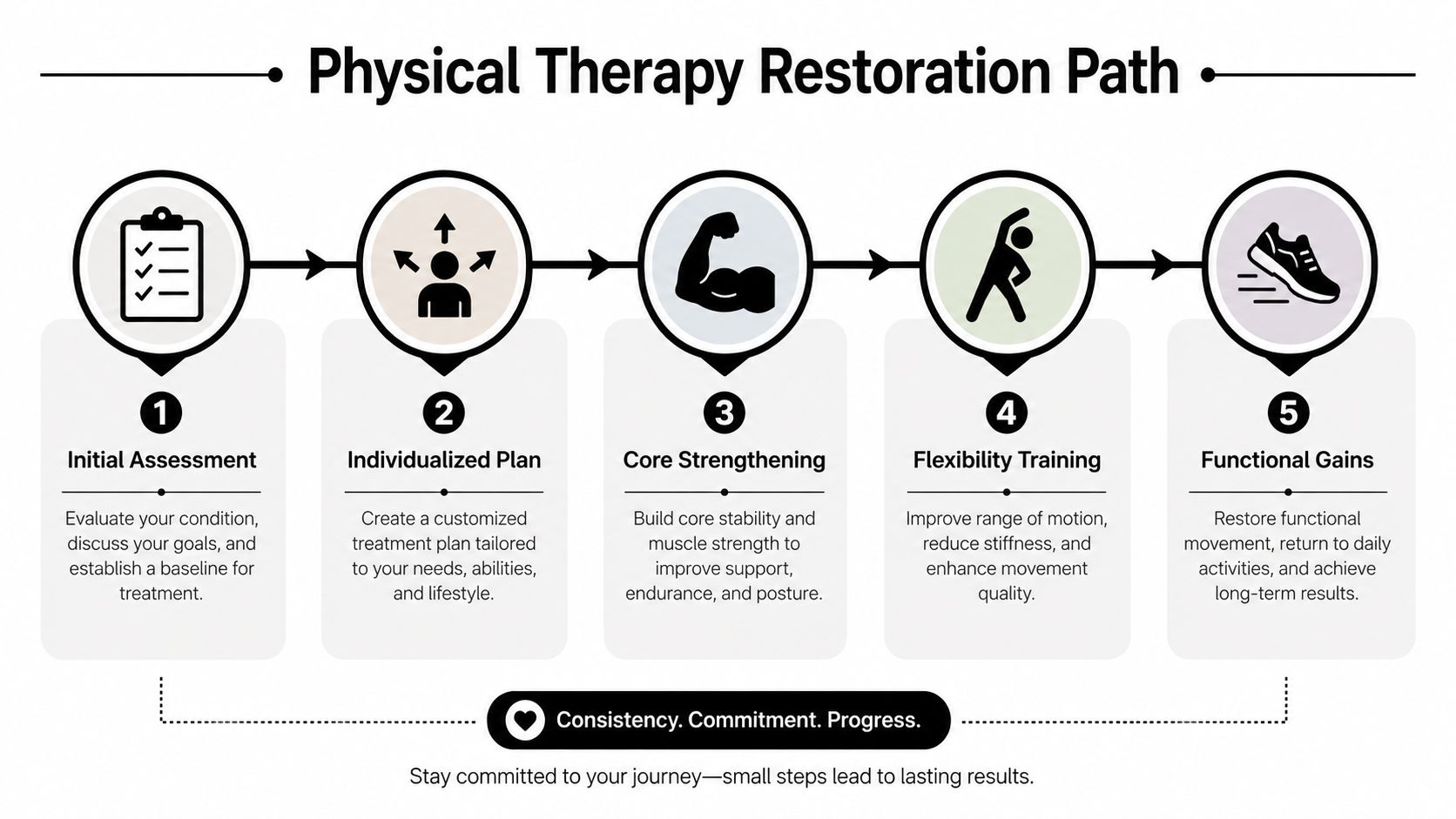
A physical therapy program should begin with a movement screen, not a generic handout. The therapist watches how you stand, walk, squat, step, and rise from a chair. They may look at ankle mobility, hip control, balance, muscle strength, and the way your kneecap tracks during movement. That information helps determine whether your main limitation is weakness, stiffness, poor coordination, swelling, fear of loading, or a combination.
A typical progression might start with controlled quadriceps contractions, supported leg lifts, sit-to-stand practice, and hip strengthening. As control improves, the program can add step-ups, resistance bands, balance drills, cycling, or aquatic exercise. The goal is to increase useful capacity gradually, not to exhaust the joint.
Research supports this progressive approach. A meta-analysis of 77 randomized controlled trials involving 6,472 participants found significant improvements at about eight weeks in pain, function, performance, and quality of life. The reported effect sizes were 0.56 for pain, 0.50 for function, 0.46 for performance, and 0.21 for quality of life, with effects peaking around two months and then diminishing over time. These findings are available in the exercise therapy meta-analysis.
Match the tool to the limitation
A brace may help someone whose knee feels unstable or whose alignment increases stress on one side of the joint. A cane can improve confidence and reduce loading when walking limitations are present, but it needs to be fitted and used correctly. Aquatic therapy can make movement more comfortable because water supports part of the body while still allowing strengthening and walking practice.
Weight management is another load-management tool when it applies. It isn't about blaming the patient or chasing a particular appearance. The practical question is whether reducing joint load could make walking, exercise, and daily activities easier. A 2026 guideline update also conditionally recommends considering GLP-1 receptor agonists for people with knee osteoarthritis and obesity, alongside diet and exercise, to help achieve appropriate weight management. Medication decisions belong with the clinician managing your overall health.
| Limitation | Best first option | Why it helps |
|---|---|---|
| Pain during ordinary walking | Graded walking or aquatic exercise | Builds tolerance without abandoning movement |
| Difficulty rising from a chair | Sit-to-stand and quadriceps strengthening | Practices a daily task while improving leg power |
| Knee instability | Movement assessment and selected bracing | Adds control while the underlying weakness is addressed |
| Reduced confidence on uneven ground | Balance and gait training, with a properly fitted cane when appropriate | Improves stepping control and walking safety |
| Flares after activity | Pacing, cold therapy, and program adjustment | Reduces the cycle of overactivity followed by prolonged rest |
Passive treatments, including hands-on care, heat, cold, acupuncture, or shockwave therapy, may have a role for selected symptoms. They're most useful when they help you participate in active rehabilitation rather than become the entire plan. You can review the clinic's approach to physical therapy for knee arthritis pain when comparing local rehabilitation options.
Here's a short movement resource to discuss with your clinician before trying exercises at home:
Progress should be judged by function. Can you walk farther, stand longer, use stairs more confidently, or recover faster after activity? If the answer is no, the program may need a different dose, better exercise selection, more recovery time, or a fresh diagnosis.
Injections and Next Step Options When Standard Care Is Not Enough
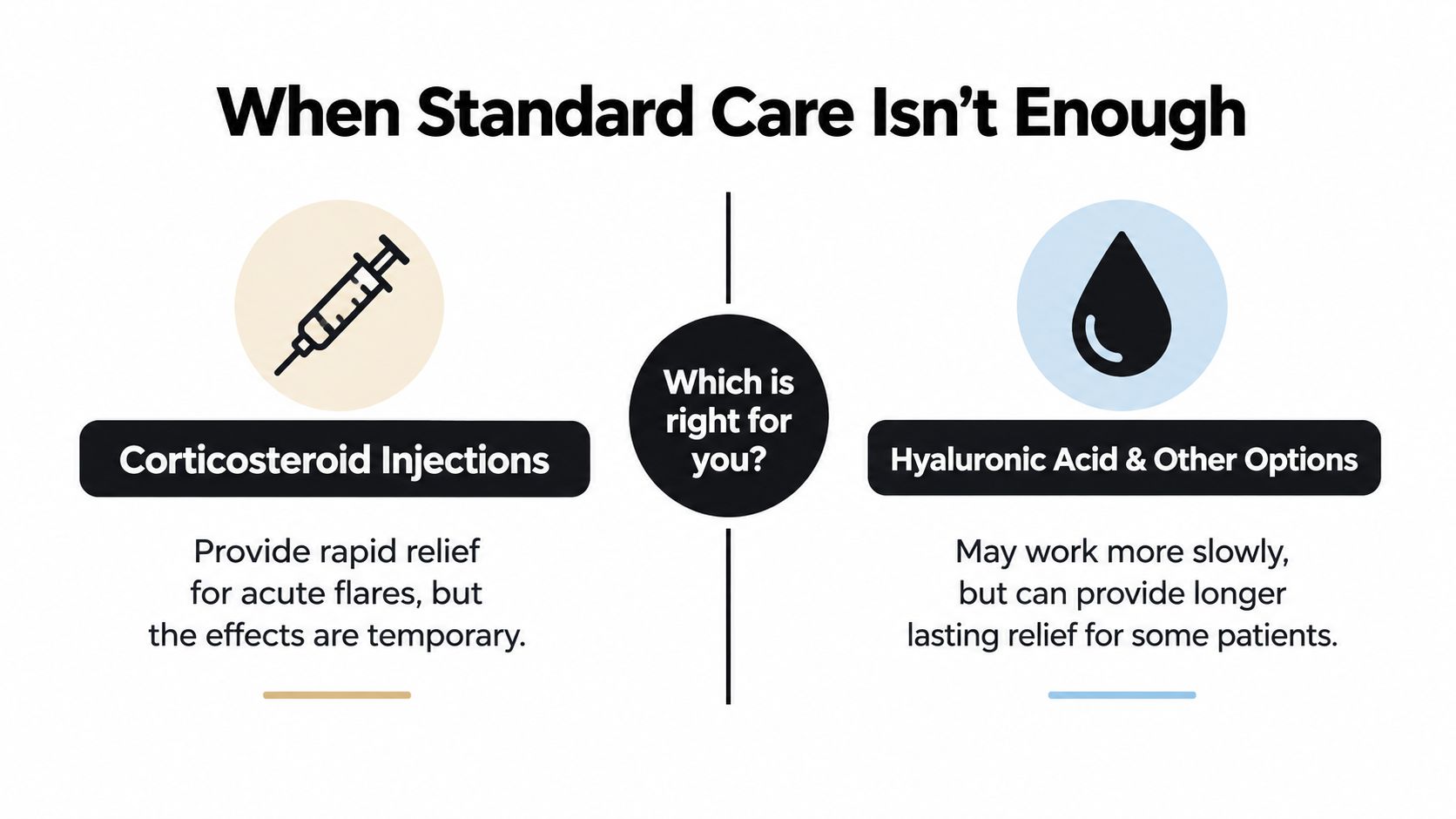
Injections become easier to evaluate when you stop asking, “Which shot is strongest?” and ask, “What problem am I trying to solve?” A corticosteroid injection may be considered when inflammation and pain are blocking participation in rehabilitation. Current guidance supports intra-articular corticosteroid injections for short-term symptom relief, not as a permanent repair.
Viscosupplementation with hyaluronic acid is more complicated. One major guideline found insufficient evidence to prefer corticosteroid over viscosupplementation. That doesn't mean every option works equally well for every person. It means the decision should account for symptom pattern, previous response, cost, risks, expectations, and whether the injection will help you return to active care. The relevant recommendations appear in the 2026 osteoarthritis guideline from the Veterans Health Administration.
Sort the pain before choosing the procedure
Mechanical pain often appears with loading, stairs, squatting, or specific positions. The next step may be gait correction, strengthening, activity modification, bracing, or a cane.
Inflammatory pain may include swelling, warmth, and flares that limit movement. A clinician may consider medication or an injection while also looking for conditions that require medical management.
Neuropathic or nerve-related pain can feel burning, electric, tingling, or unusually sensitive. Treating the joint alone may not address it. A pain specialist may discuss nerve-focused medication or procedures, but the diagnosis needs to be clear first.
Some expert reviews describe individualized options such as radiofrequency ablation for selected nerve-related pain, while guidance remains cautious about several newer interventions. In particular, a recent guideline suggests against genicular artery embolization for knee osteoarthritis. That recommendation is a reminder that a newer procedure isn't automatically a better procedure.
Before agreeing to an injection or procedure, ask:
- What pain mechanism are we treating?
- Is the goal short-term relief, improved walking, or a bridge to rehabilitation?
- What alternatives should I try first?
- How will we judge whether it helped?
- What are the risks for my health history?
Shockwave therapy may also be discussed as a non-surgical modality for selected musculoskeletal conditions. Learn more about how providers describe shockwave therapy for pain relief and recovery, then ask whether it matches your specific diagnosis. The safest next step is the one tied to a clear goal, measurable function, and realistic expectations.
When Surgery Becomes the Right Conversation and What Recovery Looks Like
A surgical consultation makes sense when knee pain continues to limit walking, sleep, household tasks, or meaningful activities after a sustained, well-designed non-surgical plan. Surgery is not a sign that rehabilitation failed. It is one option when the joint's pain and functional impact remain larger than the benefit you are getting from conservative care.
The decision should connect several pieces: your symptoms, physical examination, imaging, general health, expectations, and response to treatment. An X-ray can show advanced joint changes, yet daily function may still be acceptable. In that situation, immediate surgery may not fit your goals. If walking ability keeps shrinking despite appropriate care, an orthopedic opinion can clarify choices without requiring you to schedule an operation.
The AAOS guideline supports supervised, unsupervised, and aquatic exercise rather than no exercise for improving pain and function. It also supports sustained weight loss for people with knee osteoarthritis who are overweight or obese. The guideline reports a United States knee osteoarthritis incidence estimate of 240 persons per 100,000 per year. These recommendations help explain why strengthening, movement practice, and weight management can remain useful before and after a surgical decision. You can review the AAOS knee osteoarthritis guideline for the full discussion.
Recovery is a process, not a single appointment
Preparation may begin before surgery. Prehabilitation can address safe strengthening, knee range of motion, walking confidence, home setup, and realistic planning. After surgery, early therapy commonly focuses on safe mobility, swelling control, restoring movement, and transfers such as getting in and out of bed or a chair.
Later sessions usually build strength, balance, walking quality, and tolerance for daily activities. Progress can vary from day to day, so clinicians should track function as well as symptoms. For older adults, balance and fall-prevention practice may be especially useful when pain has caused limping or reduced activity.
Temporary equipment can make daily movement safer while the knee heals. A DME Superstore knee walker guide explains basic device use, but your surgical or therapy team should confirm that a knee walker suits your condition, balance, and home environment.
Surgery may reduce pain from advanced joint disease, while recovery still depends on strength, balance, and repeated movement practice. Starting that work before the operation gives you a clearer foundation for the rehabilitation that follows.
A Personalized Path Forward With MedAmerica Rehab Center
Effective arthritis pain knee treatment isn't a contest between exercise, medication, injections, and surgery. It's a sequencing problem. You match the intervention to the pain mechanism and functional limitation, then reassess based on what changes in real life.
A practical plan may look like this:
- Clarify the diagnosis. Use your history, examination, and imaging only when they answer a specific question.
- Restore capacity. Build quadriceps and hip strength, walking tolerance, balance, and confidence through progressive rehabilitation.
- Reduce unnecessary load. Adjust activities, use support when appropriate, and pursue weight management if it applies to your health.
- Add targeted symptom relief. Consider topical NSAIDs or other medical options with professional guidance.
- Reassess before escalating. If progress stalls, revisit the diagnosis and pain mechanism before choosing an injection or procedure.
- Discuss surgery when function remains restricted. A referral is a decision-support step, not an obligation to operate.
The 2026 guideline summary continues to prioritize exercise, weight management when appropriate, and topical or oral NSAIDs. It also conditionally considers GLP-1 receptor agonists for people with knee osteoarthritis and obesity, alongside diet and exercise, when weight management support is needed. You can review the 2026 osteoarthritis guideline summary with your healthcare professional.
For Deerfield Beach residents, MedAmerica Rehab Center offers individualized physical therapy, chiropractic care, acupuncture, and shockwave therapy, along with support for pre-surgical and post-surgical recovery, balance, and gait training. A first visit can focus on your symptoms, movement limits, goals, and the safest starting point. Track progress with practical measures such as walking tolerance, stair confidence, chair transfers, sleep, and flare recovery.
Visit MedAmerica Rehab Center to discuss a personalized knee arthritis rehabilitation plan in Deerfield Beach. The team can help you determine whether physical therapy, targeted exercise, supportive modalities, or preparation for another medical opinion fits your current symptoms and goals.
MedAmerica Rehab · Deerfield Beach
Talk to a clinician about your pain
Physical therapy, chiropractic, acupuncture and shockwave therapy under one roof, since 1995. Same-day appointments are available.
Mon–Thu 8:00 AM – 6:30 PM · Fri 8:00 AM – 3:00 PM