
Physical Therapy After Back Surgery Recovery Guide
It is commonly assumed that more supervised physical therapy after back surgery automatically produces a better recovery. That sounds reasonable, but the evidence doesn't support a simple “more visits equals better outcome” rule. Your procedure, tissue healing, symptoms, daily movement, surgical restrictions, access to care, and ability to follow the plan all influence what rehabilitation should look like.
A successful recovery isn't passive. Surgery may address compression, instability, or another structural problem, but rehabilitation helps you relearn how to walk, hinge, lift, stabilize, and tolerate normal activity. The most useful plan is usually the one you can perform safely and consistently, with progression guided by your surgeon and physical therapist.
Rethinking the Standard Approach to Spinal Rehab
Why supervised care isn't the entire treatment
A randomized trial of rehabilitation after lumbar decompression found that 12 weeks of supervised physiotherapy didn't change pain or disability trajectories through 24 months after surgery. A 2012 BMJ Open systematic review of rehabilitation after lumbar fusion also found no statistically significant pooled effect on pain at six months, 12 months, or two years. Its pooled pain estimates were 0.72 at six months, 0.52 at 12 months, and 0.75 at two years, with confidence intervals crossing zero. The authors judged the evidence very low quality and inconclusive.
That doesn't mean physical therapy has no role. It means the prescription must answer a more useful question than “How many appointments should I attend?” The right question is, “What movement, strength, education, and functional training does this person need at this stage of healing?”
A clinic visit can teach you how to brace gently, get out of bed, walk with better mechanics, or lift without repeatedly flexing through the surgical area. But the visit can't replace the many hours between appointments. If you leave therapy and return to prolonged sitting, guarded walking, poor sleep positions, or inconsistent home exercises, the supervised session has limited influence on your overall recovery.
Practical rule: Treat each appointment as coaching for the movements you need to repeat safely at home, at work, and in daily life.
The evidence favors individualization
Routine supervised rehabilitation didn't consistently outperform simpler care in the trials and reviews above. Those findings helped move modern practice away from a single pathway for everyone. A decompression, discectomy, and fusion don't create identical rehabilitation needs, and the same operation can require different progression depending on neurological findings, bone healing, fitness, work demands, and surgeon restrictions.
Your therapist should therefore assess more than pain. Useful questions include:
- Movement tolerance: Can you roll, stand, walk, and sit without a meaningful symptom increase?
- Neurological status: Has leg strength, sensation, or coordination changed?
- Functional goals: Do you need to return to desk work, caregiving, driving, construction, sport, or household lifting?
- Recovery response: Do symptoms settle after activity, or do they remain worse into the next day?
- Practical capacity: Can you attend appointments and complete the home program?
The strongest plan may include hands-on treatment, walking, stabilization work, education, and graded strengthening. It may also include fewer clinic visits than you expected, provided the home component is clear, safe, and reviewed regularly. The goal isn't to collect appointments. It's to build dependable capacity without irritating healing tissues.
Navigating the Phases of Spinal Rehabilitation
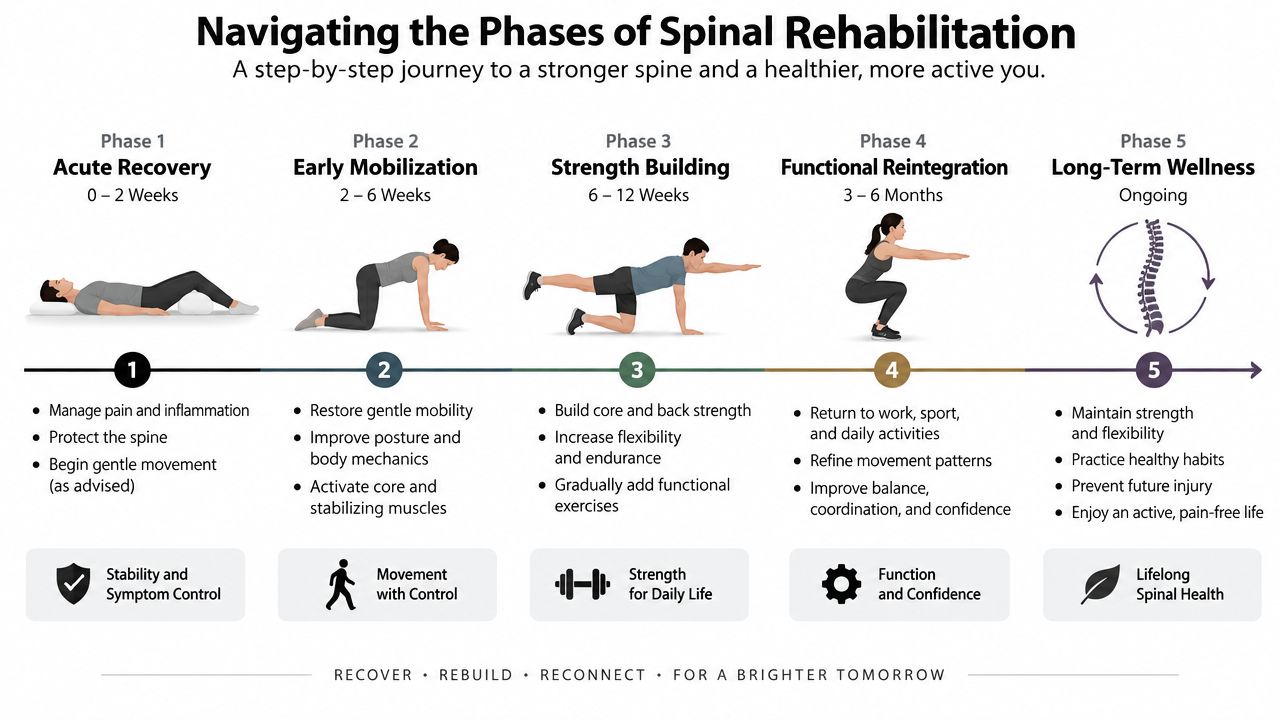
Recovery after a lumbar procedure isn't a linear sprint. It moves through broad phases, but the boundaries depend on the operation and your surgeon's instructions. A fusion, for example, requires different precautions from a decompression, and no generic timeline should override specific surgical guidance.
The protection and mobility phase
Immediately after surgery, the priority is safe mobility without unnecessary strain. Hospital staff may teach log rolling, short walks, supported transfers, breathing strategies, and ankle movement. At home, you'll usually need to change positions regularly rather than remain in bed for long stretches, unless your medical team has given different instructions.
A log roll keeps your trunk moving as a unit. Bend your knees, roll onto your side without twisting, lower your legs as you push with your arms, and avoid a sudden sit-up. For walking, begin with the distance and frequency approved by your care team. Smooth steps and an upright but relaxed posture matter more than speed.
During this phase, avoid guessing about bending, lifting, twisting, driving, or wound care. Ask specifically what applies to your procedure. A therapist can also show you how to place frequently used items at waist height so that dressing, bathing, and meal preparation don't force repeated deep bending.
The early outpatient phase
Formal therapy often begins later than patients expect. In one study of lumbar surgery patients, 72% initiated physical therapy between six weeks and three months after surgery, with a mean of 8.5 visits; none met the recommended 150 minutes per week of moderate-to-vigorous physical activity at three or six months. These findings come from a study of activity and rehabilitation after lumbar surgery, and they highlight a practical problem: delayed clinic care doesn't automatically create an active recovery.
A therapist may start with low-load abdominal activation, walking review, hip mobility within restrictions, posture changes, and basic endurance. The aim is to find the dose your body tolerates. Mild muscular effort can be acceptable, while escalating leg pain, new weakness, or symptoms that remain substantially worse after activity require reassessment.
The rebuilding phase
Once the surgeon clears greater activity, treatment can progress toward hip and trunk strength, balance, endurance, and task-specific practice. You might move from supported sit-to-stands to repeated transfers, from short walks to longer routes, or from unloaded patterns to carefully controlled resistance.
The progression should follow function, not the calendar alone. A person returning to office work may need sitting tolerance and frequent movement strategies. Someone returning to physical work may need lifting mechanics, carrying practice, and graded exposure to job tasks. Someone focused on walking may need gait endurance and balance rather than aggressive strengthening.
Watch the video below for a visual demonstration of movement principles that may be discussed with a clinician.
Long-term conditioning
The final phase isn't a discharge from movement. It's the point at which your program becomes self-managed. Continue building general strength, walking tolerance, hip capacity, and trunk control around your medical restrictions and goals. A maintenance plan should be realistic enough to survive busy weeks, travel, work demands, and occasional symptom fluctuations.
Safe Mobilization and Progressive Exercise Protocols
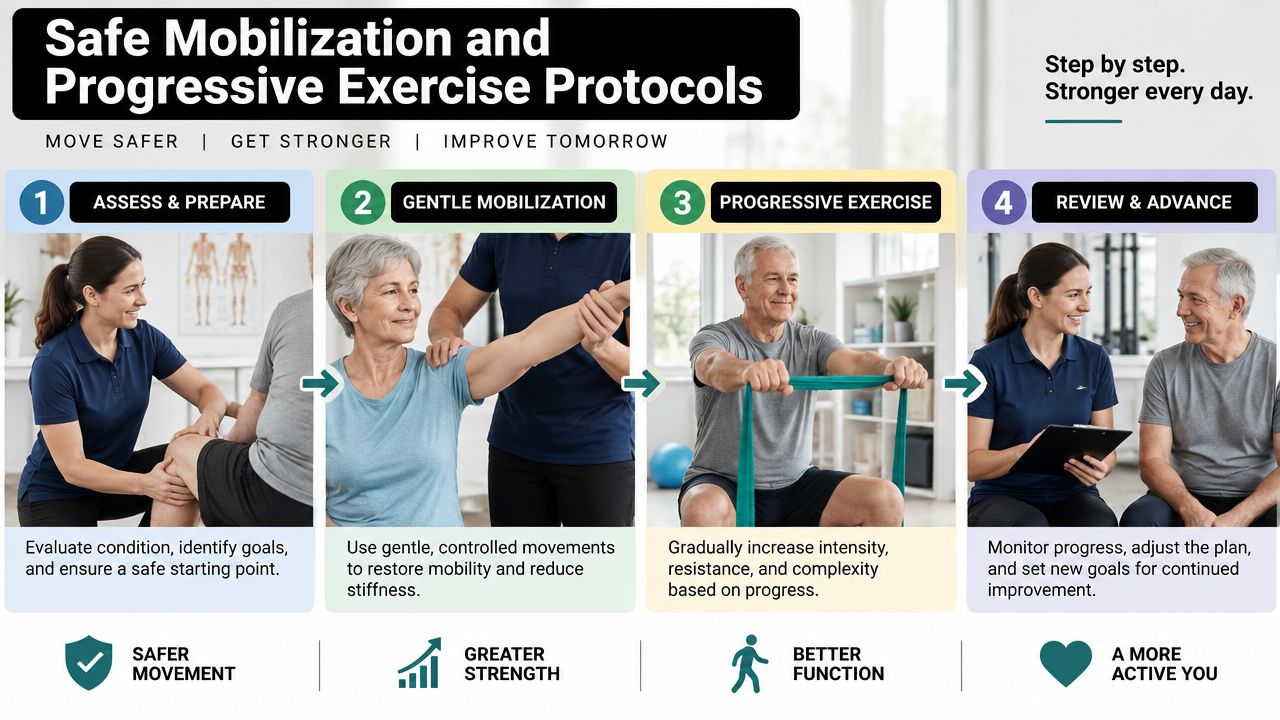
The safest exercise list is the one your surgical team has approved and your therapist has adapted to your symptoms. The following movement patterns are useful teaching tools, not a substitute for clearance. Stop and contact your medical team if an exercise causes new neurological symptoms, wound concerns, or a sharp and escalating pain response.
Start with transfers and walking
Getting out of bed is an exercise in coordination. Roll to your side, keep your shoulders and pelvis moving together, lower your legs, and push through your arms to sit. Reverse the sequence when lying down. Keep the movement controlled, and set up a stable surface nearby rather than pulling on a rolling table or unstable chair.
For walking, use a route that lets you turn without sudden twisting. Take shorter, comfortable steps, keep your gaze forward, and let your arms move naturally if permitted. Increase either distance or frequency gradually, not both at once. If your symptoms are noticeably worse later that day or the next morning, reduce the most recent change and discuss the response with your therapist.
Learn the hip hinge
The hip hinge teaches you to move through the hips while keeping the spine relatively controlled. Stand with your feet comfortable and your hands on your hip bones. Soften your knees, shift your hips backward as though reaching for a chair, keep your ribs stacked over your pelvis, and return by pressing through your feet and engaging your gluteal muscles.
Practice first without an object. A dowel or wall can provide feedback, but don't force your back into a rigid position. The point isn't to freeze your spine. It's to avoid repeatedly collapsing into a rounded, painful posture when reaching for clothing, loading a dishwasher, or lifting a light item.
Build stabilization before loading
Early stabilization may involve a gentle abdominal brace. Exhale without holding your breath, lightly draw the lower abdomen inward, and maintain normal breathing. Your therapist may progress this to heel slides, supported marching, bridges, or modified plank variations, depending on the procedure and healing status.
Quality matters more than fatigue. Stop a repetition if your pelvis shifts, your ribs flare, you hold your breath, or your pain spreads down the leg. Glute bridges, for example, should come from controlled hip extension rather than forceful arching through the lumbar spine.
For a broader movement reference, review this guide to exercises after surgery, then confirm which exercises apply to your operation with a clinician. If you're looking for movement professionals outside your immediate area, a Mayenne 53 wellness provider on Wispra can be a resource to investigate, although post-operative restrictions still need to come from your surgical and rehabilitation team.
Transfer technique into daily life
At a desk, keep frequently used items close, support your feet, and change position before stiffness becomes severe. When lifting a light object, move close to it, hinge at the hips, keep it near your body, and pivot with your feet instead of twisting your trunk. Ask for help with awkward or heavy loads until your surgeon clears them.
Use this simple progression:
- Control: Perform the pattern without provoking symptoms.
- Repeatability: Tolerate the movement across ordinary daily tasks.
- Endurance: Maintain technique during longer walks or work periods.
- Load: Add resistance only after your clinician approves it.
Managing Pain and Recognizing Recovery Red Flags
Post-operative pain can come from the incision, irritated muscles, protective guarding, or a recovering nerve. The important question isn't whether you feel anything. It's whether the symptom follows an expected pattern, settles with rest and position changes, and remains consistent with the instructions you received.
Muscular soreness often feels localized and develops after a new activity. It may improve with gentle movement, repositioning, or a quieter day. Nerve-related symptoms can include tingling, burning, or electric sensations, but a new or worsening neurological deficit deserves prompt attention rather than experimentation with exercises.
Use pacing instead of pushing through
Break demanding tasks into smaller bouts. Alternate walking with rest, avoid testing your limits on a good day, and track what happened after an activity rather than judging success only during it. A symptom diary can record the task, duration, position, and response later that day or the next morning.
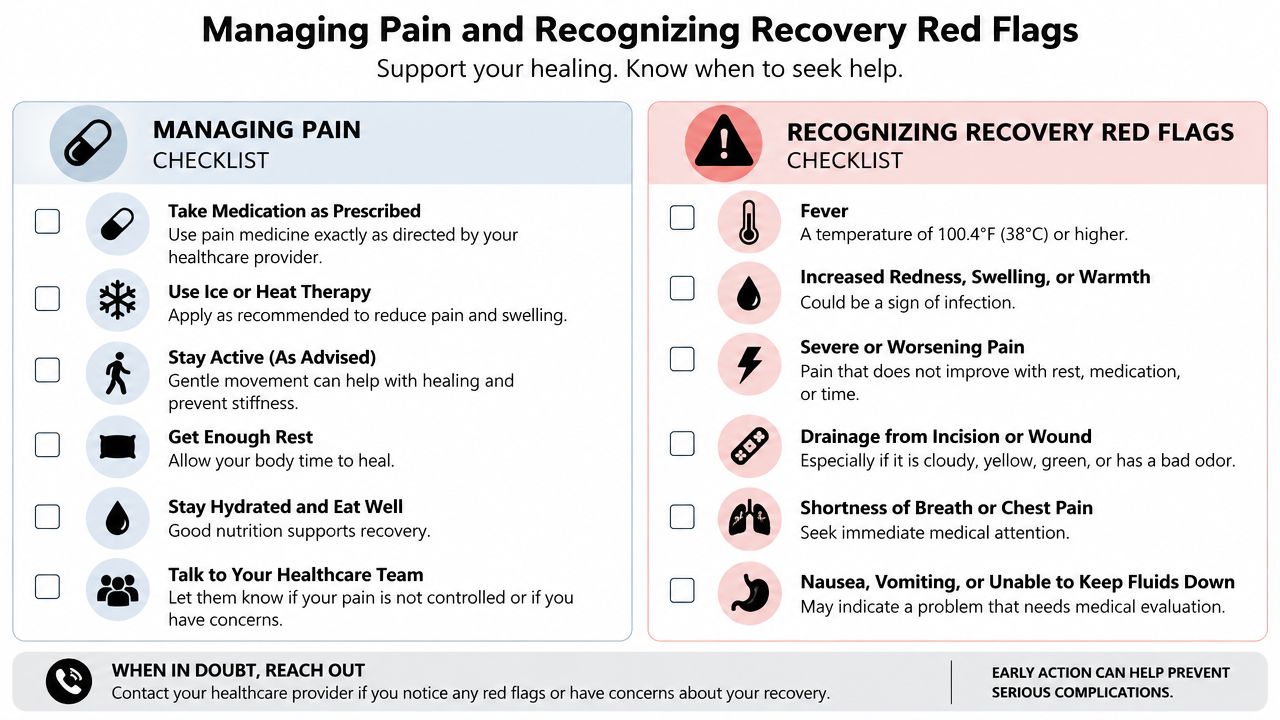
Cold or heat may provide comfort, but use them according to your clinician's advice and protect the skin. Don't place heat over an area with reduced sensation, and don't use either modality to ignore a warning symptom. Positioning can help as well, such as side lying with support between the knees or a supported back position, provided it matches your surgical instructions.
More practical guidance on comfort strategies is available in this pain management guide after surgery. Medication changes should come from the prescribing clinician, especially when pain suddenly changes.
Know when to stop and call
Seek urgent medical guidance for new or worsening weakness, loss of coordination, significant new numbness, saddle anesthesia, or changes in bowel or bladder control. Contact the surgical team promptly for worsening symptoms that don't settle, fever, drainage or concerning wound changes, severe calf swelling, chest symptoms, or breathing difficulty.
Don't wait for the next therapy appointment when neurological function changes. A therapist can help interpret movement tolerance, but the surgeon or emergency service must evaluate potentially serious post-operative complications.
Overcoming Logistics and Insurance Hurdles
A rehabilitation plan can fail for reasons unrelated to motivation. Insurance authorization, transportation, work schedules, caregiving, pain during travel, and clinic distance can all interrupt treatment. One rehabilitation study reported that only 43% of participants were adherent, and logistical barriers included personal issues, insurance authorization, and geographic accessibility. More than 20% of non-adherent patients said they stopped because they couldn't obtain authorization or transportation, as described in the PLOS One rehabilitation study.
Fix administrative problems before they become missed care
Ask the surgeon's office or therapy clinic to clarify the referral, authorization requirements, visit approval, copay, and documentation needed for continuation. Keep a written record of names, dates, reference numbers, and unanswered questions. If approval is delayed, ask whether the clinic can provide a home program, telehealth check-in, or a rescheduling option that prevents a long gap.
Call the insurer before the first visit when possible. Questions should be concrete:
- Authorization: Has therapy been approved, and for what dates?
- Network status: Is the treating clinic covered under your plan?
- Documentation: Does the insurer require operative notes or a surgeon's referral?
- Continuation: What information supports additional visits if progress is incomplete?
- Alternatives: Are remote visits or another accessible location covered?
Design the plan around your real week
Tell your therapist exactly when you work, commute, sleep, and provide care. A short home routine that fits after breakfast may be more sustainable than an ambitious program that requires equipment, floor space, or a long uninterrupted session. Put exercises next to an existing habit, such as walking after a meal or practicing sit-to-stands before a shower, if your clinician approves.
When transportation is unreliable, combine in-person visits with carefully reviewed home work or remote follow-up where clinically appropriate. Telehealth can't replace every hands-on assessment, wound concern, strength test, or equipment adjustment, but it can help review technique, update goals, and maintain accountability when travel is the obstacle.
The same principle applies to work. Share your job's actual demands, including lifting, prolonged sitting, climbing, driving, and unpredictable shifts. Return-to-work planning should build the required tasks gradually rather than treating “back to work” as a single switch.
For questions about referral requirements and access, review this guide to physical therapy without a referral, then confirm the rules that apply to your state, insurer, and surgical team.
How MedAmerica Rehab Center Personalizes Your Care
Post-surgical rehabilitation works best when the plan reflects the person who has to carry it out. A clinic may begin by reviewing the surgical history, current restrictions, pain behavior, walking tolerance, strength, balance, work demands, and practical barriers. That information shapes the first treatment choices instead of forcing every patient into the same exercise sequence.
At MedAmerica Rehab Center in Deerfield Beach, the care model includes physical therapy, chiropractic care, acupuncture, and shockwave therapy, with treatment selected according to the patient's condition and clinical needs. Its team also supports post-surgical recovery, balance and gait training, and fall-prevention programs, while emphasizing hands-on therapy, targeted exercise, and evidence-based modalities.
What personalization looks like in practice
A patient struggling with bed transfers may need movement coaching and a home setup review before advanced strengthening. Someone who can walk comfortably but cannot tolerate desk work may need sitting strategies, trunk endurance, and a graded work routine. A patient facing transportation or scheduling problems may need an appointment pattern and home plan that fit family and job responsibilities.
The clinic describes itself as family-owned, with licensed therapists and doctors, same-day appointment availability, insurance-friendly processes, and clear expectations for first visits. Those features don't replace clinical judgment, but they can reduce friction during a period when travel, paperwork, and uncertainty already consume energy.
The rehabilitation team should also communicate with your surgical providers when restrictions or symptom changes require clarification. Good coordination prevents a therapist from progressing loading too quickly or keeping you unnecessarily inactive because the surgical instructions are unclear.
A 2025 review found that telerehabilitation after lumbar surgery is expanding, but protocols vary widely in timing, content, and technology, with inconsistent long-term findings beyond one year. The review indexed by PubMed reinforces why remote care should still be individualized rather than treated as a universal replacement for in-person assessment.
The practical test is simple: after an evaluation, you should know what you're allowed to do, what you should avoid for now, how to monitor your response, what to practice at home, and whom to contact if symptoms change.
MedAmerica Rehab Center offers individualized post-surgical physical therapy, hands-on care, targeted exercise, and supportive rehabilitation services for patients in Deerfield Beach and nearby communities. Visit MedAmerica Rehab Center to request an appointment and discuss a recovery plan that fits your surgical restrictions, symptoms, schedule, and daily goals.
MedAmerica Rehab · Deerfield Beach
Talk to a clinician about your pain
Physical therapy, chiropractic, acupuncture and shockwave therapy under one roof, since 1995. Same-day appointments are available.
Mon–Thu 8:00 AM – 6:30 PM · Fri 8:00 AM – 3:00 PM