

Hunters Creek Rehab Guide: Types, Costs & What to Expect
You wake up, roll toward the edge of the bed, and feel the same sharp pull in your back or neck that stopped you yesterday. Maybe the pain followed an accident, surgery, or a long period of trying to “push through.” At that point, searching for Hunters Creek rehab isn't about finding a nearby address. You need to know whether you require inpatient recovery, outpatient physical therapy, chiropractic care, acupuncture, shockwave therapy, or a coordinated combination.
The local picture has also changed as the community has grown. Hunter's Creek had 24,433 residents in the 2020 census, compared with 9,369 in 2000 and 14,321 in 2010, according to this Hunter's Creek community profile. More residents and a maturing suburban population create more demand for practical, accessible rehabilitation after illness, injury, and surgery.
Navigating Local Rehabilitation Care
A patient I often think about is the person who has spent weeks changing how they dress, drive, sleep, or work because one movement triggers pain. They may not need a complicated explanation. They need a clinician to determine whether the problem calls for skilled nursing rehabilitation, outpatient therapy, medical evaluation, or a home program that can be followed safely.
The phrase Hunters Creek rehab can refer to different levels of care. Hunters Creek Nursing and Rehab Center is a 116-bed skilled nursing facility, and published summaries report average occupancy of roughly 109 to 110 residents, or about 95%, with 4.00 nursing hours per resident per day compared with a U.S. average of 3.86. The same summary reports a 31.7% rehospitalization rate, figures that show how intensive post-acute care can be after hospitalization (facility details and published benchmarks).
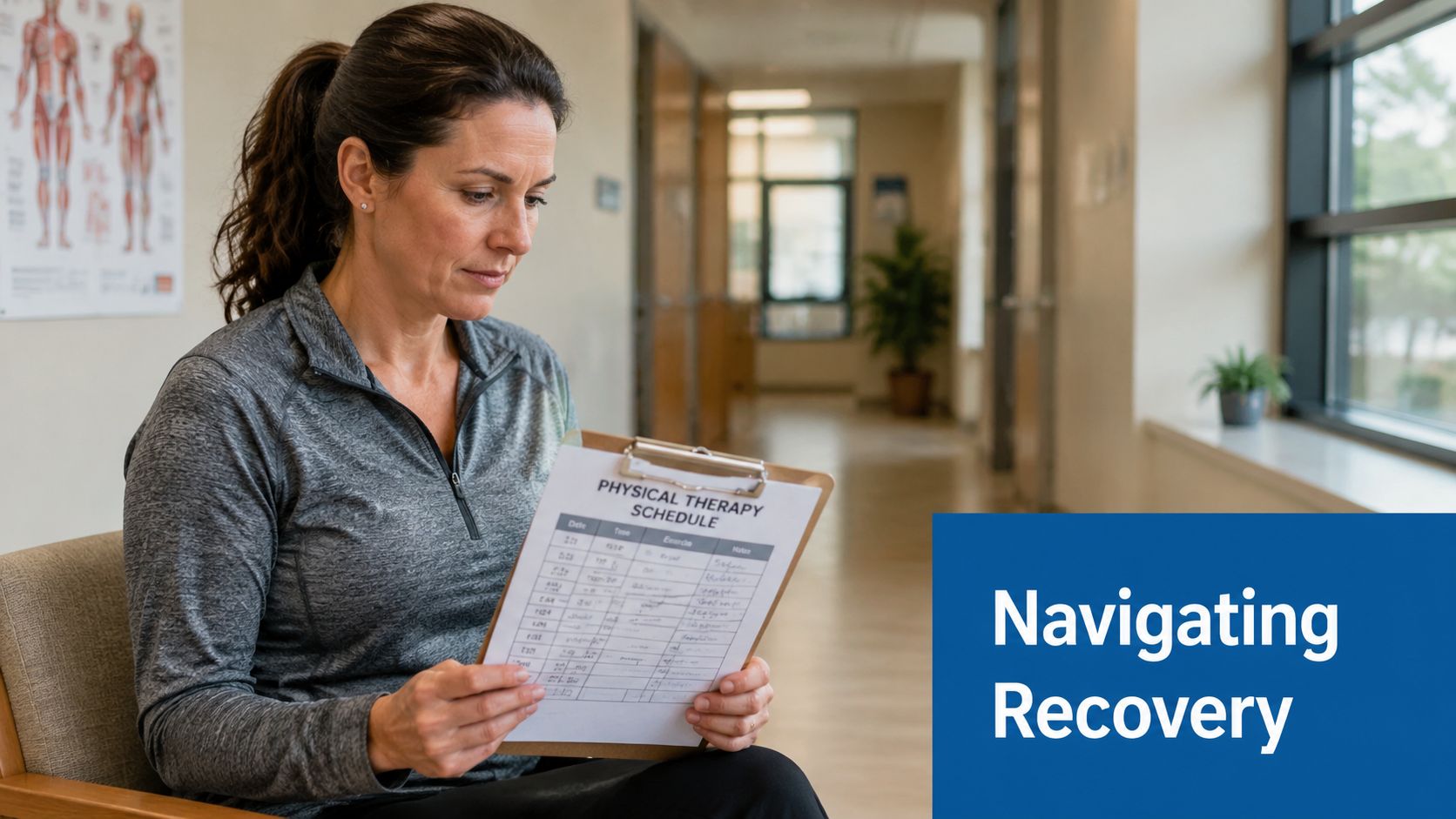
Match the setting to the problem
A nursing-and-rehab stay may fit someone who isn't ready to return home safely after an acute illness, surgery, or hospital admission. Outpatient therapy suits a person who can travel to appointments and needs supervised exercise, manual treatment, gait work, or functional retraining. Home-based rehabilitation may be more appropriate when leaving the house is difficult, although the available services depend on clinical and coverage requirements.
Don't choose by the word “rehab” alone. Ask what happens after the evaluation, who provides the treatment, how progress is measured, and whether the plan addresses the activity you need to regain. A good plan connects a diagnosis to function, such as walking to the mailbox, lifting at work, climbing stairs, or returning to a sport.
Practical rule: The right rehabilitation setting is the one that can safely deliver the level of supervision your current condition requires.
Types of Rehabilitation Therapies Available
Rehabilitation works best when each treatment has a defined job. Physical therapy usually supplies the foundation. A therapist assesses strength, joint motion, balance, coordination, walking mechanics, and tolerance for activity, then uses progressive exercise and selected hands-on techniques to restore function. Passive treatment can reduce symptoms temporarily, but it shouldn't replace the active work that helps your body tolerate daily demands.
For chronic low back pain, the Orthopaedic Section of the American Physical Therapy Association recommends moderate- to high-intensity exercise when generalized pain isn't present, and low-intensity, submaximal endurance activity when generalized pain is present. The clinical practice guideline for low back pain supports matching exercise intensity to the patient's presentation rather than keeping every program at the same conservative level.
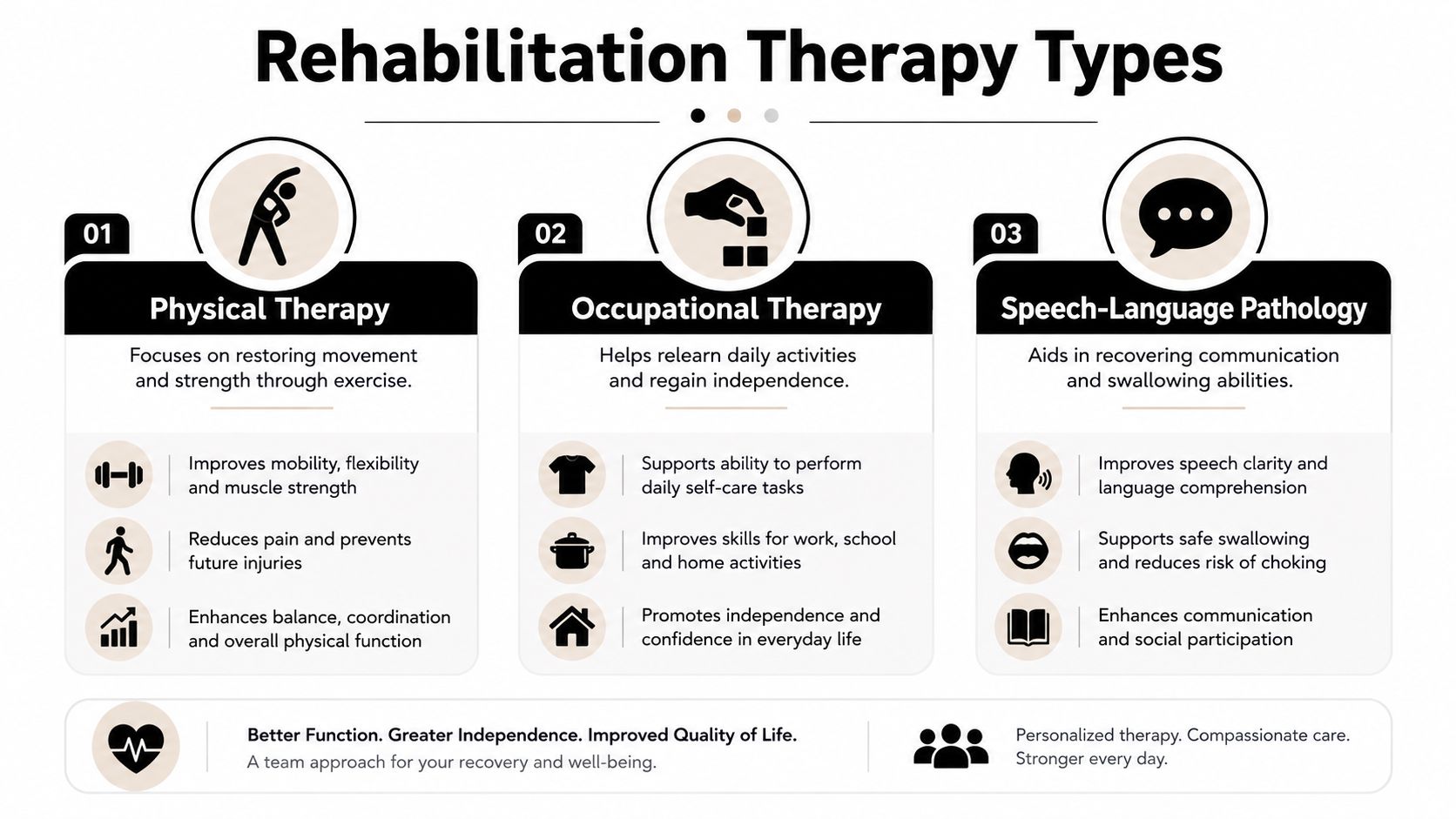
Four tools, four different purposes
Physical therapy: Builds movement capacity through strengthening, aerobic conditioning, balance training, mobility work, and task-specific practice. For back pain, the program may progress trunk control and endurance instead of relying on heat or massage alone.
Chiropractic care: Uses hands-on evaluation and treatment to address joint movement, spinal mechanics, and related musculoskeletal pain. It can be useful for selected patients, but repeated adjustments without exercise, education, or a clear functional goal may provide an incomplete plan.
Acupuncture: Places fine needles at selected points to influence pain processing and muscle sensitivity. Some people prefer it as a drug-free symptom-management option. It should complement, rather than substitute for, diagnosis and active rehabilitation when weakness, limited function, or movement avoidance is present.
Shockwave therapy: Delivers acoustic energy to a targeted area, often as part of care for persistent tendon problems. Evidence supports extracorporeal shockwave therapy for lower-limb tendinopathies overall, with particularly consistent support for chronic Achilles tendinopathy and stronger results when paired with eccentric loading. The evidence is mixed by site, and a review found negligible short-term benefit for patellar tendinopathy compared with placebo (meta-analysis of shockwave therapy for tendinopathy).
If an injury affects dressing, cooking, bathing, work tasks, or other daily activities, occupational therapy may be more appropriate than a plan focused only on muscles and joints. Communication and swallowing problems require speech-language pathology. Patients whose injury affects employment may also need guidance beyond clinical treatment, including vocational rehabilitation legal help when work rights or return-to-work responsibilities become difficult to interpret.
What to Expect During Your First Visit
Your first appointment should reduce uncertainty, not add to it. Bring your medication list, surgical or hospital records if available, imaging reports, insurance information, and a short description of what you can no longer do comfortably. Wear clothing that allows the clinician to see and move the affected area.
The evaluation has a purpose
After intake paperwork, the therapist or clinician will ask when symptoms began, what changes them, whether pain travels, and how the problem affects sleep, work, walking, lifting, or self-care. The physical assessment may include active range of motion, strength, balance, posture, gait, neurological screening, and specific movement tests.
The goal isn't to chase the loudest symptom. A painful shoulder may be affected by weakness, restricted motion, poor mechanics, or a problem outside the shoulder itself. The clinician should explain what the findings suggest and identify warning signs that require referral or medical review.
Expect an initial plan, not a final promise
You may begin with guided exercise, education, manual therapy, or a home routine during the first visit. The exact treatment depends on irritability, tissue healing, recent surgery, medical history, and safety. A credible therapist won't promise instant recovery. They will explain the first functional targets, how often treatment may be recommended, and how progress will be reassessed.
For a plain-language description of treatment flow, review what a typical physical therapy session looks like. You should leave knowing what to do at home, which activities to modify, and what symptoms should prompt a call.
Ask before you leave: “What should improve first, and how will we know the plan is working?”
Choosing the Right Rehab Provider Near You
A provider should fit the condition, the setting, and the level of support you need. Start by separating four common situations. Someone recovering after hospitalization may need skilled nursing oversight. Someone with persistent back pain may need progressive outpatient exercise. A person after an auto accident may need coordinated medical assessment and therapy. A senior concerned about falls may need balance, gait, and functional training rather than a generic strengthening routine.
Compare the treatment model
| Your situation | What to look for | What to question |
|---|---|---|
| Chronic back or neck pain | Exercise progression, education, strength and movement testing | Is treatment mostly passive? |
| Tendon pain | A tissue-specific loading plan, with shockwave considered selectively | Is a modality being offered without loading rehab? |
| Post-surgical recovery | Communication with the surgical team and clear precautions | Does the therapist understand the procedure and restrictions? |
| Accident-related injury | Evaluation, documentation, and coordinated care | Who handles records and communication? |
| Balance or mobility loss | Gait assessment, functional practice, and fall-risk planning | Are exercises tied to real daily tasks? |
Look for licensed professionals, individualized goals, and a clinic that can explain why each treatment is being used. Integrated care can reduce the confusion that occurs when one office evaluates you, another provides treatment, and nobody owns the full plan. At the same time, “integrated” shouldn't mean unnecessary services. Each discipline should have a distinct role.
A small practice may offer a personal atmosphere, while a larger facility may provide more disciplines or equipment. Neither model guarantees good care. Use this guide to choosing a physical therapist to assess communication, credentials, evaluation quality, treatment planning, and whether the clinician listens to your goals.
MedAmerica Rehab Center is one local option that provides physical therapy, chiropractic care, occupational therapy, acupuncture, and shockwave therapy at its Deerfield Beach clinic. The useful question isn't whether a clinic offers many services. It's whether the services offered match your diagnosis and help you return to the activities that matter.
Navigating Insurance and Appointment Logistics
Insurance questions can derail treatment before the first exercise begins. Coverage depends on your plan, diagnosis, setting, authorization requirements, and whether the service is considered medically necessary. Medicare and Medicaid rules also differ by patient and service category. Florida Medicaid coverage can vary by age, plan type, and service category, so a clinic's eligibility check is more reliable than an assumption based on a neighbor's experience.
Ask the scheduling team to clarify whether they verify benefits, whether a referral is required, whether authorization is needed, and what you may owe at the visit. For a nursing-and-rehab stay, ask the hospital discharge planner which skilled services are being recommended and what documentation the facility needs before transfer. Public guidance around post-hospital rehabilitation often leaves families unsure about qualification, the three-night hospital rule, and the distinction between skilled nursing, outpatient therapy, and home-based care. Those questions should be answered directly before you commit.
Avoid fragmented administration
A coordinated clinic can make the process easier because the same team may manage the evaluation, treatment records, referrals, and follow-up communication. That doesn't remove the need to read your policy or confirm benefits, but it can prevent avoidable delays caused by incomplete paperwork or unclear responsibility.
Workers' compensation and auto-injury claims require additional documentation and communication. Choose a provider comfortable recording functional limitations, treatment response, work demands, and medical recommendations. Ask how the office communicates with the insurer, employer, attorney, or referring physician.
Cost matters even when insurance is available. Review physical therapy cost without insurance before scheduling if you expect to self-pay. A transparent estimate is more useful than a vague promise that care will be affordable.
Before booking: Confirm the appointment type, expected duration, records to bring, authorization status, payment responsibility, and cancellation policy.
Start Your Recovery Journey Today
Pain changes behavior before it changes a diagnosis. You stop taking walks, avoid stairs, lift with one side, skip social plans, or accept poor sleep as normal. The longer those adaptations continue, the more important it becomes to assess both the painful body part and the tasks you have stopped doing.
A sensible rehabilitation plan doesn't promise a perfect day after one appointment. It gives you a measurable direction. You may begin by tolerating a movement, walking with better control, sleeping in a more comfortable position, or completing a home exercise routine consistently. The therapist then adjusts the workload as your capacity changes.

Choose action over indefinite waiting
Local rehabilitation may involve one discipline or several. Physical therapy often provides the active framework, while chiropractic care, acupuncture, or shockwave therapy may have a role when the diagnosis and treatment goals support them. The key decision is not which therapy sounds most advanced. It's whether the plan identifies the problem, progresses safely, and teaches you how to manage your recovery outside the clinic.
Technology can support that process. Rehabilitation is moving toward hybrid care, remote therapeutic monitoring, wearable tracking, motion analysis, and more personalized home programs, as described in this overview of rehabilitation care trends. Ask whether a provider tracks home exercise performance, uses objective movement testing, or offers tele-rehabilitation when an in-person visit isn't practical.
If an injury affects your job, clinical recovery is only part of the return-to-work decision. You may also need information about workplace accommodations after injury so that your work duties and medical restrictions are addressed together.
You can watch the video below for another perspective on rehabilitation and patient care.
Don't wait for pain to decide what your life will look like. Write down the activity you want to regain, gather your medical and insurance information, and schedule an evaluation with a licensed rehabilitation provider who can examine the problem and explain your options.
MedAmerica Rehab Center offers individualized physical therapy, chiropractic care, acupuncture, occupational therapy, and shockwave therapy for pain, injury recovery, post-surgical rehabilitation, and mobility needs. Visit MedAmerica Rehab Center to review the available services and request an evaluation that matches your condition and recovery goals.
MedAmerica Rehab · Deerfield Beach
Talk to a clinician about your pain
Physical therapy, chiropractic, acupuncture and shockwave therapy under one roof, since 1995. Same-day appointments are available.
Mon–Thu 8:00 AM – 6:30 PM · Fri 8:00 AM – 3:00 PM