
Active Recovery Physical Therapy: A Complete Guide
You may be in that frustrating middle ground right now. The injury isn't brand new, but you're not back to normal either. You rested, tried to “take it easy,” and maybe even avoided movement because you didn't want to make things worse. Yet the joint still feels stiff, the muscles still ache, and simple things like getting out of a chair, climbing stairs, or reaching overhead still don't feel right.
That's where many people get stuck.
A lot of recovery advice is written for athletes. It talks about training days, heart rate zones, and performance goals. Everyday patients often get much less guidance, especially older adults, post-op patients, and people living with arthritis or chronic back pain. The good news is that the core idea behind active recovery physical therapy is not just for elite competitors. It can be adapted for regular life, and in many cases, it's exactly what helps people move forward.
Why Just Resting Might Not Be Enough
Rest has a role. If you just had a flare-up, surgery, or fresh injury, your body may need a short window of reduced activity. But many people stay in “rest mode” too long. That's when healing can start to feel like it has stalled.
A common pattern looks like this: you protect the sore area, move less, sit more, and wait for pain to settle. Instead, the area often gets tighter, weaker, and more sensitive. The body is designed to respond to demand. When demand drops too low for too long, tissues lose some of the support they need.
What too much rest can feel like
You may notice:
- More stiffness in the morning after lying still overnight
- Less confidence with movement because the body starts to feel unreliable
- Faster fatigue during basic tasks like walking, standing, or carrying groceries
- Protective movement habits such as limping, leaning, or avoiding certain positions
That doesn't mean rest was wrong. It means rest by itself may no longer be enough.
Complete inactivity can reduce irritation early on, but it rarely rebuilds strength, coordination, or confidence.
There's another problem. Guidance on recovery intensity is often much clearer for athletes than for everyone else. A review of this gap notes that athlete-focused advice often includes specific targets, while sedentary or chronically ill people are left guessing whether their version of “active” recovery is helpful or too much, which can lead to setbacks or hesitation (discussion of intensity gaps for non-athlete populations).
Why everyday people need a better roadmap
If you're a senior with arthritis, a person recovering from surgery, or someone dealing with recurring back pain, you usually don't need more motivational slogans. You need practical answers.
Questions like these matter:
| Situation | Common worry | Better question |
|---|---|---|
| After surgery | “Should I just rest more?” | “What gentle movement is safe today?” |
| With arthritis | “Will movement wear out my joints?” | “What amount of movement helps without flaring me up?” |
| With back pain | “Should I avoid bending?” | “How do I reintroduce motion without aggravating symptoms?” |
That's where active recovery comes in. It gives your body enough movement to support healing, but not so much that you overload irritated tissues.
What Is Active Recovery in Physical Therapy
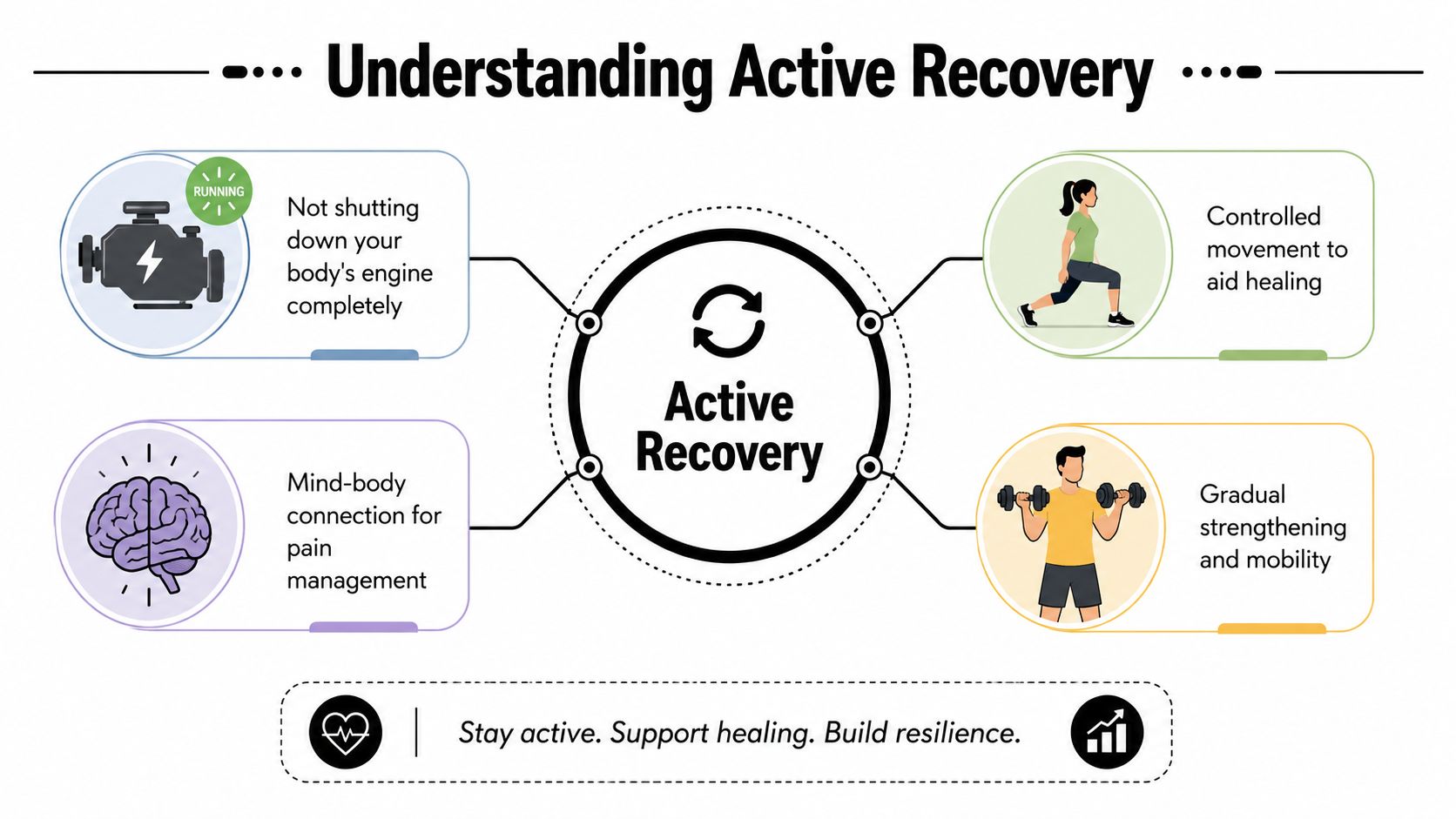
Active recovery means using controlled, low-intensity movement to help your body heal. Instead of shutting the engine off completely, you let it idle smoothly.
That “gentle engine cool-down” idea helps patients understand it quickly. Your body often responds better to the right amount of motion than to total stillness. Light movement can help circulation, reduce the sense of stiffness, and reintroduce normal patterns without asking the body for high effort.
What it looks like in real life
In a clinic, active recovery physical therapy might include:
- Gentle mobility work for a stiff spine, knee, or shoulder
- Easy walking or cycling to keep blood moving without heavy joint stress
- Light strengthening through range so muscles support healing tissues
- Aquatic therapy when land-based movement feels too uncomfortable
- Breathing and pacing strategies for people who tense up around pain
The key is dosage. The movement should feel productive, not punishing.
Why motion helps
Think of a sore knee after several inactive days. The joint often feels rusty, not broken. Once you start moving carefully, the knee may feel less stuck. That's not magic. It's the effect of circulation, joint motion, muscle engagement, and nervous system reassurance working together.
A pilot study in athletes gives a useful window into this principle. Participants using active recovery based on their maximum exercise capacity reached a 94.7% ± 24.6% performance recovery rate, compared with 72.9% ± 23.1% in a control group, and the active recovery bout was only 4 minutes long (pilot study on active recovery and performance recovery).
That study focused on athletic performance, not arthritis or post-op rehab. Still, it supports an important clinical idea. Well-dosed movement can outperform complete passivity when the body is ready for it.
Practical rule: Active recovery should help you feel looser, steadier, or more capable afterward. If it consistently leaves you wiped out, the dose is off.
For non-athletes, the same philosophy applies with simpler goals. We're not chasing jump performance. We're trying to help you walk farther, stand longer, bend easier, and trust your body again.
Active Recovery Versus Passive Recovery
Patients often think they have to choose one side. Either they rest, ice, and get hands-on treatment, or they exercise. In reality, both approaches can belong in the same recovery plan. The primary consideration is when each one fits.
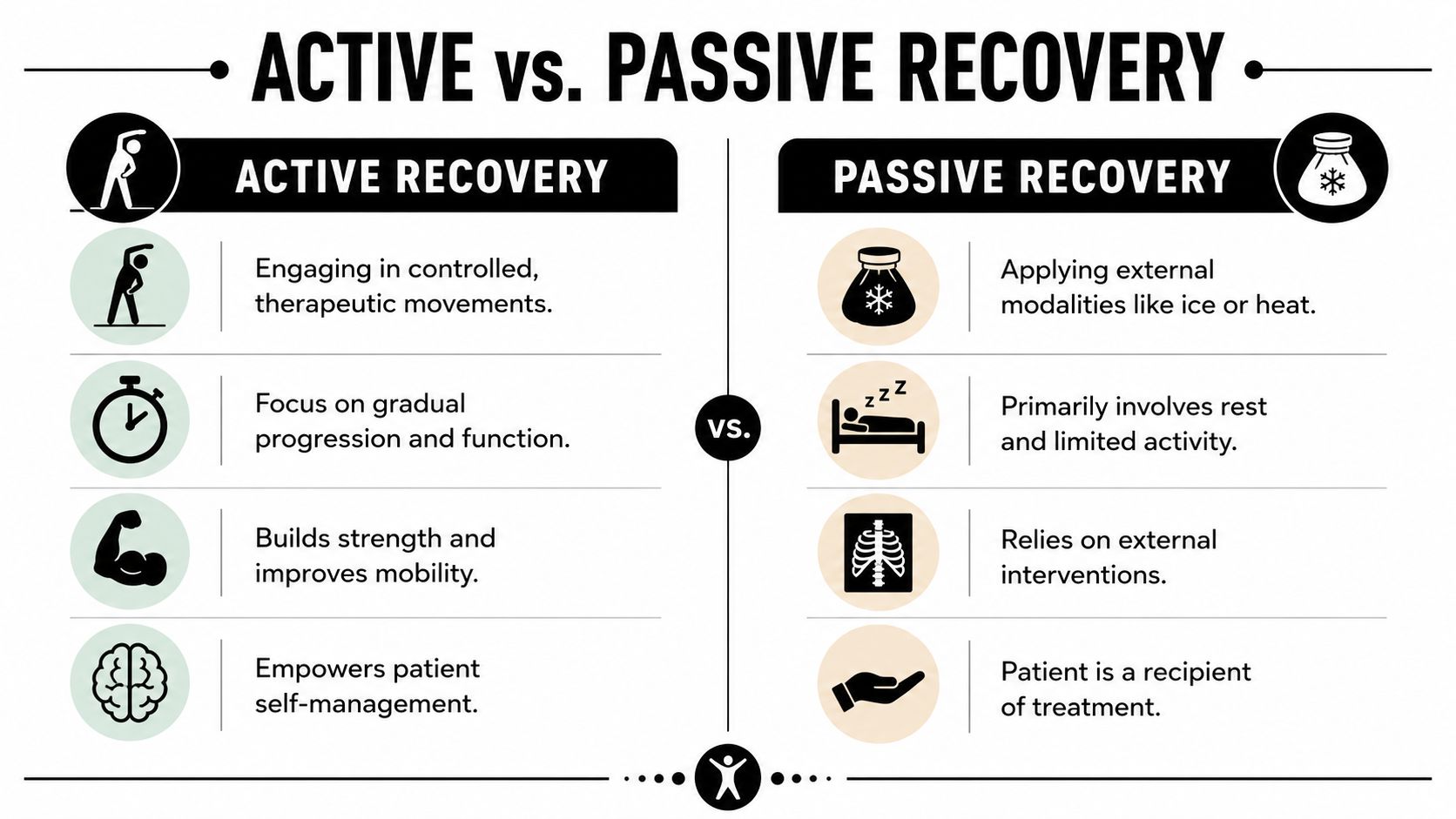
Passive recovery includes treatments where you receive care without producing much movement yourself. Active recovery asks you to participate through guided motion, light exercise, or low-effort physical tasks.
A simple side-by-side view
| Recovery style | What it includes | When it helps most | Main limitation |
|---|---|---|---|
| Passive recovery | Ice, heat, manual therapy, rest, supportive positioning | Early pain flare-ups, high irritability, short-term symptom relief | Doesn't rebuild function by itself |
| Active recovery | Walking, mobility drills, light strengthening, pool work | As symptoms allow, especially when stiffness and weakness start limiting life | Can aggravate symptoms if overdosed |
Passive care can be useful in the beginning. If your shoulder is acutely inflamed or your back just seized up, immediate aggressive exercise usually isn't the answer. You may need a brief period of calming things down first.
But passive methods have a ceiling. They can reduce discomfort, yet they don't automatically restore your ability to squat, lift, turn, or climb stairs.
The difference patients feel
Passive recovery often feels like relief is being done to you.
Active recovery feels like relief is being built with you.
That distinction matters because long-term function depends on what your body can do, not only on how it feels while lying still on a treatment table.
A useful way to think about timing
Many clinicians use a practical progression like this:
Calm the area first
If pain is sharp, swollen, or highly irritable, short-term protection and passive support may come first.Add safe movement early
Once symptoms begin to settle, gentle motion usually helps prevent guarding and stiffness.Build capacity gradually
Over time, the goal shifts toward strength, tolerance, balance, and confidence.
Passive recovery can quiet the alarm. Active recovery teaches the body how to function again.
Examples by condition
- After a knee flare-up: Ice and rest might help on day one. Seated leg motion and short walking bouts often matter more after that.
- With chronic neck pain: Heat may reduce guarding. Lasting change usually comes from posture-specific mobility, strength, and movement retraining.
- After surgery: Early protection is important, but most successful rehab plans gradually layer in guided motion instead of prolonged immobilization.
This isn't about proving one method is superior in every case. It's about matching the tool to the stage of healing.
Benefits for Pain Relief and Lasting Mobility
Individuals are less concerned with a rehab plan's perceived complexity. They care whether they can sleep better, move with less pain, and get back to normal routines.
That's where active recovery physical therapy becomes powerful. It doesn't just aim to reduce symptoms for an hour. It helps patients regain useful movement in ways that carry into daily life.
What patients usually notice first
The first wins are often simple:
- Less stiffness after sitting
- Easier walking
- More confidence using the sore area
- Fewer “I'd better not do that” moments
Those changes matter because they create momentum. When movement feels safer, patients stop bracing as much. When they brace less, movement often becomes smoother. That smoother movement can reduce irritation further.
Why pain often changes with movement
Pain is not always a sign that damage is increasing. Sometimes pain reflects sensitivity, guarding, deconditioning, or poor load tolerance. Gentle, repeatable motion can calm those responses over time.
That's one reason active care is often part of a broader pain management physical therapy approach. It gives people a way to influence symptoms through movement instead of relying only on rest or medication.
Mobility that lasts longer than a treatment session
A heating pad may help your back feel better for the evening. A good active recovery plan can help you bend, walk, and lift more comfortably the next day too. That's a different kind of result.
It's the difference between loosening a sticky door hinge for a moment and fixing how the door moves.
Movement becomes medicine when the dose matches the person.
For people with arthritis, recurring back pain, or long recoveries after surgery, that sense of control is huge. They start learning what improves symptoms, what overloads them, and how to adjust on tough days without abandoning the whole plan.
Lasting benefits often come from these habits
- Consistent low-intensity motion instead of all-or-nothing activity
- Gradual loading so tissues adapt rather than revolt
- Better body awareness during bending, reaching, and walking
- Fewer fear-based pauses that can feed stiffness and weakness
The long-term goal isn't to avoid pain forever. It's to move through life with more resilience, fewer setbacks, and more trust in your body.
Sample Active Recovery Exercises and Protocols
The safest active recovery plan is usually the one that looks modest. People often expect dramatic exercises. Most of the time, the most useful choices are simple, repeatable, and easy to scale.
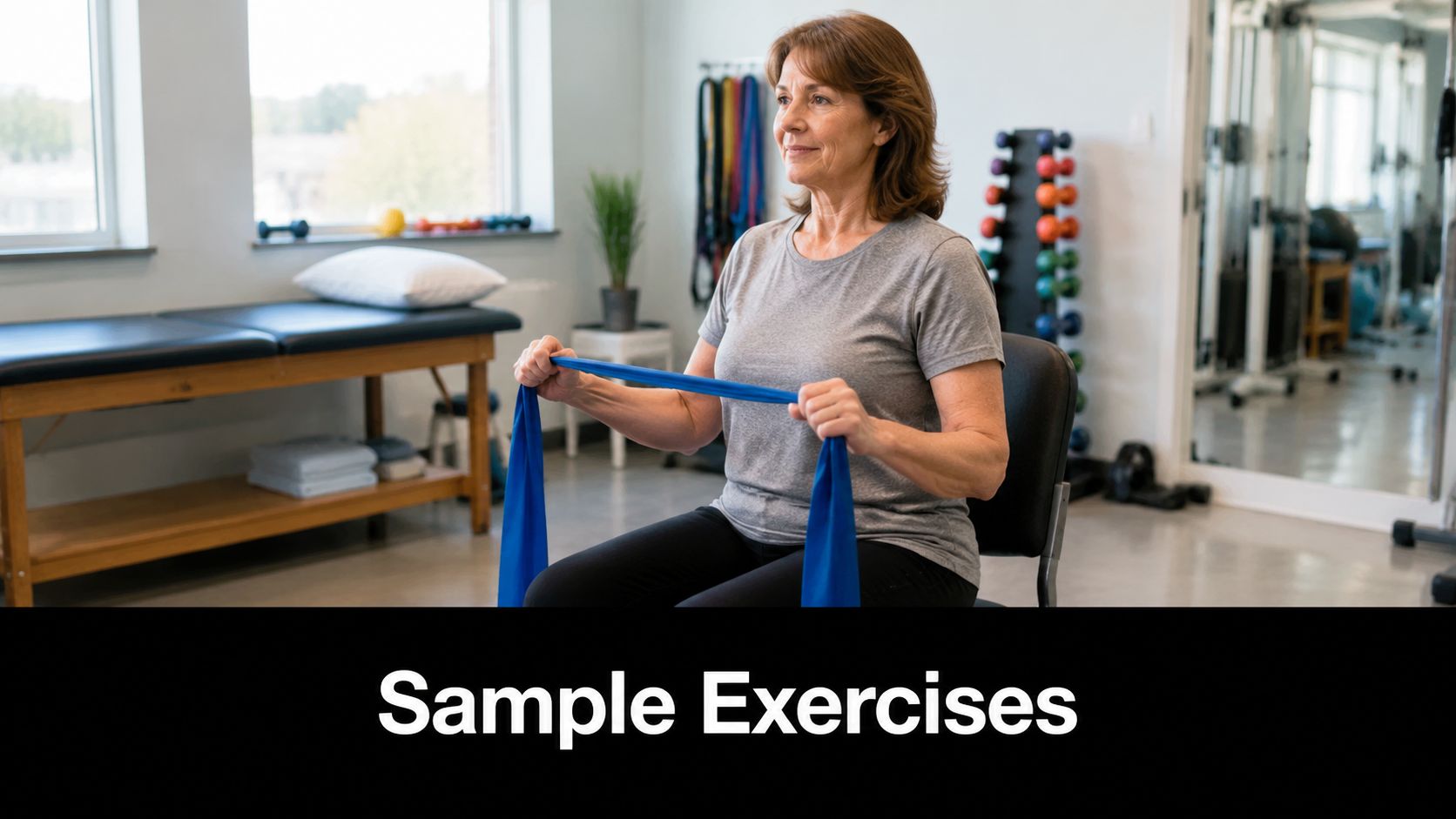
Expert guidance on active recovery recommends sessions of 10 to 30 minutes at an RPE of 4 to 6 out of 10, with the important rule that you should stop if you feel more tired after the session than before it (expert protocol details for active recovery).
How to use RPE without overthinking it
RPE means Rate of Perceived Exertion.
A simple patient version looks like this:
- RPE 1 to 3 feels very easy
- RPE 4 to 6 feels light to moderate, like you're working but still in control
- RPE 7 and above starts pushing into effort that may be too much for recovery work
For active recovery physical therapy, you're usually aiming for “I can do this, and I still feel better afterward.”
Four useful examples
Cat-cow for low back stiffness
Start on your hands and knees, or do a seated version if getting to the floor isn't practical. Gently round your back, then gently arch it. Move slowly with your breath.
This can help people who feel locked up after sitting or first thing in the morning.
Seated knee extensions
Sit in a chair with both feet on the floor. Straighten one knee until the leg is comfortably extended, then lower it back down. Alternate sides.
This is a good early option after knee irritation or surgery when you need movement without high load. It also pairs well with guided range of motion exercises when a joint feels stiff but not highly inflamed.
Wall push-ups for shoulder and upper body re-entry
Stand facing a wall with your hands placed on it at chest level. Bend your elbows slightly to move toward the wall, then press back. Keep the motion smooth.
For many patients, this is less threatening than floor push-ups and easier to control during shoulder recovery.
Easy walking or pool walking
Sometimes the best exercise doesn't look like rehab at all. A short indoor walk, hallway laps, or pool walking can restore rhythm and confidence without overloading one painful area.
If one of your goals is to return to recreation, mobility work can also support hobbies. Golfers, for example, may benefit from drills that improve rotation and control. If you want ideas that connect movement quality to performance, these exercises to improve your golf swing offer useful examples.
What a beginner session can look like
A very simple session might include:
- A gentle warm-up such as easy walking
- One or two mobility drills for the stiff area
- One light strength movement through a comfortable range
- A short cool-down with relaxed breathing and easy motion
Here's a visual example of gentle therapeutic movement in action:
Safety rules that matter more than the exercise itself
- Keep it conversational. If effort spikes too quickly, back off.
- Favor smooth movement over stretching hard.
- Use the next few hours as feedback. Mild soreness may be okay. Clear flare-ups mean the dose was too high.
- Stop if you feel drained rather than refreshed.
If the session leaves you more fatigued than when you started, it wasn't recovery work for your body that day.
That's especially important for older adults and people with chronic pain. The right exercise is not the hardest one. It's the one your body can recover from.
Your Active Recovery Plan at MedAmerica Rehab Center
A structured recovery plan usually starts with a simple question: what is limiting you right now? For one person, it's knee stiffness after surgery. For another, it's fear of bending after back pain. For someone else, it's poor balance after a long stretch of inactivity.
At a clinic visit, the first step is usually an evaluation of movement, pain behavior, range, strength, and daily limitations. That process helps separate the symptom from the driver. A shoulder may hurt, but the bigger issue might be guarding, weakness, or a movement pattern that never fully returned after injury.
What a personalized plan can include
An active recovery plan may combine several pieces:
- Hands-on treatment to reduce guarding and improve motion
- Targeted exercise based on your current tolerance
- Pacing strategies so activity increases without boom-and-bust setbacks
- Modalities or support options such as aquatic therapy or other non-invasive care when appropriate
Because response varies so much from person to person, many patients benefit from individualized treatment plans rather than a standard handout.
Why professional guidance helps
Physical therapy has a strong track record across many conditions. Field-wide data summarized in one review reported that 68% to 72% of patients experience meaningful improvement in physical function, and up to 90% report improved quality of life after treatment (summary of physical therapy success rates and quality-of-life outcomes).
Those numbers don't promise the same outcome for every person. They do show why guided rehab is worth taking seriously.
A clinic such as MedAmerica Rehab Center can be one option for patients who need active recovery physical therapy integrated with broader rehab services, including physical therapy for post-operative recovery, chronic pain, balance concerns, and orthopedic conditions.
How the patient journey often unfolds
Recovery usually doesn't happen in a straight line. A good plan adjusts.
One week may focus on regaining motion. The next may add light loading. Later visits may shift toward walking endurance, stair tolerance, or getting back to a specific activity. The point is not to chase soreness. The point is to build usable capacity.
Good rehab meets the body where it is, then nudges it forward without losing the person's trust.
That's often the difference between doing exercises and recovering.
Frequently Asked Questions About Active Recovery
Is active recovery supposed to hurt
No. It can feel like work, but it shouldn't feel like you're forcing your way through sharp or escalating pain. A mild sense of stretching, muscle effort, or temporary discomfort can happen. What you want overall is a session that feels constructive, not punishing.
How is this different from pushing through pain
“Pushing through pain” usually means ignoring warning signs and hoping the body gives in. Active recovery is different. It uses low-intensity movement, close symptom monitoring, and small adjustments. The whole idea is to work with your body's current tolerance, not overpower it.
What if I'm not athletic at all
That's completely fine. Active recovery physical therapy is often most helpful for people who feel deconditioned, stiff, or unsure how to start. You don't need a training background. You need the right entry point.
How long until active recovery helps prevent future injuries for non-athletes
There isn't one universal timeline. A commonly noted gap in current guidance is that non-athletes rarely get a clear answer to this question. What we can say is that physical therapy aims to build self-management skills and strengthen weak areas over weeks or months, which helps create long-term resilience and reduce re-injury risk (discussion of timelines for injury prevention in non-athletes).
That answer can feel less satisfying than a fixed number, but it's more honest. Injury prevention is usually not a finish line. It's a process of improving movement quality, strength, pacing, and confidence until your body handles daily life better than it did before.
If you're dealing with stiffness, pain, or a recovery that feels slower than it should, MedAmerica Rehab Center offers evaluation and treatment options for people who need a practical, personalized active recovery plan. That can include post-op rehab, care for arthritis and back pain, and movement-based treatment designed to help you return to daily life with more comfort and confidence.
MedAmerica Rehab · Deerfield Beach
Talk to a clinician about your pain
Physical therapy, chiropractic, acupuncture and shockwave therapy under one roof, since 1995. Same-day appointments are available.
Mon–Thu 8:00 AM – 6:30 PM · Fri 8:00 AM – 3:00 PM