

FOTO Outcome Measure: A Patient’s Guide to Tracking Progress
You're sitting in the waiting room, and someone hands you a tablet. Before your physical therapy session even starts, you're asked to answer a series of questions about walking, bending, lifting, sleeping, or getting through your day with pain.
A lot of patients look at that screen and think the same thing. Is this just paperwork?
Usually, it isn't. That survey is often part of the FOTO outcome measure, a tool that helps your therapist understand how your condition affects your real life, not just what shows up during an exam. It turns your answers into usable information so your care plan can be shaped around what matters to you most.
If you're starting therapy for back pain, neck pain, arthritis, an auto accident injury, or post-surgical recovery, knowing what FOTO is can make the process feel much less mysterious. It can also help you see why those questions matter to your recovery.
What Is This Survey Your Physical Therapist Gave You
The survey your therapist gave you is often part of FOTO, which stands for Focus on Therapeutic Outcomes. FOTO is a patient-reported outcome measure, or PROM, system. In simple terms, it asks you questions about what you can and can't do, then uses your answers to track your function over time.
FOTO captures your functional status when you begin care, compares it with a predicted goal status, and then compares it again with your discharge status to show change across your episode of care, according to this overview of physical therapy outcomes tracking software. That means the survey isn't just checking a box. It's helping create a before-and-after picture of your recovery.
For patients, that matters because pain is only part of the story. Your therapist also needs to know things like:
- Daily limits: Can you sit through work without your back locking up?
- Basic movement: Can you turn your head while driving?
- Home life: Can you carry groceries, climb stairs, or sleep comfortably?
- Personal goals: Are you trying to get back to tennis, gardening, or lifting your grandchild?
Those answers shape treatment.
The most useful physical therapy plan isn't built only from what the therapist sees. It's built from what you live with every day.
That's why many clinics include these surveys early in care. They help put your experience into a format that can be followed from visit to visit. If you're wondering what usually happens during an initial evaluation, this guide to what to expect in physical therapy can help you understand the bigger picture.
Why the survey comes first
Your therapist still does a hands-on evaluation. They'll look at movement, strength, balance, pain patterns, and other findings. But the FOTO outcome measure adds another layer. It gives you a structured way to express your specific challenges.
That matters because two people can have the same diagnosis and very different lives. One person with neck pain may struggle mainly at a desk. Another may struggle while driving or sleeping. FOTO helps capture that difference.
Understanding Patient Reported Outcome Measures
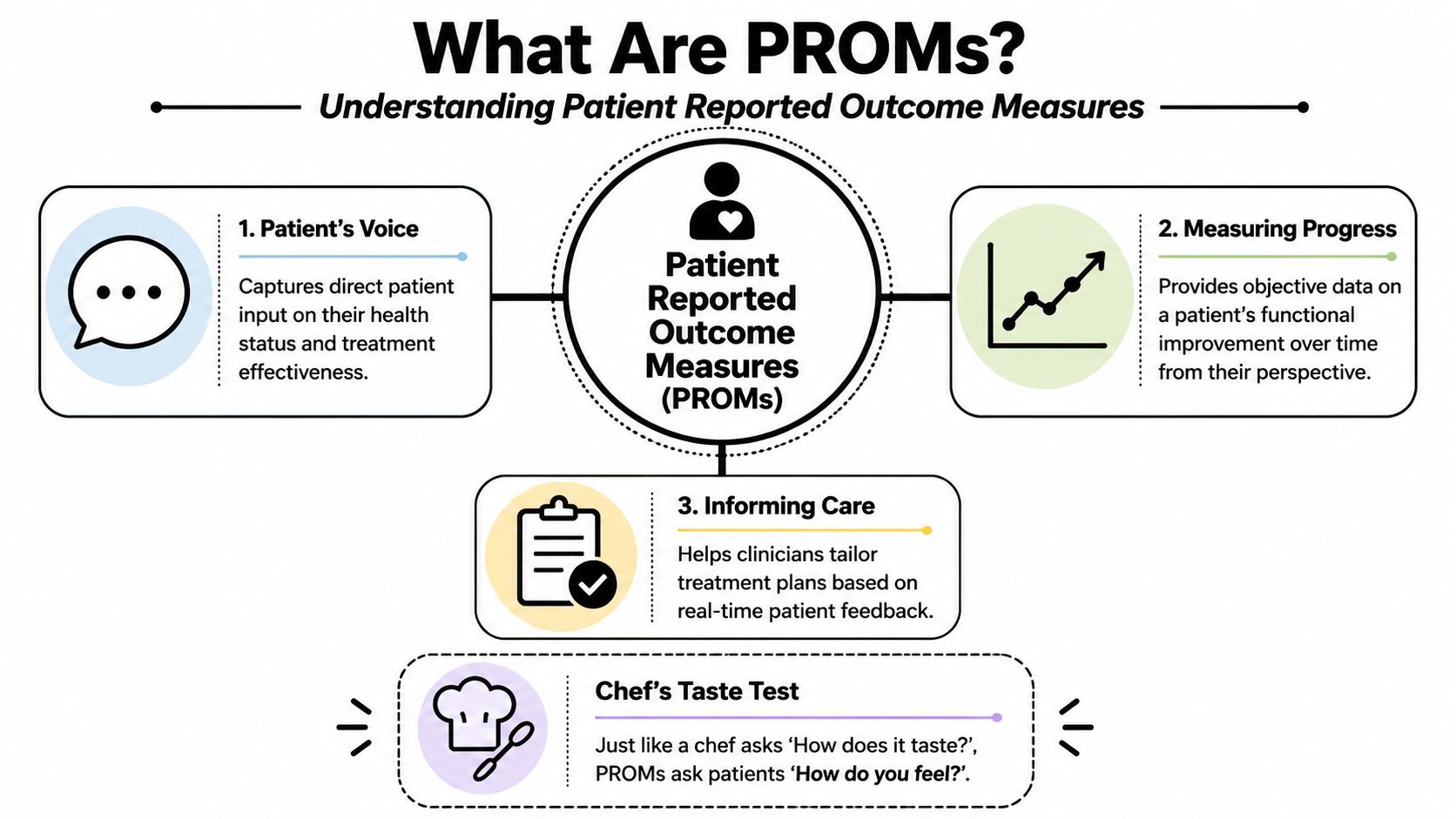
A patient-reported outcome measure, or PROM, is a structured questionnaire that records your own view of your health and function. It doesn't replace the therapist's exam. It adds the patient's voice to it.
Consider a coach working with a runner. The coach can measure speed and form. But if the runner says, “My knee hurts halfway through every run,” that information changes the training plan. Both pieces matter.
Here's another simple analogy. A chef can measure ingredients perfectly, but the meal still has to be tasted. PROMs are the “How does it feel?” part of healthcare.
What PROMs capture that exams sometimes miss
A physical therapist can measure range of motion with tools and test strength with specific movements. Those are important. But those tests don't always show how your condition affects normal life.
PROMs help capture things like:
- Real-world function: Whether you can walk, work, dress, reach, or sleep the way you want
- Your perspective: Whether an activity feels manageable, difficult, or impossible
- Change over time: Whether daily life is getting easier as therapy continues
That's why PROMs are so useful in rehab. They take your symptoms and functional limits out of the vague category of “I'm better” or “I'm worse” and turn them into a more consistent record.
Why your answers matter so much
Some patients worry they'll answer “wrong.” You won't.
The only way a PROM works well is if you answer truthfully. If bending to tie your shoes is hard, say it's hard. If you can do it some days but not others, that pattern matters too. Your therapist isn't looking for a perfect score. They're looking for an accurate starting point.
Practical rule: Answer based on what you can usually do in real life, not on your very best day or your very worst one.
PROMs also support better conversations. If your shoulder motion improves during the exam, but you still can't reach into a cabinet without pain, your therapist needs to know that. A structured questionnaire helps bring that mismatch to the surface.
In other words, PROMs help keep care patient-centered. They remind everyone in the room that recovery isn't only about test results. It's about getting back to the things your body needs to do for your life to feel normal again.
How the FOTO Outcome Measure Works
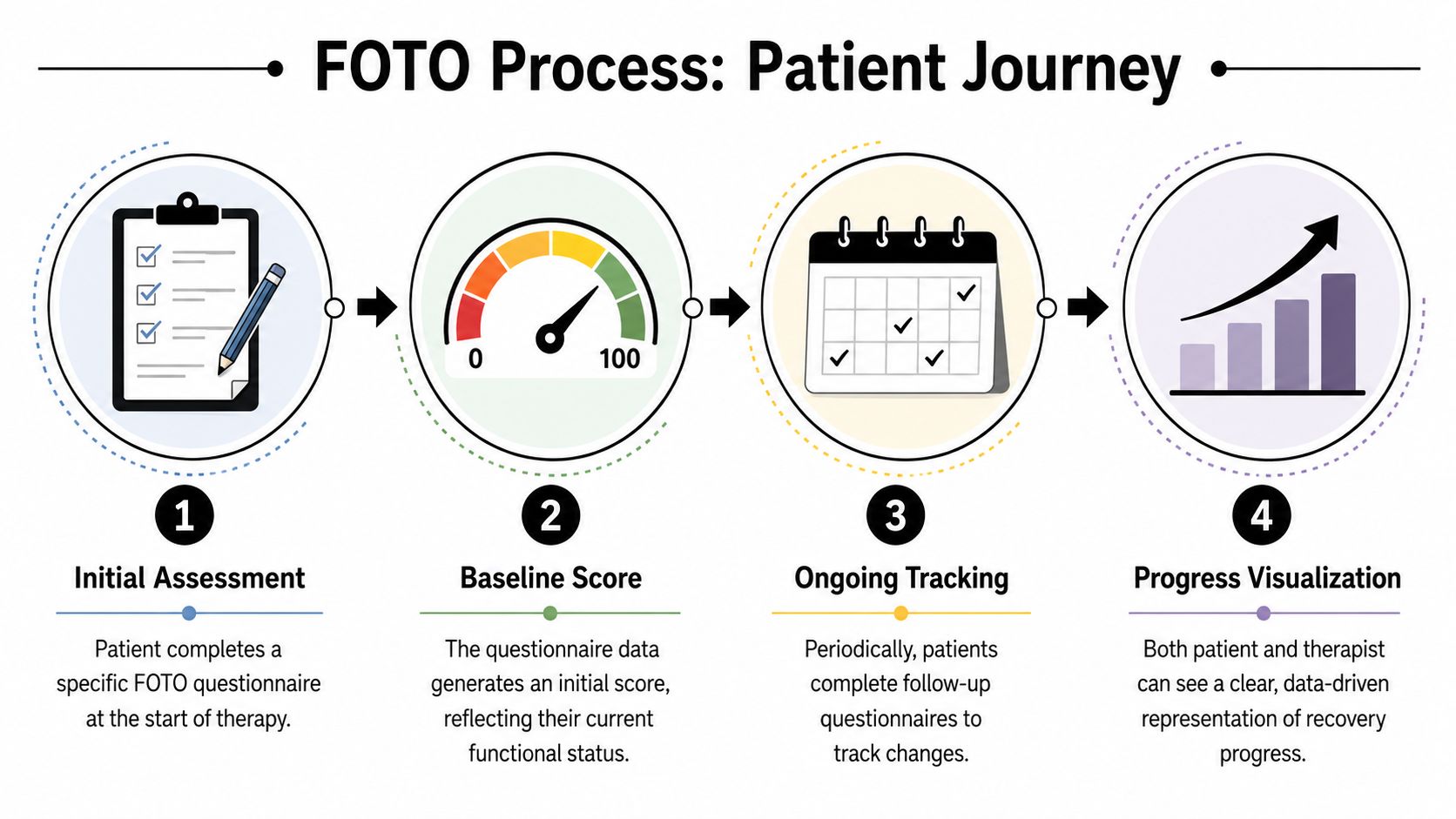
The FOTO outcome measure follows your progress across care in a pretty practical way. It starts with your first set of answers, translates those answers into a functional score, and then uses follow-up surveys to track how things change.
According to this basic introduction to Focus on Therapeutic Outcomes, FOTO is a web-based patient-reported outcomes system used in rehabilitation to measure function on a 0-to-100 scale, comparing an initial functional status with a predicted goal status and a discharge functional status. Patients typically complete a questionnaire at admission and again at discharge, and some clinics also use it at intervals such as every 5 visits to monitor progress.
Step one, your starting point
At the beginning of therapy, you answer questions related to your condition and function. The system turns those responses into a baseline score. That score reflects where you are at the start, not your worth, effort, or pain tolerance.
A lower score generally means you're dealing with more functional difficulty. A higher score generally means you're functioning better. The key is that the number gives your therapist a clear snapshot of where you're beginning.
Step two, a predicted target
This is the part that often confuses people. FOTO doesn't just show where you are today. It also estimates an expected recovery path.
That estimate isn't pulled out of thin air. FOTO uses risk-adjusted, nationally benchmarked comparisons and includes 10 risk-adjustment factors to improve prediction accuracy, according to this FOTO summary document. The reason that matters is simple. Two patients can share the same diagnosis but have different baseline function or different levels of medical complexity, so they shouldn't be judged by the exact same standard.
A helpful analogy is a race result. If two runners finish with the same time, that result means something different if one ran uphill carrying a heavy pack and the other ran on a flat track. Risk adjustment tries to make the comparison fair.
In rehab, that means your recovery is interpreted in context.
A fair outcome system compares you with people who are more like you, not just with anyone who has the same body part diagnosis.
Step three, follow-up check-ins
As therapy continues, you may complete the survey again. Some clinics repeat it at certain intervals, and many use it again at discharge. These repeat surveys show whether your function is improving, staying the same, or changing in a way that deserves a closer look.
That's useful because recovery doesn't always feel obvious from week to week. A patient may say, “I'm still sore,” but their score shows that sleeping, driving, and walking have all improved. Another patient may feel stronger in the gym but still report trouble with stairs or lifting at home. Both situations matter.
What your therapist looks for
Your therapist isn't just staring at a number. They're looking at patterns.
| Part of the FOTO process | What it means for your care |
|---|---|
| Baseline score | Shows where your function started |
| Predicted goal status | Helps set realistic expectations |
| Repeat questionnaires | Tracks change during treatment |
| Discharge status | Shows how your function changed over the full episode of care |
If your progress lines up with expectations, that can confirm the plan is on track. If it doesn't, your therapist may need to adjust exercises, review technique, reassess pain drivers, or look for another issue affecting recovery.
That's why the FOTO outcome measure is useful in real clinics. It helps turn “I think I'm doing better” into a clearer conversation about what's improving, what isn't, and what to do next.
Benefits for Your Recovery and Your Therapist
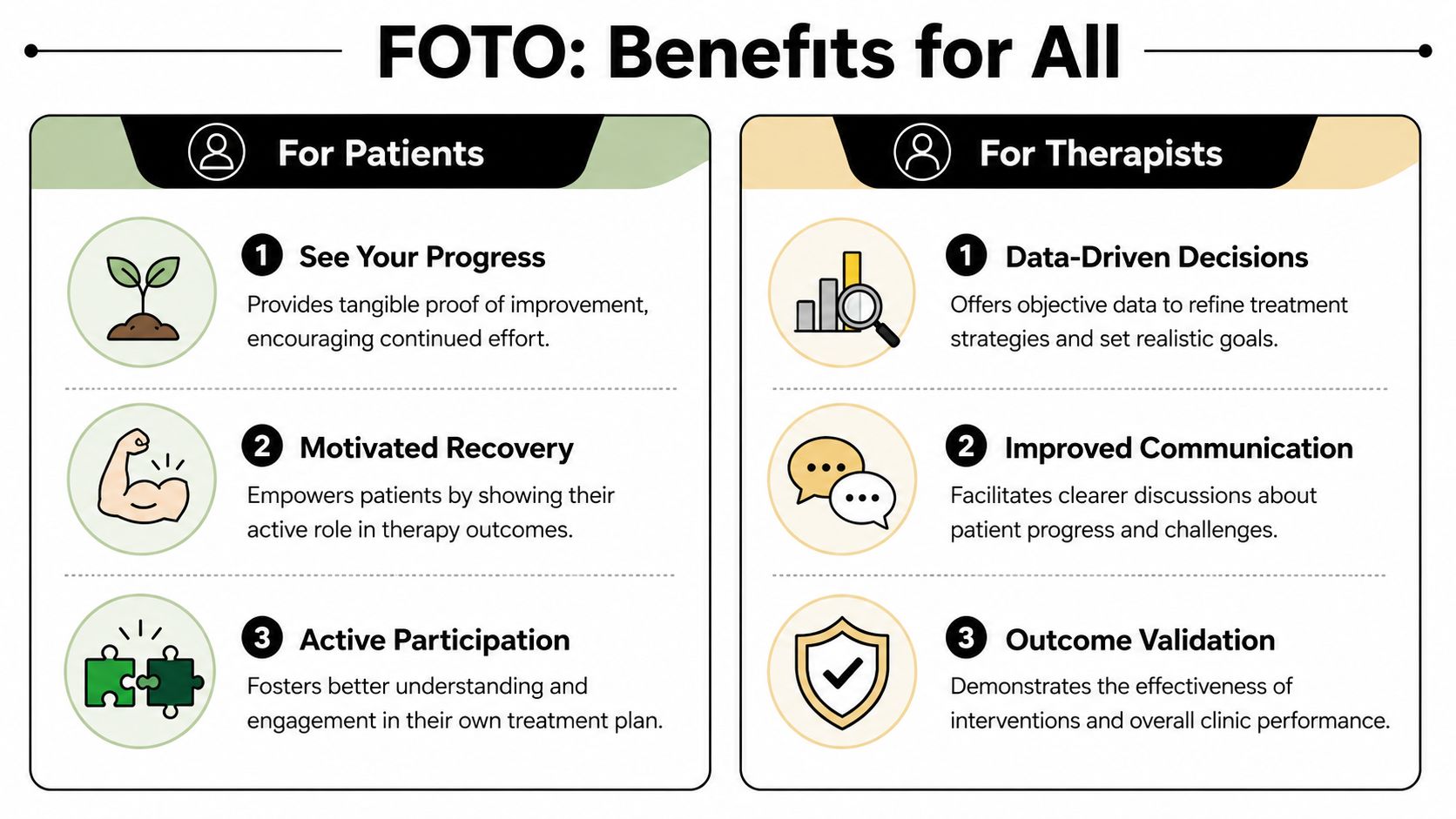
One reason FOTO has remained important in rehab is that it supports both sides of the treatment relationship. Patients get a clearer view of their progress. Therapists get structured information they can use to make better decisions.
FOTO Patient Outcomes had surpassed 125 clinical research studies by 2022, and the platform is described as nationally benchmarked and risk-adjusted in this 2022 announcement about FOTO research and benchmarking. That doesn't mean every patient experience is identical. It means the system has been used broadly enough to support meaningful comparison and tracking.
What patients gain
For many people, the biggest benefit is visibility. Recovery can feel slow, especially when pain flares or progress comes in small steps. A structured outcome measure gives you another way to see improvement.
Patients often find value in:
- Seeing progress in writing: You may forget that getting dressed used to be difficult until a follow-up survey shows change.
- Feeling heard: The questions focus on what your body can do in daily life, not just what happens in the clinic.
- Staying engaged: When you can connect your home exercise program to real-life goals, it's easier to stay involved.
Some patients also feel relieved when the survey gives them language for what they've been struggling with. Instead of saying, “My back is bad,” they can identify that standing, bending, or sleeping are trouble spots.
What therapists gain
For clinicians, FOTO supports more focused decision-making. It helps confirm whether the plan is helping the patient function better, not just whether an exercise was completed.
A therapist may use this kind of data to:
- Refine treatment choices: If symptoms are shifting but function isn't improving, the plan may need adjustment.
- Guide conversations: Specific score changes can make it easier to explain progress to patients.
- Document care clearly: Structured outcome tracking helps show why treatment is being continued, progressed, or changed.
Good rehab isn't just about doing exercises. It's about checking whether those exercises are changing the activities the patient actually cares about.
If you're looking for an example of care built around function and goals, individualized treatment plans at MedAmerica Rehab Center reflect that same general idea of tailoring treatment to the person, not just the diagnosis.
FOTO in Action at MedAmerica Rehab Center
A simple example makes this easier to understand.
Let's say a patient comes in after a car accident with neck pain, headaches, and trouble turning their head while driving. During the evaluation, the therapist listens to the history, checks movement, tests strength and posture, and reviews daily limitations. The patient also completes a FOTO questionnaire.
That survey helps capture something the physical exam alone can't fully describe. Maybe the patient can technically rotate their neck to one side, but doing it during traffic feels painful and unsafe. Maybe sleep is poor because every position aggravates symptoms. Those details matter because they shape the treatment plan.

How the score guides care
At a clinic visit, the therapist may combine the survey results with what they see in person. If the patient reports major trouble with driving, working at a computer, and sleeping, treatment can focus on those problems instead of staying too general.
That may include:
- Hands-on treatment: To address stiffness and pain in the neck and upper back
- Targeted exercise: To improve neck mobility, postural control, and strength
- Movement coaching: To make workstations, car positioning, and daily movement less aggravating
- Progress checks: To see whether function is changing, not just whether symptoms come and go
As visits continue, the therapist can compare what the patient says now with what they said at the start. If headaches improve but driving still feels limited, the plan can shift toward that specific barrier.
Why this matters in real life
The FOTO outcome measure transforms into more than a score. It becomes a conversation tool.
A patient may come in feeling discouraged because pain hasn't disappeared yet. But when the therapist reviews changes in function, both can see that sleep has improved, work tolerance is better, and head turning has become easier. That doesn't erase the remaining symptoms. It does show that recovery is moving.
On the other hand, if follow-up answers show that daily function isn't improving the way expected, that's useful too. It tells the therapist to look closer. Maybe the exercises need to be modified. Maybe the diagnosis needs another look. Maybe fear of movement, work demands, or another body region is affecting progress.
If you're curious what that visit-by-visit rehab process usually looks like, this overview of a typical physical therapy session gives a practical walkthrough.
Interpreting Your FOTO Score and Its Limits
Your FOTO score matters. It just doesn't tell the whole story.
A single number can be helpful, but it can't fully capture every part of recovery. Some patients improve quickly in one area and slowly in another. Some feel stronger before they feel confident. Some have a score that changes modestly while their ability to work or sleep improves in a very meaningful way.
That's why therapists often use FOTO alongside other tools. As noted on Net Health's FOTO analytics page, therapists may need to pair FOTO with region-specific validated tools such as the ODI, NDI, LEFS, or DASH, along with pain and global-change measures. In plain language, that means FOTO is an important guide, but not the only guide.
What to do if your score seems confusing
If your score plateaus or doesn't match how you feel, ask about it. That's not a problem. It's useful information.
A good conversation might include:
- Your daily goals: What are you still unable to do?
- Your symptoms: Are pain, stiffness, fatigue, or fear affecting performance?
- Other findings: What did the therapist see during movement testing and examination?
Recovery is rarely a straight line. A score can point the conversation in the right direction, but it should never replace that conversation.
It's also reasonable to ask how your information is used. These tools are used to track outcomes and support care quality, and your therapist can explain how your clinic handles privacy and documentation.
The best way to view the FOTO outcome measure is as a map. It helps show where you started, where you may be headed, and whether the route needs to change. It is not a judgment on you or your effort.
If you're dealing with pain, limited movement, or a recovery that feels uncertain, MedAmerica Rehab Center can help you understand what your symptoms mean in daily life and how a personalized rehab plan can address them. If you have questions about evaluations, outcome tracking, or what your first visit will involve, reaching out is a practical next step.
MedAmerica Rehab · Deerfield Beach
Talk to a clinician about your pain
Physical therapy, chiropractic, acupuncture and shockwave therapy under one roof, since 1995. Same-day appointments are available.
Mon–Thu 8:00 AM – 6:30 PM · Fri 8:00 AM – 3:00 PM