

Is Chiropractic Care Covered By Insurance?
A lot of people ask about insurance only after the pain starts interrupting normal life. You wake up with low back pain, your neck locks up after a car accident, or sciatica starts shooting down your leg. Relief becomes the priority, but almost immediately the next question shows up too. Is this going to be covered, or am I paying for everything myself?
That uncertainty keeps people from booking care more often than the pain itself. They don't want a surprise bill. They don't want vague answers. They want someone to explain, in plain language, what insurance usually pays for, what it doesn't, and what they should ask before the first visit.
The First Question After Pain Is Often About Price
A common situation goes like this. Someone in Deerfield Beach hurts their back lifting something, sitting too long, or after a fender bender. They know chiropractic care might help, but before they schedule, they stop and think about cost. They pull out an insurance card, stare at terms like copay and deductible, and still have no idea what they'll owe.
That concern is reasonable. Insurance coverage for chiropractic care is common, but it isn't simple. Some plans cover part of treatment. Some cover only certain services. Some cover care for an active problem, then stop paying once the condition shifts from treatment to maintenance.

The good news is that insurance support for chiropractic care is not unusual. According to a 2016 CDC data brief on chiropractic insurance coverage, approximately 60% of U.S. adults who saw a chiropractor had at least some health insurance coverage for the care, with 41.4% reporting partial coverage and 18.7% reporting complete coverage.
Why the answer is usually yes, but with conditions
If you're asking is chiropractic care covered by insurance, the practical answer is often yes, at least in some form. The less helpful version is when people stop there. Coverage can still leave you with out-of-pocket costs, referrals, visit caps, or denied claims for services your plan labels as nonessential.
Practical rule: Don't ask only whether chiropractic is covered. Ask which parts of the visit are covered, under what diagnosis, and for how long.
What patients usually need most
Instead of a lecture on insurance policy design, what's often needed is clarity on questions like these:
- Will my first visit be covered
- Do I need a referral or authorization
- Is the adjustment covered but the exam isn't
- Will my plan pay for care after an accident
- What happens if my pain becomes ongoing instead of acute
Those are the questions that affect your bill. Once you understand them, insurance becomes much easier to use wisely.
How Chiropractic Insurance Coverage Generally Works
Insurance works a little like a restaurant membership. Your card doesn't mean everything on the menu is free. It means the plan has rules about what items are included, what discount applies, and whether you have to order from a specific location to get the best price.
That same idea applies to chiropractic care. Your plan may cover spinal manipulation, but not massage. It may cover visits after you meet your deductible, but not before. It may pay more if you use an in-network provider and less if you go out of network.
The three terms that matter most
Deductible means the amount you may need to pay before your insurance starts sharing costs. If your deductible hasn't been met, a covered visit can still be your responsibility.
Copay is the fixed amount you pay per visit under some plans. Consider it a set entry fee.
Coinsurance means you pay a share of the allowed amount instead of a flat fee. The plan pays one portion, and you pay the rest.
In network usually means simpler billing
An in-network provider has agreed to contracted rates with your insurer. That usually means lower out-of-pocket costs and fewer billing surprises. Out-of-network care can still be covered on some plans, but reimbursement is often lower and the paperwork can be less patient-friendly.
If you're comparing benefits across medical equipment and rehab-related needs, looking at examples like mobility scooter insurance plans can help you see the same basic pattern. Coverage depends on plan terms, medical necessity rules, and whether the item or service falls inside a defined benefit.
What this means at the front desk
Before treatment starts, a good office should check the details that affect your wallet, not just whether your card is active. That includes copays, deductible status, referral rules, and whether chiropractic benefits are carved out to a third-party manager.
If you want a sense of the services a chiropractic office may bill under one roof, reviewing a clinic's chiropractic care offerings helps you spot an important point. Insurance may treat each part of the visit differently, even when the patient experiences it as one appointment.
Coverage isn't one yes-or-no switch. It's a series of smaller decisions your plan makes about each service on the visit.
Navigating Different Insurance Plans for Chiropractic Care
Plan type matters. Two patients can get similar back pain treatment and have completely different coverage because one has employer insurance, one has Medicare, and one is using an auto claim after an accident.
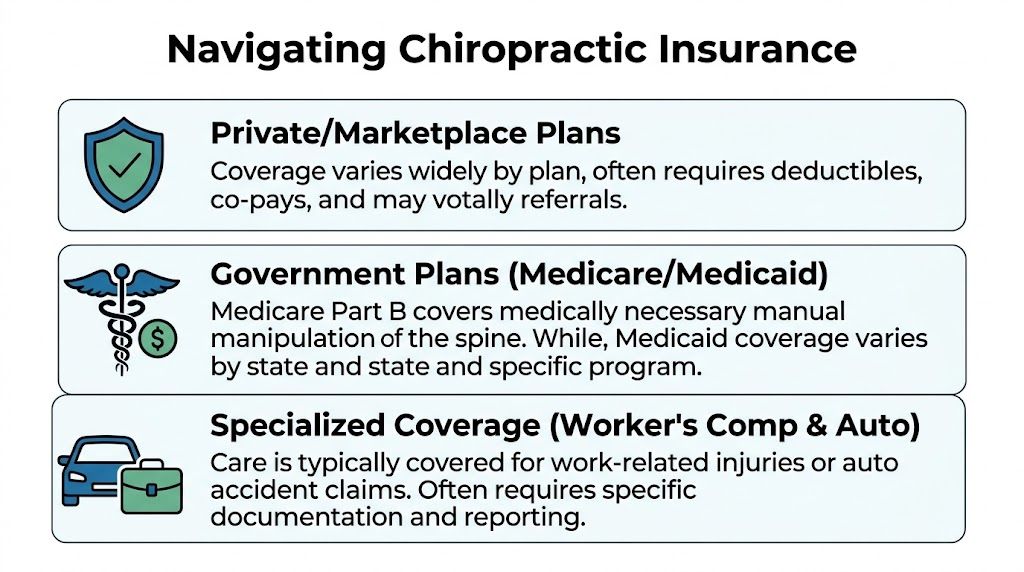
Private and marketplace plans
Private insurance is often the most flexible category, but it's also the least predictable from one plan to the next. Some plans include chiropractic as a standard specialist benefit. Others require referrals, prior authorization, or strict diagnosis-based review.
A few practical patterns show up often:
- Acute pain gets more support: Plans are usually more willing to cover care for recent back pain, neck pain, or injury-related symptoms.
- Service mix matters: An adjustment may be covered while exercise therapy, massage, or supportive modalities process differently.
- Network status changes the bill: Even patients with good benefits can pay more than expected if they choose an out-of-network office.
Government plans
Medicare is the most important one to understand clearly because many patients assume it covers a full chiropractic visit. It doesn't.
According to this Medicare chiropractic coverage explanation, Medicare Part B covers 80% of approved costs for medically necessary manual spinal manipulation after the annual deductible is met, but it strictly excludes exams, X-rays, and other therapies like massage, even if provided by the same chiropractor.
That means a Medicare patient may hear "chiropractic is covered" and still owe out-of-pocket costs for important parts of the visit. The covered service is narrow. The rest depends on supplemental coverage, secondary insurance, or self-pay arrangements.
A short overview can help if you're sorting through plan types before you call your insurer.
Injury-related coverage
This category includes auto insurance claims and workers' compensation. These cases don't behave like standard health insurance. The claim often depends on how the injury happened, when it was reported, and what documentation connects treatment to that event.
With auto cases, the insurer may want accident details, claim numbers, and prompt medical records. With workers' comp, the carrier may require authorization, employer reporting, and treatment tied specifically to the work injury.
The biggest mistake in injury claims is waiting too long to report the incident or starting care without understanding the claim process.
Side-by-side view
| Plan type | What is often covered | Common sticking points |
|---|---|---|
| Private or marketplace | Chiropractic visits for active pain conditions | Deductibles, referrals, network limits, service exclusions |
| Medicare | Manual spinal manipulation when medically necessary | Exams, X-rays, and many related therapies are excluded |
| Auto or workers' comp | Care related to an accident or work injury | Claim approval, paperwork, timing, and documentation requirements |
Understanding Common Coverage Limits and Hurdles
A lot of patients assume that if a doctor recommends treatment, insurance will pay for it. That's not how claims are reviewed. Insurance doesn't ask only whether care may help. It asks whether the service fits the plan's rules for medical necessity.
That phrase matters more than almost anything else in chiropractic billing. If the insurer sees a current problem with documented functional limits and measurable treatment goals, coverage is more likely. If the insurer sees ongoing wellness care, periodic tune-ups, or visits to maintain progress after the main issue has stabilized, payment becomes much less likely.
Acute care and maintenance care are not the same thing
Surprise bills are a common occurrence. Acute care means treatment for an active problem, such as a flare-up, injury, or painful condition affecting daily function. Maintenance care means supportive visits designed to preserve progress or help prevent future issues.
Most insurance plans separate those two categories sharply. According to this overview of chiropractor coverage rules, most insurance plans cover short-term acute care but deny maintenance care, which is deemed elective. This creates a coverage gap, as industry surveys show 70-80% of chiropractic visits are maintenance-oriented, yet provider reports indicate denial rates for these services can exceed 90%.

What usually causes denials
Some denials are frustrating but predictable. The issue isn't always the treatment itself. It's often the paperwork around it.
- Authorization wasn't obtained: Some plans want approval before care starts or before additional visits.
- Notes don't show improvement: If progress isn't documented, the plan may decide further care isn't necessary.
- The case shifted into maintenance: Once the insurer thinks the active problem has plateaued, claims may stop paying.
- The wrong payer was billed first: Accident-related treatment may need to go through the proper injury claim channel before health insurance is considered.
For Florida drivers, understanding no-fault car accident coverage helps clarify why auto injury treatment can follow a different payment path than standard health insurance. The same goes for work injuries, where the process is tied to the employer claim and authorized care pathway, not just a regular office visit. If your injury happened on the job, reviewing how workers' compensation treatment works can help you avoid billing mistakes early.
If your pain began after a car crash or at work, say that on the first call. It changes how the office verifies benefits and submits claims.
Your Step-by-Step Guide to Verifying Your Benefits
Patients do best when they call insurance with a short script and write down the answers. A vague call leads to vague reassurance. A focused call gives you usable details.
Start with your insurance card, a notepad, and the clinic's name. If you have an injury claim, have that claim number ready too. Then ask your questions in categories instead of all at once.
Start with the basics
Confirm that chiropractic care is a covered benefit under your specific plan. Then ask whether the provider is in network. After that, ask about your out-of-pocket responsibility, including deductible, copay, or coinsurance.
If the representative uses confusing language, slow them down. Ask them to explain whether they mean the whole visit or only one billed service.
Questions to ask before the first visit
| Category | Question |
|---|---|
| Eligibility | Is chiropractic care a covered benefit under my plan? |
| Network | Is this provider in network or out of network under my plan? |
| Cost share | Do I have a copay, coinsurance, or deductible for chiropractic visits? |
| Deductible | How much of my deductible has been met so far? |
| Authorization | Do I need preauthorization or a referral before the first visit? |
| Visit rules | Is there a limit on the number of covered visits? |
| Service limits | Are exams, therapies, or imaging covered separately from the adjustment? |
| Claims | For an auto accident or work injury, which payer should be billed first? |
| Documentation | Does the plan require progress notes or proof of medical necessity for continued care? |
| Billing record | Can you note today's call and give me a reference number? |
Read the paperwork after the visit
Many patients ignore the Explanation of Benefits because it looks technical. That's where billing confusion grows. The EOB tells you what was billed, what the insurer allowed, what they paid, and what amount may still be your responsibility.
If you've never decoded one before, this EOB guide for billing managers is useful because the same concepts apply to patients reading their own statements. You don't need to master every billing term. You just need to spot whether the claim was processed as covered, denied, applied to deductible, or sent to the wrong payer.
A simple call script
Use something close to this:
I'm checking chiropractic benefits before my first visit. Is chiropractic covered on my plan, does this provider count as in network, do I need authorization or a referral, and what will I owe for the first visit and follow-up visits?
If the answer sounds uncertain, ask for a benefits quote and a call reference number. It won't guarantee payment, but it creates a clear record of what you were told.
What to Expect at Your Deerfield Beach Chiropractic Clinic
A good clinic doesn't leave you to sort all this out alone. Front-desk staff should verify benefits, tell you what they can confirm, and clearly explain the gray areas. That's especially important for patients dealing with back pain, post-accident stiffness, workers' comp injuries, or post-surgical rehab who already have enough on their plate.
In practical terms, that means the office gathers your insurance information, checks active coverage, identifies likely patient responsibility, and flags issues such as referral requirements or injury-claim billing. The strongest clinics also explain what isn't guaranteed. That's not pessimism. That's good billing practice.
What a smooth process looks like
You should expect clear intake questions. Was the problem caused by an accident. Is this work-related. Do you have secondary coverage. Has another provider already ordered imaging or started a claim.
You should also expect a plain-language overview of the first visit. Many patients feel better when they know what happens clinically and financially before they arrive. A page like what to expect on your first visit can help set those expectations.
Why using benefits well matters
There is a real financial reason to sort coverage out early. A U.S. study summarized in this report on the cost-effectiveness of chiropractic care found that patients receiving only chiropractic care for lower back pain had 61% lower average medical costs ($1,366) compared to those without it ($3,522).
That doesn't mean every case is simple or every service is covered. It does mean insurance-backed chiropractic care can be a sensible part of treatment planning when the condition, documentation, and benefit structure line up correctly.
Frequently Asked Questions About Chiropractic Insurance
What if my insurance denies a claim
Ask why it was denied before you assume the bill is final. Common reasons include missing authorization, wrong payer order, missing records, or the insurer classifying the care as maintenance instead of active treatment. The office can often review the denial and help determine whether a correction, appeal, or rebilling step makes sense.
Are X-rays and exams covered
Sometimes yes under private insurance, but not always under the chiropractic portion of the benefit. Medicare is especially limited here, as covered earlier. The safest approach is to ask whether the adjustment, exam, and any additional therapies are each covered separately.
Can I use HSA or FSA funds
Many patients use HSA or FSA funds for eligible out-of-pocket healthcare expenses, but benefit rules differ by plan administrator. Check your account terms and keep itemized receipts.
Does Medicare chiropractic coverage ever change
It is possible, but patients should not assume broader coverage until a law passes. According to this update on Medicare chiropractic policy, the pending Chiropractic Medicare Coverage Modernization Act of 2025 (H.R. 538/S.106) aims to expand Medicare coverage beyond just spinal manipulation to include exams, X-rays, and other services, which could significantly increase access for seniors in Florida if passed.
What's the simplest way to avoid surprise bills
Call before the visit. Tell the office whether the problem is regular health insurance, an auto claim, Medicare, or workers' comp. Then confirm costs again after benefits are checked. Insurance works best when everyone uses the right billing path from the start.
If you're in Deerfield Beach and want help sorting out chiropractic, physical therapy, auto accident, or workers' comp coverage before you commit to treatment, MedAmerica Rehab Center can help you understand the process, verify benefits, and explain what to expect in clear terms before your first visit.
MedAmerica Rehab · Deerfield Beach
Talk to a clinician about your pain
Physical therapy, chiropractic, acupuncture and shockwave therapy under one roof, since 1995. Same-day appointments are available.
Mon–Thu 8:00 AM – 6:30 PM · Fri 8:00 AM – 3:00 PM