

What is Myofascial Release Therapy: Effective Pain Relief
Myofascial release is a hands-on therapy focused on releasing the tension in your body’s connective tissue, known as fascia. It’s a gentle yet powerful way to address the root cause of chronic stiffness and pain, helping you move more freely.
What Is Myofascial Release Therapy?
Think of a thin, strong, and flexible spiderweb that runs throughout your entire body. This web, called fascia, wraps around every single muscle, bone, nerve, and organ, holding everything in place. When it’s healthy, this fascial system is relaxed and allows your muscles and joints to glide smoothly.
But things like an injury, chronic poor posture, inflammation, or even stress can cause this web to become tight, bunched up, and restricted. These tight spots are like snags in a sweater—they pull on everything else. Because the fascial web is all one piece, a restriction in your lower back can cause tension that you feel as neck pain or even a headache.
How Does It Work?
Unlike a deep tissue massage that works mainly on the muscles, myofascial release focuses directly on this stuck fascial tissue. It's a very different approach.
A therapist will use slow, gentle, sustained pressure on a restricted area. There’s no forcing or aggressive rubbing. Instead, the goal is to hold that gentle pressure for several minutes, allowing the stiff, dehydrated fascia to "melt," soften, and lengthen.
This process gives the tissue time to let go. It rehydrates the area, breaks up the adhesions that are causing the pull, and restores normal movement. It’s less about muscle and more about giving the body's internal framework the space it needs to function properly.
By getting to the source of the problem—the tight fascia—this therapy can offer much more than just a temporary fix. It helps reset your body's alignment and relieve the patterns that keep pain coming back.
Who Is This Therapy For?
Myofascial release is incredibly helpful for people dealing with chronic pain, stiffness, and mobility issues, especially when other treatments haven't quite done the trick. It addresses problems that don't always show up on standard medical images but are very real.
Here’s a quick overview of what makes this therapy unique.
Myofascial Release at a Glance
| Component | Description |
|---|---|
| Target Tissue | The fascia, a full-body web of connective tissue, not just the muscles. |
| Technique | Gentle, sustained pressure applied to restricted areas for several minutes. |
| Sensation | A feeling of gentle stretching or a "release" rather than deep, painful pressure. |
| Primary Goal | To restore elasticity, improve mobility, and reduce pain by releasing fascial adhesions. |
Understanding this approach helps show why it’s such a valuable tool. For our patients in Deerfield Beach looking for real, lasting relief, myofascial release is a powerful method for unlocking nagging pain and improving how your body feels and moves every single day.
To really get what myofascial release therapy is all about, you first have to understand what it’s working on: your fascia. The best way to picture it is to think of an orange. That white, stringy stuff that holds all the juicy segments together? That’s a lot like the fascia in your body.
It’s not just padding. Fascia is a complex, three-dimensional web of connective tissue that surrounds and runs through every single part of you—every muscle, bone, nerve, and organ. When it’s healthy, your fascia is slippery and flexible, allowing everything to glide past each other smoothly. This is what lets you move freely and without pain.
But life takes its toll. Things like an injury, chronic inflammation, repetitive movements, or even just sitting with bad posture for too long can cause this delicate web to dry out, get stiff, and become stuck. And that’s when the problems start.
The Real Source of That Deep, Aching Pain
When your fascia gets tight and stuck, it forms adhesions and knots that we call myofascial restrictions. Think of it like a snag in a sweater—it doesn't just create a pucker in one spot. Since fascia is one continuous system, a restriction in your low back can create a pull that you feel as neck pain or a headache.
This is what causes that nagging, deep ache that never seems to go away, no matter how much you stretch or what pain relievers you take. These restrictions can also create trigger points, which are hypersensitive spots that, when pressed, shoot pain to a totally different area of the body.
This is why we focus so much on the fascial system. It connects the dots between a restriction and the pain you feel.
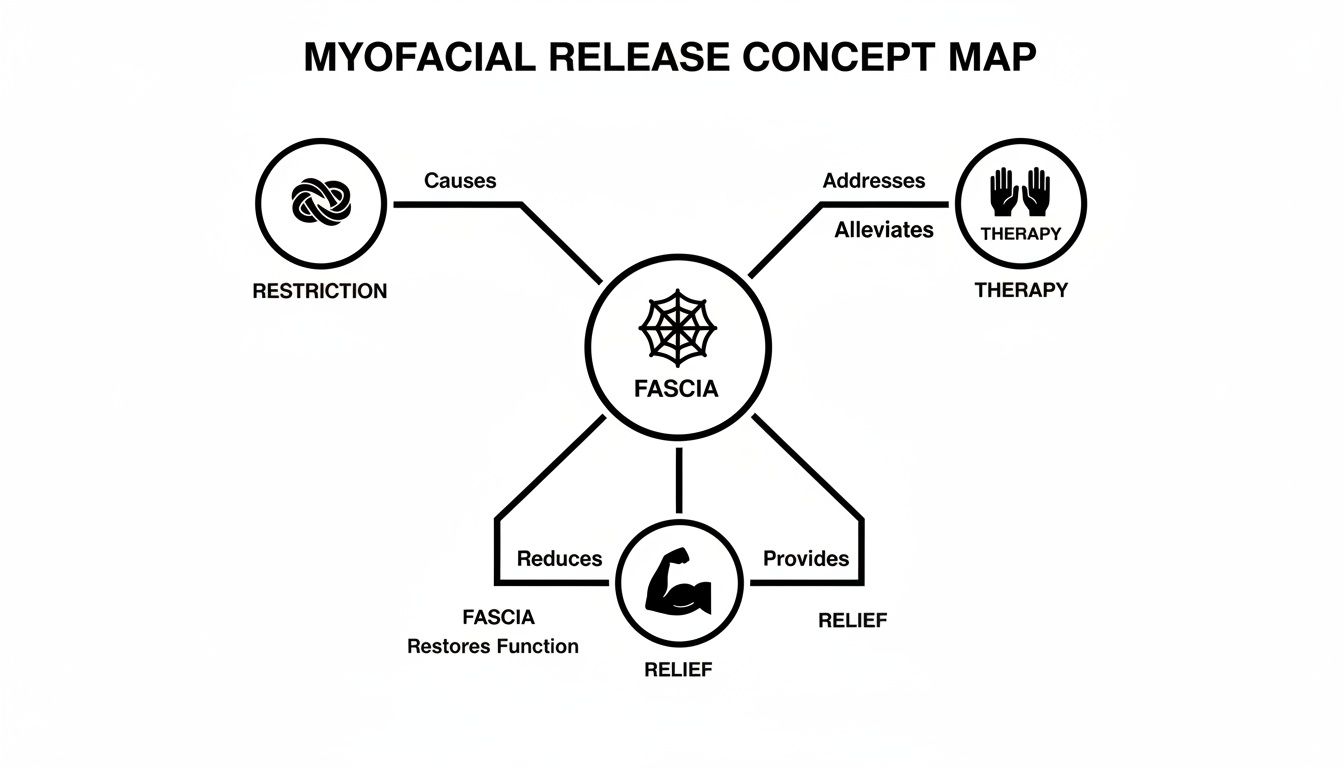
As you can see, those restrictions are a direct source of pain and lost mobility. The only way to get lasting relief is to release them.
How Fascial Restrictions Hold You Back
Beyond just causing pain, these restrictions physically limit what your body can do. When fascia gets tight, a few key things happen:
- You Lose Range of Motion: Stiff fascia basically acts like an internal straitjacket. It physically stops your joints and muscles from moving through their full, natural range.
- Nerves Get Pinched: Fascia wraps around your nerves. When it tightens, it can squeeze them, causing those frustrating sensations of tingling, numbness, or sharp, shooting pains.
- Your Posture Suffers: Over time, chronic tightness can pull your skeleton out of alignment, leading to postural problems that just feed back into the pain cycle.
Here's the most important takeaway: The spot that hurts isn't always the source of the problem. A therapist who understands the fascial system can trace these lines of tension back to the root cause, which is the key to getting relief that actually lasts.
Once you understand this connection, finding a real solution becomes much easier. Many of our patients find success by combining their in-clinic sessions with at-home care. A great tool for this is a foam roller, and you can learn more from our guide on how to use a PE foam roller for self-treatment. This one-two punch of professional therapy and consistent home maintenance can make a huge difference in your fascial health and finally quiet that chronic pain.
How Myofascial Release Grew Into the Therapy We Use Today
It might feel like myofascial release is a new trend, but the ideas behind it have been around for a long time. The journey from early observations to the hands-on treatment we use today is a story of curiosity, clinical breakthroughs, and a growing understanding that the body is one connected system. It was built by dedicated practitioners who saw beyond just the muscles.
While the first concepts started popping up over a century ago, the real foundation for modern myofascial therapy was laid in the middle of the 20th century, thanks in large part to Dr. Janet Travell.
The Groundbreaking Work of Dr. Janet Travell
Dr. Travell’s research completely changed how the medical world looked at muscle pain. In 1942, she was the first to use the term "trigger point," identifying these tight, irritable knots in muscle as a major source of referred pain—that's when you feel pain in one spot, but the actual problem is somewhere else.
Her work really got the public’s attention in 1955 when she treated then-Senator John F. Kennedy for his severe chronic back pain. By focusing on his trigger points, she gave him relief when other treatments had failed. This high-profile success story helped show everyone that targeting myofascial problems was a legitimate and powerful way to treat pain.
In 1983, Dr. Travell and her colleague David Simons published their landmark book, Myofascial Pain and Dysfunction – The Trigger Point Manual. This became the go-to guide for clinicians, laying out exactly how to diagnose and treat trigger points and solidifying their role in pain management.
The Holistic Approach of John F. Barnes
Building on that foundation, physical therapist John F. Barnes took things a step further in the 1970s and 1980s. He’s widely seen as the main founder of the modern myofascial release therapy approach that’s now used all over the world. Barnes took Travell's ideas and wrapped them in a more holistic, patient-first model.
He was a major advocate for using gentle, sustained pressure to engage the fascia and allow for a true, lasting release. His method looks at the entire body as a single connected unit, recognizing that our emotional history and physical injuries are often held in our fascial network. This turned the technique from a simple mechanical fix into a therapy that addresses the whole person. If you'd like to dig deeper, you can find a great timeline on the evolution of myotherapy.
Conditions That Can Improve With Myofascial Release
Myofascial release can provide relief for a surprising range of issues, well beyond what you might think of as simple muscle soreness. Because it works on that interconnected web of fascia, the benefits can show up all over the body. It’s a powerful tool for both long-term chronic conditions and sudden injuries.
People who have been struggling with persistent pain—the kind that just doesn’t seem to respond to anything else—often find success with this approach. Instead of just chasing symptoms, it gets to the root cause by releasing those deep, stuck tension patterns that pull the body out of alignment.
Common Conditions We See Improve
Myofascial release has become a go-to technique for physical therapists and chiropractors because it works so well for so many different musculoskeletal problems. It's especially effective when tight, restricted connective tissue is a big part of the picture.
Some of the most common issues that get better with MFR include:
- Chronic Low Back Pain: Releasing the tight fascia in the lower back can dramatically reduce the strain and stiffness that lead to those constant aches.
- Recurring Headaches and Migraines: By targeting fascial restrictions in the neck, shoulders, and upper back, we can ease the pulling that so often triggers tension headaches.
- Fibromyalgia: The gentle, sustained pressure of MFR makes it a great option for fibromyalgia. It helps ease the widespread pain and tenderness without causing a flare-up.
- TMJ Disorders: Releasing tightness in the jaw, head, and neck can decrease pain, calm inflammation, and improve how well your jaw moves.
- Carpal Tunnel Syndrome: By working on fascial restrictions in the arm, wrist, and hand, MFR can reduce the nerve compression that causes pain and numbness.
- Plantar Fasciitis: This therapy can ease the sharp heel pain of plantar fasciitis by releasing tightness in the fascia of the foot and even up into the calf.
What Does the Science Say?
The clinical evidence for myofascial release is growing, and it's showing real value in both pain management and rehab. While everyone agrees that more large-scale studies are needed, the research we have is very promising.
For instance, studies on self-myofascial release (like foam rolling) show it can effectively reduce that next-day muscle soreness (DOMS) after a workout, and it does so without hurting athletic performance. A major review in 2015 acknowledged its benefits in the clinic, concluding it was time for the scientific evidence to catch up to its widespread use.
This makes it a low-risk, high-reward option for many people. It's not just for chronic pain, either; it's also fantastic for speeding up recovery from sports injuries and improving how you move.
For anyone involved in sports or intense physical activity, myofascial release can be one of the best recovery tools for athletes. By improving how well your tissues stretch and increasing blood flow, it helps your muscles heal faster and gets your body ready for the next challenge. It’s a key piece of any complete wellness and training plan.
What to Expect During Your First Session
Stepping into a new type of therapy can feel a little uncertain, but knowing what to expect can make all the difference. Your first myofascial release session is more than just a treatment; it's a partnership between you and your therapist to uncover the real source of your discomfort.
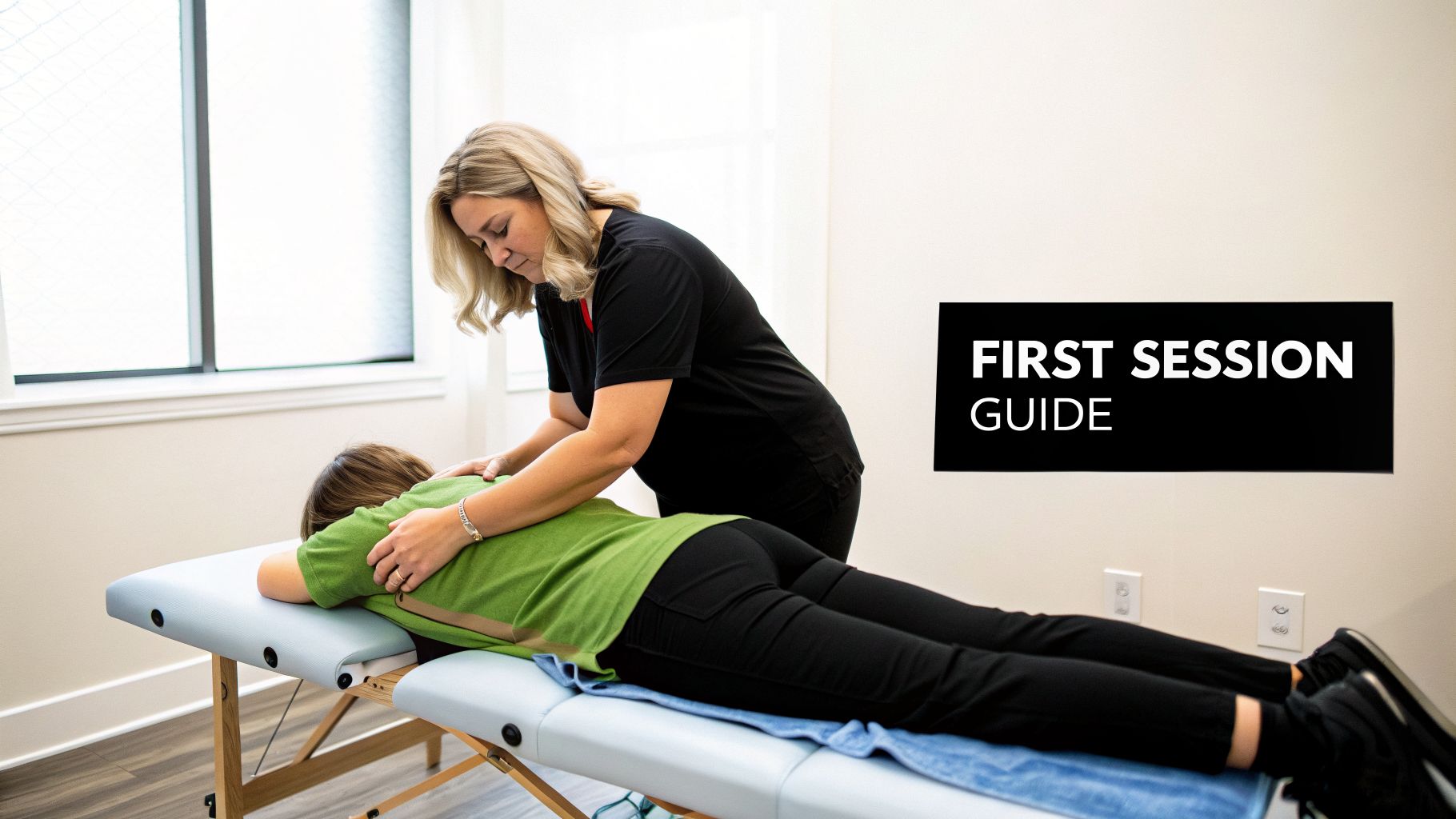
We’ll always start with a conversation. We want to hear about your medical history, your symptoms, and what you hope to achieve. From there, we move into a hands-on evaluation.
The Initial Assessment
First, your therapist will simply watch how you move. They’ll observe your posture as you stand and sit, looking for asymmetries or strain patterns that hint at where fascial restrictions might be hiding.
Next comes palpation. This is where the therapist uses their hands to gently feel for tight, hardened, or tender areas in your soft tissue. This skilled touch helps them map out the exact spots where the fascia is stuck—which often aren't even the places where you feel the most pain.
Hands-On Treatment
Once we’ve identified the restricted areas, the hands-on myofascial release therapy can begin. Your therapist will apply slow, sustained pressure directly onto the tight tissue. This isn’t like a typical massage with rubbing or kneading; it’s a gentle but firm hold.
The pressure is held for at least 90-120 seconds, and sometimes longer.
This extended hold is the key. It gives that stiff, dehydrated fascia the time it needs to finally respond, soften, and lengthen. You might feel a gentle stretch, a bit of warmth, or a sensation of the tissue "melting" under the therapist's hands.
Communication is important here. You may feel a "therapeutic discomfort" as the tissue releases, but it should never be sharp or intensely painful. Always let your therapist know how you're feeling.
After the Session
Your body needs a little time to adjust to its new mobility. Here are a couple of things you can do to help the process along:
- Hydrate, Hydrate, Hydrate: Drinking plenty of water is a must. Releasing the fascia gets your circulation moving, and water helps flush out metabolic waste while rehydrating the tissue.
- Expect Some Mild Soreness: It’s totally normal to feel a bit sore or tired for a day or two, much like you would after a good workout. This is just your body adjusting and healing.
Knowing the flow of a session helps you relax and get the most from your treatment. To see how this fits into a larger recovery plan, you can learn more about what a typical physical therapy session looks like on our blog.
Your Path to Pain Relief in Deerfield Beach
Knowing why you hurt is one thing, but knowing what to do about it is what really matters. For our neighbors here in Deerfield Beach, that's where we come in. At MedAmerica Rehab Center, our goal is to help you move from understanding your pain to actually finding lasting relief.
We believe that real results come from care that looks at the whole person, not just one technique.

Here, myofascial release isn't just a separate service. We see it as one powerful tool in a complete plan we build just for you, combining it with other therapies to get to the root of the problem. Our hands-on approach is all about helping you find relief without pills or invasive procedures.
Your First Step Toward Recovery
Since 1995, our team has helped thousands of patients get back on their feet after everything from car accident injuries to nagging chronic back pain. Our method is simple: we listen to your story, figure out what's really going on, and create a straightforward plan to get you moving freely again.
Getting started with us is easy and designed to be stress-free. Here’s what you can expect:
- Schedule Your First Visit: Just call our office to book an initial evaluation. Our friendly staff will find a time that works for you.
- We'll Handle the Insurance: Don’t worry about the paperwork. Our team is here to help you make sense of your insurance benefits so there are no surprises.
- Create Your Plan: During your first appointment, we'll do a full assessment, explain what we find in plain language, and map out a clear treatment plan that’s focused on your goals.
At MedAmerica Rehab Center, our mission is to provide compassionate, results-focused care that helps our neighbors feel better, move better, and get back to the activities they love.
We’re committed to offering the best possible care right here in our community. If you’re ready to finally address the source of your pain, take a look at our detailed guide to physical therapy in Deerfield Beach and give us a call to book your appointment today.
Frequently Asked Questions About Myofascial Release
It’s completely normal to have a few questions when you’re considering a new type of therapy. To help you get a clearer picture, we’ve put together answers to some of the most common things we’re asked by our patients here in Deerfield Beach.
How Is This Different From a Deep Tissue Massage?
While they both can make you feel better, they're worlds apart in their approach. A deep tissue massage is all about forceful, faster strokes that dig into muscle knots. Myofascial release therapy is different. It uses gentle, sustained pressure on the fascia—the web of connective tissue—for several minutes at a time.
Imagine you're working with taffy. A deep tissue massage is like aggressively kneading it. Myofascial release is like slowly and patiently stretching that taffy until it finally softens and lengthens. We’re not trying to force the tissue; we’re giving it the time and space it needs to let go on its own.
How Many Sessions Will I Need?
This is the big question, and the honest answer is: it depends. Every person and every injury is different. Someone with a minor, recent issue might feel a world of difference after just a handful of sessions. But if you’ve been dealing with chronic pain for years, it will likely take a longer series of treatments to work through those deeper, long-standing restrictions.
During your first visit, we'll talk through your history, your symptoms, and what you want to achieve. From there, your therapist will map out a personalized plan, so you’ll have a clear idea of what to expect from the start.
Is Myofascial Release Painful?
This is a really common and understandable worry. Myofascial release shouldn't be intensely painful. What you’ll probably feel is a gentle stretching or a deep pressure, something many people call a "good hurt" or a feeling of therapeutic discomfort. That’s the sensation of tight, stuck fascia finally beginning to release.
Communication is everything. Your therapist will always check in with you and work within your comfort level, adjusting their pressure to make sure the session is both effective and comfortable. Our goal is to relieve tension, not create more of it.
At MedAmerica Rehab Center, our team is always here to answer any other questions you might have. If you’re in the Deerfield Beach area and ready to see how myofascial release could work for you, book your consultation with us today at https://www.medamericarehab.com.