

Expert Chiropractic Care After Car Accident
A lot of people walk into our office saying the same thing. “I thought I was fine at first.”
That makes sense after a crash. You deal with the police report, the damage to the car, calls from insurance, and the rush of getting home. Then later that day, or the next morning, your neck feels tight, your lower back starts aching, or turning your head suddenly feels harder than it should.
That is often how post-accident injuries show up. Not as instant, dramatic pain, but as stiffness, headaches, soreness, fatigue, and a general sense that your body is not moving normally. If you are looking for chiropractic care after car accident, the most important thing to know is this. Waiting and hoping it settles down is often what turns a manageable injury into a longer recovery.
The Unseen Aftermath of a Car Accident
You get home after a crash, answer a few insurance calls, and tell yourself you were lucky. Then the next morning, your neck does not turn normally, your head feels heavy, and sitting in the car suddenly hurts.
I see that pattern often at MedAmerica Rehab Center. The first problem after a collision is not always intense pain. It is the gap between the accident and the moment your body starts showing you what it absorbed.
Why “I feel okay” can be misleading
In the first hours after an accident, people usually focus on the obvious concerns. Is anyone bleeding? Can the car move? Do I need emergency care right now?
Those questions matter, but they do not answer a different question. Did the crash strain the joints, muscles, and ligaments enough to create problems over the next several days?
A 2008 study found that people with whipllash-associated disorders who received care sooner had better outcomes than those whose treatment was delayed (study on post-MVA chiropractic outcomes). In practice, that matches what we see. The longer irritation, guarding, and restricted motion are left alone, the harder recovery can become.
There is also a practical reason to get checked early in Florida. Timely evaluation helps create a clear medical record, which matters if you plan to use PIP benefits or need to show how your symptoms developed after the wreck.
What patients often brush off in the first few days
Early symptoms are easy to dismiss because they do not always feel dramatic. They still matter.
- Neck stiffness: Common after the head and neck are thrown forward and back.
- Headaches: Often start at the base of the skull or show up later in the day.
- Low back pain with sitting or driving: A frequent sign that the body is not moving normally after impact.
- Pain between the shoulder blades: Often shows up after bracing during the collision.
- A general sense that something feels off: Many patients describe this before they can name a specific pain pattern.
Severe pain is not required before an evaluation makes sense.
If you are trying to sort out both the health side and the first legal steps, this guide on what to do after a car accident can help you organize the basics while events are still fresh. You should also review common hidden injury symptoms after a car accident so small warning signs do not get missed.
The goal at this stage is simple. Get the injury evaluated, document what changed, and avoid losing time that can affect both recovery and your claim.
Why Your Body Needs More Than Just Rest
A few days after a crash, many patients tell me the same thing. “I thought I just needed to take it easy.” That sounds reasonable, especially if the ER ruled out a fracture and the pain feels manageable. The problem is that rest only reduces activity. It does not correct the way an impact can disrupt joint motion, strain supporting ligaments, and trigger muscle guarding.
After a car accident, the body often shifts into a protective pattern. Muscles tighten to limit movement. Joints stop moving as smoothly as they should. Simple tasks like checking a blind spot, sitting at a desk, or getting comfortable in bed start to feel harder, even if the pain is not severe.
Rest helps soreness. It does not restore normal movement.
That distinction matters.
If your neck, back, or shoulders are moving differently after the collision, lying low for a few days may calm the area without fixing the underlying mechanical problem. I see this often after rear-end crashes and side impacts. Patients can still function, but they are doing it with compensation. One area stiffens. Another starts overworking. Headaches, pulling between the shoulders, and pain with driving usually follow.
Whiplash is a common example. It is not just “neck pain.” It is a force injury that can affect muscles, ligaments, joints, and the way the cervical spine moves. Symptoms also do not always peak right away. The Mayo Clinic notes that whiplash symptoms may appear within days of the injury, not only at the scene of the crash (Mayo Clinic overview of whiplash symptoms and causes).
Soft tissue injuries are easy to underestimate
A normal X-ray does not mean your body absorbed the crash without damage.
Many post-accident complaints come from soft tissue injury. That includes strained muscles, irritated ligaments, and inflamed joints. These problems can be painful, stubborn, and disruptive even when imaging does not show a dramatic finding. Patients often hear “nothing is broken” and assume they should wait it out. Then two weeks pass, and turning the head, sleeping on one side, or sitting through a commute still hurts.
Here is the practical concern. If the area stays inflamed and restricted, your body starts adapting around it instead of healing through it.
| Injury pattern | What you may notice | What can happen if it lingers |
|---|---|---|
| Muscle strain | Tightness, spasm, soreness with activity | Ongoing guarding and limited motion |
| Ligament irritation | Sharp pain with certain movements, a sense of instability | Repeated flare-ups and stiffness |
| Joint restriction | Pain when turning, bending, or sitting too long | Compensation in nearby muscles and joints |
| Scar tissue formation | Pulling, reduced flexibility, lingering tenderness | Stiff movement and chronic irritation |
Waiting too long creates two problems
The first problem is physical. Restricted joints and guarded muscles can settle into a pattern that is harder to correct later.
The second problem is documentation. In Florida, timing matters if you plan to use Personal Injury Protection benefits. Delaying care can blur the connection between the crash and the symptoms you developed after it. Even if you were trying to be tough or hoped the pain would pass, gaps in treatment can create questions that are avoidable with prompt evaluation and clear records.
That does not mean every sore muscle needs weeks of treatment. It means the injury should be assessed early, the findings should be documented, and the care plan should match what your body is doing.
What chiropractic care addresses after a crash
The goal is not to make you feel better for a few hours.
A chiropractor checks whether the accident changed how the spine and surrounding joints move, where muscles are overprotecting the area, and whether inflammation is altering normal movement patterns. Treatment is designed to reduce irritation, improve motion, and help the body heal in a more normal way. That may include manual treatment, guided exercises, soft tissue work, and activity advice based on how you respond.
Pain relief matters. Function matters just as much.
After a crash, the better question is not only how much it hurts today. The better question is whether your body is recovering cleanly, or covering up a problem that still needs attention.
Your First Chiropractic Visit Demystified
Most new patients are not nervous about the treatment itself. They are nervous about not knowing what will happen.
A first visit for chiropractic care after car accident should feel organized, thorough, and easy to follow. You should not feel rushed. You should not feel pressured into treatment before you understand what the doctor found.

The conversation comes first
The first part of the visit is not the adjustment. It is the history.
We need to know how the accident happened, where the impact came from, whether airbags deployed, whether you hit your head, and how your symptoms have changed since the crash. We also ask about any prior neck pain, back pain, arthritis, or old injuries because those details shape the exam.
You may be asked questions such as:
- Where do you feel pain most clearly
- What movements make it worse
- Did symptoms start immediately or later
- Do you have headaches, numbness, tingling, or weakness
- Have you already seen the ER, urgent care, or another provider
Those questions are not paperwork for its own sake. They help connect the mechanism of the accident to the pattern of your symptoms.
The physical exam is specific, not guesswork
Once we hear your history, the exam helps confirm what structures may be involved.
A post-accident chiropractic exam often includes:
- Range of motion testing: How far you can turn, bend, or extend without pain
- Palpation: Checking for tender spots, muscle spasm, and joint restriction
- Posture and movement analysis: Looking for guarding, shifting, or imbalance
- Orthopedic testing: Stressing certain areas in controlled ways to identify likely injury patterns
- Neurological screening: Checking reflexes, sensation, and strength where appropriate
If something in your presentation suggests you need a different level of care, that should be addressed immediately. Good clinical judgment matters as much as hands-on skill.
You should leave understanding the plan
The right first visit ends with clarity.
You should know:
- What the likely injury pattern is
- What kind of care is appropriate
- What the first phase of treatment is trying to accomplish
- What warning signs would change the plan
A patient-centered office explains findings in plain English. If your neck is restricted, your upper back is compensating, and your headaches are likely tied to that pattern, you should hear exactly that.
Later in the visit, many patients appreciate seeing a simple overview like this before treatment starts:
Consent matters
No treatment should feel automatic. Even if chiropractic is appropriate, you should know what is being recommended and why.
That may include an adjustment on the first day. In other cases, a clinic may begin with gentler work, soft tissue care, mobility work, or a shorter initial treatment depending on your pain level and presentation.
A good first visit reduces uncertainty. You should leave knowing what was found, what will be worked on first, and what progress should look like.
How Chiropractic Treatment Accelerates Healing
Treatment after a crash works best when it targets three problems at once. Joints stop moving well. Muscles tighten to protect the area. The body starts using poor movement patterns because pain changes how you move.
Chiropractic treatment addresses those layers together rather than treating pain as a single symptom.
Gentle adjustments restore motion
A spinal adjustment is used to improve joint motion in areas that became restricted after impact.
When a spinal joint is not moving properly, nearby muscles often tighten and the irritated area becomes more sensitive. Restoring motion can reduce that irritation and help the nervous system stop treating normal movement as a threat.
One cited report states that 43% of motor vehicle accident patients receiving chiropractic care achieved significant neck pain reduction, compared with 18% in standard medical care groups (reported comparison of neck pain outcomes after MVA care).
That does not mean every patient needs the same technique. Some do well with a traditional manual adjustment. Others need a gentler approach at the start because the tissue is too reactive.
Soft tissue work helps the strained parts heal better
A crash does not only affect joints. It often leaves the muscles around the neck, shoulders, and low back tight, tender, and protective.
Soft tissue treatment may include hands-on muscle work, myofascial release, trigger point work, or instrument-assisted techniques depending on the case. The purpose is simple. Reduce tension, improve tissue mobility, and make it easier for the body to move without guarding.
That matters because guarded muscles can keep pulling the body back into the same painful pattern even after the joint starts moving better.
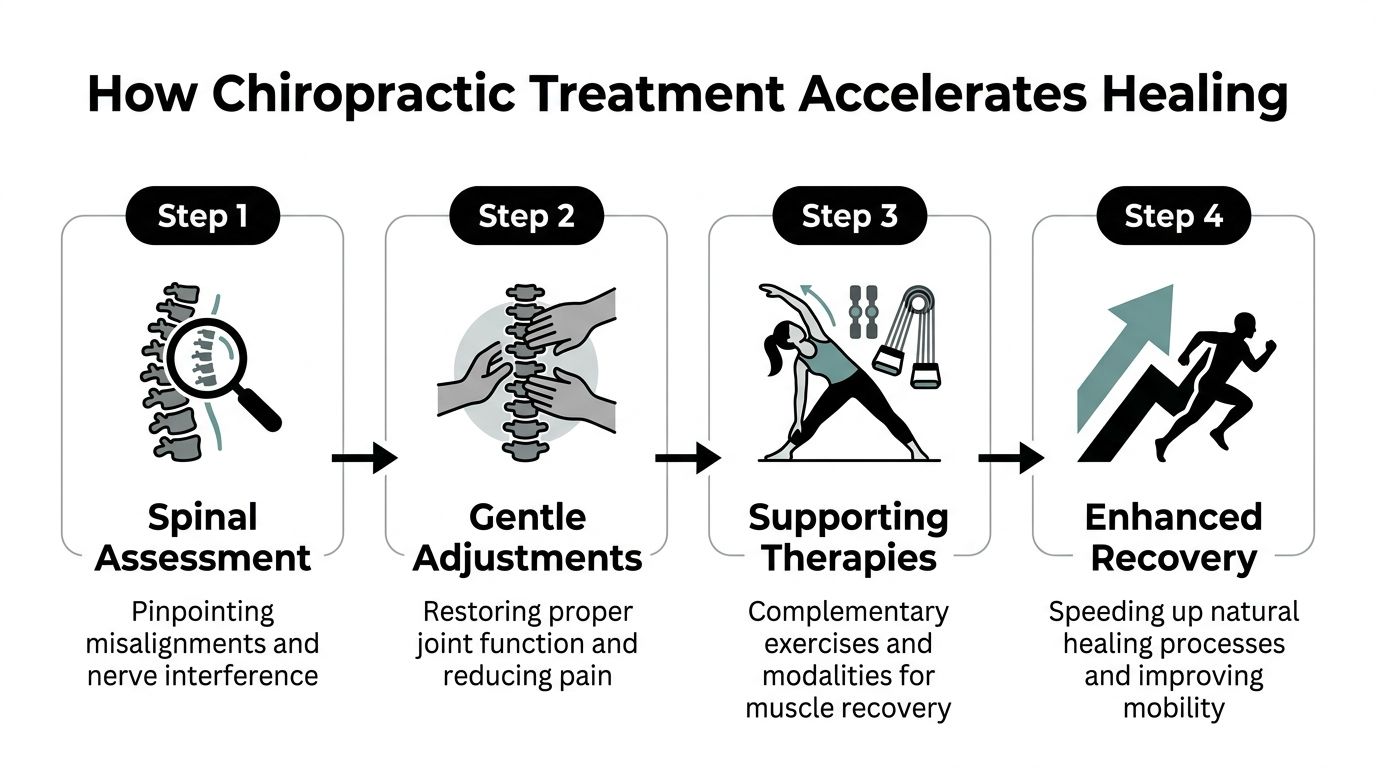
Rehab exercises keep the progress from disappearing
An adjustment can improve motion. Soft tissue care can reduce tension. But if weak or poorly coordinated muscles are not retrained, the body often slides back into the same compensation pattern.
That is why accident care often includes targeted exercise.
A treatment plan may use:
- Neck stabilization work for people with whiplash-type symptoms
- Scapular and upper back exercises when shoulder blade mechanics are poor
- Core and pelvic control drills when low back symptoms persist
- Mobility homework to maintain gains between visits
This combination is one reason many patients do better with integrated care than with a single passive treatment approach. If you want a broader view of how these therapies work together, MedAmerica has a useful page on the benefits of chiropractic and physical therapy.
What works and what usually does not
Not every approach is equally effective after a car accident.
What tends to work well
- Early evaluation: It catches movement problems before they become habits.
- A customized plan: Neck-dominant injuries and low-back-dominant injuries do not respond to identical care.
- Active participation: Home exercises and posture changes support what happens in the office.
- Reassessment: The plan should change as symptoms change.
What usually falls short
- Only waiting it out: This can leave the root problem untouched.
- Pain medication alone: It may lower symptoms without improving function.
- Generic stretching from the internet: The wrong exercise can aggravate a fresh injury.
- Stopping care the moment pain drops: Feeling better and moving normally are not always the same thing.
The purpose of treatment is not just to make pain quieter. It is to help your body heal in a stable pattern so the same symptoms do not keep returning.
Navigating Florida Auto Insurance and Injury Claims
Many accident patients are not only worried about pain. They are worried about paperwork, bills, adjusters, and whether getting care will become another problem to manage.
That concern is reasonable. A good recovery plan in Florida has to address both the clinical side and the claim side.
Why timing matters for Florida drivers
Florida uses Personal Injury Protection, usually called PIP. One practical point is often underestimated. You need to seek treatment within the required time window after the accident if you want to preserve access to those benefits.
Missing that window can create financial problems on top of physical ones. That is why early evaluation matters even when symptoms still feel mild.
If you want a plain-language overview of policy basics, deductibles, and coverage concepts, this guide to Car Insurance in Florida can help you understand the insurance side before you start making calls.
Documentation is not a formality
For an injury claim, your medical record needs to tell a clear story.
That usually includes:
- How the accident happened
- When symptoms began
- What areas were injured
- What findings were present on exam
- How function was affected
- What treatment was provided
- How your condition changed over time
Weak documentation creates problems. It can make a real injury look vague. It can also make an adjuster question whether the crash caused the symptoms.
Strong documentation does the opposite. It creates a timeline that connects the collision, the exam findings, the treatment plan, and your progress.
What patients should bring and track
You do not need to become your own case manager, but a little organization helps.
Bring or keep track of:
| Item | Why it matters |
|---|---|
| Accident date and basic details | Establishes the treatment timeline |
| Claim number and insurance information | Helps the clinic verify and coordinate benefits |
| ER or urgent care paperwork | Adds context to the initial record |
| A symptom log | Shows how pain, headaches, sleep, or mobility change day to day |
| Imaging reports if you have them | Helps all providers work from the same information |
Coordinating care without getting overwhelmed
Patients often ask whether they need to talk to the adjuster, the lawyer, and the clinic separately. In practice, yes, there may be several moving parts. But the process is easier when each party gets consistent information.
Use these rules:
- Be accurate, not dramatic. Describe what you feel and what you cannot do.
- Do not minimize symptoms. Many people downplay injuries early and regret it later.
- Keep dates straight. Gaps and inconsistencies can complicate claims.
- Attend scheduled visits. Missed care can make the injury look less serious than it is.
If you are looking for a local overview of treatment and claim-related care pathways, this page on auto accident rehabilitation is a practical reference.
A clinic may also help by maintaining complete notes, tracking progress, and coordinating records when attorneys or insurers request them. Among local options, MedAmerica Rehab Center provides chiropractic and rehabilitation services for auto accident patients and works within insurance-driven care processes in Deerfield Beach.
Good documentation protects two things at once. Your recovery plan and your ability to show what the accident caused.
Your Recovery Roadmap From Injury to Wellness
The day after a crash often surprises people. You may be able to get through work, answer emails, and drive short distances, then realize by evening that your neck has tightened, your back is aching, and a simple turn of the head feels restricted.
That pattern is common. Recovery usually happens in stages, and each stage has a different goal. Knowing that helps you judge progress more accurately and avoid stopping care too soon or pushing activity too fast.

Phase one is calming the injury down
Early care focuses on reducing pain, easing muscle tension, and restoring basic movement so everyday tasks feel manageable again.
In practice, this stage often includes gentle treatment, activity guidance, and a short-term plan for sitting, sleeping, driving, and work duties. Some patients improve quickly. Others need more time because inflammation, muscle guarding, headaches, or low back pain keep getting stirred up by normal routines.
This is also the stage where good records matter. Symptom changes, work limits, missed activities, and exam findings should be documented clearly from the start. In Florida, that paper trail can matter for your claim almost as much as it matters for treatment decisions.
Phase two is rebuilding stability
Pain relief is progress. It is not the finish line.
A patient may report that pain is down by half, but still cannot sit through a commute, lift comfortably, or sleep through the night without waking up sore. That tells me the body is improving, but it still lacks the consistency needed for normal life.
Signs you are still in this phase include:
- Long drives bring symptoms back
- Desk work or work posture still causes flare-ups
- You move better, but certain motions still feel stiff or guarded
- Headaches are less frequent, but still present
- You can do daily tasks, but pay for it later that day
This middle stage often determines whether recovery holds or slips backward. It is also where missed appointments, doing too much on a good day, or stopping home exercises can slow progress.
Phase three is returning to normal function
The goal here is durability.
Treatment usually becomes less about getting through the day and more about making sure your body can handle normal demands without repeated setbacks. That may mean improving range of motion, tolerating longer periods of sitting or standing, and returning to exercise, child care, or job tasks with less fear of flare-ups.
For some patients, discharge is appropriate once function is back and symptoms have settled. For others, especially those with prior neck or back problems, a few follow-up visits help confirm that progress is holding.
What helps at home
Office treatment works better when home habits support it.
Use these strategies if they fit your case:
- Ice an area early if it feels hot, swollen, or freshly aggravated
- Use heat for muscle tightness if it helps you move more comfortably
- Change positions often if sitting or driving increases pain
- Set screens at eye level to reduce extra strain on the neck
- Use pillows or supports that keep your neck and low back in a neutral position
- Stick to the exercises given for your injury, instead of trying random stretches from the internet
The best home plan is the one you can repeat consistently and that matches the actual injury pattern.
Protecting both recovery and your claim
Patients in Florida often ask when treatment becomes part of the insurance process. The answer is, right away.
Each visit should show what symptoms you reported, what improved, what still limits you, and whether your daily function is changing. Those details help your chiropractor adjust care. They also help show that your complaints were consistent after the accident, which can matter if the insurer questions the severity or duration of the injury.
Keep it simple. Save visit summaries, follow the treatment plan, and report changes accurately. If pain is improving but headaches remain, say that. If you returned to work but cannot tolerate a full shift without symptoms, say that too. Clear, steady documentation supports both your medical recovery and the practical side of a PIP claim.
Red flags that need urgent medical attention
Some symptoms need emergency evaluation rather than chiropractic follow-up.
Seek urgent medical care if you develop:
- A severe headache that is unusual or getting worse quickly
- Loss of strength in an arm or leg
- Numbness that is spreading or does not let up
- Loss of bladder or bowel control
- Confusion, fainting, or major balance changes
- Chest pain or shortness of breath
Those symptoms need immediate medical attention.
Common Questions About Post-Accident Chiropractic Care
Is chiropractic care safe after an accident
It can be, if the doctor screens you properly first.
Safe post-accident care starts with the right questions, a hands-on exam, and a clear decision about whether chiropractic treatment fits your injuries. Some patients are good candidates for gentle manual care early on. Others need imaging, co-treatment, or referral before any adjustment is considered. A careful chiropractor does not force treatment into a standard routine.
Can I see a chiropractor if I already went to the ER
Yes. That happens all the time.
The ER checks for fractures, bleeding, head injury, and other urgent problems. Once those immediate risks are ruled out, many patients still have neck pain, back pain, headaches, stiffness, or muscle spasm that make work and driving difficult. That is often the stage where chiropractic and rehab care help restore motion and function.
Bring your discharge papers if you have them. They help connect the timeline of the crash, the ER findings, and the symptoms that continue after you get home.
What if I need a lawyer
You can still start treatment.
In Florida accident cases, medical care, PIP insurance, and legal questions often move at the same time. The practical priority is getting evaluated promptly and keeping your records accurate from the start. If an attorney becomes involved later, clear visit notes, consistent attendance, and honest symptom reports usually help far more than trying to reconstruct everything weeks later.
What if I had a pre-existing condition like arthritis
That matters, but it does not rule out care.
A crash can aggravate an older neck or back problem, and that changes both the treatment plan and the documentation. In my office, the goal is to identify what was already there, what changed after the accident, and which daily activities are now harder because of that change. That distinction can matter for your recovery and for an insurance claim.
Will I get adjusted on the first visit
Sometimes. Sometimes not.
That choice depends on your exam, your pain level, and how your body is responding that day. If the area is too inflamed or guarded, treatment may start with gentler methods, soft tissue work, or guided exercises. If an adjustment is appropriate, it should feel like a clinical decision based on your findings, not a sales routine.
How do I know if treatment is working
Pain level is only part of the answer.
Real progress shows up in daily function. You may turn your head with less restriction, sit through a work shift with fewer flare-ups, sleep better, or get through a drive without a headache building by mile ten. Your records should track those changes over time because they guide treatment decisions and help document how the accident affected your life.
How soon should I get checked after a Florida car accident
Sooner is better.
Florida PIP rules have deadlines that can affect access to benefits, and delayed care also makes it harder to document when symptoms began and how they progressed. Even if the pain seems mild at first, an early evaluation creates a starting point for both treatment and claim records. That is one of the steps many accident guides leave out, but it matters in real cases.
If you have been in a crash and your body still does not feel right, MedAmerica Rehab Center is one place to start. The clinic provides chiropractic care, physical therapy, and related rehabilitation services for auto accident injuries in Deerfield Beach, with same-day appointment availability and an insurance-friendly process that helps patients begin care without added confusion.