

9 Carpal Tunnel Syndrome Relief Options
Carpal tunnel syndrome relief doesn't always begin with an injection or an operation. A neutral wrist splint, better pacing, and guided rehabilitation may reduce irritation around the median nerve, especially when symptoms are mild and linked to sleep position or repetitive hand use. That matters because carpal tunnel syndrome is widespread. A 2024 systematic review pooling 30 studies and 5,311,785 people estimated worldwide prevalence at 14.4%, with regional estimates of 11.4% in low- and middle-income countries and 16.9% in high-income countries (systematic review of global prevalence).
Nighttime tingling, numb fingers, dropping objects, hand weakness, and work-related strain all deserve a plan rather than isolated pain relief. The practical progression below moves from low-risk daily changes and splinting to therapy, complementary options, injections, and surgical evaluation. You can often combine approaches, but the right combination depends on symptom severity, examination findings, and whether the nerve is improving.
Seek professional assessment if numbness becomes persistent, weakness worsens, the thumb muscles begin to waste, or symptoms don't improve with sensible changes. A clinician can also check whether another nerve, the neck, arthritis, or a different condition is causing your symptoms.
1. Wrist Splinting and Immobilization
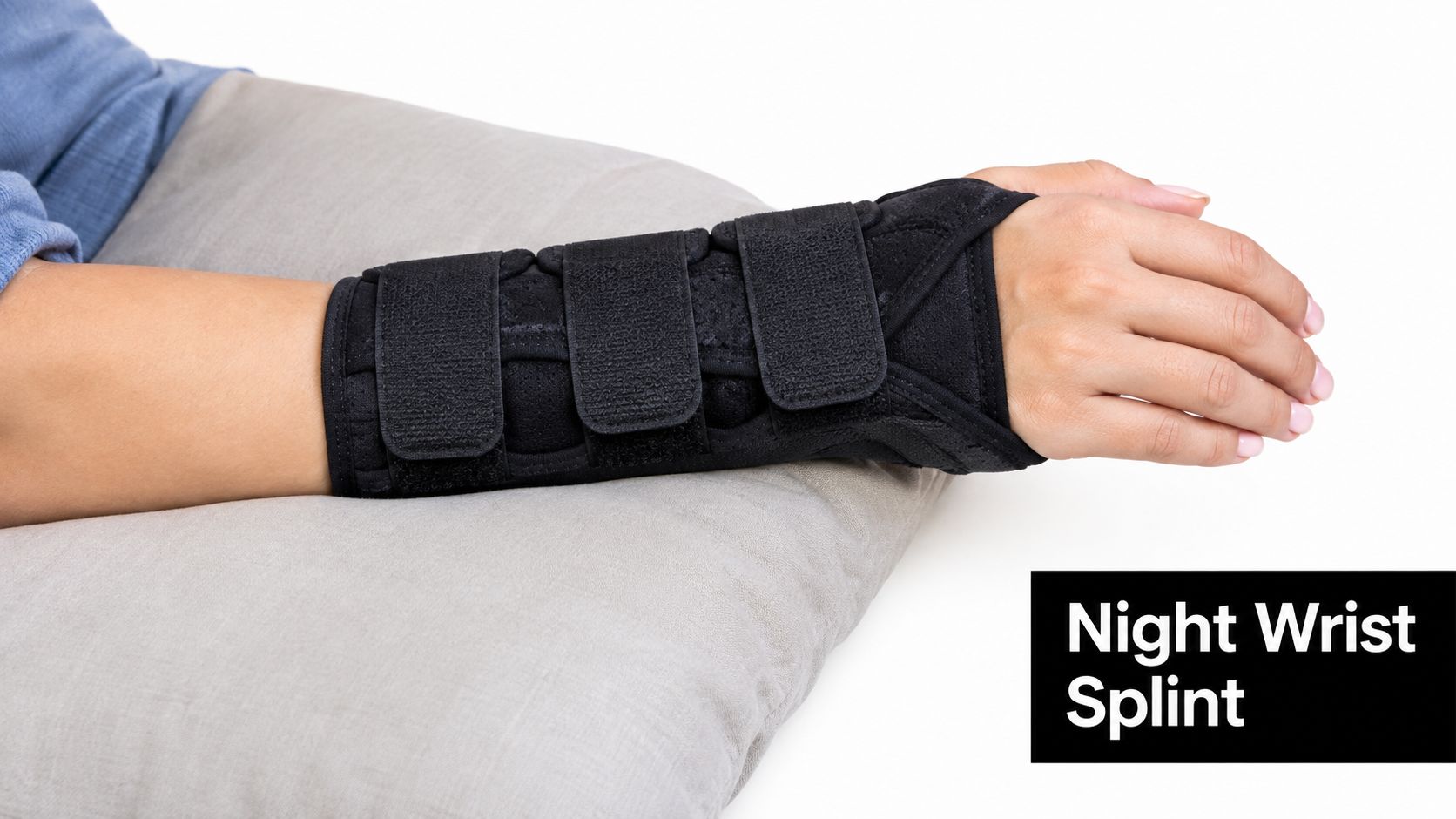
A wrist splint works by keeping the wrist near a neutral position, particularly while you sleep. That position can reduce repeated bending and limit pressure on the median nerve. For many people with nighttime tingling, a properly fitted night splint is the most practical first step because it's simple, relatively low risk, and doesn't require medication.
Evidence is more measured than many advertisements suggest. A Cochrane review included 19 randomized studies with 1,190 participants and found limited short-term benefit from splinting compared with no treatment. A later Cochrane summary estimated that the absolute chance of overall improvement might be about 9% to 16% better with a splint, with a number needed to treat of 2 in some analyses (Cochrane evidence on splinting). In practice, that supports trying a night splint, while setting realistic expectations about long-term relief.
Make the splint comfortable
Choose a brace that supports the wrist without squeezing the hand or restricting circulation. Loosen it if your fingers become cold, pale, swollen, or more numb. Daytime wear may help during a provoking task, but continuous immobilization can make the wrist stiff and may interfere with normal movement.
Use splinting alongside activity changes rather than treating it as a complete solution. A therapist can help determine whether a prefabricated brace is sufficient or whether a custom-fitted design would provide better positioning. MedAmerica's guide to treating carpal tunnel without surgery also describes how splinting can fit into a broader rehabilitation plan.
Practical rule: Start with nighttime use if you're unsure about daytime tolerance. Stop and seek advice if the brace increases numbness or causes skin problems.
2. Ergonomic Assessment, Activity Modification, and Pacing Strategies
A splint can't offset eight hours of forceful gripping or a workstation that keeps your wrists bent. Ergonomic care starts by identifying the movements, positions, and loads that provoke symptoms, then changing the task rather than just telling you to “rest.”
During computer work, keep the keyboard and mouse close enough that your elbows stay near your sides. Your wrists should remain relaxed and generally neutral, without pressing hard into the desk edge. A vertical mouse, an ergonomic keyboard, or voice-input software may reduce the amount of sustained wrist and finger activity, but no device works if it creates a new awkward posture.
Change the task before pain escalates
Pacing means alternating demanding activities with lighter ones. Someone who types, uses tools, and lifts objects should avoid placing all of those tasks in one uninterrupted block. A musician might shorten practice segments and use a gradual warm-up. A warehouse worker may need task rotation, modified gripping, or a conversation about tool vibration and force.
Useful changes include:
- Track triggers: Note which tasks bring on tingling, how long symptoms last, and whether they disturb sleep.
- Protect neutral alignment: Keep the wrist from remaining flexed while typing, driving, reading, or sleeping.
- Vary hand demands: Rotate tasks when possible so the same tendons and nerve aren't repeatedly stressed.
- Build recovery pauses: Use brief movement breaks before symptoms become intense, not only after pain arrives.
An ergonomic assessment is especially valuable when symptoms began after a new job, tool, keyboard, sport, or hobby. It can also reveal that the wrist isn't the only issue. Shoulder position, elbow compression, and neck posture may influence how your arm tolerates repetitive work.
3. Physical Therapy and Therapeutic Exercises
Physical therapy is most useful when the program matches your examination findings. A therapist may assess wrist motion, grip, forearm flexibility, shoulder and neck mechanics, sensation, and the way you perform work tasks. Treatment can then combine gentle motion, strengthening, manual techniques, education, and changes to the activities that keep irritating the nerve.
The aim isn't to force a painful stretch or build maximal grip strength immediately. Early care often focuses on comfortable movement and reducing sensitivity. As symptoms settle, the program may progress toward forearm and hand strengthening, better load tolerance, and task-specific practice.
What a guided program can include
A therapist may prescribe tendon or nerve mobility exercises, forearm stretches, shoulder and upper-limb control work, and gradual strengthening. The exact dosage should be individualized. If an exercise causes lingering numbness, electric pain, or a clear drop in hand function, tell the therapist rather than pushing through it.
A practical home routine works best when it fits an existing habit, such as after brushing your teeth or during a scheduled work pause. Keep a record of nighttime symptoms, grip function, and tolerance for typing, cooking, driving, or tool use. That information helps the clinician decide whether the program is helping or needs adjustment.
MedAmerica provides hand physical therapy as part of its rehabilitation services. A multidisciplinary assessment can be useful when splinting and ergonomic changes have helped only partly, or when you need a plan for returning to work and daily activities.
Your exercise should leave the hand feeling worked, not increasingly numb. Rehabilitation is progressive, but it shouldn't repeatedly reproduce the symptom you're trying to calm.
4. Nerve Gliding and Mobilization Exercises
Median-nerve gliding exercises use controlled positions to encourage movement of the nerve and surrounding tissues. They're usually taught as a sequence rather than a forceful stretch. The hand, wrist, elbow, shoulder, and neck may move in a coordinated pattern, with the therapist adjusting the position to avoid excessive tension.
Technique matters. A nerve glide that feels like a strong stretch, produces sharp electrical pain, or leaves numbness worse afterward may be too aggressive. The purpose is gentle mobility, not forcing the nerve through the carpal tunnel.
Use the sequence as part of a plan
A physical or occupational therapist should demonstrate the movement and explain how often to perform it. Some people use a few gentle repetitions during work pauses, combined with a night splint and workstation changes. Others need a slower program because their nerve is highly irritable.
Nerve gliding is also not a substitute for diagnosis. If symptoms are caused by significant structural compression, a home exercise routine may provide limited relief while the underlying problem continues. Persistent weakness, loss of dexterity, or constant numbness should prompt reassessment rather than more repetitions.
For a desk worker, the most useful application may be pairing a therapist-taught glide with a change in the task that triggered symptoms. For example, the person may perform the sequence during a pause, then return to a keyboard position that keeps the wrist neutral and reduces sustained gripping. That combination addresses both mobility and the source of irritation.
Continue only while the response remains favorable. A short symptom diary can show whether gliding reduces nighttime tingling, improves tolerance for work, or merely creates temporary sensations without functional improvement.
5. Massage Therapy and Manual Therapy
Manual therapy can help when forearm muscle tension, soft-tissue restriction, or stiffness makes movement more uncomfortable. Treatment may include massage, myofascial techniques, joint mobilization, and hands-on work to the forearm, wrist, hand, shoulder, or upper back. The purpose is to improve comfort and movement so you can participate more effectively in active rehabilitation.
Massage shouldn't be presented as a way to physically “push” the median nerve free. Deep pressure directly over a sensitive carpal tunnel can aggravate symptoms. A skilled clinician adjusts pressure according to sensation, irritability, swelling, and the response after treatment.
Combine hands-on care with active change
Manual therapy tends to work best as an adjunct. A session may reduce forearm tightness, but the benefit is less likely to last if the person returns to the same bent-wrist posture, forceful grip, or uninterrupted task. Pair hands-on treatment with ergonomic changes, a tolerable home program, and gradual strengthening.
A useful example is someone whose forearm becomes tight after prolonged mouse use. The therapist might address the forearm and wrist, then modify mouse position, teach movement breaks, and add gentle mobility work. That approach gives the person something to continue between appointments.
Communicate clearly during treatment. Tell the practitioner if pressure causes tingling into the thumb, index, or middle fingers, or if numbness remains afterward. The response over the next day is as important as how the treatment feels in the room.
Manual therapy may also support recovery after a procedure, but post-operative techniques must follow the surgeon's restrictions. Open wounds, infection, unusual swelling, or unexplained loss of function require medical review rather than massage.
6. Acupuncture and Traditional Chinese Medicine
Acupuncture may be considered as a complementary option for pain modulation and symptom management. A licensed practitioner inserts sterile needles at selected points, and some treatments include electrical stimulation. People often explore it when they want a non-drug approach or when standard conservative care has produced only partial relief.
The evidence should be discussed carefully. Acupuncture may change pain perception for some patients, but it doesn't remove structural compression when the median nerve is significantly compromised. It shouldn't delay evaluation for progressive weakness, muscle wasting, or persistent sensory loss.
Set a clear trial and measure the response
Before beginning, discuss the diagnosis, medications, bleeding risks, skin conditions, and any other treatment you're receiving. Choose a practitioner licensed or certified according to local requirements, and make sure every provider knows about concurrent care.
Track more than pain. Record nighttime waking, numbness duration, grip, dexterity, and work tolerance. If symptoms improve, the most meaningful question is whether you can sleep, work, and use your hand more normally, not merely whether the area feels temporarily different after a session.
Acupuncture can fit alongside splinting, pacing, and physical therapy. It shouldn't replace those measures when they address a clear mechanical trigger. If there's no meaningful functional change after a reasonable, agreed trial, reassess the diagnosis and treatment direction rather than continuing indefinitely.
For people considering an injection or surgery, complementary care can sometimes serve as symptom support while they complete diagnostic testing or make a decision. It cannot answer whether nerve compression is severe enough to require decompression. That decision belongs with a qualified medical evaluation.
7. Extracorporeal Shock Wave Therapy
Extracorporeal shock wave therapy, or ESWT, uses acoustic waves applied to a targeted area. Clinics may offer it for persistent musculoskeletal symptoms, including some cases of carpal tunnel syndrome. The proposed goals include reducing pain sensitivity and supporting local tissue response, but it isn't an established replacement for nerve-conduction testing or surgical decompression when the nerve is severely compressed.
Evidence for conservative modalities in carpal tunnel syndrome varies. Reviews describe options such as extracorporeal shock wave therapy, manual therapy, acupuncture, and nerve mobilization as potentially helpful in earlier or milder cases, while also noting that evidence quality can be mixed. Advanced or refractory disease still needs a different level of decision-making (recent review of treatment by severity).
Know when ESWT is a reasonable adjunct
A clinician should first confirm that ESWT fits your presentation and screen for contraindications. The treatment is usually integrated with activity modification and rehabilitation rather than used as a stand-alone intervention. If the nerve is losing function, delaying a surgical opinion to pursue repeated passive treatments may carry a cost.
Ask what outcome will determine success. Reduced pain is useful, but improved sensation, grip, sleep, and work tolerance matter more for long-term planning. Keep those measures consistent before and after treatment.
Safety also depends on your health history, medications, tissue condition, and the location and intensity of treatment. Review the precautions with a provider, including the guidance in MedAmerica's resource on shockwave therapy contraindications. Stop and report unusual pain, marked swelling, skin changes, or worsening neurological symptoms.
8. Anti-Inflammatory Medications
Anti-inflammatory medication can sometimes reduce pain enough to help you sleep or participate in therapy, but it doesn't correct every cause of median-nerve compression. Oral nonsteroidal anti-inflammatory drugs may be unsuitable for people with certain stomach, kidney, cardiovascular, bleeding, or medication-related risks. Discuss the choice with a clinician or pharmacist, and use the lowest effective amount for the shortest recommended period.
Corticosteroid injection is a different option. It may reduce symptoms in the short term, which can be useful during an acute flare or while you arrange rehabilitation and diagnostic follow-up. The trade-off is durability. AAOS guidance summarized by the American Academy of Family Physicians states that corticosteroid injections can reduce symptoms short term but don't provide long-term improvement compared with night splinting. The same guidance reports that PRP, hyaluronic acid, and hydrodissection don't reliably improve outcomes or lack long-term benefit.
Use medication as a bridge, not the entire plan
Ask what the injection is intended to accomplish. A temporary reduction in symptoms may allow you to correct a workstation, complete therapy, or clarify whether symptoms return when the effect fades. Repeated injections need careful discussion because benefits may be limited and risks must be weighed individually.
Never assume an over-the-counter anti-inflammatory is safe because it's familiar. Review allergies, pregnancy, ulcers, kidney disease, blood thinners, and other medications before taking it. Report adverse effects promptly.
Dietary changes may support general health, but they shouldn't be marketed as a direct treatment for nerve compression. If you're exploring food choices for joint discomfort, discuss the advice with a qualified clinician and review this anti-inflammatory breakfast guide for joint pain as general information rather than a substitute for individualized care.
9. Surgical Intervention
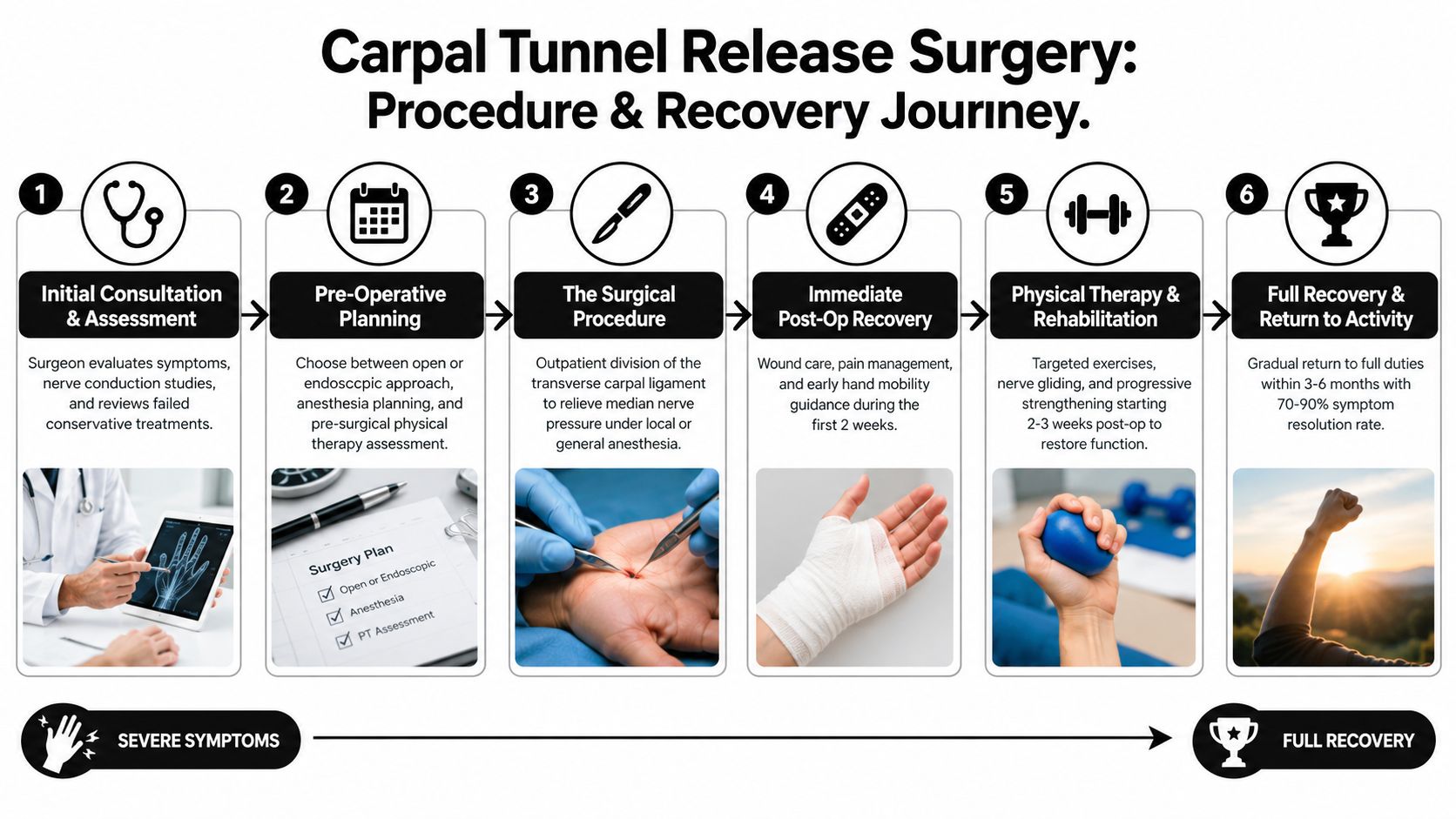
Carpal tunnel release surgery reduces pressure on the median nerve by dividing the transverse carpal ligament. Surgeons may use an open or endoscopic approach. The decision should be based on symptom severity, examination findings, testing when indicated, functional loss, and response to conservative care, not on a fixed deadline alone.
Surgery becomes more important when numbness persists, weakness progresses, the thumb muscles waste, or a well-designed conservative plan fails to restore useful function. A health-technology assessment summarizing a 2011 systematic review found surgery superior to non-surgical treatment at 6 and 12 months for symptom improvement and physical function. It also reported significant improvement or resolution in an estimated 34% to 49% of patients receiving conservative care alone (health-technology assessment on carpal tunnel treatment).
Compare durability, recovery, and risk
In a randomized trial of 934 patients, 61% of surgical patients achieved clinical recovery at 18 months, compared with 45% of those initially treated with steroid injection. The relative risk was 1.36, with an absolute benefit of about 16 percentage points, as reported in the same assessment. These findings don't mean every patient needs surgery. They show why decompression deserves serious consideration when temporary symptom control isn't enough.
Guideline summaries also report that, after surgery for confirmed carpal tunnel syndrome, return to work may be feasible within 2 to 4 weeks for clerical or light-duty workers and 5 to 6 weeks for heavy labor workers, depending on the individual and job demands. Recovery planning should include wound care, activity restrictions, grip progression, and therapy when appropriate.
Ultrasound can support assessment, but it doesn't fully replace electrodiagnostic testing. A systematic review of 12 studies involving 947 suspected patients found pooled ultrasound sensitivity of 0.80 and specificity of 0.90, while reviews continue to say routine substitution for nerve-conduction studies isn't supported (systematic review of ultrasound assessment).
9-Option Carpal Tunnel Relief Comparison
| Intervention | Implementation complexity | Resource requirements | Expected outcomes | Ideal use cases | Key advantages |
|---|---|---|---|---|---|
| Wrist Splinting and Immobilization | Low, simple fitting and use | Low, off‑the‑shelf or custom splint | Immediate symptom relief for many; reduces nighttime symptoms; variable long‑term effect | Mild–moderate CTS, night symptoms, initial conservative care | Low cost, non‑invasive, easy to start |
| Ergonomic Assessment, Activity Modification, and Pacing Strategies | Moderate, workplace evaluation and behavior change | Moderate, certified assessor, ergonomic equipment, employer buy‑in | Reduces occupational risk factors; prevents recurrence; improves comfort/productivity | Work‑related CTS, prevention, workplace injury management | Addresses root causes, long‑term prevention |
| Physical Therapy and Therapeutic Exercises | Moderate, clinician‑led programs plus home exercise | Moderate, licensed PT, clinic visits, patient adherence | Gradual improvement in strength, flexibility, function over 4–8 weeks | Mild–moderate CTS, pre/post‑op rehab, patients committed to rehab | Treats contributing deficits, builds long‑term function |
| Nerve Gliding and Mobilization Exercises | Low, teachable techniques with progressive practice | Low, therapist instruction, home program | Improves nerve mobility; symptom reduction in 4–6 weeks when consistent | Early CTS, adjunct to PT or post‑op recovery, home management | Evidence‑based, low risk, self‑managed between visits |
| Massage Therapy and Manual Therapy | Low, practitioner‑dependent hands‑on care | Low–moderate, licensed therapist, repeated sessions | Temporary relief of muscle tension and pain; facilitates participation in exercises | Patients with soft‑tissue tightness or adjunctive needs | Immediate symptom relief, enhances other therapies |
| Acupuncture and Traditional Chinese Medicine | Low–moderate, requires licensed practitioner | Moderate, trained acupuncturist, multiple sessions | Variable pain and inflammation reduction over several weeks | Patients seeking complementary care or when meds limited | Minimal systemic side effects; may reduce pain/inflammation |
| Extracorporeal Shock Wave Therapy (ESWT) | Moderate–high, device‑based outpatient procedure | High, specialized equipment, trained operator, multiple sessions | Potential improvement for chronic/refractory cases; promotes tissue healing | Chronic or refractory CTS after failed conservative therapy | Non‑surgical option that stimulates tissue repair |
| Anti‑Inflammatory Medications (NSAIDs, corticosteroid injections) | Low, medication or office injection by clinician | Low–moderate, OTC/ Rx meds or clinician for injections | Rapid symptomatic relief; injections provide weeks‑to‑months benefit | Acute flares, bridge to therapy, patients needing quick pain control | Fast pain reduction; enables participation in rehab |
| Surgical Intervention (Carpal Tunnel Release) | High, operative procedure with perioperative care | High, surgeon, OR, anesthesia, post‑op rehabilitation | High long‑term symptom resolution (70–90%); recovery time required | Severe/progressive CTS or failed conservative treatment | Definitive structural correction; most effective for severe cases |
Build Relief Around the Cause
Effective carpal tunnel syndrome relief usually comes from matching treatment intensity to the problem. A person with intermittent nighttime tingling may improve with a neutral-position night splint, a workstation adjustment, and changes to repetitive tasks. Someone with persistent numbness, dropping objects, or declining grip needs a more urgent assessment because symptom suppression alone may not protect nerve function.
Start with the lowest-risk changes that address likely irritation. Use a properly fitted splint at night, keep the wrist neutral during computer and tool use, rotate demanding tasks, and record what makes symptoms better or worse. Don't assume that more rest is always better. Complete inactivity can reduce tolerance and leave you unprepared for work, so the goal is controlled activity with fewer aggravating positions.
Guided rehabilitation adds precision. Physical or occupational therapy can assess the hand, forearm, shoulder, and neck, then build a program around mobility, nerve gliding, strengthening, manual care, and work demands. Exercises should be gentle enough that they don't leave numbness or electric pain worse. A therapist can also help you decide whether a brace, ergonomic device, or task modification is improving your function.
Adjunctive treatments have a place, but their limitations matter. Manual therapy, acupuncture, and ESWT may help selected patients, particularly when used with active rehabilitation. Injections can provide short-term relief, but current guidance doesn't support presenting them as a dependable long-term solution. Ask what each treatment is expected to improve, how you'll measure that change, and what you'll do if the benefit fades.
Surgery is not a failure of conservative care. It's a decision about whether decompression offers a better chance of durable recovery than continuing temporary measures. The evidence summarized above supports surgery when conservative treatment fails, while also showing that some patients improve without an operation. Your symptoms, examination, testing, health history, job, and goals should determine the recommendation.
Track four practical outcomes: numbness, nighttime disturbance, grip and dexterity, and tolerance for work or household tasks. Bring that record to an appointment, especially if you live in Deerfield Beach or a nearby community and want help choosing the next step. MedAmerica Rehab Center offers physical therapy, occupational therapy, acupuncture, chiropractic care, and shockwave therapy, with treatment plans that can incorporate splinting, behavioral changes, and rehabilitation for carpal tunnel symptoms.
MedAmerica Rehab Center can assess your hand symptoms and build a rehabilitation plan around splinting, ergonomic changes, therapeutic exercise, manual care, or other appropriate non-surgical options. If carpal tunnel symptoms are limiting sleep, work, or grip, visit MedAmerica Rehab Center to discuss an individualized plan in Deerfield Beach.
MedAmerica Rehab · Deerfield Beach
Talk to a clinician about your pain
Physical therapy, chiropractic, acupuncture and shockwave therapy under one roof, since 1995. Same-day appointments are available.
Mon–Thu 8:00 AM – 6:30 PM · Fri 8:00 AM – 3:00 PM